Vol. 11, No.2, 2016, 63-77
ISSN: 2320 –3242 (P), 2320 –3250 (online) Published on 1 December 2016
www.researchmathsci.org
DOI: http://dx.doi.org/10.22457/ijfma.v11n2a2
63
International Journal of
Intuitionistic Fuzzy Soft Graph
A.M.Shyla1 and T.K.Mathew Varkey2
Kerala University Library, Palayam Thiruvananthapuram, Kerala Department of mathematics, TKM College of Engineering, Kollam, Kerala
1
Corresponding Author. Email: [email protected]; 2
Received 12 November 2016; accepted 25 November 2016
Abstract. We introduce the notions of intuitionistic fuzzy soft graph, strong intuitionistic
fuzzy soft graph, complete intutionistic fuzzy soft graph in this paper. Also studied about union of two Intuitionistic fuzzy soft graph and proved that the collection of intuitionistic fuzzy soft graph is closed under finite union.
Keywords: Intuitionistic fuzzy soft graph, strong intuitionistic fuzzy soft graph, complete
intuitionistic fuzzy soft graph, union of intuitionistic fuzzy soft graph.
AMS Mathematics Subject Classification (2010): 05C72
1. Introduction
Molodtsov [13] introduced the concept of soft set that can be seen as a new mathematical theory for dealing with uncertainties. Molodtsov applied this theory to several directions [13, 14, 15] and then formulated the notions of Soft number, Soft derivative, Soft integral, etc. in [16]. The soft set theory has been applied to many different fields with greatness. Maji [11] worked on theoretical study of soft sets in detail. The algebraic structure of soft set theory dealing with uncertainties has also been studied in more detail. Aktas and Cagman [2] introduced definition of soft groups, and derived their basic properties. The most appreciate theory to deal with uncertainties is the theory of fuzzy sets, developed by Zadeh [22] in 1965. But it has an inherent difficulty to set the membership function in each particular cases. The generalization of Zadeh’s fuzzy set called intuitionistic fuzzy set was introduced by Atanassov [4] which is characterized by a membership function and a non-membership function. In Zadeh’s fuzzy set, the sum of membership degree and non- membership degree is equal to one. In Atanassov’s intuitionistic fuzzy set the sum of membership degree and non- membership degree does not exeed one.
64
In 1736, Euler first introduced the concept of graph theory. The theory of graph is extremely useful tool for solving combinatorial problems in different areas such as geometry, algebra, number theory, topology, operation research, optimization and computer science, etc.. The first definition of fuzzy graphs was proposed by Kaffmann [8] in 1973, from Zadeh’s fuzzy relations [22]. But Rosenfeld [19] introduced another elaborated definition including fuzzy vertex and fuzzy edges and several fuzzy analogs of graph theoretic concepts. The first definition of intuitionistic fuzzy graph was introduced by Atanassov [5] in1999. Karunambigai and Parvathy [7] introduced intuitionistic fuzzy graph as a special case of Atanassov’s intuitionistic fuzzy graph. Soft graph was introduced by Thumbakara and George [18]. In 2015, Mohinta and Samanta [20] introduced the concept of fuzzy soft graph.
In this paper, our aim is to introduce the notions of intuitionistic fuzzy soft graph, strong intuitionistic fuzzy soft graph, complete intutionistic fuzzy soft graph. Also studied about union of two intuitionistic fuzzy soft graph and proved that the collection of intuitionistic fuzzy soft graph is closed under finite union.
2. Preliminaries
Definition 2.1. A fuzzy set of a base set V ={v1,v2,…,vn} (non-empty set) is specified by
its membership function σ ; where
σ
:V →[0,1] assigning to each vi∈V , the degreeor grade to which V∈
σ
.Definition 2.2. A fuzzy graph G=(
σ
,µ
) is a pair of functionσ
:V →[0,1] and [0,1]:V×V →
µ
, where for all vi,vj∈V we haveµ
(vi,vj)≤σ
(vi)∧σ
(vj) foreach (vi,vj)∈V×V. Here
σ
andµ
are respectively called fuzzy vertex and fuzzy edge of the fuzzy graph G=(σ
,µ
).Definition 2.3. Let G1=(
σ
1,µ
1) and G2 =(σ
2,µ
2) be two fuzzy graphs over the setV
. Then theUnion
of G1 and G2 is another fuzzy graph G3=(σ
3,µ
3) over the setV
,whereσ
3=σ
1∨σ
2 =max{σ
1(vi),σ
2(vi)} for every vi∈Vandi=1,2…n and)} , ( ), , ( { = ) ,
( 1 2
3 vi vj max
µ
vi vjµ
vi vjµ
for every vi,vj∈Vandi, j=1,2…nDefinition 2.4. Let V be a non-empty set. An intuitionistic fuzzy set A in V defined as }
| )) ( ), ( , {(
= V v v v V
A
µ
Aγ
A ∈ which is characterised by a membership function[0,1]
:V →
A
µ
and the non-membership functionγ
A:V →[0,1] and satisfying 1.V v v
v A
A + ≤ ∈
≤ ( ) ( ) 1forevery
0
µ
γ
.2. 0≤
µ
A(v),γ
A(v),π
A(v)≤1foreveryv∈V. 3.π
A(v)=1−µ
A(v)−γ
A(v).65
Obviously if
π
A(v)=0foreveryvinV, then the intuitionistic fuzzy set A is just Zadeh’s fuzzy set.Definition 2.5. An intuitionistic fuzzy graph is defined as G=(V,E,
µ
,γ
) where1.V ={v1,v2,…,vn}(non-empty set) such that
µ
1:V →[0,1] andγ
1:V →[0,1] denote the degree of membership and non-membership of the element vi∈V respectively and 0≤µ
1(vi)+γ
1(vi)≤1foreveryvi∈V,i=1,2…n2. E⊂V×V where
µ
2:V×V →[0,1]andγ
2:V×V →[0,1] are such that(i)
µ
2(vi,vj)≤min{µ
1(vi),µ
1(vj)} (ii)γ
2(vi,vj)≤max{γ
1(vi),γ
1(vj)} and(iii)0≤
µ
2(vi,vj)+γ
2(vi,vj)≤1, 0≤µ
2(vi,vj),γ
2(vi,vj),π
(vi,vj)≤1where
π
(vi,vj)=1−µ
2(vi,vj)−γ
2(vi,vj)forevery(vi,vj)∈E,i, j=1,2,…,nLet
U
be an initial universal set, P be a set of parameters, P(U) be the power set ofU
and A⊆P.Definition 2.6. A pair (F,A) is called a softset over
U
if and only if F is amapping of A into the set of all subsets of the set
U
.Definition 2.7. A pair (F,A) is called fuzzy soft set over
U
, where Fis a mappinggiven by F :A→IU; IUdenotes the collection of all fuzzy subsets of U;A⊆P.
Definition 2.8. A pair (F,A)
⌣
is called an intuitionistic fuzzy soft set over
U
, where F⌣
is a mapping given by F:A→IFU
⌣
; IFU denotes the collection of all intuitionistic
fuzzy subsets of U;A⊆P.
Definition 2.9. Let V ={v1,v2,…,vn}(non-empty set),P(parameterset) andA⊆P. Also let
1.
ρ
:A→IU(V) (IU(V) denotes collection of all fuzzy subsets inV
)a
a
a֏
ρ
( )=ρ
(say),a
∈
A
and :V →[0,1]a
ρ
,) ,
(A
ρ
Fuzzy soft vertex.2.
µ
:A→IU(V×V),(IU(V×V) denotes collection of all fuzzy subsets inV
×
V
)a
a
a֏
µ
( )=µ
(say), a∈A and :V×V →[0,1]a
µ
(vi,vj)֏µ
a(vi,vj) ),
(A
µ
Fuzzy soft edge.66 )
( ) ( ) ,
( i j a i j
a v v
ρ
vρ
vµ
≤ ∧ for each (vi,vj)∈V×V,n j
i and A a every
for ∈ , =1,2,…, .
3. Intuitionistic fuzzy soft graph
Definition 3.1. Let G=(V,E) be a simple graph, V ={v1,v2,…,vn} (non-empty set), V
V
E⊆ × , P(parameterset)and A⊆P.Also let
1.
µ
1 is a membership function defined onV
by1:A IF (V)
U
→
µ
(IFU(V)denotes collection of all intuitionistic fuzzy subsets inV
)a֏
µ
1(a)=µ
1a (say),a
∈
A
and : [0,1]1a V →
µ
,vi ֏µ
1a(vi) (A,µ
1) Intuitionistic fuzzy soft vertex of membership function and
γ
1 is a non-membership function defined onV
by1:A IF (V)
U
→
γ
(IFU(V)denotes collection of all intuitionistic fuzzy subsets in V )a֏
γ
1(a)=γ
1a (say),a
∈
A
andγ
1a:V →[0,1],vi ֏γ
1a(vi)) ,
(A
γ
1 Intuitionistic fuzzy soft vertex of non-membership function such that nV v v
vi a i i
a( ) ( ) 1forevery ,=1,2…
0≤
µ
1 +γ
1 ≤ ∈ and a∈A.2.
µ
2 is a membership function defined on E by2:A IF (V V)
U ×
→
µ
( IFU(V×V) denotes collection of all intuitionistic fuzzysubsets in E)
a֏
µ
2(a)=µ
2a (say),a
∈
A
andµ
2a:V×V →[0,1],(vi,vj)֏µ
2a(vi,vj)
γ
2 is the non membership function defined on E by2:A IF (V V)
U ×
→
γ
( IFU(V×V) denotes collection of all intuitionistic fuzzysubsets in
V
×
V
)a֏
γ
2(a)=γ
2a (say), a∈A andγ
2a:V×V →[0,1],(vi,vj)֏γ
2a(vi,vj)where (A,
µ
2),(A,γ
2) are Intuitionistic fuzzy soft edge of membership function and non- membership function satisfying(i)
µ
2a(vi,vj)≤min{µ
1a(vi),µ
1a(vj)} (ii)γ
2a(vi,vj)≤max{γ
1a(vi),γ
1a(vj)} and (iii) 0≤µ
2a(vi,vj)+γ
2a(vi,vj)≤1,A a and n j
i E v v forevery v
v v
vi j a i j i j
a ≤ ∈ ∈
≤ ( , ), ( , ) 1, ( , ) , , =1,2, ,
0
µ
2γ
2 …Then =( , ,( , 1),( , 1),( , 2),( , 2))
*
µ
γ
µ
γ
A A
A A
E V
G is said to be the intuitionistic
fuzzy soft graph (IFSG) and this IFSG is denoted by G*A,V,E.
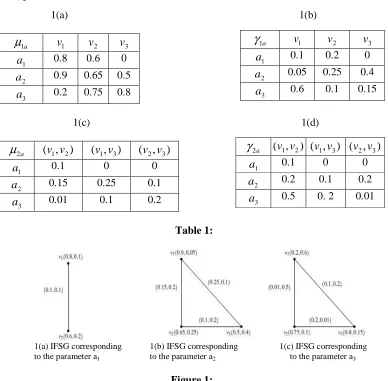
Example 3.1. Consider a simple graph G=(V,E) where V ={v1,v2,v3} and
)} , ( ), , ( ), , {(
= v1 v2 v2 v3 v1 v3
67
intuitionistic fuzzy soft graph (IFSG), G*A,V,E =(V,E,(A,
µ
1) , (A,γ
1) , (A,µ
2) ,)) ,
(A
γ
2 is described in Table 1 and Figure 1.1(a) 1(b)
a
1
µ
v1 v2 v31
a 0.8 0.6 0
2
a 0.9 0.65 0.5
3
a 0.2 0.75 0.8
1(c) 1(d)
a
2
µ
(v1,v2) (v1,v3) (v2,v3)1
a 0.1 0 0
2
a 0.15 0.25 0.1
3
a 0.01 0.1 0.2
Table 1:
1(a) IFSG corresponding 1(b) IFSG corresponding 1(c) IFSG corresponding to the parameter a1 to the parameter a2 to the parameter a3
Figure 1:
Definition 3.2. An intuitionistic fuzzy soft graph G*=(V,E,(A,
µ
1),(A,γ
1), (A,µ
2), )),
(A
γ
2 is said to be strong intuitionistic fuzzy soft graph if)} ( ), ( { = ) ,
( 1 1
2a vi vj min
µ
a viµ
a vjµ
andγ
2a(vi,vj)=max{γ
1a(vi),γ
1a(vj)} for everyA a and E v
vi, j)∈ ∈
( and is said to be complete intuitionistic fuzzy soft graph if
)} ( ), ( { = ) ,
( 1 1
2a vi vj min
µ
a viµ
a vjµ
andγ
2a(vi,vj)=max{γ
1a(vi),γ
1a(vj)} for everyA a and V v
vi, j∈ ∈ .
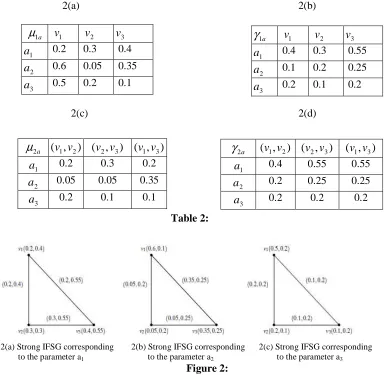
Example 3.2. Consider a simple graph G=(V,E) where V ={v1,v2,v3} and
a
1
γ
v1 v2 v31
a 0.1 0.2 0
2
a 0.05 0.25 0.4
3
a 0.6 0.1 0.15
a
2
γ
(v1,v2) (v1,v3) (v2,v3)1
a 0.1 0 0
2
a 0.2 0.1 0.2
3
68 )}
, ( ), , ( ), , {(
= v1 v2 v2 v3 v1 v3
E . Let A={a1,a2,a3} be the parameter set. Then the
strong intuitionistic fuzzy softgraph, GA*,V,E =(V,E,(A,
µ
1),(A,γ
1),(A,µ
2),(A,γ
2)) isdescribed in Table 2 and Figure 2.
2(a) 2(b)
a
1
µ
v1 v2 v31
a 0.2 0.3 0.4
2
a 0.6 0.05 0.35
3
a 0.5 0.2 0.1
2(c) 2(d)
Table 2:
2(a) Strong IFSG corresponding 2(b) Strong IFSG corresponding 2(c) Strong IFSG corresponding to the parameter a1 to the parameter a2 to the parameter a3
Figure 2:
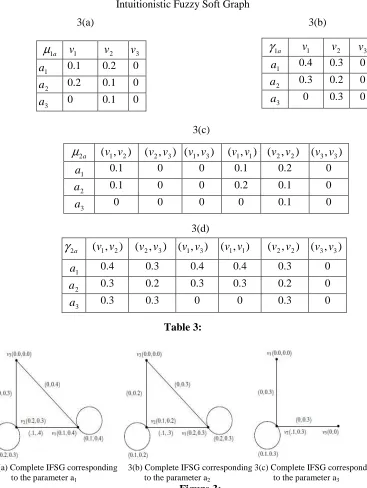
Example 3.3. Consider a simple graph G=(V,E) where V ={v1,v2,v3} and
)} , ( ), , ( ), , ( ), , ( ), , ( ), , {(
= v1 v2 v2 v3 v1 v3 v1 v1 v2 v2 v3 v3
E . Let A={a1,a2,a3} be the
parameter set. Then the complete intuitionistic fuzzy soft graph, G*A,V,E =(V,E,(A,
µ
1),) ,
(A
γ
1 , (A,µ
2), (A,γ
2)) is described in Table 3 and Figure 3.a
1
γ
v1 v2 v31
a 0.4 0.3 0.55
2
a 0.1 0.2 0.25
3
a 0.2 0.1 0.2
a
2
γ
(v1,v2) (v2,v3) (v1,v3)1
a 0.4 0.55 0.55
2
a 0.2 0.25 0.25
3
a 0.2 0.2 0.2
a
2
µ
(v1,v2) (v2,v3) (v1,v3)1
a 0.2 0.3 0.2
2
a 0.05 0.05 0.35
3
69
3(a) 3(b)
a
1
µ
v1 v2 v31
a 0.1 0.2 0
2
a 0.2 0.1 0
3
a 0 0.1 0
3(c)
3(d)
Table 3:
3(a) Complete IFSG corresponding 3(b) Complete IFSG corresponding 3(c) Complete IFSG corresponding to the parameter a1 to the parameter a2 to the parameter a3
Figure 3:
Definition 3.3. Let G=(V,E) be a simple graph, P(parameterset). Also let
P B A E E E V V
V1, 2⊆ , 1, 2 ⊂ , , ⊆ and * =( 1, 1,( , 1),( , 1),
1 , 1
, V E A
µ
Aγ
GAV E
)) , ( ), ,
(A
µ
2 Aγ
2 and =( , ,( , ),( , ),( , ),( , ))' 2 '
2 '
1 '
1 2 2 *
2 , 2
, V E B
µ
Bγ
Bµ
Bγ
GBV E be two
intuitionistic fuzzy soft graphs with V1∩V2 ≠
φ
. Then the union of intuitionistic fuzzy softgraphs *
2 , 2 , *
1 , 1 , *
3 , 3
,V E = AV E BV E
C G G
G ∪ with the condition ( , ) ( ' ( ))
1 2a vi vj max
µ
a vkµ
≥ anda
1
γ
v1 v2 v31
a 0.4 0.3 0
2
a 0.3 0.2 0
3
a 0 0.3 0
a
2
µ
(v1,v2) (v2,v3) (v1,v3) (v1,v1) (v2,v2) (v3,v3)1
a 0.1 0 0 0.1 0.2 0
2
a 0.1 0 0 0.2 0.1 0
3
a 0 0 0 0 0.1 0
a
2
γ
(v1,v2) (v2,v3) (v1,v3) (v1,v1) (v2,v2) (v3,v3)1
a 0.4 0.3 0.4 0.4 0.3 0
2
a 0.3 0.2 0.3 0.3 0.2 0
3
70 and P a V v v v every for v max v
vi j a k i j k
a( , )≥ ( ( )) , , ∈ , ∈
' 1 2
γ
γ
n k j i anyfor , , =1,2,…, is defined to be =( , ,( , ),( , '),
1 ' 1 3 3 * 3 , 3 , ′ ′
γ
µ
C C E VGCV E
)) , ( ), ,
( 2'
' 2
′ ′
γ
µ
CC where
C
=
A
∪
B
, V3 =V1∪V2 and71 B A a V V V V v v v v B A a V V V V v v v v B A a V V V V v v v v v v A B a V V V V v v v v A B a V V V V v v A B a V V V V v v v v B A a V V V V v v v v B A a V V V V v v B A a V V V V v v v v v v j i j i a j i j i a j i j i a j i a j i j i a j i j i j i a j i j i a j i j i j i a j i a ∩ ∈ × × ∈ ∩ ∈ × × ∈ ∩ ∈ × ∩ × ∈ ∧ ∈ × ∩ × ∈ ∈ × × ∈ ∈ × × ∈ ∈ × ∩ × ∈ ∈ × × ∈ ∈ × × ∈ ′ and ) ( | ) ( ) , ( forevery ) , ( = and ) ( | ) ( ) , ( forevery ) , ( = and ) ( ) ( ) , ( forevery ) , ( ) , ( = | and ) ( ) ( ) , ( forevery ) , ( = | and ) ( | ) ( ) , ( forevery 0 = | and ) ( | ) ( ) , ( forevery ) , ( = | and ) ( ) ( ) , ( forevery ) , ( = | and ) ( | ) ( ) , ( forevery 0 = | and ) ( | ) ( ) , ( forevery ) , ( = ) , ( 1 1 2 2 ' 2 2 2 1 1 2 2 2 1 1 ' 2 2 2 2 1 1 ' 2 2 2 1 1 1 1 2 2 ' 2 2 2 1 1 2 1 1 2 2 2 2 1 1 2 ' 2
γ
γ
µ
γ
γ
γ
γ
γ
γ
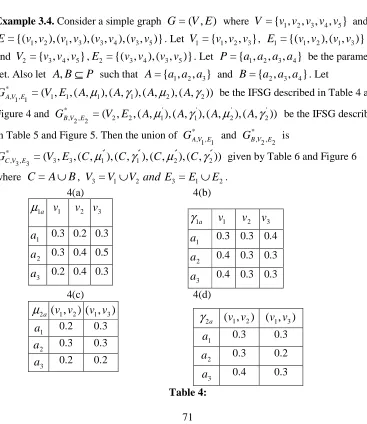
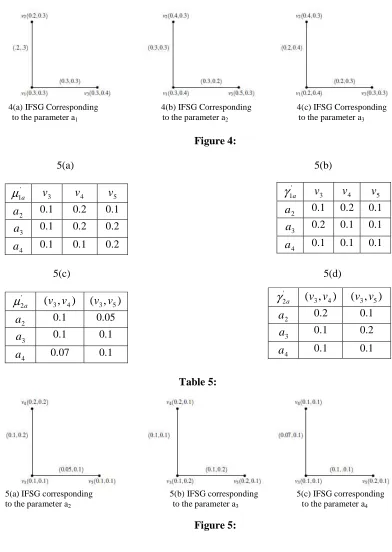
Example 3.4. Consider a simple graph G=(V,E) where V ={v1,v2,v3,v4,v5} and
)} , ( ), , ( ), , ( ), , {(
= v1 v2 v1 v3 v3 v4 v3 v5
E . Let V1={v1,v2,v3}, E1={(v1,v2),(v1,v3)}
and V2 ={v3,v4,v5},E2={(v3,v4),(v3,v5)}. Let P={a1,a2,a3,a4} be the parameter
set. Also let A,B⊆P such that A={a1,a2,a3} and B={a2,a3,a4}. Let )) , ( ), , ( ), , ( ), , ( , , (
= 1 1 1 1 2 2
*
1 , 1
, V E A
µ
Aγ
Aµ
Aγ
GAV E be the IFSG described in Table 4 and
Figure 4 and =( , ,( , ),( , ),( , ),( , 2'))
' 2 ' 1 ' 1 2 2 * 2 , 2
, V E A
µ
Aγ
Aµ
Aγ
GBV E be the IFSG described
in Table 5 and Figure 5. Then the union of * 1 , 1 ,V E A
G and *
2 , 2 ,V E B
G is
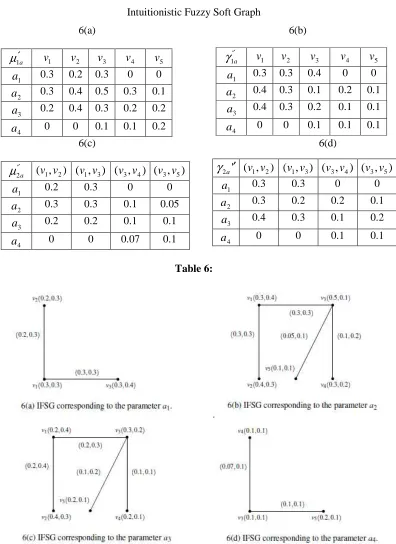
)) , ( ), , ( ), , ( ), , ( , , (
= 2'
' 2 ' 1 ' 1 3 3 * 3 , 3 , ′ ′ ′ ′
γ
µ
γ
µ
C C CC E V
GCV E given by Table 6 and Figure 6
where C= A∪B, V3=V1∪V2 and E3 =E1∪E2. 4(a)
a
1
µ
v1 v2 v31
a 0.3 0.2 0.3
2
a 0.3 0.4 0.5
3
a 0.2 0.4 0.3
4(b)
a
1
γ
v1 v2 v31
a 0.3 0.3 0.4
2
a 0.4 0.3 0.3
3
a 0.4 0.3 0.3
4(c)
a
2
µ
(v1,v2) (v1,v3)1
a 0.2 0.3
2
a 0.3 0.3
3
a 0.2 0.2
4(d)
a
2
γ
(v1,v2) (v1,v3)1
a 0.3 0.3
2
a 0.3 0.2
3
a 0.4 0.3
72
4(a) IFSG Corresponding 4(b) IFSG Corresponding 4(c) IFSG Corresponding to the parameter a1 to the parameter a2 to the parameter a3
Figure 4:
5(a) 5(b)
' 1a
µ
v3 v4 v52
a 0.1 0.2 0.1
3
a 0.1 0.2 0.2
4
a 0.1 0.1 0.2
5(c) 5(d)
' 2a
µ
(v3,v4) (v3,v5)2
a 0.1 0.05
3
a 0.1 0.1
4
a 0.07 0.1
Table 5:
5(a) IFSG corresponding 5(b) IFSG corresponding 5(c) IFSG corresponding to the parameter a2 to the parameter a3 to the parameter a4
Figure 5:
' 1a
γ
v3 v4 v52
a 0.1 0.2 0.1
3
a 0.2 0.1 0.1
4
a 0.1 0.1 0.1
' 2a
γ
(v3,v4) (v3,v5)2
a 0.2 0.1
3
a 0.1 0.2
4
73
6(a) 6(b)
' 1
′ a
µ
v1 v2 v3 v4 v51
a 0.3 0.2 0.3 0 0
2
a 0.3 0.4 0.5 0.3 0.1
3
a 0.2 0.4 0.3 0.2 0.2
4
a 0 0 0.1 0.1 0.2
6(c) 6(d)
' 2
′ a
µ
(v1,v2) (v1,v3) (v3,v4) (v3,v5)1
a 0.2 0.3 0 0
2
a 0.3 0.3 0.1 0.05
3
a 0.2 0.2 0.1 0.1
4
a 0 0 0.07 0.1
Table 6:
Figure 6:
Proposition 3.4. Let =( , ,( , ),( , ),( , ),( , 2')) '
2 '
1 '
1 3 3 *
3 , 3 ,
′ ′
′
′
γ
µ
γ
µ
C C CC E V
GCV E be the union
' 1
′ a
γ
v1 v2 v3 v4 v51
a 0.3 0.3 0.4 0 0
2
a 0.4 0.3 0.1 0.2 0.1
3
a 0.4 0.3 0.2 0.1 0.1
4
a 0 0 0.1 0.1 0.1
' 2a′
γ
(v1,v2) (v1,v3) (v3,v4) (v3,v5)1
a 0.3 0.3 0 0
2
a 0.3 0.2 0.2 0.1
3
a 0.4 0.3 0.1 0.2
4
74
of two intuitionistic fuzzy soft graphs * =( 1, 1,( , 1),( , 1),
1 , 1
, V E A
µ
Aγ
GAV E
)) , ( ), ,
(A
µ
2 Aγ
2 and =( , ,( , ),( , ),( , ),( , 2'))' 2 ' 1 ' 1 2 2 * 2 , 2
, V E B
µ
Bγ
Bµ
Bγ
GBV E . Then
* 2 , 2 , * 1 , 1 , * 3 , 3
,V E = AV E BV E
C G G
G ∪ is an Intuitionistic fuzzy soft graph.
Proof: Consider the case a∈A| B.
If vi∈V1|V2; by definition3.3 ( )= 1 ( ) '
1a vi
µ
a viµ
′and ( )= 1 ( )
'
1a vi
γ
a viγ
′ 1 ) ( ) ( = ) ( ) (0 1 1
' 1 '
1 + + ≤
≤ ⇒ ′ ′ i a i a i a i
a v
γ
vµ
vγ
vµ
, since *1 , 1 ,V E A
G is an IFSG.
If vi∈V2| V1; by definition3.3 1'a(vi)=0
′
µ
and 1'a(vi)=0′
γ
Then clearly 0 ( ) 1' ( ) 1
'
1 + ≤
≤ ′ ′
i a i
a v
γ
vµ
.Also, if vi∈V1∩V2; by definition3.3 ( )= 1 ( ) '
1a vi
µ
a viµ
′and ( )= 1 ( )
'
1a vi
γ
a viγ
′ 1 ) ( ) ( = ) ( ) (0 1 1
' 1 '
1 + + ≤
≤ ⇒ ′ ′ i a i a i a i
a v
γ
vµ
vγ
vµ
, since *1 , 1 ,V E A
G is an IFSG.
Similarly, when a∈B|A in all cases0 ( ) 1' ( ) 1
'
1 + ≤
≤ ′ ′
i a i
a v
γ
vµ
Consider the case when a∈A∩B
If vi∈V1|V2 or vi∈V2| V1 clearly by definition3.3 0≤
µ
1a'′(vi)+γ
1'′a(vi)≤1 Now ifa
∈
A
∩
B
and vi∈V1∩V2,) ( ) ( = )
( 1 1'
'
1a vi
µ
a viµ
a viµ
′ ∨and
γ
1'′a(vi)=γ
1a(vi)∧γ
1'a(vi)Consider the cases ( )= ( ) ( )= 1 ( )
' 1 1
'
1a vi
µ
a vi andγ
a viγ
a viµ
′ ′ , ) ( = ) ( ) ( = )( 1' 1' 1'
'
1a vi
µ
a vi andγ
a viγ
a viµ
′ ′Since *
1 , 1 ,V E A
G and *
2 , 2 ,V E B
G are IFSG, clearly in these cases 0 ( ) 1' ( ) 1
'
1 + ≤
≤ ′ ′
i a i
a v
γ
vµ
.When ( )= 1 ( )
'
1a vi
µ
a viµ
′and ( )= 1' ( )
'
1a vi
γ
a viγ
′By the condition in the definition 3.3 γ2a(vi,vj)≥γ1'a(vi) foreveryvi,vj∈V V v v every for v v
vi a i j i j
a ≤ ∈
⇒ ( ) ( , ) ,
2 '
1
γ
γ
.Also we have
γ
2a(vi,vj)≤max{γ
1a(vi),γ
1a(vj)} by definition 3.1. V v every for v vvi j a i i
a ≤ ∈
⇒ ( , ) ( )
1
2
γ
γ
( ) 1 ( )'
1a vi
γ
a viγ
≤ ⇒ 1 ) ( ) ( ) ( ) ( = ) ( ) (0 1 1
' 1 1 ' 1 '
1 + + ≤ + ≤
≤ ∴ ′ ′ i a i a i a i a i a i
a v
γ
vµ
vγ
vµ
vγ
vµ
Similarly, when
µ
1'′a(vi)=µ
1'a(vi) andγ
1'′a(vi)=γ
1a(vi)By the condition in the definition 3.3
µ
2a(vi,vj)≥µ
1'a(vi) foreveryvi,vj∈V V v v every for v vvi a i j i j
a ≤ ∈
⇒ ( ) ( , ) ,
2 '
1
µ
µ
.Also we have
µ
2a(vi,vj)≤min{µ
1a(vi),µ
1a(vj)} by definition 3.1. V v v every for v vvi j a i i j
a ≤ ∈
⇒ ( , ) ( ) , 1 2
µ
µ
) ( ) ( 1 '1a vi
µ
a viµ
≤75 1 ) ( ) ( ) ( ) ( = ) ( ) (
0 1 1 1
' 1 '
1 '
1 + + ≤ + ≤
≤ ∴ ′ ′ i a i a i a i a i a i
a v
γ
vµ
vγ
vµ
vγ
vµ
Now to check the condition 2 of definition 3.1.
By using the definition 3.3,in all cases clearly got the inequalities 2(i)and2(ii) of
definition 3.1.That is µ2'′a(vi,vj)≤min{µ1'′a(vi),µ1'′a(vj)} and P a and V v v every for v v max v
vi j a i a j i j
a ≤ ∈ ∈
′ ′ ′ ( , ) { ( ), ' ( )} , 1 ' 1 '
2
γ
γ
γ
Now to check the condition 2(iii) of definition 3.1
If a∈A|Band (vi,vj)∈(V1×V1)|(V2×V2)or (vi,vj)∈(V1×V1)∩(V2×V2). Then by definition 3.3
E v v every for v v v v and v v v
vi j a i j a i j a i j i j
a ∈ ′ ′ ( , )= ( , ) ( , )= ( , ) ( , ) 2 ' 2 2 '
2
µ
γ
γ
µ
. E v v every for v v v v v v vvi j a i j a i j a i j i j
a + + ≤ ∈
≤
⇒0 ′ ( , ) ′ ( , )= ( , ) ( , ) 1) ( , )
2 2
' 2 '
2
γ
µ
γ
µ
.Also if a∈A|Band (vi,vj)∈(V2×V2)|(V1×V1).
Then by definition 3.3
µ
2'′a(vi,vj)=0andγ
2'′a(vi,vj)=0.Obviously, 0≤
µ
2'′a(vi,vj)+γ
2'′a(vi,vj)≤1, Since * 1 , 1 ,V E AG is an IFSG. Similarly if
) ( ) ( ) , ( ) ( | ) ( ) , (
|Aand v v V2 V2 V1 V1 or v v V1 V1 V2 V2
B
a∈ i j ∈ × × i j ∈ × ∩ × .
By definition 3.3
E v v every for v v v v and v v v
vi j a i j a i j a i j i j
a ∈ ′ ′ ) , ( ) , ( = ) , ( ) , ( = ) ,
( 2' 2' 2'
'
2
µ
γ
γ
µ
. 1 ) , ( ) , ( = ) , ( ) , (0≤ 2' + 2' 2' + 2' ≤
⇒ ′ ′ j i a j i a j i a j i
a v v
γ
v vµ
v vγ
v vµ
.Also if a∈B|Aand (vi,vj)∈(V1×V1)|(V2×V2). Then by definition 3.3 0 = ) , ( 0 = ) ,
( 2'
'
2a vi vj and a vi vj
′
′
γ
µ
. Obviously 0≤µ
2'′a(vi,vj)+γ
2'′a(vi,vj)≤1, Since *2 , 2 ,V E B
G is an IFSG. Now consider the case when
a
∈
A
∩
B
.If a∈A∩B and (vi,vj)∈(V1×V1)|(V2×V2), by definition3.3,
1 ) , ( ) , ( = ) , ( ) , (
0≤
µ
2'′a vi vj +γ
2'′a vi vjµ
2a vi vj +γ
2a vi vj ≤ .Similarly if
a
∈
A
∩
B
and (vi,vj)∈(V2×V2)|(V1×V1) by definition3.3, 1 ) , ( ) , ( = ) , ( ) , (0≤
µ
2'′a vi vj +γ
2'′a vi vjµ
2'a vi vj +γ
2'a vi vj ≤Now consider the case when
a
∈
A
∩
B
and (vi,vj)∈(V1×V1)∩(V2×V2) By definition 3.3µ
2'′a(vi,vj)=µ
2a(vi,vj)orµ
2'a(vi,vj) and) , ( ) , ( = ) ,
( 2 2'
'
2a vi vj
γ
a vi vj orγ
a vi vjγ
′. The condition 2(iii) is clear when
) , ( = ) , ( 2 '
2a vi vj
µ
a vi vjµ
′and
γ
2'′a(vi,vj)=γ
2a(vi,vj) and also when) , ( = ) ,
( 2'
'
2a vi vj
µ
a vi vjµ
′ and ( , )= ' ( , )2 '
2a vi vj
γ
a vi vjγ
′Now consider the case
µ
2'′a(vi,vj)=µ
2a(vi,vj) andγ
2'′a(vi,vj)=γ
2'a(vi,vj)76 n
k j
i, , =1,2,…, and ( , ) { ' ( )}
1 1a vi vj max
γ
a vkγ
≥ for any i,j,k=1,2…,n. Also)} ( ), ( { )
,
( 1 1
2a vi vj max
µ
a viµ
a vjµ
≤ foreveryvi,vj∈Vby definition 3.1.V v v everyy for v v v
v v
v v
vi j a i j a i j a i j i j
a + + ∈
≤
∴0 ′ ( , ) ′ ( , )= ( , ) ' ( , ) , 2
2 '
2 '
2
γ
µ
γ
µ
V v v everyy for v v
max v
vi j a i a j i j
a + ∈
≤µ2 ( , ) {γ1' ( ),γ1' ( )} ,
V v v everyy for v v
vi j a i i j
a + ∈
≤µ2 ( , ) γ1' ( ) ,
V v v everyy for
v v v
vi j a i j i j
a + ∈
≤
µ
2 ( , )γ
2 ( , ) , 1≤
Similarly when µ2'′a(vi,vj)=µ2'a(vi,vj) and γ2'′a(vi,vj)=γ2a(vi,vj) We know that µ2'a(vi,vj)≤max{µ1'a(vi),µ1'a(vj)} foreveryvi,vj∈V
V v v everyy for v v v
v v
v v
vi j a i j a i j a i j i j
a + + ∈
≤
∴ ′ ′
, )
, ( ) , ( = ) , ( ) , (
0 2
' 2 '
2 '
2 γ µ γ
µ
V v v everyy for v v v
v
max a i a j + a i j i j∈
≤ {µ1' ( ),µ1' ( )} γ2 ( , ) ,
V v v everyy for v v
vi a i j i j
a + ∈
≤µ1' ( ) γ2 ( , ) ,
V v v everyy for
v v v
vi j a i j i j
a + ∈
≤
µ
2 ( , )γ
2 ( , ) , 1≤
Thus in all cases *
2 , 2 , *
1 , 1 , *
3 , 3
,V E = AV E BV E
C G G
G ∪ is an Intuitionistic fuzzy soft graph.
REFERENCES
1. B.Ahmad and A.Kharal, On fuzzy soft sets, Hindawi Publishing Corporation, Advances in fuzzy systems, Article ID 586507, (2009), 6 pages, doi: 10.1155/2009/ 86507.
2. H.Aktas and N.Cagman, Soft sets and soft groups, Information Sciences, 177 (2007) 2726-2735.
3. S.Alkhazaleh, A.R.Salleh and N.Hassan, Possibility fuzzy soft set, Advances in Decision Sciences, 2011, Article ID 479756, doi:10.1155|2011|479756, 18 pages. 4. K.Atanassov, Intuitionistic fuzzy sets, Fuzzy Sets and Systems, 20 (1986) 87-96. 5. K.Atanassov, Intuitionistic fuzzy sets: theory and applications, Springer-Verlag,
Heidelberg, 1999.
6. M.Borah, T.J.Neog and D.K.Sut, A study on some operations of fuzzy soft sets, International Journal of Modern Engineering Research, 2(2) (2012) 157-168.
7. K.G.Karunambigai and R.Parvathi, Intuitionistic fuzzy graphs, Journal of Computational Intelligence: Theory and Applications, 20 (2006) 139-150.
8. Kauffman, Introduction a la theorie des sous ensembles Flous, Massonet cie., vol. 1, (1973).
9. P.K.Maji, R.Biswas and A.R.Roy, Fuzzy soft sets, J. Fuzzy Math., 9(3) (2001) 589-602.
10. P.K.Maji, R.Biswas and A.R.Roy, Intuitionistic fuzzy soft sets, The Journal of Fuzzy Mathematics, 9(3) (2001) 677-692.
77
12. P.Majumdar and S.K.Samanta, Generalized fuzzy soft sets, Computers and Mathematics with Applications, 59 (2010) 1425-1432.
13. D.A.Molodtsov, Soft set theory- first results, Compt. Math. Appl., 37 (1999) 19-31. 14. D.A.Molodtsov, The description of a dependance with the help of soft sets, J. Compt.
Sys. Sc. Int., 40 (6) (2001) 977-984.
15. D.A.Molodtsov, The Theory of Soft Sets (in Russian), URRS Publishers, Moscow, 2004.
16. D.A.Molodtsov, V.Yu.Leonov and D.V.Kovkov, soft set technique and its application, Nechetkie Sistemi I Myakie Vychisleniya, 1(1) (2006) 8-39.
17. T.J.Neog and D.K.Sut, On fuzzy soft complement and related properties, International Journal of Energy, Inforation and Communication.
18. R.K.Thumbakara and B.George, Soft graph, Gen. Math. Notes, 21(2) (2014) 75-86. 19. A.Rosenfeld, Fuzzy Graphs, in L.A.Zadeh, K.cS.Fu, K.Tanka and M.Shimura (eds),
Fuzzy Sets and their pplications to cognitive and decision process, Acadamic Press, New York, 1975, 75-95.
20. S.Mohinda and T.K.Samanta, An introduction to fuzzy soft graph, Mathematica Moravica, 19-2 (2015) 35-48.
21. H. L. Yang, Notes on generalized fuzzy soft sets, Journal of Mathematical Research and Exposition, 31(3) (2011) 567-570.