The Open Journal of Occupational Therapy
The Open Journal of Occupational Therapy
Volume 5
Issue 4 Fall 2017 Article 12
October 2017
Perceptions of Occupational Therapy Students and Faculty of
Perceptions of Occupational Therapy Students and Faculty of
Compressed Courses: A Pilot Study
Compressed Courses: A Pilot Study
Martina G. Allen
Indiana University Purdue University Indianapolis - USA, [email protected]
Mary Voytek
A.T. Still University - USA, [email protected]
Follow this and additional works at: https://scholarworks.wmich.edu/ojot
Part of the Occupational Therapy Commons
Recommended Citation Recommended Citation
Allen, M. G., & Voytek, M. (2017). Perceptions of Occupational Therapy Students and Faculty of Compressed Courses: A Pilot Study. The Open Journal of Occupational Therapy, 5(4). https://doi.org/ 10.15453/2168-6408.1265
This document has been accepted for inclusion in The Open Journal of Occupational Therapy by the editors. Free, open access is provided by ScholarWorks at WMU. For more information, please contact
Perceptions of Occupational Therapy Students and Faculty of Compressed Perceptions of Occupational Therapy Students and Faculty of Compressed Courses: A Pilot Study
Courses: A Pilot Study
Abstract Abstract
As occupational therapists, our mandate is to be client centered, yet in academic settings there is little information regarding student or faculty preferences about curriculum and course design. This study investigated the perceptions of occupational therapy students and faculty regarding the delivery of content in a compressed course format, thus reducing the number of courses taken at any given time. The authors discuss how the results inform the feasibility of incorporating this format into future curriculum design. A descriptive survey design was used for this study. The participants were 33 entry-level graduate students and two faculty who completed post-course surveys for two courses. The results show that overall perceptions of students and faculty were positive regarding the compressed course format. The students had fewer courses to focus on and faculty had increased time to devote to other responsibilities. This study provides preliminary evidence for the feasibility of alternative curriculum design in the future and lays the foundation for further research in occupational therapy curriculum design. It directly responds to the needs identified by the American Occupational Therapy Association in the occupational therapy education research agenda.
Keywords Keywords
accelerated courses, condensed courses, curriculum design, graduate health sciences education, occupational therapy education
Credentials Display Martina G. Allen, OTD, OTR Mary Voytek, OTD, MC, OTR/L
Copyright transfer agreements are not obtained by The Open Journal of Occupational Therapy (OJOT). Reprint permission for this Topics in Education should be obtained from the
corresponding author(s). Click here to view our open access statement regarding user rights and distribution of this Topics in Education.
DOI: 10.15453/2168-6408.1265
The current design of occupational therapy (OT) graduate-level programs is largely based on traditional academic calendars that involve a quarter, trimester, or semester term with a number of courses in each. During these terms, there are multiple pressures on faculty, program directors, and students to meet accreditation standards, fulfill missions, and learn material while simultaneously scheduling time for research and committee work. Therefore, determining the most effective, efficient, and preferred methods of scheduling course content is an important consideration for OT education research.
Literature Review
Although professional documents, such as
The Occupational Therapy Code of Ethics
(American Occupational Therapy Association [AOTA], 2015) and the Occupational Therapy Practice Framework (AOTA, 2014b), place value on the concept of client centeredness, these documents are mainly concerned with providing services to clients and patients. One of our official documents, the Philosophy of Occupational
Therapy Education,encourages us to view students also as occupational beings “in dynamic transaction with the learning context and the teaching-learning process” (AOTA, 2014a, p. 1). In the case of academia, we can think of students, faculty, and other stakeholders as the clients, and yet we have done little to study, disseminate, or respond to the specific preferences of OT students and faculty regarding the scheduling and delivery of curricular content. A search of all issues of the American Journal of Occupational Therapy and OTJR: Occupation, Participation and Health from
December 2005 through December 2015 showed no relevant articles on this topic. An examination of all issues of the AOTA Education Special Interest Section Quarterly from the years 2000 through 2015; TheOpen Journal of Occupational Therapy
from the first issue in fall of 2012 through volume 4, issue 1 (Winter 2016); and OT Practice from 2011 through 2015 also revealed there were no articles published related to the length, duration, or schedule format of OT courses. There were also no articles about student or faculty preferences
regarding scheduling, length, duration, or format of courses.
Despite this lack of research, OT educators have been urged to make the study and
dissemination of information about best practices in OT instruction a priority per the Occupational Therapy Education Research Agenda (AOTA, 2014c). Regarding pedagogy, OT educators are advised to do research on specific instructional methods that make the best use of time and take into account environments, methods, content, and
resources for best results (AOTA, 2014b). Another incentive for a more concerted effort in discovering students’ perceptions of their program is found in the 2011 Accreditation Council for Occupational Therapy Education (ACOTE®) Standards and
Interpretive Guide. This document contains requirements in several places for programs to obtain, evaluate, and act on information about student satisfaction.
Occupational Therapy December 2015 issue; however, many of the articles focus on issues mostly related to fieldwork experiences (Chapleau & Harrison, 2015; Evenson, Roberts, Kaldenberg, Barnes, & Ozelie, 2015; Grenier, 2015). Because of our unique needs, it would be best to obtain
guidance about student preferences regarding the length of courses and individual class periods, the preferred number of classes, and the pros and cons of various scheduling methods directly from the OT literature. However, in the absence of this
literature, we can look outside of our own profession for information. Attempts in the literature to explore alternative curriculum design reveal that there are various terms and multiple variations of the concept, but they are variously referred to as intensive, accelerated, time shortened, block scheduled, modular, or compressed. These terms generally refer to the idea of providing
content over a shorter amount of time than what had been offered. This usually means teaching longer class periods over a fewer number of weeks. This might entail, for example, modifying a course that is taught over 16-weeks for 2 hr each week to one that is taught over 8-weeks for 4 hr each week. There are many other possible combinations. It is
important to note that this kind of course scheduling does not refer to the idea of simply providing less content, as in a minicourseor workshop that requires less time to teach, or as in a nanocourse, which condenses content to an overview (Ramirez et al., 2015).
According to Buzash (1994), some of the earliest descriptions of and rationales for providing courses over shorter amounts of time date back to
World War II, during which time intensive language courses were developed so that interpreters could be trained in just a few months. In the 1970s, the concept of weekend colleges emerged, which involved providing programs on Saturdays and Sundays (Morgan, 1996). Since then, studies about the advisability, results, and pros and cons of compressed courses have been conducted in various subjects, including mathematics, statistics,
education, business, English, foreign language, human sexuality, philosophy, and economics, to name just a few (Daniel, 2000).
Sources provide a host of studies and opinions about learners’ preferences, and the preference seems to be in favor of shorter courses, despite the concerns of some academics (“Shorter, intensive courses”, 2008). The controversy centers on the apprehension that shorter courses may be unwise due to early evidence that distributed practice is more effective in learner outcomes than massedpractice (McGaugh, 1966). These terms refer to the amount of time and the number of breaks that occur over a span of time during learning. A distinction should be made between massed or distributed learningand massed or distributed practice,which occurs after the initial learning. This paper is concerned with the initial learning period during the provision of course content in an OT curriculum, not the type of massed practice, such as what students might do when cramming for a test over content that has been previously presented. More recent studies tend to refute the notion that providing fewer but longer class periods taught over a shorter amount of time would result in poorer learning outcomes
(Middendorf & Kalish, 1996). A comprehensive review by Daniel (2000) explores the pros and cons of compressed courses across disciplines. These authors conclude that compressed courses provide benefits in convenience both to students and to faculty while maintaining high quality learning.
It is fortuitous that this interest in alternative curriculum design comes at a time when many institutions are developing or exploring the possibility of instituting doctoral-level OT
programs. Alongside the consideration for doctoral programs, some universities are considering the issue of whether to combine both master’s- and doctoral-level students in some courses and whether to have multiple labs. There is competition for classroom space. In addition, programs have some decisions to make about their targeted student population, and those programs that want to accommodate nontraditional or working students will be most agile if they consider factors of convenience and costs to students. For educators, there is demand for qualified faculty to teach a specific subject, and this sometimes means the use of adjunct faculty who may value the benefits of a lesser time duration and commitment. In the design of new programs, the profession has a unique opportunity to avoid quick replication that carries forth some of the challenges that have existed to this point and instead examine the preferences of students and faculty as the profession moves forward. The following pilot study provides an entry point to the discovery of preferences of OT students and faculty.
Research Questions
The research questions of this study were:
What are the perceptions of students and
faculty following involvement in a
compressed course format as compared to the standard 12-week course format?
How do the results inform the feasibility of
incorporating the delivery of an OT course in this format (4 and 8 weeks compared to 12 weeks in a regular quarter) into
curriculum design or redesign in a professional OT program?
Method
This study took place in the Southwest United States at a small private university
specializing in graduate health sciences education. The participants were one cohort of 33 first-year OT students in the entry-level master’s degree program and two faculty members. This study was granted exempt status by the university’s institutional review board.
Instruments
The authors used a descriptive survey design for this study. Postcourse surveys for two courses were sent to the students and faculty. The surveys consisted of three open-ended questions regarding the experience and perceptions of taking
compressed courses and one 4-point Likert scale question to rate the willingness of the students and faculty to take or teach a compressed course again in the future. The questions were designed in a forced-response format, and the students and faculty completed the surveys on the last day of each
The four questions designed for the student version of the survey were:
What did you like about the condensed
course format?
What did you dislike about the condensed
course format?
What suggestions would you like to make
for improving the delivery of course content in the condensed format?
If given the opportunity, I would take a
course with a condensed format again.
o Strongly agree/Agree/Disagree/
Strongly disagree
The four questions designed for the faculty version of the survey were:
What did you like about teaching this course in the condensed course format?
What did you dislike about teaching this
course in the condensed course format?
Based on your experiences, what changes
would you make in order to improve
delivery of course content in this condensed format?
If given the opportunity, I would teach a
course in a condensed format again.
o Strongly agree/Agree/Disagree/
Strongly disagree
Procedures
The traditional term format in this program consists of 12-week fall, winter, and spring quarters and a 6-week summer quarter, during which the students are concurrently enrolled in four to six courses that run for the duration of the quarter. This results in students frequently feeling overwhelmed
by having to focus on many different topics and assignments/requirements. For the purpose of this study, the authors redesigned the course sequence to reduce the number of courses taken concurrently by selecting two courses to be taught in a
non-traditional, compressed or condensed format back-to-back in the 12-week winter quarter, thereby reducing the number of courses taken at a time from five to four.
The courses chosen for this study were OT 543: OT Theory and OT 600: Conditions, both lecture-based courses. OT Theory is a 2-credit course that is traditionally taught one time per week for 2 hr. Students are introduced to the core
concepts of major theories and models of practice in OT. Conditions is a 4-credit course that is
traditionally taught two times per week for 2 hr each time. Students are introduced to medical and clinical management of common psychiatric conditions and developmental disorders of adults and children and their impact on occupational performance and participation. OT Theory was taught by the second author and Conditions was taught by both authors, who each taught half of the course content. For the study, OT Theory was taught over 4 weeks, three times per week for 2 hr with two lectures separated by a 30-min break on one of the days. Conditions was taught over 8 weeks, three times per week for 2 hr with a double lecture separated by a 30-min break on one of the days. This configuration resulted in the same number of contact hours for each course, and the content of each lecture for each course was not altered from the traditional format.
Results
OT Theory Course: Students
Thirty-two students responded to the survey, indicating a response rate of 97%. The main theme that emerged in response to the first question was that the students liked having only four courses to focus on at any given time during the quarter instead of five, with 56% of the respondents indicating this. The students made comments such as, “I like that it gives us four classes at one time during the quarter” and “Liked very much!! [sic] It allowed students to have 4 courses instead of 5, which is much more manageable, especially with the high demand of study hours in anatomy.” The students also identified that in their opinion the OT Theory course was well suited to being delivered in a compressed format, with 34% of the respondents specifically commenting on this. Some of the comments made were: “I liked that learning the theories made sense learning them all together [sic] and quickly” and “I did like having theory in a condensed format. It was easier to put the concepts together and really focus on the information all at once.”
In response to the second question, the main theme that emerged was that the students did not like the double lecture on one of the days, with 44% of the respondents commenting on this. “I do not like the long Tuesdays, but all things considered I don’t know that I would like having it 3 out of the 4 day a week either” and “The four hours of theory on Tuesdays was a bit much. I would like it better it [sic] was spread throughout the week.” Comments about feeling rushed when engaging with this content were made by 34% of the respondents, with
one stating, “The only concern I had about the format was the fact that the tests came up so quickly and I had to rush to complete the readings” and another stating, “I didn’t feel like I had time to learn some of the information.”
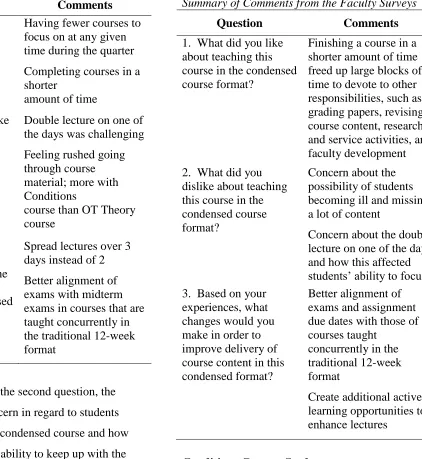
Some suggestions for improvements that the students made in response to the third question include spreading the three class sessions over 3 days instead of 2 days, with 31% of the respondents commenting on this. “Allow for more time in between classes or allow more breaks during class” and “Schedule the course differently so that it’s spread out over three days instead of two, or maybe a few more breaks throughout the day if that is not possible.” Additional comments were related to the timing of the exams in this course in relation to the midterm exams for other courses during that quarter (see Table 1). In response to the fourth question, 72% of the respondents stated that they would take a course in a condensed format again if given the opportunity. Twenty-eight percent stated that they would not.
OT Theory Course: Faculty
The number of respondents was two, indicating a response rate of 100%. In response to the first question, the faculty generated themes similar to the students. Being able to focus on the course for a shorter amount of time was considered a benefit; it freed up large blocks of time at another point in the quarter that could be devoted to grading papers, reading materials, and revising courses or course content.
textbook excerpts and revise some course content/delivery for another course; this would most likely not have been possible had I been teaching 2 days a week given the preparation time required.
In response to the second question, the faculty expressed concern in regard to students becoming ill during a condensed course and how this might affect their ability to keep up with the course material. The program also has a strict absentee policy that requires a student to retake a course if more than one third of the course is missed for any reason. In response to the third question,
the faculty stated that the timing of a written assignment might be improved to avoid a stressful week of due dates and exams (see Table 2). Both faculty indicated that they would teach a course in the condensed format again with one responding
Agree and one responding Strongly agree.
Table 2
Summary of Comments from the Faculty Surveys
Question Comments
1. What did you like about teaching this course in the condensed course format?
Finishing a course in a shorter amount of time freed up large blocks of time to devote to other responsibilities, such as grading papers, revising course content, research and service activities, and faculty development 2. What did you
dislike about teaching this course in the condensed course format?
Concern about the possibility of students becoming ill and missing a lot of content
Concern about the double lecture on one of the days and how this affected students’ ability to focus 3. Based on your
experiences, what changes would you make in order to improve delivery of course content in this condensed format?
Better alignment of exams and assignment due dates with those of courses taught
concurrently in the traditional 12-week format
Create additional active learning opportunities to enhance lectures
Conditions Course: Students
The four survey questions for the Conditions course were the same as for the OT Theory course. The number of respondents was 31, indicating a response rate of 94%. In response to the first
Table 1
Summary of Comments from Student Surveys
Question Comments
1. What did you like about the condensed course format?
Having fewer courses to focus on at any given time during the quarter Completing courses in a shorter
amount of time 2. What did you dislike
about the condensed course format?
Double lecture on one of the days was challenging Feeling rushed going through course material; more with Conditions
course than OT Theory course
3. What suggestions would you like to make for improving the delivery of course content in the condensed format?
Spread lectures over 3 days instead of 2 Better alignment of exams with midterm exams in courses that are taught concurrently in the traditional 12-week format
question, 65% of the students indicated that they liked having only four courses to focus on instead of five at any time of the quarter. Some of the comments made include, “It was easier to focus on 4 classes as opposed to 5” and “It’s much easier to manage only 4 courses at a time.” In addition, the students liked completing the course in a shorter time frame: “It was nice to get through the material quicker” and having exams every two weeks; “I actually enjoy having exams every two weeks. It makes the content more digestible, and more discernible from all of the other content we are learning.”
In response to the second question, 55% of the respondents indicated that they felt rushed when covering the course content and were under the impression that the condensed course did not go into the same depth as the traditional 12-week version. Some of the comments made were: “The condensed course does seem a bit rushed, especially given that our quarters are already so short” and “I don’t feel like we get to reflect on what we learn as much.” In addition, 19% of the respondents
indicated that the double lecture on one of the days was too long of a time block for the same course.
Some suggestions for improvements that the students made in response to the third question were: spreading out the lectures over 3 days instead of 2 (19% of the respondents), covering fewer conditions or less detail on each (19% of the respondents), and including more videos or other visuals in the lectures (16% of the respondents), as these were found to be very helpful (see Table 1). In response to the fourth question, 74% of the respondents stated that they would take a course in
a condensed format again if given the opportunity and 26% of the respondents stated that they would not.
Conditions Course: Faculty
The four survey questions for the Conditions course were the same as for the OT Theory course. The number of respondents was two, indicating a response rate of 100%. In response to the first question, both faculty indicated that they liked getting done with their part of the course sooner, as this allowed for large blocks of time to devote to other responsibilities. Some of the comments made were: “Getting done with my part of the course allowed me more concentrated time to grade the Bernice Compare and Contrast Paper. I think I do a better job grading those when I have chunks of uninterrupted time” and “this gave me some needed extra time prior in the quarter to work on other projects.”
In response to the second question, the faculty expressed concern about the double lecture on one of the days and how this affected students’ ability to pay attention during the lectures. In response to the third question, one of the faculty stated that the delivery of the course content worked out well, while the second faculty stated that it would be beneficial to create more active learning experiences to enhance the lectures (see Table 2). Both faculty (100%) indicated that they would teach a course in the condensed format again if given the opportunity, with one responding Agree and one responding Strongly agree.
Discussion
at any given time during a term. The content is easier to manage with less time between exams. The students’ comments included: “material was fresher in my mind” and that frequent exams made learning the material “more digestible.” The compressed course resulted in keeping up with studying rather than “cramming” for an exam. A study by Leeming (2002) had similar findings in a psychology course with frequent exams; the
students had improved test scores and reported that they liked having more frequent exams, as this led to better study habits and helped them keep up more with the course material. Pennebaker, Gosling, and Ferrell (2013) found that frequent testing resulted in improved performance in the current as well as subsequent courses.
One suggestion for improvement of content delivery made by students was to decrease the amount of time spent lecturing and increase the number of content application activities in class for improved learning. While many of the students suggested avoiding the double-lecture and
spreading the three lectures over 3 days instead of 2, not everyone shared this concern, and there were also a few dissenting opinions from students who did not like the frequent exams. This suggests that no single method of course design and class scheduling will always fit everyone’s needs.
The use of compressed course design enables faculty to devote larger blocks of focused time to engage in service and research or
scholarship activities that are required for continued professional development and the promotion and tenure process. This time could also be used to create and participate in interprofessional education
opportunities that are difficult to fit into busy and competing class schedules among various
disciplines and programs and that require a large time commitment from instructors (Gilbert, 2005).
In addition to student and faculty
preferences and class period and exam scheduling, careful selection of suitable content is also
important. Based on the survey responses, the students perceived the OT Theory content to be better suited for a condensed course format than the Conditions content. The OT Theory course requires students to compare and contrast theories with the intended outcome being the ability to select certain theories over others when evaluating and treating patients. The students liked having all of the theories presented over a short amount of time, as this helped them with this process. The Conditions course is a fact-based course that requires more memorization of larger amounts of material, which was perceived to be more difficult in the shorter time frame. It would be worth investigating what type of content is best suited to be delivered in a compressed format. Preparing the students for a transition to a compressed course needs to include assurance that they are not being “short-changed” in their contact hours and that the content is simply delivered with increased frequency in a shorter time frame.
lectures was minimal. This format might be challenging to less experienced faculty who would need more class preparation time.
Strengths and Limitations
This study investigated two lecture-based courses without labs delivered in the compressed format during one 12-week quarter of the academic year with one cohort of students. Generalizability is therefore limited to similar types of courses and student cohorts. The faculty conducting this study were also the instructors in the courses studied and may have had biases. For this pilot study, only two faculty were involved, which may have resulted in a limited range of opinions. There was a strong student response rate for both postcourse surveys at 97% for the OT Theory course and 94% for the Conditions course, and the results are therefore representative of the entire cohort. The students were taking traditional courses and compressed courses concurrently, which presented an
opportunity for immediate comparison of the course design.
Future Research
Future research to determine the feasibility of delivering other content in a compressed format, including courses with labs, needs to be conducted. It would be important to discern which types of courses and content would be best suited to this approach. In addition to investigating the opinions and perceptions of students and faculty, studying the effectiveness of teaching in this compressed format and the retention of OT content should be considered. The impact of this design on less experienced faculty has also not been studied, and replication of this study with faculty who are not
study authors is also indicated. In addition, research with multiple cohorts and other academic calendar systems, such as a traditional 16-week semester, should be considered.
Conclusion
The overall perceptions among faculty and students of compressed courses were positive; however, opportunities to improve the delivery of content for a smoother experience have been identified. Despite the challenges encountered, almost three quarters of the students would take a compressed course again, suggesting that overall they favor fewer concurrent courses, as this
improves the ability to focus on any one course and balance various life demands. Improved scheduling of class periods and exams as well as more
application activities in class would address many of the concerns mentioned. This study provides preliminary indications that compressed courses can meet the needs of students, faculty, and other
stakeholders in OT education. This type of content delivery is worthy of consideration in curriculum design, as the profession is currently moving toward entry-level OT doctoral programs and the creation of more postprofessional OT doctoral programs.
References
Accreditation Council for Occupational Therapy Education. (2011). 2011 Accreditation council for occupational therapy education(ACOTE®) standards and interpretive guide. Retrieved from
http://www.aota.org/-/media/Corporate/Files/EducationCareers/Accredit/St andards/2011-Standards-and-Interpretive-Guide.pdf American Occupational Therapy Association. (2014a).
American Occupational Therapy Association. (2014b). Occupational therapy practice framework: Domain and process (3rd ed.). American Journal of Occupational Therapy, 68(Suppl. 1), S1-S48. http://dx.doi.org/10.5014/ajot.2014.682006 American Occupational Therapy Association. (2014c).
Occupational therapy education research agenda. American Journal of Occupational Therapy, 68(5), S83-S86.
http://dx.doi.org/10.5014/ajot.2014.685S06h American Occupational Therapy Association. (2015).
Occupational therapy code of ethics. American Journal of Occupational Therapy, 69(Suppl. 3), S1-S8.
http://dx.doi.org/10.5014/ajot.2015.696S03 Buzash, M. D. (1994, April). Success of two-week intensive
program in French for superior high school students on a university campus . . . Fulfilling academic challenge! Paper presented at the Annual Meeting of the Central State Conference on the Teaching of Foreign Language, Kansas City, MO.
Chapleau, A., & Harrison, J. (2015). Fieldwork I program evaluation of student learning using Goal Attainment Scaling. American Journal of Occupational
Therapy, 69(Suppl. 2), S1-S8.
http://dx.doi.org/10.5014/ajot.2015.018325 Daniel, E. L. (2000). A review of time-shortened courses
across disciplines. College Student Journal, 34(2). Evenson, M. E., Roberts, M., Kaldenberg, J., Barnes, M. A., &
Ozelie, R. (2015). National survey of fieldwork educators: Implications for occupational therapy education. American Journal of Occupational Therapy, 69(Suppl. 2), S1-S5.
http://dx.doi.org/10.5014/ajot.2015.019265
Gilbert, J. H. V. (2005). Interprofessional learning and higher education structural barriers. Journal of
Interprofessional Care, 19(Suppl. 1), 87-106. http://dx.doi.org/10.1080/13561820500067132 Grenier, M.-L. (2015). Facilitators and barriers to learning in
occupational therapy fieldwork education: Student perspectives. American Journal of Occupational Therapy, 69(Suppl. 2), S1-S9.
http://dx.doi.org/10.5014/ajot.2015.015180 Leeming, F. C. (2002). The exam-a-day procedure improves
performance in psychology classes. Teaching of Psychology, 29(3), 210-212.
https://dx.doi.org/10.1207/S15328023TOP2903_06 McGaugh, J. L. (1966). Time-dependent processes in memory
storage. Science, 153(3742), 1351-1358.
https://dx.doi.org/10.1126/science.153.3742.1351 Middendorf, J., & Kalish, A. (1996). The “change-up” in
lectures. The National Teaching & Learning Forum, 5(2), 1-4.
https://dx.doi.org/10.1002/ntlf.10026
Morgan, J. (1996). Saturday school: Institutions increase weekend offerings. Community College Week, 9, 6-7. Pennebaker, J. W., Gosling, S. D., & Ferrell, J. D. (2013).
Daily online testing in large classes: Boosting college performance while reducing achievement gaps. PLoS ONE, 8(11), e79774.
https://dx.doi.org/10.1371/journal.pone.0079774 Ramirez, C. L., Gajdos, Z. K. Z., Kreatsoulas, C., Afeiche, M.
C., Asgarzadeh, M., Nelson, C., . . . Caban-Martinez, A. J. (2015). Public health 101 nanocourse: A condensed educational tool for non-public health professionals. American Journal of Public Health, 105(Suppl. 1), S50-S54.
https://dx.doi.org/10.2105/AJPH.2014.302305 Shorter, intensive courses rated more effective. (2008, May
21). UT News. Retrieved from
https://news.utexas.edu/2008/05/21/shorter-intensive-courses-rated-more-effective