R E S E A R C H
Open Access
Tracking the evolution of virtual reality
applications to rehabilitation as a field
of study
Emily A. Keshner
1*, Patrice Tamar Weiss
2, Dorit Geifman
3and Daphne Raban
3Abstract
Background:Application of virtual reality (VR) to rehabilitation is relatively recent with clinical implementation very rapidly following technological advancement and scientific discovery. Implementation is often so rapid that demonstrating intervention efficacy and establishing research priorities is more reactive than proactive. This study used analytical tools from information science to examine whether application of VR to rehabilitation has evolved as a distinct field of research or is primarily a methodology in core disciplines such as biomedical engineering, medicine and psychology.
Methods:The analysis was performed in three-stages: 1) a bibliographic search in the ISI Web of Science database created an initial corpus of publications, 2) the corpus was refined through topic modeling, and 3) themes dominating the corpus from the refined search results were identified by topic modeling and network analytics. This was applied separately to each of three time periods: 1996 to 2005 (418 publications), 2006 to 2014 (1454 publications), and 2015 to mid-2018 (1269 publications).
Results:Publication rates have continuously increased across time periods with principal topics shifting from an emphasis on computer science and psychology to rehabilitation and public health. No terminology specific to the field of VR-based rehabilitation emerged; rather a range of central concepts including“virtual reality”,“virtual gaming”,“virtual environments”,“simulated environments”continue to be used. Communities engaged in research or clinical application of VR form assemblages distinguished by a focus on physical or psychological rehabilitation; these appear to be weakly linked through tele-rehabilitation.
Conclusions:Varying terms exemplify the main corpus of VR-based rehabilitation and terms are not consistent across the many scientific domains. Numerous distinguishable areas of research and clinical foci (e.g., Tele-rehabilitation, Gait & Balance, Cognitive Rehabilitation, Gaming) define the agenda. We conclude that VR-based rehabilitation consists of a network of scientific communities with a shared interest in the methodology rather than a directed and focused research field. An interlinked team approach is important to maintain scientific rigor and technological validity within this diverse group. Future studies should examine how these interdisciplinary
communities individually define themselves with the goals of gathering knowledge and working collectively toward disseminating information essential to associated research communities.
Keywords:Virtual rehabilitation, Topic modeling, Interdisciplinary, Scientific communities
© The Author(s). 2019Open AccessThis article is distributed under the terms of the Creative Commons Attribution 4.0 International License (http://creativecommons.org/licenses/by/4.0/), which permits unrestricted use, distribution, and reproduction in any medium, provided you give appropriate credit to the original author(s) and the source, provide a link to the Creative Commons license, and indicate if changes were made. The Creative Commons Public Domain Dedication waiver (http://creativecommons.org/publicdomain/zero/1.0/) applies to the data made available in this article, unless otherwise stated.
* Correspondence:[email protected]
1Department of Physical Therapy, College of Public Health, Temple
University, Ritter Annex Room 683, 1301 Cecil B. Moore Ave, Philadelphia, PA 19122, USA
Background
Virtual Reality (VR) in general, and the application of VR to rehabilitation in particular, is a relatively young, interdiscip-linary field where clinical implementation very rapidly fol-lows scientific discovery and technological advancement. Indeed, implementation is often so rapid that demonstra-tion of intervendemonstra-tion efficacy by investigators, and establish-ment of research and developestablish-ment priorities by funding bodies, tends to be more reactive than proactive.
Rapid growth in the number and type of applications of VR to rehabilitation has occurred over the past 15 years, suggesting that the research in this area may be demonstrative of a new scientific field. Reviews of the re-search in this area (see e.g., Rizzo and Kim [1], Sveistrup [2], and Levin et al. [3]), however, focus principally on applications of VR technology to specific disability or impairment. If VR-based rehabilitation is chiefly one more tool in the field of rehabilitation science, then cross-disciplinary communication could consist primar-ily of reporting methodological approaches. If, however, VR-based rehabilitation has emerged as a distinctive sci-entific domain, then it becomes the responsibility of the scientists and clinicians engaged in this work to dissem-inate both research insights and future directions across engaged disciplines. Our aim in the current study is to use tools of analysis from the domain of information sci-ence to examine whether application of VR to rehabilita-tion has evolved as a distinct field of research or is
primarily a methodology in core disciplines such as bio-medical engineering, medicine and psychology.
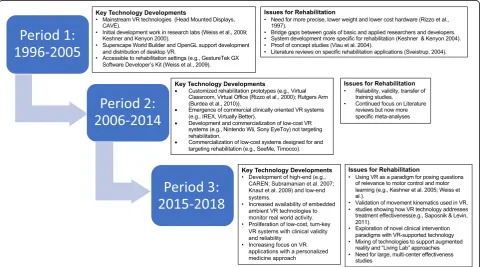
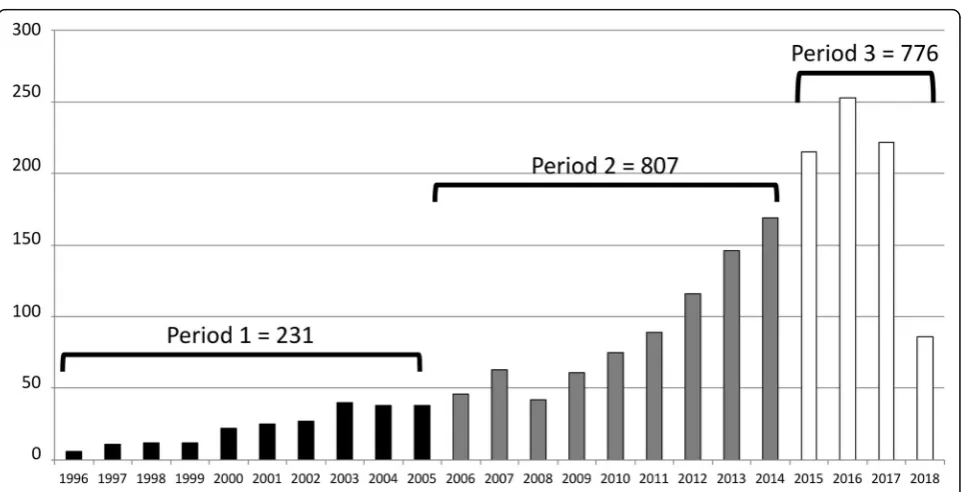
We initiated our search in 1996 because only one mod-erately relevant review article alluding to virtual reality be-ing applied to medicine was found prior to that time [4]. Thus Period 1 (1996–2005) is defined as the period in which key technological developments emerged that influ-enced the use of VR technology for rehabilitation (Fig.1). The most characteristic features of the early technologies in Period 1 were their large size, high cost and limited ac-curacy. These systems led to several pioneering motor re-habilitation applications [5–9] whose clinical relevance was still uncertain since their high cost, technical com-plexity, and encumbrance severely limited access to both hardware or software [10]. Although there was limited recognition of its growing clinical potential, no significant grassroots perception of the need for VR-based interven-tions took hold during this period.
Key changes over the period between 1996 and 2005 included the emergence of platforms such as Superscape World Builder and OpenGL that supported easier devel-opment and distribution of desktop VR applications [11]. During this period, the first clinically oriented com-mercial VR systems emerged such as IREX (for motor rehabilitation) and Virtually Better (for treatment of phobias) appeared. The focus of the work was clearly research-oriented since only funded groups could sup-port the creation of customized rehabilitation prototypes
(e.g., virtual classroom [12] and haptic interfaces [13]). VR technology began to be directed to specific rehabili-tation applications, following the Rogers and Everett’s [14] pattern of Diffusion of Innovations where the inno-vators directly interacted with and motivated early adopters of the new technology. An example of this col-laboration is that of researchers at the Rehabilitation In-stitute of Chicago and at the Electronic Visualization Laboratory at the University of Illinois at Chicago (https://www.evl.uic.edu/) to perform kinematic analyses of body kinematics in the CAVE with an eye toward identifying the impact of visual perception on postural control [15–17]. Another example is parallel work at the Hebrew University, University of Haifa and University of Ottawa to recommend refinements and experimental data that would make the GX/IREX VR systems more accessible for rehabilitation purposes [18].
Period 2 (2006–2014) was shaped by development and initial implementation of clinically accessible applica-tions. For example, this period witnessed the develop-ment and commercialization of both high-end (e.g., CAREN, Motekforce, Netherlands) and low-cost VR sys-tems as the early adopters began to recognize the value of VR to clinical treatment [19]. Off-the-shelf (e.g., Nin-tendo Wii, Sony EyeToy) products that did not target re-habilitation began to be widely used by clinicians because of their accessibility and low cost. Some clinical centers designed an own software or used external props as a compensation for commercial games that were not appropriate for persons with neuromuscular impair-ments. More recently, and in particular since 2010, a number of low-cost VR systems designed for and targeting rehabilitation (e.g., SeeMe, Timocco, Kinect, VAST, VAP-S) have become available. A variety of rehabilitation-oriented desktop gaming programs that implement VR properties (e.g., feedback, documentation, motivation) also became in-creasingly available.
Finally, Period 3 (2015–2018) was defined by the present stage of refinement of meaningful clinical research. For example, since 2015, the increasing accessibility of embed-ded ambient technologies (e.g., inexpensive cameras, proximity sensors, wearable computing) that support the monitoring of motor and cognitive functioning under real-world conditions has extended VR-based interven-tions beyond the clinical setting. One of the most exciting recent trends is the availability of authoring tools that en-able clinicians to program virtual environments with rela-tive ease (e.g., [20]). Another recent development is the use of personalization that enables automatic adjustments of levels of difficulty as a client performs tasks in virtual environments (e.g., [21]). Lastly, there has been an up-surge in the availability of high fidelity yet reasonably cost-ing head-mounted display devices that promote the use of immersive VR in a range of clinical settings [22].
From our approach to classifying these three periods, it is tempting to conclude that progress in the rehabilita-tion focus of this field was completely reliant on techno-logical advances (Fig. 1). This point of view, however, ignores the queries of the scientific disciplines that have shaped the direction of these technological advances. Similar to other rehabilitation technologies, the field of VR-based rehabilitation has emerged as a result of true interdisciplinary and interprofessional collaborations be-tween basic science, clinical science, and industry [23]. Multiple fields of study have played vital roles in extend-ing our knowledge base, and in determinextend-ing which technological developments have been critical for assist-ing the profusion of present day applications. A recent paper by Cipresso et al. [24] applied tools of network an-alytics to study the fields of virtual reality and aug-mented reality from 1970. Although they did not include the term“rehabilitation”in their search, they found that the field was expanding and moving toward increasing clinical applications.
We are the first to analyze the domain specific termin-ology using a topic modeling method to explore the foundation of this broad, multidisciplinary field. Topic modeling, specifically Latent Dirichle Allocation (LDA), is a text mining method that identifies latent topics and themes in a large corpus of text that consists of many documents [25]. It is used to navigate through large ar-chives [26], enhance Information Retrieval (IR) methods [27], identify latent topics within repositories of docu-ments by using a synchronic approach, and study the dy-namics of knowledge development over time [28]. Unlike systematic or scoping reviews of the quality of publications in a field, topic modeling provides a quanti-tative exploratory text analysis of the academic literature [29]. We now examine the structure and citation pat-terns of VR-based research by complementing the topic modeling method with network analysis [30].
common technology? 4) Are there distinguishable re-search and clinical foci that would define future direc-tions for this field? Our larger goal is to identify the themes appearing within VR-based rehabilitation in order to determine whether the full potential of this technology is being recognized and accessed [32–34].
Methods
LDA [25] uses a generative, unsupervised machine-learning algorithm that refines the semantic classifica-tion of a document beyond the rudimentary analysis of its raw terms. This allows for a more subtle topic ana-lysis as raw terms may assume a different meaning sub-ject to the context of their usage. The method builds on the assumption that documents maintain a latent struc-ture of topics and that each topic is a distribution over a fixed vocabulary of the whole corpus; therefore, each term is analyzed in the context of the document in which it appears. The method is an exploratory method and it does not require a priori annotation or labeling of the documents or terms within the documents. Instead, the algorithm infers the hidden topic structure of the corpus by computing the conditional distribution of the hidden variables (the topic structure) and the observed variables (the words of the documents).
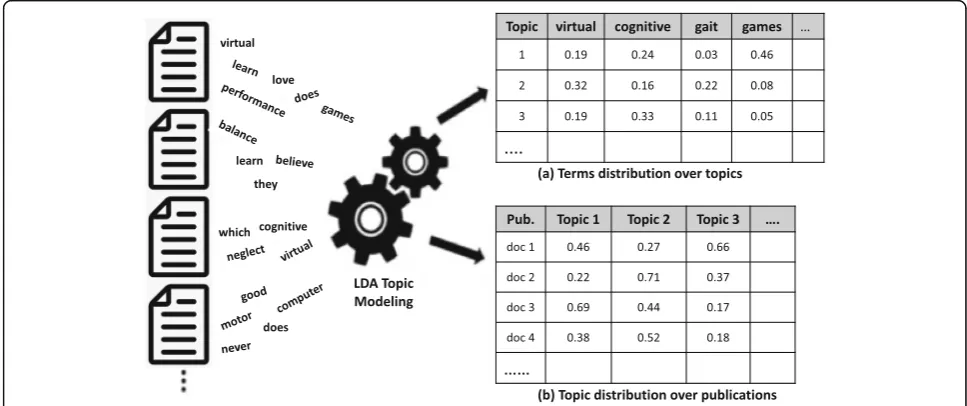
The thematic structure of the document is identified by calculating the proportion of representation of each topic within the document. Figure2, based on Raban & Geifman [30], schematically demonstrates how the LDA algorithm processes words that are included in a large corpus of publications in the field of VR-based
rehabilitation to produce a dual outcome: (1) a table of topics, each identified by the probability distribution of all the raw terms in the corpus (Fig.2a), and (2) for each publication, the estimated distribution of the topics run-ning through them, i.e. the degree of which each topic is represented in the document (Fig.2b).
Topic modeling is an exploratory method that requires much iteration in order to reach meaningful results. This study employed a three-stage analysis to obtain re-sults from the topic modeling: Stage 1) a bibliographic search in the ISI Web of Science (WoS) database to cre-ate an initial corpus of documents; Stage 2) refining the bibliographic search results through topic modeling; and Stage 3) identifying the themes that dominated the re-search agenda of the field by applying topic modeling on the refined search results.
There are various quantitative approaches to reach the desired outcome, however, quantitative methods may gen-erate less semantically meaningful topics [35]. Thus we chose to use a computational approach vetted by the do-main experts wherein each iteration cycle was reviewed, and an outcome that was considered to best reflect the predominant research areas in the field was selected.
Stage 1: bibliographic search
The initial search was performed in WoS. Search terms included “rehabilitation” both as a topic and as a WoS category, combined with “virtual reality” or “virtual en-vironment”or“simulation”and were then refined by ex-cluding areas considered to be irrelevant to the field of interest: water resources, environmental sciences,
ecology, automation control systems, construction build-ing technology, materials science, mathematical compu-tational biology, agriculture, energy fuels, mechanics, operations research management science, mathematics, physical geography, physics, cell biology, business eco-nomics, fisheries, forestry, geography, thermodynamics, metallurgy metallurgical engineering, mining mineral pro-cessing, nuclear science technology, criminology penology, meteorology atmospheric sciences, archaeology, film radio television, geochemistry geophysics, oceanography.
Results of a series of iterative searches were evaluated by the two domain experts who concluded that a strictly automated search did not uncover many of the import-ant publications and established investigators in the field. We, therefore, chose to perform a broader search and to use the topic modeling approach to aid in further filtering of the results. The rationale was to make the search as broad as possible, yet avoid the inclusion of non-relevant areas of research cited in the exclusion list above. The resultant bibliographic search generated a corpus of 3131 papers across the three periods.
Stage 2: refining the search results
The purpose of Stage 2 was to refine and filter the data set. Topic modeling was used to remove topics and, hence, papers that were marginally relevant to the core
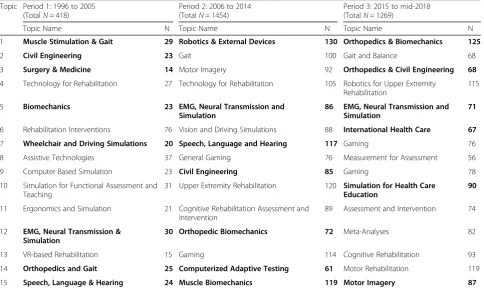
domain of VR-related rehabilitation. Due to a continu-ously increasing number of publications over time, we found that analyzing all years of interest as a single period created a bias towards research areas that domi-nated the later years of the search. As shown in Table1, and as described in the introduction section, we divided the search range into three periods, Period 1 (P1), from 1996 to 2005 (418 publications), Period 2 (P2), from 2006 to 2014 (1454 publications) and Period 3 (P3), from 2015 to mid-2018 (1269 publications). The algo-rithm was applied independently to each period. For each period we created a corpus of text that consisted of the publication title, abstract, and all keywords available in WoS. The topic modeling algorithm determined whether a publication was representative of a specific topic (i.e., if the topic is ranked highest on its distribu-tion list as seen in Fig.2b). The method provides a prob-ability distribution of the topics that are discussed within each publication and we used the topic with the highest probability as the publication’s topic. Other topics may also be represented at a lower (and some-times close) probability.
The 20 most representative publications as well as the 20 highest ranking terms per topic (Fig. 2a) were reviewed by the domain experts to annotate each topic with a thematic name, and to identify the topics most
Table 1Topics in the three periods identified by using the topic modeling algorithm. Topics in bold are those removed from the analysis.“N”is the number of publications per topic
Topic Period 1: 1996 to 2005 (TotalN= 418)
Period 2: 2006 to 2014 (TotalN= 1454)
Period 3: 2015 to mid-2018 (TotalN= 1269)
Topic Name N Topic Name N Topic Name N
1 Muscle Stimulation & Gait 29 Robotics & External Devices 130 Orthopedics & Biomechanics 125
2 Civil Engineering 23 Gait 100 Gait and Balance 68
3 Surgery & Medicine 14 Motor Imagery 92 Orthopedics & Civil Engineering 68
4 Technology for Rehabilitation 27 Technology for Rehabilitation 105 Robotics for Upper Extremity
Rehabilitation
115
5 Biomechanics 23 EMG, Neural Transmission and
Simulation
86 EMG, Neural Transmission and Simulation
71
6 Rehabilitation Interventions 76 Vision and Driving Simulations 88 International Health Care 67
7 Wheelchair and Driving Simulations 20 Speech, Language and Hearing 117 Gaming 76
8 Assistive Technologies 37 General Gaming 76 Measurement for Assessment 56
9 Computer Based Simulation 23 Civil Engineering 85 Gaming 78
10 Simulation for Functional Assessment and Teaching
31 Upper Extremity Rehabilitation 120 Simulation for Health Care
Education
90
11 Ergonomics and Simulation 21 Cognitive Rehabilitation Assessment and
Intervention
89 Assessment and Intervention 74
12 EMG, Neural Transmission & Simulation
30 Orthopedic Biomechanics 72 Meta-Analyses 82
13 VR-based Rehabilitation 15 Gaming 114 Cognitive Rehabilitation 93
14 Orthopedics and Gait 25 Computerized Adaptive Testing 61 Motor Rehabilitation 119
relevant to that field of research (Table1). After running several cycles of the algorithm, each with different pa-rameters, and reviewing the outcomes, we found that distinguishing 15 topics per period was the best repre-sentation of the topical structure of the corpus.
Topics shown in bold in Table 1 were considered by the domain experts to be of low relevance to the field of VR-based rehabilitation. Of the 21 remaining topics, 1775 representative publications were extracted for the final stage of analysis. After evaluating this outcome, an additional 39 publications that were highly cited in the field and for which the probability of their second rank-ing topics was close in value to the probability of their first ranking topics were included. The resultant 1814 relevant papers consisted of 231 publications in Period 1 (1996–2005), 807 publications in Period 2 (2006–2014) and 776 publications in Period 3 (2015–mid-2018).
Stage 3: refining topics and trends that dominated the research agenda
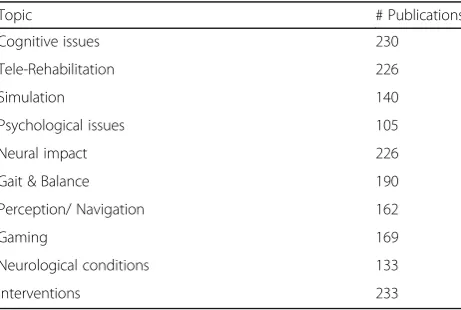
The purpose of Stage 3 was to study the patterns of emergence of the field from the most germane publica-tions. In order to generate a set of topics common across all periods, the topic modeling algorithm was ap-plied to the corpus as a whole without partitioning it into the three separate periods. We were then able to identify temporal trends within the topics over the three periods. Following several iterations, the domain experts determined that 10 topics represented an optimal parti-tioning of the corpus into its thematic structure (Table2) . As a result, by using the process described in Stage 2, each of the publications in the entire corpus could be assigned to one of the topics based on its highest ranked probabilities. Domain experts then assigned a thematic name to each topic based on the 20 terms and 20 publi-cations ranked highest for each of the 10 topics.
The probability distributions of the 20 highest ranking terms in two sample topics,“Gait & Balance”and“ Gam-ing” (Fig. 3), demonstrate how the probabilistic alloca-tion of terms to topics (cf. Fig. 2a) can assist in determining topic themes. For example, domain experts assigned the theme name“Gait & Balance” to the topic on the left as it includes the terms balance, control, gait and walking as the highest ranking terms. Gaming was assigned as the theme name to the topic on the right. Although gaming is used in many scientific disciplines (e.g., computer science, medicine), we relate to this term as having therapeutic and entertainment features (i.e., games, exercise, and activity) as the highest ranking terms. Probability distributions for all ten topics are pre-sented in a tabular form inAppendix.
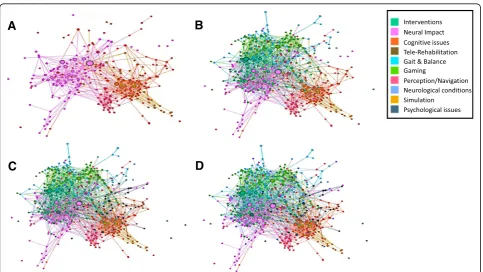
To depict the patterns of interaction among the differ-ent disciplines participating in the field of VR-based re-habilitation research, we built a network of cross-citations among all publications in the corpus. Each node in the network represents a publication from the corpus and its color represents the topic that it is best defined by. An edge links node“A”to node “B”if publi-cation“A”cites publication“B”. The size of the node re-flects the number of citations for that publication within our corpus (also known as node in-degree). To ease the visualization of the graph, only publications (nodes) that have been cited over 8 times have been included. We note that the selection of an 8 citation threshold for the displayed data did not change the patterns portrayed in the full network.
Results
The final corpus of 1814 publications represents the out-come of the topic modeling analysis. This refined list of publications across the three periods of interest (Fig. 4) indicates a progressive increase in the number of publi-cations over time; even though its duration was less than half as long, Period 3 produced almost as many papers as Period 2.
Identifying content areas in VR-based rehabilitation
We started by examining the relevant content of the field through an analysis of the Subject Categories (SC) assigned by the WoS database for these publications. In the WoS database, 252 SCs describe all of the scientific areas covered and that are applied in the process of cataloging the journal titles indexed by the database. A total of 66 SCs emerged from the bibliographic analysis of our retrieval set, however, some of these SCs were not related to psychological, cognitive or physical rehabilita-tion but to clinical medicine (e.g., “dermatology”) and technology development (e.g.,“telecommunications”).
To illustrate the utility of the SCs, the two domain ex-perts selected the 10 most relevant SCs in the field of
Table 2Topic themes based on terms, titles, keywords and absracts of the 20 most relevant papers. N is the number of publications per topic
Topic # Publications
Cognitive issues 230
Tele-Rehabilitation 226
Simulation 140
Psychological issues 105
Neural impact 226
Gait & Balance 190
Perception/ Navigation 162
Gaming 169
Neurological conditions 133
VR-based rehabilitation which included 80% (2478 out of 3131) of all the SCs assigned to the publications in the corpus (Table3). The SC“Rehabilitation” was more pronounced than other SCs for all periods accounting for more than one third of publications. The SC “ Neurosci-ences and Neurology”accounted for only 10% of publica-tions during Period 1 but increased to 20–25% during Periods 2 and 3. “Engineering” accounted for 8.4% of
publications during Period 1 and then increased to about 12% during Periods 2 and 3. In contrast, “Computer sci-ence” declined from about 12% during Period 1 to less than 6% during Periods 2 and 3.
Whereas SCs are typically assigned by librarians, in this study we have used text analytics to identify the emergent key topics that are researcher-driven and to examine the distribution of publications per topic across
Fig. 3Probability distribution of 20 highest ranking terms in each of two topics
the three periods of interest (Fig. 5). We note that the topics of Simulation, Tele-rehabilitation and Cognitive Issues are prominent in Period 1, but their proportion declines greatly in subsequent periods. There is a dra-matic shift in interest in Period 2 to the topic of Neural Impact whereas Period 3 demonstrates an increased interest in Intervention. In general, publications, and hence research, appear to be more evenly distributed across the ten topic themes in Periods 2 and 3 than it was in Period 1. As can be seen, topic modeling displays a more precise definition of the themes used in the re-search, and provides a subtler view of the trends the dominate the research across the three periods.
Correspondence of terms across the corpus
To gain insight into terminology representing each of the topics, the two domain experts selected terms that were considered to be particularly meaningful to the field of VR-based rehabilitation. The weight (the ratio of the frequency of terms in a given topic to the number of representative publications) of these terms was com-pared across each of the topics (Fig.6). For example, the topic of Gaming is clearly identified by the term“games” which also appears frequently in the Intervention, Neurological Conditions, and Telerehabilitation topics. The term “balance” is also weighted strongly in these same topics as well as in the topic Gait & Balance. The
Table 3Number of and percentage of publications in the 10 most relevant WoS Subject Categories for the total study period and for each of P1, P2 and P3
WoS Subject Categories Total P1 P2 P3
N % N % N % N %
Rehabilitation 919 37.1 126 39.3 432 36.8 361 36.7
Neurosciences & Neurology 532 21.5 33 10.3 294 25.1 205 20.8
Engineering 283 11.4 27 8.4 144 12.3 112 11.4
Psychology 173 7.0 38 11.8 78 6.6 57 5.8
Sport Sciences 145 5.9 28 8.7 69 5.9 48 4.9
Computer Science 137 5.5 39 12.1 42 3.6 56 5.7
Health Care Sciences & Services 105 4.2 9 2.8 37 3.2 59 6.0
Orthopedics 67 2.7 5 1.6 32 2.7 30 3.0
Education & Educational Research 60 2.4 16 5.0 17 1.4 27 2.7
Public, Environmental & Occupational Health 57 2.3 0 0.0 28 2.4 29 2.9
Total 2478 100.0 321 100.0 1173 100.0 984 100.0
Fig. 6Weighted frequency of important terms over the 10 topics
A
B
C
D
Fig. 7The citation network.aThe network of publications from the topics of Cognitive Issues, Perception and Navigation, Simulation, and Neural Impact demonstrating the two assemblages.bTopics of Gait and Balance, Interventions, and Gaming added to the network portrayed in (a).c
term“assessment”is weighted similarly for the Interven-tions, Simulation, and Cognitive Rehabilitation topics whereas the term “intervention” emerged in the Inter-ventions, Gaming, and Neurological Conditions topics. The term “technology” is most frequently employed in the Telerehabilitation, topic and the terms “disability” and “participation” are not particularly weighted in any topic. The terms “patients” and “performance” appear across most topics with similar weighting.
Multidisciplinary field or shared technology?
The shape of the network depicted in Fig. 7 suggests three predominant assemblages of topics. One incorpo-rates Cognitive issues, Perception and Navigation, and Simulation (Fig.7a right). A second demonstrates an as-semblage of publications in the area of Neural impact (Fig. 7a left). As shown in Fig.7b, Interventions, Neuro-logical Conditions, and Gait and Balance are deeply in-terspersed with Neural Impact; Gaming tends to form a separate assemblage even though its publications perme-ate the other topics (as would be expected from a term that is widely used in many areas of medicine and sci-ence). The relatively few overlapping nodes or linked edges between Psychological issues and the other topics (Fig. 7c) suggests that publications from the topics of Cognitive Issues, Simulation, and Perception and Navi-gation are more fully linked with each other than those on Psychological issues. Tele-rehabilitation, appearing in Fig. 7d, forms a narrow bridge between those publica-tions focused on either physical (the first assemblage) or psychological (the second assemblage) rehabilitation. The organization of the network implies that publica-tions in the fields of physical and psychological rehabili-tation remain separate and demonstrate a low rate of mutual citations even though they employ a similar technology for intervention.
Discussion
VR-based rehabilitation has traditionally been viewed as an interdisciplinary arena requiring the interaction of computer scientists and engineers with behavioral and clinical scientists (ref ). As the technology and software have progressed, research in VR-based rehabilitation has undergone a rapid transformation from having a primary focus on the development of the technology to evaluat-ing how these technologies can be applied toward re-habilitation research and clinical applications. Such changes have been driven mainly by commercial gaming and simulation technology with an increasing number of applications developed at the behest of clinical practi-tioners and supported by numerous “startups” (https:// www.eu-startups.com/2019/02/10-european-vr-startups-to-look-out-for-in-2019-and-beyond/).
The fundamental question in this study was whether research in VR-based rehabilitation may be viewed as a new scientific field within the domain of rehabilitation. Typically, the emergence of a new scientific field has been shown to be driven by the discovery of something new – a central problem and goals and expectations about the solution to the problem – with theories that address these goals [36]. The goal for most VR-based re-habilitation is the achievement of rere-habilitation out-comes with the expectation that the use of the particular properties of virtual reality technology will promote clin-ical gains. But a scientific field can also be described by
“a collection of individuals with a common interest in some aspect of science who interact on a regular basis.” ([37], pg. 2). The responsibility of a field is to maintain up-to-date information and provide normative standards for scientific work [37]. Thus the definition of a scientific field depends not only on scientific content but also the extent of scientific interactions.
In order to identify whether the application of VR to rehabilitation exists as a scientific field, we have pursued four questions that we predicted to be answered in the positive through publications analyzed by topic modeling and network analysis. Traditionally, when researchers have tried to understand general trends, topics, or themes in a scientific field, they used systematic reviews and meta-analyses. The selection of publications in-cluded in such approaches is often limited by a lack of consistent domain terminology that biases the literature search. There is difficulty in dealing with a large corpus of publications and the scientific discipline and agenda of an individual investigator often directs the focus of analysis [38].
example, the term “balance” will be placed in different topics based on the way it is used within the context of different publications and domains.
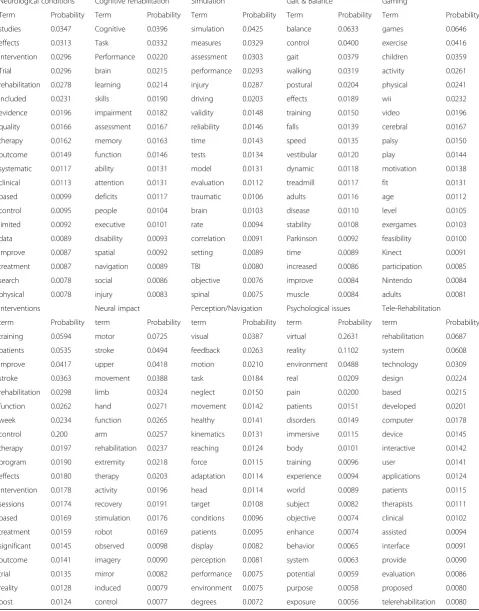
Our first question was whether a consistent termin-ology has emerged in the field of VR-based rehabilitation that could be used to identify the field’s research corpus. The overlap of terms across different topics suggests that virtual rehabilitation has a shared terminology across the engaged scientific and clinical disciplines although spe-cific terms are differentially weighted. Except for the subject category of Psychological issues, the terms “ vir-tual” and “reality” did not emerge as essential terms across all of the topic terms identified in this study (see
Appendix). For example, over the years, a range of add-itional terms including “virtual gaming”, “virtual envi-ronments”, “simulated environments” and many others have also been used. Moreover, terminology specific to human factors in virtual reality, for example “presence” and“immersion”, did not appear across all topics.
This finding suggests that a consistent terminology has not been established which may have hindered the for-mation of an identifiable scientific field. Indeed, the terms that are shared across topics are not specific to a new field of VR-based rehabilitation but can be found in publications from many domains. For example, the term
“technology” and terms that we would expect to appear when focusing on healthcare and human behavior (e.g., assessment, patients and performance) are evenly dis-tributed across all topics.
Our second question was whether the collection of terms found in VR-based rehabilitation publications can be used to identify the foremost research corpus in the field. The diverse academic origins of the investigators involved with this technology promotes the use of differ-ing terminology so that even a discussion of similar ideas may be obscured by the use of different terms. The find-ing, however, that there is no ubiquitous terminology as-sociated with this field alone supports the conclusion that there is no emergent discipline of VR-based re-habilitation. Rather, investigators from many domains share a mutual interest in using these technologies to probe, evaluate and promote innovative rehabilitation applications. Thus, the answer to our second question leads us to conclude that the field of VR-based rehabili-tation represents a network of scientific communities with a shared interest in techniques and methods for re-search and intervention rather than a directed and fo-cused research field.
Scientific fields thrive on collaboration between re-searchers in technology, cognitive sciences, and health sci-ences, and the usage of common terminology is important if the collaborative efforts are to eventually form unique academic disciplines [45]. Our results suggest that our third question about whether VR-based rehabilitation has
emerged as a well-defined and highly visible multidiscip-linary field must be answered in the negative. While mul-tiple disciplines have joined together with a common mandate of applying novel technologies to rehabilitation, the community exists throughinterlinkednetworks rather thana single, cohesive field of study.
These interlinked sub-communities do not imply weakness in the quality or quantity of the science gener-ated by its researchers. Rather, VR-based rehabilitation appears to thrive as a network of traditional disciplines utilizing a common technology rather than as a new multidisciplinary field. Sharing of methods, results and conclusions across investigatory domains occurs when there is an identified need or scientific rationale, but there is no trend, nor indeed, necessity to identify an in-dependent discipline. For example, even though a group of investigators may identify with the subject category of Gait and Balance, the particular research study might be identified by the mechanisms underlying the behavior (e.g., neural vs. biomechanical), the research population being studied (e.g., stroke), the technology employed (e.g., movement analysis), or even the long-term goal of their research (e.g., treatment outcomes). Thus, publica-tions could frequently appear in categories in addition to the primary category of Gait and Balance (e.g., Neural Impact and Neurological Conditions).
Future directions of this field
Our last question focused on delineating distinguish-able areas of research and clinical application that could guide us toward future directions of VR-based rehabilitation. One of the central results from the analysis presented in this paper is that the distribu-tion of publicadistribu-tions across topics has varied over time. Subject categories emerging from the WoS search in Period 1 were directed principally toward expanding the technology outside the laboratory. These topics decline greatly in Periods 2 and 3 and physical rehabilitation and intervention become pre-dominant, which might well reflect increased accessi-bility of the technology for the clinical domain. But if we were to rely on a conventional WoS search, we may have concluded that the categories of rehabilita-tion, neuroscience, and engineering remain robust across time. By engaging in topic modeling, we have been able to further refine the precise areas of study within those broad categories, and to explore in-creased productivity and focus over time.
directly linked, telerehabilitation bridges cognitive is-sues and perception/navigation with topics in the physical rehabilitation domain. Across the examined period of time there is evidence that application of this technology has become more widespread throughout the rehabilitation domains, and there are an increased number of investigators and clinicians employing this technology. The paucity of overlap-ping citations and dissemination of results across the physical and psychological rehabilitation domains, however, implies that contributors continue to com-municate and identify more with their original scien-tific or clinical bases than with the emerging discipline referred to as VR-based rehabilitation. We suggest that awareness of this discrepancy may en-courage researchers to search for information in, for example, conference venues that they would not typ-ically access.
Limitations of the study
This study was exploratory in nature and has several limitations. First, while a leading database served as the data source, it likely does not cover the entire spectrum of publications in the field. This limitation is also an advantage since publications in the WoS database are generally considered to be of high quality and high importance to the scientific community [38]. Another limitation may be that this is a descriptive study which does not support inference at least in its formal connotation of test-ing hypotheses; for example, we cannot determine why specific terminology has not developed over the years or why communities are interlinked rather than interdisciplinary.
A third limitation relates to the iterative approach of the modeling process between computer-based searching and investigator-driven decision making; we were particularly sensitive to the possibility of a limitation related to bias when selecting the Subject Categories and identifying the topic names. Al-though the labeling of the topic titles were assigned by the domain experts and, as such, are somewhat subjective, the publications within each topic were automatically extracted and filtered by topic model-ing methods and the labels themselves were cross-checked between the significant terms and publica-tions of each topic.
Conclusions
In order to retain technological currency and rehabili-tative impact, research and intervention with VR-based technology requires that the technology and clinical based disciplines communicate their needs and their limitations. However, in order for this
communication to succeed, there needs to be a bal-ance between language consistency and academic di-versity. The scarcity of interprofessional or interdisciplinary teams participating in clinical trials and technology development underlies the poor reli-ability and generalizreli-ability of results reported by nu-merous systematic reviews (e.g., [46–49]). Stronger language uniformity, for example in the selection of keywords, will build a more coherent and tightly-knit, albeit interlinked community. Guiding principles for applications of this technology to specific psycho-logical and motor factors in rehabilitation would likely increase the validity and generalizability of out-comes. A team-based, interprofessional approach to rehabilitation and research would significantly strengthen the impact of this technology from the sci-ence to its application [50, 51].
Perhaps the most important message emerging from this analysis is the impact these findings might have on the future of VR-based rehabilitation. If our hypothesis that the emergence of VR-based rehabili-tation as a distinctive scientific domain requires its proponents to disseminate both research insights and future directions across multiple disciplines is correct, then it is currently unlikely that this field will progress to the level of a scientific discipline. As the technology increases its commercial availability, there is a likelihood that VR technology will be adopted without addressing its strengths and limita-tions. Often, appreciation of how to optimize human factors or justify selected technological features may be lacking.
Appendix
Table 4Probability distribution of terms over topics
Neurological conditions Cognitive rehabilitation Simulation Gait & Balance Gaming
Term Probability Term Probability Term Probability Term Probability Term Probability
studies 0.0347 Cognitive 0.0396 simulation 0.0425 balance 0.0633 games 0.0646
effects 0.0313 Task 0.0332 measures 0.0329 control 0.0400 exercise 0.0416
intervention 0.0296 Performance 0.0220 assessment 0.0303 gait 0.0379 children 0.0359
Trial 0.0296 brain 0.0215 performance 0.0293 walking 0.0319 activity 0.0261
rehabilitation 0.0278 learning 0.0214 injury 0.0287 postural 0.0204 physical 0.0241
included 0.0231 skills 0.0190 driving 0.0203 effects 0.0189 wii 0.0232
evidence 0.0196 impairment 0.0182 validity 0.0148 training 0.0150 video 0.0196
quality 0.0166 assessment 0.0167 reliability 0.0146 falls 0.0139 cerebral 0.0167
therapy 0.0162 memory 0.0163 time 0.0143 speed 0.0135 palsy 0.0150
outcome 0.0149 function 0.0146 tests 0.0134 vestibular 0.0120 play 0.0144
systematic 0.0117 ability 0.0131 model 0.0131 dynamic 0.0118 motivation 0.0138
clinical 0.0113 attention 0.0131 evaluation 0.0112 treadmill 0.0117 fit 0.0131
based 0.0099 deficits 0.0117 traumatic 0.0106 adults 0.0116 age 0.0112
control 0.0095 people 0.0104 brain 0.0103 disease 0.0110 level 0.0105
limited 0.0092 executive 0.0101 rate 0.0094 stability 0.0108 exergames 0.0103
data 0.0089 disability 0.0093 correlation 0.0091 Parkinson 0.0092 feasibility 0.0100
improve 0.0087 spatial 0.0092 setting 0.0089 time 0.0089 Kinect 0.0091
treatment 0.0087 navigation 0.0089 TBI 0.0080 increased 0.0086 participation 0.0085
search 0.0078 social 0.0086 objective 0.0076 improve 0.0084 Nintendo 0.0084
physical 0.0078 injury 0.0083 spinal 0.0075 muscle 0.0084 adults 0.0081
Interventions Neural impact Perception/Navigation Psychological issues Tele-Rehabilitation
term Probability term Probability term Probability term Probability term Probability
training 0.0594 motor 0.0725 visual 0.0387 virtual 0.2631 rehabilitation 0.0687
patients 0.0535 stroke 0.0494 feedback 0.0263 reality 0.1102 system 0.0608
improve 0.0417 upper 0.0418 motion 0.0210 environment 0.0488 technology 0.0309
stroke 0.0363 movement 0.0388 task 0.0184 real 0.0209 design 0.0224
rehabilitation 0.0298 limb 0.0324 neglect 0.0150 pain 0.0200 based 0.0215
function 0.0262 hand 0.0271 movement 0.0142 patients 0.0151 developed 0.0201
week 0.0234 function 0.0265 healthy 0.0141 disorders 0.0149 computer 0.0178
control 0.200 arm 0.0257 kinematics 0.0131 immersive 0.0115 device 0.0145
therapy 0.0197 rehabilitation 0.0237 reaching 0.0124 body 0.0101 interactive 0.0142
program 0.0190 extremity 0.0218 force 0.0115 training 0.0096 user 0.0141
effects 0.0180 therapy 0.0203 adaptation 0.0114 experience 0.0094 applications 0.0124
intervention 0.0178 activity 0.0196 head 0.0114 world 0.0089 patients 0.0115
sessions 0.0174 recovery 0.0191 target 0.0108 subject 0.0082 therapists 0.0111
based 0.0169 stimulation 0.0176 conditions 0.0096 objective 0.0074 clinical 0.0102
treatment 0.0159 robot 0.0169 patients 0.0095 enhance 0.0074 assisted 0.0094
significant 0.0145 observed 0.0098 display 0.0082 behavior 0.0065 interface 0.0091
outcome 0.0141 imagery 0.0090 perception 0.0081 system 0.0063 provide 0.0090
trial 0.0135 mirror 0.0082 performance 0.0075 potential 0.0059 evaluation 0.0086
reality 0.0128 induced 0.0079 environment 0.0075 purpose 0.0058 proposed 0.0080
Acknowledgements
NOT APPLICABLE
Authors’contributions
DR and DG were primarily responsible for completing the computerized analyses. EK and PLW were primarily responsible for the manual analyses. All authors analyzed and interpreted the data. All authors contributed to writing the manuscript. All authors read and approved the final manuscript.
Authors’information
EAK and PLW are founding members of the International Society for Virtual Rehabilitation (ISVR). EAK served as the first president of ISVR. They both serve on the steering committee of the International Conference for Virtual Rehabilitation (ICVR) and PLW is chair of the committee.
Funding
There were no funding sources for this research.
Availability of data and materials
The datasets used and/or analyzed during the current study are available from the corresponding author on reasonable request.
Ethics approval and consent to participate
NOT APPLICABLE
Consent for publication
NOT APPLICABLE
Competing interests
The authors declare that they have no competing interests.
Author details
1Department of Physical Therapy, College of Public Health, Temple
University, Ritter Annex Room 683, 1301 Cecil B. Moore Ave, Philadelphia, PA 19122, USA.2Department of Occupational Therapy, Faculty of Social Welfare
and Health Sciences, University of Haifa, Haifa, Israel.3Faculty of
Management, University of Haifa, Haifa, Israel.
Received: 14 December 2018 Accepted: 14 June 2019
References
1. Rizzo A, Kim GJ. A SWOT analysis of the field of virtual reality rehabilitation and therapy. Presence Teleop Virt. 2005;14:119–46.
2. Sveistrup H. Motor rehabilitation using virtual reality. J Neuroeng Rehabil. 2004;1.https://doi.org/10.1186/1743-0003-1-10.
3. Levin MF, Weiss PL, Keshner EA. Emergence of virtual reality as a tool for upper limb rehabilitation: incorporation of motor control and motor learning principles. Phys Ther. 2014;95:415–25.https://doi.org/10.2522/ptj. 20130579.
4. Kaltenborn KF, Rienhoff O. Virtual reality in medicine. Methods Inf Med. 1993;32:407–17.
5. Krebs HI, Hogan N, Aisen ML, Volpe BT. Robot-aided neurorehabilitation. IEEE Trans Rehabil Eng. 1998;6:75–87.https://doi.org/10.1109/86.662623. 6. Jack D, Boian R, Merians AS, Tremaine M, Burdea GC, Adamovich SV, Recce
M, Poizner H. Virtual reality-enhanced stroke rehabilitation. IEEE Trans Neural Syst Rehabil Eng. 2001;9:308–18.https://doi.org/10.1109/7333.948460. 7. Deutsch JE, Merians AS, Burdea GC, Boian R, Adamovich SV, Poizner H.
Haptics and virtual reality used to increase strength and improve function in chronic individuals post-stroke: two case reports. Neurol Rep. 2002;26:72– 86.
8. Holden M. Virtual environments for motor rehabilitation: review. CyberPsychol Behav. 2005;8:187–211.
9. Gaggioli A, Keshner E, Weiss P, Riva G. Advanced technologies in neurorehabilitation: emerging applications in evaluation and treatment. Amsterdam: IOS Press; 2010.
10. Cao S. Virtual reality applications in rehabilitation. In: Kurosu M, editor. Human-computer interaction. Theory, design, development and practice. New York: Springer; 2016. p. 9731.
11. Weiss PL, Keshner EA, Levin MF. Current and future trends for VR and motor rehabilitation. In: Weiss PL, Keshner EA, Levin MF, editors. Applying virtual
reality technologies to motor rehabilitation. New York: Springer Verlag; 2014. p. 217–26.
12. Rizzo AA, Buckwalter JG, van der Zaag C. Virtual environment applications for neuropsychological assessment and rehabilitation. In: Stanney K, editor. Handbook of virtual environments. New York: Erlbaum; 2002. p. 1,027–64. 13. Burdea G, Popescu V, Hentz V, Colbert K. Virtual reality-based orthopedic
telerehabilitation. IEEE Trans Neural Syst Rehabil Eng. 2000;8:430–2.https:// doi.org/10.1109/86.867886.
14. Rogers E. Diffusion of innovations. 5th ed revised. New York: Simon & Schuster; 2003.
15. Kenyon RV, Leigh J, Keshner EA. Considerations for the future development of virtual technology as a rehabilitation tool. J Neuroengineering Rehabil. 2004;1.https://doi.org/10.1186/1743-0003-1-13.
16. Keshner EA, Kenyon RV. The influence of an immersive virtual environment on the segmental organization of postural stabilizing responses. J Vestib Res. 2000;10:201–19.
17. Keshner EA, Kenyon RV. Using immersive technology for postural research and rehabilitation. J Assist Technol. 2004;16:54–62.https://doi.org/10.1080/ 10400435.2004.10132074.
18. Weiss P, Sveistrup H, Rand D, Kizony R. Video capture virtual reality: a decade of rehabilitation assessment and intervention. Phys Ther Rev. 2009; 14:307–21.https://doi.org/10.1179/108331909x12488667117339. 19. Lange B, Suma EA, Newman B, Phan T, Chang C, Rizzo AA, Bolas MT.
Leveraging unencumbered full body control of animated virtual characters for game-based rehabilitation. In: Proceedings of the 2011 international HCI convention, vol. 14; 2011. p. 243–52.
20. Lange B, Koenig S, Chang CY, McConnell E, Suma E, Bolas M, Rizzo AA. Designing informed game-based rehabilitation tasks leveraging advances in virtual reality. Disabil Rehabil. 2012;34:1863–70.https://doi.org/10.3109/ 09638288.2012.670029.
21. Navarro E, González P, López-Jaquero V, Montero F, Molina J, Romero-Ayuso D. Adaptive, multisensorial, physiological and social: the next generation of telerehabilitation systems. Front Neuroinform. 2018;12:43.https://doi.org/10. 3389/fninf.2018.00043.
22. Maravilla MM, Cisneros A, Stoddard A, Scretching DD, Murray BK, Redmiles E. Defining virtual reality: insights from research and practice. iConference 2019 proceedings; 2019.
23. Reinkensmeyer DJ, Blackstone S, Bodine C, Brabyn J, Brienza D, Caves K, et al. How a diverse research ecosystem has generated new rehabilitation technologies: review of NIDILRR’s rehabilitation engineering research centers. J Neuroeng Rehabil. 2017;14:109. https://doi.org/10.1186/s12984-017-0321-3.
24. Cipresso P, Giglioli I, Raya M, Riva G. The past, present, and future of virtual and augmented reality research: a network and cluster analysis of the literature. Front Psychol. 2018;9.https://doi.org/10.3389/fpsyg.2018.02086. 25. Blei DM. Probabilistic topic models. Commun ACM. 2012;55:77–84.https://
doi.org/10.1145/2133806.2133826.
26. Newman D, Block S. Probabilistic topic decomposition of an eighteenth-century American newspaper. J Am Soc Inf Sci Technol. 2006;57:753–67. https://doi.org/10.1002/asi.20342.
27. Jian F, Huang J, Zhao J, He T, Hu P. A simple enhancement for ad-hoc information retrieval via topic modelling. In: Proceedings of the 39th international ACM SIGIR conference on Research and Development in information retrieval; 2016. p. 733–6.https://doi.org/10.1145/2911451. 2914748.
28. Hall D, Jurafsky D, Manning CD. Studying the history of ideas using topic models. In: Association for Computational Linguistics Proceedings of the conference on empirical methods in natural language processing; 2008. p. 363–71.
29. Boyd-Graber J, Hu Y, Mimno D. Applications of topic models. Found Trends Inf Retr. 2017;11:143–296.https://doi.org/10.1561/1500000030.
30. Raban D, Geifman D. Forming socio-intellectual capital: the case of LINKS. In: Kali Y, Baram-Tsabari A, Schejter A, editors. Learning in a NetworKed Society (LINKS). Springer; p. 39–54.
31. Raban DR, Geifman D. Forming Socio-intellectual Capital: The Case of LINKS. In: Kali Y, Baram-Tsabari A, Schejter A. (eds) Learning In a Networked Society. Computer-Supported Collaborative Learning Series, vol 17. Springer, Cham. 2019.https://doi.org/10.1007/978-3-030-14610-8_3.
33. Miller E, Polson D. Apps, avatars, and robots: the future of mental healthcare. Issues Ment Health Nurs. 2019;40:208–14.
34. Keshner EA, Fung J. The quest to apply VR technology to rehabilitation: tribulations and treasures. J Vestib Res. 2017;27:1–5.
35. Chang J, Boyd-Graber J, Wang C, Gerrish S, Blei D. Reading tea leaves: how humans interpret topic models. Adv Neural Inf Proces Syst. 2009:288–96. 36. Darden L. Discoveries and the emergence of new fields in science. In:
Asquith PD, Hacking I, editors. Proceedings of the Biennial Meeting of the Philosophy of Science Association. East Lansing: Philosophy of Science Association; 1978.
37. Casadevall A, Fang F. Field science—the nature and utility of scientific fields. mBio. 2015;6:e01259–15.https://doi.org/10.1128/mBio.01259-15.
38. Robinson K, Dickersin K. Development of a highly sensitive search strategy for the retrieval of reports of controlled trials using PubMed. Int J Epidemiol. 2002;31:150–3.https://doi.org/10.1093/ije/31.1.150.
39. Cascio C, Woynaroski T, Baranek G, Wallace M. Toward an interdisciplinary approach to understanding sensory function in autism spectrum disorder. Autism Res. 2016;9:920–5.
40. Rúbio T, Gulo C. Enhancing academic literature review through relevance recommendation. In: 11th Iberian conference on information systems and technologies; 2016. p. 1–6.
41. Whyte J, Dijkers M, Hart T, Zanca J, Packel A, Ferraro M, Tsaousides T. Development of a theory-driven rehabilitation treatment taxonomy: conceptual issues. Arch Phys Med Rehabil. 2014;95:S24-S32.e2.https://doi. org/10.1016/j.apmr.2013.05.034.
42. Dejong G, Horn S, Gassaway J, Slavin M, Dijkers M. Toward a taxonomy of rehabilitation interventions: using an inductive approach to examine the
“black box”of rehabilitation. Arch Phys Med Rehabil. 2004;85:678–86. https://doi.org/10.1016/j.apmr.2003.06.033.
43. Ozelie R, Sipple C, Foy T, Cantoni K, Kellogg K, Lookingbill J, Backus D, Gassaway J. SCIRehab project series: the occupational therapy taxonomy. J Spinal Cord Med. 2009;32:283–97.
44. Dijkers M, Hart T, Tsaousides T, Whyte J, Zanca J. Treatment taxonomy for rehabilitation: past, present, and prospects. Arch Phys Med Rehabil. 2014;95: S6–S16.https://doi.org/10.1016/j.apmr.2013.03.032.
45. Darden L, Maull N. Interfield theories. Philos Sci. 1977;44:43–64.https://doi. org/10.1086/288723.
46. Garrett B, Taverner T, Gromala D, Tao G, Cordingley E, Sun C. Virtual reality clinical research: promises and challenges. JMIR Serious Games. 2018;6: e10839.https://doi.org/10.2196/10839.
47. Laver KE, George S, Thomas S, Deutsch JE, Crotty M. Virtual reality for stroke rehabilitation. Cochrane Database Syst Rev. 2015;(2).https://doi.org/10.1002/ 14651858.CD008349.pub3.
48. Mishkind MC, Norr AM, Katz AC, Reger GM. Review of virtual reality treatment in psychiatry: evidence versus current diffusion and use. Curr Psychiatry Rep. 2017;19:80.https://doi.org/10.1007/s11920-017-0836-0. 49. Yates M, Kelemen A, Sik Lanyi C. Virtual reality gaming in the rehabilitation
of the upper extremities post-stroke. Brain Inj. 2016;30:855–63.https://doi. org/10.3109/02699052.2016.1144146.
50. Rimmer J, Thirumalai M, Young H, Pekmezi D, Tracy T, Riser E, Mehta T. Rationale and design of the tele-exercise and multiple sclerosis (TEAMS) study: a comparative effectiveness trial between a clinic- and home-based telerehabilitation intervention for adults with multiple sclerosis (MS) living in the deep south. Contemp Clin Trials. 2018;71:186–93.
51. Rimmer JH, Vanderbom KA, Graham ID. A new framework and practice center for adapting, translating, and scaling evidence-based health/wellness programs for people with disabilities. J Neurol Phys Ther. 2016;40:107–14. https://doi.org/10.1097/npt.000000000000012.
Publisher’s Note