REVIEW
Improving
E. coli
growth performance
by manipulating small RNA expression
Alejandro Negrete
1,2†and Joseph Shiloach
1*†Abstract
Efficient growth of E. coli, especially for production of recombinant proteins, has been a challenge for the biotech-nological industry since the early 1970s. By employing multiple approaches, such as different media composition, various growth strategies and specific genetic manipulations, it is now possible to grow bacteria to concentrations exceeding 100 g/L and to achieve high concentrations of recombinant proteins. Although the growth conditions are carefully monitored and maintained, it is likely that during the growth process cells are exposed to periodic stress conditions, created by fluctuations in pH, dissolved oxygen, temperature, glucose, and salt concentration. These stress circumstances which can occur especially in large volume bioreactors, may affect the growth and production process. In the last several years, it has been recognized that small non-coding RNAs can act as regulators of bacterial gene expression. These molecules are found to be specifically involved in E. coli response to different environmental stress conditions; but so far, have not been used for improving production strains. The review provides summary of small RNAs identified on petri dish or in shake flask culture that can potentially affect growth characteristics of E. coli grown in bioreactor. Among them MicC and MicF that are involved in response to temperature changes, RyhB that responds to iron concentration, Gady which is associated with lower pH, Sgrs that is coupled with glucose transport and OxyS that responds to oxygen concentration. The manipulation of some of these small RNAs for improving growth of E. coli in Bioreactor is described in the last part of the review. Overexpression of SgrS was associated with improved growth and reduced acetate expression, over expression of GadY improved cell growth at acidic conditions and over expression of OxyS reduced the effect of oxidative stress. One of the possible advantages of manipulating sRNAs for improving cell growth is that the modifications occur at a post-translational level. Therefore, the use of sRNAs may exert minimal effect on the overall bacterial metabolism. The elucidation of the physiological role of newly discovered sRNAs will open new possibilities for creating strains with improved growth and production capabilities.
Keywords: Small RNA, Stress response, High cell density cultures, E. coli, Acetate production
© The Author(s) 2017. This article is distributed under the terms of the Creative Commons Attribution 4.0 International License (http://creativecommons.org/licenses/by/4.0/), which permits unrestricted use, distribution, and reproduction in any medium, provided you give appropriate credit to the original author(s) and the source, provide a link to the Creative Commons license, and indicate if changes were made. The Creative Commons Public Domain Dedication waiver (http://creativecommons.org/ publicdomain/zero/1.0/) applies to the data made available in this article, unless otherwise stated.
Background
Escherichia coli is the preferred platform for industrial production of various biological products due to its short doubling time, ability to grow to high cell densities, the relatively simple scale-up procedure, cost-effectiveness, known genomics, as well capability to express high
con-centrations of recombinant proteins [1–4]. Of the 94
protein-based anti-cancer pharmaceuticals currently on the market, 70% are produced in E. coli [5, 6].
Production of biologicals from E. coli is typically done
by growing the microorganism to high density, a
proce-dure that was developed in the mid 1970s [7], and is
cur-rently the method of choice [6, 8]. Achieving high cell
concentration of the bacteria is done by adequate supply of nutrients, such as carbon sources (mostly glucose) and dissolved oxygen and by controlling growth parameters such as pH and temperature. Although the growth param-eters are being controlled, fluctuations in osmolality, temperature, dissolved oxygen, substrates, and metabo-lites concentration such as glucose, acetate and ammonia
can affect bacterial growth and production capability [9].
Open Access
*Correspondence: [email protected]
†Alejandro Negrete and Joseph Shiloach contributed equally to this manuscript
Bacterial strains resistant to stress are expected to exhibit improved growth and recombinant protein production. Genetic engineering approaches have generated strains resistant to stress [8, 10–13]. However, the genetic modi-fications were usually associated with lower cell con-centrations or production of metabolites that affect the overall process efficiency [8, 11]. E. coli responds to dif-ferent stress parameters by initiating responses through the activation of complex physiological and molecular
mechanisms [14, 15]. In the past few years, it has been
recognized that small RNAs play a role as regulators of
bacterial gene expression [16, 17]. These molecules were
found to be involved in E. coli response to different
envi-ronmental stresses [18–20]. About 100 sRNAs were
dis-covered by microarrays, biocomputational prediction algorithms and confirmed by reporter gene tags,
north-ern blots, or pulse-expression [21–23]. The functions of
only a few have been identified by experimental methods such as specific binding of the sRNA to its target, verify-ing the stress conditions that triggered its expression, and
showing the evidence of its physiological effect [24]. In
this review, we are focusing on those small RNAs that can potentially enhance bacterial response to stress especially when grown to high cell densities in bioreactors.
Small RNAs respond to stress during E. coli growth in shake flasks
Most of the information on sRNAs involvement in response to stressed growth conditions was obtained
from E. coli growing to low density in shake flask. The
data obtained from these studies identified several sRNAs responding to stress including temperature, osmolarity, iron limitation, glucose phosphate accumula-tion, pH, and oxygen. All these studies concentrated only on understanding the molecular response of the sRNA to the stress, but not on the possible physiological implica-tions of manipulating the expression of these sRNA. The
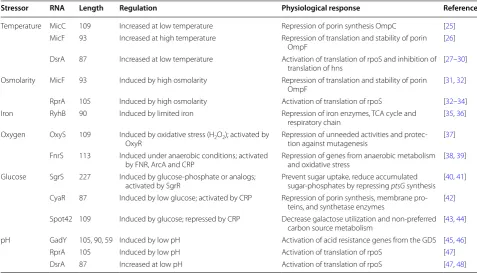
information currently known is summarized in Table 1.
Temperature
Two sRNAs, MicC and MicF, were identified to be involved in the regulation of translation and stability
of porins [49]. Both were found to be associated with
response to temperature changes. MicC was expressed at low temperature (24 °C) and was identified by grow-ing E. coli K-12 (JM109) in LB and in M9-glycerol mini-mal media at different temperatures at a stationary and
at an exponential phases to an OD600 of 0.2 or 0.4 [25].
MicF was found to be expressed at higher temperatures
(37 or 42 °C) and was identified by growing E. coli K-12
JA221 overnight to an OD550 of 0.2 which was followed
by increasing the growth temperature to 37 °C by adding
equal volume of medium at 50 °C [32]. Another sRNA
responding to temperature change is DsrA, this sRNA
was found to be induced in E. coli K-12 cultures grown
in LB media at 24 °C to an OD600 of 0.4–0.6 [27]. DsrA
is a sRNA that regulates rpoS and hns mRNAs [29]. This
sRNA interacts with the mRNA of the transcriptional
regulator σS (encoded by rpoS) and the transcriptional
repressor H-NS [50], it activates RpoS translation and
inhibits hns translation [29, 30].
Osmolarity
The sRNA MicF, in addition to its response to tempera-ture change, has also been associated with high osmo-larity conditions created by adding 20% sucrose to the
growth media. MicF expression was increased when E.
coli K-12 was grown in LB, low-phosphate medium, or in
nutrient broth or in M9 medium supplemented with 0.4% glucose, MicF expression was increased when the culture
was exposed to high osmolarity conditions [26].
Another sRNA responding to changes in osmo-larity is RprA, a sRNA of 105nt that activates RpoS translation when the bacteria are exposed to osmotic
shock [33, 34]. Experiments were performed by
grow-ing E. coli K-12 (MG1655) in LB to stationary phase (OD600 = 3.5) and the addition of 0.12, 0.23, 0.46 or
1.0 M sucrose for 20 min [34]. RprA expression has
also been induced by osmotic shock in an E. coli K-12
MC1061 strain grown in LB to an OD600 of 0.3 by
add-ing 0.46 M sucrose [33].
Iron concentration
The transcription of RyhB, a 90 nt sRNA, was found to be associated with iron availability in the media. RyhB
is usually repressed at iron-rich conditions [51] and is
expressed when the iron concentration is low, thereby reducing iron consumption by downregulating the expression of iron-containing proteins and, as a result, increasing the concentration of free intracellular Fe3+ [51,
52]. This was studied by using derivatives of E. coli K-12
MG1655 that were grown in M63 media supplemented
with 1 μM FeSO4 [52]. Other studies to access the effect
of high iron concentration were conducted by growing E.
coli K-12 MG1655 to an OD600 = 0.3 in LB or M63 media
supplemented with 0.2% glycerol at 50 μM FeSO4 [35].
These showed that increased RyhB expression triggered reduced expression of genes associated with the TCA
cycle and the respiratory chain such as acnA (aconitase),
sdhCDAB (succinate dehydrogenase), sodB (superoxide
dismutase), fumA (fumarase), and ferritins bfr and ftnA
[35, 36].
pH
conditions. There are three species of the GadY sRNA: full-length GadY at 105 nt and two processed forms at
90 and 59 nt respectively; all detected when E. coli K-12
MC4100 and E. coli K-12 MG1655 were grown in shake
flasks in LB at pH 5.8 [45]. In a different experiment,
GadY and its processed forms were detected in in E. coli
grown to OD600 of 2.0 in LB-MES media buffered at pH
5.5 with 100 mM 2-(N-morpholino)ethanesulfonic acid (MES) [46].
Overexpression of GadY was associated with
activa-tion of the acid resistance genes gadA, gadB, and gadC
(part of the GDS-glutamate decarboxylase system), which in turn activated the GadX mRNA, inducing the
expression of GDS [45, 53, 54]. GadY was also found to
activate the Lysine decarboxylase system (LDS) at pH
5.8 [55]. Two other sRNAs RprA and DsrA have been
associated with acid resistance [47]. The RprA and DsrA
were expressed when E. coli K-12 MG1655 cells were
grown in M9 media supplemented with 0.4% glucose. The culture was diluted 1:10 or 1:100 with M9 minimal media supplemented with 0.4% glucose and 1.5 mmol/L glutamate, which was adjusted to pH 2.0 or 3.0 with
concentrated HCl [47]. RprA induces the expression of
rpoS which protects against acid resistance [47]. The
overexpression of DsrA induces rpoS similarly to the
RprA sRNA [48].
Glucose transport and glucose phosphate accumulation Expression of the glucose transporter ptsG was found to be regulated at the posttranscriptional level by the 227 nt sRNA SgrS that binds to the mRNA ptsG [40, 56]. The effect
of SgrS was observed when E. coli K-12 (MG1655) grew in
M63 minimal media agar plates supplemented with 0.2% glucose, and in liquid LB medium supplemented with 1% of glucose or the non-metabolized glucose alpha methyl gluco-side (αMG) [40, 57]. It was established that SgrS is expressed in response to glucose-6-phosphate accumulation,
inhibit-ing the translation of the ptsG mRNA, and as result
caus-ing decrease of the glucose transporter IICBGlc and glucose
entry into the cells [58–61]. SgrS also encodes the 43 amino acids polypeptide SgrT that regulates the activity of pre-existing IICBGlc transporters [41]. This polypeptide rescues cells growing in the presence of αMG by reducing glucose
transport independently of mRNA degradation [41, 62].
Other sRNAs that are associated with carbon metabolism are CyaR and Spot42. CyaR an 87 nt sRNA, is induced at low glucose concentrations and is positively regulated by
the global regulator Crp [42]. This was studied by growing
E. coli in shake flask or agar plates containing Lennox broth or M63 minimal medium supplemented with 0.001%
vita-min B1 and 0.2% glucose or glycerol [42]. Overexpression of
CyaR downregulated at least 25 additional genes, responsi-ble for the expression of membrane proteins, transporters, Table 1 Hfq-dependent sRNAs involved in the stress response of E. coli growing in bioreactor
Stressor RNA Length Regulation Physiological response References
Temperature MicC 109 Increased at low temperature Repression of porin synthesis OmpC [25]
MicF 93 Increased at high temperature Repression of translation and stability of porin
OmpF [26]
DsrA 87 Increased at low temperature Activation of translation of rpoS and inhibition of
translation of hns [27–30]
Osmolarity MicF 93 Induced by high osmolarity Repression of translation and stability of porin
OmpF [31, 32]
RprA 105 Induced by high osmolarity Activation of translation of rpoS [32–34]
Iron RyhB 90 Induced by limited iron Repression of iron enzymes, TCA cycle and
respiratory chain [35, 36]
Oxygen OxyS 109 Induced by oxidative stress (H2O2); activated by
OxyR Repression of unneeded activities and protec-tion against mutagenesis [37] FnrS 113 Induced under anaerobic conditions; activated
by FNR, ArcA and CRP Repression of genes from anaerobic metabolism and oxidative stress [38, 39] Glucose SgrS 227 Induced by glucose-phosphate or analogs;
activated by SgrR Prevent sugar uptake, reduce accumulated sugar-phosphates by repressing ptsG synthesis [40, 41] CyaR 87 Induced by low glucose; activated by CRP Repression of porin synthesis, membrane
pro-teins, and synthetase enzymes [42] Spot42 109 Induced by glucose; repressed by CRP Decrease galactose utilization and non-preferred
carbon source metabolism [43, 44]
pH GadY 105, 90, 59 Induced by low pH Activation of acid resistance genes from the GDS [45, 46]
RprA 105 Induced by low pH Activation of translation of rpoS [47]
and essential enzymes to adapt cells to low glucose
condi-tions [42]. Spot42 is a109 nt Hfq-dependent sRNA that
represses genes involved in central and secondary metabo-lism, redox balancing, and consumption of various
non-preferred carbon sources resulting in slow growth [63]. The
information above was obtained by growing E. coli K-12 in
LB or M9 media supplemented with 10 μg/mL thiamine,
2 mM MgSO4, 0.1 mM CaCl2, and 0.2% casamino acids, and
different carbon sources [63].
Oxygen
The sRNA OxyS, is induced in response to increased expression of the OxyR regulon which was triggered by
exposing E. coli K-12, grown in LB media to OD600 = 0.2,
to H2O2 [37]. OxyS acts post-transcriptionally by inhib-iting rpoS and regulating the expression of FhlA (format hydrogen lyase activator) which protects the cells against mutagenesis [37, 64, 65].
High oxygen concentrations cause cellular damage by affecting enzymes, proteins, and DNA through the
for-mation of reactive oxygen species (ROS). E. coli is
pro-tected against oxidative stress by activating the SoxRS and
the OxyR regulons [66, 67]. When E. coli K-12, grown in
LB or defined media, is exposed to superoxide or
redox-cycling drugs, the SoxR regulon activates the soxS gene
that acts as transcription factor, inducing the expression of several genes from the SoxRS regulon. Some of the genes activated by the SoxS protein are sodA, acnA, fumC,
micF, and zwf, replacing sensitive enzymes such as
acon-itase B and fumarases A and B with the oxygen resistant
isozymes aconitase A and fumarase C [68, 69].
Manipulation of sRNAs expression to improve high cell density E. coli growth in bioreactors
The identification of the different small RNAs associated with stress growth conditions, described in the previ-ous section, was performed when the bacterial culture was grown on petri dishes or in shake flasks at low den-sity. The research focused on discovering which sRNA responded to a specific stress condition and on locat-ing potential target genes and their possible physiologi-cal roles. This was elucidated by using molecular biology and computational predictive tools. Since shake flasks are mostly being used for low density growth at non-controlled conditions, this approach did not provide
suf-ficient information on the possible role of sRNAs on E.
coli growth in bioreactor for biological production. At
these growth conditions, especially when it is done to achieve high density growth, the bacteria are exposed to multiple stresses as a result of high nutrient and metabo-lite concentrations, changes in pH, dissolved oxygen, and temperature that can affect their growth and production
capability [13]. Since some sRNAs were found to respond
to bacterial stress, their overexpression or inhibition can potentially affect the bacterial growth and production properties especially at high cell density culture in a
bio-reactor. E. coli strains with modified sRNA expression
will potentially be more resistant to stress and thus more suitable for industrial production. The following section summarizes the information currently available on
utiliz-ing sRNAs for creatutiliz-ing E. coli strains less susceptible to
environmental stresses, specifically pH, oxygen concen-tration, glucose, and acetate.
Effect of SgrS manipulation on acetate in high cell density growth of E. coli
Growing E. coli to high cell densities is done, in most
cases, by supplying the growing culture with adequate supply of glucose. However, glucose is also associated with acetate production that negatively affects the bacte-rial growth and, as a result, various growth strategies are routinely implemented, together with genetic construc-tion of bacterial strains, to minimize acetate producconstruc-tion and allow the bacteria to grow and produce without
inter-ruption [70, 71]. These growth strategies were focused on
controlling the glucose supply rate, and on altering the central carbon metabolism by diverting the metabolic flux through increasing glucose uptake, manipulating the gene
cra or modifying the phosphotransferase system (PTS).
Although, these approaches solved the acetate accumula-tion they were associated with lower cell densities [72–76]. Several studies reported reduction in acetate
excre-tion by knocking down the ptsG gene, which is
responsi-ble for coding the glucose-specific enzyme II of the PTS. This approach minimized the acetate excretion by reduc-ing the glucose uptake which decreased the flux through glycolysis. However, the growth rate of this mutant strain
was slower than the parental strain [72]. The genetic
manipulation of specific genes by overexpression or dele-tion frequently limits cell growth since the reguladele-tion of
other genes is being affected [3]. Using sRNAs for
reduc-ing acetate excretion is an attractive approach, since the regulation occurs at the posttranscriptional level and, therefore, might not affect cell growth.
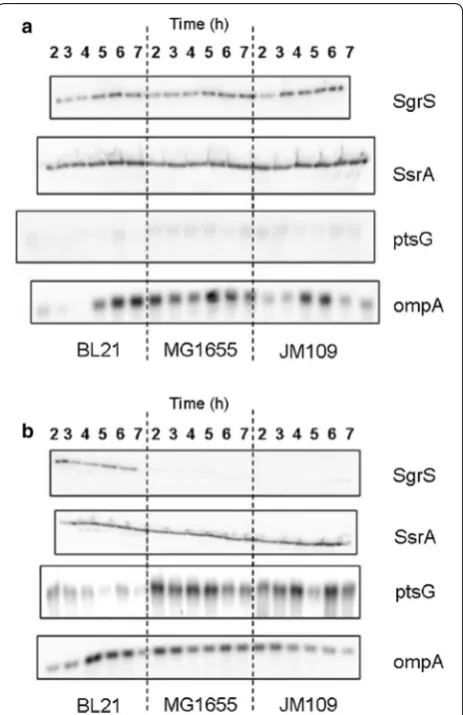
When transcription of the sRNA SgrS was evaluated in E. coli culture growing in shake flask, its expression increased when the bacteria were exposed to the non-metabolizable glucose analog alpha methyl glucoside (αMG) which was associated with decreased expression
of the glucose transporter ptsG, as seen in Fig. 1a [40,
77]. The increase in SgrS transcription and reduction in
ptsG expression was observed in both E. coli B (BL21)
and E. coli K-12 (JM109 and MG1655). However, when both strains were exposed to high glucose concentra-tion, SgrS transcription was dissimilar; it increased in
The increased SgrS transcription likely reduced the ptsG biosynthesis and lowered the bacterial glucose transport
rate. This is an indication that E. coli B tolerates high
glucose concentration, not only because of its more
effi-cient central carbon metabolism [78] but also as a result
of its ability to control the rate of glucose transport into the cells, thus minimizing the overflow of glucose and
acetate production. The overexpression of SgrS in E. coli
B was attributed to a possible accumulation of glucose-phosphate suggesting a possible overflow of glucose. This
did not happen in E. coli K-12 perhaps because glucose
was converted to acetate and pyruvate. Additionally, in
high cell density cultures, the SgrS-ptsG interaction is
activated by high glucose concentration and is specific to
E. coli B.
Based on the above observations, an overexpression
of the sRNA SgrS in E. coli K-12 seems to be a logical
approach to increase the bacteria tolerance to high glu-cose concentration and to reduce acetate excretion. The
behavior of E. coli K-12 overexpressing SgrS grown in
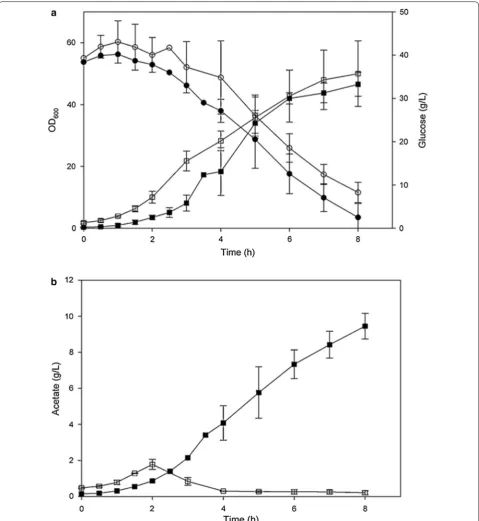
bioreactor at high glucose concentration is seen in Fig. 2.
Growth and glucose consumption in E. coli with plasmid
control and with plasmid overexpressing SgrS described
in Fig. 2a and acetate excretion of the two strains in
Fig. 2b. It is obvious that SgrS expression minimized
the negative effect of acetate accumulation on the cell growth, the low production of acetate without affecting cell growth suggest that the overexpressing SgrS strain is promising candidate for large scale production of recom-binant proteins [79].
Effect of GadY on growth of E. coli under acidic conditions Exposure to low pH is a common stress condition during
E. coli growth in media supplemented with glucose can affect the bacterial growth rate and protein production efficiency. The main cause for a drop-in pH is the
accu-mulation of acetic acid [80], and it is usually occurring at
high density growth. Even when the culture pH is being kept around 7.0 (by adding base, such as ammonium hydroxide or sodium hydroxide), there is always the pos-sibility of local regions in the bioreactor where the pH is low, as was identified when dissolved oxygen concen-tration was followed in different sections of the biore-actor [81, 82]. Bacterial strains resistant to low pH will, therefore, have an advantage compared with the parental strain. Creating such strains by manipulating small RNA expression seems to be an attractive option, since, unlike genetic manipulation of glucose utilization pathways
[75], it is possible that the effect on the bacterial growth
and metabolism will be minimal.
As described in the previous section, the small RNA GadY was expressed at low pH in cultures grown in
shake flasks [45] but no explanation for the GadY
expression effect on the bacterial metabolism or growth was suggested. Expressing GadY was considered as a possible approach for creating a bacterial strain which may be less sensitive to low pH. To test this concept, an
E. coli K-12 strain (MG1655) expressing the sRNA GadY was created and its performance in high cell density cultures in a bioreactor was compared with its parental
strain [81]. It was found that at pH 7.0, both strains grew
to a similar cell density of OD600 = 43, but the
overex-pressing GadY strain produced 40% less acetate than the
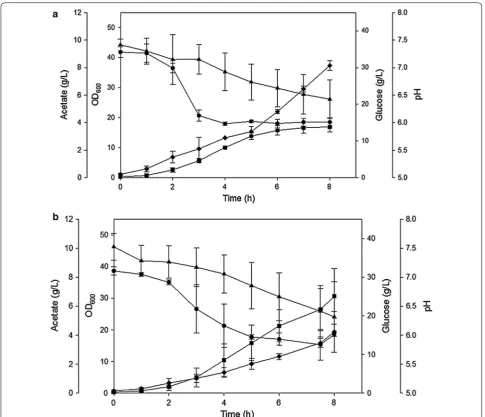
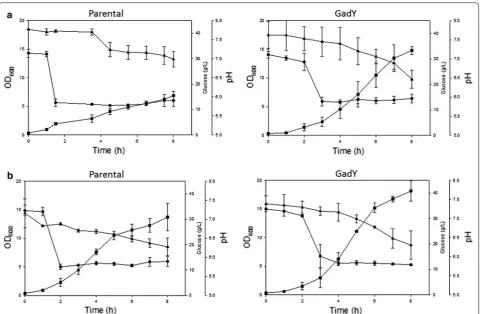
parental strain. At pH 6.0, the parental strain (Fig. 3a)
grew 35% less and produced 6 g/L (200%) more acetate
than the GadY overexpressing strain (Fig. 3b) [81].
The overexpressing GadY strain was evaluated further by following its response to media acidification with
Fig. 1 Transcription levels of sRNA and mRNA from E. coli growing in shake flasks. Transcription levels of the sRNAs SgrS, ssrA (internal control), mRNAs ptsG, and ompA (internal control) in E. coli B (BL21),
various organic acids [81]. The strain was exposed to pH 6.0 by adding acetic or phosphoric acid to the growth
media (Fig. 4). The results showed that the
overexpres-sion GadY strain responded better than the parental
strain to the acid addition and, that at the same pH, the
acetic acid (Fig. 4a) affected the bacterial growth more
than the phosphoric acid (Fig. 4b). Further analysis was
performed by determining the expression level of 17
Fig. 2 Growth, glucose consumption and acetate production in E. coli K-12(MG1655) and E. coli K-12 (MG1655 lacIq) containing plasmid pLCV1 overexpressing SgrS. a Growth and glucose consumption in (filled square, filled circle) E. coli K-12 (MG1655) and in (open square, open circle) E. coli
sRNAs that were previously reported to be associated
with acid stress [83]. The results showed that in both
strains growing at pH 7.0 the lysine decarboxylase system (LDS) was expressed in the early exponential phase and the glutamate decarboxylase system (GDS) was expressed in the late exponential phase. At pH 6.0, this pattern was similar except that the GDS was only expressed in the late exponential phase at the parental strain but not in the overexpressing GadY strain, an indication that GadY
improved the growth of E. coli by deactivating the GDS
system in the late exponential phase [81].
The overexpressing GadY strain was also found to decrease the production of acetate, regardless of the culture pH, which reduced further its negative effect on
cell growth. Acetate dissociation depends on the media
pH and affects the internal pH of the cells [80, 84].
Sev-eral processes and genetic approaches have been imple-mented to reduce acetate production, but some of these approaches had negative effects on cell growth and/or
recombinant protein production [75]. An E. coli strain
resistant to the acetate accumulation has an obvious advantage for high density growth and recombinant pro-teins production.
Effect of OxyS on high cell density growth of E. coli
The small RNA OxyS is over-expressed when E. coli is
exposed to oxidative stress generated by H2O2 or
redox-cycling drugs, which the bacterial culture is not exposed
to when it grown in shake flasks or in bioreactors [37,
69, 85–87]. To identify the possible role of this sRNA in
high cell density cultures grown in bioreactor, its expres-sion was followed when the bacterial culture was grown in the presence of high dissolved oxygen concentration. Supplying oxygen-enriched air or pure oxygen is a pro-cedure commonly used to satisfy the oxygen demand
of the bacterial culture [88, 89]. It was found that high
concentrations of molecular O2 in a bioreactor caused
the activation of the superoxide stress regulator SoxRS,
which induces the transcription of the soxS and the sodA
genes [90]. The sodA gene encodes the manganese
super-oxide dismutase (SOD), which allows the cells to
con-tinue growing during the oxidative stress [91]. The SoxRS
and SOD system have been described as the major
pro-tection mechanisms against the toxic effects of pure O2.
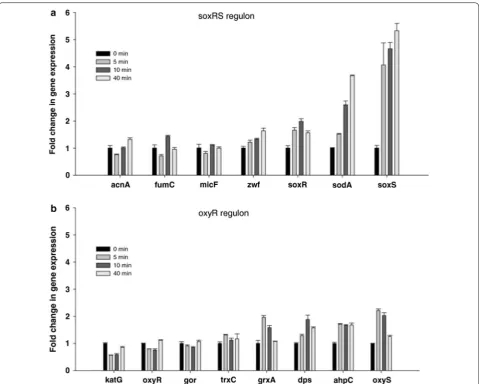
The main response of the cells to the oxygen stress was
through the soxRS regulon (Fig. 5a) although there was
a small increase in the OxyS expression, from the oxyR regulon (Fig. 5b) [90].
The OxyR, which activates the expression of the sRNA OxyS, is a transcriptional dual regulator responding to
oxidative stress, mainly to high concentrations of H2O2.
This regulon includes genes from the peroxide
metabo-lism, redox balance, and manganese uptake [92, 93].
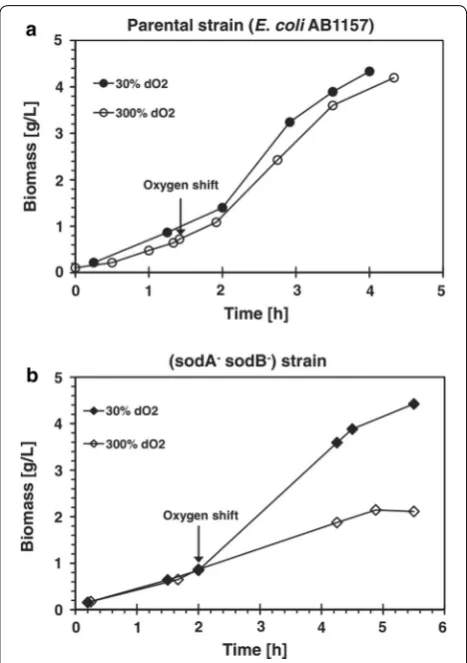
Since the OxyS was not activated while E. coli was grown
at high dissolved oxygen concentrations (Fig. 6a), it is an
indication that the H2O2 level was low, and the activation
of the SoxRS system together with the SOD (Fig. 6b) was
sufficient to protect the cells from the oxidative stress allowing the cells to continue growing without the
con-tribution of OxyS [90]. The response to oxidative stress in
high cell density cultures is an example where the post-transcriptional regulation mediated by this sRNA differs from the physiological response observed in low density cultures exposed to external induced stress.
Summary
Changes in growth conditions are known to
gener-ate stress responses in E. coli by a variety of complex
mechanisms, among them the posttranscriptional response mediated by small RNAs. By using experimen-tal approaches, high-throughput computational searches [94], shotgun cloning [95] and tiling array analyses [22],
123 sRNAs have been experimentally verified and
reg-istered in the Rfam database and specifically for E. coli
K-12 in the RegulonBD database [96, 97]. Although
considerable work has been done on sRNA expression in E. coli, not much effort was directed towards
utiliz-ing small RNAs for creatutiliz-ing E. coli strains resistant to
growth-related stress conditions. Stress conditions are likely to occur when the bacteria are propagated at high density growth for production of biologicals. In this short review, we summarize the modifications of small RNA
expression that were implemented to create E. coli strains
resistant to stress conditions caused by glucose
concen-tration, low pH, and pure O2. The strains
overexpress-ing SgrS and GadY showed improved cell growth and an
additional decrease in acetate productions. This indicates that manipulations at the posttranscriptional regulation, mediated by sRNAs, improve cell growth by enhancing cell resistance to low pH, and by decreasing the produc-tion of undesirable metabolites. This observaproduc-tion opens
up ample opportunities to modify E. coli at the
posttran-scriptional level without affecting cell growth through the modifications of metabolic pathways. The current sum-mary describes the effect of sRNAs only on glucose and pH, but there are certainly more stress-creating condi-tions that can affect the bacterial growth that need to be evaluated in industrial settings. We believe that the appli-cation of transcriptional regulation mediated by sRNA will improve large-scale productions of recombinant
Fig. 5 Time course expression of selected genes controlled by SoxRS and OxyR regulons during E. coli K-12 MG1655 growth at 30 and 300% dO2. a
proteins in E. coli where environmental changes are likely to occur.
Abbreviations
αMG: alpha methyl glucoside; FhlA: format hydrogen lyase activator; GDS: glutamate decarboxylase system; LDS: lysine decarboxylase system; SOD: manganese superoxide dismutase; MES: 2-(N-morpholino)ethanesulfonic acid; PTS: phosphotransferase system; ROS: reactive oxygen species.
Authors’ contributions
AN and JS wrote the manuscript together, AN performed the literature search and assembled the relevant published results. JS reviewed and edited the information collected. Both authors read and approved the final manuscript.
Author details
1 Biotechnology Core Laboratory, NIDDK, NIH, Bethesda, MD 20892, USA. 2 Present Address: MilliporeSigma, Carlsbad, CA 92009, USA.
Acknowledgements
The authors would like to thank Dr. N. Majdalani for valuable comments and Mrs. D. Livnat for editorial assistance.
Competing interests
The authors declare that they have no competing interests.
Availability of data and materials
The datasets supporting the conclusions of this article are included within the article.
Consent for publication Not applicable.
Ethics approval and consent to participate Not applicable.
Funding
Funding was provided by the intramural program of the NIDDK/NIH.
Publisher’s Note
Springer Nature remains neutral with regard to jurisdictional claims in pub-lished maps and institutional affiliations.
Received: 6 July 2017 Accepted: 2 November 2017
References
1. Graumann K, Premstaller A. Manufacturing of recombinant therapeutic proteins in microbial systems. Biotechnol J. 2006;1:164–86.
2. Sivashanmugam A, Murray V, Cui C, Zhang Y, Wang J, Li Q. Practical pro-tocols for production of very high yields of recombinant proteins using
Escherichia coli. Protein Sci. 2009;18:936–48.
3. Rosano GL, Ceccarelli EA. Recombinant protein expression in Escherichia coli: advances and challenges. Front Microbiol. 2014;5:172.
4. Baeshen MN, Al-Hejin A, Bora RS, Ahmed MM, Ramadan HA, Saini KS, Bae-shen NA, Redwan EM. Production of biopharmaceuticals in E. coli: current scenario and future perspectives. J Microbiol Biotechnol. 2015;25:953–62. 5. Redwan ERM. Cumulative updating of approved biopharmaceuticals.
Hum Antibodies. 2007;16(3–4):137–58.
6. Sanchez-Garcia L, Martín L, Mangues R, Ferrer-Miralles N, Vázquez E, Villaverde A. Recombinant pharmaceuticals from microbial cells: a 2015 update. Microb Cell Fact. 2016;1615:33.
7. Bauer S, Shiloach J. Maximal exponential growth rate and yield of
E. coli obtainable in a bench-scale fermentor. Biotechnol Bioeng. 1974;16(7):933–41.
8. Ferrer-Miralles N, Domingo-Espin J, Corchero JL, Vazquez E, Villaverde A. Microbial factories for recombinant pharmaceuticals. Microb Cell Fact. 2009;8:17.
9. Shimizu K. Metabolic regulation of a bacterial cell system with emphasis on Escherichia coli metabolism. ISRN Biochem. 2013;2013:1–47. 10. Delaney JM. A grpE mutant of Escherichia coli is more resistant to heat
than the wild-type. J Gen Microbiol. 1990;136:797–801.
11. Carneiro S, Ferreira EC, Rocha I. Metabolic responses to recombinant bioprocesses in Escherichia coli. J Biotechnol. 2013;164(3):396–408. 12. Chong H, Yeow J, Wang I, Song H, Jiang R. Improving acetate tolerance
of Escherichia coli by rewiring its global regulator cAMP receptor protein (CRP). PLoS ONE. 2013;8(10):e77422.
13. Lennen RM, Herrgård MJ. Combinatorial strategies for improving multiple-stress resistance in industrially relevant Escherichia coli strains. Appl Environ Microbiol. 2014;80:6223–42.
14. Chung HJ, Bang W, Drake MA. Stress response of Escherichia coli. Compr Rev Food Sci Food Saf. 2006;5:52–64.
15. Persson O, Valadi A, Nystrom T, Farewell A. Metabolic control of the
Escherichia coli universal stress protein response through fructose-6-phosphate. Mol Microbiol. 2007;65:968–78.
16. Repoila F, Darfeuille F. Small regulatory non-coding RNAs in bacteria: physiology and mechanistic aspects. Biol Cell. 2009;101:117–31. 17. Beisel CL, Storz G. Base pairing small RNAs and their roles in global
regu-latory networks. FEMS Microbiol Rev. 2010;34:866–82.
18. Guillier M, Gottesman S. Remodelling of the Escherichia coli outer mem-brane by two small regulatory RNAs. Mol Microbiol. 2006;59(1):231–47. 19. Lalaouna D, Simoneau-Roy M, Lafontaine D, Massé E. Regulatory
RNAs and target mRNA decay in prokaryotes. Biochim Biophys Acta. 2013;1829:742–7.
Fig. 6 Effects of dissolved oxygen shift on growth of aE. coli AB1157 and b SOD deficient mutant. The arrows indicate when dO2 was increased from 30 to 300%. The 30% dO2 reference culture (circle) in (a) parental strain and (diamond) in (b) sodA−sodB− strain (Taken
20. Hoe CH, Raabe CA, Rozhdestvensky TS, Tang TH. Bacterial sRNAs: regula-tion in stress. Int J Med Microbiol. 2013;303:217–29.
21. Vogel J, Wagner EG. Target identification of small noncoding RNAs in bacteria. Curr Opin Microbiol. 2007;10(3):262–70.
22. Tjaden B. Prediction of small, noncoding RNAs in bacteria using hetero-geneous data. J Math Biol. 2008;56(1–2):183–200.
23. Vogel J, Sharma CM. How to find small non-coding RNAs in bacteria. Biol Chem. 2005;386:1219–38.
24. Richards GR, Vanderpool CK. Molecular call and response: the physiology of bacterial small RNAs. Biochim Biophys Acta. 2011;1809:525–31. 25. Chen S, Zhang A, Blyn LB, Storz G. MicC, a second small-RNA regulator of
Omp protein expression in Escherichia coli. J Bacteriol. 2004;186:6689–97. 26. Andersen J, Forst SA, Zhao K, Inouye M, Delihas N. The function of micF
RNA. micF RNA is a major factor in the thermal regulation of OmpF protein in Escherichia coli. J Biol Chem. 1989;264(30):17961–70. 27. Sledjeski DD, Gupta A, Gottesman S. The small RNA, DsrA, is essential for
the low temperature expression of RpoS during exponential growth in
Escherichia coli. EMBO J. 1996;15:3993–4000.
28. Majdalani N, Cunning C, Sledjeski D, Elliott T, Gottesman S. DsrA RNA regulates translation of RpoS message by an anti-antisense mechanism, independent of its action as an antisilencer of transcription. Proc Natl Acad Sci USA. 1998;95(21):12462–7.
29. Lease RA, Belfort M. Riboregulation by DsrA RNA: trans-actions for global economy. Mol Microbiol. 2000;38:667–72.
30. Lease RA, Woodson SA. Cycling of the Sm-like protein Hfq on the DsrA small regulatory RNA. J Mol Biol. 2004;344:1211–23.
31. Aiba H, Matsuyama SI, Mizuno T, Mizushima S. Function of micF as an antisense RNA in osmoregulatory expression of the ompF gene in
Escherichia coli. J Bacteriol. 1987;169:3007–12.
32. Coyer J, Andersen J, Forst SA, Inouye M, Delihas N. micF RNA in ompB mutants of Escherichia coli: different pathways regulate micF RNA levels in response to osmolarity and temperature change. J Bacteriol. 1990;172:4143–50.
33. Majdalani N, Chen S, Murrow J, St John K, Gottesman S. Regulation of RpoS by a novel small RNA: the characterization of RprA. Mol Microbiol. 2001;39(5):1382–94.
34. Madhugiri R, Basineni SR, Klug G. Turn-over of the small non-coding RNA RprA in E. coli is influenced by osmolarity. Mol Genet Genom. 2010;284(4):307–18.
35. Massé E, Gottesman S. A small RNA regulates the expression of genes involved in iron metabolism in Escherichia coli. Proc Natl Acad Sci USA. 2002;99:4620–5.
36. Massé E, Vanderpool CK, Gottesman S. Effect of RyhB small RNA on global iron use in Escherichia coli. J Bacteriol. 2005;187(20):6962–71.
37. Altuvia S, Weinstein-Fischer D, Zhang A, Postow L, Storz G. A small, stable RNA induced by oxidative stress: role as a pleiotropic regulator and antimutator. Cell. 1997;90(1):43–53.
38. Durand S, Storz G. Reprogramming of anaerobic metabolism by the FnrS small RNA. Mol Microbiol. 2010;75(5):1215–31.
39. Boysen A, Møller-Jensen J, Kallipolitis B, Valentin-Hansen P, Overgaard M. Translational regulation of gene expression by an anaerobi-cally induced small noncoding RNA in Escherichia coli. J Biol Chem. 2010;285(14):10690–702.
40. Vanderpool CK, Gottesman S. Involvement of a novel transcriptional activator and small RNA in post-transcriptional regulation of the glucose phosphoenolpyruvate phosphotransferase system. Mol Microbiol. 2004;54:1076–89.
41. Wadler CS, Vanderpool CK. A dual function for a bacterial small RNA: SgrS performs base pairing-dependent regulation and encodes a functional polypeptide. Proc Natl Acad Sci USA. 2007;104:20454–9.
42. De Lay N, Gottesman S. The Crp-activated small noncoding regulatory RNA CyaR (RyeE) links nutritional status to group behavior. J Bacteriol. 2009;191(2):461–76.
43. Papenfort K, Vogel J. Sweet business: Spot42 RNA networks with CRP to modulate catabolite repression. Mol Cell. 2011;41(3):245–6.
44. Møller T, Franch T, Udesen C, Gerdes K, Valentin-Hansen P. Spot 42 RNA mediates discoordinate expression of the E. coli galactose operon. Genes Dev. 2002;16(13):1696–706.
45. Opdyke JA, Kang JG, Storz G. GadY, a small-RNA regulator of acid response genes in Escherichia coli. J Bacteriol. 2004;186:6698–705.
46. Tramonti A, De Canio M, De Biase D. GadX/GadW-dependent regulation of the Escherichia coli acid fitness island: transcriptional control at the gadY–gadW divergent promoters and identification of four novel 42 bp GadX/GadW-specific binding sites. Mol Microbiol. 2008;70:965–82. 47. Bak G, Han K, Kim D, Lee Y. Roles of rpoS-activating small RNAs in
path-ways leading to acid resistance of Escherichia coli. Microbiologyopen. 2014;3(1):15–28.
48. Lease RA, Smith D, McDonough K, Belfort M. The small noncoding DsrA RNA is an acid resistance regulator in Escherichia coli. J Bacteriol. 2004;186(18):6179–85.
49. Booth IR, Louis P. Managing hypoosmotic stress: aquaporins and mechanosensitive channels in Escherichia coli. Curr Opin Microbiol. 1999;2(2):166–9.
50. Battesti A, Majdalani N, Gottesman S. The RpoS-mediated general stress response in Escherichia coli. Annu Rev Microbiol. 2011;65:189–213. 51. Porcheron G, Dozois CM. Interplay between iron homeostasis and
virulence: Fur and RyhB as major regulators of bacterial pathogenicity. Vet Microbiol. 2015;179(1–2):2–14.
52. Jacques JF, Jang S, Prévost K, Desnoyers G, Desmarais M, Imlay J, Massé E. RyhB small RNA modulates the free intracellular iron pool and is essential for normal growth during iron limitation in Escherichia coli. Mol Microbiol. 2006;62(4):1181–90.
53. Ma Z, Richard H, Tucker DL, Conway T, Foster JW. Collaborative regulation of Escherichia coli glutamate-dependent acid resistance by two AraC-like regulators, GadX and GadW (YhiW). J Bacteriol. 2002;184:7001–12. 54. Waters LS, Storz G. Regulatory RNAs in bacteria. Cell. 2009;136:615–28. 55. Foster JW. Escherichia coli acid resistance: tales of an amateur acidophile.
Nat Rev Microbiol. 2004;2:898–907.
56. Vanderpool CK, Gottesman S. The novel transcription factor SgrR coordinates the response to glucose-phosphate stress. J Bacteriol. 2007;189(6):2238–48.
57. Rice JB, Vanderpool CK. The small RNA SgrS controls sugar-phosphate accumulation by regulating multiple PTS genes. Nucleic Acids Res. 2011;39:3806–19.
58. Vanderpool CK. Physiological consequences of small RNA mediated regu-lation of glucose-phosphate stress. Curr Opin Microbiol. 2007;10:146–51. 59. Gottesman S. Micros for microbes: non-coding regulatory RNAs in
bacte-ria. Trends Genet. 2005;21:399–404.
60. Kimata K, Tanaka Y, Inada T, Aiba H. Expression of the glucose transporter gene, ptsG, is regulated at the mRNA degradation step in response to glycolytic flux in Escherichia coli. EMBO J. 2001;20:3587–95.
61. Morita T, El-Kazzaz W, Tanaka Y, Inada T, Aiba H. Accumulation of glucose 6-phosphate or fructose 6-phosphate is responsible for destabiliza-tion of glucose transporter mRNA in Escherichia coli. J Biol Chem. 2003;278:15608–14.
62. Vanderpool CK, Balasubramanian D, Lloyd CR. Dual-function RNA regula-tors in bacteria. Biochimie. 2011;93:1943–9.
63. Beisel CL, Storz G. The base-pairing RNA spot 42 participates in a multioutput feedforward loop to help enact catabolite repression in
Escherichia coli. Mol Cell. 2011;41(3):286–97.
64. Altuvia S, Zhang A, Argaman L, Tiwari A, Storz G. The Escherichia coli OxyS regulatory RNA represses fhlA translation by blocking ribosome binding. EMBO J. 1998;17(20):6069–75.
65. Zhang A, Altuvia S, Tiwari A, Argaman L, Hengge-Aronis R, Storz G. The oxyS regulatory RNA represses rpoS translation by binding Hfq (HF-1) protein. EMBO J. 1998;17:6061–8.
66. Fu H, Yuan J, Gao H. Microbial oxidative stress response: novel insights from environmental facultative anaerobic bacteria. Arch Biochem Bio-phys. 2015;15(584):28–35.
67. Imlay JA. Cellular defenses against superoxide and hydrogen peroxide. Annu Rev Biochem. 2008;77:755–76.
68. Cunningham L, Gruer MJ, Guest JR. Transcriptional regulation of the aconitase genes (acnA and acnB) of Escherichia coli. Microbiology. 1997;143:3795–805.
69. Gu M, Imlay JA. The SoxRS response of Escherichia coli is directly activated by redox-cycling drugs rather than by superoxide. Mol Microbiol. 2011;79:1136–50.
• We accept pre-submission inquiries
• Our selector tool helps you to find the most relevant journal
• We provide round the clock customer support
• Convenient online submission
• Thorough peer review
• Inclusion in PubMed and all major indexing services
• Maximum visibility for your research
Submit your manuscript at www.biomedcentral.com/submit
Submit your next manuscript to BioMed Central
and we will help you at every step:
71. Gosset G. Improvement of Escherichia coli production strains by modifica-tion of the phosphoenolpyruvate:sugar phosphotransferase system. Microb Cell Fact. 2005;4(1):14.
72. Chou CH, Bennett GN, San KY. Effect of modified glucose uptake using genetic engineering techniques on high-level recombinant protein production in Escherichia coli dense cultures. Biotechnol Bioeng. 1994;44:953–60.
73. Han C, Zhang WC, You S, Huang LY. Knockout of the ptsG gene in Escheri-chia coli and cultural characterization of the mutants. Sheng Wu Gong Cheng Xue Bao. 2004;20:16–20.
74. Lara AR, Caspeta L, Gosset G, Bolívar F, Ramírez OT. Utility of an Escherichia coli strain engineered in the substrate uptake system for improved cul-ture performance at high glucose and cell concentrations: an alternative to fed-batch cultures. Biotechnol Bioeng. 2008;99(4):893–901.
75. Wong MS, Wu S, Causey TB, Bennett GN, San KY. Reduction of acetate accumulation in Escherichia coli cultures for increased recombinant protein production. Metab Eng. 2008;2:97–108.
76. Son YJ, Phue JN, Trinh LB, Lee SJ, Shiloach J. The role of Cra in regulating acetate excretion and osmotic tolerance in E. coli K-12 and E. coli B at high density growth. Microb Cell Fact. 2011;10:52.
77. Negrete A, Ng WI, Shiloach J. Glucose uptake regulation in E. coli by the small RNA SgrS: comparative analysis of E. coli K-12 (JM109 and MG1655) and E. coli B (BL21). Microb Cell Fact. 2010;9:75.
78. Phue J, Noronha SB, Hattacharyya R, Wolfe AJ, Shiloach J. Glucose metabolism at high density growth of E. coli B and E. coli K: differences in metabolic pathways are responsible for efficient glucose utilization in E. coli B as determined by microarrays and Northern blot analyses. Biotech-nol Bioeng. 2005;90(7):805–20.
79. Negrete A, Majdalani N, Phue JN, Shiloach J. Reducing acetate excretion from E. coli K-12 by over-expressing the small RNA SgrS. N Biotechnol. 2013;30(2):269–73.
80. Wolfe AJ. The acetate switch. Microbiol Mol Biol Rev. 2005;69(1):12–50. 81. Negrete A, Shiloach J. Constitutive expression of the sRNA GadY
decreases acetate production and improves E. coli growth. Microb Cell Fact. 2015;14:148.
82. Sieblist C, Jenzsch M, Pohlscheidt M, Lübbert A. Insights into large-scale cell-culture reactors: I. Liquid mixing and oxygen supply. Biotechnol J. 2011;6(12):1532–46.
83. Hirakawa H, Hayashi-Nishino M, Yamaguchi A, Nishino K. Indole enhances acid resistance in Escherichia coli. Microb Pathog. 2010;49(3):90–4. 84. Russell JB. Another explanation for the toxicity of fermentation acids
at low pH: anion accumulation versus uncoupling. J Appl Bacteriol. 1992;73:363–70.
85. Storz G, Zheng M. Oxidative stress. In: Storz G, Hengge-Aronis R, editors. Bacterial stress responses. Washington, DC: ASM Press; 2000. p. 47–59. 86. Pomposiello PJ, Bennik MHJ, Demple B. Genome-wide transcriptional
profiling of the Escherichia coli responses to superoxide stress and sodium salicylate. J Bacteriol. 2001;183:3890–902.
87. Zheng M, Wang X, Templeton LJ, Smulski DR, LaRossa R, Storz G. DNA microarray-mediated transcriptional profiling of the Escherichia coli
response to hydrogen peroxide. J Bacteriol. 2001;183:4562–70. 88. Castan A, Nasman A, Enfors SO. Oxygen enriched air supply in Escherichia
coli processes: production of biomass and recombinant human growth hormone. Enzyme Microb Technol. 2002;30:847–54.
89. Lara AR, Knabben I, Regestein L, Sassi J, Caspeta L, Ramirez OT, Buchs J. Comparison of oxygen enriched air vs. pressure cultivations to increase oxygen transfer and to scale-up plasmid DNA production fermentations. Eng Life Sci. 2011;3:1–5.
90. Baez A, Shiloach J. Escherichia coli avoids high dissolved oxygen stress by activation of SoxRS and manganese-superoxide dismutase. Microb Cell Fact. 2013;12:23.
91. Liochev SI, Benov L, Touati D, Fridovich I. Induction of the soxRS regulon of Escherichia coli by superoxide. J Biol Chem. 1999;274:9479–81. 92. Storz G, Tartaglia LA, Ames BN. The OxyR regulon. Antonie Van
Leeuwen-hoek. 1990;58(3):157–61.
93. Mongkolsuk S, Helmann JD. Regulation of inducible peroxide stress responses. Mol Microbiol. 2002;45(1):9–15.
94. Saetrom P, Sneve R, Kristiansen KI, Snove O, Grunfeld T, Rognes T, Seeberg E. Predicting non-coding RNA genes in Escherichia coli with boosted genetic programming. Nucleic Acids Res. 2005;33(10):3263–70. 95. Vogel J, Bartels V, Tang TH, Churakov G, Slagter-Jager JG, Huttenhofer A,
Wagner EG. RNomics in Escherichia coli detects new sRNA species and indicates parallel transcriptional output in bacteria. Nucleic Acids Res. 2003;31(22):6435–43.
96. Nawrocki EP, Burge SW, Bateman A, Daub J, Eberhardt RY, Eddy SR, Floden EW, Gardner PP, Jones TA, Tate J, Finn RD. Rfam 12.0: updates to the RNA families database. Nucleic Acids Res. 2014. https://doi.org/10.1093/nar/ gku1063.