O R I G I N A L R E S E A R C H
Knowledge, attitude and practice towards dengue
fever prevention and associated factors among public
health sector health-care professionals: in Dire Dawa,
eastern Ethiopia
This article was published in the following Dove Press journal: Risk Management and Healthcare Policy
Amir Mohammed Yusuf1
Neil Abdurashid Ibrahim2
1Department of Public Health, Harar Health Science College, Harar, Ethiopia; 2Department of Midwifery, College of Medicine and Health Science, Dire Dawa University, Dire Dawa, Ethiopia
Background: The Ethiopian national strategy for the prevention, control and elimination of
malaria is one of the Health Development Programs (HDP IV). Dengue fever is one of the vector borne diseases that causes Acute Febrile Illness and death in tropical and sub-tropical countries. Knowledge, attitude and practice of health-care professionals towards dengue fever prevention and associated factors among health professionals is not yet well known across the country and concern is varied in context and place. Therefore, the aim of this research was to assess knowl-edge, attitude and practice towards dengue fever prevention and associated factors among public health sector health-care professionals in Dire Dawa administrative city, eastern Ethiopia.
Materials and methods: An Institution-based cross sectional study was conducted from
September 9 to October 13, 2017. The study was conducted among a sample of 348 health-care professionals which were from the randomly selected nine clusters of public health facilities located in urban and rural areas of Dire Dawa. Data were collected by self-administered structured questionnaire. Bivariate and multinomial logistic regression analyses were made to check the associations among predictor variables and to control for
confound-ing factors. AP-value <0.05 was used to declare statistical significance.
Results:Of the 348 sampled health-care professionals, 300 were included in the analysis giving a
response rate of 86.2%. Nearly half (148/49.3%) of the participants demonstrated a moderate level of knowledge, 140 (46.7%) a neutral level of attitude and 156 (52%) a low level of practice towards dengue fever prevention. Multinomial logistic regression revealed that type of health profession,
type of health facility and dengue fever prevention training status were significantly associated with
the knowledge, attitude and practice of health-care professionals. The odds of physicians and
public-health officers having a high level of knowledge or a low knowledge level were (AOR [95%
CI] =38.793 [7.279, 206.734]) and (AOR[95% CI] =6.15[1.643, 23.026]) times higher than the odds for nurse professionals. The odds for professionals who worked in health centers and had a high knowledge level towards dengue fever prevention were (AOR [95% CI] =0.252 [0.086, 0.737]) times higher than those working in referral hospitals. The odds of health-care professionals
who were public-health officers and those who worked in primary hospitals having a favorable
attitude towards dengue fever prevention were (AOR [95% CI] =7.011 [1.867, 26.321]) and (AOR [95% CI] =3.683 [1.284, 10.563]) times higher than the odds for nurse professionals and those who worked in a referral hospital setting respectively. The odds of health-care professionals who took dengue fever prevention training were 10.23 times (AOR [95% CI] =10.23 [1.052, 99.478]) higher than the odds for health-care professionals who had not received the training.
Conclusion: Knowledge attitude and practice of health-care professionals were not
satis-factory towards dengue fever. Additional training is required to plug this gap. Thus, the Correspondence: Neil Abdurashid
Ibrahim
Department of Midwifery, College of Medicine and Health Science, Dire Dawa University, PO Box 1362, Dire Dawa, Ethiopia
Emailfi[email protected]
Risk Management and Healthcare Policy
Dove
press
open access to scientific and medical research
Open Access Full Text Article
Risk Management and Healthcare Policy downloaded from https://www.dovepress.com/ by 118.70.13.36 on 27-Aug-2020
regional health bureau and stakeholders should follow up and provide support including provision of the World Health Organization’s
standardized guidelines of dengue fever prevention. We recommend similar studies to be done specifically in Ethiopia and elsewhere to
better understand the gaps.
Keywords:dengue fever, knowledge, attitude, practice, health care professionals
Introduction
Dengue virus is a single-stranded RNA virus with four
serotypes (DENV 1–4) which belong to the genus
Flavivirus of the Flaviviridae family.1–3The arbovirus com-monly called break bone fever4is transmitted to humans by theAedes aegyptimosquito andAedes albopictus5Dengue fever is characterized by fever, which lasts from 5 to 7 days with two or more symptoms: headache, retro-orbital pain, myalgia, arthralgia, rash, hemorrhagic manifestations, or leucopenia.6 Infection with additional dengue serotypes increases the risk of hemorrhagic disease, resulting in severe mucosal and gastrointestinal bleeding, hypovolemia and potentially death.1Population growth, increased move-ment of individuals, rapid urbanization, limited financial and human resources, environmental changes and neglected (rural and slums) areas are attributed to vector breeding and the rise in dengue outbreaks.7–9
Dengue virus infection is found in tropical and sub-tropical regions around the world, is increasingly recog-nized as one of the world’s emerging infectious diseases10 and has become a major international public health concern.11 The World Health Organization estimated that about 2.5 billion people are at risk for dengue fever and, in recent decades, its incidence rate around the world has increased and become an important public health issue.12 The actual numbers of dengue cases have been underre-ported and misclassified. One recent estimate indicates that there are 390 million dengue infections per year, of which 96 million manifest clinically with any severity of World Health Organization disease classification (Dengue Fever,
Dengue Hemorrhagic Fever and Dengue Shock
Syndrome).3,13 In the absence of changes in other deter-minants, studies suggest that climate change could expose an additional 2 billion people worldwide to dengue trans-mission by the 2080s.14An estimated 500,000 people with severe dengue (DHF/DSS) require hospitalization each year and about 2.5% of those affected will die.15 In addi-tion, severe dengue (DHF/DSS) remains a leading cause of hospitalization and death of children in at least eight Southeast Asian countries.16 In Africa, dengue fever
outbreak has been reported and confirmed in Mauritania, Senegal, and Ethiopia. Dengue is likely under-recognized and under-reported in Africa due to low awareness of health-care providers, other prevalent febrile illnesses, lack of diagnostic testing, and systematic surveillance.17
Most researchers conducted previously were mainly in Asia and focused on how community members view den-gue infections; however, there have been few attempts to date to better understand the perspectives of clinicians.18–23 A study conducted in Taiwan among health professionals towards their knowledge on mosquito-transmitted dis-eases (Malaria, yellow fever and dengue fever) showed significant knowledge deficits.22 Similarly, in a study in Karachi, physicians had basic knowledge but were lack-ing in clinical diagnosis and management and needed
training.18 Whereas a study conducted in Pakistan
showed that practitioners had a stronger understanding of dengue patho-physiology than clinical diagnosis and treatment.24 Among primary health-care professionals in Makkah (Saudi Arabia), more than half of them had an excellent knowledge regarding clinical presentation of dengue fever (DF) but insufficient knowledge towards DF diagnosis.25 A study conducted in Abidjan (Cote d’Ivore) among health professionals working in public hospitals showed that one fifth of health professionals had a good knowledge and good diagnostic practice of DF and three-quarters of them knew dengue is a series illness.26 Treatment and management of dengue with co-morbidities is a major health problem, because it causes deaths.27,28In major cities of Pakistan, half of the physi-cians surveyed were not aware of the management of dengue patients with liver disease and taking medicines like metformin.29 A recent report showed that 60% of dengue cases had co-morbidities. Hepatitis B and C were major risks to developing dengue shock syndrome.30
One of the HSDP-IV national strategy of Ethiopian is prevention, control and elimination of malaria.31 The pre-vention and control of dengue outbreak mainly depends on the epidemiological surveillance of cases and mosquito vectors.32,33Dengue fever emerged for thefirst time in the
Risk Management and Healthcare Policy downloaded from https://www.dovepress.com/ by 118.70.13.36 on 27-Aug-2020
eastern part of the country14and the outbreak continued in this area with more than 12,000 cases reported to the World Health Organization since 2013.34Also a total of 6,192 new dengue fever cases were reported from Gode of Somalia region, Hadar of Afar region and Dire Dawa city administra-tion in May 2014.35And it becomes an ongoing outbreak in Dire Dawa city administration and so far about 106 cases were reported by the date of study onset in 2017.36
Since there is no previous study done regarding the knowledge, attitude and practice (KAP) of health-care professionals (HCPs) towards dengue fever prevention and associated factors in Ethiopia including the study area, this study expected to provide evidence-based infor-mation in order to bridge the gaps and be used as a mile-stone for policy makers to improve the prevention of and control the outbreak of the disease.
Materials and methods
Study design and setting
An institution-based cross-sectional study was conducted from September to October 2017, in Dire Dawa administrative city, which is located 515 km from the capital city of Ethiopia. According to the 2009 census of the Dire Dawa regional health bureau (DRHB), the total population of the city was 466,000. The city has one referral hospital, one primary hospital, 15 health centers (seven in rural and eight in urban areas), 32 health posts, three private hospitals, two higher clinics and 32 mid-level clinics. The source populations were all health-care professionals working in Dire Dawa public health facilities. The study population wwas the total number of HCPs (physi-cians (GPs), nurses and public-health officers) working in selected Dire Dawa public health facilities and who were working and available at the time of data collection.
Sampling size determination and sampling
technique
The sample size was calculated using a single population proportion formula (n= Zα/22p (1−p)/d2) by considering the following assumption; prevalence of knowledge about dengue fever prevention was taken as 0.5 (as there was no previous data available in Ethiopia and elsewhere with a similar setting), 95% level of confidence (Zα/2=1.96), 5% margin of error (d=0.05), making the sample size of 384. However, the total numbers of HCPs working in the selected public health facilities were 348, all of them were included in the study so there was no need for sampling. From the total of 17 public health
facilities located in both urban and rural areas of the city administration, nine (seven health centers and two hospitals) were selected using SRS technique and included in the study. In total, 107 HCPs were found in urban and rural health centers. Three health centers from rural areas with a total of 29 HCPs (Wahil health center: eleven HCPs, Jelobelina health center: nine HCPs and Kalicha: 9 HCPs) and the four health centers from urban residency were: Dire-Dawa, Adiss-ketema, Legehare and Gende-gerada with distribution of HCPs 17, 19, 25 and 18 respectively. The two hospitals included were Dilchora referral hospital and Sabiyan primary hospital with 240 HCPs together (175 and 65 HCPs respectively). Our study subjects were primary physicians (G.Ps), pub-lic-health officers and nurses because in our set up or context they are the first-line health-care providers to diagnose, notify and manage dengue fever cases. The health professional to population ratio in the city admin-istration were 1:1,324 for nurses, 1:18,957 for public-health officers and 1:6,796 for physicians in 2009.31 Data collection and analysis
Data were collected using a structured self-administered questionnaire which was initially prepared in English then translated into the local language (Amharic) by an individual who had a good knowledge of the language. It was then translated back to English to check for any inconsistencies. The 31-item questionnaires were adapted from the literature25 and composed of four parts: Thefirst part asked about the socio-demographic characteristics of the HCPs. The second part consisted of knowledge assessment questions towards dengue fever prevention and the third part assessed the atti-tude of HCPs towards dengue fever prevention using afi ve-point Likert scale, where 1 indicated“strongly disagree”and 5“strongly agree.”And thefinal part assessed the practice of HCPstowards dengue fever prevention. Pre-testing was done on 18 (5%) of total sample size in another health facility outside the study setting and before the actual data collection and then necessary modifications and corrections were made accordingly before using it for the actual study. Validity and reliability analysis was done. The tool was found to be reliable with Cronbach’s alpha (r) of 0.72, 0.73 and 0.79 for knowl-edge, attitude and practice respectively. Before Data were collected verbal consent was obtained from the HCPs. The collected data were cleared and entered into EPIDATA 3.0 then exported to SPSS Version 23 (IBM Corporation, Armonk, NY, USA) for analysis. Univariate analysis was done to describe the socio-demographic section of the data and for categorical variables frequency tables and percentages
Risk Management and Healthcare Policy downloaded from https://www.dovepress.com/ by 118.70.13.36 on 27-Aug-2020
were calculated. Based on bloom’s cut off points we have classified knowledge and practice into three levels. Knowledge- and practice-based questions were analyzed by calculating the cumulative knowledge and practice score per-cent as an aggregate of all questions and a score from zero to one point was given accordingly for appropriate responses that the participants were familiar with their choice of responses and then calculated participants cumulative score percent. Knowledge (Low <60%), (Moderate 60–80%) and (High 80–100%); Practice (Low level <60%), (Moderate level 60–80%) and (High level 80–100%). Attitude questions were analyzed based on a Likert scale and calculated for cumulative score of participants with maximum possible score of 5 points per question for a total of 10 items and categorized into three scoring categories based on the litera-ture (Favorable attitude: 39–50 score, neutral: 33–38 score and unfavorable <32 score).32Variables in the bivariate ana-lysis withP-value≤0.25 were considered for thefinal multi-nomial logistic regression model. The strength of statistical association was measured by AOR at 95% CI. Statistical significance was declared atP<0.05.
Ethics statement
Ethical clearance was obtained from the Ethical clearance committee of the College of Public Health and Medical Sciences of Jimma University (Reference number: IHRPGD/849/17). Study participants were oriented and informed about the objective of the study. Then, written/
verbal informed consent was secured from each
study participant prior to commencement of data collection.
Results
Socio-demographic characteristics
From a total of 348 study subjects, 300 were included in the analysis giving a response rate of (86.2%); among these, 165 (55%) were females and 162 (98.2%) were in the age group between 21 and 40 years old. The mean age of HCPs was 29.89 (SD ±6.21) years and the majority of participants 95 (65%) possessed a BSc degree. More than four-fifths of the participants were nurses 247 (82.3%) and only 10 (3.3%) of the HCPs (3 (1%) nurses, 4 (1.3%) public health officers and 3 (1.3%) physicians) had received training regarding den-gue fever prevention. The mean experience of HCPs was 6.73 years and the majority (155/51.7%) of HCPs were from a referral hospital setting (Table 1).
Knowledge of HCPs towards DF
prevention
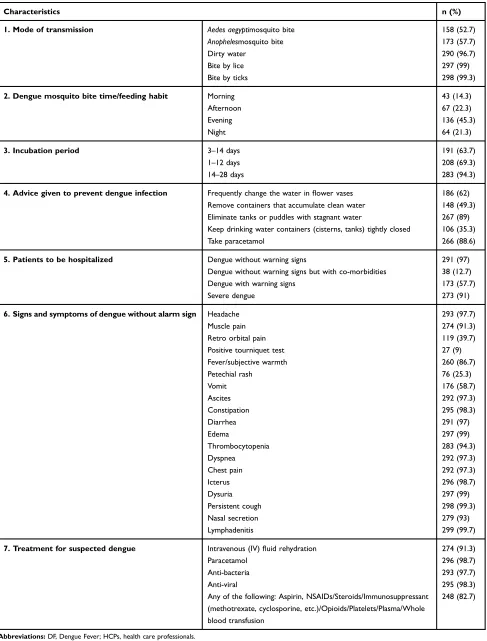
Knowledge is categorized into high, moderate and low based on Bloom’s cut off. Nearly half of the HCPs 148 (49.3%) demonstrated a moderate level of knowledge and only 31 (10.3%) demonstrated a high level of knowledge while the rest 121 (40.3%) demonstrated a low level of knowledge towards DF prevention. Overall, 270 (90%) HCPs correctly identified treatments that could be used in a patient suspected to have dengue (Table 2).
Attitude of HCPs towards DF prevention
Less than a quarter 68 (22.7%) of HCPs showed a favor-able attitude towards DF prevention but the remaining 140 (46.7%) and 92 (31%) participants showed a neutral and unfavorable attitude towards dengue prevention, respec-tively. More than half 168 (56%) were not trained to manage patients with an infection of dengue without alarming signs and 133 (44.3%) were agreed that dengueTable 1Socio-demographics of HCPs working in public health
facilities (N=300) in Dire Dawa, eastern Ethiopia, 2017
Variables n (%)
Gender Male 135 (45)
Female 165 (55)
Age (years) 21–40 279 (93)
40–60 21 (7)
Profession Doctor (GP) 22 (7.3)
Public health officer 31 (10.3)
Nurse 247 (82.3)
Education level MSc degree 3 (1)
MD 22 (7.3)
BSc degree 195 (65)
Diploma 80 (26.7)
Experience <1 year 24 (8)
1–4 years 99 (33)
5–9 years 113 (37.7)
10–14 years 40 (13.3) 15–19 years 10 (3.3) >19 years 14 (4.7)
Health facility type Referral hospital 155 (51.7) Primary hospital 38 (12.7) Health center 107 (35.7)
DF training Yes 10 (3.3)
No 290 (96.7)
Abbreviation:HCPs, health care professionals.
Risk Management and Healthcare Policy downloaded from https://www.dovepress.com/ by 118.70.13.36 on 27-Aug-2020
Table 2 Knowledge assessment of DF prevention among HCPs (N=300) working in public health facilities in Dire Dawa, eastern Ethiopia, 2017
Characteristics n (%)
1. Mode of transmission Aedes aegyptimosquito bite 158 (52.7)
Anophelesmosquito bite 173 (57.7)
Dirty water 290 (96.7)
Bite by lice 297 (99)
Bite by ticks 298 (99.3)
2. Dengue mosquito bite time/feeding habit Morning 43 (14.3)
Afternoon 67 (22.3)
Evening 136 (45.3)
Night 64 (21.3)
3. Incubation period 3–14 days 191 (63.7)
1–12 days 208 (69.3)
14–28 days 283 (94.3)
4. Advice given to prevent dengue infection Frequently change the water inflower vases 186 (62) Remove containers that accumulate clean water 148 (49.3) Eliminate tanks or puddles with stagnant water 267 (89) Keep drinking water containers (cisterns, tanks) tightly closed 106 (35.3)
Take paracetamol 266 (88.6)
5. Patients to be hospitalized Dengue without warning signs 291 (97)
Dengue without warning signs but with co-morbidities 38 (12.7)
Dengue with warning signs 173 (57.7)
Severe dengue 273 (91)
6. Signs and symptoms of dengue without alarm sign Headache 293 (97.7)
Muscle pain 274 (91.3)
Retro orbital pain 119 (39.7)
Positive tourniquet test 27 (9)
Fever/subjective warmth 260 (86.7)
Petechial rash 76 (25.3)
Vomit 176 (58.7)
Ascites 292 (97.3)
Constipation 295 (98.3)
Diarrhea 291 (97)
Edema 297 (99)
Thrombocytopenia 283 (94.3)
Dyspnea 292 (97.3)
Chest pain 292 (97.3)
Icterus 296 (98.7)
Dysuria 297 (99)
Persistent cough 298 (99.3)
Nasal secretion 279 (93)
Lymphadenitis 299 (99.7)
7. Treatment for suspected dengue Intravenous (IV)fluid rehydration 274 (91.3)
Paracetamol 296 (98.7)
Anti-bacteria 293 (97.7)
Anti-viral 295 (98.3)
Any of the following: Aspirin, NSAIDs/Steroids/Immunosuppressant (methotrexate, cyclosporine, etc.)/Opioids/Platelets/Plasma/Whole blood transfusion
248 (82.7)
Abbreviations:DF, Dengue Fever; HCPs, health care professionals.
Risk Management and Healthcare Policy downloaded from https://www.dovepress.com/ by 118.70.13.36 on 27-Aug-2020
has high morbidity, of which 41 (31%) of them agreed dengue decreases economic productivity (Table 3).
Practice of HCPs towards DF prevention
Only 71 (23.7%) HCPs demonstrated a high level of practice and the remaining 78 (24.3%) and 156 (52%) had moderate and low levels of practice towards DF pre-vention respectively. The majority (197/66%) of HCPs saw DF cases in the health facility and 255 (85%) of participants reported they were not familiar with the WHO’s 2010 dengue clinical management guideline and 201 (67%) reported that they did not have adequate resources to treat patients with dengue. From the study subjects, 191 63.7%) were lacking training, 12 (4%) were lacking medication needed to treat dengue, 9 (3%) were lacking instruments needed to treat DF. The rest, 74 (24.7%) were lacking access to laboratory tools (Table 4).Factors associated with knowledge level
of HCPs towards DF prevention
All predictor variables (sex, age, type of profession, experience, practice setting and dengue training status) were checked individually for the presence of association in bivariate analysis and those variables withP-value less than 0.25 were sex, age, type of profession and practice setting were associated with the knowledge level of HCPs in bivariate analysis. However, in thefinal model only type of profession and type of health facility (practice setting) were significantly associated (P<0.05) with the knowledge level (High) of HCPs towards DF prevention. So, the odds of HCPs who were physicians and public health officers having a high rather than a low knowledge level were 38.793 times (AOR[95% CI] =38.793 [7.279, 206.734]) and 6.15 times (AOR[95% CI] =6.15 [1.643, 23.026]) higher than the odds for nurses respectively. HCPs who worked in health centers having a high rather than a low knowledge of DF prevention were 74.8% lower than the odds for HCPs who worked at a referral hospital (AOR [95% CI] =0.252 [0.086, 0.737]) (Table 5).
Factors associated with attitude of HCPs
towards DF prevention
In the bivariate analysis, sex, type of profession and prac-tice setting were associated (P<0.25) with the attitude of HCPs towards DF. However, in the multinomial logistic regression only type of profession and type of health
facility (practice setting) were significantly associated Table
3 Opinion about DF pr e vention among HCPs w orking in public health facilities (N=300), Dir e Da wa, eastern Ethiopia, 2017 Categorical responses n (%) Characteristics Str ongly ag ree Agree Neutral Disa gre e Str ongly disa gr ee Do you belie ve that dengue fev er could be pr ev ented and contr olled 148 (49.3%) 133 (44.3%) 8 (2.7%) 6 (2%) 5 (1.7%) Do you think you ar e fully trained to manage a patient with an infection of dengue without warning signs? 12 (4%) 33 (11%) 14 (4.7%) 168 (56%) 73 (24.3%) D o yo u th in k th at el im in at in g th e b re e d in g si te o ft h e d en gu e -c au si n g m o sq u it o is co m p lic at e d an d ti m e co n su m in g? 52 (17.3%) 146 (48.7%) 11 (3.7%) 71 (23.7%) 20 (6.7%) Do you think that you ha ve an importan t role in dengue fev er pr e vention? 67 (22.3%) 142 (47.3%) 64 (21.3%) 23 (7.7%) 4 (1.3%) Do you think that dengue is a major pr oblem for your population? 38 (12.7%) 170 (56.7%) 7 (2.3%) 77 (25.7%) 8 (2.7%) Do you think that dengue is dif fi cult to detect? 11 (3.7%) 93 (31%) 13 (4.3%) 170 (56.7%) 13 (4.3%) Do you think that the en vir onment is conduciv e to disease transmission? 67 (22.3%) 210 (70%) 6 (2%) 12 (4%) 5 (1.7%) Do you think that dengue has a high morbidity? 44 (14.7%) 133 (44.3%) 17 (5.7%) 99 (33%) 7 (2.3%) Do you think dengue is considere d an alarming diagnosis? 37 (12.3%) 141 (47%) 28 (9.3%) 89 (29.7%) 5 (1.7%) Do you feel lik e dengue decr eases economic pr oductivity? 107 (35.7%) 171 (57%) 6 (2%) 15 (5%) 1 (0.3%) Abbre viations: DF ,Dengue Fe ver ; HCPs, health car e pr ofessionals.
Risk Management and Healthcare Policy downloaded from https://www.dovepress.com/ by 118.70.13.36 on 27-Aug-2020
T able 4 Practice towar ds DF pr e vention among HCPs (N=300) w orking in public health facilities in Dire Da wa, eastern Ethiopia, 2017 Practice related variables n (%) Ha ve you e ve r seen dengue fev er case? Y es 197 (65.7) No 103 (34.3) Are you familiar with the WHO ’ s 2010 clinical management of dengue guidelines? Y es 45 (15) No 255 (85) WHO ’ s dengue guidelines help in managing dengue fev er Y es 277 (93.3) No 23 (7.7) Are ther e adequate resour ces available to tr eat dengue? Y es 97 (32.3) No 201(67) What resour ce lacking to tre at patients with dengue? Suf fi cient training Y es 191 (63.7) No 14 (4.7) Medication needed to tr eat Y es 12 (4) No 193 (64.3) Instruments needed to tr eat Y es 9 (3) No 196 (65.3) Access to laborator y tools Y es 74 (24.7) No 131(43.7) Do you perform a dengue test if you suspected dengue? Alwa ys 33(11) Most of the time 46 (15.3) Sometimes 118 (39.3) Nev er 103 (34.3) Which dengue diagnostic test do you utilize most fr equently? Leuk ocyte, platelet and hematocrit Y es 77 (25.7) No 2 (0.7) Dengue ser ology (IgM/IgG) Y es 3 (1) No 76 (25.3) Dengue R T-PCR Y es 0 (0) No 79 (26.3) Do not apply 221 (73.7) Viral cultur e Y es 0 (0) No 79 (26.3) Do not apply 221 (73.7) How fr equently do you pr escribed paracetamol to dengue patients? Alwa ys 86 (28.7) Most of the time 102 (34) Sometimes 85 (28.3) Nev er 27 (9) ( Continued )
Risk Management and Healthcare Policy downloaded from https://www.dovepress.com/ by 118.70.13.36 on 27-Aug-2020
T
able
4
(Continued).
Practice
related
variables
n
(%)
How
fr
equently
do
you
advise
dengue
patient
to
av
oid
mosquito
bite?
Alwa
ys
78
(26)
Most
of
the
time
45
(15)
Sometimes
142
(47.3)
Nev
er
35
(11.7)
How
fr
equently
do
you
pr
efer
CBC
lab
in
vestigation
to
monitor
patients
with
suspected
or
con
fi
rmed
dengue?
Alwa
ys
59
(19.7)
Most
of
the
time
57
(19)
Sometimes
82
(27.3)
Nev
er
102
(34)
Abbre
viations:
DF
,Dengue
Fe
ver
;
HCPs,
health
car
e
pr
ofessionals.
T
able
5
Bivariate
and
multinomial
logistic
regr
ession
model
showing
factors
associated
with
a
high
le
vel
of
knowledge
of
HCPs
towar
ds
DF
pr
e
vention
in
Dir
e
Da
wa
public
health
facilities,
eastern
Ethiopia,
2017
(N=300)
V
ariables
Kno
wledg
e
le
v
el
COR
at
95%
CI
A
OR
at
95%
CI
High
Moderate
Lo
w
(Refer
ence
categor
y)
Pr
ofession
Ph
ysician
(n=22)
13
7
2
55.500
11.253,
273.720)
38.793
(7.279,
206.734)
Public
health
of
fi
cer
(n=31)
5
18
8
5.340
(1.519,
18.746)
6.151
(1.643,
23.026)
Nurse
(n=247)
13
123
111
1
1
Practice
settings
Health
center
(n=107)
5
51
51
0.284
(0.099,
0.816)
0.252
(0.086,
0.737)
Referral
hospital
(n=155)
19
81
55
1
1
Abbre
viations:
DF
,Dengue
Fe
ver
;
HCPs,
health
car
e
pr
ofessionals.
Risk Management and Healthcare Policy downloaded from https://www.dovepress.com/ by 118.70.13.36 on 27-Aug-2020
with the attitude level (favorable and neutral) of HCPs towards DF prevention.
The odds of HCPs who were public health officers and who worked in primary hospitals and had a positive rather than negative attitude were 7.011 times (AOR [95% CI] =7.011 [1.867, 26.321]) and 3.683 times (AOR [95% CI] =3.683 [1.284, 10.563]) higher than the odds for nurses and referral hospital workers towards DF prevention respectively. The odds of HCPs who were public health officers having a neutral rather than negative attitude were 3.452 times (AOR [95% CI] =3.452 [1.126, 15.027]) higher than the odds for nurse profes-sionals towards dengue fever prevention (Tables 6and7).
Factors associated with practice level of
HCPs towards DF prevention
All variables like sex, age, type of profession, practice setting and dengue training status were checked for the presence of association in the bivariate analysis. Hence, age, sex, type of profession, practice setting and DF training status were significantly associated with the practice level of HCPs towards DF prevention. However, in the multi-nomial logistic regression analysis, type of profession, type of health facility and DF training status were significantly associated with the practice level of HCPs towards DF prevention. The odds of physicians and public health offi -cers having a high rather than a low practice level were 17.618 times (AOR [95% CI] =17.618 ([.072, 149.787]) and 7.65 times (AOR [95%CI] =7.65 [2.523, 23.194]) higher than the odds for nurses towards dengue fever pre-vention. The odds of HCPs who took DF training were 10.23 times (AOR [95% CI] =10.23 [1.052, 99.478]) higher than the odds for HCPs who had not received DF preven-tion training. The odds of male HCPs having a moderate rather than a low level of practice was 2.211 times (AOR [95% CI] =2.211 [1.179, 4.146]) higher than the odds for female HCPs. The odds of having a moderate rather than a low level of practice among physicians and public health officers were 28.524 times (AOR [95% C.] =28.524 [3.500, 232.436]) and 4.706 times (AOR [95% CI] =4.706 [1.466, 15.108]) higher than the odds for nurses towards DF pre-vention respectively (Tables 8and9).
Discussion
Primary physicians and nurses serve as thefirst-line health care providers to diagnose, notify and treat dengue cases. The KAP of HCPs regarding dengue diseases also provide early recognition and improve the outcome of dengue.21,37
According to this study, the larger proportion of HCPs 148 (49.3%) demonstrated a moderate level of knowledge towards dengue fever prevention. One of the possible reasons attributed to this might be the lack of training of thefirst line HCPs towards the subject matter. It has also identified specific gaps in knowledge of dengue infection, prevention and management. A total of 63 (21%) HCPs did not correctly identify the correct time of feeding habit of the Aedes mosquito. Thisfinding is higher than a study conducted in Taiwan 14.4%.22However, in both cases the result was low and may reflect a significant knowledge gap of health care providers towards the Aedes mosquito.
The attitude of HCPs towards DF prevention was lar-gely neutral 138 (46%). This is because the study was conducted among different HCPs who provided health services at different health facility sites (urban versus rural), different health service departments, responsibilities and some of the HCPs might not have even seen a dengue case. Of the total, 168 (56%) HCPs reported that they were not fully trained to manage a patient with an infection of dengue without alarming signs. This simply indicates the majority of HCPs general lack of training about DF pre-vention and hence this shows the need for an avenue to be created to plug this gap in knowledge.
In this study, more than half, 156 (52%) HCPs demon-strated a low level of practice towards DF prevention. This might be due to one-third of our study areas being rural health centers where cases of DF were unusual. Another possible reason could be the lack of diagnostic testing.30 No published study has evaluated specifically the practice level of HCPs towards DF prevention and hence limited our comparison. Only 45 (15%) of the HCPs reported they were familiar with the WHO’s 2010 dengue clinical man-agement guideline. This finding was inconsistent and much lower than a study done on Sri Lankan practitioners 45%.18 The possible explanation could be Kularatne’s study was conducted prior to the current version of the WHO dengue guidelines and might be more cognate to local context. And it was also noted that there was an absence of WHO dengue standard guidelines across most of the study sites.
In our study, 201 (67%) of the HCPs reported the presence of inadequate resources to treat dengue patients. This result is much higher than a study conducted in Machala, Ecuador (31%).17 This difference might be due to differences in the health settings, health system manage-ment and economic set up of Ecuador. Overall, only 45 (15%) of our HCPs“most of the time”perform a dengue
Risk Management and Healthcare Policy downloaded from https://www.dovepress.com/ by 118.70.13.36 on 27-Aug-2020
T able 7 Bivariate and multinomial logistic reg ression model showing factors associated with a neutral attitude le vel of HCPs towar ds DF pr e vention in Dir e D awa public health facilities, eastern Ethiopia, 2017 (N=300) V ariables Attitude le v el COR at 95% CI A OR at 95% CI F a v orable Neutral Unfa vor able (Refer ence categor y) Pr ofession Ph ysician (n=22) 6 13 3 3.298 (0.911, 11.937) 2.811 0.752, 10.506) Public health of fi cer (n=31) 14 14 3 3.552 (0.989, 12.750) 3.452 (1.126, 15.027) Nurse (n=247) 48 113 86 1 1 Abbre viations: DF ,Dengue Fe ver ; HCPs, health car e pr ofessionals. T able 6 Bivariate and multinomial logistic regr ession model showing factors associated with a fa vorable attitude le vel of HCPs (N=300) towar ds DF pr e venti on in Dir e Da wa public health facilities, eastern Ethiopia, 2017 V ariables Attitude le v el COR at 95% CI A OR at 95% CI F a v orable Neutral Unfa vor able (Refer ence categor y) Pr ofession Ph ysician (n=22) 6 13 3 3.583 0.857, 14.976) 2.6 (0.586, 11.543) Public health of fi cer (n=31) 14 14 3 8.361 (2.288, 30.556) 7.011 (1.867, 26.321) Nurse (n=247) 48 113 86 1 1 Practice setting Health center (n=107) 27 41 39 1.274 (0.638, 2.543) 1.84 (0.588, 2.384) Primar y hospital (n=38) 16 15 7 4.206 (1.527, 11.581) 3.683 (1.284, 10.563) Referral hospital (n=155) 25 84 46 1 1
Risk Management and Healthcare Policy downloaded from https://www.dovepress.com/ by 118.70.13.36 on 27-Aug-2020
T able 8 Bivariate and multinomial logistic reg ression model showing factors associated with a high practice lev el of HCPs (N=300) towar ds DF pr e vention in D ir e Da wa public health facilities, eastern Ethiopia, 2017 V ariables Practice le vel COR at 95% CI A OR at 95% CI High Moderate Lo w (Refer ence) Pr ofession Ph ysician (n=22) 8 13 1 25.532 (3.112, 209.441) 17.618 (2.072, 149.787) Public health of fi cer (n=31) 16 10 5 10.213 (3.551, 29.368) 7.650 (2.523, 23.194) Nurse (n=247) 47 50 150 1 1 Practice setting Health center (n=107) 22 27 58 4.231 (0.643, 6.364) 3.582 (0.521, 5.132) Primar y hospital (n=38) 17 8 13 3.474 (1.517, 7.955) 2.648 (1.076, 6.515) Referral hospital (n=155) 32 38 85 1 1 DF training Receive d (n=10) 6 3 1 14.308 (1.689, 121.209) 10.231 (1.052, 99.478) Not receiv ed (n=290) 65 70 155 1 1 Abbre viations: DF ,Dengue Fe ver ; HCPs, health car e pr ofessionals. T able 9 Bivariate and multinomial logistic regr ession model showing factors associated with a moderate practice lev el of HCPs (N=300) towar ds DF pr e vention in Dir e Da wa public health facilities, eastern Ethiopia, 2017 V ariables Practice le v el COR at 95% CI A OR at 95% CI High Moderate Lo w Pr ofession Ph ysician (n=22) 8 13 1 39.000 (4.976, 305.681) 28.524 (3.500, 232.436) Public health of fi cer (n=31) 16 10 5 6.000 (1.957, 18.393) 4.706 (1.466, 15.108) Nurse (n=247) 47 50 150 1 1 Sex Male (n=135) 30 46 59 2.801 (1.576, 4.977) 2.211 (1.179, 4.146) Female (n=165) 41 27 97 1 1 DF training Receiv ed (n=10) 6 3 1 6.643 (0.679, 64.991) 4.741 (0.431, 52.158) Not re ceiv ed (n=290) 65 70 155 1 1
Risk Management and Healthcare Policy downloaded from https://www.dovepress.com/ by 118.70.13.36 on 27-Aug-2020
test when they suspect dengue. This is lower than a study done in Makkah, Saudi Arabia (75%).38 This difference might be due to the fact that the incidence of dengue fever and dengue hemorrhagic fever has increased significantly in Makkah over the last few years38 and endemic occur-rence of the disease in the city was recently confirmed which increased the physicians’suspicion of the diseases. Based on multinomial logistic regression, type of health profession and type of health facility were signifi -cantly associated with a high level of knowledge of HCPs towards DF prevention. The physicians and public health officers were 38.793 and 6.15 times more likely to have a highrather than a low level of knowledge towards DF prevention when compared with nurse professionals’ respectively. The possible explanation for this difference might be differences in educational qualifications and responsibilities. No published studies are in line with our current study and hence limited the comparison. HCPs who worked in health centers were 74.8% times less likely to have a high rather than a low level of knowledge towards DF prevention when compared with HCPs who worked in referral hospital settings. Similarly, type of profession and type of health facility were significantly associated with a positive attitude level of HCPs towards DF prevention. Public health officers were 7.011 times more likely to have a positive rather than a negative attitude towards DF prevention when compared to nurse professionals. This is because public health officers are usually involved in patient diagnosis and management in the outpatient department and might have frequent expo-sure to DF cases.
Similarly, type of profession and DF training status were significantly associated with the high level of practice of HCPs towards DF prevention. Physicians were 17.618 times and public health officers were 7.65 times more likely to have a high rather than a low practice level towards DF prevention when compared with nurse professionals. One of the possible reasons might be the differences in professional education qualifications and responsibilities. The odds of having a moderate rather than a low level of practice towards DF prevention among public health officers were 4.706 times higher than the odds for nurse HCPs. The difference is because physicians and public health officers are usually involved in patient diagnosis and management. The odds of HCPs who took DF prevention training and had a high rather than a low practice level towards DF prevention were 10.23 times higher than the odds for HCPs who did not take the training. The main reason for this difference was the lack of
training. So providing effective training tailored to allfirst line HCPs towards DF prevention could be advantageous and a step forward for updating the knowledge of HCPs towards DF prevention. But good knowledge does not necessarily lead to good practice.39
Overall in our study, there existed inadequacy in the sample especially from physicians and public health officers which were not proportional and the small sample size may limit the precision of certain bivariate relationships between variables. Therefore, comparison across certain factors might not have enough sample or power. However, most low-income courtries suffer from a severe shortage of health professionals and Ethiopia is no exception. Ethiopia has a health workforce of 0.7 per 1,000 population, which is low compared with the WHO recommendation of 2.3 health workers per 1,000 population. Health extension workers and general nurses dominate the available supply of health workers and there are critical shortages of physicians, den-tists, midwifes, and anesthesia professionals. The greatest inadequacy is for physicians with a decreasing trend in the past and now only 1:42,706 population which is among the lowest ratio in sub-Saharan Africa. However, the country has achieved the minimum WHO recommendation of 1 nurse per 5,000 population.35
Generally, there is a deficit in published studies evalu-ating the KAP of primary HCPs and associated factors towards DF prevention. Hence, limiting the comparison of ourfindings. KAP surveys are of the utmost important in determining effective evidence-based prevention and control strategies through changing poor KAPs. To the best of our knowledge, this is the first study on the KAPs of Ethiopian HCPs in Dire Dawa administrative district towards dengue. It is noteworthy that in spite of such limitations, the present findings unveil the existing gaps in the KAPs of Dire Dawa administrative city HCPs and highlights the need for further large-scale studies that consider the possible limitations for the sake of a better generalization of results.
Limitations
Since the study is a public health facility-based (not including private health facilities), it might not indicate the overall KAP of HCPs towards DF prevention. It is also difficult to establish a temporal relationship as the study design was cross-sectional and the wider confidence interval observed with some variables may also indicate inadequate sample size. The study is also limited by the survey method in collecting data only using the quantitative method. Despite
Risk Management and Healthcare Policy downloaded from https://www.dovepress.com/ by 118.70.13.36 on 27-Aug-2020
these limitations, thefindings of this study are expected to contribute a lot to the understanding of the existing problems associated with DF prevention in the study area.
Conclusion and future
recommendations
The results of this study showed that the larger proportion of HCPs demonstrated a moderate level of knowledge, neutral level of attitude and low level of practice towards DF prevention. However, there is a lack of knowledge about dengue infection, diagnosis and management. Further, HCPs showed a lack of knowledge about the Aedes mosquito, important clinical features, management of co-morbid cases and prevention methods of dengue disease. Finally, there is a need for similar studies to be done in Ethiopia and elsewhere in the world to better understand the gaps.
Based on thefinding of this study, we recommended that: The regional health bureau should provide training about dengue fever prevention, transmission, and high-risk patient populations. It is also recommended that work-shops regarding dengue fever prevention be prepared for the first line health care providers including guidelines preparation. And should continue to strengthenthe surveil-lance system including assessment of the need of health facilities with provision of the necessary resources to manage dengue patients.
Abbreviations
DF, dengue fever; DENV, dengue virus; DHF, dengue
hemorrhagic fever; DSS, dengue shock syndrome;
DRHB, Dire Dawa regional health bureau, HCP, health care professionals; HDP; health development program; KAP, knowledge, attitude and practice; WHO, world health organization.
Data sharing statement
Data will not be shared in order to protect the participants‘ anonymity.
Acknowledgments
We are very grateful to Jimma University, College of Public Health and Medical Sciences, for their technical support and giving clearance to conduct this study. We would like to express our gratitude to Mr Desta and Mr Mamo for their guidance from the beginning to the end of this study.
Author contributions
Both authors contributed toward data analysis, drafting and revising the paper, gavefinal approval of the version to be published and agree to be accountable for all aspects of the work.
Disclosure
The authors report no conflicts of interest in this work.
References
1. Halstead S. Dengue.Lancet.2007;370(9599):1644–1652. doi:10.1016/ S0140-6736(07)61687-0
2. Heinz FX, Collett MS, Purcell RH, et al., editors.Virus Taxonomy: Seventh Report of the International Committee on Taxonomy of Viruses, Part Three Ed. San Diego: Academic Press;2000:859–878. 3. WHO. Dengue Haemorrhagic Fever: Diagnosis, Treatment,
Prevention and Control. 2nd ed. Geneva: WHO;1997:48–59. 4. Awoke A, Kassa L.Vector and Rodent Control. Ethiopia Public Health
Training Initiative, The Carter Center, the Ethiopia Ministry of Health, and the Ethiopia Ministry of Education;2006. Available from: https://www. cartercenter.org/resources/pdfs/health/ephti/library/lecture_notes/env_ health_science_students/VectorRodent.pdf. Accessed April 30, 2019. 5. Qadir MI, Abbas K, Tahir M, et al. Dengue fever: natural
manage-ment.Pak J Pharm Sci.2015;28(2):647–655.
6. Jamaiah I, Rohela M, Nissapatorn V, et al. Retrospective study of dengue fever (DF) and dengue hemorrhagic fever (DHF) patients at university Malaya Medical Center, Kualalumpur, Malaysia.Southeast Asian J Trop Med Public Health.2005;38(1):224–230.
7. Gubler DJ. The changing epidemiology of yellow fever and dengue, 1900 to 2003: full circle? Comp Immunol Microbiol Infect Dis. 2004;27(5):319–330.
8. Gubler DJ. Dengue and dengue hemorrhagic fever.Clin Microbiol Rev.1998;11(3):480–496.
9. Malhotra G, Yadav A, Dudeja P. Knowledge, awareness and practices regarding dengue among rural and slum communities in north Indian city, India. Int J Med Sci Public Health. 2014;3(3):295–299. doi:10.5455/ijmsph.2013.181220132
10. Mairuhu AT, Wagenaar J, Brandjes DP, van Gorp ECM. Dengue: an arthropod-borne disease of global importance.Eur J Clin Microbiol Infect Dis.2004;23:425–433. doi:10.1007/s10096-004-1145-1 11. Gibbons RV, Vaughn DW. Dengue: an escalating problem.Br Med J.
2002;324(7353):1563–1566.
12. World Health Organization. Dengue: Guidelines for Diagnosis, Treatment, Prevention and Control. 3rd ed. Geneva: WHO;2009. 13. Bhatt S, Gething PW, Brady OJ, et al. The global distribution and burden
of dengue.Nature.2013;496:504–507. Federal Ministry of Health of Ethiopia National Framework of Climate Resilient Health Sector. December 2014. Addis Ababa, Ethiopia. doi:10.1038/nature12060 14. Protecting health from climate change, WHO.2008. Available from:
http://www.who.int/world-healthday/toolkit/report_web.pdf. Accessed February 7, 2019
15. World Health Organization. Dengue and Severe Dengue. 2017. Available from: https://www.who.int/news-room/fact-sheets/detail/ dengue-and-severe-dengue. Accessed April 30, 2019.
16. WHO. TDR dengue. 2017. Available from: http://apps.who.int/tdr/ svc/diseases/dengue. Accessed May 9, 2015.
17. Franco L, di Caro A, Carletti F, et al. Recent expansion of dengue virus serotype 3 in West Africa.Euro Surveill.2010;15(7):2. 18. Thaver AM, Sobani ZA, Qazi F, Khan M, Zafar A, Beg MA. Assessing
the need for training: general practitioners’knowledge, attitude and practice concerning dengue and malaria in Karachi, Pakistan. Int Health.2011;3:126–130. doi:10.1016/j.inhe.2011.03.001
Risk Management and Healthcare Policy downloaded from https://www.dovepress.com/ by 118.70.13.36 on 27-Aug-2020
19. Prasad D, Kumar C, Jain A, Kumar R. Accuracy and applicability of the revised WHO classification (2009) of dengue in children seen at a tertiary healthcare facility in Northern India. Infection. 2013;41 (4):775–782. doi:10.1007/s15010-013-0405-3
20. Kularatne SA. Survey on the management of dengue infection in Sri Lanka: opinions of physicians and pediatricians.Southeast Asian J Trop Med Public Health.2005;36(5):1198–1200.
21. Lee LK, Thein TL, Kurukularatne C, Gan VC, Lye DC, Leo YS. Dengue knowledge, attitudes, and practices among primary care physicians in Singapore.Ann Acad Med Singapore.2011;40(12):533–538. 22. Huang H-L, Chiu T-Y, Huang K-C, Cheng S-Y, Yao C-A, Lee L-T.
Travel-related mosquito-transmitted disease questionnaire survey among health professionals in Taiwan. J Travel Med. 2011;18 (1):34–38. doi:10.1111/j.1708-8305.2010.00483.x
23. Ho T-S, Huang M-C, Wang S-M, Hsu H-C, Liu C-C. Knowledge, attitude, and practice of dengue disease among healthcare profes-sionals in southern Taiwan.J Formos Med Assoc.2013;112(1):18– 23. doi:10.1016/j.jfma.2012.11.004
24. Handel S, Ayala B, Borbor-Cordova J, et al. Knowledge, attitude and practice regarding dengue infection among public sector healthcare providers in Machala, Ecuador. Trop Dis Travel Med Vaccines. 2016;2(8):2–8. doi:10.1186/s40794-016-0024-y
25. Alzahrani A. Knowledge and practice of primary health-care physicians regarding the dengue fever in Makkah Al-Mokarramah city, 2013.Int J Med Sci Public Health.2015;4:266–274. doi:10.5455/ijmsph. 26. Ekra KD, Cherif D, Kouassi DP, et al. Determinants of practices for
dengue diagnosis among healthcare professionals working in public hospitals of Abidjan, Cote d'Ivoire. J Public Health Epidemiol. 2017;9(8):212–218. doi:10.5897/JPHE2017.0933
27. Leo YS, Thein TL, Fisher DA, et al. Confirmed adult dengue deaths in Singapore: 5-year multi-center retrospective study. BMC Infect Dis.2011;11:123. doi:10.1186/1471-2334-11-208
28. Trung DT, le Thao TT, Hien TT, et al. Liver involvement associated with dengue infection in adults in Vietnam. Am J Trop Med Hyg. 2010;83:774–780. doi:10.4269/ajtmh.2010.10-0090
29. Rafique I, Saqib ANF, Munir MA, et al. Dengue knowledge and its management practices among physicians of major cities of Pakistan.
JPMA.2015;65:392.
30. Saqib MA, Rafique I, Bashir S, Salam AA. A retrospective analysis of dengue fever case management and frequency of co-morbidities asso-ciated with deaths. BMC Res Notes. 2014;7:205. doi:10.1186/1756-0500-7-205
31. Federal Democratic Republic of Ethiopia Ministry of Health Health Sector Development Programme IV2010/11–2014/15. Draft Version. January 16,2011.
32. Amarasinghe A, Kuritsky JN, Letson GW, Margolis HS. Dengue virus infection in Africa.Emerg Infect Dis.2011;17(8):1349–1354. doi:10.3201/eid1701.100876
33. Chow VTK, Chan YC, Yong R, et al. Monitoring of dengue viruses in field-caught Aedes aegypti and Aedesalbopictus mos-quitoes by a type-specific polymerase chain reaction and cycle sequencing. Am J Trop Med Hyg. 1998;58(5):578–586. doi:10.4269/ajtmh.1998.58.578
34. Shuaib F, Todd D, Campbell-Stennett D, Ehiri J, Jolly PE. Knowledge, attitudes and practices regarding dengue infection in Westmoreland, Jamaica.West Indian Med J.2010;59:139–146. 35. Health Sector Development Programme IV, 2010/11–2014/15. Addis
Ababa: Government of Ethiopia, Ministry of Health;2010. Available from: http://www.aho.afro.who.int/profiles_information/index.php/ Ethiopia:Health_workforce_-_The_Health_System. Accessed February 7, 2019.
36. Ethiopian Public Health Institute Center for Public Health Emergency Management.Ethiopia Wkly Epi Bulletin.2017;3(31):1–19. 37. Nguyen NM, Whitehorn JS, Luong Thi Hue T, et al. Physicians,
primary caregivers and topical repellent: all under-utilised resources in stopping dengue virus transmission in affected households. PLoS Negl Trop Dis. 2016;10(5):e0004667. doi:10.1371/journal.pntd.0004667
38. Shahina W, Nassara A, Kalkattawia M, Bokharia H. Dengue fever in a tertiary hospital in Makkah, Saudi Arabia. Dengue Bull. 2009;33:34–44.
39. Hairi F, Ong CH, Suhaimi A, et al. Knowledge, attitude and practices (KAP) study on dengue among selected rural communities in the Kuala Kangsar district.Asia Pac J Public Health.2003;15:37–43. doi:10.1177/101053950301500107
Risk Management and Healthcare Policy
Dove
press
Publish your work in this journal
Risk Management and Healthcare Policy is an international, peer-reviewed, open access journal focusing on all aspects of public health, policy, and preventative measures to promote good health and improve morbidity and mortality in the population. The journal welcomes submitted papers covering original research, basic science, clinical & epidemiological studies, reviews and evaluations,
guidelines, expert opinion and commentary, case reports and extended reports. The manuscript management system is completely online and includes a very quick and fair peer-review system, which is all easy to use. Visit http://www.dovepress.com/testimonials.php to read real quotes from published authors.
Submit your manuscript here:https://www.dovepress.com/risk-management-and-healthcare-policy-journal
Risk Management and Healthcare Policy downloaded from https://www.dovepress.com/ by 118.70.13.36 on 27-Aug-2020