Training Package for Fostering Stable Self-Esteem and Reducing
Fear of Negative Evaluation and Testing its Effectiveness on Self –
Handicapping
Atie Arab-Mohebi-Shahrabi
1, Shahla Pakdaman
2, Mahmood Heidari
21Department of Psychology, School of Education and Psychology, Shahid Beheshti University,
Tehran, Iran
2Associate Professor, Department of Psychology, School of Education and Psychology, Shahid
Beheshti University, Tehran, Iran
Submitted: 26 December 2017
Accepted: 19 February 2018
Int J Behav Sci. 2018; 11(4): 128-134
Corresponding Author: Atie Arab-Mohebi-Shahrabi Department of Psychology, School of Education and Psychology, Shahid Beheshti University, Tehran,
Iran
E-mail: atie . m o h e b i@ g m ai l. c o m
Abstract
Introduction: Self-handicapping is a defense strategy in which a person, prior to any performance, creates some obstacles by which they manipulate their attributions after the performance. This variable is regarded as one impediment to educational efficiency. This study aims to design a training package to foster stable esteem and reduce the fear of negative evaluation to influence teenagers’ self-handicapping.
Method: Based on an empirical research study and after the confirmation of the validity of the designed training package by experts (p<0.001), one high school was selected through convenience sampling method from among Junior high schools. The population of eighth grade high schoolers (150) answered to Jones Self-Handicapping Scale (1982), Brief Form of the Fear of Negative Evaluation Scale (FNES-B) and Instability of Self-Esteem Scale (ISES). From among the foregoing population, a group of 60 high school students with an average age of 14 years old who had obtained the highest self-handicapping scores were randomly assigned to two experimental and control groups and received the training package for 8 one-hour sessions. Then, a post-test and a follow-up test were administered after one subsequent month. Data was analyzed using the regression analyze, independent-t method and mixed analysis of variance.
Result: The study results suggested the effectiveness of the training package in promoting the stable self-esteem and reducing the fear of negative evaluation and consequently reducing self-handicapping scores of the subjects (p<0.001,partial η²= 0/315).
Conclusion: This study proposes that, owing to the criticality of adolescence, training packages focusing on fostering stable self-esteem and decreasing fear of negative evaluation may be highly effectual in alleviating adolescents’ self-handicapping and operate as a factor leading to more development and growth for them.
Keywords: Education, Fear, Evaluation, Self-esteem, Adolescents
Introduction
According to Harter, from a teenager’s perspective, perceptions of others’ evaluation of them are derived primarily from the acceptance of the community where their performance ability is evaluated. When teenagers encounter a situation in which there is a possibility of mistake or failure, they begin to experience their own negative evaluation of themselves and subsequently exhibit a poor performance [4]. Researchers have pointed out in their studies that an individual who is afraid of negative evaluation by others, experiences anxiety in inappropriate forms as they are placed in situations where they are in sight of others and likely to be evaluated or criticized by them. As a result of this fear, they worry that others’ judgments of them be negative so they try to avoid such situations since they feel that others may find them worthless or foolish [5-7]. Individual’s increased fear of negative evaluation by others and then their avoidance of such situations help augment their anxiety [8].
When teenagers feel all eyes on themselves, it is this real or imaginary presence of others that augments the occurrence of self-handicapping [9].Self-handicapping can be seen as a strategy a teenager employs to draw their attention away from their weak performance to protect their own self-esteem from being hurt. This strategy is manifested in two behavioral and claimed forms. The claimed self-handicapping refers to the situations where the individual claims a handicapping factor such as mental pressure, tiredness, or an exam anxiety; whereas in behavioral self-handicapping, they actively erect some obstacles to reduce their chance of success [10].
Embarking on the self-handicapping strategies, teenagers not only obfuscate evaluation conditions, but also seek to keep their self-esteem safe from being hurt since self-handicapping strategies are employed as one feels that one’s important aspects which are related to one’s self, e.g. self-esteem, may be threatened [11]. For self-esteem, self-assessment is located at the center of the issue. Those people who are hindered in achieving their own goals and those who see negative traits and particularities in themselves and find themselves unappealing possess lower self-esteem than others [12]. Findings by many researchers suggest that individuals of lower self-esteem utilize more of self-handicapping strategies compared to individuals with higher self-esteem [13-16]. This is while low self-self-esteem makes the suffering individual meet more of those situations which generate doubt as to their abilities and success [17].
The association between the low self-esteem and the use of self-handicapping strategies do not mean that they are not utilized by people of high self-esteem. Research studies conducted on the level of self-esteem and the handicapping reflect that both low and high self-esteem individuals make use of self-handicapping [18, 19]. Thus, it seems that one major factor predicting self-handicapping is one’s stability of self-esteem rather than self-esteem level. Individuals with unstable self-esteem place their focus on the threatening aspects of unpleasant inter-personal events and they have been proven to have a larger extent of educational failure. This threatening feeling triggers the self-handicapping behavior [20]. As a
form of avoidance behavior, self-handicapping apparently leads to the reduction in, and damages to, performance and it exerts a persistent effect on individual’s personality and future adaptability and also serves as an impediment to one’s sound and efficient development. This is why it is critical to identify factors affecting the use of such strategies and to provide essential training for teenagers so as to alleviate the role of these factors and equip them with appropriate and effectual strategies for handling different situations to optimize their lifestyle. Although employing these strategies may be effective for a short period of time, it may bring about harmful consequences and generate a cycle of disappointment and fear in facing stressful situations when it turns to one’s general pattern of performance and somehow one’s lifestyle.
Taking into account the foregoing and the predictive roles of stable self-esteem and fear of negative evaluation as well as the fact that the self-handicapping itself is among factors influencing individuals’ social and educational performance, the researcher attempted to design and develop a training package to nurture stable self-esteem and alleviate fear of negative evaluation, and to determine the effectiveness of the proposed package on teenagers’ self-handicapping.
The hypotheses of this study was that;” Training Package for Fostering Stable Self-Esteem and Reducing Fear of Negative Evaluation can reduce students self-handicapping”.
Methods
This study was an experimental survey with a control group, and pre-test, post- test and follow-up tests were used.
The statistical population of this study comprised all eighth grade high school students who were studying in the educational year of 2014-2015. The mean of students’ age was 14, the standard deviation was 0.6. According to demographic studies, 2 percent of parents were illiterate, 9 percent had not finished high school, 57 percent of them had obtained their diploma/ associate's degree, 24 percent had bachelor’s degree, 6 percent of them had master’s degree, PhD or higher degrees. Two percent of the parents' education level was unknown.
While selecting a sample group, the convenience sampling method was employed. From among first-round high schools, one was sampled. The entire eighth grade high school students (150) who formed the research population of this study responded to the self-handicapping scale. Next, 60 high school students of the highest scores on the self-handicapping scale were selected as the research population. They were then randomly assigned to experimental and control groups.
The 25-item Self-Handicapping Scale (SHS) introduced by Jones and Rhodewalt (1982) assesses individuals’ attitudes to the self-handicapping with answers ranging from ‘perfectly agree’ to ‘perfectly disagree’. This scale evaluates respondents’ attitudes to the use of such strategies as a failure to attempt, feigning sickness, procrastination, emotional distress, and worry about progress. Correlation of this scale with related constructs such as excuse making and low effort in a sample of 245 individuals was reported 0.27 to 0.6. In addition, its internal consistency was reported 0.38 to 0.70 by various research studies [21].
Rhodewalt examined the factor structure of SHS and reported that only 14 out of 25 items had meaningful factor loadings on one or two factors, i.e. excuse making and effort. The excuse making subscale was related to one’s tendency to pose obstacles and make up excuses prior to the under-evaluation act; and the effort subscale signified one’s tendency to failure to make an effort for future success [22]. Researchers have utilized both versions of this scale and their findings revealed the effectiveness of these scales in measuring self-handicapping [23]. Heidari, Dehghani & Khodapanahi translated SHS and investigated its factor structure(21). They found that 23 out of 25 items had factor loadings on the three factors negative mood, failure to effort and excuse making. The reliability of this scale was measured at 0.86 by means of a 15-day-inteval test-retest method, 0.6 for the excuse making subscale, and 0.72 for the negative mood subscale by means of internal consistency. The internal consistency was computed at 0.72, 0.81 and 0.61 for total handicapping, claimed self-handicapping and behavioral self-handicapping, respectively. In a research conducted by Shamsi, the reliability of SHS was reported as 0.78, 0.76 and 0.80 for total self-handicapping, claimed self-handicapping and behavioral self-handicapping, respectively, using Cronbach’s alpha [24].
The present study used the 23-item version of SHS whose items were to be answered on a 6-point Likert scale (perfectly disagree “1”, almost disagree “2”, slightly disagree “3”, slightly agree “4”, almost agree “5”, and perfectly agree “6”. The total score of the answers to items 4, 7, 8, 9, 13, 15, 19, 20 and 23 showed the negative mood subscale. Reversed total score of the answers to items 3, 5, 6, 10, 17, 21 and 22 indicated the effort subscale, and total score of the answers to items 1, 2, 11, 12, 14, 16 and 18 showed the excuse making subscale. Combination of negative mood with reversed score of effort (i.e. failure to effort) implied the behavioral self-handicapping, and that of negative mood with excuse making implied the claimed self-handicapping. Cronbach’s alpha carried out by this study for SHS was measured at 0.72 for total self-handicapping, and 0.77 and 0.69 for the subscales claimed and behavioral self-handicapping, respectively.
Brief Form of the Fear of Negative Evaluation Scale (FNES-B: Leary, 1983)
This scale was developed to assess the anxiety derived from social evaluation based on the fear of negative evaluation scale [7].This scale with its 12 items is used for
the measurement of the fear of others’ negative evaluation, for the diagnosis of social phobia and other disorders, and for the examination of social behavior. In FNES-B, each item was answered on a spectrum of 5 degrees (1= never true to 5= almost always true). Higher scores signified higher levels of the experience of fear and anxiety. Eight items of this scale was worded positively and the other 4 items had negative wording. In scoring the negative items, therefore, scores had to be reversed [7, 25, 26].
Garavand, Shokri, Khodaei, Omaraei and Tulaei administered this scale to 325 high schoolers to investigate psychometric features of FNES-B. In exploring the internal consistency of those items which were directly scored, Cronbach’s alpha was calculated at 0.87. The correlation between the items and the whole questionnaire was 0.50 to 0.66. Also, the elimination of item(s) did not lead to any increase in reliability. In addition, Cronbach’s alpha was calculated at 0.47 for the internal consistency of the items scored reversely. Once again, the elimination of item(s) did not lead to any increase in reliability [27]. Pakdaman & Mortezavi Nasiri performed an examination on 137 participants to assess the reliability of this questionnaire which was reported as 0.78 [28]. However, Cronbach’s alpha of this scale was computed at 0.75 in the present study.
Instable Self-Esteem Scale (ISES)
The Self-Esteem Scale which was developed by Chabrol, Rousseau and Callahan, comprises 4 items which is a 4-point Likert scale (1= perfectly disagree to 4= perfectly agree) with a total score ranging from 4 to 16. Higher scores on this scale indicate more instable self-esteem [29]. Koinis also reported -0.498 and 0.350 for the correlation of the unstable self-esteem with the Rosenberg self-esteem and dependent self-esteem, respectively [30].
Chabrol
et al.
reported the reliability of this scale
as 0.89(28). In another study by Koinis on the
association
of
instable
self-esteem
and
procrastination, the reliability was measured at
0.885 (30).
The reliability of the Unstable Self-Esteem Scale was computed at 0.867 in a study by Azadi, Fathabadi & Heidari with a two-week time interval (P<0.001) which implied an acceptable reliability of the foregoing scale. They also reported a Cronbach’s alpha of 0.62 [31]. The present study measured the latter at 0.57.
Training Package
in an applied way over 8 sessions.To determine content validity of the proposed training package, it was submitted to some experts (These professionals were Shahid Beheshti and Tehran University professors with doctoral degrees in the field of psychology that were expertise in self-handicapping ,clinical and educational
issues of adolescents.) and experts’ agreed coefficient (of its internal consistency) stood at 0.57, which was significant at the level of significance (0.001).
Table 1 presents a summary of the training session contents. On average, every training session took 60 minutes.
Table 1. General Contents of the Training Sessions
Session General Goals Number of Sessions
1 Getting familiar with concepts; motivating 1
2 Promoting self-awareness; encouraging them to reach a realistic self-image and accept their strengths and weaknesses 2
3 Teaching positive inner conversation; revealing thoughts; identifying fundamental beliefs 2
4 Confronting wrong values imposed by environment; creating appropriate standards for valuating; defining terms 1
5 Distinguishing between reality and idea; questioning the extreme importance of others’ approval and acceptance 1
6 Questioning extremely high standards of performance; identifying positive and negative perfectionism 1
Results
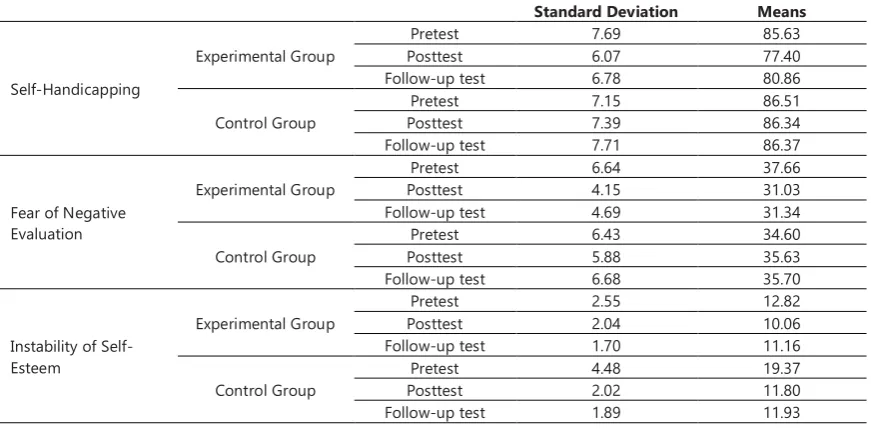
Descriptive indices of both experimental and control groups for three stages of pre-test, post-test and follow-up test are presented in Table 2.
In order to determine the contribution of each predictor variable in the variance explanation of self-handicapping researchers used regression analyze. The results are shown in table 3.
In Table 3, fear of negative evaluation and instability of self-esteem is the positive and significant predictor of self-handicapping, indicating that higher levels of fear of negative evaluation and instability of self-esteem contribute to higher levels of self-handicapping.
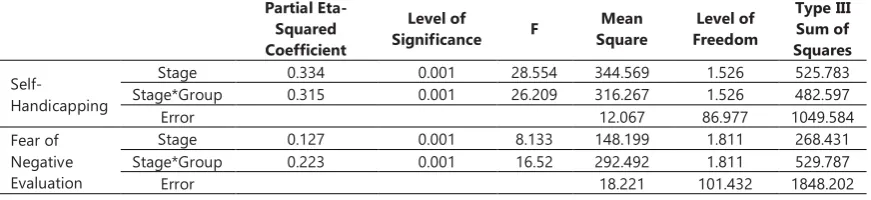
Results from the statistical analysis of data showed that the difference between the pre-tests of experimental and control groups was not significant for neither self-handicapping nor fear of negative evaluation. As a result, mixed variance analysis was employed to compare
pre-tests, post-tests and follow-up tests of the groups. Testing the assumption of the equality of error variances for the self-handicapping variable revealed that with F=0.061 at the level of significance 0.650 for pre-test, F=0.048 at the level of significance 0.828 for post-test and F=0.005 at the level of significance 0.946 for follow-up test, and for the variable fear of negative evaluation with F=0.192 at the level of significance 0.663 for pre-test, F1.979 at the level of significance 0.165 for post-test and F=0.009 at the level of significance 0.924 for follow-up test, the requirement of error variances equality was satisfied for both variables. Owing to the significance of Mauchly’s test (P<0.05), the assumption of sphericity was violated, therefore it was reported in the table presenting the results of the modified Greenhouse-Geisser test.
As shown in Table 4, the association between stage and group was significant for both self-handicapping and fear of negative evaluation in experimental and control groups’ pre-test, post-test and follow-up test (p=0.001).
Table 2. Descriptive indices for self-handicapping, fear of negative evaluation and instability of self-esteem in relation to the research groups and measurement stages
Standard Deviation Means
Self-Handicapping
Experimental Group
Pretest 7.69 85.63
Posttest 6.07 77.40
Follow-up test 6.78 80.86
Control Group
Pretest 7.15 86.51
Posttest 7.39 86.34
Follow-up test 7.71 86.37
Fear of Negative Evaluation
Experimental Group
Pretest 6.64 37.66
Posttest 4.15 31.03
Follow-up test 4.69 31.34
Control Group
Pretest 6.43 34.60
Posttest 5.88 35.63
Follow-up test 6.68 35.70
Instability of Self-Esteem
Experimental Group
Pretest 2.55 12.82
Posttest 2.04 10.06
Follow-up test 1.70 11.16
Control Group
Pretest 4.48 19.37
Posttest 2.02 11.80
With regard to the variable instability of self-esteem, the results revealed the difference of the experimental and control groups in pre-test. Considering the significant difference of the pre-tests of these groups, different scores of pre-test and post-test and those of pre-test and follow-up test were examined by independent-t test whose results are presented in Table 5.
As shown in Table 5, the mean difference of pre-test/post-test scores in the experimental group (M=2.79, SD=2.70) and in the control group (M=7.62, SD=4.64) was significant (P<0.001) and the mean of instability of self-esteem scores showed a reduction in both post-test and follow-up test compared to the pre-test in the experimental group.
Table 3. Self-handicapping based on fear of negative evaluation and unstable self-esteempredicting
variable F
P R
𝑹𝟐
𝜷
T
fear of negative evaluation 18.01
0.001 33.7
11.3 33.7
4.24
Instability of Self-Esteem 19.87
0.001 35.2
12.4 35.2
4.45
Table 4. Results of mixed variance analysis for the comparison of experimental and control groups’ pre-test, post-test and follow-up test for self-handicapping and fear of negative evaluation
Partial Eta-Squared Coefficient
Level of
Significance F
Mean Square
Level of Freedom
Type III Sum of Squares
Self-Handicapping
Stage 0.334 0.001 28.554 344.569 1.526 525.783
Stage*Group 0.315 0.001 26.209 316.267 1.526 482.597
Error 12.067 86.977 1049.584
Fear of Negative Evaluation
Stage 0.127 0.001 8.133 148.199 1.811 268.431
Stage*Group 0.223 0.001 16.52 292.492 1.811 529.787
Error 18.221 101.432 1848.202
Table 5. Independent-t test for different scores of pre-test/post-test and pre-test/follow-up test for instability of self-esteem among the experimental and control groups
t-test
Mean difference Level of Significance Level of Freedom t
Pretest-Posttest 4.83 0.001 35.437 4.50
Pretest-Follow-up Test 6.01 0.001 51 6.179
4. Discussion
As its main objective, the present study aimed to determine the effectiveness of the training package developed for fostering stable self-esteem and alleviating fear of negative evaluation on self-handicapping. Results obtained from the analysis of the variable self-handicapping revealed significance variations at assessment stages (pre-test, post-test and follow-up test). There was no significant difference between the scores of both experimental and control groups prior to the intervention. However, a significant decrease was observed after intervention and during the follow-up stage.
According to Higgins and Brglas, we need to change people's thoughts and beliefs about their functions to reduce self-handicapping, and this can be achieved through cognitive orientation techniques such as examining the automatic thoughts, replacing negative thoughts and clarifying the criteria for success. They also believe that self-handicappers are uncertain about their abilities which is identified as success -from the perspectives of others- in many cases. Thus, the treatment of these individuals should involve specification of success criteria for them [32].
In this context and based on the obtained results, it can be concluded that promoting empowerment of personality can lead to significant changes in emotional, cognitive and behavioral aspects [33]. For example, some researches [34-36] that were in line with the results of this study indicate that psychological and educational
interventions can be utilized for changing some items, such as, extreme perfectionism, approval-seeking, identifying the strengths and weaknesses of individuals as well as self-talk that can ultimately influence self-handicapping behaviors.
present study are in agreement with the results obtained by previous studies e.g. Barrett, Webster & Wallis and Anderson which used cognitive and behavioral interventions to augment the sense of self-worth among students while taking into account the effects of social praises and challenging negative thoughts, self-talk and automatic thoughts [41, 42].
It can be stated that the variables of this study are in such a close association with each other that unstable self-esteem causes fear of others’ negative evaluation and excessive sensitivity to their judgments. This cycle eventually leads to self-handicapping behaviors. Continuity of the mentioned cycle and the use of self-handicapping strategies in various situations may impose serious damages and bring about drastic failures among teenagers. The expense of employing self-handicapping behaviors may involve negative implications from others [43], defective social relations [37], reinforcement of inefficient methods of confronting evaluation situations, and persistence of low-ability appraisals [44].
5. Conclusion:
To sum up, it appears that incorporating training packages, such as the one proposed by this study, into educational and therapeutic interventions in educational environments may help decrease the extent to which harmful confrontation methods including self-handicapping strategies are used among students, and also help minimize negative effects of such behaviors.
Such limitations as selection through convenience sampling, the population being restricted to 14-year-old female students, the lack of control over environmental factors and the affective atmosphere prevailing in their families and classrooms confine generalizability of the results obtained by this study. Utilizing questionnaires for assessment restricted the possibility of access to different variations derived from the intervention. The effectiveness of the proposed training package can be improved by supplementing it with methods which minimize the foregoing limitations such as conducting clinical interviews beside questionnaire administration, taking into account participants’ family system, applying random cluster sampling for all male and female teenagers of different age groups, and holding more and longer sessions.
6. Acknowledgment:
We would like to thank the subjects who collaborated with us in this research.
References
1. Anisi J, Marzmani, H., Reisi, M. & Nicknam, F. . Examination of behavioral problems of teenagers. Behavioral Sciences Journal, 1(2), 7 2007;1(2):7.
2. Milner Jr M. Paradoxical Inequalities: Adolescent Peer Relations in Indian Secondary Schools. Sociology of Education. 2013;86(3):253-67.
3. Idri N. Sources of FNE among First Year LMD1 Students of Abderrahmane Mira University. Procedia-Social and Behavioral Sciences. 2011;29:1932-41.
4. Harter S. Developmental processes in the construction of the self. Integrative processes and socialization: Early to middle childhood. 1988:45-78.
5. Levinson CA, Rodebaugh TL, White EK, Menatti AR, Weeks JW, Iacovino JM, et al. Social appearance anxiety, perfectionism, and fear of negative evaluation. Distinct or shared risk factors for social anxiety and eating disorders? Appetite. 2013;67:125-33.
6. Vakilian SGH, B. . Examination of the effectiveness of the combination of behavioral-cognitive group therapy and training social skills of confronting the fear of negative evaluation and social avoidance. . Clinical Psychology,. 2009;1(2):11-28. 7. Watson D, Friend R. Measurement of social-evaluative anxiety.
Journal of consulting and clinical psychology. 1969;33(4):448. 8. Faytout M, Tignol J, Swendsen J, Grabot D, Aouizerate B,
Lepine J. Social phobia, fear of negative evaluation and harm avoidance. European psychiatry. 2007;22(2):75-9.
9. Hall TR. Self-handicapping: An evaluation and comparison of honors and traditional college students’ utilization. Retrieved February. 2000;24:2009.
10. Ferrari JR, Thompson T. Impostor fears: Links with self-presentational concerns and self-handicapping behaviours. Personality and Individual Differences. 2006;40(2):341-52. 11. Cooley P, Pedersen S. Using handicaps to Protect
Self-esteem: Young Peoples’ Responses to Evaluative Threat in Sport. Universal Journal of Psychology. 2014;2(2):95-102. 12. Hajlu N, Sobhi Gharamaki, N. & Mohammadi, I. . . Effects of
perfectionism on the experience of pride and self-esteem. . Behavioral Sciences, . 2013;7(2):101-8.
13. Martin KA, Brawley LR. Self-handicapping in physical achievement settings: The contributions of esteem and self-efficacy. Self and Identity. 2002;1(4):337-51.
14. Prapavessis H, Grove JR, Maddison R, Zillmann N. Self-handicapping tendencies, coping, and anxiety responses among athletes. Psychology of Sport and Exercise. 2003;4(4):357-75. 15. Snyder CR, Higgins RL. Excuses: their effective role in the
negotiation of reality. Psychological bulletin. 1988;104(1):23. 16. Burroughs E. The Astrobiology Project: Effects on Students'
Science Aspirations and Achievement, and an Analysis of Self-Handicapping Behavior. 2012.
17. Coudevylle GR, Gernigon C, Ginis KAM. Self-esteem, self-confidence, anxiety and claimed self-handicapping: A mediational analysis. Psychology of Sport and Exercise. 2011;12(6):670-5.
18. Tice DM. Esteem protection or enhancement? Self-handicapping motives and attributions differ by trait self-esteem. Journal of Personality and Social Psychology. 1991;60(5):711.
19. Midgley C, Urdan T. Academic self-handicapping and achievement goals: A further examination. Contemporary educational psychology. 2001;26(1):61-75.
20. Waschull SB, Kernis MH. Level and stability of self-esteem as predictors of children's intrinsic motivation and reasons for anger. Personality and Social Psychology Bulletin. 1996;22(1):4-13.
21. Heidari M, Khodapanahi, M. & Dehghani., M. . . Examination of psychometric features of the Self-Handicapping Scale. . Familiology Quarterly. 2009;5(18):125-37.
22. Rhodewalt F. Self-handicappers. Self-Handicapping: Springer; 1990. p. 69-106.
23. Baumeister RF, Kahn J, Tice DM. Obesity as a self-handicapping strategy: Personality, selective attribution of problems, and weight loss. The Journal of social psychology. 1990;130(1):121-3.
24. Shamsi G. Investigation of the effectiveness of group and mood on students’ self-handicapping. . Master’s Degree Thesis University of Shahid Beheshti 2013.
25. Collins KA, Westra HA, Dozois DJ, Stewart SH. The validity of the brief version of the Fear of Negative Evaluation Scale. Journal of anxiety disorders. 2005;19(3):345-59.
26. Rodebaugh TL, Woods CM, Thissen DM, Heimberg RG, Chambless DL, Rapee RM. More information from fewer questions: the factor structure and item properties of the original and brief fear of negative evaluation scale. Psychological assessment. 2004;16(2):169.
27. Garavand F, Shokri, O., Khodaei, A., Omaraei, M. & Tulaei, S. . Fear of negative evaluation among student teenagers of 12-18 years old in Tehran City. Quarterly Journal of Psychological Studies. 2011; 7(1):65-95.
2014;10(39):262-49.
29. Chabrol H, Rousseau A, Callahan S. Preliminary results of a scale assessing instability of self-esteem. Canadian Journal of Behavioural Science/Revue canadienne des sciences du comportement. 2006;38(2):136.
30. Koinis CN. Self-esteem level, self-esteem stability, and procrastination: Predictors of academic achievement in first year medical students: Fielding Graduate University; 2009. 31. Azadi E, Fathabadi, J. & Heidari, M. . .Relationship of instable
esteem and fear of negative evaluation with self-handicapping among student teenagers in Tehran City. Educational Psychology Quarterly. 2012;8,((25)):23.
32. Higgins RL, Berglas S. The maintenance and treatment of self-handicapping. Self-Handicapping: Springer; 1990. p. 187-238. 33. Hosseini SA, Salimi, H., & Eisazadegan, A. Effectiveness of
hope promoting cognitive training on educational self-handicapping of male students in boarding secondary schools of Bukan city. Journal of Educational Psychology. 2014;10(18):83-102.
34. Kross E, Bruehlman-Senecal E, Park J, Burson A, Dougherty A, Shablack H, et al. Self-talk as a regulatory mechanism: how you do it matters. Journal of Personality and Social Psychology. 2014;106(2):304.
35. Kearns H, Forbes A, Gardiner M. A cognitive behavioural coaching intervention for the treatment of perfectionism and self-handicapping in a nonclinical population. Behaviour Change. 2007;24(3):157-72.
36. Ferguson KL, Rodway MR. Cognitive behavioral treatment of perfectionism: Initial evaluation studies. Research on Social Work Practice. 1994;4(3):283-308.
37. Norem JK, Cantor N. Cognitive strategies, coping, and perceptions of competence. 1990.
38. Schwinger M, Wirthwein L, Lemmer G, Steinmayr R. Academic self-handicapping and achievement: A meta-analysis. American Psychological Association; 2014.
39. Kernis MH, Cornell DP, Sun C-R, Berry A, Harlow T. There's more to self-esteem than whether it is high or low: The importance of stability of self-esteem. Journal of personality and social psychology. 1993;65(6):1190.
40. Newman LS, Wadas RF. When the stakes are higher: Self-esteem instability and self-handicapping. Journal of Social Behavior and Personality. 1997;12(1):217.
41. Barrett PM, Webster HM, Wallis JR. Adolescent self-esteem and cognitive skills training: A school-based intervention. Journal of Child and Family Studies. 1999;8(2):217-27.
42. Anderson HE. Effects of Self-Esteem Intervention Programs on At-Risk Behaviors of Rural I: NORTHERN MICHIGAN UNIVERSITY; 2011.
43. Arkin RM, Baumgardner AH. Self-presentation and self-evaluation: Processes of self-control and social control. Public self and private self: Springer; 1986. p. 75-97.