IRANIAN JOURNAL OF DIABETES AND OBESITY, VOLUME 11, NUMBER 2, SUMMER 2019
122
The Effect of Circular Training Program on Endothelial-Derived
Microparticles in Overweight Men
Sayed Alireza Ghorashi1, Shirin Zilaei Bouri2*, Mohammad ALi Azarbayjani3
Introduction
ndothelial dysfunction is a key step in the pathogenesis of atherosclerosis. Under physiological conditions, the endothelium provides anti-sclerosis condition,
by which it prevents the adhesion of leukocytes and the proliferation of vascular smooth muscles. The endothelium regulates the vascular smooth muscle tone; it also
E
1. Department of Physical Education and Sport Sciences, Shoushtar Branch, Islamic Azad University, Shoushtar, Iran.
2. Department of Physical Education and Sport Sciences, Masjed Soleyman Branch, Islamic Azad University, Masjed Soleyman, Iran.
3. Department of Exercise Physiology, Central Tehran Branch, Islamic Azad University, Tehran, Iran.
*Correspondence:
Shirin Zilaie Bouri, Department of Physical Education and Sport Sciences, Masjed Soleyman Branch, Islamic Azad University, Masjed Soleyman, Iran. Tel:(98) 916 113 4092
Email: [email protected]
Received: 24 May 2019
Accepted: 05 September 2019
Published in November 2019
Abstract
Objective: Aging is associated with endothelial dysfunction and arthrosclerosis. This study aimed to assesses the impact of combined circular training (resistance-interval) on endothelial-derived microparticles (EMPs) as a marker of endothelial function and cardiovascular risk factors in overweight elderly men.
Materials and Methods: In this experimental study, twenty four
overweight men aged 50 - 55 years were divided to exercise group (8 weeks circular training, 3 times/weekly, n= 12) and control group (no training, n= 12) by simple random sampling. The anthropometric measurements, serum EMPs and cardiovascular risk factors (triglyceride (TG), total cholesterol (TC), low density lipoprotein (LDL), and high density lipoprotein (HDL)) were measured before and after training program in exercise and control groups. Data were analyzed by student’s T-test to assess the statistical significance of the changes. P-value less than 0.05 were considered statistically significant.
Results: A significant decreases were observed in anthropometrical markers (weight, BMI, body fat percentage) by training program in exercise group (P-value< 0.001). Circular training induced significant decrease in EMPs (P-value= 0.004), TG (P-value= 0.020), TC (P-value= 0.001) and increase in HDL (P-value< 0.001) compared to pre-training. No significant change was observed in LDL by circular training in exercise group (P-value= 0.052). There were no changes in all dependent variables in the control subjects (P -value≥ 0.05).
Conclusion: Based on these data, it is concluded that combined circular training can be improve endothelial function in overweight elderly men.
Keywords: Circular exercise, Endothelial function, Overweight, Elderly
regulates arterial dilation according to the demand for blood flow. Clinical studies have revealed that endothelial dysfunction of small blood vessels is the start of endothelial dysfunction of large blood vessels, which is the first step in the development of vascular diseases (1).
Obesity and overweight are associated with endothelial dysfunction of small and large blood vessels, which appears via high levels of endothelial-derived microparticles (EMPs) and reduction of endothelial progenitor cells (2). EMPs are one of the biological markers of endothelial damage and vascular abnormalities that contribute to the pathogenesis of cardiovascular, inflammatory, and metabolic diseases (3). There is evidence that in the presence of obesity and increased body fat mass, endothelial dysfunction induces atherosclerosis and other cardiovascular disorders (4,5), and the increase of EMPs and cardiovascular risk factors along with obesity, especially in the elderly, is the main reason for endothelial dysfunction (6). Hence, over the last two decades, new and emerging approaches for improving cardiovascular risk factors and endothelial function, especially in healthy or diseased obese populations, have been at the center of health and wellbeing researchers’ attention.
In this regard, it has been suggested that the endothelial function of large vessels in obese adolescents can be improved by exercise (7) and diet (8), although the combination of exercise and diet is more effective (9). However, lifestyle interventions such as exercise and diet that are capable of reversing endothelial dysfunction of small vessels and the balance of EMPs are still not well known. In this regard, some relatively new studies have revealed that endothelial function rises significantly within 2 and 72 h after an exercise session, however, no changes have been reported in EMPs (10-12).
Another study suggested that traditional endurance exercise with moderate intensity leads to a decrease in the levels of EMPs (13-15). It is also hypothesized that exercise
training intensifies the desire to reduce the EMPs in obese or overweight individuals. However, the effect of circular exercises on EMPs in obese or overweight individuals, especially in the elderly, has been reported in few studies. Hence, the present study aimed to determine the effect of a period of combined circular exercises on the levels of EMPs as well as cardiovascular risk factors in overweight elderly men.
Materials and Methods
This is an experimental study with pre and post-training design. The studied sample were aged 50-55 years, with sedentary lifestyle and overweight (BMI 25–30 kg/m2). They were selected by convenience sampling method and then divided into exercise (Circular exercise, 8-weeks, 3d/wk n= 12) and control (n= 12) group based on random sampling according the table of random numbers. (Shushtar, Iran, Fall 1396). Each participant received written and verbal explanations about the nature of the study before signing an informed consent form.
All subjects of two groups were non-smoker and non-alcoholics. They were non-smokers and had not participated in regular exercise/diet programs for the preceding 6 months. None of the subjects used drugs or therapies for obesity, and none had a past history of disease or injury that would prevent daily exercise. The exclusion criteria were as follows: patients with known history of acute or chronic respiratory infections, neuromuscular disease, and cardiopulmonary disease.
Overweight was defined according body mass index (BMI); calculated by dividing body mass (kg) by height in meters squared (m2). Height and weight of participants were measured by standard procedures (in underwear, but barefoot) with a Seca 220 scale (22089 Hamburg, Germany). Abdominal circumference (WC) was measured at the superior border of the iliac crest and was taken to the nearest 0.1 cm after a normal expiration.
124 IRANIAN JOURNAL OF DIABETES AND OBESITY, VOLUME 11, NUMBER 2, SUMMER 2019 Percentage body fat was measured using body
composition monitor (OMRON, Finland). The participants completed 8 weeks circular training, 3 times per weeks in consist of combined resistance and interval exercise in each exercise session. In each exercise session, participants performed warm-up exercises for 5-10 min, followed by a 30- 45 min circular exercise (resistance-interval exercise) and relaxation exercises for 5- 10 min at the end. Pre and post training (48 h after lasted exercise session) of fasting blood samples were collected for measure biochemical markers of 2 groups. Participants were also given instructions to strictly follow the same diet for 24 h prior to each blood samples, which was confirmed upon arrival to the laboratory. All participants were asked to avoid any serious physical activity for 48-h before blood sampling. Serums were immediately separated and stored at -80° until the assays were performed. Circulating EMPs were measured in platelet poor plasma by flow cytometry following the methods of Jenkins et al. (43 of 933). TG, TC, HDL and LDL-cholesterol as cardiovascular risk factors were measured by enzymatic methods (Randox direct kits) using Kobas Miraauto-analyzer made in Germany.
Statistical analysis
SPSS (version 16.0; SPSS, Chicago, IL, USA) used for statistical analyses of all variables. Kolmogorov-Smirnov normality test used to analyze normal distribution of the data, subsequent analysis was independent and paired sample test. Independent sample
T-test was used to compare all variables between two groups at baseline. Paired sample T-test was used to determine the mean differences between pre and post-training values of each variable. A P-value of < 0.05 was considered significant.
Ethical considerations
This study was approved according to compliance with Ethics Standards in Research of the Ministry of Sciences, Research and
Technology, with the code
IR.SSRC.REC.1398.453.
Results
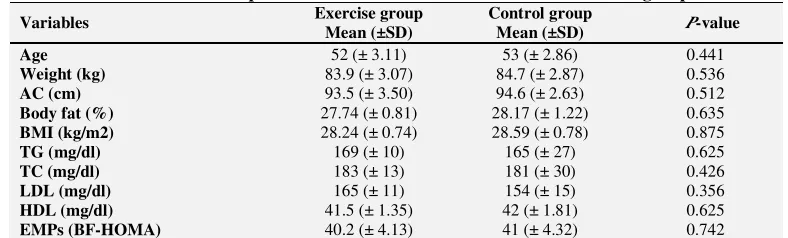
The anthropometrical and clinical characteristics of two studied groups are presented at baseline (P-value> 0.05, table 1). Pre and post-training of the anthropometric indexes of the study subjects are described in table 2. Compared to pre training, exercise group obtained significant decreases in body weight, visceral fat, body fat percentage and the other anthropometrical indexes in exercise group (P-value< 0.05) but these variables remained without changed in control subjects (P-value> 0.05) (table 2).
We are noted that the determine effect of circular training on EMPs and cardiovascular risk factor is the main aims of present study. Table 3 presents, pre and post-training of this variables of 2 groups.
The difference between pre and post training for each variable (delta) were measured, and then compare them between the two groups
Table 1. The baseline anthropometrical and clinical characteristics in studied groups
Variables Exercise group Mean (±SD)
Control group
Mean (±SD) P-value
Age 52 (± 3.11) 53 (± 2.86) 0.441
Weight (kg) 83.9 (± 3.07) 84.7 (± 2.87) 0.536
AC (cm) 93.5 (± 3.50) 94.6 (± 2.63) 0.512
Body fat (%) 27.74 (± 0.81) 28.17 (± 1.22) 0.635
BMI (kg/m2) 28.24 (± 0.74) 28.59 (± 0.78) 0.875
TG (mg/dl) 169 (± 10) 165 (± 27) 0.625
TC (mg/dl) 183 (± 13) 181 (± 30) 0.426
LDL (mg/dl) 165 (± 11) 154 (± 15) 0.356
HDL (mg/dl) 41.5 (± 1.35) 42 (± 1.81) 0.625
EMPs (BF-HOMA) 40.2 (± 4.13) 41 (± 4.32) 0.742 AC, abdominal circumference; BF, body fat percentage; BMI, body mass index; TG, Triglyceride; TC, Total cholesterol; LDL, Low density lipoprotein cholesterol; HDL, High density lipoprotein cholesterol; EMPs, Endothelial-derived microparticles
with the independent T-test. Data showed significant difference between 2 groups with regard to delta of EMPs (P-value= 0.028), TG (P-value= 0.033), TC (P-value= 0.014) and HDL- cholesterol (P-value= 0.009) but not in LDL-cholesterol (P-value= 0.073).
In addition, paired sample T-test was used to determine intra-group differences for each variable. Based on data, circular training induced significant decrease in TG, TC and EMPs compared with pre-training in the exercise group but these variables remained unchanged in the control subjects. We also observed a significant increase for HDL-cholesterol by circular training in exercise group but not in control group. Compared to pre-training, serum LDL-cholesterol remained unchanged by training program in exercise as well control groups (table 3).
Discussion
The main finding of the present study is the reduction of EMPs in response to circular exercises. In other words, 8 weeks of circular exercises in the form of resistance and interval circulate trainings reduced EMPs in elderly men who had previously sedentary lifestyle. Reduction of EMPs is reported in the current study while elevated blood circulation levels in overweight or obese people with metabolic syndrome (16) and various cardiovascular diseases (17) have been previously reported.
Although few studies have been reported on the effect of circular exercises on EMPs as one of the determinants of endothelial function in overweight elderly individuals, some studies have reported an increase in endothelial function of large vessels in obese adolescents following exercise training (7). In the study by Sossdorf et al. (2011), a slight increase was observed in EMPs 45 min immediately after moderate intensity cycling in athletic men, but the levels returned to basal level after 2 hours of recovery (18). Chaar et al. (2011) did not record any changes in the levels of EMPs within 2 hours recovery following intense interval exercises in healthy individuals (19). Also, in the study by Jenkins et al. (2011), the concentration of EMPs significantly declined within 16-18 hours of recovery following 45 min of endurance exercise with 70% VO2peak intensity compared to non-exercise test samples in the other day in healthy young men (20).
Reduction of EMPs in response to circular exercises was associated with the improvement of cardiovascular risk factors. In spite of the lack of changes in HDL, the exercise program reduced the levels of TG and TC, and increased HDL compared to the control group. However, these variables did not change in the control group. Similarly, Kadoglou et al. (2007) reported that 6 months of aerobic exercise, three sessions per week,
Table 2. Pre and post training of anthropometrical characteristics in studied groups
Variables
Exercise group Control group Pre-training
Mean (±SD) post-training P-value
Pre-train
Mean (±SD) post-training P-value Weight (kg) 83.9 (± 3.07) 82.1 (± 2.97) <001 84.7 (± 2.87) 84.9 (± 2.75) 0.213
AC (cm) 93.5 (± 3.50) 90.8 (± 2.97) <001 94.6 (± 2.63) 94.9 (± 2.89) 0.279
Body fat (%) 27.74 (± 0.81) 26.6 (± 0.75) <001 28.17 (± 1.22) 28.07 (± 0.97) 0.476
BMI (kg/m2) 28.24 (± 0.74) 27.6 (± 0.77) <001 28.59 (± 0.78) 28.66 (± 0.72) 0.209 AC, abdominal circumference; BF, body fat percentage; BMI, body mass index
Table 3. Circulation level of clinical characteristics at pre and post training in studied groups (Mean ± SD).
Variable
Exercise group Control group
Pre-training
Mean (±SD) post-training P-value
Pre-training
Mean (±SD) post-training P-value TG (mg/dl) 169 (± 10) 162 (± 14) 0.020 165 (± 27) 161 (± 20) 0.436
TC (mg/dl) 183 (± 13) 173 (± 10) 0.001 181 (± 30) 180 (± 25) 0.890
LDL (mg/dl) 165 (± 11) 160 (± 16) 0.052 154 (± 15) 152 (± 12) 0.676
HDL (mg/dl) 41.5 (± 1.35) 45.5 (± 2.22) 0.000 42 (± 1.81) 42.4 (± 1.90) 0.817
EMPs (BF-HOMA) 40.2 (± 4.13) 36.8 (± 3.99) 0.004 41 (± 4.32) 40.4 (± 5.76) 0.757
126 IRANIAN JOURNAL OF DIABETES AND OBESITY, VOLUME 11, NUMBER 2, SUMMER 2019 reduced insulin resistance and lipid profile
indices such as TG, TC, and LDL; it also increased HDL and significantly reduced CRP in obese type 2 diabetic patients (21). In a study by George et al. (2011), 12 weeks of aerobic, resistance, and combined training decreased fasting blood glucose, blood pressure, and CRP levels and improved cardiovascular risk factors (TG, TC, LDL, and HDL) in obese participants (22). However, Colombo et al. (2013) reported no changes in cardiovascular risk factors following 12 weeks of aerobic exercise in obese diabetic patients (23).
Despite these consistent and inconsistent pieces of evidence, the circular exercises were associated with the reduction of EMPs and the improvement of cardiovascular risk factors. The increase of EMPs of blood circulation in some age-related vascular and metabolic diseases, such as dyslipidemia and asymptomatic atherosclerosis, has been reported frequently (24,25). Due to the exposure of EMPs to pre-coagulation phospholipids and specific receptors on their surfaces, it has been pointed out that EMPs are able to regulate endothelial integrity (26,27). This intercellular connection, in turn, also has a reciprocal relationship with inflammation, dyslipidemia, coagulation, and angiogenesis (24). It has been reported that EMPs are derived from intercellular adhesion (ICAM-1), vascular cell adhesion, and platelet cell adhesion molecules, and other active peptides, such as active endogenous endothelial cells (25,28). The transfer of these molecules is
increased by EMPs through
postprandial hyperglycemia and
hypertriglyceridemia as well as the levels of LDL (29). Rautou et al. pointed out that EMPs isolated from the platelets of elderly people with atherosclerosis transmit ICAM-1 molecules to endothelial cells to call for inflammatory cells, which in turn leads to progression and increased severity of atherosclerosis (30). This effect can be linked to the activity of the P38 MAPK signaling pathways, the mechanisms involved in the
formation and saturation of EMPs, and the proliferation of blood platelets (31). Recently, it has been shown that an increase in blood glucose levels through the increase in the activity of NADPH oxidase in EMPs leads to a rise in endothelial inflammation and endothelial function damage as a result of promoting endothelial activity (32).
The correlation between EMPs progenitor cells and cardiovascular risk factors denotes aortic stiffness, endothelial dysfunction, and asymptomatic atherosclerosis (33). The reduction of EMPs along with the decrease of TG and cholesterol and increase of HDL can be attributed to weight loss and fat mass in elderly people. Although evidence regarding EMPs is less available, in the study by Racil et al. (2013), 4 weeks of interval training was associated with the improvement of cardiovascular risk factors in obese women, and researchers attributed this improvement to the reduction of weight and body fat mass (34). In the study by Ghardashi Afousi et al. (2016), 3 months of aerobic training increased nitric oxide as another indicator of endothelial function along with weight loss and decline of body fat percentage, but flow mediated dilation as another endothelial function index did not change significantly (35). On the other hand, Afshunpour et al. (2016) reported an increase in HDL with a decrease in insulin resistance along with weight loss and body fat mass in obese or overweight diabetic patients in response to circular resistance exercises, but the levels of TG, TC, and LDL did not change significantly (36).
Based on this evidence, changes in the markers of cardiovascular function in response to exercise training may be attributed to other adaptations independent of weight change or body fat mass. In addition, Kadoglou et al. (2007) believed that the improvement of inflammation profile and cardiovascular risk factors following 12 weeks of aerobic training in obese type 2 diabetic patients was independent of body weight changes and related to the increased aerobic capacity (VO2max) or cardio-respiratory fitness of
these patients in response to the training intervention (37). The close correlations between CRP as well as cardiovascular components, and aerobic capacity and muscular fitness have also been reported in Norwegian girls and boys by Steene et al. (2013) (38).
Conclusions
Eight weeks of combined circular training in the form of resistance and interval circulate training led to the reduction of EMPs along with the improvement of cardiovascular risk factors in overweight elderly men. Based on these findings and some other available pieces of evidence, improvement of cardiovascular
function can be attributed somewhat to weight loss and body mass, as well as increased cardiovascular fitness. However, recognizing other mechanisms responsible for these changes requires further studies.
Acknowledgments
We thank to all participated patients in the study and Islamic Azad University for financial support and cooperation in implementing this study.
Conflict of Interest
No conflict of interest are declared by the author(s).
References
1. Montero D, Walther G, Perez‐Martin A, Roche E, Vinet A. Endothelial dysfunction, inflammation, and oxidative stress in obese children and adolescents: markers and effect of lifestyle intervention. Obesity reviews. 2012;13(5):441-55. 2. Bruyndonckx L, Hoymans VY, De Guchtenaere A,
Van Helvoirt M, Van Craenenbroeck EM, Frederix G, et al . Diet, exercise, and endothelial function in obese adolescents. Pediatrics. 2015;135(3):e653-61. 3. Mause SF, Weber C. Microparticles: protagonists of a novel communication network for intercellular information exchange. Circulation research. 2010;107(9):1047-57.
4. Tounian P, Aggoun Y, Dubern B, Varille V, Guy-Grand B, Sidi D, et al. Presence of increased stiffness of the common carotid artery and endothelial dysfunction in severely obese children:
a prospective study. The Lancet.
2001;358(9291):1400-4.
5. Hamburg NM, Palmisano J, Larson MG, Sullivan LM, Lehman BT, Vasan RS, et al. Relation of brachial and digital measures of vascular function in the community: the Framingham heart study. Hypertension. 2011;57(3):390-6.
6. Gündüz Z, Dursun Đ, Tülpar S, Baştuğ F, Baykan A, Yıkılmaz A, et al. Increased endothelial microparticles in obese and overweight children. Journal of Pediatric Endocrinology and Metabolism. 2012;25(11-12):1111-7.
7. Meyer AA, Kundt G, Lenschow U, Schuff-Werner P, Kienast W. Improvement of early vascular changes and cardiovascular risk factors in obese children after a six-month exercise program. Journal of the American College of Cardiology. 2006;48(9):1865-70.
8. Kaufman CL, Kaiser DR, Kelly AS, Dengel JL, Steinberger J, Dengel DR. Diet revision in overweight children: effect on autonomic and vascular function. Clinical Autonomic Research. 2008;18(2):105.
9. Woo KS, Chook P, Yu CW, Sung RY, Qiao M, Leung SS, et al. Effects of diet and exercise on obesity-related vascular dysfunction in children. Circulation. 2004;109(16):1981-6.
10. Tyldum GA, Schjerve IE, Tjønna AE, Kirkeby-Garstad I, Stølen TO, Richardson RS, et al. Endothelial dysfunction induced by post-prandial lipemia: complete protection afforded by high-intensity aerobic interval exercise. Journal of the American College of Cardiology. 2009;53(2):200-6.
11. Tjønna AE, Rognmo Ø, Bye A, Stølen TO, Wisløff U. Time course of endothelial adaptation after acute and chronic exercise in patients with metabolic syndrome. The Journal of Strength & Conditioning Research. 2011;25(9):2552-8.
12. Padilla J, Harris RA, Fly AD, Rink LD, Wallace JP. The effect of acute exercise on endothelial function following a high-fat meal. European Journal of Applied Physiology. 2006;98(3):256-62.
13. Feairheller DL, Diaz KM, Kashem MA, Thakkar SR, Veerabhadrappa P, Sturgeon KM, et al. Effects of moderate aerobic exercise training on vascular health and blood pressure in a frican a mericans. The Journal of Clinical Hypertension. 2014;16(7):504-10.
14. Babbitt DM, Diaz KM, Feairheller DL, Sturgeon KM, Perkins AM, Veerabhadrappa P, et al. Endothelial activation microparticles and inflammation status improve with exercise training
128 IRANIAN JOURNAL OF DIABETES AND OBESITY, VOLUME 11, NUMBER 2, SUMMER 2019 in African Americans. International Journal of
Hypertension. 2013;2013.
15. Kretzschmar J, Babbitt DM, Diaz KM, Feairheller DL, Sturgeon KM, Perkins AM, et al. A standardized exercise intervention differentially affects pre-and post-menopausal African American
women. Menopause (New York, NY).
2014;21(6):579.
16. Agouni A, Lagrue-Lak-Hal AH, Ducluzeau PH, Mostefai HA, Draunet-Busson C, Leftheriotis G, et al. Endothelial dysfunction caused by circulating microparticles from patients with metabolic syndrome. The American Journal of Pathology. 2008;173(4):1210-9.
17. Dignat-George F, Boulanger CM. The many faces of endothelial microparticles. Arteriosclerosis, thrombosis, and vascular biology. 2011;31(1):27-33.
18. Sossdorf M, Otto GP, Claus RA, Gabriel HH, Lösche W. Cell-derived microparticles promote coagulation after moderate exercise. Medicine and science in sports and exercise. 2011;43(7):1169-76. 19. Chaar V, Romana M, Tripette J, Broquere C, Huisse MG, Hue O, et al. Effect of strenuous physical exercise on circulating cell-derived microparticles. Clinical hemorheology and microcirculation. 2011;47(1):15-25.
20. Jenkins NT, Landers RQ, Thakkar SR, Fan X, Brown MD, Prior SJ, et al. Prior endurance exercise prevents postprandial lipaemia‐induced increases in reactive oxygen species in circulating CD31+ cells. The Journal of Physiology. 2011;589(22):5539-53.. 21. Kadoglou NP, Iliadis F, Angelopoulou N, Perrea D,
Ampatzidis G, Liapis CD, et al. The anti-inflammatory effects of exercise training in patients with type 2 diabetes mellitus. European Journal of Cardiovascular Prevention & Rehabilitation. 2007;14(6):837-43.
22. Jorge ML, de Oliveira VN, Resende NM, Paraiso LF, Calixto A, Diniz AL, et al. The effects of aerobic, resistance, and combined exercise on metabolic control, inflammatory markers, adipocytokines, and muscle insulin signaling in patients with type 2 diabetes mellitus. Metabolism. 2011;60(9):1244-52.
23. Colombo CM, Macedo RM, Fernandes-Silva MM, Caporal AM, Stinghen AE, Costantini CR, et al. Short-term effects of moderate intensity physical activity in patients with metabolic syndrome. Einstein (Sao Paulo). 2013;11(3):324-30.
24. Brodsky SV, Malinowski K, Golightly M, Jesty J, Goligorsky MS. Plasminogen activator inhibitor-1 promotes formation of endothelial microparticles with procoagulant potential. Circulation. 2002;106(18):2372-8.
25. Yong PJ, Koh CH, Shim WS. Endothelial microparticles: missing link in endothelial dysfunction?. European Journal of Preventive Cardiology. 2013;20(3):496-512.
26. Burger D, Montezano AC, Nishigaki N, He Y, Carter A, Touyz RM. Endothelial microparticle formation by angiotensin II is mediated via Ang II receptor type I/NADPH oxidase/Rho kinase pathways targeted to lipid rafts. Arteriosclerosis, thrombosis, and vascular biology. 2011;31(8):1898-907.
27. Owens III AP, Mackman N. Microparticles in hemostasis and thrombosis. Circulation research. 2011;108(10):1284-97..
28. Tramontano AF, Lyubarova R, Tsiakos J, Palaia T, Deleon JR, Ragolia L. Circulating endothelial microparticles in diabetes mellitus. Mediators of inflammation. 2010;2010.
29. Horstman LL, Jy W, Jimenez JJ, Ahn YS. Endothelial microparticles as markers of endothelial dysfunction. Front biosci. 2004;9(1118):e35.
30. Rautou PE, Leroyer AS, Ramkhelawon B, Devue C, Duflaut D, Vion AC, et al. Microparticles from human atherosclerotic plaques promote endothelial ICAM-1–dependent monocyte adhesion and transendothelial migration. Circulation research. 2011;108(3):335-43.
31. Curtis AM, Wilkinson PF, Gui M, Gales TL, Hu E, Edelberg JM. p38 mitogen‐activated protein kinase targets the production of proinflammatory endothelial microparticles. Journal of Thrombosis and Haemostasis. 2009;7(4):701-9.
32. Jansen F, Yang X, Franklin BS, Hoelscher M, Schmitz T, Bedorf J, et al. High glucose condition increases NADPH oxidase activity in endothelial microparticles that promote vascular inflammation. Cardiovascular research. 2013;98(1):94-106. 33. Berezin A, Zulli A, Kerrigan S, Petrovic D,
Kruzliak P. Predictive role of circulating endothelial-derived microparticles in cardiovascular diseases. Clinical biochemistry. 2015;48(9):562-8. 34. Racil G, Ounis OB, Hammouda O, Kallel A,
Zouhal H, Chamari K, et al. Effects of high vs. moderate exercise intensity during interval training on lipids and adiponectin levels in obese young females. European Journal of Applied Physiology. 2013;113(10):2531-40.
35. Ghardashi Afousi A, Gaeini A, Gholami Borujeni B. The effect of aerobic interval training on endothelial vasculature functions in type 2 diabetes patient. Iranian Journal of Rehabilitation Research. 2016;2(3):27-39. (in Persian).