Iranian Evolutionary and Educational Psychology Journal
December 2019: 259-275
© University of Hormozgan Publication 2019 DOI: 10.29252/ieepj.1.4.3
http://ieepj.hormozgan.ac.ir
A Structural Equation Modeling Analysis of the
Model of Motivational Variables Affecting Iranian
EFL Teachers’ Competency in ELT
Khalil Sazideh1, Shahram Afraz2*, Fazlolah Samimi3
1. PHD Candidate, Department of English Language, Qeshm Branch, Islamic Azad University, Qeshm, Iran
2. PHD, Department of English Language, Qeshm Branch,Islamic Azad University, Qeshm,Iran, *Corresponding author email: [email protected]
3. PHD, Department of English Language, Bandar Abbas Branch,Islamic Azad University, BandarAbbas,Iran Introduction
Education has the vital function in the process of human growth and development. It is a character building process, enhancing owns personality and makes him/her capable, rational, and responsive and intelligent. Education is viewed as an instrument to develop the cognitive qualities, tolerance and understanding of peo-ple. Education quality is a central theme in education systems, and various studies have been directed toward seeing how quality in training is accomplished (Kulshrestha & Pandey, 2013). The history of English language teaching (ELT) in Iran indicates that it has undergone a host of ups and downs and gone to extremes (Aghagol-zadeh & Davari, 2017).
Despite the importance of learning English, it seems that English education is still suffering in Iran and educa-tors turn out to have paid only lip service to it. The faceduca-tors conducive to this situation are not, of course, easy to identify. However, one single factor, which undoubtedly plays a crucial role and overshadows other factors, even if they are favorable, is the teacher.
Teachers have the fundamental role in educational development. No country can make any progress without Abstract: Teacher competency is defined as an integrated set of personal characteristics, knowledge, skills and attitudes that are
needed for effective performance in various teaching contexts. Despite the importance of teachers’ competency in the design of classroom practices and methods, few studies in Iranian EFL context have explored the effects of factors affecting this construct. Accordingly, the present study attempted to develop and test a model of motivational variables affecting a group of Iranian EFL teachers’ competency by using Structural Equation Modeling (SEM) approach. A total of 197 EFL teachers teaching at a number of
schools in Hormozgan province participated in the study and completed a teacher competency test, a self-efficacy beliefs scale and a self-regulation in teaching questionnaire. The tested model gave satisfactory fit indexes and the variables of study had a positive relation with teachers’ competency. More specifically, instructional strategy, as the subscale of self-efficacy, and intrinsic interest, as
the subcomponent of self-regulation, could best predict teachers’ competency.
Keywords: Teachers’ Competency, Self-regulation, Self-efficacy beliefs, Structural Equation Modelling (SEM)
good teacher. Teachers are the torchbearer of the race and guardian in the future of the mankind (Allimuthu , Annadurai & Muthupandi, 2018). Traditionally teachers were always thought the source of knowledge and were expected to transfer that knowledge to their students. However, today’s teachers are facilitator, commu-nicator and mediator. The present time requires the availability of the competent teachers who are interested in the welfare of the students (Goklap, 2016).
Teaching profession needs specific knowledge and skills (Abdul Razaq et al., 2013). Therefore, teacher ed-ucation programs are proposed to ensure that teachers are competent in content knowledge and pedagogical skills. By mastering these two main elements, teachers are able to face challenges in school. Effective teachers are capable of carrying out their duties and responsibilities successfully. Effective teachers must have broad knowledge and pedagogical skills to promote appropriate behavior (Awang, Jindal-Snape, & Barber, 2013). According to Markley (2004) qualified teachers and their activities in the classroom have important role in generating effective learning environments and creating proficient learners.
The relationship between teachers and students is of significant importance especially in countries like Iran where English language is taught formally in the classroom setting, and teachers are considered the major source of learners’ knowledge capable of affecting students’ learning (Kariminia & Salehizadeh, 2007). One of the crucial questions that educational researchers study is related to recognizing the qualities of a good teacher. Educational Researchers have explored common teacher characteristics that go beyond several fields of study such as identifying the subject matter, being capable of clarifying the subject matter clearly, applying tangible instances to clarify constructs, utilizing effective approaches, being capable of controlling the class and being fluent and accurate in the process of language learning (Rahimi, 2007). EFL teachers must have a number of skills and abilities to be thought competent. Rahimi (2007) proposes that EFL teachers must have three types of knowledge:
Firstly; knowledge of language: content knowledge and knowledge of the subject matter. Secondly; edge of teaching: pedagogical knowledge, knowledge of teaching strategies, beliefs, practices, and the knowl-edge of the various disciplines that would develop teachers’ approach to the teaching and learning of En-glish. Thirdly; knowledge/competency of teaching in reality: pedagogical content knowledge, the specialized knowledge of how to represent content knowledge in the classroom and how students understand the subject matter in the context of real teaching; the students’ problems and how to overcome those problems by con-sidering all variables related to their learning (teaching materials, assessment procedures and dealing with parents, etc.). (p. 4)
Teachers must gain confidence, acquire new perspectives, enhance knowledge, find out new methods, and have new roles. However, the main focus of teacher development is that which deals with in-service teachers. Nevertheless, the content of teacher development programs is mostly based on teachers’ background knowl-edge and personal experiences. Action research, teacher study groups or self-development practices comprise most typical teacher development activities. The results of these activities are usually assessed through jour-nal writing and reflective thinking or other forms of self-assessment techniques. Alternatively, the process of teacher training is mostly perceived as an in-service strategy, the content of which is mainly expressed externally, and content of the input is shown through conventional processes such as readings, lectures, obser-vations, case studies, project work or other participant-oriented processes (Rahimi, 2007).
No effective teaching is possible without an effective teacher. So a competent teacher is identified through
his/her performance and the quality of his/her teaching. In all education systems, the competency of teachers is one of the important factors determining school effectiveness and students’ achievements. To hold highest standards of professional performance, instructors must be aware of different variables and beliefs that may affect their competency. Although the main concentration is on teaching nature and the competencies a good teacher ought to possess, there has been little emphasis on the specific variables that affect these charac-teristics and competencies. Researchers have shown that motivational beliefs are fundamental for effective teaching. According to Eggen and Kauchak (2002), teachers’ beliefs and perceptions influence their practice and affect the students’ performance. Also Ispir (2010) indicates that teachers’ motivational beliefs influence the activities they perform in the classroom. Accordingly, the present study intends to investigate the role of a set of motivational variables (namely, self-efficacy beliefs and self-regulation capacity) in the performance of ELT teachers in Iran. In fact, a model of role of motivational variables in ELT teachers’ competency will be developed and tested by using structural equational modeling (SEM). More specifically, the current research attempts to answer the following research questions:
1. Does the model of motivational variables of teachers’ competency in ELT give satisfactory fit indexes based on the data collected from a number of Iranian EFL teachers?
2. Is there any relationship between motivational variables and EFL teachers’ competency in ELT? 3. Which motivational variable can best predict Iranian EFL teachers’ competency in ELT?
Theoretical framework
A comprehensive understanding of competence in language teaching is required in order to be able to study what essential skills, knowledge, values, attitudes and goals, ELT teachers need and how they can get them. Conceptualization of competency has experienced important alters from the time when it was proposed in the literature of teachers’ competency. The notion of teachers’ competency which was a concept with discrete, no theory and practical skills dispersed in different parts of the world began in the late 1960s. According to the mentioned notion, teacher competency is the skill, ability and capabilities possessed by the teacher to create effective and productive teaching-learning environment in order to realize the full potential of teachers as well as students and to achieve the goals of education (Sekar, 2016). Therefore, in order to have competent teach-ers, they have to act effectively in every day practice (Van Huizen, Van Oers and Wubbles, 2005). The idea supporting this model indicated that acquiring competence required a lot of techniques, procedures, and class-room management, which teachers experienced during their instructional endeavors. In developing countries, the notion of educating and training teachers concentrated on the development of techniques and procedures related to teaching. This model of competence, which focused on teacher education, decreased the effect of university on teacher education and reinforced the formation of cooperation with schools as a cornerstone of teaching competence.
Scholars argue that this notion of competence can make generally an effective structure for curriculum development in higher education (Barnett, 1994) and particularly a proper basis for teacher education. Barnett (1994) had two reasons for insufficiency of observable competency in developing curriculum. He believes that higher education is not able to develop competency for a specific profession. Moreover, in practice the concept of competency is just capable of predicting competency in predictable conditions. In addition, Barnett believes that developing competency causes change in process of teacher instruction: “Today’s competencies are not tomorrow’s” (Barnett, 1994, p. 73). Barnett (1994) claims that competent teachers are able to generate an idea of their job and they can create changes in learners’ needs. Based on this notion, teacher competency
development programs must prepare future teachers to face the competing and challenging situations rather than being able to apply special procedures and activities in teaching. It needs knowledgeable teachers who have a profound understanding of their society pedagogical system and comprehension of the situation, which is not clear and measurable. Cowen (2002) believes that emphasis must be on those aspects of teacher competency, which are assessable and applicable.
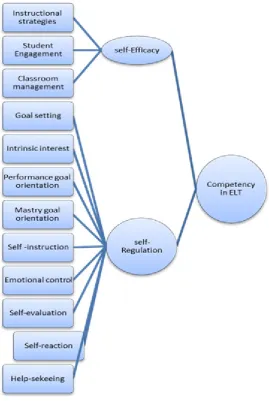
In the present study due to the importance of motivational aspects of teachers’ competency, a model was de-veloped to explore the relationship between teachers’ competency and their motivational variables in Iranian EFL contexts (see Figure 1). The theoretical objective of this model is to explore the capabilities that EFL teachers require to achieve the demand of their profession, with the main focus of interest being on self-effi-cacy beliefs and self-regulation capacity. These factors are further elaborated upon below.
Figure 1 . The model of motivational variables of competency in ELT
Teachers’ Self-Efficacy: Slavíc (2012) indicates that teachers’ competency is seen as capacity of excellence. Bandura (1997) and Pajares (1996) believe that teachers’ self-efficacy is teachers’ self -perception of compe-tence in performing their classroom practices. Moreover, Federici and Skaalvik (2012) indicate that self- effi-cacy is teachers’ beliefs in planning, organizing and performing tasks to gain the required instructional goals. The self-efficacy aspect contains three subscales: “student engagement, instructional strategies and classroom management (Tschannen-Moran et al., 1998)”. According to Tschannen-Moran et al. (1998) teachers who
have educational capability to motivate students and to engage them in classroom activities are competent teachers. Moreover, Tschannen-Moran et al. (1998) state that competent teachers are capable of employing interesting, effective and suitable teaching procedures, regulating the behavior of students and managing the classroom.
Bandura (1997) believe that teachers’ beliefs are related to their real performance in the teaching environment. More specifically, teachers’ self-perceptions of their abilities, which are called self-efficacy, are considered influential facet of teachers’ insights because teachers take part in activities that they have competency and evade tasks that they are not competent. Therefore, according to Bandura (1997) self-efficacy belief can in-fluence teachers’ performance because of its psychological strength. Based on instructional study, teachers’ self-efficacy is capable of influencing both pedagogical activities and the whole educational environment. For instance, teachers with high self-efficacy belief indicate that they have ability to generate incredible variations in the students’ process of learning whereas teachers with low self-efficacy state that they are not able to affect students’ learning. They believe that environmental factors are stronger than teachers’ education (Gibson & Dembo, 1984).
Tschannen-Moran et al. (1998) claim that teachers’ self-efficacy aspects are determining in effective educa-tion. Moreover, Coladarci (1992) believe that self-efficacy can affect teachers’ personal commitment. Fur-thermore, Allinder (1994) indicates that teachers’ self-efficacy increases eagerness to teach effectively. In second language situations, the focus of teachers’ self-efficacy is on the educational achievement (Ghanizadeh & Moafian, 2011). In addition, Wong (2005) declares that teachers’ self-efficacy has relation with strategies which pre-service teachers employ in self-reported language learning. In spite of misperception in measuring and conceptualizing of previous studies, teachers’ self-efficacy still appears as a powerful concept in the cur-rent literature. According to Bandura’s model, the classification of teachers’ self-efficacy is based on bilateral relationship between self-efficacy, behavior and environment. There are a lot of studies in which their focus is on the relationship between teachers’ self-efficacy and behavior. In addition, they investigate the connection between self-efficacy beliefs and environment. More specifically, the concentration of research is on the rela-tion among teachers’ self-efficacy and teachers’ educarela-tional experience, self-efficacy and teachers’ attitudes, teachers’ self-efficacy and academic performance and finally teachers’ self-efficacy and innovation in teaching (e.g., Chacón, 2005; Ghaith & Yaghi, 1997; Goker, 2006; Guskey, 1988).
Teachers’ Self-regulation: Self-regulation is defined as “self-generated thoughts, feelings and actions that are planned and cyclically adapted to the attainment of personal goals” (Zimmerman, 2000, p. 14). Delfino, Dettori and Persico (2010) maintain that self-regulation in learning is vital for teachers to manage the intrica-cy of teaching activities which involves both personal and social facets. From individual viewpoint, teachers must provide themselves with self-regulation skills in order to pursue several goals and tasks and reinforce and strengthen their motivation, commitment and competence. Considering the social viewpoint, self-regulation is capable of supporting the teachers to plan educational activities in line with students’ particular aims, and to regulate curriculum based on students’ needs, technology development and cultural advances (Delfino, et al, 2010). To provide teachers with perceptive teaching, they need both competency and self-regulation related to pedagogy and learning (Dembo, 2001).
To be a competent teacher, it is necessary to be a competent learner first. Fortunately, some teachers are able to create opportunity to increase self-regulating learning. Enhancing the level of self-regulating learning develop
quickly in circumstances in which teachers are capable of participating in intricate and meaningful activities and they have ability to provide conditions to regulate their advancements and consequences (Perry, Hutchin-son, & Thauberger, 2008). Also, Randi (2004) believes that classroom activities including lesson plans and as-sessment can develop teachers’ self-regulation and learning. Teachers who employ self-regulation are charac-terized as energetic, creative and initiative instructors with capability of initiating specific educational insights, creating suitable instructional activities and regulating pedagogical environments (Butler, 2003; Manning & Payne, 1993; Randi, 2004). Moreover, teachers in the process of self- regulation use metacognitive strategies (Manning & Payne, 1993) spirally as follow: regulating aims for teaching and learning, creating proper tasks and activities, establishing educational techniques, controlling and assessing consequences, and familiarizing and reviewing methods as needed (Butler, Lauscher, Jarvis-Selinger, & Beckingham, 2004; Peeters, De Back-er, Reina, Kindekens, Buffel, & Lombaerts; 2013; Van Eekelen, Boshuizen & Vermunt, 2005).
Material and Method
Participants and settings: The population sample consisted of Iranian EFL teachers who were teaching English in Hormozgan Province high schools (namely, in Bandar Abbas and Minab cities) in the south of Iran. The rationale for selecting the participants was based on convenience sampling method, which involves selecting those who are available to the researchers at the time. A total of 197 teachers agreed to participate in the study. There were 72 females and 125 males. They had B.A and M.A degrees in TEFL, English Language and literature, linguistics and English Translation. They were from both genders. It is worth mentioning that all the participants were native speaker of Persian with teaching experiences ranging from 2 to 30 years. Instruments
Teachers’ Competency Test: The teachers’ competency test developed and validated by Pishghadam, Ba-gheri, and Shahriari (2011) was used to measure EFL teachers’ competency. The test consisted of 61 items including:
a. Items corresponding to the teaching of skills
b. Items corresponding to the process of assessment and testing
c. Items related to the theories of first and second language acquisition d. Items related to teacher behavior within the classroom
The items were in multiple-choice format and intended to be functional in nature and present participants with clearly-defined circumstances which they had possibly been faced while teaching in their own classes. Some Measures were taken to evade the presence of items dealing with the theoretical knowledge or beliefs of the participants (Pishghadam, et al, 2011). It was a test with the reliability index of 0.64 which had been calculated with Cronbach alpha.). ELT-competency test had been validated by using Rasch analysis version 3.66. Fit statistics showed that all items fit the Rasch model following the criteria proposed by Bond & Fox (2007). The reliability index of the current research was0.73, which had been calculated with Cronbach alpha. Confirma-tory factor analysis (CFA) was conducted to ensure the appropriateness of the competency model. The results of the confirmatory factor analysis of the present study confirmed the construct validity of the questionnaire ( x2/df=1.25 NFI=0.91 GFI=0. 0.89, AGFI=0.89, RMSEA=0.036).
Teachers’ Self-Efficacy Scale: Teacher self-efficacy scale (TSES) developed by Tschannen-Moran et al. (1998) was used as a criterion to assess teachers’ self-efficacy beliefs since its validity has been proved in different contexts (Klassen et al., 2009). TSES is one of the most frequently used scales measuring teachers’
sense of efficacy .In order to test the validity of the scale in Iranian context, five experts in the field were asked to assess the questionnaire and give their comments and suggestions. The experts were teaching English at the University of Hormozgan, Shiraz, Sistan and Balouchestan, Islamic Azad university-Khorasgan branch and Islamic Azad university- Bandar Lengeh branch. After the analysis of their comments, the original scale was approved. The scale was comprehensive, integrated and easy to administer. The questionnaire comprised 24 items, classified into three components: “efficacy in student engagement (ESE), efficacy in instructional strat-egies (EIS) and efficacy in classroom management (ECM). Each subscale contains eight items, and each item is measured on a nine-point Likert scale ranging from ‘nothing’ (1) to ‘a great deal’ (9)” (Tschannen-Moran et al., 1998) .
Efficacy in student engagement includes items like, “How much can you do to get through to the most diffi-cult students?” and “How much can you do to help your students think critically?” efficacy in instructional strategies involves items like, “How well can you respond to difficult questions from your students?” while efficacy in classroom management comprises items like, “How much can you do to control disruptive behav-ior in the classroom?” (Tschannen-Moran et al., 1998). This questionnaire enjoyed from a good reliability index: .89 Cronbach’s Alpha. In current study, the total reliability of the scale estimated via Cronbach’s al-pha was 0.78, which was quite satisfactory. In Ghonsooli and Ghanizadeh (2011) study, the total reliability of the questionnaire was calculated via Cronbach’s alpha was 0.89. Confirmatory factor analysis (CFA) was conducted to confirm the appropriateness of the self-efficacy model. The results of the confirmatory factor analysis confirmed the construct validity of the questionnaire (x2/df=2.07 NFI=0.9 GFI=0.88, AGFI=0.88, RMSEA=0.07).
Teachers’ Self-regulation Scale: To measure teachers’ self-regulation capacity, the Teacher Self-Regulation Scale (TSRS) designed and validated by Yesim, Sungur and Uzuntiryaki (2009) was utilized in the study. In order to test the validity of the scale in Iranian context, five experts in the field were asked to assess the ques-tionnaire and give their comments and suggestions. The experts were teaching English at the University of Hormozgan, Shiraz, Sistan and Balouchestan, Islamic Azad university-Khorasgan branch and Islamic Azad university- Bandar Lengeh branch. After the analysis of their comments, the original scale was approved. “This scale was based on Zimmerman’s (2002) self-regulation model and was developed from semi-structured interviews with pre-service and in-service teachers” (Yesim et al., 2009, P.354). “This questionnaire consisted of 41 items and each item was measured using a six-point Likert scale ranging from ‘strongly disagree’ (one) to ‘strongly agree’ (six). Scores on the 41 items were averaged to give an overall indicator of the teachers’ de-gree of self-regulation” (Yesim et al., 2009, P.354). Moreover, Confirmatory factor analysis revealed that the test consisted of 9 factors including: “(1) Goal setting, (2) Intrinsic interest, (3) Performance goal orientation, (4) Mastery goal orientation, (5) Self-instruction, (6) Emotional control, 7) Self-evaluation, (8) Self-reaction, (9) Help-seeking” (Yesim et al., 2009, P.354). The computed reliability index for this questionnaire is .85 Cronbach’s Alpha, which is quite satisfactory for the present study.
In this study, the total reliability of the scale, which is estimated via Cronbach’s alpha was 0.79. In Ghonsooli and Ghanizadeh (2011) study, the total reliability of the questionnaire was calculated via Cronbach’s alpha was 0.85. Confirmatory factor analysis (CFA) was conducted to confirm the appropriateness of the self-regu-lation model. The results of the confirmatory factor analysis confirmed the construct validity of the question-naire(x2/df=2.12 NFI=0.91 GFI=0.90, AGFI=0.89, RMSEA=0.048).
Procedure of data collection: In order to collect the required data, the participants were required to respond
to the teachers’ competency test, self-efficacy beliefs and self-regulation capacity scales. In fact, the objective was to test the model of motivational variables of competency in ELT. The researcher consulted with the head of education administration and English department in both cities two weeks prior to the commencement of the data collection in winter 2019. Moreover, prior to the period of data collection, EFL teachers were given consent form and the aim and the procedure of the study were explained to the participants. The teachers were assured that their views would be confidential and that they would be used only for academic purposes and have no effect on their professional and educational careers. In monthly sessions, at the time of gathering teachers in the meeting hall of education administration in both cities the questionnaires were distributed among the informed teachers. In the first part of administration, the participants were given teachers’ competency test, in the second stage they completed the self-efficacy questionnaire with 24 items, and as far as the final part was concerned, the participants that took part in the research responded to the self-regulation questionnaire. Procedure of data analysis: The measured variables produced numeric data that was analyzed statistically in order to provide insight into the effects of motivational variables on teachers’ competency. Initial analysis was done to confirm no violation of normality in the data and a number of confirmatory factor analyses were run to evaluate the appropriateness of the variables and see the possible relationship among the variables of concern. The original aim of the study was to test the model of motivational variables of competency in ELT using Structural Equation Modelling (SEM) approach which brings together reliability statistics analysis, One-sam-ple t-test and confirmatory factor analysis in hypothesizing the relationships between a set of constructs and measured variables based on a substantive theory (Kunnan, 1998). In fact, “linear structural equation mod-eling is a useful methodology for statistically specifying, estimating, and testing hypothesized relationships among a set of substantively meaningful variables” (Bentler, 1995, p. ix). Linear Structural Relationships (LISREL) statistical package, which enables the researchers to “specify the nature of the relationship between variables and then test for how well the data obtained fits the complex model that has been specified” (Skehan, 1991, p. 282), was used to estimate the model. In addition, we made use of WARPPLS for testing the hypoth-eses and responding to the questions. The SEM model enables investigators to measure the relations between variables. Moreover, it helps the researchers to observe how the variables affect each other. More specifically, it deals with the structural and measurement part of the model (Winke, 2013). Accordingly, we decided to see the relationship among EFL teachers’ competency, self-efficacy beliefs and self-regulation capacity.
Reliability Statistics: Cronbach alpha, confirmatory factor analysis and composite reliability were used to de-termine the reliability of the scale of the study. The following table shows the related results. As Table 2 shows all of the research constructs possess an alpha Cronbach 0.70 and above, which is considered an acceptable reliability. Moreover, the results of the composite reliability are above 0.70 which show the appropriateness of the research questions. Furthermore, the results of the AVE of the research variables were above 0.50 showing the acceptable reliability of the questionnaire.
Table 1. Cronbach’s alpha, Composite reliability and the AVE of the variables
Variables Dimensions Cronbach's Alpha Combined reliability AVE
Self-Efficacy Instructional Strategy 0.820 0.715 0.567
Student Engagement 0.771 0.744 0.615
Classroom Management 0.769 0.817 0.516
Self-Regulation
Goal Setting 0.812 0.801 0.588
Intrinsic interest 0.749 0.764 0.814
Performance goal orientation 0.812 0.863 0.725
Mastery goal orientation 0.917 0.714 0.612
Self- instruction 0.763 0.792 0.879
Emotional control 0.718 0.815 0.547
Self- evaluation 0.811 0.837 0.612
Help-seeking 0.781 0.852 0.559
Self-reaction 0.733 0.861 0.583
Competency
Feedback and flexibility 0.719 0.819 0.519
Teaching methodology 0.698 0.911 0.512
Learning boosters 0.816 0.937 0.876
Motivation 0.785 0.917 0.983
Sociology of language teaching and learning 0.850 0.856 0.651
EQ 0.719 0.864 0.569
NLP 0.815 0.871 0.858
Self-esteem 0.841 0.745 0.679
Thinking 0.912 0.790 0.762
As Table 1 shows the mean of the variables are above five and all of the variables of the study are in appropri-ate status (t>1.96, Sig. <0.05).
Table 2. One-sample t-test of variables of the study
Variables Dimensions No. Means SD T-value Sig Status
Self-Efficacy Instructional StrategyStudent Engagement 195193 5.495.02 0.7880.245 22.4714.33 0.000.00 AppropriateAppropriate
Classroom Management 192 5.33 0.832 17.45 0.00 Appropriate
Self-Regulation
Goal Setting 190 5.12 0.891 45.12 0.00 Appropriate
Intrinsic interest 192 5.44 1.11 52.01 0.00 Appropriate
Performance goal orientation 189 5.13 0.766 55.14 0.00 Appropriate Mastery goal orientation 193 5.27 0.619 42.13 0.00 Appropriate
Self- instruction 190 5.16 0.882 21.19 0.00 Appropriate
Emotional control 188 5.42 0.824 55.21 0.00 Appropriate
Self- evaluation 194 5.11 0.912 44.30 0.00 Appropriate
Help-seeking 195 5.38 0.703 41.17 0.00 Appropriate
Self-reaction 192 5.72 0.817 37.13 0.00 Appropriate
Considering the fact that the response to Competency Test was one or zero, 0.5 was considered as the median of the scale. The design of the hypotheses would be as the following:
Null hypothesis: H0 the variable status is not appropriate. H0: µ≤0.5
Alternative hypothesis: H1 the status of the related variable is appropriate. H1: µ≥0.5
Table 3. One sample t-test for Competency
Variables Dimensions No. Means SD T-value Sig Status
Competency
Feedback and flexibility 191 0.55 0615 77.12 0.00 Appropriate
Teaching methodology 195 0.61 1.118 11.32 0.00 Appropriate
Learning boosters 193 0.57 1.09 61.12 0.00 Appropriate
Motivation 193 0.51 0.877 49.11 0.00 Appropriate
Sociology of language teaching and learning 194 0.50 0.914 53.18 0.00 Appropriate
EQ 190 0.59 0.716 66.11 0.00 Appropriate
NLP 194 0.52 0.591 54.00 0.00 Appropriate
Self-esteem 194 0.71 1.312 47.99 0.00 Appropriate
Thinking 191 0.62 0.903 22.18 0.00 Appropriate
FSA 95 0.51 0.715 19.57 0.00 Appropriate
As Table 3 shows the significance values for all the variables were less than 0.05. Also, the mean of these variables has significant difference at 0.5 level. Therefore, the null hypothesis is rejected and the alternative hypothesis is accepted. Considering t>1.96, it can be observed that the mean of these variables is more than 0.5 and possesses an appropriate status.
Results
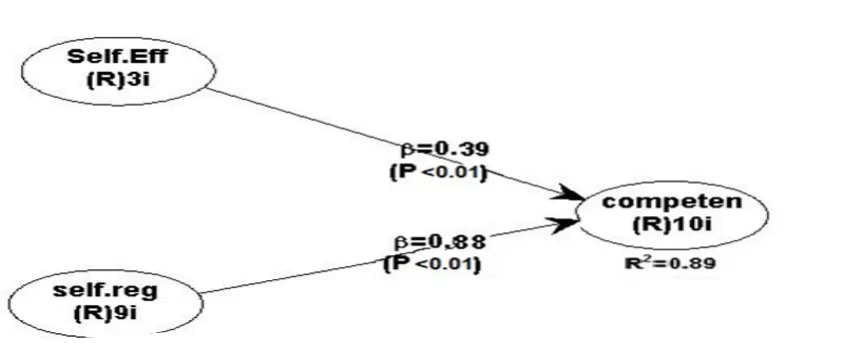
After confirming the measurement model, testing of the hypotheses was done using SEM. In this study, we made use of WARPPLS for testing the hypotheses. PLS models use multiple regressions, for each part of the regression model. To confirm the hypothesis the result of P-value for the model should be P<0.01, in this mod-el, β shows the value of the effect size. The related SEM model is shown in Figure 2.
Figure 2. SEM model for the effect of motivational variables on teachers’ competency
As figure 2 shows, the two variables of Self-efficacy and Self-regulation predicts 89 percent of the
cy variances. The fitness indices of the model are as the following (Table 4).
Table 4. The fitness indices of the SEM Model
Index The index value in the model The reference value
Path coefficient mean 0.37 0.05 ≤
R2 mean 0.540 0.302≤
AVIF 2.43 5≥
SPR 1 0.70≤
SSR 1 0.70≤
As Table 4 shows the SEM model has an appropriate fitness in the general state. Hence, it can be claimed that the model of motivational aspects of teachers’ competency in ELT give satisfactory fit indexes based on the data collected from a number of Iranian EFL teachers. The results of the related model fitness and response to the second question are given in Table 5.
Table 5. The results of SEM analysis for the main model of the research
Path β Effect p-value Status
Self-efficacy to competency 0.39 Positive /moderate P<0.001 Confirmed
Self-regulation to competency 0.88 Positive/high P<0.001 Confirmed
As Table 5 indicates self-efficacy has a positive and moderate effect on competency and self-regulation has a positive and high effect on competency. Hence, it can be claimed that there is positive relationship between motivational variable and EFL teachers’ competency.
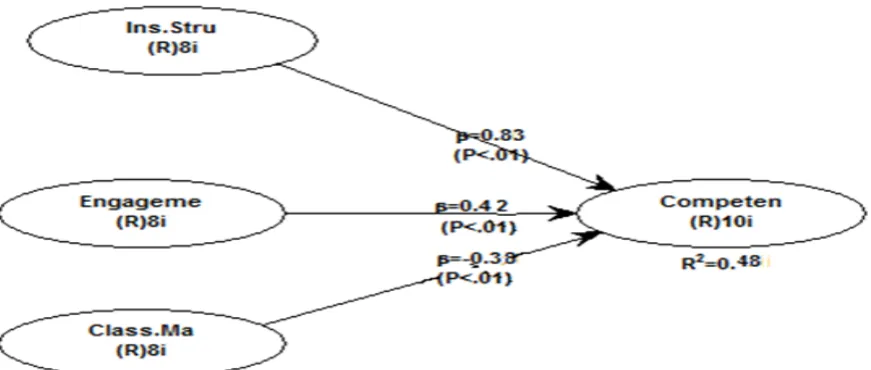
To investigate the third research question and to identify each constitutes of self-efficacy variable, the model was tested with the presence of three constitutes of self- efficacy. The output of the WARP PLS is provided in Figure 3.
Figure 3. The SEM model for self-efficacy
The fitness indices of the model are as the following (Table6). As Table 6 shows the SEM model has a goodness of fit. The related results for the effect of self-efficacy variables on competency are provided in Table 7. The results show that instructional strategy has the highest effect on the competency. The second ranking is related to student engagement, and the third ranking is related to classroom management.
In order to identify the component of Self-regulation with the highest level of influence on teachers’ competency, the SEM model was evaluated again. The related results can be found in Figure 4. The fitness indices are provided in the table 8.
Table 6. The fitness indices of SEM for Self-efficacy
Parameter The value in the model The reference value
Path coefficient mean 0.51 0.05≤
R2 mean 0.812 0.302≤
AVIF 3.71 5≥
SPR 1.02 0.7≤
SSR 1 0.7≤
Table 7. The results of SEM analysis for the main model of the research
Path β Effect p-value Status
Instructional Structure to competency 0.83 Positive /high P<0.001 Confirmed
Engagement to competency 0.42 Positive/high P<0.001 Confirmed
Classroom Management to competencey 0.38 Positive/high P<0.001 Confirmed
Figure4. SEM model for Self-regulation
The fitness indices of the model are as the following (Table6). As Table 6 shows the SEM model has a goodness of fit. The related results for the effect of self-efficacy variables on competency are provided in Table 7. The results show that instructional strategy has the highest effect on the competency. The second ranking is related to student engagement, and the third ranking is related to classroom management.
In order to identify the component of Self-regulation with the highest level of influence on teachers’ competency, the SEM model was evaluated again. The related results can be found in Figure 4. The fitness indices are provided in the table 8.
Table 6. The fitness indices of SEM for Self-efficacy
Parameter The value in the model The reference value
Path coefficient mean 0.51 0.05≤
R2 mean 0.812 0.302≤
AVIF 3.71 5≥
SPR 1.02 0.7≤
SSR 1 0.7≤
Table 7. The results of SEM analysis for the main model of the research
Path β Effect p-value Status
Instructional Structure to competency 0.83 Positive /high P<0.001 Confirmed
Engagement to competency 0.42 Positive/high P<0.001 Confirmed
Classroom Management to competencey 0.38 Positive/high P<0.001 Confirmed
Figure4. SEM model for Self-regulation
Table 8. Fitness indices of SEM model for Self-regulation
Parameter The value in the model The reference value
Path coefficient mean 0.68 0.05≤
R2 mean 0.318 0.302≤
AVIF 4.225 5≥
SPR 0.73 0.7≤
SSR 0.81 0.7≤
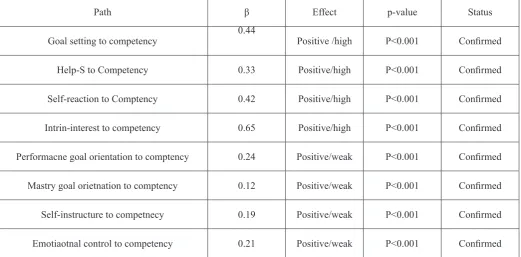
Table 9. The results of SEM analysis for Self-regulation
Path β Effect p-value Status
Goal setting to competency 0.44 Positive /high P<0.001 Confirmed
Help-S to Competency 0.33 Positive/high P<0.001 Confirmed
Self-reaction to Comptency 0.42 Positive/high P<0.001 Confirmed
Intrin-interest to competency 0.65 Positive/high P<0.001 Confirmed
Performacne goal orientation to comptency 0.24 Positive/weak P<0.001 Confirmed
Mastry goal orietnation to comptency 0.12 Positive/weak P<0.001 Confirmed
Self-instructure to competnecy 0.19 Positive/weak P<0.001 Confirmed
Emotiaotnal control to competency 0.21 Positive/weak P<0.001 Confirmed
Table 9 shows the related results for the effect of self-regulation variable on competency. The results of data analysis presented in Table 10 show that all of the self-regulation components have an effect on competency. The highest effect is attributed to intrinsic interest, self-evaluation and goal setting respectively.
Among the motivational components, instructional strategy (β=0.85), intrinsic interest (β=0.65), self-eval-uation (β=0. 52), goal setting (β=0.44), self-reaction (β=0.42), and student engagement (β=0.42) have the highest effect on competency.
Discussion
The current research attempted to study the effect of a set of motivational variables on EFL teachers’ competency. More specifically, a model of motivational variables influencing teachers’ competency was tested by using Structural Equation Modelling technique. The results of this analysis indicated that the model of motivational aspects of teachers’ competency in ELT give satisfactory fit indexes based on the data collected from a number of Iranian EFL teachers. It is generally believed that competent educators are required to be knowledgeable and capable of applying their competency in different pedagogical environment (Shulman, 1987). Moreover, Cowen (2002) claims that teachers’ competency comprises knowledge of pedagogy, history, philosophy and sociology. This study adds to this body of research by asserting that motivational variables can play a significant role in teachers’ competency since there was positive relationship between motivational variable and EFL teachers’ competency. This finding led us to accept the definition of competence as “an integrated set of personal characteristics, knowledge, skills and attitudes that are needed for effective performance in various
teaching contexts” (Tigelaar, Dolmans, Wolfhagen, & van der Vleuten, 2005, p.255).
As for responding to other research question, it was found that self-efficacy has a positive and moderate effect on competency and self-regulation has a positive and high effect on competency. More specifically, instruc-tional strategy, as the subscale of self-efficacy, and intrinsic interest, as the subcomponent of self-regulation, had the highest effect on teachers’ competency. These motivational variables are highly influential in teachers’ competency since teachers’ knowledge, thought, feeling and beliefs are completely connected to their teaching in the classroom. More specifically, teachers’ self-perceptions of their competency are considered as influen-tial part of teachers’ insights because teachers take part in activities that they have competency and elude tasks that they are not competent (Bandura 1997).
This finding is in line with the findings of researchers who have confirmed the effective function of self-ef-ficacy to teachers’ pedagogical success (Ghanizadeh & Moafian, 2011), the relation of teachers’ self-efself-ef-ficacy with their emotional intelligence (Moafian & Ghanizadeh, 2009) and as pre-service teachers are concerned, it is associated with rehearsal procedures that teachers use in the process of language learning (Wong ,2005). As for the influence of self-regulation on teachers’ competency, scholars have claimed that in managing the intricacy of teaching profession, it is essential for teachers to self-regulate both individual and social facets of their learning (Delfino et al., 2010). In fact, in order to provide condition for perceptive teaching, teachers not only need basic teaching knowledge and skills of managing classroom, but also require scrutinizing their be-liefs and their professional motivation as well as self-regulatory aspects associated with learning and teaching process (Dembo, 2001).
On the whole, teachers’ competency is perceived as capacity of excellence (Slavíc, 2012). An approach which intends to develop teachers’ competency must draw on the teacher’s own experience where teachers consider new ideas, reevaluate their beliefs and work out how to use them and theories from the results. In addition, one of the main goals of educational practices especially teacher training courses must be generat-ing self-confident and competent teachers who are able to teach in the complex and challenggenerat-ing and at the same time attractive context of classroom (Malderez &Wedell,2007). This study has shed some lights on the motivational aspects of teachers’ competency, especially the role of self-efficacy beliefs and self-regulation; further studies can be conducted to study the effects of other cognitive, affective and social factors on their competency.
Declaration of Conflicting Interests
The author(s) declared no potential conflicts of interest with respect to the research, authorship, and/or
pub-lication of this article.
Funding
The author(s) received no financial support for the research, authorship, and/or publication of this article.
References
Abdul Razaq A., Ahamad Rahim, A., & Seman, A. A. (2013). Active learning through History Subject towards Racial Unity in Malaysia. The Social Science, 8(1), 19-24.
Aghagolzadeh, F., & Davari, H. (2017). English education in Iran: From ambivalent policies to paradoxical practices. In R. Kirkpatrick (Ed.) English Language Education Policy in the Middle East and North Africa
(pp. 47-62). Springer International Publishing.
Allimuthu, N., Annadurai, R., & Muthupandi, P. (2018). A Study of Teaching Competency among B.Ed. Trainees, Shanlax International Journal of Education, 1-3.
Allinder, R.M. (1994). The relationship between efficacy and the instructional practices of special education teachers and consultants. Teacher Education and Special Education 17: 86–95.
Awang, M. M., Jindal-Snape, D., & Barber, T. (2013). A documentary analysis of the government’s circulars on positive behaviour enhancement strategies. Asian Social Science, 9(5), 203-208.
Bandura, A. (1997). Self-efficacy: The exercise of control. New York, NY: W.H. Freeman.
Barnett, R. (1994). The Limits of Competence: Knowledge, Higher Education and Society. The Society of Research into Higher Education & Open University Press.
Bentler, P. M. (1995). EQS structural equations program manual. Multivariate Software.
Bond, T.G., & Fox, C.M. (2007). Applying the Racsh model: fundamental measurement in the human sciences.
Brown, D.H. (1994). Principles of language learning and teaching. New Jersy: Prentice Hall Regents.
Butler, D. L. (2003, August). Self-regulation and collaborative learning in teachers’professional development. Paper presented at the biannual meetings of the European Association for Research in Learning and In-struction (EARLI). Padua, Italy.
Butler, D. L., Lauscher, H. N., Jarvis-Selinger, S., & Beckingham, B. (2004). Collaboration and self regulation in teachers’ professional development. Teaching and Teacher Education, 20(5), 435-455.
Chacón, C. (2005). Teachers’ perceived efficacy among English as a foreign language teachers in middle schools in Venezuela. Teaching and Teacher Education, 21, 257- 272.
Coladarci, T. (1992). Teachers’ sense of efficacy and commitment to teaching. Journal of Experimental Edu-cation, 60, 323-337.
Cowen, R. (2002). Socrates was right? Teacher education systems and the state. In T. Elwyn (Ed.), Teacher education: Dilemmas and Prospects (pp. 3-12). London: Kogan.
Delfino, M., G. Dettori and D. Persico. (2010). An online course fostering self- regulation of trainee teachers. Psicothema 22, no. 2: 299–305.
Dembo, M. H. (2001). Learning to teach is not enough: Future teachers also need to learn how to learn. Teach-er Education QuartTeach-erly, 28(4), 23-35.
Eggen, P., Kauchak, D. (2002). Strategies for teachers: Teaching content and thinking skills (4th ed.). Need-ham Heights: M.A. Allyn and Bacon.
Federici, R. A., & Skaalvik, E. M. (2011). Principal self-efficacy and work engagement: Assessing a Norwe-gian principal self-efficacy scale. Social Psychology of Education. doi: 10.1007/s11218-011-9160-4. Ghaith, G. & Yaghi, H. (1997). Relationships among experience, teacher efficacy, and attitudes toward the
implementation of instructional innovation. Teaching and Teacher Education, 13, 451-458.
Ghanizadeh, A., & Moafian, F. ( 2011). The relationship between Iranian EFL teachers’ sense of self-efficacy and their pedagogical success in Language Institutes. Asian EFL Journal 13, no. 2: 249–72.
Ghonsooli, B., & Ghanizadeh, A. (2011). Self-efficacy and self-regulation and their relationship among Ira-nian EFL. Language Learning Journal. 1-17. http://profdoc.um.ac.ir/articles/a/1024259.pdf. (accessed 21/11/2012).
Gibson, A. and Dembo, M. (1984). Teacher efficacy: a construct validation. Journal of Educational
ogy 76, no. 4: 569–82.
Goker, S. D. (2006). Impact of peer coaching on self-efficacy and instructional skills in TEFL. teacher educa-tion. System, 34, 239-254.
Goklap, M. (2016). Investigating Classroom Teaching Competencies of Pre service Elementary Mathematics Teachers, Eurasia Journal of Mathematics, Science & Technology Education, 1-2.
Guskey, T. R. (1988). Teacher efficacy, self-concept, and attitudes toward the implementation of instructional innovation. Teaching and Teacher Education, 4, 63-69.
Hargreaves, A., & Fullan, M. G. (1992). Introduction. In A. Hargreaves & M. G. Fullan (Eds.), Understanding teacher development (pp. 1–19). New York: Teachers College Press.
Ispir, O.A. (2010). Teachers’ Burnout Levels and Their Attitudes Towards Teaching Profession. EABR & ETLC Conference Proceedings. Dublin, Ireland. pp. 229-233
Kariminia, A., & Salehizadeh, S. (2007). Communication strategies: English language departments in Iran. Iranian Journal of Language Studies, 1(4), 287-300.
Klassen, R. B., Bong, M., Usher, E. L., Chong, W. H., Huan, V. S., Wong., I. Y. F., & Georgiou, T. (2009). “Exploring the validity of teachers’ self-efficacy scale in five countries”. Contemporary Educational Psy-chology. 34: 67-76.
Kulshrestha, A. K., & Pandey, K. (2013). Teachers training and professional competencies. Voice of Research, 1(4), 29-33.
Kunnan, A. J. (1998). An introduction to structural equation modelling for language assessment research. Lan-guage Testing, 15(3), 295-332.
Malderez, A., & Wedell, M. (2007). Teaching teachers: Processes and practices. A&C Black.
Manning, B. H., & Payne, B. D. (1993). A Vygotskian-based theory of teacher cognition: Toward the acquisi-tion of mental reflecacquisi-tion and self-regulaacquisi-tion. Teaching and Teacher Educaacquisi-tion, 9(4), 361-371.
Markley, T. (2004). Defining the effective teacher: Current arguments in education. Essays in Education, 11(3), 1-14
Moafian, F., & Ghanizadeh., A. (2009). The relationship between Iranian EFL teachers’ emotional intelligence and their self-efficacy in language institutes. System 37, no. 4: 708–18.
Pajares, F. (1996). Self-efficacy beliefs in academic settings. Review of Educational Research, 66, 543e578. http://dx.doi.org/10.3102/00346543066004543.
Peeters, J., De Backer, F., Reina, V. R., Kindekens, A., Buffel, T., & Lombaerts, K. (2013). The role of teach-ers’ self-regulatory capacities in the implementation of self-regulated learning practices. Procedia-Social and Behavioral Sciences, 116, 1963-1970.
Perry, N. E., Hutchinson, L., &Thauberger, C. (2008). Talking about teaching self –regulated learning: Scaf-folding student teachers’ development and use of practices that promote self-regulated learning. Interna-tional Journal of EducaInterna-tional Research,47(2), 97-108.
Pishghadam, R., Baghaei, P., & Shahriari, H. (2011). Development and validation of an English language teacher competency test. The International Journal of Educational and Psychological Assessment, 8(2), 54-68.
Rahimi, M. (2008). What do we want teaching-materials for in EFL teacher training programs. Asian EFL Journal, 31(1), 1-35.
Randi, J. (2004). Teachers as self-regulated learners. Teachers’ College Record 106, no. 9: 1825–53.
Richards, J.C. (2001). Curriculum development in language teaching. New York: Cambridge University Press. Sekar, A. K. (2016).Teaching Competency of B.Ed. Female Teacher Trainees, An International Indexed,
Ref-ereed & Peer Reviewed Bi-Annual Journal in Education, 3(2) 1-3.
Shulman, L. S. (1987). Knowledge and Teaching: Foundations of the New Reform. Harvard Educational Re-view, 57(1), 1-22.
Skehan, P. (1991). Individual differences in second language learning. Studies in Second Language Acquisi-tion, 13(02), 275-298.
Slavíc, M. (2012). Vysokoškolská pedagogika [University Pedagogics]. Praha: Grada.
Song, Q. (2008). Research on the relationship between college teachers’ competency and job performance. Master thesis. Guangxi Normal University, Guilin.
Tigelaar, D. E. H., D. H. J. M. Dolmans, I. H. A. P. Wolfhagen, and C. P. M. van der Vleuten. (2005). The Development and Validation of a Framework for Teaching Competencies in Higher Education. Higher Education 48, 253-268.
Tschannen-Moran, M., A. Woolfolk, H., & Hoy, W.K. (1998). Teacher efficacy: its meaning and measure. Review of Educational Research 68: 202–48.
Van Eekelen, I. M., Boshuizen, H. P. A, &Vermunt, J. D. (2005). Self-regulation in higher education teacher learning. Higher Education, 50(3), 447-471.
Van Huizen, P., Van Oers, B., & Wubbels, T. (2005). A Vygotskian Perspective on Teacher Education. Journal of Curriculum Studies, 37(3), 267-290.
Winke, P. (2013). An investigation into Second Language Aptitude for advanced Chinese language learning. The Modern Language Journal, 97(1), 109- 130.
Wong, M.S. (2005). Language learning strategies and language self-efficacy. RELC Journal,l 36 (3 245–69. Yesim, C.A., S. Sungur and E. Uzuntiryaki. (2009). Teacher self-regulation: examining a multidimensional
construct. Educational Psychology 29, 3: 345–56.
Zimmerman, B. J. (2002). Becoming a Self-Regulated Learner: An Overview. Theory Into Practice, 41(2), 64-70.
Zimmerman, B.J. (2000). Attaining self-regulation: A social cognitive perspective. In M. Boekaerts, P.R. Pin-trich, & M. Zeidner (Eds.), Handbook of self-regulation (pp. 13–39). San Diego, CA: Academic Press.