A New and Efficient Method for DNA Extraction from Human Skeletal Remains
Usable in DNA Typing
Ali mohammadi1, Akbar Ghorbani Alvanegh1, 2, Mostafa Khafaei1, Sajjad Habibi Azarian1, Mahdi Naderi1,
Ebrahim Kiyani1, Ali Miri1, Hasan Bahmani1, Maryam Ramezani1, Mahmood Tavallaei1*
Abstract
Introduction
The introduction of new DNA analysis techniques for human identification is a recent development in forensic genetics. The application of an identification method based on DNA analysis is basic when recognition cannot be based only on the survey of personal effects or other phys-ical traits. In the last twenty years, serious efforts have been continuously made to identify human remains found in different instances such as mass disasters, wars, socio-political events, to identify people responsible for violent crimes and to solve paternity issues [1].
The possibility of DNA extraction from bones and teeth exposed over time to a variety of environmental effects has become a valuable tool for the identification of missing persons and unknown remains. Due to low content of genomic DNA and high levels of environmental effects such as environmental chemical and physical degradation, bacterial effects, as well as the potential presence of envi-ronment inhibitors that are co-extracted with DNA such as
enzymatic and ions inhibitors, the recovery of DNA data from degraded samples can still pose a significant chal-lenge [2].
Moreover, bone is a growing tissue made up principally of collagen, a protein that supplies a soft framework, and minerals that add stability and harden the framework. About 70% of bone is composed of the inorganic mineral hydroxyapatite that includes calcium phosphate, calcium carbonate, calcium fluoride, calcium hydroxide and citrate. Regions of extensive mineralization within the bone pro-vide physical barriers to the extraction reagents and there-fore impede the release of DNA molecules [3-5].
All these factors make DNA extraction and analysis of degraded skeleton remains complicated. Fundamentally, different steps for the identification of human skeleton remains consist of preparation, pulverization, DNA extrac-tion, Quality control, PCR, DNA profiling and data bank. At present there are various methods for DNA extraction from bone; however, there is no reliable method to recover
In historical cases, mass disasters, missing person’s identification and ancient DNA investigations, bone and teeth samples are often the best and the only biological material available for DNA typing. This is because of the physical and chemical nature of the protein-mineral matrix of bone which is relatively resistant to the adverse environmental effects and biological attacks. Most bone extraction proto-cols used in the forensic laboratories involve an incubation period of bone powder in extraction buffer for proteinase digestion, followed by the collection of the su-pernatant, and the elimination of large quantities of undigested bone powder. Here we demonstrate an extremely effective protocol for recovery of DNA. This is per-formed in a method that retains and concentrates all the reagent volume for com-plete DNA recovery. For our study, we selected challenging bone samples of skele-ton remains of the martyred individuals in Iraq’s imposed war on I.R. Iran (1980-1988). The bones that were extracted with our new protocol showed that this new protocol significantly enhances the quantity of DNA that can be used for amplifica-tion from degraded skeletal remains. At the same time we tested in parallel the samples by using of QIAamp DNA Investigator Kit and attained the best results by using new protocol. In fact, our new DNA extraction method is based on previous standard methods such as Chelex and salting out. We have used this technique to successfully recover authentic DNA Typing from extremely challenging samples that failed repeatedly using the standard protocols. However, the amount of recov-ered DNA was very small but it was possible to extract genomic DNA from these challenging bone samples. The results indicated that our procedure for DNA extrac-tion although yielded little amount of genomic DNA; however, it was pure DNA that can be used for further analysis such as PCR amplification and DNA profiling. Since the new procedure is fast and needed less time than previously standard pro-cedures, we have named it FDEB (Fast DNA Extraction of Bone).
Keywords: Bone, DNA Extraction, PCR, STR Profiling, Identification
1. Human Genetics Research Center, Baqiyatallah University of Medical Sciences Tehran, Iran 2. Young Researchers and Elite Club, Islamic Azad University, Tehran, Iran
* Corresponding Author Mahmood Tavallaei
Human Genetics Research Center, Baqiyatallah University of Medical Sciences Tehran, Iran E-mail: [email protected]
DNA from severely degraded bone tissue. In this study, we focused on process of DNA extraction and attempted to discover a new protocol for better results without using conventional kits. We selected challenging bone samples of skeleton remains of martyrs of Iraq’s imposed war on I.R. Iran. We used different types of human bones ranging in age from 1 to 90 years, found in different states of pre-servation and kept in various places such as desert, forest, plain, swampland as well as in the depth of sea. Moreover, while carrying out PCR, for better recovery of information from these degraded samples, we used Mini Short Tandem Repeats (STRs). Nine STR markers were included in available commercial multiplex PCR kits were designed by moving forward and reverse primers in closeness to the STR repeat region [6].
Our modified protocol was successfully applied to extract DNA from bone samples of different ages and in various states of preservation. At the same time we tested in paral-lel the samples by using of QIAamp DNA Investigator Kit and observed the acceptable agreement. Additionally, in the some alleles, the pike height was better.
Materials and Methods
One hundred Human bones around 30 years ago were used as the sample for this study. These bones had been recov-ered from different locations such as desert, forest, plain, and swampland as well as from the depth of sea. These individuals were martyred during Iraq’s imposed war on I.R. Iran in extensive war zone from south and west of I.R. Iran. The bones had been affected by various environmen-tal factors which had caused different levels of physical degradation. We used different bones such as femur, tibia,
humerus
, radius, ulna, fibula, hip and teeth.Preparation
In order to contamination controls during every part of extraction process, great care was taken to minimize the contamination of modern DNA. All the reagents and equipment used for DNA extraction and PCR was steri-lized by autoclave and UV irradiation. Simultaneously, only the 4 bone samples were extracted, and blank controls were used to discern possible contamination at the same time. Furthermore, the genotyping results were compared with the lab personnel profiles to check the accuracy. In the first instance, the fragments of femoral bones were segmented equally and the bone surfaces were stripped mechanically using sterile hand drill (BOSCH GGS 27C). Then the samples were washed once with sodium hypoch-lorite solution containing 2.5% active chlorine (20 min) and once with sterile water (30 min). The bones were then washed with 70% ethanol and dried at room temperature for a minimum of 3 hours and then samples were exposed by UV irradiation (30 min) [8-11]. In the next stage, the bone samples were crushed manually by sterile pincers and were prepared for pulverization. Finally the samples were pulverized by freezer mill (CertiPrep6770 Freezer Mill, SpexMetuche, NJ).
DNA extraction (FDEB method)
300 mg of pulverized bone was decalcified in 10 ml of Ethylene Diamine Tetra-acetic Acid (EDTA 0.5 M, pH 8.0) overnight at 4°C in a shaker. After centrifugation
(4000 rpm, 5 min), the supernatant was discarded and remained decalcified pellet. Then, for digestion, 300 μl cell lysis buffer and 30 μl proteinase K and 5 μl DTT (dithioth-reitol) were added to lower sediment and then incubated for 3 h at 56°C with continuous shaking. Then 100 μl of Nucleue lysis buffer was added and incubated for 30 min at 70°C. After complete digestion, solution was spun for 5 minutes at 4,000 rpm using centrifuge and then superna-tant was transferred to 2 ml microtube. At this stage, for fresh bones, we used 20 μl RNase enzyme at 37°C to re-move RNA molecules. Then one stage salting-out (salt - chloroform) was carried out as: 100μL NACL (5M) and equal volume of chloroform were added and vortexed briefly and centrifuged at 14000 rpm for 5 min. The aqueous phase was removed and transferred to 2 ml micro-tube. In the following, sodium acetate (5 M) 0.1 volume and ethanol (100 %) 1.5 volume were added and placed at -20°C for at least 3 hrs. Then the solution was centrifuged at 14000 rpm for 10 min and the supernatant was com-pletely removed. The Chelex solution (5%) 170 μl, and tris solution (10mM) 0.1 volume were added. The samples were then incubated at 56°C for 1 hr. The supernatant was transferred to 1.5 ml microtube and added 100 μl ethanol (100%) and centrifuged at 14000 rpm for 10 min. Then the ethanol was completely removed and added 30 μl deio-nized water to sediment. At this stage, the samples were prepared for PCR. DNA extraction of bone was performed using dedicated laboratory chamber that was prior decon-taminated with sodium hypochlorite solution containing 2.5% active chlorine and then followed by 70% ethanol prior to DNA extraction, for minimize cross contamination with modern DNA.
Quality control
Quality control was performed by using nanophotometer (IMPLEN) instrument and gel electrophoresis that the results were found satisfactory
.
PCR
Minifiler PCR amplification was ruled out in a reaction volume of 25 µl containing 10 µl DNA, 10 µl of AmpF/STR MiniFiler Master Mix and 5 µl AmpF/STR MiniFiler Primer Set then plates centrifuged at 3000 rpm for about 20 seconds in a tabletop centrifuge with plate holders to remove any bubbles, Minifiler PCR were ampli-fied in a in a GeneAmp PCR system 9600. The thermal cycling conditions consisted of one cycle at 95°C for 11 min and 30 cycles at 94°C for 20 s, annelling 59°C for 2 min and extension for 1 min. A final extension was done for 45 min at 60°C with a 4°C temperature hold.
Profiling
PCR products were detected on the 3130XL instrument (Applied Biosystems), and post PCR performed as follow: 1 µl of PCR product or Allelic Ladder and 0.3 µl were mixed with 8.7 µl of deionized (Hi-Di) Formamide (Ap-plied Biosystems) at 95°C for 5 min and then it was incu-bated on ice for three minutes.
The sequencing products were analyzed with an ABI Prism 3130XL genetic analyzer (Applied Biosystems)
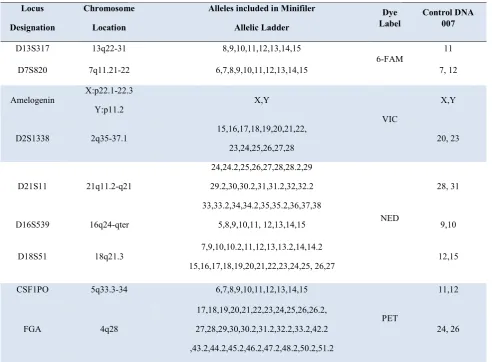
Loci information
correspond-ing dyes used. The AmpF/STR MiniFiler Allelic Ladder was used to genotype the analyzed samples. The alleles contained in the allelic ladder and the genotype of the control DNA 007 are also listed in the Table 1.
Results and Discussion
In this study, we achieved significant results for DNA extraction from bone. Important factors that influenced DNA identification were: time duration since death, envi-ronmental effects, chemical factors that permeate inside bone tissue, physical destruction of skeletal remains and type of bone available for sampling [5, 12]. When working with DNA from old bones, the main problem encountered was the low amount of DNA molecules, the presence of PCR inhibitors and DNA degradation. Inhibitors included environmental inhibitors or other metal ion-rich environ-ments that often go along with bone samples found in soil, but also exist other inhibitors that are naturally inherent in bones, such as calcium ions and collagen proteins [7]. All these factors often make the DNA extraction of bone very complicated and process of DNA typing mostly depends on choice of particular DNA extraction protocols. Quality control by using nanophotometer (IMPLEN) instrument and gel electrophoresis was showed the results are satisfac-tory (Fig. 1). After PCR, the PCR products were analyzed with genetic analyzer machine (Applied Biosystems, 3130XL) and STR profile of 9 loci were obtained (Fig. 2).
Efficient DNA extraction methods, as well as accurate DNA amplification are critical stages involved in the process of successful DNA identification of skeletal remains. The conventional kits that are commonly used for DNA extraction of bone rely on purification of extracted DNA with silica binding.
While in current study we attempted to discover new protocol for better results and without using conventional kits while simultaneously using these kits for evaluation of the ability to recover DNA from skeletal samples.
Figure 1. Agarose gel electrophoresis of DNA extracted by cur-rent method.
In our cases, post mortem period, environmental condi-tions, preservation of skeletal remains and available of bone samples were highly variable.
We were aware that environmental conditions, preserva-tion and type of bones would be important factors that in-fluence successful DNA extraction and purification. The environmental conditions such as temperature, humidity, pH value, and the general degree of microbial colonization in the soil are the environmental effects that have an im-portant role on DNA preservation [3-5].
Locus
Designation
Chromosome
Location
Alleles included in Minifiler
Allelic Ladder
Dye Label
Control DNA 007
D13S317 13q22-31 8,9,10,11,12,13,14,15
6-FAM
11
D7S820 7q11.21-22 6,7,8,9,10,11,12,13,14,15 7, 12
Amelogenin
X:p22.1-22.3 Y:p11.2
X,Y
VIC
X,Y
D2S1338 2q35-37.1
15,16,17,18,19,20,21,22, 23,24,25,26,27,28
20, 23
D21S11 21q11.2-q21
24,24.2,25,26,27,28,28.2,29 29.2,30,30.2,31,31.2,32,32.2 33,33.2,34,34.2,35,35.2,36,37,38
NED
28, 31
D16S539 16q24-qter 5,8,9,10,11, 12,13,14,15 9,10
D18S51 18q21.3
7,9,10,10.2,11,12,13,13.2,14,14.2 15,16,17,18,19,20,21,22,23,24,25, 26,27
12,15
CSF1PO 5q33.3-34 6,7,8,9,10,11,12,13,14,15
PET
11,12
FGA 4q28
17,18,19,20,21,22,23,24,25,26,26.2, 27,28,29,30,30.2,31.2,32.2,33.2,42.2 ,43.2,44.2,45.2,46.2,47.2,48.2,50.2,51.2
We found samples were discovered in arid environment are better than samples discovered from humid environ-ment, as well as the fact that burned samples have very trivial amount of DNA. Differences in quantity and quality of DNA could be ascribed to the respective environmental effects or to the respective preservation conditions. In order to develop a reliable method to extract DNA and to confirm the repeatability of obtained results, we used various samples of cadavers such as tooth, femur, hume-rus, tibia, jaw, rib, and cranium.
The best samples for DNA extraction of bone are tooth and femur and the decreasing order of best results are: > femur > tooth > tibia > fibula > humerus > radius > ulna [5]. Al-so, the bone sample of adults was better than children and older individuals due to the better compression.
Furthermore, for reliability, the profiles obtained from bone samples were confirmed by comparison of DNA pro-files obtained from blood sample of supposed living rela-tives. For DNA extraction with standard protocols, use of 1-2 g of bone powder is necessary, while with new proto-col, using 0.3 g of bone powder is sufficient. In our cases, post mortem period, environmental conditions, preserva-tion of skeletal remains and available of bone samples were highly variable. We were aware that environmental conditions, preservation and type of bones would be im-portant factors that influence successful DNA extraction and purification. The environmental conditions such as temperature, humidity, pH value, and the general degree of microbial colonization in the soil are the environmental effects that have an important role on DNA preservation [3-5]. We found that samples that were discovered in arid environment are better than samples discovered from humid environment, as well as the fact that burned samples have very trivial amount of DNA. Differences in quantity and quality of DNA could be ascribed to the respective environmental effects or to the respective preservation conditions.
Another benefit of the reduced amount of bone powder for DNA extraction was reduction of problems caused by in-hibitors. Our findings suggest that when more amount of bone powder is used, the quantity of co-extracted inhibi-tors also will increase and cause problems in extraction and purification of DNA.
Conclusion
DNA extraction from a diversity of samples is still a com-plicated venture in obtaining useful genotypes. Several procedures are currently used for DNA purification and extraction of degraded samples such as skeletal remains. However, due to low content of genomic DNA and high levels of environmental effects such as environmental chemical and physical degradation, bacterial effects, as well as the potential presence of environmental inhibitors that are co-extracted with DNA such as enzymatic and ions inhibitors, the recovery of DNA data from degraded samples is still a significant challenge. Environmental conditions that affect skeleton remains have stronger influ-ence on the state of DNA quality than the age of skeletal remains [1-5].
In selecting a DNA extraction method it is important that the method remove many inhibitors that may be at the same time get co-extracted with DNA yield. In the new method, due to use of less bone powder, the quantity of co-extracted inhibitors is decreased. As well as due to con-tained Chelex, many inhibitors such as metal ions and proteins are removed. We have demonstrated that the new procedure for DNA extraction from bone/tooth powder significantly increases quality and quantity of DNA yields and therefore, improves DNA typing results from degraded skeletal remains. We have shown that the new protocol clearly increases the quality of STR profiles recovered from degraded samples. Since the new procedure is fast and needs lesser time than previous standard procedures, we have named this method as FDEB (fast DNA extrac-tion of bone). Furthermore, this procedure has a less costly than other procedures. The extracted DNA in this method is suitable for DNA typing but is not suitable for other DNA experiments such as DNA cloning. FDEB method able to provide more complete profiles for bone samples that had been exposed to different environmental condi-tions. For checking reliability of this method, we tested in parallel the samples by using of QIAamp DNA Investiga-tor Kit and found similar results. To further authenticate results, the profiles obtained from bone samples were confirmed by comparison of DNA profiles obtained from blood sample of supposed living relatives.
References
1. Ariffin, S.H., Wahab, R.M., Zamrod, Z., Sahar, S., Razak., M.F., Ariffin, E.J., Senafi, S., Molecular archeology of ancient bone from 400 year old shipwreck. Asia Pacific J Mol Biol Bio-technol, 2007, Vol. 15(1), pp. 27-31.
2. Putkonen, M.T., Palo, J.U., Cano, J.M., Hedman, M., Sajantila, A., Factors affecting the STR amplification success in poorly preserved bone samples. Invest Genet, 2010, Vol. (1), pp. 9-15. 3. Loreille, O.M., Diegoli, T.M., Irwin, J.A., Coble, M.D., Par-sons, T.J., High efficiency DNA extraction from bone by total demineralization. Forensic Sci Int Genet, 2007, Vol. 1(2), pp. 191-195.
4. O'Rourke, D.H., Hayes, M.G., Carlyle, S.W., Ancient DNA studies in physical anthropology. Annu Rev Anthropol, 2000, Vol. 29(1), pp. 217-242.
5. Katzmarzyk, A.R., Parsons, T.J., Success rates of nuclear short tandem repeat typing from different skeletal elements. Croat Med J, 2007, Vol. 48, pp. 486-93.
6. Marjanović, D., Durmić-Pašić, A., Bakal, N., Haverić, S., Kalamujić, B., Kovačević, L., Ramić, J., Pojskić, N., Škaro, V., Projić, P., Bajrović, K., DNA identification of skeletal remains from World War II mass graves uncovered in Slovenia. Croat Med J, 2007, Vol. 48(4), pp. 513-519.
7.Vanek, D., Saskova, L., Koch, H., Kinship and Y-chromosome analysis of 7th century human remains: novel DNA extraction and typing procedure for ancient material. Croati Med J, 2009, Vol. 50(3), pp. 286-295.
8. Kalmár, T., Bachrati, C.Z., Marcsik, A., Raskó, I., A simple and efficient method for PCR amplifiable DNA extraction from ancient bones. Nucleic Acids Res, 2000, Vol. 28(12), pp. 67-71.
remains discovered in an alaskan glacier. J Forensic Sci, 2010, Vol. 55(3), pp. 813-818.
10. Kemp, B.M., Smith, D.G., Use of bleach to eliminate conta-minating DNA from the surface of bones and teeth. Forensic Sci Int, 2005, Vol. 154(1), pp. 53-61.
11. Bogdanowicz, W., Allen, M., Branicki, W., Lembring, M., Gajewska, M., Kupiec, T., Genetic identification of putative re-mains of the famous astronomer Nicolaus Copernicus. Proc Natl Acad Sci USA, 2009, Vol.106 (30), pp. 12279-12282.