Original Article
Comparing the Effects of Continuous Hormone Replacement Therapy
and Tibolone on the Genital Tract of Menopausal Women;
A Randomized Controlled Trial
Ziaei, Saeideh 1*; Masoumi, Raziyeh 1; Faghihzadeh, Soghrat 2
1- Department of Midwifery and Reproductive Health, Faculty of Medical Sciences, Tarbiat Modares University, Tehran, Iran 2- Department of Biostatistics, Faculty of Medical Sciences, Tarbiat Modares University, Tehran, Iran
Abstract
Introduction: Many postmenopausal women who are on hormone replacement
therapy discontinue medications due to vaginal bleeding. Tibolone, a synthetic
steroid, has minimal stimulatory effect on the endometrium. The aim of this study was to assess the effects of continuous HRT regimen and tibolone on the onset of vaginal bleeding and vaginal maturation value.
Materials and Methods: A total of 150 healthy women in postmenopausal period were randomly enrolled in this controlled clinical trial. Patients were randomly allocated into three groups, and were followed for six months. The first 50 women
received 2.5 mg tibolone plus a Cal+D tablet (500 mg Calcium and 200 IU vitamin
D) daily, the second 50 women received 0.625 mg conjugated equine estrogen and
2.5 mg medroxyprogesterone acetate (CEE/MPA) plus one Cal+D tablet daily, and
the remaining 50 received only one Cal+D tablet per day and served as the control group. Symptoms were recorded using a questionnaire that assessed vaginal bleeding or spotting, vaginal dryness and intention to continue the medications. Vaginal maturation value was assessed by examining vaginal smears before and after the treatment. The results for the three groups were analyzed using statistical methods.
Results: In comparison with the control group, CEE/MPA and tibolone increased
vaginal maturation value and decreased the frequency of vaginal dryness (p < 0.01).
Women in tibolone group were more likely to continue the treatment regimen than
those in the CEE/MPA or the control groups (p < 0.01).
Conclusion: Tibolone can serve as an appropriate choice for HRT as it has low rates of vaginal bleeding/ spotting episodes and high acceptance rate in postmenopausal women.
Keywords: Calcium, Hormone replacement therapy, Menopause, Tibolone, Vaginal
bleeding, Vaginal maturation value.
To cite this article: Ziaei S, Masoumi R, Faghihzadeh S. Comparing the Effects of Continuous Hormone Replacement Therapy and Tibolone on the Genital Tract of Menopausal Women; A Randomized Controlled Trial. J Reprod Infertil. 2010;11(3):183-87.
Introduction
any postmenopausal women use long-term hormone replacement therapy (HRT) and for most of them the potential benefits greatly outweigh its possible disadvantages or risks. Irregular bleeding occurs in up to 60% of HRT recipients which leads to discontinuation of the
therapy in up to one in three users (1 - 3). The management of HRT-associated bleeding prob-lems is invariably unsatisfactory, since there are no established methods for regulating or reducing the bleeding. This method is of clinical import-ance for a number of reasons. First, the potential
* Corresponding Author: Dr. Saeideh Ziaei, Department of Obstetrics and Gynecology, Faculty of Medical Sciences, Tarbiat Modares University, Tehran, Iran, P.O. Box: 14115-111.
E-mail:
Received: Apr. 7, 2010
Accepted: Jun. 30, 2010
HRT and Tibolone in Menopause Women
JRI
health advantages of HRT, apart from the meno-pausal symptom relief, require longer use to be of benefit, although expectation of unscheduled vaginal bleeding may deter many women from starting HRT. Second, erratic bleeding in post-menopausal women may be a presenting symptom of malignancies of the cervix, endometrium or ovaries; therefore, current management protocols which involve invasive and costly investigations, may further result in anxiety.
Tibolone is a synthetic steroid with tissue-specific actions. Following rapid conversion to
3
α
- and 3β
-hydroxy-metabolites and the Δ4-isomer, tibolone may engage the ER-
α
,express-ing estrogenic actions or the progesterone and androgen receptors and act as a progestogen-androgen (4). Tibolone has been administered in Europe as an effective alternative to continuous HRT in treating climacteric symptoms and vaginal atrophy, in improving libido and in preventing bone loss (5) with minimal stimulatory effect on the breasts (6, 7) or endometrium (8). These data, however, mostly result from observa-tional studies, while results from randomized controlled trials are highly needed to reach a common conclusion.
This randomized controlled trial was undertaken to assess the effects of continuous HRT and tibolone regimen on the frequency of spotting/ bleeding episodes and vaginal maturation value (VMV) in menopausal women.
Materials and Methods
A total of 150 healthy postmenopausal women, aged 45-60 years, whose last menstrual period
was more than a year ago and had a plasma 17
β
-estradiol < 35 pg/ml were enrolled in the study.
The subjects were referred from Fadjr Hospital and a private clinic in Tehran, when they had attended to seek medical advice about their menopause. None of the participants had been treated with hormones known to influence vaginal bleeding during the preceding six months before the study. The initial screening included taking a medical history, and doing physical and gynecological examinations.
Patients were randomly allocated into three groups, according to a computer-generated list of random numbers, and were followed for six
months. Fifty women received 2.5 mg tibolone
(Tibofem, Cipla Ltd., India) plus one Cal-D tablet
(Calcium 500 mg and vitamin D 200 IU),
(Pharmachemi Ltd., Iran) on daily bases, 50
women received 0.625 mg conjugated equine
estrogen plus 2.5 mg medroxyprogesterone
acet-ate (CEE/MPA), (Aboreihan Ltd., Iran) plus a daily Cal+D tablet, and the remaining 50 women received only a Cal+D tablet and served as the control group.
Symptoms were recorded using a questionnaire that assessed vaginal bleeding or spotting, vaginal dryness and intention to continue the medications. The data were collected before and three and six months after the intervention. The following def-initions were used for bleeding/spotting record-ings:
Bleeding: any vaginal flow requiring more than one sanitary napkin per day.
Spotting: any vaginal flow requiring not more than one sanitary napkin per day.
Estrogenisation of the vagina was assessed by performing vaginal smears before and after the treatment by drawing the rounded part of a spatula from the upper portion of each lateral vaginal wall to the lower part of the organ. The resulting speci-mens were thinly smeared onto a slide and immediately fixed by 95% ethyl alcohol. Vaginal smears were examined by a skilled pathologist. Vaginal Maturation Value (VMV) was calculated by multiplying the percentage of cell types by a weighting factor and then adding up the total. The weights applied were: superficial cells 1.0; intermediate cells 0.5; Para basal cells 0.
Blood chemistry tests were performed for sex hormone binding globulin (SHBG) and the free estradiol index (FEI = estradiol ×100/ SHBG). The levels of SHBG and estradiol were deter-mined using ELISA (manufactured by IBL and DRG kits, respectively). Samples were handled in identical, blinded fashion throughout the study. They were analyzed in triplicate and in random order so as to reduce system bias and interassay variations. All the measurements were repeated after six months of commencing the study.
For a better evaluation of vaginal bleeding, the endomerium was assessed by sonography, and when endometrial double-wall thickness was
more than 5 mm, additional biopsies were
per-formed.
This study was approved by the Ethic Commit-
Ziaei S, et al.
JRI
tee of Tarbiat Modares University and the participaants signed an informed consent form.
Statistical Analysis: The χ2, Kruskal Wallis and
Wilcoxon signed rank tests were used for the analysis of non-parametrical data. For the analysis of parametric data, Tukey adjustment for the comparison of means (ANOVA) and paired T-test
were used. The significance level was set at p <
0.05. All confidence intervals were calculated at the 95% level.
Results
One-hundred and fifty postmenopausal women participated in this study. Four women withdrew from the study in the first month due to breast tenderness in three women and fear of breast cancer in another. During the study two women in the tibolone group, six women in the continuous HRT group and one in the control group inter-rupted the treatment before the third month due to vaginal bleeding or prolonged vaginal spotting. Finally, 47 women in the tibolone group, 42 women in the CEE/MPA group, and 48 women in
the control group completed the six- month period of the study.
No individual with bleeding or spotting was found to have endometrial hyperplasia in endo-metrial biopsy.
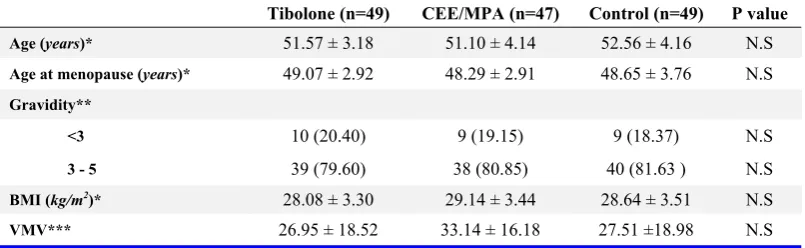
There were no statistically significant differ-ences among the three groups for parameters including age, age at menopause, gravidity, BMI and VMV shown in Table 1 before the treatment.
The CEE/MPA group had higher incidence of bleeding and spotting episodes than the tibolone and control groups during the first three months (Table 2).
There were no statistically significant differ-ences in the initial data (Table 3) among the three groups. In the tibolone group, vaginal maturation value (VMV) and free estradiol index (FEI) increased while the number of women with vaginal dryness and sex hormone binding globulin
(SHBG) decreased significantly (p < 0.05). In the
CEE/MPA group, VMV and SHBG increased and the number of women with vaginal dryness
decreased significantly upon treatment (p <
Table1. Comparing the demographic data among the three groups of menopausal women on HRT, Tibolone and placebo (M ± SD or n (%))
Tibolone (n=49) CEE/MPA (n=47) Control (n=49) P value
Age (years)* 51.57 ± 3.18 51.10 ± 4.14 52.56 ± 4.16 N.S
Age at menopause (years)* 49.07 ± 2.92 48.29 ± 2.91 48.65 ± 3.76 N.S
Gravidity**
<3 10 (20.40) 9 (19.15) 9 (18.37) N.S
3 - 5 39 (79.60) 38 (80.85) 40 (81.63 ) N.S
BMI (kg/m2)* 28.08 ± 3.30 29.14 ± 3.44 28.64 ± 3.51 N.S
VMV*** 26.95 ± 18.52 33.14 ± 16.18 27.51 ±18.98 N.S
*ANOVA test, ** χ2 test,***Kruskal wallis test
Table 2. Bleeding / spotting (B/S) episodes among the three groups of menopausal women on HRT, Tibolone and placebo (M ± SD or n (%))
Tibolone
group (n:49) group (n:47) CEE/MPA Control group (n:49) Pa* Pb* Pc*
Women reporting B/S episode during the 6 months 14 (28.57) 28 (59.54) 9 (18.36) <0.05 N.S <0.01
Number of B episode during the first 3 months 0.14 ± 0.45 0.69 ± 1.02 0.24 ± 1.30 0.03 N.S <0.01
Number of B episode during the second 3 months 0.12 ± 0.38 0.26 ± 1.09 0.18 ±1.27 N.S N.S N.S
P** N.S <0.01 N.S - - -
Number of S episode during the first 3 months 0.20 ± 0.81 0.74 ± 1.21 0.22 ± 1.29 <0.01 N.S <0.01
Number of S episode during the second 3 months 0.46 ± 1.21 0.36 ± 1.10 0.24 ± 1.33 N.S N.S N.S
P** N.S <0.01 N.S - - -
Pa, P-value between tibolone and CEE/MPA groups, Pb, P-value between tibolone and control groups, Pc, P-value between CEE/MPA and control
groups,* χ2 test, Kruskal wallis test,**Wilcoxon signed rank test
HRT and Tibolone in Menopause Women
JRI
0.001). There were significant differences be-tween the tibolone and CEE/ MPA groups for SHBG, FEI and the number of women with
vaginal dryness (p < 0.001). In comparison with
the control group, CEE/MPA and tibolone in-creased VMV and dein-creased the number of
women with vaginal dryness (p < 0.01). Women
in the tibolone group were more willing to continue the medication in comparison with the
CEE/MPA and the control groups (p < 0.01).
Discussion
The purpose of administering continuous HRT is to prevent scheduled bleeding and improve compliance among women wishing to remain amenorrheic. However, women on continuous HRT may still develop unscheduled bleeding, a serious and disturbing adverse event which may influences their decision to whether terminate or adhere to the treatment.
Accepted treatment modalities have been re-evaluated in varying estrogen-progestin dose ratios and alternative therapies have been con-sidered in an attempt to alleviate their side-effects (9). Furthermore, investigators have focused on identifying the biological mechanisms responsible for the occurrence of unscheduled bleedings. Unscheduled bleedings may be influenced by factors such as menopausal age, BMI, the level of endogenous estrogens and its corresponding effect on mucosal changes in the genital tract (2).
The present study was designed to examine the effects of tibolone on the genital tract in postmen-pausal women compared with that of continues HRT over a 6-month period.
In the present study, the prevalence of bleeding / spotting episodes in continues HRT was signifi-cantly higher as compared to tibolone and the
controls. This study supports the results of studies that depict a lower bleeding/ spotting episodes for tibolone intake, than continues HRT (2, 10, 11).
In order to acquire objective data, we practically used the hormonal milieu of the body and measured VMI. Vaginal maturation, as assessed by VMI, vaginal dryness and FEI are highly reliable predictors of genital tract mucosal changes following different treatment regimens. Significant differences in mean VMI, the number of women with vaginal dryness and FEI were observed in women in HRT and tibolone groups in comparison with the control group as similarly reported by several other investigators (12, 13).
We have shown here by cytological analysis that six months of tibolone therapy produces a signifi-cant, sustained oestrogenic effect on the vagina and tibolone in comparison to CEE/MPA signifi-cantly had lower bleeding/spotting episode rate.
Tibolone decreased vaginal dryness, as seen in our previous study and improved sexual dysfunc-tion in comparison with CEE/MPA (14).
As sexuality is an important aspect of health that affects the overall well-being of postmenopausal women, tibolone can be an appropriate choice for HRT in postmenopausal women as it has low bleeding/ spotting episodes.
Tibolone increased fat free mass without any increase in weight or fat mass in postmenopausal (15). As adipose tissue has adverse effects on vaginal bleeding due to undesirable hormonal changes, this beneficial effect may cause low vaginal bleeding in individuals taking tibolone.
The limitation of this study was lack of endometrial assessment by regular sonography, unless vaginal bleeding or spotting was the case. In osteoporosis prevention and arterial effects of tibolone study (OPAL), endometrial thickness Table 3. Comparing the three groups of menopausal women before and after treatment with HRT, Tibolone and placebo (M ± SD or n (%))
Tibolone group (n=47) CEE/MPA group (n=42) Control group (n=48)
before after P* before after P* before after P* Pa** Pb** Pc**
VMV 26.95±18.52 53.07±19.50 <0.001 33.14±16.18 51.65±21.29 <0.001 27.51±18.98 29.41±18.75 N.S N.S <0.01 <0.01
Women who
like to continue - 38(81.06) - - 31(73.80) - - 34(70.8) - 0.001 0.002 N.S
Women with
vaginal dryness 36(73.46) 33(67.34) <0.01 34(72.34) 20(40.00) <0.001 36(72.00) 37(74.00) - <0.001 <0.01 <0.001 SHBG 38.33±13.95 23.01±10.50 <0.001 45.92±15.30 74.86±36.30 <0.001 45.27±22.10 40.50±20.81 N.S <0.001 <0.001 <0.001
FEI 0.31±0.45 0.49±0.44 0.021 0.20±0.09 0.16±0.20 N.S 0.21±0.18 0.26±0.25 N.S <0.001 0.01 <0.01
Pa, P-value between tibolone and CEE/MPA groups, Pb, P-value between tibolone and control groups, Pc, P-value between CEE/MPA and control groups,* paired t test, χ2 test,
Wilcoxon signed rank test,** ANOVA (Tukey) test,kruskal wallis, χ2 test
Ziaei S, et al.
JRI
measured by transvaginal ultrasound increased slightly during the first year on tibolone and CEE/MPA, but no further progression occurred after three years (11).
Conclusion
The rate of bleeding/ spotting episodes decreased progressively in CEE/MPA group after three months of treatment. Tibolone was generally well-tolerated and the overall continuation rate was significantly higher. It seems that tibolone can be an appropriate choice for HRT due to lower rates of bleeding/ spotting episodes and higher
accept-ance rate in postmenopausal women.
Acknowledgement
We express our thanks to the kind cooperation of the participating patients. We appreciate CIPLA Company for supplying Tibofem tablets. We would also like to thank Mrs. Moghadam who helped us in this respect. Our study had no competing interest and was funded by Tarbiat Modares University.
References
1. Hickey M, Higham J, Sullivan M, Miles L, Fraser IS. Endometrial bleeding in hormone replacement therapy users: preliminary findings regarding the role of matrix metalloproteinase 9 (MMP-9) and tissue inhibitors of MMPs. Fertil Steril. 2001;75(2): 288-96.
2. Christodoulakos GE, Botsis DS, Lambrinoudaki IV, Papagianni VD, Panoulis CP, Creatsa MG, et al. A 5-year study on the effect of hormone therapy, tibolone and raloxifene on vaginal bleeding and endometrial thickness. Maturitas. 2006;53(4):413-23.
3. Mirkin S, Navarro F, Archer DF. Hormone therapy and endometrial angiogenesis. Climacteric. 2003;6 (4):273-7.
4. de Gooyer ME, Deckers GH, Schoonen WG, Verheul HA, Kloosterboer HJ. Receptor profiling and endocrine interactions of tibolone. Steroids. 2003;68(1):21-30.
5. Modelska K, Cummings S. Tibolone for postmeno-pausal women: systematic review of randomized trials. J Clin Endocrinol Metab. 2002;87(1):16-23. Review.
6. Lundström E, Christow A, Kersemaekers W, Svane
G, Azavedo E, Söderqvist G, et al. Effects of tibolone and continuous combined hormone replace-ment therapy on mammographic breast density. Am J Obstet Gynecol. 2002;186(4):717-22.
7. van de Ven J, Donker GH, Sprong M, Blankenstein MA, Thijssen JH. Effect of tibolone (Org OD14) and its metabolites on aromatase and estrone sulfatase activity in human breast adipose stromal cells and in MCF-7 and T47D breast cancer cells. J Steroid Biochem Mol Biol. 2002;81(3):237-47. 8. Schatz F, Kuczynski E, Kloosterbooer L, Krikun G,
Buchwalder LF, Rahman M, et al. Tibolone exerts progestational inhibition of matrix metalloproteinase expression in human endometrial stromal cells. Steroids. 2006;71(9):768-75.
9. Bruhat M, Rudolf K, Vaheri R, Kainulainen P, Timonen U, Viitanen A. Effective bleeding control and symptom relief by lower dose regimens of continuous combined hormone replacement therapy: a randomized comparative dose-ranging study. Maturitas. 2001;40(3):259-71.
10. Huber J, Palacios S, Berglund L, Hänggi W, Sathanandan SM, Christau S, et al. Effects of tibolone and continuous combined hormone re-placement therapy on bleeding rates, quality of life and tolerability in postmenopausal women. BJOG. 2002;109(8):886-93.
11. Langer RD, Landgren BM, Rymer J, Helmond FA; OPAL Investigators. Effects of tibolone and continuous combined conjugated equine estrogen/ medroxyprogesterone acetate on the endometrium and vaginal bleeding: results of the OPAL study. Am J Obstet Gynecol. 2006;195(5):1320-7. 12. Morris EP, Wilson PO, Robinson J, Rymer JM.
Long term effects of tibolone on the genital tract in postmenopausal women. Br J Obstet Gynaecol. 1999;106(9):954-9.
13. Nijland EA, Weijmar Schultz WC, Davis SR. Effects of tibolone and raloxifene on health-related quality of life and sexual function. Maturitas. 2007; 58(2):164-73.
14. Ziaei S, Moghasemi M, Faghihzadeh S. Compara-tive effects of conventional hormone replacement therapy and tibolone on climacteric symptoms and sexual dysfunction in postmenopausal women. Climacteric. 2010;13(2):147-56.
15. Ziaei S, Moaya M, Faghihzadeh S. Comparative effects of continuous combined hormone therapy and tibolone on body composition in postmen-pausal women. Climacteric. 2010;13(3).249-54.