University of New Orleans University of New Orleans
ScholarWorks@UNO
ScholarWorks@UNO
University of New Orleans Theses and
Dissertations Dissertations and Theses
5-16-2008
Evolution: The Progress of a Painter
Evolution: The Progress of a Painter
Rachel Jones
University of New Orleans
Follow this and additional works at: https://scholarworks.uno.edu/td
Recommended Citation Recommended Citation
Jones, Rachel, "Evolution: The Progress of a Painter" (2008). University of New Orleans Theses and Dissertations. 655.
https://scholarworks.uno.edu/td/655
This Thesis is protected by copyright and/or related rights. It has been brought to you by ScholarWorks@UNO with permission from the rights-holder(s). You are free to use this Thesis in any way that is permitted by the copyright and related rights legislation that applies to your use. For other uses you need to obtain permission from the rights-holder(s) directly, unless additional rights are indicated by a Creative Commons license in the record and/or on the work itself.
Evolution: The Progress of a Painter
A Thesis
Submitted to the Graduate faculty of the University of New Orleans
in partial fulfillment of the requirements for the degree of
Master of Fine Arts In
Fine Arts
by
Rachel Amanda Jones
ACKNOWLEDGEMENTS
I would like to thank the entire Fine Arts Faculty for their help and support. In particular, I would especially like to thank my advisor Richard Johnson, Cheryl Hayes, Lawrence Jenkins, and Jim Richard. I would also like to thank my partner, Fernando Braxton and my family for their patience, love, and support.
TABLE OF CONTENTS
List of Illustrations... iv
Abstract ... v
Introduction ... 1
Evolution (Or the Way Out is Through) ... 2
Found Imagery as a Foundation ... 10
Why Painting ... 12
Freedom... 14
Discussion of a Work... 17
Paintings as Installations ... 22
Conclusion... 26
Bibliography ... 27
LIST OF ILLUSTRATIONS
Figure 1 Untitled (Carrying)... 3
Figure 2 National Geographic...7
Figure 3 Apocalypse (Explosion)... 17
Figure 4 Arthur Dove, Sun... 19
Figure 5 Francisco de Zurbaran, St Francis of Assisi... 19
ABSTRACT
This analysis explores the progression of my work over the past three years of
study. My initial pursuits involved ideas that revolved around contemporary feminism,
however, with time I expanded upon those ideas by exploring other subjects. I realized
the connection in all of my work lies in the use of manipulated found imagery, and the
desire to release this imagery from the confines of traditional pictorial space. With this
discovery, I became free to utilize any manner of subjects, as the subject matter relied
heavily on the finding and re-interpreting of these disparate images into the language of
paint. Moreover, specific modes of thought, such as Feminism, were allowed to become
single threads in a diverse, complex tapestry.
Keywords: Painting
INTRODUCTION
In my painted works, I wish to create a world that is full of suggestive
information, yet lacks specificity, a place where abstraction, representation, and the void seem to merge. Mining the vast amount of printed and reproduced photographic imagery for sources, I try to isolate imagery that has some sort of resonance rather than meaning, and then use this imagery as a catalyst for the creation of painted works. Overall, the meaning of each work lies in the exploration of the significance of the specific juxtaposed imagery, combined with the sensuality of the painted surface. In subtle ways, I would like my work to relate to the overarching themes of mortality, spirituality and sexuality, however, I enjoy works that are ‘open’, and that contain many layers of meaning. I strive to retain that quality in my work. By overflowing the traditional pictorial rectangle, and combining many painted pieces into single paintings, I hope to generate an experience that evades easy categorization. Ultimately, I hope to merge the practices of painting and installation and present worlds that can only exist in this amalgamated territory.
EVOLUTION (OR: THE WAY OUT IS THROUGH)
“The past is never dead. It’s not even past.” William Faulkner
Over the course of the past few years I have been working in an unfettered manner of painting that has allowed me to explore a reasonable range of subjects- however, I have gravitated most notably toward largely representational images of the female form. As a student of history, I was very much aware of the weight of this subject. The female form has been used in a plethora of ways historically, however, it is certain that most
representations were produced by male artists and/or dictated by male patrons. Following this logic, historical works are to be viewed through that lens and contemporary female artists have a unique opportunity; they can now mine the past and create works that re-imagine themselves as both the beneficiaries of this inheritance and the critics of it. This mode of discourse has been nearly exhausted throughout the last half of the 20th century, though its motives are obviously still potent. Feminism in visual art has taken a legion of forms, and some modes of thought and production are more sustainable than others. In our present time, the status of ‘Feminism’ as a whole cannot be easily determined, because in true postmodern form, there have been too many offshoots and related movements, theories, and philosophies developed to be fully measured. Moreover, ‘Feminist art’ as we know it has been around for over 50 years, and now has an
are in fact simply a backlash against the thoughts of previous Feminist generations, and that Feminism in general is no longer relevant.
In spite of all this, I still felt compelled to explore the limits of the Feminist mode of art making, particularly in regards to the female self-portrait. I had an interest in the psychological impact of presenting oversized images of un-idealized female forms. I also had an interest in postmodern reconfigurations of Feminism, particularly the idea that representations of women by women could be presented in a way that undermines the historical seductiveness of the images.1
Figure 1: Untitled (Carrying), 2006, Oil on Synthetic Paper, 60x72”
The idea that contemporary representations of women were reflective of an overall
damaged state was also something that intrigued me, as well as incorporating the idea of
the grotesque. However, in contrast to older postmodern ideas, and perhaps in an effort to
put a more contemporary spin on it, I was schizophrenically still flirting with the ideas of
beauty and pleasure.
The painting, Untitled (Carrying), was the first of these explorations. I was interested in
creating a dramatic scene between two women who appeared to be, possibly, the same
individual doubled, but are actually taken from photos of myself. Both figures seem to
be unaware of the presence of the other, and though there is an appearance of a struggle
or conflict, they each radiate an ambivalence that leaves viewers unsure of their actual
condition. The figures are certainly animated, yet one gets the impression that neither of
them is in full control of their motion. Both figures are situated in a white field of
nothingness, a void. The title suggests that one figure is indeed carrying the other,
however, it appears as if they are both falling, making it hard to assign a dominant role to
either figure. The bodies are painted in a very sensuous style, with emphasis on pinkish
flesh-tones and exaggerated swathes of pigmented flesh.
The raw, un-idealized qualities of the figures themselves contrast the typical romanticized
damsel-in-distress imagery that these poses could conjure. The grotesqueness of the
scene cannot be denied; there are several intentional features that create this effect. The
generous exaggeration of the flesh tones can be interpreted as bruised or damaged skin,
and lends a ‘dirty’ feel to the figures, particularly in regards to the limbs and soles of the
themselves from the dark drama and become caught up in the corporeal nature of the
paint. Upon closer inspection it becomes evident that an extra limb hangs, seemingly,
from the body of the figure on top. A definite explanation of this aberration cannot be
found in the work. It is possible that the figure on top is abnormal, or simply that
another body exists in the field behind the main figure, hidden from our view. In either
case, with the discovery of this feature, both figures loose a bit of their harmlessness and
take on a more monstrous, sinister air.
A very literal Feminist interpretation can be found in a simple examination of the work.
The image of the women in a state of struggle/power/helplessness/apathy, to me, has
parallels in small-scale everyday issues as well as over-arching issues in the women’s
movement. The everyday struggles of life, for everyone, not just women, take the
individual through a range of emotional states daily. Also, the fluctuations in the health
of the women’s movement in the last 60 years could be said to relate to the erratic,
ambivalent emotional states portrayed. The choice to use myself as the template or a
stand-in for an ‘every woman’ is deliberate, however, not obvious to the viewer who is
unfamiliar with myself or my work, and is not necessarily essential to the decoding of the
work. Also, the image of the woman is not universal, she is specific, so the work also
becomes about personal female identity issues, which could be said to relate to the
Feminist theme as a whole.
This work, admittedly, is not easily explained and there are many ways in which it
contradicts itself. I believe this work is a complicated example of my foray into the
work within the strict confines of Feminism is a dangerous move. However, the dual
nature of this work is precisely what I was attempting to communicate, a simultaneous
attraction/repulsion. An attraction exists in relation to the sensuality of the paint as well
as the fleshy female figure, and repulsion exists in relation to the grotesqueness and
ambiguity of the context. Many Feminist works contain repulsion-for-repulsion’s sake
and, obviously, history resounds with paintings full of beauty-for-beauty’s sake. I
wanted to contain it all within one work, if possible.
However, over time, I began to believe I had either used up the potential this feminine
imagery had possessed, or I had not been able to successfully harness it. I feared the
work had too much potential for being misinterpreted, and I began to lose interest. I had
the desire to wipe the slate clean and begin thinking about the simple, formal implications
of the work, and rebuild from there.
At this time I also began experimenting with the actual materials I was using. For the
year before this, I had been working on a slick synthetic paper that allowed a lot of
freedom in terms of painting style. I was interested in continuing to work with this
material, but I felt I needed to utilize it better. During this time, I had also been working
within the confines of the traditional rectangular picture plane. I realized I could take
better advantage of the thin synthetic paper by allowing the paintings to exist in their
own, unique space by cutting the figures out. I was already placing figures into plain,
white voids, so the transition from defined rectangular space to the gallery wall was a
natural, easy progression. This eventually led me to entertaining the idea of creating
With this new direction in terms of production, I found the isolated, ambiguous
female figures were evolving into more complicated paintings, in regards to both form
and content. With much critical self-examination I began to realize that, for me, the
concept of the work had become as much about the creation/discovery of the actual
photographic images used to produce the works as it had the feminist or historical
overtones. I realized the paintings could contain many layers of meaning, and could
relate to both formal and conceptual issues.
Figure 2: National Geographic, 2007, Oil on Cut Synthetic Paper, 90x52”
The painting, National Geographic, evolved during this time of exploration and
dimensions of the wall it is displayed on. The woman came from a found Internet-based
image, and the imagery on the body was composed from a collage made from random
images of landscapes taken from a volume of National Geographic Magazine. This work
is quite large, and the overbearing, ominous presence of an obese, larger-than-life woman
is simultaneously frightening and empowering. However, to experience the work in
person and close-up is to become lost in the painted textures and folds, which contrast the
logical anatomy of the figure. The viewer is invited to become engrossed in the illusions
of the painted surface. Many layers of meaning can be found here. There is a very
obvious allusion to the ‘body as landscape’ cliché, as well as the reoccurring feminist
themes I was still toying with.
However, it seemed that the new works were beginning to outgrow their origins. The
means I was using to construct a painting were becoming much more exciting to me than the
essentiality of the female subject. I began to realize that I was, and always had, essentially been
isolating and then translating carefully structured photographic information into paint. During
the entire process, I had been using staged photographs of myself as well as relentlessly
collecting found imagery of all kinds to build up an archive that was forming the base of all of
the works created during this time. The need to forage and construct imagery to use as a
reference to paint ‘from’ had always been a non-issue to me; I had always worked this way and I
had yet to question it. It was beginning to occur to me that it was at the root of all my work.
Borrowing from, and the use of, every manner of imagery, without respecting ‘high’ and ‘low’,
from art history to Internet pornography was beginning to emerge as central. In the early stages,
always explored, and I used it as a means. I was now becoming freer to include all sources and
FOUND IMAGERY AS A FOUNDATION
As the age of technology that we have the privilege of participating in progresses,
it becomes obvious that specific modes of communication are breaking down, while
others have grown at a rate that was once considered healthy, and has now proven to be
crushingly overwhelming. The plethora of produced and manipulated images that we are
confronted with, as well as expected to digest daily, is astounding. The constant barrage
eventually results in a form of desensitization in which the images are no longer seen as
bearers of specific kinds of information, but rather a form of visual ‘noise’. Meanings
become lost. The author’s intentions are uncertain. With the advent of the Internet and
other undefined visual sources, we actually can never be truly sure who the author is. As
a result it is impossible to fully understand the original context of the events portrayed in
a photograph, which is in fact one of the easier forms to define; graphics, illustrations,
and a range of other indefinable forms also exist in this realm of visual ‘noise’. So we
are left with incomplete bits of visual information, all of which could fall into what
Barthes called the ‘studium’, the class of unremarkable (and ultimately indecipherable)
images. Naturally, these images do not fall easily into the prescribed categories of ‘high’
and ‘low’. They exist independent of such categories, as the viewer does not have enough
information to classify anything, which leads to the conclusion that such an action is
pointless. With a legion of anonymous images of all sorts at the artist’s fingertips, the
designation of ‘high’ and ‘low’ dissolves, and the artist is free to explore a new mix of
sources. However, not in the ironic, distancing way of previous Pop art generations, but
‘Artistes bruts’ or naïve artists have often been the only individuals truly capable of
working this way, as they have no knowledge of historical precedents and contemporary
categories. I aspire to use borrowed imagery much in the way naïve artists often have: I
wish to steal imagery, lift figures from narratives, take them out of context, disorientate
them, and re-enchant them. I also desire for some of the qualities of the original imagery
to remain, so I use methods of copying that are sometimes primitive or coarse. I often
trace, or use projections to retain the exact crispness (or conversely, the non-clarity) of
the found imagery. Like the untrained artist, I make no effort to hide this process; I feel it
is an important part of the work. A major difference, however, is my knowledge of the
artistic heritage and the implications of my actions.
So, the collecting and the slowly dismantling of images plucked from the surplus
of available imagery becomes ‘a way’ to begin to compose a painting. Elements are
borrowed from varied sources, picked apart, and then reassembled in a manner that forms
WHY PAINTING?
“Painting is one of the great visionary tools ever invented, and among the most effective ways to alter reality, see it better, or invent a new one. Painting gives permission, it doesn’t ask for it; it not only explores consciousness, it changes it.”
Jerry Saltz, Seeing Out Loud
The burden of the history of painting coupled with the frequent declaration that
painting is ‘dead’ cannot help but create much anxiety among younger generations of
painters. However, for me, the question “how can I paint?” is always followed
immediately with the answer, “how can I not paint?”. The outcome of the processes
described earlier could easily result in works that were in a variety of media, most
evidently photo collage or bricolage. So, the question remains, why painting? I trust
sincerely that painting has the ability to communicate in a manner that cannot be
duplicated in any other medium. There are manners of working with paint that produce
worlds than can only exist within the realm of painting, and within the discourse that has
been spawned by earlier generations of painted works and their authors. In this process,
the paintings actually become very much about painting itself, as all painting since
Modernism and then Conceptualism could be said to be. I am able to fluctuate easily
between the realms of representation and abstraction, as it could be said that paintings
now do not exist to represent an image, but the image exists to represent the painting. In
other words, contemporary paintings represent not only the singular ‘painting’, but also
I must believe, as well, that in the end, the paintings outgrow their sources; that the
disparate elements are somehow elevated to a new state that has the ability to
communicate on another plane. While I share Gerhard Richter’s suspicion in regards to
doubt and belief in painted works2, I think those issues and anxieties have now been
canonized and resolved to an extent, and the new era ushers in a new set of problems in
regards to belief and irony/sincerity. In regards to my own work, I know that I must
‘believe’ in the works themselves; I must trust in their ability to transcend utilitarian
value.
Ultimately, working in this manner confirms painting’s significance. There are
views that cannot accurately be expressed in any other way, and there is an established
discourse that cannot be engaged by any other medium.
2 Storr, Robert. Gerhard Richter: Doubt and Belief in Painting. New York: Museum of Modern Art, 2003,
FREEDOM
“Freedom would be not to choose between black and white but to abjure such prescribed choices.”
Theodor Wiesengrund Adorno
By choosing to work in an unrestrained way in which disparate composite images
are translated, I am also acknowledging that an obsessive preoccupation with a particular
style of painting would be counterproductive. My commitment is to each painting as it
develops; I try to avoid forcing myself to work in a particular style. Each work is an
amalgamation of varied imagery, and I would like to think that a great number of
combined painting styles inform the works as well. As stated, I am mindful of historical
precedents and I am heavily influenced in terms of style by a number of painters credited
with the beginnings of Modernism or self-conscious painting. The flatness of the works
of Manet as well as the saturation of the works of Gauguin have made an impression.
The late works of Neil Jenny have been instrumental to my development as well. I am
fascinated by the idea of the rejection of ‘good’ painting. However, in the end, that too
can become too prescriptive in terms of a group style. While I acknowledge that the
development of a personal style is hard to avoid, I do my best to disregard the boundaries
of what we consider to be historical categories of ‘style’.
I also tend to reject notions of strict boundaries between the worlds of
‘representation’ and ‘abstraction’. I fluctuate between the two supposedly different
domains, choosing ‘when’ to operate in a mimetic way and when to make marks that
on observation of the natural world, can never be truly exact; they can never be perfectly
flawless representations. The translation of visual information to form will always result
in abstraction. All two-dimensional works are inherently abstract, to varying degrees. So
the anxiety caused by the definite labeling of one or the other is ultimately unnecessary.
I also feel that in working this way, I have the freedom to exploit imagery that has
the power to be abundantly suggestive and yet, has the potential of remaining
meaningless; to be simultaneously full and empty. I know full well this is dangerous
territory, and many artists have here met their peril. Often, it has been said that the
dividing line between the academic and the naïve artist lies in the trained artists’ desire to
control every aspect of her expression.3 I do take full responsibility for the work I
produce, and I do wish to participate in, if not dictate, the discourse surrounding the
work. However, I truly intend for the specific meaning of a work, if any, to be discovered through the exploration of the juxtaposed elements, as well as an
acknowledgement of the self-referential nature of the history of painting. I intentionally
choose imagery that I feel has some sort of a resonance. In doing this, I try to avoid easy
answers and work that feels over-resolved; for I truly believe that ‘nothing whole is ever
complete’. I propose that if you picture something exactly you eventually diminish its
impact, and I have never wanted to be overly concerned with ‘picturing’. There are
always ‘issues’ surrounding the work, things that occupy my mind at the time of
production, as well as reasons, both deliberate and subconscious, that I choose particular
imagery, as well as the time that I ‘find’ it. I subscribe to the ‘magpie’ aesthetic,
rummaging until images begin to surface that appeal to me aesthetically and feel as
though they are open enough for me to utilize conceptually. I must be convinced that an
DISCUSSION OF A WORK
Figure 4: Apocalypse (Explosion), Installation View, 2007, Oil on Cut Synthetic Paper, 108x96”
The painting, Apocalypse (Explosion), can be dissected in a number of ways.
I will mention the sources for the sake of full disclosure; revealing the origins of
borrowed imagery is not a device I intend to use in a routine viewer/artwork encounter.
The base photo of the figure of the old man was plucked from a magazine photo of a
group of elderly joggers. The explosion image was taken from an Internet photograph of
a bomb detonation in Iraq. Both images were isolated from larger photos that contained a
lot of other visual information.
The posture of the old man may be interpreted one of several ways: he is possibly
implications of either scenario could be harmless or devastating. It is possible that he is
looking up at a kite, or at a missile. He could be trying to catch his breath after a light jog
or gasping for air during a heart attack. It is assumed that he may be reacting to the large,
ambiguous cloud explosion to his left. However, his attention is focused upward, not in
the direction of the explosion, and that conclusion seems unlikely. He actually seems
oblivious to the event on his left. It is quite possible that he is simply confused or
disoriented.
I am mindful of each of these interpretations while I am composing the work, and
I take careful steps to insure that many roads are possible. Either way, most can agree
that the scene is simultaneously comical and disturbing. The title, Apocalypse, at first
leads us back to a darker analysis; however, to know the actual meaning of the word
‘apocalypse’ is know that it can simply suggest a moment of irreversible change, and not
necessarily the Biblical End of Days. The layers of meaning within the title echo the
tension created by the multi-faceted reaction of the individual.
The blast to the left is large and colorful; it almost has a floral quality. It has the
character of a sun, or even something edible. It seems friendly enough, however the title
indicates that it is indeed an explosive event. There is no obvious indication of its origins
or whether it is in fact tangled into the evolving narrative of the old man. An event of
this magnitude could warrant a reaction similar to the man’s, however; we do not have
enough direct information to make an accurate narrative congeal.
I am careful to be aware of all of the possible interpretations, so as to reasonably
that fluctuates back and forth from present-day world events to religious and historical
iconography.
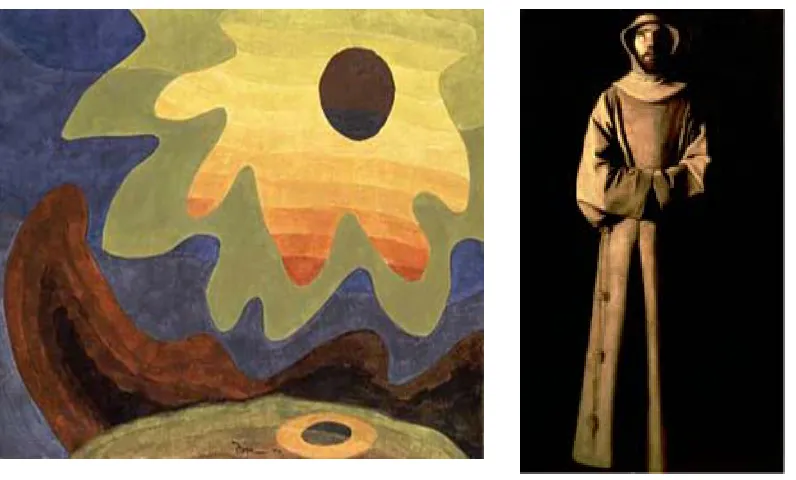
Two specific art historical images heavily influenced Apocalypse (Explosion),
both consciously as I was choosing the images to work from and later when I realized
that specific imagery I had been exposed to had directed my choice of imagery.
Figure 5: Arthur Dove, Sun, Oil on Canvas, 1943 Figure 6: Francisco de Zurbaran, St Francis of Assisi, Oil on Canvas, 1645
The Arthur Dove image of the Sun is rendered in the same palette as my explosion
and the radiating edges influenced the contours of the work. I am attracted to the
ambiguous forms that Dove invented. I have always been fascinated with this particular
painting of St Francis by Zurbaran as well. The upward glance and open-mouthed
expression has always been terrifying in a wonderful sort of way; because the entity in
his view is out of our line of sight, we have no way of knowing what he is seeing and
worth noting that St. Francis is the patron saint of the environment, which could add to
the mystery of the nature of the explosive event in my Apocalypse.
In Apocalypse (Explosion), I also believe that the frailty of the old man becomes
important, we see our future selves in his dually tragic and comedic form. The piece then
encourages us to ponder the process of aging and the retention of dignity, and our own
demise.
This work is an example of the attempt to select imagery that seems to resonate
with the viewer, as opposed to symbols that point to a literal meaning. In contemporary
culture the idea of a tragic, violent event, such as a bomb detonation and the imagery
associated with it is now, sadly, a globally familiar theme.
It is also worth noting that I see this work as a metaphor for the individual’s
encounter with art in general. For me, the ‘moment of irreversible change’ can apply to
the aesthetic experience. I am often most thrilled by works that I don’t fully understand
or I find thoroughly confusing, which may or may not lead to a revelatory moment of
elation or desperation.
The manner in which both components are painted is also very significant.
Among all of the suggestive form that exists here, there are aspects that seem to rebel;
areas that do not wish to politely promote the cause of mimesis. Upon close examination,
both figures are filled with marks that seem destructive, as if the image wants to break
down and dissolve into fields of marks made for their own sake. I often use thin, washed
out layers to give the appearance of deterioration, or thick, interfering marks of pigment
appearance of suggestive fullness from a distance, but up close, I would like for them to
deteriorate into nothingness. However, knowing full well that they can never truly
become ‘nothing’, I would rather that they appear to fragment and that they contain less
PAINTINGS AS INSTALLATIONS
Over the past 40 years, the use of the descriptive term, ‘installation’ has evolved to
refer to any work that is said to engage or activate space in an unconventional manner. I
sincerely believe that two paintings hung on opposing walls, facing one another, could be
called an installation, thus, the word usage varies and is movable. From my initial
experimentation with cutting figures out of the synthetic paper, I have considered the
works installations. The figures had to be attached directly onto the wall in an unusual
manner and the space surrounding the work on the wall became engaged in a way that
was not typical of framed and hung works.
At that time, I was still preoccupied with isolating specific, figurative imagery and
neatly defining the borders of these works. It was still important to me for the works to
melt into the walls, for their hanging methods to be mysterious.
However, shortly after, it became obvious that outlining the figures by removing
them crisply from the paper and making the ‘objectness’ of their forms evident was not
necessary. I began to allow portions of the background to remain as I was cutting the
pieces apart. This changed the works dramatically, as they were allowed to function as
layers that could be manipulated as opposed to solid shapes; I was beginning to think
about building a painting up with these layers or components. I began to test methods in
which I allowed the cut edge to become an equal partner in the forming of the works.
I began to think about the cutting apart of the works as an act of deconstruction; a
reordering of the ‘natural order’ of the works. This was beginning to give me an
painting. Dissecting the paintings into parts and reorganizing those parts, as well as
adding new pieces, to form a whole was becoming a new way of working.
In working this way, the edges of the paintings were becoming extremely
important. I began thinking about cutting implements as if they were drawing tools, as
ways of creating line. It was as if I was learning to work ‘via negativa’. With the cutting
tool, I was able to suggest form in specific areas of the paintings without actually painting
it. I believe that the juxtaposition of sharp, finite, linear elements with soft, painterly
marks was beginning to map out some new territory for me.
It also was becoming apparent that hiding the way in which the pieces were
attached to the wall was becoming unnecessary, and I saw the potential for some shadow
play with the new intricately cut pieces. I began to experiment with more visible means
of supporting the pieces on the wall, and I was pleased with the results of using pins of
various sorts to carefully hold the works up. In the most current series I am allowing the
works to slightly project off of the wall and engage the space beyond the supports by
Figure 4: Feminist Painting, (After Manet, Saville, and Flynt), Oil on Cut Synthetic Paper, 66x42”, 2007
An example of this manner of working would be the painting, Feminist Painting,
(After Manet, Saville, and Flynt). This work is designed to be displayed as an
installation. It exists in four components that are assembled on the wall, and can be
altered according to the actual space.
The style of painting is loose and the palette is light, the flesh tones are dominant.
The cut edge is of great importance here and becomes central. The female figure furthest
There is a revisiting of some of my older Feminist ideas here, but this time a more
ironic voice is utilized, as is apparent with the title. To title a work ‘Feminist Painting’
suggests a generic prototype, and it is questionable to imply that such a label can even be
applied to a work. I have also chosen to reveal my sources, which gives the viewer
further clues to the work’s intention. The torso in front is lifted from a Jenny Saville
self-portrait entitled, Reflective Flesh. I have excluded the head and lower legs and just
included the torso, the focal point of the Saville painting as well. Manet is a reference
that I always have in my find, and I feel the flatness and pristine whiteness of Saville’s
torso is borrowed from Manet’s Olympia. Larry Flynt is known as a prominent
pornographer and general scallywag, and I pilfered the images of the smoking young girl
in the background from his ‘Barely Legal’ website. I preferred to take a more sardonic
approach by juxtaposing images that are considered to be misogynistic with an image that
was painted by a ‘Feminist’ artist (Saville) of herself. Ultimately, I do not plan to further
pursue the exclusive use of female-centered imagery. I would rather let each painting
develop how it may, focusing instead on more universal themes and experiences. Pulling
imagery from a full range of sources helps diversify the subjects while keeping as the
subject matter the fragmenting and isolating of recycled imagery and the transformation
CONCLUSION
If I were to isolate a reoccurring theme in my work, it would be that of the
digesting and regurgitation of disparate imagery and the translation of it into the language
of paint. This means of making is central to my process and ultimately determines the
end result. The merging of the worlds of painting and installation also remain a
preoccupation of mine and I plan to continue to pursue the creation of site-specific works
and environments that rely heavily on the painted image.
Finally, I feel as though my paintings have matured tremendously over my
three-year course of study. I have gained a better understanding of the evolution of my ideas
Bibliography
1. Adorno, Theodor Wiesengrund. Minima Moralia: Reflections On A Damaged Life.
New York, NY: Verso, 1984.
2. Anderson, Brook Davis, and Thevoz, Michel. Darger: The Henry Darger Collection at the American Folk Art Museum. New York, NY: Harry N Abrams, 2001.
3. Bois, Yves-Alain, Benjamin Buchloch, Hal Foster, and Rosalind Krauss. Art Since 1900: Modernism, Antimodernism, and Postmodernism. New York, NY: Thames and Hudson, 2005.
4. Danto, Arthur C. After the End of Art: Contemporary Art and the Pale of History. Princeton, NJ: Princeton University Press, 1997.
5. Drucker, Johanna. Sweet Dreams: Contemporary Art and Complicity. Chicago, IL: University of Chicago Press, 2006.
6. Harrison, Charles, and Paul Wood. Art in Theory 1900-2000: An Anthology of Changing Ideas. Malden, MA: Blackwell Publishing, 2003.
7. Heartney, Eleanor. Postmodernism. Canbridge, UK: University of Cambridge Press, 2001.
8 Obrist, Hans-Ulrich. Gerhard Richter: The Daily Practice of Painting, Writings 1962-1993. Cambridge, MA: MIT Press, 1995.
9. Saltz, Jerry. Seeing Out Loud. NewYork, NY: The Figures Press, 2003.
10. Storr, Robert. Gerhard Richter: Doubt and Belief in Painting. New York: Museum of Modern Art, 2003.
11. Welish, Marjorie. Signifying Art: Essays on Art after 1960. Cambridge, UK: Cambridge University Press, 1999.
Periodicals
Vita
Rachel Jones was born in Ada, Oklahoma in 1979. She received her B.S. from