Factors affecting discharge time of well differentiated thyroid cancer patients
receiving
131I therapy: Five years’ experience
Hameed Ullah, Aakif Ullah Khan, Iftikhar Ahmad, Shakil Ahmad
Institute of Radiotherapy and Nuclear Medicine (IRNUM), Peshawar, Khyber Pakhtunkhwa, Pakistan
(Received 28 August 2019, Revised 9 December 2019, Accepted 17 December 2019)
ABSTRACT
Introduction:The post-surgical management of patients with differentiated thyroid cancer include ablation of remnant local and distant metastatic tissues with 131I therapy, which accentuates isolation of the patient in order to avoid unnecessary radiation exposure to the care givers, general public and the environment. The duration of isolation is subject to the reduction of exposure to the safe limit as defined by the regulatory bodies.
Methods:This study presents the correlation of isolation period of the radioiodine treated patients with administered activity, surgical endeavors and the disease extent. The study was conducted on 222 patients at the Institute of Radiotherapy and Nuclear Medicine (IRNUM), Peshawar, Pakistan from 2008-2012.
Results:The number of patients in the four groups on the basis of 131I administered activity were, <3.7GBq (n=7), 3.7-5.55GBq (n=182), 5.59-7.4GBq (n=30) and ˃7.4GBq (n=3), while in the four surgical groups were, total thyroidectomy (n=116), subtotal thyroidectomy (n= 73), lobectomy (n=14) and unknown (n=19). Regarding the extent of the disease, the three defined groups were thyroid remnant (n=96), locally advance disease (n=88) and distant metastatic disease (n=38). It was found that 30.63% of patients were discharged after 48 hours of 131I administration while 27.03%, 24.32%, 10.81%, 6.31%, and 0.90% patients were kept in isolation for 72, 96, 120, 144 and 168 hours, respectively.
Conclusion: The isolation period of radioactive 131I treated patients is directly related to the 131I activity administered, size of the remnant, and extent of the disease.
Key words:Metastatic disease; Papillary carcinoma; Radioactive iodine; Release criteria; Thyroidectomy
Iran J Nucl Med 2020;28(1):28-32
Published: January, 2020 http://irjnm.tums.ac.ir
Corresponding author:Hameed Ullah, Institute of Radiotherapy and Nuclear Medicine (IRNUM), University Campus, Peshawar, Pakistan. E-mail: [email protected]
O
rigi
na
l A
rticl
Ir
an
J
N
u
cl
Me
d
20
2
0
,
V
ol
28,
No
1
(
S
er
ial
N
o
54
)
h
tt
p:
//
ir
jn
m
.tu
m
s.a
c.ir
Jan
u
ar
y,
20
20
29 INTRODUCTION
Differentiated Thyroid Cancer (DTC) is the most common thyroid malignancy that accounts for 2% of all cancers [1-2]. High and intermediate risks DTC patients are usually treated by surgery followed by adjutant high dose 131I therapy [3, 4]. Radioactive 131I (RAI) treatment is based on radiation-induced cell damage through the β- radiation (maximum energy ~ 606 KeV and average energy ~ 191 KeV) emitted by 131I. The mean penetration range of β− particles in soft tissue is about 0.8 mm. The energy of the accompanied principal γ-ray is 364 KeV [3, 5]. The amount of activity administered during RAI range from 1.85-9.25GBq, subject to the remnant thyroid tissues, age of the patient, renal function, nature and severity of the disease. [6, 7]. To avoid unnecessary radiation exposures to the patient’s care giver, family members, medical staff, general public and environment, the DTC patients are kept isolated till the radiation exposure from the retained activity falls to the acceptable limits, as defined by the national/ institutional protocols. Specifically, the decision to release a patient from isolation after RAI therapy is mostly based on the administered activity, measured dose rate at one meter or on patient-specific dose calculations [8-11].
In Pakistan, the criteria for the release of the patients from isolation is based on the retained radioactivity of 131I [12]. In particular, the patients are released from the isolation when the 131I body burden falls below 1100MBq [13, 14]. The isolation period of a patient undergoing through RAI therapy depends upon several factors, such as the given amount of radioiodine, biological/effective half-life of 131I, disease extent, the renal function of the patient, residual tissues of thyroid and the liquid intake of patient [15, 16]. In the present work, isolation period of the DTC patients after high dose 131I therapy is evaluated against administered activity, surgical procedure and disease extent.
MTHODS
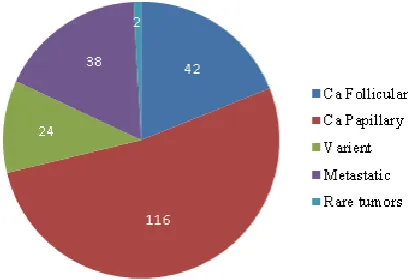
A total of 222 DTC patients, 54 (24.32%) male and 168 (75.67%) female, were registered at Institute of Radiotherapy and Nuclear Medicine (IRNUM), Peshawar during 2008-2012 for RAI therapy. The age of the patients was 08-78 years (median age 44 years). The diagnosis was confirmed by histopathology. The administered activities to all these DTC patients ranged from 1.85-9.25 GBq. All crucial demographic information like age, gender, administered activity, and type of surgery were also recorded. All patients were evaluated against these three variables (a) 131I administered activity (b) type of surgery and (c) disease extent. These patients were hospitalized and kept in isolation till the 131I body burden fell below the regulatory limit. A summary of the number of patients
in a particular type of disease has been presented in
Figure 1.
Fig 1. Disease wise distribution of cases.
The exposure rate from all the patients was measured within one hour of oral administration and on daily basis at the door of isolation room and at a distance of one meter from a standing patient with the help of a hand-held pressurized battery operated γ survey meter, Victoreen Model 450P. The survey meter was calibrated from Secondary Standard Dosimetry Laboratory, Islamabad Pakistan. The dose rate was recorded in units of µSv/hr while the retained activity was estimated by:
AR = A0D/D0
where AR is the retained activity, A0 is the administered activity, D0 is the dose rate immediately after administration and D is the dose rate at the time of discharge.
Regression analysis is a commonly used statistical tool that allows to assess the relationship between two or more variables of interest. Herein, the patient’s data were analyzed for any possible correlation between the isolation period of the patient and the radioactivity administered, type of surgery and disease extent with the help of linear regression model; the reported metrics are correlation coefficient R2 and p-value.
RESULTS
It is clear from Figure 1 that the leading histopathology of thyroid cancer in both genders treated at our institute is papillary carcinoma which accounts for 116(52.25%) followed by follicular carcinoma in 42(18.92%) cases. Papillary carcinomas with follicular variant were found 24(10.81%) while patients showing metastases were 38(17.12%) and the minimal thyroid cancer were found in only 02(0.9%) cases. It is worthy to mention that metastatic cases of either pathology has been considered as a separate group due to its critical role in the clinics.
Ir
an
J
N
u
cl
Me
d
20
2
0
,
V
ol
28,
No
1
(
S
er
ial
N
o
54
)
h
tt
p:
//
ir
jn
m
.tu
m
s.a
c.ir
Jan
u
ar
y,
20
20
30
patients has been shown in Table 1. It is evident that only 07(3.15%) patients were given activity of 131I less than 3.70 GBq, in which 04 (57.14%) patients were discharged after 48 hours, 01 (14.28%) patient was released after 72 hours and 02 (28.57%) patients were released from isolation after 96 hours. The second group of DTC patients receiving 3.7-5.55GBq of 131I contained 182 (81.98%) patients; of these, 44 (35.16%) patients were released from isolation after 48 hours while 58 (31.87%), 38 (20.88%), 14 (7.69%), and 08 (4.40%) patients were discharged in 72, 96, 120 and 144 hours, respectively. Moreover, 30 (13.51%) were given 5.59-7.40 GBq of 131I; of these 1 (3.33%) patients were relieved after 72 hours while 12 (40.00%), 9 (30.00%), 6 (20.00%), and 02 (6.66%) patients achieved the released radiation limit in 96, 120, 144 and 168 hours, respectively. The final group with administered activity ˃ 7.40 GBq of 131I comprised of only 03(1.35%); of these, only 02 (6.66%) patient was discharged after 96 hours while only 01 (33.33%) patient were relieved from isolation after 120 hours, respectively.
The correlation of the duration spent in isolation with the type of thyroidectomy (i.e., total, subtotal, and
lobectomy) has been presented in Table 2. It has been observed that 116 (52.25%) patients underwent total thyroidectomy, 73 (32.88%) cases had subtotal thyroidectomy and lobectomy was performed in 14 (6.31%) patients. The type of surgery was unknown in 19 (8.56%) patients. Of the total 116 patients with total thyroidectomy, 58 (50.00%) patients were discharged after 48 hours, 39 (33.62%) patient after 72 hours, 18 (15.52%) after 96hrs and only 01(0.86%) patient was released in 120hrs. Out of the 73 patients with subtotal thyroidectomy, 10 (13.70%) patients reached the released limit after 48 hours while 20 (27.40%), 33 (45.20%), 8 (10.96%), 01 (1.37%) and 1 (1.37%) cases were discharged in 72, 96, 120, 144 and 168 hours, respectively. Among the total 14 patients who underwent lobectomy, 1 (7.14%) achieved the regulatory release limit in 96 hours, 6 (42.86%) in 120 hours, 6 (42.86%) in 144 hours and 01 (7.14%) were discharged in 168 hours. In all 19 patient with unknown nature of surgery, 01 (5.26%) was released in 72 hours while 02 (10.53%), 09 (47.37%) and 07 (36.84%) cases were relieved in 96, 120 and 144 hours, respectively.
Table 1: The number of patients released vs. administered 131I dose in the DTC patients and related regression analysis.
131I Dose given (GBq) Time (h) Linear regression
24 48 72 96 120 144 R2 P value
<3.70 (n=7) 4 1 2 0 0 0 0.43 0.540
3.70-5.55 (n=182) 64 58 38 14 8 0 0.96 0.004
5.59-7.40 (n=30) 0 1 12 9 6 2 0.06 0.640
>7.40 (n=3) 0 0 2 1 0 0 0.45 0.320
Table 2: The number of patients released vs. the type of thyroidectomy in the DTC patients and related regression analysis.
Surgery type Time (h) Linear regression
24 48 72 96 120 144 R2 P value
Total thyroidectomy 58 39 18 1 0 0 0.99 0.0008
Subtotal thyroidectomy 10 20 33 8 1 1 0.30 0.2600
Lobectomy 0 0 1 6 6 1 0.27 0.2900
Unknown 0 1 2 9 7 0 0.77 0.0500
Table 3: Number of patients released vs. disease extent in our patient population and related regression analysis.
Disease extent Time (h) Linear regression
24 48 72 96 120 144 R2 P value
Local remnant 49 26 19 2 0 0 0.93 0.007
Locally advance 19 34 30 4 1 0 0.61 0.07
Ir
an
J
N
u
cl
Me
d
20
2
0
,
V
ol
28,
No
1
(
S
er
ial
N
o
54
)
h
tt
p:
//
ir
jn
m
.tu
m
s.a
c.ir
Jan
u
ar
y,
20
20
31
Table 3 shows the correlation between the extent of
disease (i.e., local, locally advance, distant metastasis) and the duration spent in isolation by the DTC patient after oral administration of RAI. It was observed that of the total 222 patients, only 96 (43.24%) patients have local thyroid remnants: of these, 49 (51.04%) were discharged from isolation after 48 hours, while 26 (27.08%), 19 (19.79%) and 2 (2.1%) patients remained isolated for 72, 96, and 120 hours, respectively. Moreover, 88 (39.64%) patients presented with locally advance disease, in which 19(21.59%) were relieved in from isolation in 48 hours while 34 (38.63%), 30 (34.09%), 4 (4.54%) and 01 (1.13%) in 72, 96, 120, 144 and 168 hours, respectively. Finally, aggressive disease with distant metastasis was observed in 38 (17.11%) patients, of which 5 (13.16%) were relieved from isolation after 96 hours, while 18 (47.37%), 13 (34.21%), and 02 (5.26%) remained in isolation for 120, 144 and 168 hours respectively.
DISCUSSION
The use of radioactive iodine after surgical resection in high risk groups of DTC is a routine clinical practice all over the world [4]. The cancer patients following 131I therapy must be held isolated for several days to prevent unnecessary exposure to caregivers and members of the general public [17]. Although, the release criteria of thyroid cancer patients from isolation is different in different state of the world as per their national or international regulatory guidelines [6, 10]. In Pakistan, the patient is released from isolation when the flux of the radiation exposure falls below 20 µSv/hr at one meter or residual activity inside the patient falls below 1100MBq. As the elimination of 131I from patient body depends on multiple factors, including amount of 131I dose, biological half-lives and Iodine concentrating tissues in the body. The biological half-lives further depends on residual tissues of thyroid, metabolic activity, disease extent, the renal system of the patient, thyroid uptake fraction and also liquid intake of patient within first 24 hours [15, 16]. Hence duration of stay in isolation and dose reduction pattern is different in all patients [18].
Thyroid gland has two lobes and is the target organ for 131I therapy. The metabolism of iodine is closely linked with the functional capacity of the thyroid gland and 131I avid metastases [19, 20]. Uptake and retention of 131I and the subsequent decrease in exposure rate with time varies from patient to patient. As observed in this study, the exposure measurements followed by the retained activity calculation demonstrated that the time spent in isolation by a DTC patient is primarily related to theamount of administered activity of 131I, remnant thyroid tissue and nature of the disease [21]. The effective half life of the administered 131I activity extends with the activity given to the patient.
However, in case of total thyroidectomy when thyroid gland is completely removed, and 131I is given to destroy the microscopic disease, hence the uptake of the 131I is comparatively low but in case of lobectomy, the remaining lobe of the thyroid actively absorbs most of the iodine taken into the body, hence the dose retention time is high [19, 22].On the other hand, if the disease bulk is high locally or distantly, this will prolong the stay of patients in isolation. Hence the isolation period in advance disease or metastatic thyroid carcinomas is longer [23]. These results show that the patients with total or subtotal thyroidectomy required less time to achieve the regulatory release limit. The patients with metastatic disease and partial thyroidectomy took more time for release from the hospital.
The stay of patients in isolation receiving high dose 131I therapy is mainly determined by activity administered, while size of thyroid remnant and extent of disease also has a vital role in patient’s isolation period. However due to lack of large pool of evidence, the statistical analysis performed may be used with caution, as indicated by the larger p-values.
CONCLUSION
This study revealed that apart from the activity administered to the patients presented in DTC, the disease extent and nature of surgical interventions also plays an important role in defining the isolation period after RAI therapy. Therefore, the stay of patients in isolation with exposure rate of 20µSv/hr as per national guidelines cannot be generalized and each patient needs to be monitored and evaluated individually to adhere regulatory criteria.
REFERENCES
1. Pellegriti G, Frasca F, Regalbuto C, Squatrito S, Vigneri R. Worldwide increasing incidence of thyroid cancer: update on epidemiology and risk factors. J Cancer Epidemiol. 2013;2013:965212.
2. Jegerlehner S, Bulliard JL, Aujesky D, Rodondi N, Germann S, Konzelmann I, Chiolero A; NICER Working Group. Overdiagnosis and overtreatment of thyroid cancer: A population-based temporal trend study. PLoS One. 2017 Jun 14;12(6):e0179387.
3. American Thyroid Association (ATA) Guidelines Taskforce on Thyroid Nodules and Differentiated Thyroid Cancer, Cooper DS, Doherty GM, Haugen BR, Kloos RT, Lee SL, Mandel SJ, Mazzaferri EL, McIver B, Pacini F, Schlumberger M, Sherman SI, Steward DL, Tuttle RM. Revised American Thyroid Association management guidelines for patients with thyroid nodules and differentiated thyroid cancer. Thyroid. 2009 Nov;19(11):1167-214.
Ir
an
J
N
u
cl
Me
d
20
2
0
,
V
ol
28,
No
1
(
S
er
ial
N
o
54
)
h
tt
p:
//
ir
jn
m
.tu
m
s.a
c.ir
Jan
u
ar
y,
20
20
32
5. Mazzaferri EL. Empirically treating high serum thyroglobulin levels. J Nucl Med. 2005 Jul;46(7):1079-88.
6. Hewamanna R, Loganathan N and Perera DKA. Releasing thyroid cancer patients from the hospital based on dose rate measurement after 131I activity administration. J Natl Sci Found Sri. 2014;42 (2):137-141.
7. Lassmann M, Reiners C, Luster M. Dosimetry and thyroid cancer: the individual dosage of radioiodine. Endocr Relat Cancer. 2010 Jun 3;17(3):R161-72.
8. Zhang H, Jiao L, Cui S, Wang L, Tan J, Zhang G, He Y, Ruan S, Fan S, Zhang W. The study of external dose rate and retained body activity of patients receiving 131I therapy for differentiated thyroid carcinoma. Int J Environ Res Public Health. 2014 Oct 21;11(10):10991-1003.
9. Shah AS, Hameedullah, Saeed F, Shah KA, Khan AU, Khattak MR. Radiation doses from 131I treated hyperthyroidism patients versus life style: - a survey. Int J Radiat Res. 2015;13(1): 67-72.
10. Ahmadi Jeshvaghane N, Paydar R, Fasaei B, Pakneyat A, Karamloo A, Deevband MR, Khosravi HR. Criteria for patient release according to external dose rate and residual activity in patients treated with 131I-sodium iodide in Iran. Radiat Prot Dosimetry. 2011 Sep;147(1-2):264-6.
11. Demir M, Parlak Y, Cavdar I, Yeyin N, Tanyildizi H, Gümüser G, Sayit E, Erees S, Sayman H. The evaluation of urine activity and external dose rate from patients receiving radioiodine therapy for thyroid cancer. Radiat. Radiat Prot Dosimetry. 2013;156(1):25-9.
12. Pakistan Nuclear Regularity Authority. Guidance level for maximum activity for patients in therapy on discharge from hospital. Regulations on Radiation Protection (PAK-904) Government of Pakistan, 2004.
13. National Council of Radiation Protection and Measurement (NCRP). Management of radionuclide therapy patients. NCRP report No. 155. USA; NCRP, 2006.
14. International Commission of Radiation Protection (ICRP). The 2007 Recommendations of the International Commission on Radiation Protection, ICRP Publication 103. Ann ICRP. 2007; 37(2- 4):1-332.
15. Alevizaki C, Molfetas M, Samartzis A, Vlassopoulou B, Vassilopoulos C, Rondogianni P, Kottou S, Hadjiconstantinou V, Alevizaki M. Iodine 131 treatment for differentiated thyroid carcinoma in patients with end stage renal failure: dosimetric, radiation safety, and practical considerations. Hormones (Athens). 2006 Oct-Dec;5(4):276-87.
16. Jhummon NP, Tohooloo B, Qu S. Iodine-131 induced hepatotoxicity in previously healthy patients with Grave's disease. Thyroid Res. 2013 Mar 16;6:4.
17. Muhammad W, Faaruq S, Matiullah, Hussain A, Khan AA. Release criteria from hospitals of 131I thyrotoxicosis therapy patients in developing countries--case study. Radiat Prot Dosimetry. 2006;121(2):136-9.
18. Khan SA, Khan MS, Arif M, Durr-e-Sabih, Rahim MK, Ahmad I. Radiation Dose-rate Reduction Pattern in Well-differentiated Thyroid Cancer Treated with I-131. J Coll Physicians Surg Pak. 2015 Jul;25(7):510-3.
19. Oh JR, Ahn BC. False-positive uptake on radioiodine whole-body scintigraphy: physiologic and pathologic variants unrelated to thyroid cancer. Am J Nucl Med Mol Imaging. 2012;2(3):362-85.
20. de Carvalho JW, Sapienza M, Ono C, Watanabe T, Guimarães MI, Gutterres R, Marechal MH, Buchpiguel C. Could the treatment of differentiated thyroid carcinoma with 3.7 and 5.55 GBq of (131I)NaI, on an outpatient basis, be safe? Nucl Med Commun. 2009 Jul;30(7):533-41.
21. Van Dyke M, Punja M, Hall MJ, Kazzi Z. Evaluation of toxicological hazards from medical radioiodine administration. J Med Toxicol. 2015 Mar;11(1):96-101.
22. Paschke R, Lincke T, Müller SP, Kreissl MC, Dralle H, Fassnacht M. The treatment of well-differentiated thyroid carcinoma. Dtsch Arztebl Int. 2015 Jun 26;112(26):452-8.