UDC 658.5 Paper accepted: 08.07.2009
*
Corr. Author's Address: University of Ljubljana, Faculty of Mechanical Engineering, Aškereva 6, Ljubljana,
Slovenia, [email protected] 427
A Company’s Readiness For Concurrent Product And
Process Development
Urban Žargi1 - Janez Kušar2,* - Tomaž Berlec2 - Marko Starbek2 1
TCG Uniteh LTH, Slovenia 2
University of Ljubljana, Faculty of Mechanical Engineering, Slovenia
When entering the global market, companies encounter several difficulties, the most severe being long product development times, which are unacceptable for customers. In order to overcome this problem, companies will have to make a shift from sequential to concurrent product development as soon as possible.
This paper presents strategic management in product development: parallelness, standardisation and integration of product development processes. Furthermore, the changes required by a transition from sequential to concurrent product development are presented with respect to the organisation of processes ,the organisation of work (team-work), IT and preparation of product documentation.
The paper concludes with a case study: analysis regarding readiness for a transition to concurrent product development (capability and motivation for team-work, susceptibility to team-work dysfunctions) in a company which is a development supplier of components for automotive industry and a proposal of activities that will have to be carried out in the company before the transition to the concurrent product development is done.
© 2009 Journal of Mechanical Engineering. All rights reserved.
Keywords: manufacturing, work organisation, product development, optimisation, management
0 INTRODUCTION
"Customer is the king!” is becoming the motto of the global market. In the competition between suppliers of products only those companies which can offer innovative and individual products of good quality, produced in the shortest possible time and at the lowest price, will survive.
Strong competition, the market of customers and increased complexity of products and processes are the characteristics of today's competition.
Fast product and process development, combined with timely participation of customers and suppliers together with entering the market at the right time, seem to be the decisive criteria for the market success of a product. The first supplier of a new product on the market has an advantage over the competition and thus, has the possibility of a faster return of product development investments.
The company has to switch from sequential to concurrent product and process development (i.e. from sequential to concurrent engineering) in order to reduce product and
process development time as well as development costs and ensure product quality.
The product development process [1] begins with a product definition, continues with product manufacturing and ends with tests, sales, product dispatch and launch and therefore, forms a part of the product's life cycle, as shown in Figure 1.
Žargi, U. - Kušar, J. - Berlec, T. - Starbek, M.
428
2 STRATEGIC MANAGEMENT DURING CONCURRENT PRODUCT AND PROCESS
DEVELOPMENT
Concurrent product development requires three levels of strategic management [2]:
- parallelness in product development processes, - standardisation of product development processes, - integration of product development processes, as presented in Figure 2.
PARALLELNESS IN PRODUCT DEVELOPMENT PROCESSES
INTEGRATION OF PRODUCT DEVELOPMENT PROCESSES CONCURRENT PRODUCT DEVELOPMENT STANDARDISATION OF PRODUCT DEVELOPMENT PROCESSES customers, suppliers
Fig. 2. Strategic management in concurrent product and process development
2.1 Parallelness in Product Development Processes
The total product development time is reduced considerably by parallelising new product development processes.
Independent processes, which are executed one after another in sequential development, are executed parallelly during concurrent development.
In concurrent product development the execution of interdependent product development processes starts before the previous processes have been completed, and thus the portion of uncertain and uncompleted data increases.
An advantage of parallel product development processes is fast execution of networked processes, while a disadvantage is increased transfer of data between product-development teams.
Figure 3 presents the goal of strategic management of parallel processes of product development, and the paths that lead to this goal.
PARALLELNESS IN PRODUCT DEVELOPMENT PROCESSES
2. HOW TO ACHIEVE THIS GOAL:
transition from sequential to concurrent engineering elimination of time reserves data delivery on time concurrent implementation of independent processes start of execution of dependent processes before completion of the previous processes
1. GOAL:
reduction of product development time
Fig. 3. Parallelness in product development processes
2.2 Standardisation of Product Development Processes
Standardisation of product development processes means the description of product development processes, which is continuous and independent of individuals and events.
Standardisation applies to: product components (modules, components, parts), processes for manufacturing product components, and organisational plan for the implementation of product components (interfaces between departments).
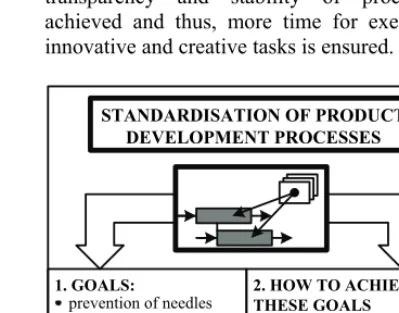
By standardising product development processes, unnecessary work is avoided, higher transparency and stability of processes is achieved and thus, more time for execution of innovative and creative tasks is ensured.
STANDARDISATION OF PRODUCT DEVELOPMENT PROCESSES
2. HOW TO ACHIEVE THESE GOALS
standardisation of product components and parts standardisation of product development processes standardisation of interfaces between company departments
1. GOALS:
prevention of needles and redundant work transparency of product development processes stability of product development processes
A Company’s Readiness For Concurrent Product And Process Development 429
Figure 4 presents the goals of strategic management of standardisation of product development processes, and the paths that lead to these goals.
2.3 Integration of Product Development Processes
All company departments, as well as customers and suppliers should be part of the chain creating the features of the product under development. However, this leads to high interface losses because of uncoordinated scheduling and various interpretations of the roles of tasks.
Integration with direct inclusion of all company departments, customers and suppliers into the product development processes allows for a possibility of overcoming collisions at interfaces. Interdisciplinary work, process-oriented thinking and functioning, as well as creativity require integrated product development processes.
The goal of product development process integration is therefore, a transformation of separate interfaces into a coherent whole.
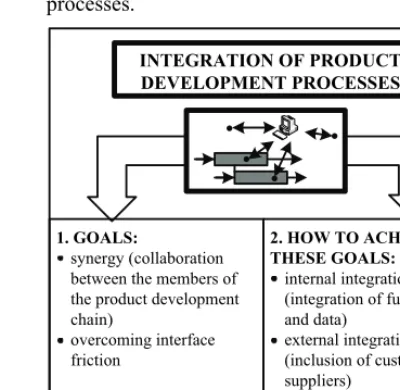
Figure 5 presents the goals of strategic management of integration of product development processes, and the paths that lead to these goals.
Integration of product development processes comprises:
- integration of personnel, - IT integration,
- organisational integration.
Figure 6 presents an overview of methods that support the implementation of integration of product development processes.
Disadvantages of parallelness in product development processes can be eliminated by a high level of standardisation and integration of processes, and by using computer-assisted methods for fast modelling and the simulation of processes.
INTEGRATION OF PRODUCT DEVELOPMENT PROCESSES
2. HOW TO ACHIEVE THESE GOALS:
internal integration (integration of functions and data)
external integration (inclusion of customers and suppliers)
1. GOALS:
synergy (collaboration between the members of the product development chain)
overcoming interface friction
Fig. 5. Integration of product development processes
3 CHANGES REQUIRED BY TRANSITION FROM SEQUENTIAL TO CONCURRENT PRODUCT DEVELOPMENT
According to our experience in the field of concurrent product development, a company that wants to make a transition from sequential to concurrent product development should change the following:
- organisational concept of the company, - organisation of processes,
- organisation of work, - IT,
- preparation of product documentation.
A Company’s Readiness For Concurrent Product And Process Development
430
3.1 Changes of the Company Organisational Concept
The organisational concept of the company defines the structure and competences of the employees, engaged in the concurrent product development.
The foundation of concurrent product development is a transition from individual- to team-work, the basis of team-work being a cooperation and interdependence between team members (successful communication between team members ensures the team success).
Team members reach decisions together in a democratic way, because it is important that all of them agree with these decisions.
Team-work is performed by team members. Their main tool is communication and none of the team members may leave the team until the work has been completed.
Team-work is a form of collaboration between team members who are responsible for the distribution and implementation of tasks, the solution of problems, as well as for communication within the team and between teams.
Good organisation and implementation of team-work is essential for a successful transition from sequential to concurrent product development.
The success of concurrent product development depends largely on the planning and management of a product development project.
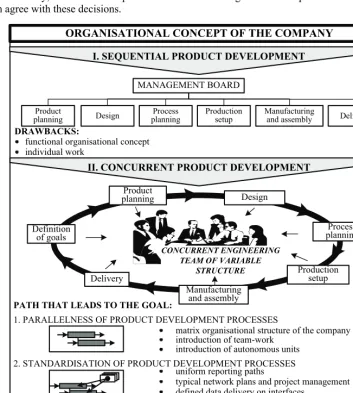
I. SEQUENTIAL PRODUCT DEVELOPMENT
MANAGEMENT BOARD
Production setup
Manufacturing and assembly Process
planning
Design Delivery
II. CONCURRENT PRODUCT DEVELOPMENT
Design
Definition of goals
Product planning DRAWBACKS:
functional organisational concept individual work
Product planning
Process planning
Production setup Manufacturing
and assembly Delivery
PATH THAT LEADS TO THE GOAL:
1. PARALLELNESS OF PRODUCT DEVELOPMENT PROCESSES
CONCURRENT ENGINEERING TEAM OF VARIABLE
STRUCTURE
matrix organisational structure of the company introduction of team-work
introduction of autonomous units
uniform reporting paths
typical network plans and project management defined data delivery on interfaces
overcoming of distances defined interfaces
inclusion of customers and suppliers 3. INTEGRATION OF PRODUCT DEVELOPMENT PROCESSES
2. STANDARDISATION OF PRODUCT DEVELOPMENT PROCESSES
ORGANISATIONAL CONCEPT OF THE COMPANY
A Company’s Readiness For Concurrent Product And Process Development 431
During planning and management, a special attention has to be paid to the standardisation of product development processes, information transfer methods and the fastest possible integration of all the members of the product development team, including customers and suppliers.
Figure 7 presents changes in the organisational concept of the company that decided to make a transition from sequential to concurrent product development.
3.2 Changes in the Organisation of Processes
A specific feature of product development processes is that they are goal- and result-oriented [3].
An analysis of the current sequential product development processes is the basis for planning concurrent product development processes.
The barriers between company departments and between the company and its customers and suppliers can be eliminated if the company mind structures are changed.
Standardised process descriptions are essential for parallel execution of development-process activities. All product-development-process data should be prepared in the same way, so that during the development of the planned product the results of the previously developed products can be used.
Figure 8 presents changes in the organisation of processes in the transition from sequential to concurrent product development.
A Company’s Readiness For Concurrent Product And Process Development
432
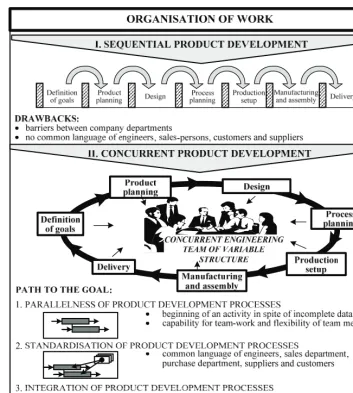
3.3 Changes in the Organisation of Work
A company usually has employees with particular professional education who have certain behaviour patterns. However, a company wishing to make a transition from sequential to concurrent product development needs employees with precisely defined capabilities:
- capability of team-work, - capability of rotational-work.
Team-work is successful when the team output exceeds the sum of outputs of team members, working individually.
In practice [4] we deal with:
- a small team when the team consists of 2 to 25 members;
- a large team when the team consists of more than 25 members.
In large teams the team-approach weakens because the team members do not know each other and it is not possible for each team member to have contacts with all other team members.
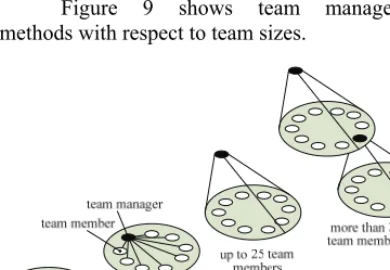
Figure 9 shows team management methods with respect to team sizes.
Fig. 9. Team management methods [4]
A team of up to 7 members operates without an appointed team manager – team members manage themselves.
In a team of up to 15 members, a team manager is appointed; (s)he should be a team member – (s)he works in team operations.
In a team of 15 to 25 members a team manager is not supposed to be a team member – (s)he should work only as the team manager.
If a team consists of more than 25 members, it is divided into several sub-teams in order to ensure successful team management.
If there are up to 7 members in a concurrent product development team, each team
member is interconnected with each other. Any team member can start a communication and all the team members have the same decision rights. If a team consists of more than 7 members, communication is always done via the team manager.
Capability of team-work means being open to share information and admit errors, as well as being responsible for decisions, so that individual tasks will be performed at the right time and thus, the highest possible parallelness will be achieved.
Team members should have rotational-work capability, which is essential for understanding the views of others on the problems encountered.
Figure 10 presents changes in the organisation of work in a transition from sequential to concurrent product development.
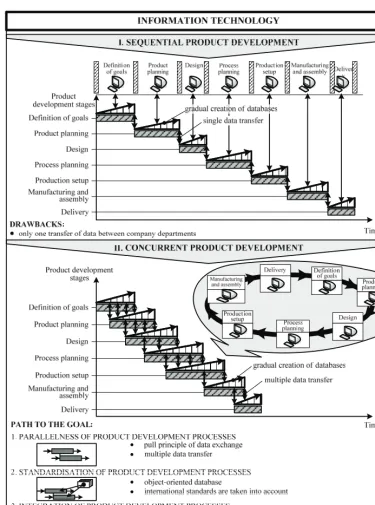
3.4 Changes of IT
Concurrent product development requires large investments in IT. It is necessary to:
- invest in data storage and data processing tools, - ensure that the data are consistent and stored
only once,
- ensure that the data are in proper formats, - ensure that the data are available in every
location.
The data must be accessible on all of the product-development-process locations.
Changes of IT, required by concurrent product development [5] and [6], support parallelness, standardisation and integration of product development processes.
Figure 11 presents changes of IT in the transition from sequential to concurrent product development.
3.5 Changes in the Preparation of Product Documentation
The results of a product development process are gathered in the product documentation, which consists of product model, calculations, drawings and bills of material, drawings of tools and technology routings.
A Company’s Readiness For Concurrent Product And Process Development 433
Fig. 10. Changes in the organisation of work
The integrated product model, labelled as STEP-model, allows for significant support for computer-assisted system integration [2].
Fast prototyping methods can considerably reduce product development time, because prototypes facilitate the clarification of different views and thus allow for faster solution of problems.
Recently, much attention has been paid to a definition of unique product structures. There are libraries of normalised and standard parts, which facilitate product development.
On the basis of experience it is possible to define modular structures, which could remain
unchanged in the future or undergo just small changes for several new products.
Concurrent product development requires the following from IT and technical support: - insurance and re-search of the existing product
development solutions, - product documentation,
- building libraries of standard parts of the company,
- use of libraries of standard parts.
A Company’s Readiness For Concurrent Product And Process Development
434
Fig. 11.Changes of IT
4 CASE STUDY: HOW IS A COMPANY PREPARED FOR CONCURRENT PRODUCT
DEVELOPMENT
A company – a component developer and supplier for the automotive industry – decided to
perform an analysis regarding fulfilment of the basic conditions for a transition from sequential to concurrent product development.
A Company’s Readiness For Concurrent Product And Process Development 435 - whether the sequential product development
team members are capable of and motivated for work, and whether any of the team-dysfunctions exists in the teams,
- whether and to which extent does the company consider strategic management of product development.
In order to find out whether the sequential product development team members are capable of team-work, the employees used a questionnes on:
x team-work capabilities [7],
x motivation for team-work [7], and
x susceptibility to team-dysfunctions [7].
DRAWBACKS:
preparation of documentation for individual product component no creation of product modules
I. SEQUENTIAL PRODUCT DEVELOPMENT
II. CONCURRENT PRODUCT DEVELOPMENT engine
drive chassis and understructure
PREPARATION OF PRODUCT DOCUMENTATION
electronics control seats
PRODUCT COMPONENTS
Under-structure
system Control
system
Engine system
Chassis system
Seat system Electronics
system
Drive system
PRODUCT MODULES
PATH TO THE GOAL:
1. PARALLELNESS OF PRODUCT DEVELOPMENT PROCESSES
creation of modules (separation of dependent components/systems)
modular system
uniform definition of interfaces
suppliers develop some product modules creation of product platforms
2. STANDARDISATION OF PRODUCT DEVELOPMENT PROCESSES
3. INTEGRATION OF PRODUCT DEVELOPMENT PROCESSES
Žargi, U. - Kušar, J. - Berlec, T. - Starbek, M.
436
The questionnaire regarding the capability for team-work, motivation and dysfunctions were filled-in by members of eight teams. By evaluating the results we found the following: - five teams are capable of team-work, they are
motivated and there are no signs of team-dysfunctions;
- two teams are capable of team-work, they are motivated, but they have “No interest in results" dysfunction;
- one team is not capable of team-work, team members are partially motivated for team work and they have “Lack of confidence” and “No interest in results” dysfunctions.
The analysis of the parallelness of product development processes has shown that only independent processes run parallelly and that there is no parallelness of interdependent processes.
The analysis of product development process standardisation has shown that the following items are standardised:
- all company products and procedures for development of components,
- technology and assembly routings for manufacturing of components,
- all workplaces (operations).
The analysis of the integration of processes in product development processes has shown firstly that the company manages internal integration of functions and data, but it does not manage external integration, secondly that there are small difficulties in integration of personnel – team-work, motivation, that there are interfaces for data transfer from PROENGENEER to SAP, from SAP to Excel and from SAP to MS Project and finally that delayed data entry into the SAP system is a big disadvantage.
On the basis of the above-mentioned findings we proposed the following activities to the company management:
- additional training of team members to ensure successful team-work;
- team member training on concurrent engineering and strategic management in concurrent product development;
- test of efficiency of concurrent product development on practical cases in the company.
5 CONCLUSION
The global market requires short product development times, and this forces Slovenian companies to a transition from sequential to concurrent product development.
The pre-condition for a transition from sequential to concurrent product and process development is a successful team-work and strategic management (parallelness, standardisation and integration of processes in product development processes). In our paper we have therefore, focused on checking the efficiency of team-work and integration of strategic management into product development processes [8] and [9].
Furthermore, we analysed changes in a company, which were required by a transition from sequential to concurrent product development, with respect to the organisational concept of the company, the organisation of processes, the organisation of work, IT and the preparation of product documentation.
On the basis of our knowledge of team-work and strategic management in concurrent product development we analysed how the existing teams in a company (which was a supplier of components for automotive industry) was prepared to make a transition from sequential to concurrent product development.
6 REFERENCES
[1] Ehrlenspiel, K. Integrated Product Development, Carl Hauser Verlag München Wien, 2003, 752 p. (In German), ISBN 3-446-40733-2.
[2] Bullinger, H.J., Warnecke, H.J. New Organisation Forms in a Company, Springer-Verlag, Berlin Heidelberg, 1996, 1128 p. (In German), ISBN 3-540-60263-1.
[3] Eversheim, W., Bochtler, W., Laufenberg, L. Simultaneous Engineering, Springer-Verlag, Berlin Heidelberg, 1995, 144 p., ISBN 3-540-57882-x.
[4] Lencioni P. (2007) Teammanagement. Retreived on 20.6-2007, http://www.4managers.de/ themen/ teammanagement.
A Company’s Readiness For Concurrent Product And Process Development 437
engineering: Research and Applications, vol. 9 no. 3, p. 191-210.
[6] Prasad, B. (1996) Concurrent Engineering Fundamentals, Volume I, Integrated Product and Process Organization, New Jersey, Prentice Hall PTR, p. 216-276.
[7] Lencioni, P. The Five Dysfunctions of a Team, San Francisco, Jossey-Bass, 2002, 229 p., ISBN 0-7879-6075-6.
[8] Kušar, J, Duhovnik, J., Tomaževi, R., Starbek, M. (2007) Finding and evaluating
customers needs in the product-development process. Strojniški vestnik - Journal of Mechanical Engineering, vol. 53, no. 2, p. 78-104.