Substrate Diffusion Analysis in Immobilized Spherical Cell-Support Aggregate by Using
of Least Square Method
Ali Izadi1*, Sobhan Mosayebi dorcheh2, Hamid Rashedi3
Abstract
Introduction
In recent years, using of immobilized cells is developed for various applications. Some of these applications are removing organic pollutants from contaminated ecosystems or producing of useful products such as ethanol [1-3] and many aerobic fungi have been immobi-lized for production of extracellular enzymes [4, 5]. Cell immobilization has several advantages including achieving to higher cell densities and increasing productivity respect to conventional suspension culture. Immobilization of mammalian cells within support can protect cells from destruction due to shear forces and simplify product separation and purification [6-8]. Despite of mentioned benefits for cells immobilization, there are disadvantages such as limitation of available space in the support for microorganisms growth [9]. Products and substrates dif-fuse from local environment within the biofilm layer and structure of biofilm is related to the motion of surface cells and existence of rate-limiting substrate [10, 11]. As regards to entrapment of cells in supports such as ca-alginatehas been performed for degradation of toxic substance since 1975, but diffusion limitations decreased productivity and environmental condition controlling [12-14] nitrate and nitrite diffusion into the spherical immobilized cell are studied for groundwater denitrification and quasi-steady-state model formulated for this reaction [15]. Immobilization of two morphologically different strains of anaerobic chytridin Ca-alginathas been studied for cellulolytic enzymes production and immobili-zation conditions have been optimized in order to fungal biomass increasing [16].
Experimental studies have showed that the biomass concentration in an immobilized cell support aggregate as non-uniform due to accumulation of biomass in the outer core of the support particle and this non-uniform distribution is affected on biological properties such as cell specific growth rate and effectiveness diffusion coefficient of the substrates and products [17-19]. The mathematical model have been derived based on uniform diffusivity in carrageen an gel beads and the effects of immobilized cells growing conditions upon biomass production are studied in support particles [20]. E. coli microorganism has been immobilized in agar membrane and substrate diffusion-reaction and cell reproduction has been modeled. The results showed that product inhibition was more effective on cell reproduction than substrate limitation [21].
Validation of a dynamic model has been studied for immobilized cells growth in kappa-carrageenan gel beads and simultaneous oxygen, nitrite, nitrate and ammonia conversion [22]. Macroscopic diffusion in immobilized cell supportcan be described by an effective diffusion coefficient (De) and this coefficient depends on the
molecules diffusivity within the support phase (D0) and the
heterogeneous milieu of cells (Dc) [13, 23, 24]. There are
several methods for evaluating molecular diffusivities in immobilized microorganism systems such as bead methods, diffusion chambers and holographic laser interferometry [25-27]. Many of nonlinear equations in the transport phenomena problems should be solved by analytical and numerical methods. Ozisik introduced some simple and accurate analytical techniques for solving non-linear differential equations called the Weighted Residuals In this study, the substrate diffusion in an immobilized spherical cell-support
aggregate is studied and effects of various parameters are investigated on substrates profile. Analyses are performed by using of an analytical solution called the Least Square Method (LSM) and results are compared with numerical solution. The effects of effective diffusion coefficient (De), maximum specific growth rate (µm)
and type of limiting substrate are studied on substrate concentration profile in im-mobilized Nitrosomonas europaea and Nitrobacter agilis microorganisms. Outcomes reveal that LSM is an appropriate method for analyze of biological non-linear equations. In the center of the spherical microbial support, the substrates concentration is minimums and with reducing µm or increasing De, substrate concentration profile gradient reduces.
Keywords: Nitrosomonas europaea, Nitrobacter agilis, LSM, Substrate Concen-tration
1. Department of Chemical Engineering,Babol University of Technology, mazandaran, Iran 2. Department of Mechanical Engineering,Babol University of Technology, mazandaran, Iran 3. Department of Chemical Engineering, Tehran University, Tehran, Iran
* Corresponding Author Ali Izadi
Department of Chemical Engineering,Babol Uni-versity of Technology, mazandaran, Iran
E-mail: [email protected]
Ali Izadi, et al. Substrate Diffusion Analysis in Immobilized Spherical Cell-Support
178 Journal of Applied Biotechnology Reports, Volume 2, Issue 2, Spring 2015
Methods (WRMs). Collocation, Galerkin and Least Square Method (LSM) are examples of the WRMs [28, 29]. The main motivation of this paper is to solve mass balance one-dimensional differential equation by using of Least Square Method (LSM) and demonstrating of substrate concentration profile in diverse conditions. Effects of various parameters including effective diffusion coefficient, maximum specific growth rate and the type of limiting substrate are described on substrate profile in immobilized cells-support aggregate. With respect to using of analytical methods for biochemical differential equations dissolution remains unnoticed, the main advantage of this study is using of LSM which does not need any linearization or perturbation, and comparing of results with numerical solution.
Materials and Methods
Problem description and governing equation
Cell entrapment in a porous matrix protects them from the shear stress outside of the support particles. Physical entrapment of microorganisms inside a polymeric matrix (gel) is one of the most widely used methods for cell immobilization. The gels commonly used for cell entrapment are polymers such as K-carrageenan, agar, alginate [30, 31]. When cells are immobilized within suitable support, concentration of limitation substrate change in diverse layers. In this paper we assumed that Nitrosomonas europaea and Nitrobacter agilis cells are entrapped within spherical beads of k-carrageenan and microbial flocare formed. So, substrate should diffuse in cells aggregation to be used by inner layers cells. Parame-ters which include effective diffusion coefficient (De),
maximum specific grow rate (µm) and limiting substrates type are effective on substrate concentration profile in immobilized Nitrosomonas europaea and Nitrobacter agilis cells and this study has tried to illustrate these parameters effects.
The following assumptions have been used for this model derivation:
1. Since the rate of biofilm thickness increasing is much slower than the rate of substrate consumption, the system conditions can be assumed to be at quasi-steady state for little periods of time. So the simplest case is to assume that the immobilized cell aggregation is at quasi-steady state and all of the cells inside the biofilm are in the same physiological state and average kinetic constant are used for the biotic phase.
2. Only immobilized cells convert substrate to product. 3. Support is considered as uniform sphere and cells are uniformly distributed within spherical support particle. 4. The external mass transfer limitation is negligible for the transport of the substrate.
On the basis of these assumptions, the governing equation of substrate diffusion rate within immobilized cell layer has been written based on following nonlinear differential mass balance [32]:
(1)
2 2
2 2
1
d S d S S
S
d r r d r
(2)
0 S S
S
0 r r
R
0
s
S K
m
s e s
X R
Y D K
Where S is the dimensionless substrate concentration, S0 is
the initial substrate concentration,
r
is the dimensionless radius, Ks is the saturation constant, µm is maximumspecific growth rate, X is the biomass concentration, Ys is
the substrate yield and De is the effectiveness diffusion
coefficient.
The appropriate boundary conditions are:
(3)
1
r
:
S 1(4)
0
r
:
dS 0dr
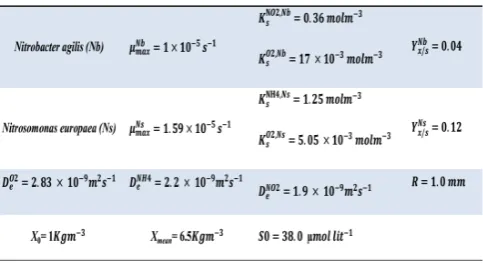
The cells and substrates properties of the immobilized cells are given in Table 1. Generally, these presented numerical values are used for clear explain of various parameters effect on substrate profile [22].
Analytical solution
There is an approximation method to solve ordinary differential equations called Least Square Method (LSM). Consider the following differential equation:
(5)
D u x p x
Let consider the function uan approximation of u, which is a linear combination of trial functions:
(6)
1
n i i i
u u c
By substituting into the differential equation, an error or residual will exist:
(7)
0R x D u x p x
The notion in LSM is to force the residual to zero, so:
(8)
i 0 , 1, 2 , ...,X
R x W X d x i n
Where w(x) is weight function and
n
is the number of unknown constants ci in ũ. The result is a system of nalgebraic equations for obtaining the unknown constants
ci. If the continuous summation of all the squared
residuals is minimized, the rationale behind the LSM’s name can be seen:
(9)
2
X X
S
R x R x d x
R x d xFor obtaining the minimum of the function S, the derivatives of S with respect to all constants must be zero.
(10)
2 0 , 1, 2 , ...,
i X i
S R x R d x i n
c c
By comparing Eqs (6) and (10), the weight functions are
(11) 2
i
i
R W
c
Some advantages of LSM comparing to other methods are presented in [33, 34]. Here, we apply the LSM on the present problem. We should first choose a trial function. Because trial function must satisfy the boundary conditions (Eq. (3) and (4)), so it will be assumed as,
(12)
2
3
4
6
1 2 3 5
1 1 1 1 1
S r c r c r c r c r
By combining the above equation and Eq. (1), residual function will be found and via substituting the residual function into Eq. (10), a system of equation with five equations will appear and by solving this set of equa-tions, coefficientsc1,...,c5will be obtained. The analytical solution of the problem is in the following form for
1, 1
:S(r) = 0.9191+0.0798r2 + 0.0r3 + 0.0011r4 + 0.000001r5 –
0.0001r6
(13)
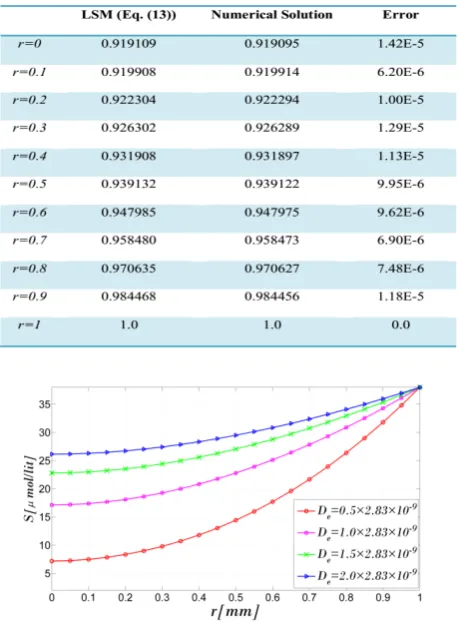
To validate our solution and find the accuracy of the method, we compared the results of the LSM and numeri-cal solution in the Table 2. The numerinumeri-cal solution is performed by using the algebra package Maple 15.0, to solve the present case. The package uses a fourth–fifth order Runge-Kutta–Fehlberg procedure for solving nonlinear boundary value problem (BVP). The algorithm is proved to be precise and accurate in solving a wide range of mathematical and engineering problems. As we can see in Table 2, the results of LSM have an excellent accuracy and order of the error is about 10-6 to 10-5.
Result and Discussion
In this study Least Square Method is applied to obtain an explicit analytical solution of the substrate diffusion equation in an immobilized cell-support aggregate. In the following analysis, all parameters are kept constant except for one and the effect of this parameter is studied on the substrate concentration profile.
The effective diffusion coefficient (De) is affected by
various parameters such as cell concentration (X) [23] for this reason constant values of cell concentrations are applied for demonstration of substrates concentration pro-files in Figures 1-10.
Effects of the effective diffusion coefficients ( ) on concentration profile of NO2 as limiting substrate are
kg/m3.Substrate concentration reduces with approaching to the center of spherical bacterial aggregation. Increasing of effective diffusion coefficient reduces substrate profile gradient since substrate can diffuse within cells easily (Fig. 1).
Figure 1. Effect of the D on NO2 concentration profile for
immobilized Nitrobacter agilis.
Considering the fact that saturation constant (Ks) is related
to the type of substrate and microorganism, O2 profile is
demonstrated in Figure 2 for Nitrobacter agilis when X=1 kg/m3. With respect to O2 NO2
e e
D D in similar conditions, but O2 profile gradient is more than NO2since , > ,
(Table 1).
Table 1. The numerical value of model parameters.
Therefore, as regards to Deand Ks have inverse effect on
substrate profile gradient, but Ks has more effect than De in
this conditions. Increasing diffusion coefficient of O2
reduces difference of substrate concentration between the bulk medium and the center of immobilized cells support. Effects of N H4
e
D as nitrogen source nutrient on NH4
concentration profile has been studied in Figure 3 for Nitrosomonas europaea when X=1 kg/m3.
It's obvious that increasing of N H4
e
D makes substrate diffusion increases within immobilized cell support particle aggregate. O2 concentration profile is
Ali Izadi, et al. Substrate Diffusion Analysis in Immobilized Spherical Cell-Support
178 Journal of Applied Biotechnology Reports, Volume 2, Issue 2, Spring 2015
Table 2. Comparison of the LSM results and numerical solution
for 1, 1.
Figure 2. Effect of the D on O2 concentration profile for
im-mobilized Nitrobacter agilis.
Figure 3. Effect of the D on NH4 concentration profile
for immobilized Nitrosomonas europaea.
Cell specific growth rate constant is a way of measuring how fast the cells are dividing in a culture. In Figure 5a and b, effects of µm have been show on substrate concen-tration profile for Nitrobacter agilis. It's obvious that with increasing maximum specific growth rate, substrate consumption increases and thus gradient of limiting sub-strate concentration profile (NO2 and O2) increases (X=1
kg/m3). Effects of specific growth rate have been studied
on substrate diffusion for Nitrosomonas europaea in Figure 6a and b for X=1 kg/m3. This figure confirms our
appointment about effects of maximum specific growth rate on substrate concentration profile.
Figure 4. Effect of the D on O2 concentration profile for
immobilized Nitrosomonas europaea.
Figure 5a. Effect of Nitrobacter agilis specific growth rate (µm)
on NO2 concentration profile.
Figure 5b. Effect of Nitrobacter agilis specific growth rate (µm)
on O2 concentration profile.
Figure 6a. Effect of Nitrosomonas europaea specific growth rate
(µm) on NH4 concentration profile
Fig (µm Co agi Fig imm bac org sou agi NH NO res nut lay Fig agi Fig for
gure 6b. Effect
m) on O2 concen
omparison of ilis and Nitro gure 7 (X=1 k
mobilized Nit cter agilis due ganisms (Tab urce nutrient ilis and Nitros H4 diffusion w
O2 diffusion in
sult shows tha trient, require yers of spheric
gure7. Compari
ilis and Nitrosom
gure 8. Compa
Nitrobacter ag
of Nitrosomon
ntration profile
O2 concentr
osomonas eu g/m3). It's obv
trosomonas e e to diverse p le 1). In Fig (NO2, NH4) a
somonaseurop within Nitrosom
n Nitrobacter at with using ed nitrogen o cal cell-suppor
ison of O2 conc
monaseuropae
arison of nitrog
gilis and Nitroso
as europaea sp .
ration profile ropaea are d vious that O2
europaea is m properties of th gure 8 diffus are compared
paea. monaseuropa
agilis when X g of NH4 as
of cells is pro rt aggregate.
centration profi
ea.
gen source con
omonas europa
pecific growth r
in Nitrobac demonstrated diffusion with more than Nitr hese two micr ion of nitrog for Nitrobac
aea is more th X=1 kg/m3. Th
nitrogen sour ovided in inn
ile for Nitrobac
ncentration prof
aea. rate cter in hin ro-gen cter han his rce ner cter file Co be pr cr tra m le m A m eu sp pr Fi Ni Fi Ni C D ce sig fo pa m di Ni Sq Re ex ap tio m
omparison of een performed rofile are show robial aggrega
ation are min more than NO2
ss than nitrog may cell metab s seen in F minimums in
uropaea whe pherical cell
rofile gradient
igure 9. Comp itrobacteragilis
igure 10. Comp
itrosomonas eu
onclusion ue to mass ba ell-support agg
gnificant chal or this equati arameters suc maximum spec iverse substr Nitrosomonase
quare Method esults showed xcellent agree pproaching to on reduces a microorganism
f oxygen and d in figure 9 wed for Nitro ation when X= nimums in r=
2.This figure
gen source nu olism shift to Figure10, O2
the center o en X=6.5 kg
aggregation i t is less than o
parison of O2 a
.
parison of O2 a
uropaea
alance for imm gregate is non llenge is obtai ion. In this ch as effectiv
cific growth rate profile
europaea mic d.
d that the LSM ement. In s o the center o and its gradie properties.
nitrogen sou 9. O2 and NO
obacter agilis =6.5 kg/m3. Su =0 and O2 pr
state that oxy utrient and in
anaerobic me and NH4 c
of immobilize g/m3. NH
4 d
is more than oxygen.
and NO2 concen
and NH4 conce
mobilized cells n-linear differ
ining of the an work the ef ve diffusivity rate have b for Nitrobac roorganisms b
M and numer spherical mic of sphere, sub ent is functio . By effe
rce substrate O2 concentrat
in spherical ubstrates conc rofile gradien ygen diffusion center of supp etabolism.
oncentration ed Nitrosomo
diffusion wit n O2 and so,
ntration profile
entration profile
s within spher ential equatio nalytical solut ffects of vari y coefficient
been studied cter agilis by using of L
rical solution crobial floc w bstrate concen on of media ective diffus
has tion
mi- cen-nt is
n is port
are onas
thin its
e for
Ali Izadi, et al. Substrate Diffusion Analysis in Immobilized Spherical Cell-Support
178 Journal of Applied Biotechnology Reports, Volume 2, Issue 2, Spring 2015
but reducing of microorganism specific growth rate increases substrate profile slope within spherical microbial floc.
Acknowledgment
The authors thank Dr. Sayadi for valuable discussions and providing some of the literature information.
References
1. Debarati, H., Paswan, K.A., Chowdhury, A., Biswas, E., Basu, M., Characterization and cell mmobilization of a potent amylase producing mesophilic soil bacteria Bacillus cereus strain BRSC-S-A26MB. J Mycopathological Res, 2014, Vol. 52, pp.11-19. 2. Juliana Maria, S., Susana Benimeli, C., Amoroso, J., "Cell Immobilization Technique for the Enhanced Removal of Lindane Using Streptomyces Strains Isolated from Northwestern Argentina. Bioremediation in Latin America. Springer International Publishing, 2014. pp. 289-299.
3. Cláudia Silveira, S., Miranda Martins, C., Fiúza, L.M., Tédde Santaella, S., Immobilization of microbial cells: A promising tool for treatment of toxic pollutants in industrial wastewater. Afr J Biotechnol, 2013, Vol (12), pp. 4412-4418.
4. Kuek, C., Production of glucoamylase using Aspergillus phoenicus immobilized in calcium alginate beads. Appl Microbiol Biotechnol, 1991, Vol. 35, pp. 466 –70.
5. Jirku, V., Wijffels, R., Buitelaar, R., Bucke, C., Vincent, J., Effect of C/N ratio and cellulose type on the cellulolytic activity of free and immobilized Trichoderma reesei. Immobilized Cells: Basics and Applications, 1996, Vol. pp. 136-9.
6. Iijima, S., Mano, T., Taniguchi, M., Kobayashi, a.T., Immobilization of hybridoma cells with alginate and urethane polymer and improved monoclonal antibody production. Appl Microbiol Biotechnol., 1988, Vol. 28, pp. 572–576.
7. Shirai, Y., Hashimoto, K., Yamaji, H., Kawahara, H., Oxygen uptake rate of immobilized growing hybridoma cells. Appl Microbiol Biotechnol Bioeng, 1988, Vol. 29, pp. 113–118. 8. Yamaguchi, M., Shirai, Y., Inouye, Y., Shoji, M., Kamei, M., Hashizume, S., Shirahata, S., Changes in monoclonal antibody productivity of recombinant BHK cells immobilized in collagen gel particles. Cytotechnol, 1997, Vol. 23, pp. 5–12.
9. Lazar, A., Immobilization of animal cells in fixed bed bioreactors. Biotechnol Adv, 1991, Vol. 9, pp. 411–424.
10. Just, C., Hentzer, M., Givskov, M., Shrout, J., Chopp, D., Parsek, M., The impact of quorum sensing and swarming motility on Pseudomonas aeruginosa biofilm formation is nutritionally conditional. Mol Microbiol, 2006, Vol. 62(5), pp. 1264–1277. 11. Laspidou, C., Rittmann, B., Evaluation trends in biofilm density using the MCCA model. Water Res, 2004, Vol. 38, pp. 3362–3372.
12. Aksu, Z., Bülbül, G., Determination of the effective diffusion coefficient of phenol in Ca-alginate-immobilized P. putida beads. Enzyme Microb Technol, 1999, Vol. 25, pp. 344-348.
13. Karel, S., Libicki, S., Robertson, C., The immobilization of whole cells: engineering principles. Chem Eng Sci 1985, Vol. 40, pp. 1321-54.
14. Tanaka, H., Matsumura, M., Veliky, I., Diffusion characteristics of substrates in Ca-alginate gel beads. Biotechnol Bioeng, 1984, Vol. 26, pp. 53-8.
15. Langley, W., G.; Wu, J.S., Chao, A.C., Reaction kinetics of immobilized-cell denitrification. I: Background and model development. J Environ. Eng, 2001, Vol. 127 (8), pp. 682-688. 16. Bernadette, K., McCabea, Kueka, C., Geoffrey, L.R., Gordonb, Michael, W., Phillipsb, Immobilization of monocentric and polycentric types of anaerobic chytrid fungi in Ca-alginate. Enzyme Microb Technol, 2001, Vol. 29, pp. 144–149.
17. Poet, d.u., Dhulster, P.T.P., Barbotin, J.N., Thomas, D., Plasmid inheritability and biomass production comparison between free and immobilized cell cultures of Escherichia coli BZ18(pTG201) without selection pressure. J Bacteriol, 1986, Vol. 165, pp. 871-877.
18. Cindy, C., Van Derlinden, E., Mertens, L., Noriega, E., Van Impe., J.F., Effect of cell immobilization on the growth dynamics of Salmonella Typhimurium and Escherichia coli at suboptimal temperatures. Int J Food Microbiol, 2015, Vol (208): 75-83. 19. Babu, H., Buehler, K., Schmid, A., Biofilms as living catalysts in continuous chemical syntheses. Trends Biotechnol, 2012, Vol (30), pp. 453-465.
20. Berry, F., Sayadi, S., Nasri, M., Barbotin, J.N., Thomas, D., Effect of growing conditions of recombinant E. coli in carrageenan gel beads upon biomass production and plasmid stability. Biotechnol Lett, 1988, Vol. 10, pp. 619-624.
21. Lefebvre, J., Vincent, J., diffusion-reaction-growth coupling in gel-immobilized cell systems.model and experiment. Enzyme Microb Technol, 1995, Vol. 17, pp. 276–284.
22. Hunik, J.H., Bo, C.G., Hoogen, v.d., Gooijer, C.D.D., Tramper, J., Co-immobilized Nitrosomonas europaea and Nitrobacter agilis cells: validation of a dynamic model for simultaneous substrate conversion and growth in kappa-carrageenan gel beads. Biotechnol Bioeng, 1994, Vol. 43, pp. 1153–1163.
23. Westrin, B., Axelsson, A., Diffusion in gels containing immobilized cells: a critical review. Biotechnol Bioeng, 1991, Vol. 38, pp. 439–446.
24. Kao, H.P., Abney, J.R., Verkman, a.A.S., Determinants of the translational mobility of a small solute in cell cytoplasm. J Cell Biol, 1993, Vol. 120, pp. 175–184.
25. Scott, C.D., Woodward, C.A., Thompson, J.E., Solute diffusion in biocatalyst gel beads containing biocatalysis and other additives. Enzyme Microb Technol, 1989, Vol. 11, pp. 258– 263.
26. Axelsson, A., Persson, B., Determination of effective diffusion coefficients in calcium alginate gel plates with varying yeast cell content. Appl Biochem Biotechnol, 1988, Vol. 18, pp. 231–250.
27. Gustafsson, N.O., Westrin, B., Axelsson, A., Zacchi, G., Measurement of diffusion coefficients in gels using holographic laser interferometry. Biotechnol. Prog, 1993, vol. 9, pp. 436–441. 28. Ozisik, M.N., Heat conduction. 2nd. 1993: John Wiley & Sons Inc.
29. Shao, B., Sun, Z.h., Wang, L., Optimization design of microchannel cooling heat sink. Int J Numer Methods Heat Fluid Flow, 2007, Vol. 17, pp. 628–37.
30. Chibata, I., Tosa, T., Fujimura, M., Immobilized living microbial cells. Annu Rep Ferment Proc, 1983, Vol. 6, pp. 1-22. 31. Chao, K.C., Haugen, M.M., Royer, G.P., Stabilization of K-carrageenan gel with polymeric amines: use of immobilized cells as biocatalysts at elevated temperatures. Biotechnol Bioeng, 1986, Vol. 28, pp. 1289-1293.
32. Shuler, M.L., Kargi, F., Bioprocess Engineering: Basic Concepts. 2nd Edition ed. 2002: Prentice-Hall
33. Hatami, M., Ganji, D.D., Thermal and flow analysis of microchannel heat sink (MCHS) cooled by Cu–water nanofluid using porous media approach and least square method. Energ Convers Manage, 2014, Vol. 78, pp. 347–358.
34. Hatami, M., Ganji, D.D., Thermal Performance of Circular Convective-Radiative Porous Fins with Different Section Shapes and Materials. Energ Convers Manage, 2013, Vol. 76, pp. 185-193.