in the population sciences published by the Max Planck Institute for Demographic Research Konrad-Zuse Str. 1, D-18057 Rostock · GERMANY www.demographic-research.org
DEMOGRAPHIC RESEARCH
VOLUME 20, ARTICLE 14, PAGES 313-352
PUBLISHED 03 APRIL 2009
http://www.demographic-research.org/Volumes/Vol20/14/ DOI: 10.4054/DemRes.2009.20.14
Descriptive Finding
Cohort fertility patterns in the Nordic countries
Gunnar Andersson
Lisbeth B. Knudsen
Gerda Neyer
Kathrin Teschner
Marit Rønsen
Trude Lappegård
Kari Skrede
Andres Vikat
© 2009 Gunnar Andersson et al.
This open-access work is published under the terms of the Creative Commons Attribution NonCommercial License 2.0 Germany, which permits use, reproduction & distribution in any medium for non-commercial purposes, provided the original author(s) and source are given credit.
1 Introduction 314
2 Data and methods 316
3 Fertility developments in the Nordic countries 319
4 Main components 321
4.1 Fertility postponement 321
4.2 Ultimate childlessness 323
4.3 Fertility recuperation 324
4.4 Later means fewer? 324
5 The role of education 326
5.0 The Nordic setting: Educational developments 328 5.1 Education and fertility postponement 329 5.2 Education and childlessness 331 5.3 Education, fertility recuperation and ultimate fertility 334 5.4 Education, timing of first birth, and lifetime fertility 336
6 Summary and conclusion 338
7 Acknowledgements 340
References 341
Cohort fertility patterns in the Nordic countries
Gunnar Andersson1 Marit Rønsen2 Lisbeth B. Knudsen3 Trude Lappegård4 Gerda Neyer5 Kari Skrede6 Kathrin Teschner7 Andres Vikat8
Abstract
Previous analyses of period fertility suggest that the trends of the Nordic countries are sufficiently similar that we may speak of a common "Nordic fertility regime". We investigate whether this assumption can be corroborated by comparing cohort fertility patterns in the Nordic countries. We study cumulated and completed fertility of Nordic birth cohorts based on the childbearing histories of women born in 1935 and later derived from the population registers of Denmark, Finland, Norway, and Sweden. We further explore childbearing behaviour by women’s educational attainment. The results show remarkable similarities in postponement and recuperation between the countries. Median childbearing age is about two to three years higher in the 1960−64 cohort than in the 1950−54 cohort, but the younger cohort recuperates the fertility level of the older cohort at ages 30 and above. A similar pattern of recuperation can be observed for highly educated women compared to women with less education, resulting in small differences in completed fertility across educational groups. Another interesting finding is that of a positive relationship between educational level and the final number of children when women who become mothers at similar ages are compared. Despite some differences in the levels of childlessness, country differences in fertility outcome are generally small. The cohort analyses thus support the notion of a common Nordic fertility regime.
1 Stockholm University, [email protected]. 2 Statistics Norway, [email protected] (Corresponding author). 3 Aalborg University, [email protected].
4 Statistics Norway, [email protected].
5 Max Planck Institute for Demographic Research, [email protected]. 6 Statistics Norway, [email protected].
1. Introduction
Very low fertility in many parts of Europe and other industrialised societies has increasingly put issues of reproduction and population development high on the agenda of politicians, researchers, and the media. The Nordic countries are often in focus in this discussion, as their fertility levels have remained close to the reproduction level, at the same time as levels of female participation in the labour market, politics, and public life in these societies are high. Since the Nordic countries also have a long history of relatively generous social policies, the possible pro-natalistic effects of the 'Nordic model of family welfare' have received considerable attention (UN 2000; Demeny 2003).
The family policies of the Nordic countries have many common characteristics. Following Esping-Andersen's seminal work (Esping-Andersen 1990), comparative analyses of welfare states usually place the Nordic countries under the common denominator 'The Nordic Social Democratic welfare regime'. The welfare policies in these countries are based on the principles of social and gender equality, universal provision of care services, and individual rights to social security and welfare benefits. Since the late 1960s, social policies have been geared toward supporting the labour force participation of women and men, furthering the redistribution of childcare obligations between parents, and securing individual independence and a high standard of living throughout the life course. The educational systems have been organized so as to promote post-secondary schooling and facilitate flexible participation in education across the life course. Active labour market and gender equality policies have been implemented to support women’s careers and participation in public life. Family policies have been expanded to (a) provide childcare services for children of all age groups, (b) offer the option of taking parental leave with benefits that replace all or most of a parent’s previous earnings, and (c) oblige or encourage fathers to take parental leave. However, as several authors have pointed out, there are considerable differences between these countries with regard to the historical development of their family policy programmes, and in the extent to which present family policies also integrate gender equality as an explicit political goal (Leira 1992, 1993; Borchorst 1994; Bergqvist 1999; Skrede 1999; Kjeldstad 2001; Sainsbury 2001). While acknowledging these differences, we should not overlook the many similarities in the general political, economic, and social developments in the Nordic countries during the post-Second World War period, which may be seen in areas such as educational expansion and female labour force participation, as well as in the general goals of welfare policies.
fluctuation of period fertility rates in Sweden in the 1980s and 1990s (see Andersson 2004; Neyer et al. 2006). An interesting question is, therefore, whether a common Nordic fertility regime really exists. How similar are the fertility patterns of the Nordic countries on closer inspection, and to what extent can these patterns be ascribed to the Nordic welfare state policies?
These questions are at the core of a comparative research project entitled "Family policies, fertility trends, and family changes in the Nordic countries: How sustainable is 'the Nordic model of family welfare'?" which is supported by the Nordic Council of Ministers, the Max Planck Institute for Demographic Research, and Statistics Norway. The project is based on data that have been harmonized for the first time to allow comparative analyses of Denmark, Finland, Norway, and Sweden. In order to assess whether a Nordic fertility regime exists, fertility patterns of women born in 1935 and later have been analysed from two perspectives: (i) trends in period fertility rates in 1970−2000 (Andersson 2004; Neyer et al. 2006), and (ii) developments of cohort fertility, cumulated by age and completed at the end of reproductive life. In this article, we focus on the cohort perspective. The reproductive years of the birth cohorts included in our study overlap with the calendar period we analyse elsewhere (ibid.). The female cohorts in question entered their reproductive life at different calendar years and with different social and cultural surroundings, including different political contexts concerning family policy, educational schemes, and gender equality. The completed fertility of these cohorts may thus be regarded as the outcome of their cumulated behaviour over the observed period. In the present article, we study both the outcome and the cumulation that produces it. Analysing fertility development from a cohort perspective provides further insights into potential linkages between the Nordic model of social welfare and generational changes in fertility development.
of involving relatively straightforward measures of fertility in terms of cumulated and ultimate number of children born.
Our analyses are based on genuine birth cohorts of women, and this is a novelty of our study. We observe the birth histories of women born in each of the four Nordic countries, and calculate cohort fertility measures from age-specific parity-progression rates over women's reproductive years. This approach is different from that used in published statistics on cohort fertility in national and international sources. These are normally based on data on the resident female populations in different calendar years, and the rearrangement of these period data into cohort data. Due to immigration, emigration, and mortality, such cohort fertility measures are likely to deviate from those of a genuine birth cohort. In our study, we follow every woman of a given cohort over her life course, and censor at emigration or death. Women who were born abroad and immigrated to the Nordic countries are not included. Our approach therefore reflects the logic of a true cohort analysis, and differs from previous analyses of cohort fertility in the Nordic countries (Frejka and Calot 2001; Frejka and Sardon 2006; Björklund 2006).9 Furthermore, we have access to longitudinal information on women’s
educational attainment, and are thus, to a large extent, able to condition on past educational attainment when analysing subsequent cumulated fertility.
In the following, we first provide a presentation of the data and methods we have used, including a discussion of the comparability of educational classifications across countries. We then take a brief look at overall fertility trends before moving on to more in-depth analyses of the two key fertility developments among women born after World War II: postponement of childbearing at young ages, and recuperation of births at higher ages. Finally, we explore educational differentials in fertility outcomes, both within and between the four Nordic countries. As documentation, we provide all the data for the diagrams we present in our study in an URL Annex to our article.
2. Data and methods
Our analyses are based on individual-level data stemming from the population register and educational register systems of Denmark, Finland, Norway, and Sweden. The population register systems have been computerised since the end of the 1960s and early 1970s, and have a long history of full and reliable coverage of the resident populations and their vital events. In particular, each resident has a unique identifying code, which makes it possible to link information from different data sources to each
other. We have access to demographic and educational data on the entire female populations of Denmark, Norway, and Sweden, and a 10% sample of that of Finland. Our analyses are based on data on women born in the respective country.
The data contain longitudinal information on each date of recorded childbearing of every woman who has ever lived in the respective country from 1960 (Norway and Sweden), 1970 (Finland), or 1980 (Denmark) onwards. The longitudinal databases originate from the censuses held in these years, or, in the case of Denmark, from the registered resident population in 1980.Co-residing children who were born before the censuses are included in the childbearing histories of women registered in the census. The data for Denmark also include non-co-resident children residing in Denmark when the database was created. Individuals who were born subsequently in the respective countries have been added to the databases, and the vital events of these individuals have been recorded as well. Children and mothers who died or emigrated (without a subsequent re-entry) prior to the census years do not appear in our calculations. This means that the fertility rates for the oldest cohorts have been computed conditioned on survival and non-migration until the census year. Earlier investigations by, for example, Andersson and Sobolev (2001) and Brunborg and Kravdal (1986), have shown that this conditioning has only a negligible effect on our fertility measures. We have access to fertility histories up to 1999 for Finland, 2000 for Sweden, 2001 for Denmark, and 2002 for Norway.
Our study is based on calculations of age-specific fertility rates of female cohorts born in 1935 (Finland, Norway, Sweden) or 1945 (Denmark) and later, cumulated over their reproductive period (ages 15−49). Age is defined as age by the end of a calendar year (calendar year minus birth year). Women who die or emigrate before age 49 are censored at the time of death or emigration.
The definitions of attained educational level have been harmonised to ensure maximum comparability across countries using the 1997 International Standard Classification of Education (ISCED97). The groups are as follows:
Low education (primary and lower secondary) ISCED codes 0−2 Medium education (upper secondary) ISCED codes 3−4 High education (tertiary) ISCED codes 5−6
There are clear international definitions that specify the types of education each ISCED level should comprise. However, due to different educational systems in different countries and changes over time, it is difficult to obtain complete comparability. One advantage of the Nordic countries is that their educational systems are fairly similar, but different developments over time and different practices in the ranking of certain levels of educational attainment may still impair comparability. This is especially the case at the secondary and tertiary levels. For example, in our data there are minor differences between Norway and Sweden in the extent to which brief courses at the tertiary level (university or college education) produce an educational attainment at that level. In recent revisions of coding praxis in these two countries, a requirement has been introduced that students must have completed at least two years of education at the tertiary level to be placed in the “high education” category (Statistics Sweden 2000; Jørgensen 2006). However, this does not apply for the cohorts we follow; the group with tertiary education is defined somewhat more broadly. Similarly, classification practices in Norway have led to a larger proportion of the population being ranked at the secondary level because shorter vocational courses are included, in addition to full secondary educations (which normally takes three years). These practices have since been revised (see Jørgensen 2006), but the revised definitions have not been used in our analyses.10
People with missing information on educational attainment have been excluded from our analyses, but they are a very small group in each country. In the Finnish raw data, missing education had instead been set to primary level, which implies that this category may also contain some misclassified individuals.
3. Fertility developments in the Nordic countries
As an introduction to our cohort fertility study, we first take a brief look at the period Total Fertility Rate (TFR) from the early 1960s onwards, i.e., the period during which most of our female cohorts spent their reproductive lives (Figure 1). As we mentioned earlier, the trends of our four Nordic countries have developed fairly similarly, except for Sweden, which has experienced stronger fluctuations since the 1980s. During the 1970s, fertility declined throughout most of the region. In the early 1980s, the TFR in Norway and Sweden had stabilised at around 1.6−1.7 children per woman, with an all-time low so far reached by both countries in 1983. In Denmark, fertility continued to decline into the early 1980s, and hit a historic low in the same year as in Norway and Sweden, with a TFR just below 1.4. In contrast to the other Nordic countries, Finland had already reached a low TFR level (at 1.5) in the early 1970s. From around the mid-1980s, fertility started to rise in all four countries. The increase was most pronounced in Sweden. Likewise, while trends in Denmark, Finland, and Norway stabilised or fell slightly during the 1990s, Sweden continued to exhibit a roller-coaster pattern, with sharply falling rates during most of this decade, followed by a new upturn towards the end of the 1990s. By 2005, Swedish total fertility had again converged with that of the other Nordic countries at TFR levels of 1.8 or more.
While Figure 1 displays changes in aggregate fertility over calendar periods, our main concern in this study is to detect and document developments in cumulated and ultimate fertility across birth cohorts of Nordic women. In Figure 2, we present our own calculations of the completed fertility of these birth cohorts. It presents the Cohort Total Fertility Rates (CTFR) as of age 40 for the single-year cohorts born in 1935−1963. Following a falling trend across the early cohorts of Denmark, Finland, and Norway, completed fertility of women born since the early 1950s has been quite stable in all four Nordic countries, and has at times even been rising. The increase in cohort fertility has been most pronounced in Finland. For Norway and Sweden, we observe a slight decrease for the very last cohorts of women born in the early 1960s. Whether this is an indication of an incipient downward trend, or part of minor fluctuations in recent completed fertility, is too early to say. Generally, the CTFR levels of the four Nordic countries seem to be converging.
Figure 1: Period Total Fertility Rate of the Nordic countries, 1960−2005
Source: published statistics from the Nordic statistical bureaus
Figure 2: Cohort Total Fertility at age 40, female single-year cohorts born in 1935−1963
4. Main components of the fertility development
4.1 Fertility postponement
Postponement of first motherhood is an ongoing and persistent process in most developed countries. Previous analyses of female birth cohorts have confirmed this trend for the Nordic countries as well (Frejka and Calot 2001; Frejka and Sardon 2006; Björklund 2006). We shall use median age at first birth, defined as the age at which 50% of a birth cohort have become mothers, to illuminate this development. Figure 3 depicts the median age defined in this way for Nordic women born between 1935 and 1969 grouped in cohorts of five years11. There are relatively large variations in the
levels of median first-birth age between the countries. In most cohorts, Finnish women have the highest median age, followed by Swedish and Danish women, while Norwegian women have the lowest median age. In the 1965−69 cohort, the median age
at first birth was 28.8 in Finland, 27.8 in Sweden, 27.7 in Denmark, and 26.4 in Norway.
Figure 3: Age at which 50% of women have become mothers, cohorts born in 1935−1969
childbearing has not yet come to a halt in the region (see, for example, Billari et al. 2007).
4.2 Ultimate childlessness
When more women postpone motherhood to the end of their reproductive period, it is likely that many women will end up having no children at all. We can, therefore, generally expect increasing median ages at first childbearing (Figure 3) to result in higher levels of ultimate childlessness. When we look at this latter outcome, we find striking differences in observed levels between the Nordic countries (Figure 4). Over all the cohorts, the proportion of women remaining childless was highest in Finland and lowest in Norway. The difference in levels of childlessness between the two countries was rather stable over the cohorts (at about six percentage points). Among Finnish women born in 1955−59, which is the latest five-year cohort that we can observe at age 40, 17.3% had no child at that age; among Norwegian women of the same cohort, the share was 11.6%. In all countries, there is a trend towards slightly increasing levels of childlessness among women born since 1950. Denmark has had a more rapid increase in recent cohorts than the other countries, resulting in Denmark closing in on Sweden. For Finland, ultimate childlessness had already increased in the early cohorts, but for the other countries, increasing childlessness is a more recent development.
4.3 Fertility recuperation
One important issue when childbearing is delayed to ever higher ages is whether this will result in lower ultimate cohort fertility. In other words: Will women who have their first child at higher ages end up with fewer children than women who began childbearing earlier in life? Since fecundity declines with age, one may expect they will. Rising levels of childlessness (Figure 4) seem to support this assumption. On the other hand, previous studies suggest that, despite the continued postponement of first births, the fertility recuperation in the Nordic countries is quite remarkable (Frejka and Calot 2001).
So far, we have demonstrated that the total number of children born to cohorts (CTFR) tended to decrease for our early cohorts, and stabilise or even increase for later cohorts (Figure 2), even as cohort levels of ultimate childlessness increased in our more recent cohorts (Figure 4). The two developments do not seem to be particularly well synchronised. Evidently, increasing levels of childlessness can be compensated for by increases in the numbers of children born to those who do become mothers. To provide a more detailed illustration of cumulated total fertility, we have plotted the cumulated number of live births by single years of age for selected five-year cohorts of women from each country (Figure 5).
Comparing the 1945−49 and the 1965−69 cohorts, the oldest and the youngest cohorts for which we have data for all countries, we observe a reduction in the number of children born at each age before age 30 in the youngest cohort throughout the region. In the 1965−69 cohort, cumulated fertility at age 20 amounts to 0.04−0.06 children per woman, and at age 30 the curves for all countries lie below 1.4 children.
The cumulated fertility up to age 30 is very similar across countries in the youngest cohort, and more similar than in the oldest cohort. Furthermore, the number of children by age 25 diminished from approximately 1.0 to 0.5 children over the 20 years between the cohorts. However, in all four countries, the younger cohorts almost recuperate or even overtake the CTFR reached by the somewhat older cohorts at ages past 30. This reflects the fertility postponement mentioned earlier. Women of the younger cohorts had their children later in life than women of the older cohorts, but they did not end up with fewer children on average.
4.4 Later means fewer?
this relationship by presenting the ultimate number of children born to mothers conditional on the age when a woman had her first child. Separate curves are presented for each of our five-year cohorts. The figure shows that, overall, an early onset of individual childbearing is related to a much higher number of children ever born than a later start. The relationship is strongest for the oldest cohorts in all countries. In Norway and Sweden, the gradient has weakened very clearly across cohorts. In Denmark and Finland, the weakening is less pronounced.
When we consider the issues of childbearing behaviour and fertility recuperation, we can see that, in most cases, the younger cohorts have changed their patterns of behaviour. The early starters in the young cohorts have fewer children than the early starters in the older cohorts, while the late starters in the young cohorts end up with slightly more children at age 45 than the late starters in the previous cohorts. This indicates that fertility postponement does not always imply fewer children.
Figure 6: Number of children ever born by age 45 for mothers in the Nordic countries, by age at first childbirth
5. The role of education
components are not observable, but education is a good proxy. Similar to models on total fertility, these models predict that the higher the woman’s educational level, the later her transition to motherhood.
Adopting a life course perspective, Blossfeld and Huinink (1991) point to the role of educational enrolment per se as a determinant of fertility postponement. Enrolment is not just a crude proxy for human capital accumulation, but also has a direct effect on the life course, as women in education tend to postpone family formation until after the end of their studies. Comparative research has shown that the influence of educational attainment on postponement of motherhood and final number of children varies across countries (Blossfeld 1995; Neyer and Hoem 2008). This may be attributed to differences in family- and gender-related welfare state policies between countries. Negative effects on ultimate fertility of educational attainment seem to be stronger in societies with a high degree of social stratification, gender inequality, and incompatibility of employment and family formation, than in societies which aim at reducing social and gender inequalities, and support the combination of employment and care. The Nordic countries no doubt belong to the latter category. Previous research on the effects of education on childbearing and ultimate fertility in these countries shows that there is not always a simple inverse relationship between educational attainment and fertility (Lappegård and Rønsen 2005; Hoem, Neyer, and Andersson 2006b; Kravdal 2007; Kravdal and Rindfuss 2008). Furthermore, the size and direction of effects are strongly dependent on how and when in the life course education and fertility are measured.
5.0 The Nordic setting: Educational developments
During recent decades, there has been a rapid educational expansion in all Nordic countries, and the proportions of women with more than compulsory education (i.e., more than primary or lower secondary education) has increased substantially across cohorts (Figure 7). From women born just after World War II to women born 20 years later, the proportion with higher levels of education has about doubled in Finland and Norway, and increased substantially in Denmark and Sweden. In all cohorts, Finland has the largest proportion with higher education, and the difference compared to the other countries has increased over time. In the 1965−69 cohort, 45% of Finnish women had attained tertiary education by age 30, while the corresponding proportions in Norway, Sweden, and Denmark were 33%, 29%, and 26%, respectively. The proportion with secondary education has increased in Denmark, Finland, and Sweden, but remained fairly stable in Norway. The increase in Sweden has been particularly large, from 35% in the 1945−49 cohort to almost 60% in the cohorts born in the 1960s. This is about the same proportion as in Norway, while the proportions in Denmark and Finland are lower, 51% and 42%, respectively, in the 1965−69 cohort. The group with low education has declined rapidly in all countries. In Norway, the share of low-educated women has been smaller than in the other countries in all cohorts. In the youngest cohorts, the difference between Norway on the one hand, and Finland and Sweden on the other, has dwindled, with proportions in the three countries ranging from 8% to 14%. Meanwhile, the proportion of women with primary education in Denmark in those cohorts still exceeds 20%.
Figure 7: Educational level at age 30 for five-year cohorts of women born in 1945−1969
5.1 Education and fertility postponement
In all Nordic countries, there are large differences between the educational groups in age of entry into motherhood (Figure 8). Women with high education, as measured at age 30, had the highest median age, and women with low education had the lowest median age at first birth. From the 1945−49 cohort, which is the earliest cohort for which we have educational data, the median age has increased in all educational groups in each country, but not as rapidly as for all women taken together (Figure 3). The reason for the more rapid increase for the entire female population is the changing educational composition over cohorts, with a larger proportion in younger cohorts having higher levels of education.
However, the group with the largest variation in the pace of change among the countries is women with low education, among whom the median age increased by 1.1 years in Norway and 3.2 years in Denmark. When comparing the countries, we further notice that the educational groups exhibit slightly different tempos of increasing median age at first birth. Among women in Sweden, Denmark, and Finland, there has been a parallel process of postponement in the three educational groups starting in the same cohort as among all women considered together. In Norway, on the other hand, the process started among the highly educated (in the 1950−54 cohort), followed by women with medium education (in the 1955−59 cohort) and, lastly, by women with low education (in the 1960−64 cohort).
Figure 8: Age at which 50% of women have become mothers, by educational level at age 30, cohorts born in 1945−1969
compared to 5.4 and 4.5 years in the 1945−49 cohort. In Denmark and Finland, the median age differs by approximately 4.9 and 4.8 years between women with high and low educational levels in the 1965−69 cohort, which is practically the same as in the 1945−1949 cohort. In Sweden, Finland, and Norway, women with medium education are more similar to women with low education, while in Denmark, women with medium education are more similar to women with high education.
If we compare women with analogous levels of educational attainment across countries, we find that women with high education have the most similar postponement processes and median ages, while the most diverse pattern is found among women with low education. For each educational group, Norwegian women start childbearing earlier than women in the other Nordic countries. For the 1965−69 cohort, the difference between Norway and the country with the highest median age is 1.7 years among women with high education, 2.7 years among those with medium education, and 3.6 years among women with low education. Sweden was the country with the highest median age in the high and low educational groups, 30.6 and 25.4 years, respectively; while Denmark had the highest median age among women with medium education, 27.4 years.
5.2 Education and childlessness
As different educational groups start childbearing at different ages, one would expect to find more childlessness among highly educated women than among their less-educated peers. This assumption is based on the notion that a later onset of childbearing is related to lower fertility. It is also supported by theories on the role of women’s educational attainment in fertility decisions (see above). However, as depicted in Figure 9, the relationship between educational level (as measured at age 30) and ultimate childlessness varies across countries, as well as across cohorts. In the Nordic countries, there seems to be no straightforward relationship between women’s educational levels and childlessness that is stable over cohorts or across countries.
The levels of childlessness among highly educated women in the younger cohorts are very similar across the Nordic countries. For the 1955−59 cohort, there is a difference of just 2.5 percentage points between the two countries that are the farthest apart, Finland (17.1%) and Norway (14.6%). Childlessness differs most among women with low education: between Finland (19.2%) and Norway (8.6%), the gap in the latest cohort is 10.6 percentage points.
and low education. In Sweden and Finland, women with medium education have the lowest proportions of childlessness. For women with high and low education, we observe an interesting cross-over in patterns in both countries: while it is the highly educated women who more often remained childless in the early cohorts, it is women with low education who more often remained childless in the latest cohorts. This is due to a larger increase in childlessness among the less-educated than among the other educational groups, but in Finland it also results from a remarkable drop in the proportion of women with no children among the highly educated. In Norway and Denmark, the highest level of childlessness is found among women with high education. In Denmark, there has been a parallel process of increasing childlessness in all educational groups, with a slightly steeper increase among women with high education. In Norway, there has also been a fairly parallel rise among women with high and medium education, but almost no rise in childlessness among women with low education. Norway is the only Nordic country where higher educational attainment is clearly related to a higher level of ultimate childlessness.
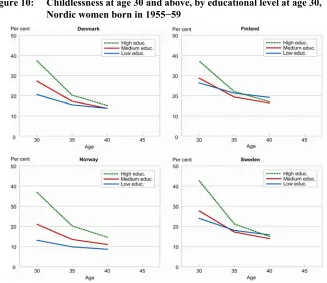
Evidently, highly educated women start childbearing at later ages than women with lower education (Figure 8), but the percentage of highly educated women who become mothers is, in many cases, roughly the same as among the less-educated (Figure 9). Further insight into this process of fertility recuperation can be gained by looking at the levels of childlessness among women with different levels of education at different ages.
Figure 10: Childlessness at age 30 and above, by educational level at age 30, Nordic women born in 1955−59
much more than among women with low education. However, at age 40 the share of childless among the highly educated had dropped to about 15%−17% The figures for earlier cohorts show a similar pattern of fertility recuperation for the highly educated (Appendix 1). In our next section, we provide further evidence of fertility recuperation past age 30 in terms of the ultimate number of children born to Nordic women.
5.3 Education, fertility recuperation and ultimate fertility
In Figure 11 (for cohorts born in 1950−54) and Appendix 2 (for all cohorts of 1945−59), we provide further data on fertility recuperation, and on how these patterns differ by country, cohort, and educational level. In line with our findings for ultimate childlessness in Figure 10 and Appendix 1, we see that initial differences in cumulated fertility by educational level at age 30 diminish as the cohorts reach the end of their reproductive careers. In all Nordic countries, there are no or only small differences in the ultimate number of children born to women in the 1950−54 cohort with different levels of education12. In Finland and Sweden, educational differences in the number of
children ever born more or less disappear at higher ages, while in Denmark and Norway women with low education still have had more children than the other educational groups when they reach the end of their childbearing years.
Figure 12 presents the fertility outcome by means of ultimate fertility (CTFR) at age 40 for female cohorts born in 1945−49 to 1955−59 in each country, by their educational level at age 30. Even though the graphs only include information for cohorts born within a 10- to 15-year period interval, they illustrate the rather homogenous pattern of ultimate fertility across cohorts and educational groups in Finland and Sweden, and a converging pattern in Denmark and Norway.
The largest educational differences are seen in Denmark and Norway, though they have diminished over time as women with low education have reduced their fertility across the cohorts. Norway has the clearest pattern of a lower (higher) educational level being associated with a higher (lower) ultimate number of children. In Denmark, the CTFRs of women with high and medium education are very close to each other. In Finland and Sweden, we observe some minor increases in ultimate fertility within each educational category over the cohorts. For Finland, we also observe an interesting cross-over in patterns, as women with low education in the youngest cohort have lower, rather than higher, ultimate fertility than women in the other educational groups.
The CTFRs for the various educational groups (Figure 12) must be seen in relation to the trends and levels in aggregate cohort fertility for the different countries (Figure 2). These, in turn, are affected by the compositional changes of women over the educational groups (Figure 7). In sum, we note that, as in the case of ultimate childlessness, we find no strong or universal relationship between higher educational levels and lower ultimate fertility. The direction of association is clearer than for childlessness, but differences are sometimes small, diminishing or even changing direction across the cohorts. Nevertheless, in most cases a higher educational attainment is indeed correlated with having somewhat fewer children.
Figure 12: Cohort total fertility at age 40, by educational level at age 30, female cohorts born in 1945−1959
5.4 Education, timing of first birth, and lifetime fertility
in 1950−54. Appendix 3 displays the corresponding relationship for the other cohorts of our study.
Within each educational group of mothers, we note that a later onset of childbearing is related to a lower number of children finally born. More interesting, however, is that, for all four countries, we observe that highly educated women who become mothers at a given age have higher lifetime fertility than women with medium or low education who have their first child at the same age. In Finland and Norway, there are also visible differences between mothers at the low and the medium educational levels, with the medium-educated having higher lifetime fertility for a given age at first birth. Our findings point to the role of “relative age” in higher-order childbearing (cf. Hoem 1996). A highly educated woman who has her first birth at the same age as a given group of less-educated women can be considered an early starter of childbearing within her own educational group. Early starters have more children than late starters (Figure 6), but there are differences across educational groups in what can be considered a late or early onset of childbearing. Figure 13 demonstrates that highly educated mothers will exhibit higher second and third birth rates than women with less education in any fertility model that involves a control for women’s ages. Elevated birth rates among highly educated mothers is indeed a standard finding in event history analyses of the second and third birth behaviour of women in the Nordic countries (Hoem and Hoem 1989; Vikat 2004; Kravdal 2007; Gerster et al. 2007). In Figure 12, we demonstrate that women with higher levels of education nevertheless have a completed fertility that often is slightly lower than that of women with less education. This is not surprising, as the highly educated on average start their childbearing later than the less-educated (Figure 8), and because the age at first birth is strongly related with ultimate fertility (Figures 6 and 13).
Figure 13: Number of children ever born by age 45 for mothers in the Nordic countries, by age and educational level at first childbirth,
women born in 1950−54
6. Summary and conclusion
number of children when mothers who had their first birth at similar ages are compared. The dissimilarities between countries in cohort fertility patterns primarily concern details in the median age at first birth, the timing of the onset of the fertility postponement, the level of ultimate childlessness, and the exact associations of educational level with childlessness and final number of children. Our analyses also show that the Nordic countries have become more similar over time, with differences in cohort fertility patterns appearing to have diminished over the cohorts we studied.
As in the case of our related study on period fertility in the Nordic countries (Andersson 2004; Neyer et al. 2006), we may therefore conclude that there is a common Nordic fertility regime. In line with other Western countries, there is an ongoing postponement of first parenthood. But what distinguishes the Nordic countries is the strong recuperation of fertility at older ages, and the weak role of educational attainment in completed fertility. It is reasonable to argue that these patterns can, to some extent, be attributed to the impact of Nordic social policies that facilitate fertility recuperation and make social differences in behaviour small. As mentioned in the introduction, since the 1960s the Nordic countries have geared their social, labour market, and gender policies towards reducing social differences and increasing gender equity. Clearly, the Nordic societies have a lot in common in their social policies, labour market institutions, and culture in general – and, as we have demonstrated in the present study, in ultimate fertility patterns as well.
Our cohort analyses seem to support the notion that similar welfare policies have contributed to more similar childbearing patterns. The remarkable recuperation record among well-educated women, resulting in small or declining educational differences in completed fertility in all countries, is one indication in this direction. Another indication is the convergence of trends across countries among highly educated women, as evidenced in age at first birth, childlessness, and final number of children.
behaviour of couples. Preferably, such research should be based on models and data that include information on occupation, labour-market attachment, and employment sector, as well as education for both partners.
7. Acknowledgements
References
Andersson, G. (2000). The impact of labour-force participation on childbearing behavior: Pro-cyclical fertility in Sweden during the 1980s and the 1990s.
European Journal of Population 16(4): 293−333.
doi:10.1023/A:1006454909642.
Andersson, G. (2004). Childbearing developments in Denmark, Norway, and Sweden from the 1970s to the 1990s: A comparison. Demographic Research SC3(7): 155−176. doi:10.4054/DemRes.2004.S3.7.
Andersson, G. and Sobolev, B. (2001). Small effects of selective migration and selective survival in retrospective studies of fertility. Rostock: Max Planck Institute for Demographic Research (MPIDR Working Paper; WP 2001−031). Available at: http://www.demogr.mpg.de/Papers/Working/wp-2001-031.pdf Becker, G. (1991). A Treatise on the Family. Cambridge: Harvard University Press. Bergqvist, C., Borchorst, A., Christensen, A. D., Ramstedt-Silén, V., Raaum, N. C., and
Styrkársdóttir, A. (1999). Equal Democracies? Gender and Politics in the Nordic Countries. Oslo: Scandinavian University Press.
Billari, F., Kohler, H-P., Andersson, G., and Lundström, H. (2007). Approaching the limit: Long-term trends in late and very late fertility. Population and Development Review 33(1): 149−170. doi:10.1111/j.1728-4457.2007.00162.x. Björklund, A. (2006). Does family policy affect fertility? Lessons from Sweden.
Journal of Population Economics 19(1): 3−24. doi:10.1007/s00148-005-0024-0. Blossfeld, H.-P. (1995). Changes in the process of family formation and women’s
growing economic independence: A comparison of nine countries. In: Blossfeld, H.-P. (ed.). The New Role of Women: Family Formation in Modern Societies. Oxford: Westview Press: 3−32.
Blossfeld, H.-P. and Huinink, J. (1991). Human capital investments or norms of role transition? How women’s schooling and career affect the process of family formation. American Journal of Sociology 97(1): 143−168.
doi:10.1086/229743.
Brunborg, H. and Kravdal, Ø. (1986). Fertility by birth order in Norway. A register based analysis. Report 86/27. Oslo: Statistics Norway.
Demeny, P. (2003). Population policy dilemmas in Europe at the dawn of the twenty first century. Population and Development Review 29(1): 1−28.
doi:10.1111/j.1728-4457.2003.00001.x.
Esping-Andersen, G. (1990). The Three Worlds of Welfare Capitalism. Princeton: Princeton University Press.
Frejka, T. and Calot, G. (2001). Cohort reproductive patterns in the Nordic countries. Demographic Research 5(5): 125−186. doi:10.4054/DemRes.2001.5.5.
Frejka, T. and Sardon, J-P. (2006). First birth trends in developed countries: Persisting parenthood postponement. Demographic Research 15(6): 147−180. doi: 10.4054/DemRes.2006.15.6
Gerster, M., Keiding, N., Knudsen, L.B., and Strandberg-Larsen, K. (2007). Education and second birth rates in Denmark, 1981−1994. Demographic Research 17(8): 181−210. doi:10.4054/DemRes.2007.17.8.
Gustafsson, S. (2001). Optimal age at motherhood. Theoretical and empirical considerations on postponement of maternity in Europe. Journal of Population Economics 14(2): 225−247. doi:10.1007/s001480000051.
Hoem, B. (1996). The social meaning of the age at second birth for third-birth fertility: A methodological note on the need to sometimes respecify an intermediate variable. Yearbook of Population Research in Finland 33: 333−339.
Hoem, B. (2000). Entry into motherhood in Sweden: The influence of economic factors on the rise and fall in fertility, 1986−1997. Demographic Research 2(4).
doi:10.4054/DemRes.2000.2.4.
Hoem, B. and Hoem, J. M. (1989). The impact of women's employment on second and third births in modern Sweden. Population Studies 43(4): 47−67.
doi:10.1080/0032472031000143846.
Hoem, J. M. and Kreyenfeld, M. (2006a). Anticipatory analysis and its alternatives in life-course research: Part 1: The role of education in the study of first childbearing. Demographic Research 15(16): 461−484.
doi:10.4054/DemRes.2006.15.16
Hoem, J. M., Neyer, G., and Andersson, G. (2006a). Education and childlessness: The relationship between educational field, educational level, and childlessness among Swedish women born in 1955−59. Demographic Research 14(15): 331−380. doi:10.4054/DemRes.2006.14.15.
Hoem, J., Neyer, G., and Andersson, G. (2006b). Educational attainment and ultimate fertility among Swedish women born in 1955−59. Demographic Research 14(16): 381−404. doi:10.4054/DemRes.2006.14.16.
Jørgensen, T. (2006). Nye definisjoner av utdanningsnivåer. Mimeo. Available at: http://www.ssb.no/vis/magasinet/slik_lever_vi/art-2006-09-14-01.html.
Kjeldstad, R. (2001). Gender policies and gender equality. In: Kautto, M., Fritzell, J., Kvist, J., Hvinden, B., and Uusitalo, H. (eds.). Nordic Welfare States in the European Context. London: Routlegde: 66−97.
Kneale, D. and Joshi, H. (2008). Postponement and childlessness - Evidence from two British cohorts. Demographic Research 19(58): 1935−1968.
doi:10.4054/DemRes.2008.19.58.
Knudsen, L. B. (1993). Fertility trends in Denmark in the 1980s. A register based socio-demographic analysis of fertility trends. Copenhagen: Statistics Denmark. Korpi, W. (2000). Faces of inequality: Gender, class, and patterns of inequalities in
different types of welfare states. Social Politics 7(2): 127−191.
doi:10.1093/sp/7.2.127.
Kravdal, Ø. (2001). The high fertility of college educated women in Norway: An artefact of the separate modelling of each parity transition. Demographic Research 5(6): 187−216. doi:10.4054/DemRes.2001.5.6.
Kravdal, Ø. (2007). Effects of current education on second- and third-birth rates among Norwegian women and men born in 1964: Substantive interpretations and methodological issues. Demographic Research 17(9): 211−246.
doi:10.4054/DemRes.2007.17.9.
Kravdal, Ø. and Rindfuss R. R. (2008). Changing relationships between education and fertility: A study of women and men born 1940 to 1964. American Sociological Review 73(5): 854−873.
Kreyenfeld, M. (2006). Women’s education and first birth: East Germany before and after unification. In: Gustafsson, S. and Kalwij, A. (eds.). Education and Postponement of Maternity: Economic Analyses for Industrialized Countries. Berlin: Springer: 225−236. doi:10.1007/1-4020-4716-9.
Lappegård, T. (2000). New fertility trends in Norway. Demographic Research 2(3).
doi:10.4054/DemRes.2000.2.3.
Lappegård, T. and Rønsen, M. (2005). The multifaceted impact of education on entry into motherhood. European Journal of Population 21(1): 31−49.
doi:10.1007/s10680-004-6756-9.
Leira, A. (1992). Welfare States and Working Mothers. The Scandinavian Experience. Cambridge: Cambridge University Press.
Leira, A. (1993). The ”woman-friendly” welfare state? The case of Norway and Sweden. In: Lewis, J. (ed.). Women and Social Policy in Europe. Aldershot: Edward Elgar Publishing Ltd.: 49−71.
Liefbroer, A. and Corijn, M. (1999). Who, what, where and when? Specifying the impact of educational attainment and labour force participation on family formation. European Journal of Population 15(1): 45−75.
doi:10.1023/A:1006137104191.
Neyer, G. and Andersson, G. (2008). Consequences of family policies on childbearing behavior: Effects or artifacts?. Population and Development Review 34(4): 699−724. doi:10.1111/j.1728-4457.2008.00246.x.
Neyer, G. and Hoem, J. (2008). Education and permanent childlessness: Austria vs. Sweden. A research note. In: Surkyn, J., Deboosere, P., and Van Bavel, J. (eds.). Demographic Challenges for the 21st Century. A State of the Art in Demography. Brussels: VUB Press: 91−112.
Neyer, G., Andersson, G., Hoem, J. M., Rønsen, M., and Vikat, A. (2006). Fertilität, Familiengründung und Familienerweiterung in den nordischen Ländern. In: Bertram, H., Krüger, H., and Spieß, C. K. (eds.). Wem gehört die Familie der Zukunft? Expertisen zum 7. Familienbericht der Bundesregierung. Opladen: Verlag Barbara Budrich: 207−233.
Rendall, M., Couet, C., Lappegård, T., Robert-Bobee, I., Rønsen, M., and Smallwood, S. (2005). First birth by age and education in Britain, France and Norway. Population Trends 121: 27−34.
Skrede, K. (1999). Shaping gender equality: The role of the state. Norwegian experiences, present policies and future challenges. In: Bouget, D. and Palier, B. (eds.). Comparing Social Welfare Systems in Nordic Europe and France. MIRE Vol 4. Nantes: Maison des Sciences de l'Homme Ange-Guépin: 169−199. Statistics Denmark (1973). Ægteskaber, fødte og døde 1956−1969. Copenhagen. Statistics Sweden (2000). Svensk utbildningsnomenklatur 2000. Stockholm−Örebro. United Nations (2000). Below Replacement Fertility. Population Bulletin of the United
Nations. Special Issue 40/41 1999. New York.
Appendix
Appendix 3: Number of children ever born by age 45 for mothers, by age and educational level at first childbirth, five-year cohorts of Nordic women13