________________
*Corresponding author
Received June 13, 2016
943
Available online at http://scik.org
J. Math. Comput. Sci. 6 (2016), No. 5, 943-952
ISSN: 1927-5307
A FINITE ELEMENT MESH GENERATION FOR COMPLEX GEOMETRY
G. MANJULA, K.T. SHIVARAM* AND N.V. VIGHNESAM
Department of Mathematics, Dayananda Sagar College of Engineering, Bangalore, India
Copyright © 2016 G. Manjula, K.T. Shivaram and N.V. Vighnesam. This is an open access article distributed under the Creative Commons Attribution License, which permits unrestricted use, distribution, and reproduction in any medium, provided the original work is properly cited. Abstract: A new approach to generate quadrilateral and pentagonal finite element meshes in convex, non convex and curved domain is presented. The method is based partially on triangle and pentagon, centroid of each triangle is considered joining the sides of its midpoints and discretised into quadrilaterals and pentagons. This procedure is applied to each triangle in the domain and a quadrilateral and pentagonal mesh is generated. For this a program has been developed in computer algebra and symbolic computational software MAPLE.
Keywords: Mesh generation; Finite element method; quadrilateral element; pentagonal element; Maple. 2010 AMS Subject Classification: 65L60.
1. Introduction
Finite element mesh generation is one of the most time consuming aspects for solving two
dimensional partial differential equations in complex domain. The advent of modern computer
technologies provided a powerful computational tool in numerical solutions of the partial
differential equations over complex domains. A triangle quadrilateral and pentagonal mesh is
required for finite element method as it uses in finite elements of a domain discretization. Finite
Element Method (FEM) is widely used for many fields of engineering and applied science. Mesh
generation technique is used in many industrial sectors such as automobile engineering,
aerospace engineering, civil engineering, medical electronics, manufacturing and others. The
Finite Element Analysis (FEA) and its applications comprises three phases i) Domain
discretization or Mesh generation ii) Equation solving iii) Error analysis.
Mesh generation is the important role in the achievement of accurate solutions of the partial
solution by dividingthe analysisregion into smallersubregionsthese smaller sub regions are the
elements which are linked with adjacent elements at their nodel points. The procedure of the
mesh generation technique depends on the geometric data of the elements and their nodes. First
all the coordinate nodes are created and connecting nodes from arbitrary triangles. FEM is the
computational basis of many computer aided design its usefulness is often hampered by the need
to generate a quadrilateral or pentagonal mesh in complex domain. To creating a mesh in
complex domain is the first step in a wide range of applications, including computer graphics,
biomedicine, materials science and scientific and engineering computing. This can be very time
consuming and error prone task when done manually. A large number of methods have been
devised to automate the mesh generation task. Proposed paper is an attempt to create automatic
mesh generation over convex, non convex and curved domain. From the literature survey a
quadrilateral mesh generation in plane and curved surfaces in isoperimetric techniques presented
by [1]. High quality of quadrilateral mesh gives the better accurate solution than a triangle mesh
is given in [2],[3],[4]. A number of researchers [5],[6],[7] have made effort to develop adaptive
Finite element method which integrates with error estimation and modification of automatic
mesh generator. The research literature of various meshing methods and the applications of these
meshes along with the development of mesh generation method are provided in [8]-[12]. The
scope of the structured meshes and unstructured meshes by optimization method is discussed in
[13]. There have been a number of approaches to develop automatic mesh generation based on
partitioning the domain of interest into sets of sub domains and subsequently meshing those sub
domains in medical electronics [14], finite element mesh can be usually categorized into
structured and unstructured triangle or quadrilateral mesh. A structured mesh has a uniform
defined structure that unstructured meshes lack the uniformity. The automatic generation of both
structured and unstructured meshes is non trivial task and each comes with challenges of their
own even though for most of the appropriate numerical solution [15], [16]. In this paper. we
propose a new technique for generating quadrilateral and pentagonal meshes for geometry
specified in the coordinate system. First we decompose the convex and non convex polygonal
domain into sub triangles and every arbitrary triangle is again discretized into three quadrilaterals
by adding three vertices in the middle of the edges and a node at the centre of the linear
triangular element. The subsequent quadrilateral and pentagonal meshes are developed by
52,…..,n2 sub triangles of equal size to generate triangular mesh. In section 3, we explain the
procedure to split these arbitrary triangle into quadrilaterals. In section 4, we present several
examples to illustrate the quadrilateral and pentagonal meshes in complex domain.
2. Discretization of Triangles
2.1. Subdivision of an Linear Arbitrary Triangle
a) 22 sub triangle b) 42 sub triangles
Fig. 1 Division of an arbitrary triangle into sub triangles in Cartesian space
Figure 1a and 1b show the division of arbitrary triangle into 22, 32, 42, 52,…..n2 sub triangles of
equal size in the Cartesian coordinates. The sides of the triangle is divided into equal parts with same length, the area of the linear arbitrary triangle ∆ with vertices ( (𝑥𝑖, 𝑦𝑖), 𝑖 = 1, 2, 3) is equal to sum of the area of the sub triangles ∆/𝑛2 where n is the equal division of all sides in the
Cartesian space.
2.2. Division of Arbitrary triangle into quadrilaterals
a) 3 – Quadrilaterals b) 12 – Quadrilaterals
Fig. 2. Division of an arbitrary linear triangle into quadrilaterals
We first discretize arbitrary triangle into three quadrilaterals by joining the centroid of the
midpoints of sides of the linear triangle. The area of the arbitrary linear triangle with vertices
( (𝑥𝑖, 𝑦𝑖), 𝑖 = 1, 2, 3) is same as the sum of the three quadrilaterals. to divide the arbitrary linear
𝐶(𝑥𝑖+𝑥𝑗+𝑥𝑘
3 ,
𝑦𝑖+𝑦𝑗+𝑦𝑘
3 ) these six nodes, linear triangle to the midpoints of their sides. To
illustrated the same process for the two or more divisions of sides of the arbitrary linear triangles
to converted into quadrilaterals.
3. Subdivision of an Linear Arbitrary pentagon
a) Regular pentagon b) 6 - Pentagons
Fig.3 Division of an arbitrary pentagon into sub pentagons in Cartesian space
We first divided arbitrary pentagon into 6 sub pentagon of equal size in the Cartesian
coordinates, the sides of the pentagon is divided into equal parts with same length, the area of the linear arbitrary pentagon with vertices ( (𝑥𝑖, 𝑦𝑖), 𝑖 = 1, 2, 3,4,5) is equal to sum of the area
of the sub pentagons. We can generate pentagonal mesh in polygonal domain. We first
discretised the polygonal domain into pieces of arbitrary pentagons and each pentagonal domain
is again discretised into pentagons. Finally, we can generate pentagonal mesh in polygonal
domain. We have included some meshes generated by using maple program. We further
illustrated the applications of the algorithm by generating quadrilateral and pentagonal meshes in
convex, non-convex polygonal and curved domain.
Mesh 3 Mesh 4
Mesh 5 Mesh 6
Mesh 9 Mesh 10
Mesh 11 Mesh 12
4. Application Examples
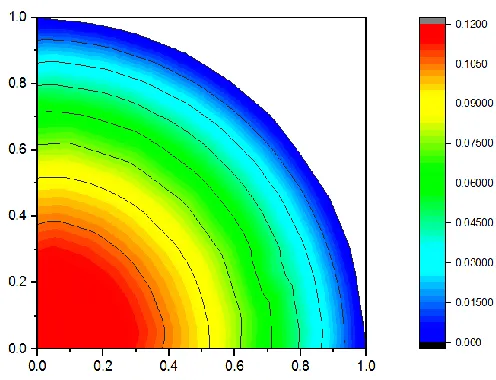
The mesh generation technique is applied to solve the Saint Venant Torsion problem in triangle
and circle domain, the boundary value problem is described by
∂2ϕ ∂x2+
∂2ϕ
∂y2 = −2 , within T or C
(1)
ϕ= 0 , on ∆1 , ∂ϕ∂n= 0, on ∆2
Using Galerkin weighted residual method. The numerical solution of eq.(1) for the domain T or
C expressed as
[𝐾]𝑀 × 𝑀 {𝑈}𝑀×1 = {𝐹}𝑀×1 (2)
Where 𝐾𝑖,𝑗= ∬𝑇 𝑜𝑟 𝐶(𝜕𝑁𝜕𝑢𝑖𝜕𝑁𝜕𝑢𝑗+𝜕𝑁𝜕𝑣𝑖𝜕𝑁𝜕𝑣𝑗) 𝑑𝑥 𝑑𝑦
= 𝐾𝑢,𝑢+ 𝐾𝑣,𝑣 (3)
𝐾𝑢,𝑢 = ∫ ∫ (−11 −11 𝜕𝑁𝜕𝜉𝑖𝜕𝑣𝜕𝜂+𝜕𝑁𝜕𝜂𝑖𝜕𝑣𝜕𝜉) ∗ (𝜕𝑁𝜕𝜉𝑗𝜕𝑣𝜕𝜂+𝜕𝑁𝜕𝜂𝑗𝜕𝑣𝜕𝜉)1𝐽 𝑑𝜉 𝑑𝜂 (3a)
𝐾𝑣,𝑣 = ∫ ∫ (−11 −11 𝜕𝑁𝜕𝜉𝑖𝜕𝑢𝜕𝜂+𝜕𝑁𝜕𝜂𝑖𝜕𝑢𝜕𝜉) ∗ (𝜕𝑁𝜕𝜉𝑗𝜕𝑢𝜕𝜂+𝜕𝑁𝜕𝜂𝑗𝜕𝑢𝜕𝜉)1𝐽 d𝜉 d𝜂 (3b)
𝐹𝑖 = ∫ ∫ 𝑓(𝑢(𝜉, 𝜂), 𝑣(𝜉, 𝜂)) 𝐽 𝑁−11 −11 𝑖(𝜉, 𝜂) 𝑑𝜉 𝑑𝜂 (3c)
Integrals of Eqn.3a-c are calculated for each quadrilateral elements by Gauss Legendre
quadrature rule and assembling is performed to add the effect of all quadrilateral elements into
account with boundary condition, finding all unknown’s of u of eqn. [2] and these are contour
Fig. 4 Stress function for bar of triangle cross section of Mesh 8
Fig. 5 Stress function for bar of circle cross section of Mesh 1
5.Conclusions
In this paper, a new technique for automatic quadrilateral and pentagonal meshes are generated
in convex, non convex and curved domain is proposed. The method is based on considering
arbitrary triangle and each triangle is discretized into three quadrilaterals by adding three vertex
in the middle of the edges and a vertex at the centroid of the linear triangular element. A
accuracy is obtained by when dense quadrilateral mesh is considered comparing with triangle
mesh for solving in partial differential equation problems
Conflict of Interests
The authors declare that there is no conflict of interests.
REFERENCES
[1] O.C. Zienkiewicz and D.V. Philips, An Automatic Mesh Generation Scheme for Plane and Curved Surface by isoparametric Coordinates, Int J. Numer. Meth. Eng, 3(1971), 519-528.
[2] S.H. Lo and C.K. Lee, On Using Mesh of Mixed Element Types in Adaptive Finite Element Analysis, Finite element Analysis and design, 11(1992), 307-336.
[3] D.A. Lavender and D.R. Hayhurst, An Assessment of Higher – Order Isoparametric Elements for Solving an Elastic Problem, Comput. Methods, Appl. Mech. Eng. 56(1986), 139-165.
[4] J. Zhu, O.C. Zienkiewicz, E. Hinton and J. Wu, A New Approach to the Development of Automatic Quadrilateral Mesh Generation, Int. J. Numer. Meth. Eng., 32(1991), issue 4, 849-866.
[5] W.J. Gardan and C.A. Hall, Construction of Curvilinear Coordinates Systems and Application to Mesh Generation, Int. J.Numer. Meth. Eng, 3(1973), 461-477.
[6] J.C. Cavendish, Automatic Triangulation of Arbitrary Planar Domains for the Finite Element Method, Int. J. Numer. Meth. Eng, 8(1974), 679-696.
[7] A.O. Moscardini, B.A. Lewis and M. Gross, Automatic Generation of Triangular and Higher Order Meshes, Int. J. Numer. Meth.Eng, 19(1983), 1331- 1353.
[8] M.S. Shephard, Approaches to the Automatic Generation and Control of Finite Element Meshes, Appl. Mech. Review, 41(1988), 169-185.
[9] M.S. Shephard, Automatic Generation of Finite Element Models in M.Papadrakakis, Ed, Solving Large Scale Problems in Mechanics, John Wiley and sons, 1993, 431-460.
[10]K. Ho-Le, Finite Element Mesh Generation Methods, A Review and Classification, Computer Aided Design, 20(1988), 21-38.
[11]W.R. Buell and B.A. Bush, “Mesh Generation: A Survey”, J. Eng. Industry. ASME Ser B. 95(1973), 332-338. [12]M.A. Yerry and M.S. Shephard, “Automatic mesh generation for three dimensional solids, comput. Structure.
20(1985), 31-39.
[13]J. Cabello, R. Loher and O.P. Jacquotte, A variational method for the optimization of two and three dimensional unstructured meshes, ONERA TP( 1992).
[14]T.K.H. Tam and C.G. Armstrong. Finite element mesh generation by medical axis subdivision, Advance Engineering and software 13(1991), 313-324.
[16]P. Per-Olof, Mesh generation for implicit geometries, Lund Institute of technology, (2005), 19-40.
[17]K.T.Shivaram, Generalised Gaussian Quadrature over a circle, International Journal of Research in Aeronautical and Mechanical Engineering, 1(2013), Issue.5, 19-24.
[18]K.T.Shivaram, Generalised Gaussian Quadrature over a Triangle, American Journal of Engineering Research. 2(2013), 290–293.
[19]K.T.Shivaram, Generalised Gaussian Quadrature Rules over an arbitrary Tetrahedron in Euclidean Three- Dimensional Space’ International Journal of Applied Engineering Research 8(2013), 1533—1538.