University of New Orleans University of New Orleans
ScholarWorks@UNO
ScholarWorks@UNO
University of New Orleans Theses and
Dissertations Dissertations and Theses
8-9-2006
Comparing the Effects of Various Estrogen Replacement
Comparing the Effects of Various Estrogen Replacement
Paradigms on Working Memory Performance in the Radial-Arm
Paradigms on Working Memory Performance in the Radial-Arm
Maze
Maze
Johannes Bohacek
University of New Orleans
Follow this and additional works at: https://scholarworks.uno.edu/td
Recommended Citation Recommended Citation
Bohacek, Johannes, "Comparing the Effects of Various Estrogen Replacement Paradigms on Working Memory Performance in the Radial-Arm Maze" (2006). University of New Orleans Theses and
Dissertations. 404.
https://scholarworks.uno.edu/td/404
This Thesis is protected by copyright and/or related rights. It has been brought to you by ScholarWorks@UNO with permission from the rights-holder(s). You are free to use this Thesis in any way that is permitted by the copyright and related rights legislation that applies to your use. For other uses you need to obtain permission from the rights-holder(s) directly, unless additional rights are indicated by a Creative Commons license in the record and/or on the work itself.
COMPARING THE EFFECTS OF VARIOUS ESTROGEN REPLACEMENT PARADIGMS ON WORKING MEMORY PERFORMANCE
IN THE RADIAL-ARM MAZE
A Thesis
Submitted to the Graduate Faculty of the University of New Orleans in partial fulfillment of the requirements for the degree of
Master of Science in
Psychology Applied Biopsychology
by
Johannes Bohacek
1st Diploma, Karl-Franzens-Universitaet Graz, 2003
This manuscript is dedicated to my parents,
Table of Contents
List of Figures ... iv
Abstract ...v
Introduction...1
Method ...13
Results...18
Discussion ...24
References...29
Appendix...35
Animal Subjects Approval Form ...35
List of Figures
Figure 1 ...19
Figure 2 ...20
Figure 3 ...21
Figure 4 ...21
Abstract
The current study compared the impact of different paradigms of estradiol replacement on
working memory performance. In adult ovariectomized rats, a vehicle-treated control group
(n=10) was compared to three estradiol replacement paradigms: 1) continuous delivery via
Silastic capsules (n=8); 2) cyclic replacement via two 10 µg injections on two out of every four
days (n=10); 3) cyclic replacement via one 2 µg injection every four days (n=10). While
treatment continued, animals were tested over 24 days in the 8-arm radial maze. After this
acquisition period, various delay times were introduced between 4th and 5th arm choices.
Treatments had no effects during acquisition or delay trials of 1 min, 10 min, and 3 hours.
However, when a 5-hour delay was imposed, rats receiving estradiol via implants outperformed
all other groups. These results indicate that long-term continuous estradiol replacement is more
Comparing the Effects of Various Estrogen Replacement Paradigms
on Working Memory Performance in the Radial-Arm Maze
Estrogens, a group of female sex hormones (the most prevalent of which is estradiol), are
produced mainly by the ovaries and play a crucial role in regulating reproductive functions in
mammals (Becker, Breedlove, Crews, & McCarthy, 2002). In addition to its primary function as
a reproductive hormone, estradiol also exerts remarkable effects on brain regions not classically
associated with reproduction. Pronounced effects of estradiol on the hippocampus, a structure
implicated in learning and memory, have been repeatedly reported (for review, see Woolley,
1998). In line with these findings, manipulations of estradiol levels have been demonstrated to
affect behavioral measures of learning and memory in rodents, non-human primates and humans
(Dohanich, 2002; Rapp, Morrison, & Roberts, 2003; Sherwin, 2003).
Estrogen and the Hippocampus
Many studies demonstrate that estrogen has profound effects on hippocampal structure
and function. Specifically, dendritic spine density on CA1 pyramidal neurons in the
hippocampus is lowered in ovariectomized rats, but can be restored to baseline of intact animals
upon exogenous estradiol replacement (Gould, Woolley, Frankfurt, & McEwen, 1990; Woolley
& McEwen, 1992). Accordingly, spine and synapse density also fluctuate over the female cycle
(Woolley, Gould, Frankfurt, & McEwen, 1990; Woolley et al., 1992). Dendritic spines are
protrusions with a thin neck and a bulbous head; they form the postsynaptic part of excitatory
synapses and are believed to compartmentalize calcium influx in response to synaptic activity
(Chittajallu, Alford, & Collingridge, 1998; Nimchinsky, Sabatini, & Svoboda, 2002). In line with
these findings, estradiol replacement has been shown to increase presynaptic (synaptophysin and
ovariectomized rats (Brake et al., 2001). Further, it has been demonstrated that estradiol
replacement in ovariectomized animals increases NMDA receptor binding in the hippocampus
(Weiland, 1992; Daniel & Dohanich, 2001). NMDA receptors are located mainly on the head of
dendritic spines and are highly permeable to calcium, playing a crucial role in synaptic plasticity,
e.g. long-term potentiation, a construct thought to represent a biological mechanism for memory
formation (Bliss & Collingridge, 1993). Accordingly, in female rats during proestrus – when
estradiol levels reach their peak – long-term potentiation is enhanced (Warren, Humphreys,
Juraska, & Greenough, 1995), and similarly, estradiol replacement in ovariectomized animals
also increases hippocampal long-term potentiation (Foy et al., 1999).
Estrogen and the Cholinergic System
Cholinergic neurons in the basal forebrain (septal nucleus, diagonal band nucleus) project
afferent fibers to the hippocampus, constituting the septohippocampal pathway (Woolf, 1991).
The cholinergic system has long been thought to play a role in learning and memory, and there is
substantial evidence that the cognitive impairments associated with Alzheimer’s disease are
linked to a loss of cholinergic neurons (for review, see Francis, Palmer, Snape, & Wilcock,
1999). Interestingly, estradiol replacement in ovariectomized rats was shown to increase several
markers of cholinergic function in the basal forebrain, such as choline acetyltransferase (ChAT)
activity (Singh, Meyer, Millard, & Simpkins, 1994), number of ChAT containing neurons
(Gibbs, Wu, Hersh, & Pfaff, 1994), and amount of acetylcholine release in the hippocampus
(Gibbs, Hashash, & Johnson, 1997; Marriott & Korol, 2003). Because the septohippocampal
projections constitute an important input pathway to the hippocampus, it has been argued that the
modulating effects of estradiol on the cholinergic system could explain the impact of estradiol on
receptors in the hippocampus mediate the impact of estradiol on hippocampal NMDA receptor
binding and on working memory performance (Daniel et al., 2001; Daniel, Hulst, & Lee, 2005).
Estrogen Acts Via Estrogen Receptors
The physiological effects of estrogen on the hippocampal structure and on the basal
forebrain are mediated through different estrogen receptors (ER). “Classical” intracellular
receptors (ERα and ERβ) are differentiated from newly detected membrane bound receptors (for
reviews, see McEwen & Alves, 1999; Toran-Allerand, 2004). Estrogen binding to the classical
receptor subtypes exerts its effects via comparatively slow genomic mechanisms, the
receptor-ligand complexes dimerize and bind to either an estrogen response element (ERE) or to an
activator protein 1 (AP-1) site where they trigger gene expression. The membrane bound
receptors are thought to employ rapid nongenomic mechanisms of action via second messenger
pathways, specifically cyclic adenosine monophasphate (cAMP) and mitogen-activated protein
kinase (MAPK) pathways. Recently, the presence (and colocalization) of ERα and ERβ has been
documented in the cortex, in the basal forebrain, and in all regions of the hippocampus (Li,
Schwartz, & Rissman, 1997; Shughrue & Merchenthaler, 2000; Mehra, Sharma, Nyakas, & Vij,
2005).
Effects of Estrogen on Learning and Memory Performance
The physiological results demonstrating the impact of estrogen on brain structure and
function discussed above are accompanied by a large body of behavioral studies analyzing the
cognitive effects associated with fluctuating estrogen levels. Because the hippocampus is a
structure known to play an important role in learning and memory (Eichenbaum & Cohen, 2001),
cognitive performance. Interestingly, the behavioral data is very contradictory and task
dependent (for review, see Dohanich, 2002).
One way to differentiate and categorize the equivocal findings is to distinguish between
working memory and reference memory tasks. Working memory is here defined as a form of
short-term memory for information that is currently but only temporarily useful, while reference
memory is a form of long-term memory for information that yields a general principle which is
useful over longer periods of time (see Dohanich, 2002). Within this framework, experiments
from our and other laboratories have shown the differential effects of estradiol on working and
reference memory using the radial-arm maze. In the working memory version of the radial-arm
maze, all arms are initially baited and the food deprived animal can freely choose between arms.
If an arm that has already been visited during that trial is entered again, the animal commits a
working memory error. Variations of this task have consistently indicated improved performance
of estradiol treated animals as compared to controls (Daniel, Fader, Spencer, & Dohanich, 1997;
Luine, Richards, Wu, & Beck, 1998; Fader, Johnson, & Dohanich, 1999; Daniel et al., 2001). In
contrast, for a reference memory task only certain (and always the same) arms of the radial-arm
maze would be baited over several trials. Hence, a reference memory error is scored anytime the
animal enters one of the arms that are never baited. Estradiol replacement in these tasks generally
fails to improve or even impairs performance (Luine et al., 1998; Fader et al., 1999).
Working and reference memory can also be tested in the aversive water escape task,
where the animal is put in a circular pool filled with opaque water and has to use extramaze cues
to find an escape platform just beneath the water surface. For the reference memory task, the
escape platform would be in the same spot every session/day, so the animal has to use extramaze
find the platform on the first trial and then find the platform again at the same spot on a later trial
the same day, but the platform would be moved every day/session. Studies assessing the impact
of estradiol on different water escape tasks have yielded contradictory results even within the
framework of working versus reference memory (for review see, Dohanich, 2002). However,
swim path analysis have raised the possibility that rats with high estradiol levels might employ
different learning strategies than animals with low estradiol levels (Korol, 2004). This idea is
well in line with modern theories of multiple memory systems that map onto distinct brain
regions (McDonald & White, 1993; White & McDonald, 2002). Lesion studies have, for
example, shown a clear dissociation between place and response learning which preferentially
involve the hippocampus and striatum, respectively (Packard & McGaugh, 1996). Behaviorally,
place and response learning can be dissociated in a T-maze with one (for example the right) arm
baited. The animals can choose either an egocentric response strategy (always turn right) or an
extramaze cue-dependent place strategy (always turn towards a specific location in the room).
Consistent with the pronounced effects of estradiol on hippocampal structure and physiology, it
has recently been demonstrated that estradiol differentially impacts strategy selection in the
plus-maze (Korol & Kolo, 2002) and the water plus-maze (Daniel & Lee, 2004). Specifically, high
estradiol levels seem to bias female rats to use a place rather than a response strategy. According
to modern theories of learning and memory, memory systems do not act independently, but
rather seem to show complex patterns of competition and cooperation between different neural
systems (White et al., 2002; Gold, 2004). Consequently, it is possible that striatum and
hippocampus compete for participation in certain learning tasks, and estradiol could bias an
animal towards using a hippocampus-based strategy, which might be advantageous or impairing
the differentiation between working and reference memory, there is evidence that working
memory might be dependent primarily upon the hippocampus, while reference memory seems to
be striatum-dependent (Packard & White, 1990). Hence, it is possible that the estradiol-mediated
enhancement of hippocampal structure and function might bias animals to use working memory
strategies and potentially impair striatum-based reference memory performance.
Estrogen Replacement and its Role in Postmenopausal Women
Currently, there is an ongoing debate over the effectiveness of hormone replacement
therapy (HRT) in postmenopausal women. HRT is typically administered in the form of daily
pills containing either conjugated equine estrogen alone (CEE) or combined with
medroxyprogesterone acetate (CEE+MPA). Until recently, accumulating experimental evidence
suggested that the dramatic decline in ovarian hormones in women after menopause contributes
to age-related cognitive decline and the increased incidence of Alzheimer’s disease in elderly
women, and that HRT can counteract these effects (for review, see Sherwin, 2003). HRT is
highly effective in alleviating menopause-associated symptoms like acute climacteric symptom
(hot flashes) and osteoporosis (loss of bone mass), but it has also become a promising tool for
protection against postmenopausal cognitive decline (for review, see Prevelic, Kocjan, &
Markou, 2005). Recently, however, this view has been challenged by the randomized,
double-blind, placebo-controlled Women’s Health Initiative Memory Study (WHIMS). A large sample
of women aged 65 years and above received either CEE, CEE+MPA, or placebo. Unexpectedly,
the study reported adverse effects of both HRT paradigms on cognitive function and an increased
risk for Alzheimer’s disease (Rapp et al., 2003; Espeland et al., 2004; Shumaker et al., 2004).
Yet, these results were criticized for methodological inconsistencies with previous human and
estrogen), route (oral, injections, transdermal), time (perimenopausal vs. postmenopausal) and
type (chronic vs. cyclic) of hormone replacement therapy seem to be crucial factors for therapy
success (Sherwin, 2005; Prokai-Tatrai & Prokai, 2005; Sohrabji, 2005; Gleason, Carlsson,
Johnson, Atwood, & Asthana, 2005). For example, animal studies almost exclusively use
synthetically produced estradiol, while the WHIMS trials used the clinically most commonly
prescribed form, conjugated equine estrogen (CEE). CEE uses estrone as its main active
ingredient, which is a less potent and pharmacologically distinct form of estrogen than estradiol.
Fundamental differences in the pharmacology and effectiveness of these forms of estrogen
preparations have recently been suggested, and there are some clinical trials that favor estradiol
treatments over CEE administration (for review, see Gleason et al., 2005). With respect to time
of HRT onset, recent evidence suggests that there is a critical time window following cessation
of ovarian function during which estradiol replacement must be initiated to produce enhancing
effects on working memory performance in middle-aged rats (Gibbs, 2000; Daniel, Hulst, &
Berbling, 2006). The WHIMS trials, however, initiated HRT in women aged 65 years and above,
which is more than a decade after ovarian hormones have declined during menopause.
In the current study, we wanted to focus on possible differences between chronic versus
cyclic replacement paradigms. Data from animal studies have recently raised interesting
questions concerning the effectiveness of chronic as compared to cyclic estradiol replacement. In
the first study long-term hormone deprivation (14 – 20 months) caused a dramatic decline in
spine density of dentate granule cells in ovariectomized rats (Miranda, Williams, & Einstein,
1999). However, long-term chronic estradiol implants (14 – 20 months) did not restore spine
density in the dentate gyrus of the aged female rat if compared to ovariectomized controls.
apart) did increase spine density in those animals that were long-term hormone-deprived as well
as in those who received long-term chronic estradiol replacement. This opens the possibility that
cyclic but not chronic estradiol treatment might exert positive effects on hippocampal physiology
and hence maybe on memory function in aged animals.
In line with these findings, another experiment has demonstrated that long-term cyclic
estradiol and progesterone replacement (~ 7 months) in aged rats proves at least as effective as
chronic estradiol replacement in enhancing performance on a spatial delayed matching to
position working memory task in the T-maze (Gibbs, 2000). In this study, the cyclic paradigm
consisted of one 10 µg injection of 17ß-estradiol sc. once a week, followed by a 500 µg injection
of progesterone after 48 hours. These studies yield some support to the hypothesis that cyclic
estradiol replacement might be physiologically more beneficial than chronic replacement in aged
animals, and behaviorally it seems to be at least as effective as chronic treatment on the
examined tasks.
It must be mentioned though, that the use of progesterone in addition to estradiol adds
another layer of complexity to these results. Generally, progesterone is believed to initially
increase the effects of estradiol on the hippocampus, but to reduce them quickly thereafter
(Woolley & McEwen, 1993). Although the role of progesterone in modulation of cognitive
function needs to be further investigated, it is beyond the scope of the current investigation to
include progesterone injections in the treatment schedule.
Different Paradigms of Estradiol Delivery
Two regimens of estradiol replacement dominate the behavioral as well as physiological
animal literature. The most common replacement paradigm uses a two-day injection schedule of
1994; Sandstrom & Williams, 2001). The second frequently used paradigm is implantation of a
Silastic capsule containing powdered estradiol – either pure or mixed with cholesterol –
subcutaneously into the nape of the neck (Daniel et al., 1997; Luine et al., 1998; Bimonte &
Denenberg, 1999). The fundamental pharmacokinetic differences between these treatment
regimens are apparent: While injections result in a sharp peak of estradiol levels, Silastic
implants produce steady levels over the course of the experiment. The cyclic injection paradigm
of two 10 µg estradiol benzoate injections 24 hours apart has been demonstrated to cause sharp,
supraphysiological estradiol peaks, with the second injection pushing estradiol titers up to about
150 – 200 pg/ml before they rapidly decline to physiological levels on days three and four
(Woolley et al., 1994; Ziegler & Gallagher, 2005). In comparison, the most commonly used
Silastic implants produce steady estradiol levels in the low- to mid-physiological range around
30 – 40 pg/ml (Singh et al., 1994; Luine et al., 1998; Fader et al., 1999; unpublished data from
our lab).
In the intact female rat, the estrous cycle lasts four to five days. Typically it begins with
two days of diestrus during which estradiol levels slowly increase to a level of about 15 – 30
pg/ml, followed by proestrus where estradiol levels gradually reach their peak (40 – 60 pg/ml),
and during the final day – estrus – estradiol levels rapidly decline below the detectable limit
(Isgor, Huang, Akil, & Watson, 2002; Becker et al., 2005). Consequently, neither the cyclic nor
the chronic estradiol replacement paradigm mimic the in vivo fluctuations of estradiol observed
in intact cycling animals.
With respect to mimicking the estradiol levels of naturally cycling animals, there is
another interesting injection paradigm that has to our knowledge not yet been studied in
replacement where one sc. injection of 2 µg of estradiol benzoate is given once every four days
(Micevych, Eckersell, Holland, & Smith, 1996; Geary & Asarian, 1999; Asarian & Geary, 2002).
This paradigm has proven successful in research on lordosis behavior, feeding and weight gain.
The attractiveness of this replacement paradigm is that it resembles the natural estradiol levels
during the rat estrous cycle more closely than any other treatment regimen mentioned above
(Micevych et al., 1996; Asarian et al., 2002).
Different Estradiol Replacement Paradigms and Cognitive Function
Despite the pharmacokinetic differences discussed above, the enhancement of
hippocampal structure by estradiol has been shown in naturally cycling animals (Woolley et al.,
1990) as well as in response to the two-day cyclic injection paradigm (10 µg of estradiol
benzoate; Woolley, 1998; Foy et al., 1999). Accordingly, this replacement paradigm increases
working memory performance in the radial-arm maze as well as in the water maze (Daniel et al.,
2001; Sandstrom et al., 2001). A recent study has revealed that the improved performance
following this two day estradiol regimen is detectable for four days after the second injection
(Sandstrom & Williams, 2004). This mirrors the estradiol-triggered increase in CA1 spine
density reported in earlier experiments (Woolley et al., 1993) that lasts for about a week before
returning to baseline.
In comparison, chronic estradiol replacement has not been assessed with regard to
hippocampal spine density, but physiological effects on the basal forebrain and markers of
acetylcholine activity have been repeatedly reported (Singh et al., 1994; Gibbs et al., 1994).
Behaviorally, estradiol delivered continuously via Silastic capsules has yielded beneficial effects
on spatial working memory performance in the radial-arm maze if delivered for several weeks at
1999). However, a study using a chronic, high physiological dose of about 90 pg/ml found no
memory enhancement (Luine & Rodriguez, 1994). Another study found that low physiologic
estradiol levels produced by daily injections of 0.3 µg estradiol benzoate enhanced working
memory, while higher doses impaired it (Holmes, Wide, & Galea, 2002). However, the use of
daily injections is pharmacologically different from Silastic implants. The administered doses,
0.3, 1.0, and 5.0 µg, reportedly produced physiologically low (~ 24 pg/ml), mid-physiological (~
38 pg/ml), and supraphysiological (~ 102 pg/ml) levels of serum estradiol, respectively.
Finally, the 2 µg cyclic one-day replacement paradigm introduced above has not been
studied in cognition thus far. However, the authors who originally introduced this more
physiologically realistic replacement paradigm and compared it to other doses and regimens of
estradiol replacement, have reported some striking effects on a protein (cholecystokinin) relevant
for reproductive behaviors (Micevych et al., 1996). Cholecystokinin (CCK) is an
estrogen-regulated neuropeptide in the limbic-hypothalamic system and is associated with the expression
of estrogen-induced lordosis behavior in cycling as well as in ovariectomized rats (for detailed
review, see Micevych & Ulibarri, 1992). The relevant finding for the comparison of estradiol
replacement paradigms is that the one-day 2 µg injection of estradiol benzoate induced
expression of CKK in the amygdala as well as in the hypothalamus. Interestingly, it does so even
more effectively than either a chronic estradiol replacement paradigm producing
supraphysiologic estradiol levels, or an acute very high dose injection (50 µg). Hence, this study
suggests that this physiologically more realistic estradiol replacement paradigm is not only
behaviorally and neurologically effective, but that it might even have a more powerful impact on
brain function than much higher doses of estradiol either chronic or acute. To our knowledge,
replacement paradigm. In this study, sc. injections of 4 µg of 17ß-estradiol were administered
every fourth day and its effects on performance in a water maze reference memory task were
assessed (El-Bakri et al., 2004). The authors reported an improvement in performance for the
estradiol replacement group, which is somewhat surprising given that estradiol has most
commonly been shown to impair performance in the water maze reference memory paradigm
(for review, see Dohanich, 2002). Given the above mentioned effectiveness of the low dose
cyclic replacement regimen in reproduction-associated neural circuits, it is tempting to speculate
that a paradigm more closely resembling estradiol levels in the intact cycling animal might yield
beneficial effects on learning and memory performance.
Aims and Hypothesis of the Current Investigation
The radial-arm maze has repeatedly proven to be a sensitive behavioral tool for assessing
the impact of estradiol on working memory, and it yields reliable results over different
paradigms of estradiol replacement, as discussed above (Daniel et al., 1997; Luine et al., 1998;
Daniel et al., 2001). The aim of the current study was to investigate the impact of an estradiol
replacement regimen that resembles the physiological estradiol levels of intact, cycling rats on
working memory performance in the radial-arm maze. This cyclic one-day paradigm (one sc.
injection of 2 µg estradiol benzoate every four days) was compared to a chronic replacement
paradigm (Silastic capsule implant) which has a well-documented enhancing effect on
acquisition and working memory on the radial-arm maze task (Daniel et al., 1997; Luine et al.,
1998). Additionally, we also included a group of animals that received a very commonly used
cyclic replacement paradigm that produces supraphysiological estradiol peaks (two injections of
10 µg of estradiol benzoate 24 hours apart, given on two out of four days). This paradigm is
increase working memory performance in the radial-arm maze (Woolley, 1998; Daniel et al.,
2001). Even though this cyclic paradigm has been shown to enhance working memory in the
water escape task if given daily over the course of 10 consecutive days (Sandstrom et al., 2004),
it has to our knowledge not been extended as a two-out-of-four-days injection paradigm over a
longer time course. The present study, for the first time, tested the effectiveness of this “classic”
replacement paradigm over an extended time period. Yet, the main hypothesis of the current
work was that the cyclic, low dose estradiol replacement paradigm can induce working memory
enhancements in the radial-arm maze.
Method
Subjects
Forty female Long-Evans hooded rats, approximately 4 months of age (adult female rats),
were purchased from Harlan Sprague–Dawley (Indianapolis, IN). Rats were housed individually
in a temperature-controlled vivarium under a 12-h light/dark cycle (lights on at 0700 h). One
week after arrival all rats were ovariectomized while under anesthesia induced by injection of
ketamine (100 mg/kg ip, Bristol Laboratories, Syracuse, NY) and xylazine (7 mg/kg ip, Miles
Laboratories, Shawnee, KS). Rats were randomly assigned to one of the following four groups:
1) Blank implant + 2 µg of estradiol benzoate injections once every four days (n = 10; Cyclic E
– 2µg x 1)
2) Blank implant + 10 µg of estradiol benzoate injections twice every four days (n = 10; Cyclic
E – 10µg x 2)
3) Estradiol implant (containing 25% 17β-estradiol in cholesterol) + Blank injections (n = 10;
Continuous E)
At the time of the ovariectomies, 5-mm Silastic capsules containing either 25% 17β-estradiol
(Sigma Chemical, n = 10) diluted with cholesterol, or blank capsules (n = 30) were implanted
subcutaneously on the dorsal aspect of the neck. Capsules of these dimensions and estradiol
concentration maintain circulating estradiol levels in the low- to mid-physiological range (30 –
40 pg/ml; unpublished observations from our lab). In addition to the implants, all animals started
receiving subcutaneous injections according to the group assignment at the time of surgery. For
the estradiol injections, 2 µg and 10 µg of estradiol benzoate were diluted in 0.1 ml of cottonseed
oil for the Cyclic E – 2µg x 1 and the Cyclic E – 10µg x 2 groups, respectively, whereas rats
receiving blank injections were only pinched with an empty syringe. Vehicle injections of
cottonseed oil alone were not given, because of potential interference of these injections with the
Silastic capsules of the chronic treatment group. Rats in the Cyclic E – 2µg x 1 group received a
2 µg injection of estradiol benzoate on day one and a blank injection on day two; rats in the
Cyclic E – 10µg x 2 group received 10 µg injections of estradiol benzoate on days one and two;
animals in the Chronic E group and OVX Control group received blank injections on days one
and two. None of the animals received injections on days three and four. All injections were
given between 08:45 h and 09:15 h, approximately 3 - 6 hours before behavioral testing, when
serum estradiol levels are known to reach their peak (Micevych et al., 1996; Asarian et al.,
2002).
Behavioral Testing
Radial-Arm Maze Acquisition. One week after surgeries, animals were food restricted to
maintain body weights at 90% of their free-feeding weights. Additionally, they received several
Kellogg’s Froot Loops which were later used as food rewards in the maze testing. After
animals. The day before training, each rat was placed in the maze for a 15-minute acquisition
period with Froot Loops sprinkled throughout the maze.
The maze was purchased from Lafayette Instruments (Lafayette, IN) and consisted of
black metal floors and clear Plexiglas walls. The eight arms (10 cm wide x 70 cm long x 20 cm
high) extended out from an octagonal center (33 cm across) and were separated by guillotine
doors. The maze was located in the center of a 3 by 5 meter room. Fixed extramaze cues
including lighting fixtures, a door and electrical outlets as well as large geometric shapes
attached to walls were visible from the maze. To begin each trial, the rat was placed in the center
compartment with all doors leading to the arms opened. Doors remained open throughout the
trial. The rat was allowed to enter any of the eight arms. The experimenter, who was seated in
the room at a fixed location approximately one meter from the maze, recorded arm choices. An
arm choice was scored if the rat traveled halfway down the length of an arm. The animal was
allowed to choose arms in any order until all arms had been visited or until 5 minutes had
elapsed. A working memory error was scored if a rat reentered an arm previously visited.
Arm-choice accuracy was measured by the number of correct arm Arm-choices before the first error. Maze
training took place every day over the course of the experiment. Each animal received one trial
per day across 24 days of acquisition.
Delay Trials. Because it has been shown that estradiol is effective in enhancing memory
performance as working memory load increases (Bimonte et al., 1999), delay trials were
conducted following the 24-day acquisition period. During these trials, delays at varying lengths
were imposed between the fourth and fifth arm choices. Consequently, the animal had to
remember – over an extended period of time - which arms had already been visited, which
introduction of such delays, rats underwent the same daily behavioral training as during
acquisition for another treatment cycle (4 days), but after each fourth arm choice the animal was
removed from the maze and put in a cage in a holding room for a delay time of one minute. Then
the animal was returned to the maze until the four remaining, still baited arms had been visited or
until 5 minutes had elapsed.
After this pre-training, another cycle (4 days) of one-minute delays was added to assure
that animals had reached asymptote performance. Longer delays were then introduced. For 8
days (two consecutive cycles), the animals were tested on one daily trial with either a 10-minute
or 3-hour delay interval in a counterbalanced fashion. As described for the training phase, the
animal was removed from the maze after the fourth correct arm choice and placed in a holding
cage in a different room for a period of 10 minutes or 3 hours. It was then returned to the center
compartment of the maze with all arms open and allowed to choose arms in any order until all
arms have been visited or until 5 minutes have elapsed. Finally, to further increase the memory
load, one cycle (4 days) of a 5-hour delay period was added. As during acquisition, arm choice
accuracy was measured by the number of correct arm choices before the first error. Additionally,
errors made during the pre-delay and post-delay periods were scored separately. Post-delay
errors were broken down into retroactive errors and proactive errors (Daniel et al., 2006). A
retroactive error is the first reentry into an arm already visited prior to the delay. A proactive
error is any reentry into an arm already visited in the post-delay period.
Blood Sampling and Hormone Assay
After behavioral testing had been completed, one last injection cycle (4 days) was carried
out. To assess blood levels over the course of this last injection cycle, blood samples of at least
days. While under anesthesia induced by ketamine and xylazine (ip), jugular blood was collected
and animals were sacrificed by decapitation.
Blood was collected from all animals in heparin-coated microtubes (Becton Dickinson
and Company, New Jersey). The collected blood was immediately centrifuged and the plasma
transferred into Eppendorf microtubes and stored for the hormone assay at -80˚C. Hormone
assay was carried out using a commercially available ELISA kit (ultrasensitive estradiol, DRG
Laboratories, Germany), in close adherence to the manufacturer’s recommendations.
As additional measures of treatment efficacy, uteri were removed and weighed following
sacrifice. Also, proper removal of the ovaries and intactness of Silastic capsules was assessed.
Statistical Analyses
Data collected from the 24-day acquisition trials were grouped into six four-day blocks
and analyzed by a two-way ANOVA (treatment x four-day block) with repeated measures on
block. Additionally, to assess effects of varying estradiol levels on performance in the cyclic
replacement groups, separate repeated measures one-way ANOVAs, with cycle day as factor,
were conducted for each cyclic group.
Data from the different delay trial intervals were analyzed with separate one-way
ANOVAs, with group as factor. In addition, to assess the effects of varying estradiol levels in the
cyclic replacement groups, separate one-way ANOVAs (cycle day) were conducted for each
cyclic group.
A one-way ANOVA, with treatment as the factor, was used to test for differences in the
mean uterine weight across the 4-day cycle. Separate one-way ANOVAs, with cycle day as
factor, were used to test for differences in the uterine weight within each of the four treatment
in plasma estradiol levels for each cyclic estradiol injection group. If a significant main effect
was revealed in any of these analyses (p < 0.05), then Duncan’s multiple range post hoc test (p <
0.05) was applied. Further, partial eta-squared (η2) was calculated to estimate the effect size for
significant treatment effects.
Results
One rat from the Continuous E group was excluded from the experiment because it did
not eat the food rewards until day 15 of acquisition training and spent most of the time in the
center compartment of the radial-arm maze. Another rat from the Continuous E group was not
included in the statistical analyses, because of unusually high plasma estradiol levels after
sacrifice, indicating damage to the implanted Silastic capsule.
Acquisition Training
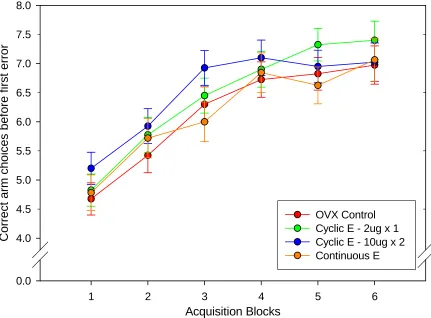
As illustrated in Figure 1, estradiol replacement had no effect on working memory
performance as measured by number of correct arm choices before the first error during 24 days
of acquisition in a radial-arm maze. There was a significant main effect of block (F5,33 = 39.63; p
< 0.001, see Figure 1) indicating that the arm choice accuracy of all groups improved over time.
There was no significant main effect for group and no interactive effect of treatment and block.
Analyses of cycle day revealed no significant main effect of cycle day on number of correct arm
choices before the first error within either the Cyclic E – 2µg x 1 group or the Cyclic E – 10µg x
Acquisition Blocks
1 2 3 4 5 6
Co rre ct arm ch oi ces bef o
re first error
4.5 5.5 6.5 7.5 0.0 4.0 5.0 6.0 7.0 8.0 OVX Control Cyclic E - 2ug x 1 Cyclic E - 10ug x 2 Continuous E
Fig. 1. Number of correct arm choices over 24 days of acquisition. There is no effect of treatment on the number of correct arm choices before the first error over the six four-day blocks of acquisition training.
Delay Trials
The first four days of delay testing with one minute delays between the fourth and fifth
arm choices served as training trials and were not included in the analysis. The following section
reports the data for one four-day cycle of each delay length, 1 minute, 10 minutes, 3 hours and 5
hours. The number of correct arm choices before the first error and the number of retroactive and
proactive errors are presented.
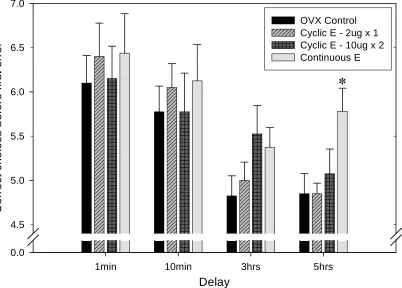
Correct before the first error. Separate one-way ANOVAs on the different delay times
revealed no significant group effect on number of correct arm choices on the 1-minute,
10-minute and 3-hours delays (see Figure 2). There was a significant effect of group on the 5-hour
Delay
1min 10min 3hrs 5hrs
Corr ec t c hoic e s befor e fir s t err o r 4.5 5.5 6.5 0.0 5.0 6.0 7.0
analysis revealed that the Continuous E group made more correct arm choices before the first
error than all other groups. The effect size (partial η2) for the impact of estrogen treatment on
performance in the 5-hour delay trials was found to be η2 = 0.229, which is in the range of a large
effect according to Tabachnick and Fidell (2006).
OVX Control Cyclic E - 2ug x 1 Cyclic E - 10ug x 2 Continuous E
*
Fig. 2. Number of correct arm choices before the first error during all delay trials. Asterisks indicates a significant difference between all other groups at the 5-hour delay (p < 0.05).
Analyses of cycle day revealed no significant main effect of cycle day across all delay
trials on number of correct arm choices before the first error within either the Cyclic E – 2µg x 1
group or the Cyclic E – 10µg x 2 group.
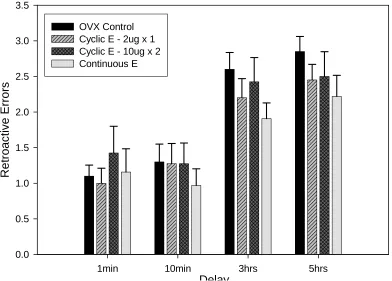
Retroactive errors. There was no significant effect of estradiol replacement on the
number of retroactive errors on any of the delay intervals (see Figure 3). There was no
significant effect for proactive errors on any delay interval for the different treatment groups
Delay
1min 10min 3hrs 5hrs
Re tr oac tive Err o rs 0.0 0.5 1.0 1.5 2.0 2.5 3.0 3.5 OVX Control Cyclic E - 2ug x 1 Cyclic E - 10ug x 2 Continuous E
Fig. 3. Number of retroactive errors across four blocks of increasing delay lengths. There is no significant difference between groups across the different delay lengths.
Cycle Day
1 2 3 4
Retroactive E rrors 0.0 0.5 1.0 1.5 2.0 2.5
Cyclic E - 2ug EB
*
Analysis of cycle day across all delays for retroactive errors revealed a significant main
effect of cycle day for the Cyclic E – 2µg x 1 group (F3,6 = 3.34, P < 0.05, partial η2 = 0.271, see
Figure 4). Post hoc analyses revealed significantly fewer errors on Day 2 of the four-day cycle
than on Day 3. There was no effect of cycle day in the other groups (data not shown).
Efficacy of Hormone Treatment
There was a main effect of hormone treatment on uterine weight (F3,35 = 15.95, p < 0.001,
see Figure 5A). Post hoc analyses revealed that the uteri of animals in the control group weighed
significantly less than those of all other replacement paradigm groups. Further, the uteri of the
Cyclic E – 2µg x 1 group weighed significantly less than those of the Cyclic E – 10µg x 2 group
and the Continuous E group. There was no significant uterine weight difference between the
Cyclic E – 10µg x 2 group and the Continuous E group. Further, an analysis of uterine weight
over the four days of the injection cycle revealed significant fluctuations of the uterine weight in
the Cyclic E – 2µg x 1 group (F3,6 = 4.928, p < 0.05, see Figure 5B). No effects of cycle day
were evident in any other group (data not shown).
Cycle Day
1 2 3 4
Ut eri n e we ig ht in mg 0 10 20 30 40 50 60 70 * * Group
Fig. 5. Effect of estrogen replacement on uterine weight. (A) Mean uterine weight across days for each t eatment group. Different letters represent significant differences between groups (p < 0.05) (B) Uterine weight for the Cyclic E – 2µg x 1 group across the four-day injection cycle. Asterisks indicate a significant difference from Cycle Day 2 as result of Duncan’s post hoc test (p < 0.05).
r Uter in e w e ig h t in m g 0 10 20 30 40 50 60 70 OVX Control Cyclic E 2ug x 1
Cyclic E 10ug x 2
Continuous E a b bc c A B
Plasma Estradiol Levels
Blood from two animals was excluded from the analyses. One animal from the
Continuous E group (sacrificed on Day 2) was excluded because its estradiol levels were
animal from the Cyclic E – 2ug x 1 group on day one was excluded because blood estradiol
levels were too low (~ 8 pg/ml) three hours after injection, indicating a bad injection. Estradiol
levels are summarized in Table 1. Data indicate successful hormone depletion of animals in the
ovariectomized control group and steady mid-physiological levels of estradiol in the Continuous
E group (~ 40 pg/ml) where estradiol was delivered continuously via Silastic capsules. The
Cyclic E – 10µg x 2 group reached supra-physiological estradiol levels on days one, two, and
three and data are comparable to those reported previously by Woolley and McEwen (1993). The
Cyclic E – 2µg x 1 injection paradigm is shown here to produce low physiological levels when
measured three hours after injection (~ 25 pg/ml), which is somewhat lower than previously
reported by Asarian and Geary (2002), but still within the physiological range. Further, previous
studies using the same paradigm have shown peak levels of estradiol at six hours after injection.
The three hour time point was most likely too early to detect the peak levels following the 2 µg
estradiol benzoate injection (Asarian et al., 2002). Cycle day analyses indicated significant
fluctuations of estradiol across the four-day injection cycle for the Cyclic E – 2µg x 1 group (F3,5
= 14.382, p < 0.05) and the Cyclic E – 10µg x 2 group (F3,6 = 7.35, p < 0.05, see Table 1).
Table 1. Mean plasma estradiol levels in pg/ml per group over the four-day injection cycle.
Cycle Day
Cyclic E – 2ug x 1
Mean ± SEM
Cyclic E – 10ug x 2
Mean ± SEM
Continuous E
Mean ± SEM
OVX control
Mean ± SEM
1 25.51 ± 2.98c 176.56 ± 23.45c 41.52 ± 6.11 4.32 ± 1.50
2 14.96 ± 2.73b 144.51 ± 11.54bc 26.45 ± - # 5.75 ± 2.98
3 9.57 ± 0.28 ab 91.57 ± 28.04ab 44.08 ± 2.24 4.60 ± 2.40
4 2.99 ± 0.63a 35.57 ± 3.73a 41.44 ± 6.18 8.43 ± 1.31
Note. Different letters represent significant differences between days within the respective group (p < 0.05) #
Discussion
The primary finding of the present work is that continuous but not cyclic estradiol
replacement enhances working memory performance in ovariectomized adult female rats if the
working memory load is sufficiently increased in a radial-arm maze memory task. Specifically,
only during the longest delay period of 5 hours between the fourth and fifth arm choices, the
continuous estradiol replacement group outperformed the ovariectomized control group and both
cyclic replacement groups. No significant differences in working memory performance were
observed between groups neither during acquisition training nor at the 1-minute, the 10-minute,
and the 3-hours delay trials.
These results suggest that long-term continuous delivery of estradiol replacement at
physiological levels (~ 40 pg/ml) is more effective in enhancing radial-maze performance than
are the cyclic regimens tested in the current experiment. These findings are in line with earlier
reports that already established the effectiveness of continuous estradiol replacement to increase
working memory performance relative to ovariectomized control animals (Luine et al., 1998;
Bimonte et al., 1999; for review, see Dohanich, 2002). However, two of the findings reported in
the current work were unexpected, first the absence of an effect of any form of estradiol
replacement as compared to ovariectomized controls during the acquisition period and during the
short delay trials, and secondly, the ineffectiveness of the cyclic replacement paradigms as
compared to the continuous replacement paradigm in the 5-hour delay trials.
The absence of enhanced performance during the acquisition period in the current study
is in contrast to earlier reports from our and other laboratories that found enhanced performance
during acquisition of the same maze task in animals treated with continuous estradiol
Fader et al., 1999; Daniel et al., 2006). The only obvious methodological difference between
these studies and our current work is the increased handling of the animals due to the injection
paradigms. All rats were weighed every day to maintain their body weight at 90% of
pre-ovariectomy free-feeding weight, and they were injected every two out of four days for the
duration of the experiment. There is evidence to support the hypothesis that experience can
interact with estrogen status to affect radial-arm maze performance. For example, we
demonstrated in an earlier experiment that estrogen replacement enhances working memory
performance in animals reared in isolated environments, not this effect of estrogen was not
detected in animals reared in complex environments (Daniel, Roberts, & Dohanich, 1999). In
this experiment all ovariectomized animals in the isolated environment performed well below
our ovariectomized control animals in the current study. However, our control animals
performed similarly as the animals in the complex environment condition (Daniel et al., 1999),
although our rats were reared single caged in non-complex environments. Hence, increased
handling might have had similar effects on these animals as the complex environment condition.
While it is well accepted that post-natal handling in rats has positive effects on memory
performance throughout life, putatively via modulation of the stress response (Meaney, Aitken,
vanBerkel, Bhatnagar, & Sapolsky, 1988), little is known about the effect of handling in adult
rats. However, a reduced stress response in adults as a result of handling could have contributed
to our results. Ovariectomized females receiving estradiol replacement respond to chronic stress
with an enhanced working memory performance on the radial-arm maze, as compared to
ovariectomized controls (Bowman, Ferguson, & Luine, 2002). In males, stress generally has
impairing effects on memory performance, while females seem to be somewhat protected from
response to chronic stress (for reviews, see Luine, 2002; Bowman, Beck, & Luine, 2003). The
extensive handling might have rendered our animals less stressed when faced with the memory
task as compared to other studies in which animals were not handled as much (Luine et al., 1994;
Daniel et al., 1997; Luine et al., 1998; Fader et al., 1999; Daniel et al., 2006). Consequently, it is
possible that the enhancing effects of estradiol on hippocampus-sensitive working memory
performance repeatedly reported by different labs might be partially based on an interaction
between stress and estradiol treatment. An absence of the stress response might have eliminated
the effect of estradiol treatment during the acquisition period in the current experiment and only
a sufficient increase in working memory load was able to tease out the differences between
estradiol replacement and control animals. There has been another recently published study that
also failed to detect estradiol induced enhancement in the radial-arm maze (Ziegler et al., 2005).
These authors also used a cyclic injection paradigm, with two injections of estradiol given every
two out of six days. Further, these authors used a pre-training protocol, and moreover the rats
were used in a different behavioral experiment previous to radial-arm maze testing. Altogether,
this exposed the animals to a large amount of handling and human contact, possibly reducing the
stress response during memory testing. Nevertheless, a potentially modulating effect of handling
on an estradiol-induced working memory enhancement at this point is only speculative and
requires further investigation.
The ineffectiveness of the two cyclic replacement paradigms used was unexpected.
Previously, short-term treatment with the Cyclic E – 10µg x 2 injection paradigm (72 and 48
hours before testing) has been shown to enhance working memory performance compared to
ovariectomized control animals on the radial-arm maze with a 3-hour delay between fourth and
(Sandstrom et al., 2001). Further, 10 µg injections of estradiol benzoate given daily over 10
consecutive days has also been reported to enhance performance of ovariectomized rats on a
matching-to-place water escape task (Sandstrom et al., 2004). However, another study reports
that over longer periods of daily 10 µg estradiol benzoate injections (> 30 days), no enhancement
of working memory performance in the radial-arm maze was found (Galea et al., 2001). This is
comparable to the findings reported in the current study where the cyclic 10 µg estradiol
benzoate treatment was carried over almost two months of training, without significant effects on
working memory performance. As shown in Table 1, the Cyclic E – 10µg x 2 injection
paradigm produced supraphysiological levels on three out of the four cycle days, consequently
leaving the animals almost constantly with supraphysiologically elevated estradiol levels.
Therefore, our findings suggest that long-term supraphysiolgical levels of estradiol in
ovariectomized animals do not enhance working memory performance, although short-term
treatment with the same dose is effective behaviorally and physiologically (e.g. Woolley et al.,
1994; Daniel et al., 2001)
The original hypothesis that physiological doses of cyclic estradiol injections would
prove effective in enhancing working memory performance was not supported in the current
experiment. During the five-hour delay trials only the continuous estradiol replacement paradigm
significantly improved working memory performance compared to all other groups. The Cyclic
E – 2µg x 1 injection paradigm has, to our knowledge, not been investigated in memory studies,
although it has been shown to mimic estradiol levels over the four day estrous cycle in intact rats
(Micevych et al., 1996; Asarian et al., 2002) and impact feeding behavior. Our blood analysis
indicated somewhat lower levels than reported by these authors, but the estradiol levels reported
animals treated with the Cyclic E – 2µg x 1 paradigm showed significant fluctuations across
days, with the mean uterine weight being highest on Day 2 of the injection paradigm (~ 27 hours
after the 2 µg estradiol benzoate injection, see Figure 5B). This indicates the physiological
relevance of this low-dose cyclic injection paradigm. Interestingly, the number of retroactive
errors averaged over all delay trials was shown to significantly fluctuate over the four-day cycle,
with performance being better on Day 2 after injection as compared to performance on Day 3,
which coincides with the increased uterine weight on Day 2. No effect of cycle day was revealed
for any of the other treatment groups. However, the number of correct arm choices before the
first error over all delay trials showed no significant fluctuations over the injection cycle.
In conclusion, the main finding of the current study is that chronic estradiol replacement
enhances working memory performance in the radial-arm maze if the working memory load is
sufficiently increased. The studied cyclic physiological and supraphysiological replacement
paradigms do not enhance performance as compared to ovariectomized control animals. Further,
we suggest a potential interaction between handling and estradiol replacement on working
memory performance, especially during acquisition and during delay trials shorter than five
hours. These results have possible implications with regard to hormone replacement therapy in
postmenopausal women. Our data indicate that the regimen of estrogen administration may
affect its efficacy. Further, the data suggest that continuous estradiol replacement such as
provided by skin patches might prove more beneficial for maintaining cognitive function than
cyclic treatments of physiological doses of estradiol.
References
Asarian, L. & Geary, N. (2002). Cyclic estradiol treatment normalizes body weight and restores physiological patterns of spontaneous feeding and sexual receptivity in ovariectomized rats. Hormones and Behavior, 42, 461-471.
Becker, J. B., Arnold, A. P., Berkley, K. J., Blaustein, J. D., Eckel, L. A., Hampson, E. et al. (2005). Strategies and methods for research on sex differences in brain and behavior.
Endocrinology, 146, 1650-1673.
Becker, J. B., Breedlove, S. M., Crews, D., & McCarthy, M. M. (2002). Behavioral Endocrinology. (2nd ed.) Cambridge, MA: MIT Press.
Bimonte, H. A. & Denenberg, V. H. (1999). Estradiol facilitates performance as working memory load increases. Psychoneuroendocrinology, 24, 161-173.
Bliss, T. V. P. & Collingridge, G. L. (1993). A synaptic model of memory: long-term potentiation in the hippocampus. Nature, 361, 31-39.
Bowman, R. E., Beck, K. D., & Luine, V. N. (2003). Chronic stress effects on memory: sex differences in performance and monoaminergic activity. Hormones and Behavior, 43, 48-59.
Bowman, R. E., Ferguson, D., & Luine, V. N. (2002). Effects of chronic restraint stress and estradiol on open field activity, spatial memory, and monoaminergic neurotransmitters in ovariectomized rats. Neuroscience, 113, 401-410.
Brake, W. G., Alves, S. E., Dunlop, J. C., Lee, S. J., Bulloch, K., Allen, P. B. et al. (2001). Novel target sites for estrogen action in the dorsal hippocampus: an examination of synaptic proteins. Endocrinology, 142, 1284-1289.
Chittajallu, R., Alford, S., & Collingridge, G. L. (1998). Ca2+ and synaptic plasticity. Cell Calcium, 24, 377-385.
Daniel, J. M., Hulst, J. L., & Lee, C. D. (2005). Role of hippocampal M2 muscarinic receptors in the estrogen-induced enhancement of working memory. Neuroscience, 132, 57-64.
Daniel, J. M. & Dohanich, G. P. (2001). Acetylcholine mediates the estrogen-induced increase in NMDA receptor binding in CA1 of the hippocampus and the associated improvement in working memory. Journal of Neuroscience, 21, 6949-6956.
Daniel, J. M., Fader, A. J., Spencer, A. L., & Dohanich, G. P. (1997). Estrogen enhances performance of female rats during acquisition of a radial arm maze. Hormones and Behavior, 32, 217-225.
Daniel, J. M. & Lee, C. D. (2004). Estrogen replacement in ovariectomized rats affects strategy selection in the Morris water maze. Neurobiology of Learning and Memory, 82, 142-149.
Daniel, J. M., Roberts, S. L., & Dohanich, G. P. (1999). Effects of ovarian hormones and environment on radial maze and water maze performance of female rats. Physiology & Behavior, 66, 11-20.
Dohanich, G. P. (2002). Gonadal steroids, learning and memory. In D.W.Pfaff, A. P. Arnold, A. M. Etgen, S. E. Fahrbach, & R. T. Rubin (Eds.), Hormones, brain and behavior (pp. 265-327). San Diego: Academic Press.
Eichenbaum, H. & Cohen, N. J. (2001). From conditioning to conscious recollection: Memory systems of the brain. (1st ed.) Oxford, NY: Oxford University Press.
El-Bakri, N. K., Islam, A., Zhu, S., Elhassan, A., Mohammed, A., Wikndblad, B. et al. (2004). Effects of estrogen and progesterone treatment on rat hippocampal NMDA receptors: relationship to Morris water maze performance. Journal of Cellular and Molecular Medicine, 8, 537-544.
Espeland, M. A., Rapp, S. R., Shumaker, S. A., Brunner, R., Manson, J. E., Sherwin, B. B. et al. (2004). Conjugated equine estrogens and global cognitive function in postmenopausal women: women's health initiative memory study. The Journal of the American Medical Association, 291, 2959-2968.
Fader, A. J., Johnson, P. E. J., & Dohanich, G. P. (1999). Estrogen improves working but not reference memory and prevents amnestic effects of scopolamine on a radial-arm maze. Pharmacology Biochemistry and Behavior, 62, 711-717.
Foy, M. R., Xu, J., Xie, X., Brinton, R. D., Thompson, R. F., & Berger, T. W. (1999). 17beta-estradiol enhances NMDA receptor-mediated EPSPs and long-term potentiation. Journal of Neurophysiology, 81, 925-929.
Francis, P. T., Palmer, A. M., Snape, M., & Wilcock, G. K. (1999). The cholinergic hypothesis of Alzheimer's disease: a review of progress. Journal of Neurology, Neurosurgery, and Psychiatry, 66, 137-147.
Galea, L. A. M., Wide, J. K., Paine, T. A., Holmes, M. M., Ormerod, B. K., & Floresco, S. B. (2001). High levels of estradiol disrupt conditioned place preference learning, stimulus response learning and reference memory but have limited effects on working memory. Behavioural Brain Research, 126, 115-126.
Geary, N. & Asarian, L. (1999). Cyclic estradiol treatment normalizes body weight and test meal size in ovariectomized rats. Physiology and Behavior, 67, 141-147.
Gibbs, R. B., Wu, D., Hersh, L. B., & Pfaff, D. W. (1994). Effects of estrogen
replacement on the relative levels of choline acetyltransferase, trkA, and nerve nrowth factor messenger RNAs in the basal forebrain and hippocampal formation of adult rats. Experimental Neurology, 129, 70-80.
Gibbs, R. G., Hashash, A., & Johnson, D. A. (1997). Effects of estrogen on potassium-stimulated acetylcholine release in the hippocampus and overlying cortex of adult rats. Brain Research, 749, 143-146.
Gleason, C. E., Carlsson, C. M., Johnson, S., Atwood, C., & Asthana, S. (2005). Clinical pharmacology and differential cognitive efficacy of estrogen preparations. Annals of the New York Academy of Sciences, 1052, 93-115.
Gold, P. E. (2004). Coordination of multiple memory systems. Neurobiology of Learning and Memory, 82, 230-242.
Gould, E., Woolley, C. S., Frankfurt, M., & McEwen, B. S. (1990). Gonadal steroids regulate dendritic spine density in hippocampal pyramidal cells in adulthood. Journal of Neuroscience, 10, 1286-1291.
Holmes, M. M., Wide, J. K., & Galea, L. A. (2002). Low levels of estradiol facilitate, whereas high levels of estradiol impair, working memory performance on the radial arm maze. Behavioral Neuroscience, 116, 928-934.
Isgor, C., Huang, G. C., Akil, H., & Watson, S. J. (2002). Correlation of estrogen [beta]-receptor messenger RNA with endogenous levels of plasma estradiol and progesterone in the female rat hypothalamus, the bed nucleus of stria terminalis and the medial amygdala. Molecular Brain Research, 106, 30-41.
Korol, D. L. (2004). Role of estrogen in balancing contributions from multiple memory systems. Neurobiology of Learning and Memory, 82, 309-323.
Korol, D. L. & Kolo, L. L. (2002). Estrogen-induced changes in place and response learning in young adult female rats. Behavioral Neuroscience, 116, 411-420.
Li, X., Schwartz, P. E., & Rissman, E. F. (1997). Distribution of estrogen receptor-beta-like immunoreactivity in rat forebrain. Neuroendocrinology, 66, 63-67.
Luine, V. N. (2002). Sex differences in chronic stress effects on memory in rats. Stress, 5, 205-216.
Luine, V. N., Richards, S. T., Wu, V. Y., & Beck, K. D. (1998). Estradiol enhances learning and memory in a spatial memory task and effects levels of monoaminergic
neurotransmitters. Hormones and Behavior, 34, 149-162.
Marriott, L. K. & Korol, D. L. (2003). Short-term estrogen treatment in ovariectomized rats augments hippocampal acetylcholine release during place learning. Neurobiology of Learning and Memory, 80, 315-322.
McDonald, R. J. & White, N. M. (1993). A triple dissociation of memory systems: hippocampus, amygdala, and dorsal striatum. Behavioral Neuroscience, 107, 3-22.
McEwen, B. S. & Alves, S. E. (1999). Estrogen actions in the central nervous system. Endocrine Reviews, 20, 279-307.
Meaney, M. J., Aitken, D. H., vanBerkel, C., Bhatnagar, S., & Sapolsky, R. M. (1988). Effect of neonatal handling on age-relateed imparirments associated with the hippocampus. Science, 239, 766-768.
Mehra, R. D., Sharma, K., Nyakas, C., & Vij, U. (2005). Estrogen receptor [alpha] and [beta] immunoreactive neurons in normal adult and aged female rat hippocampus: A qualitative and quantitative study. Brain Research, 1056, 22-35.
Micevych, P., Eckersell, C. B., Holland, K., & Smith, A. (1996). Induction of CCK mRNA levels in the limbic-hypothalamic circuit: Time course and site-specific effects of estrogen. Journal of Neurobiology, 30, 465-479.
Micevych, P. & Ulibarri, C. (1992). Development of the limbic-hypothalamic
cholecystokinin circuit: a model of sexual differentiation. Developmental Neuroscience, 14, 11-34.
Miranda, P., Williams, C. L., & Einstein, G. (1999). Granule cells in aging rats are sexually dimorphic in their response to estradiol. Journal of Neuroscience, 19, 3316-3325.
Nimchinsky, E. A., Sabatini, B. L., & Svoboda, K. (2002). Structure and function of dendritic spines. Annual Review of Physiology, 64, 313-353.
Packard, M. G. & McGaugh, J. L. (1996). Inactivation of hippocampus or caudate nucleus with lidocaine differentially affects expression of place and response learning. Neurobiology of Learning and Memory, 65, 65-72.
Packard, M. G. & White, N. M. (1990). Lesions of the caudate nucleus selectively impair "reference memory" acquisition in the radial maze. Behavioral and Neural Biology, 53, 39-50.
Prevelic, G. M., Kocjan, T., & Markou, A. (2005). Hormone replacement therapy in postmenopausal women. Minerva Endocrinologica, 30, 27-36.
Prokai-Tatrai, K. & Prokai, L. (2005). Impact of metabolism on the safety of estrogen therapy. Annals of the New York Academy of Sciences, 1052, 243-257.
Rapp, S. R., Espeland, M. A., Shumaker, S. A., Henderson, V. W., Brunner, R. L., Manson, J. E. et al. (2003). Effect of estrogen plus progestin on global cognitive function in postmenopausal women: the women's health initiative memory study: a randomized controlled trial. The Journal of the American Medical Association, 289, 2663-2672.
Sandstrom, N. J. & Williams, C. L. (2001). Memory retention is modulated by acute estradiol and progesterone replacement. Behavioral Neuroscience, 115, 384-393.
Sandstrom, N. J. & Williams, C. L. (2004). Spatial memory retention is enhanced by acute and continuous estradiol replacement. Hormones and Behavior, 45, 128-135.
Sherwin, B. B. (2003). Estrogen and cognitive functioning in women. Endocrine Reviews, 24, 133-151.
Sherwin, B. B. (2005). Surgical menopause, estrogen, and cognitive function in women: what do the findings tell us? Annals of the New York Academy of Sciences, 1052, 3-10.
Shughrue, P. J. & Merchenthaler, I. (2000). Estrogen is more than just a "sex hormone": novel sites for estrogen action in the hippocampus and cerebral cortex. Frontiers in
Neuroendocrinology, 21, 95-101.
Shumaker, S. A., Legault, C., Kuller, L., Rapp, S. R., Thal, L., Lane, D. S. et al. (2004). Conjugated equine estrogens and incidence of probable dementia and mild cognitive impairment in postmenopausal women: women's health initiative memory study. JAMA: The Journal of the American Medical Association, 291, 2947-2958.
Singh, M., Meyer, E. M., Millard, W. J., & Simpkins, J. W. (1994). Ovarian steroid deprivation results in a reversible learning impairment and compromised cholinergic function in female Sprague-Dawley rats. Brain Research, 644, 305-312.
Sohrabji, F. (2005). Estrogen: A neuroprotective or proinflammatory hormone? Emerging evidence from reproductive aging models. Annals of the New York Academy of Sciences, 1052, 75-90.
Tabachnick, B. G. & Fidell, L. S. (2006). Using multivariate statistics. (5 ed.) Allyn & Bacon.
Toran-Allerand, C. D. (2004). Minireview: a plethora of estrogen receptors in the brain: where will it end? Endocrinology, 145, 1069-1074.
Warren, S. G., Humphreys, A. G., Juraska, J. M., & Greenough, W. T. (1995). LTP varies across the estrous cycle: enhanced synaptic plasticity in proestrus rats. Brain Research, 703, 26-30.
White, N. M. & McDonald, R. J. (2002). Multiple parallel memory systems in the brain of the rat. Neurobiology of Learning and Memory, 77, 125-184.
Woolf, N. J. (1991). Cholinergic systems in mammalian brain and spinal cord. Progress in Neurobiology, 37, 475-524.
Woolley, C. S., Gould, E., Frankfurt, M., & McEwen, B. S. (1990). Naturally occurring fluctuation in dendritic spine density on adult hippocampal pyramidal neurons. Journal of Neuroscience, 10, 4035-4039.
Woolley, C. S. & McEwen, B. S. (1992). Estradiol mediates fluctuation in hippocampal synapse density during the estrous cycle in the adult rat. Journal of Neuroscience, 12, 2549-2554.
Woolley, C. S. & McEwen, B. S. (1993). Roles of estradiol and progesterone in
regulation of hippocampal dendritic spine density during the estrous cycle in the rat. The Journal of Comparative Neurology, 226, 293-306.
Woolley, C. S. & McEwen, B. S. (1994). Estradiol regulates hippocampal dendritic spine density via an N-methyl- D-aspartate receptor-dependent mechanism. Journal of Neuroscience, 14, 7680-7687.
Woolley, C. S. (1998). Estrogen-mediated structural and functional synaptic plasticity in the female rat hippocampus. Hormones and Behavior, 34, 140-148.
Appendix
Vita
Johannes Bohacek was born in Graz, Austria. He graduated from Bischoefliches
Gymnasium (high school) in 2000. After 8 months of mandatory military service, he started the
studies of Psychology at the Karl-Franzens Universitaet in Graz, Austria. He was awarded the 1st
Diploma in Psychology in 2003. The academic year 2003 – 2004 he spent as an exchange
student at the University of Arkansas at Little Rock, before being accepted to the Applied