A dated phylogeny of the genus
Pennantia
(Pennantiaceae) based on whole chloroplast
genome and nuclear ribosomal 18S–26S
repeat region sequences
Kévin J. L. Maurin1
1 The University of Waikato – School of Science, Private Bag 3105, Hamilton 3240, New Zealand
Corresponding author: Kévin J. L. Maurin ([email protected])
Academic editor: James W. Byng | Received 21 April 2020 | Accepted 13 July 2020 | Published 7 August 2020
Citation: Maurin KJL (2020) A dated phylogeny of the genus Pennantia (Pennantiaceae) based on whole chloroplast
genome and nuclear ribosomal 18S–26S repeat region sequences. PhytoKeys 155: 15–32. https://doi.org/10.3897/
phytokeys.155.53460
Abstract
Pennantia, which comprises four species distributed in Australasia, was the subject of a monographic taxonomic treatment based on morphological characters in 2002. When this genus has been included in molecular phylogenies, it has usually been represented by a single species, P. corymbosa J.R.Forst. & G.Forst., or occasionally also by P. cunninghamii Miers. This study presents the first dated phylogenetic analysis encompassing all species of the genus Pennantia and using chloroplast DNA. The nuclear riboso-mal 18S–26S repeat region is also investigated, using a chimeric reference sequence against which reads not mapping to the chloroplast genome were aligned. This mapping of off-target reads proved valuable in exploiting otherwise discarded data, but with rather variable success. The trees based on chloroplast DNA and the nuclear markers are congruent but the relationships among the members of the latter are less strongly supported overall, certainly due to the presence of ambiguous characters in the alignment resulting from low coverage. The dated chloroplast DNA phylogeny suggests that Pennantia has diversi-fied within the last 20 My, with the lineages represented by P. baylisiana (W.R.B.Oliv.) G.T.S.Baylis, P. endlicheri Reissek and P. corymbosa diversifying within the last 9 My. The analyses presented here also confirm previous molecular work based on the nuclear internal transcribed spacer region showing that P. baylisiana and P. endlicheri, which were sometimes considered synonyms, are not sister taxa and therefore support their recognition as distinct species.
Keywords
chimeric mapping reference, chloroplast DNA, internal transcribed spacer, Next Generation Sequencing, off-target reads, Torricellia
http://phytokeys.pensoft.net
Copyright Kévin J. L. Maurin. This is an open access article distributed under the terms of the Creative Commons Attribution License (CC BY 4.0), which permits unrestricted use, distribution, and reproduction in any medium, provided the original author and source are credited.
Introduction
Pennantia J.R.Forst. & G.Forst. is the sole genus of the family Pennantiaceae J.Agardh, a member of Apiales that comprises four species in Australasia (Gardner and de Lange 2002, Fig. 1). Pennantia endlicheri Reissek is a forest tree endemic to Norfolk Island, a small volcanic remnant located about 1400 km east of Australia’s mainland. Pennantia baylisiana (W.R.B.Oliv.) G.T.S.Baylis (Three Kings Kaikomako/Kaikōmako Manawa Tāwhi) is a small tree originally known in the wild by only one plant, discovered in 1945 on Great Island/Manawa Tawhi (Three Kings Islands/Manawatāwhi, New Zealand, Bay-lis 1977) and thought to be female. However, cuttings of the plant were induced to pro-duce seeds in cultivation (Beever and Davidson 1999, Gardner et al. 2004) and later the wild individual was observed seeding (Wright 1989). It is nowadays planted throughout New Zealand in both residential and botanic gardens (Gardner and de Lange 2002; pers. obs.) from cuttings of the original tree and from the seeds they produced (de Lange et al. 2010). Pennantia baylisiana was regarded by Sleumer (1970) as synonymous with P. endlicheri, a view disputed by Baylis (1977, 1989); more recently, Gardner and de Lange (2002) maintained P. baylisiana on morphological grounds, while Mabberley (2017) still considered it a synonym of P. endlicheri. Pennantia corymbosa J.R.Forst. & G.Forst. is a tree endemic to the main islands of New Zealand (North Island, South Island and Stewart Island) and some outlying islands. It is a heteroblastic tree of coastal and lowland forests with a divaricating juvenile form (Dawson and Lucas 2012). Pennantia cunning-hamii Miers is an Australian endemic tree of subtropical to warm-temperate rainforest of the east coast. Miers (1852) initially placed this species in a monotypic section, P. sect.
Dermatocarpus Miers, because of its fruits, which are different from those of P. corymbosa
and P. endlicheri. In Miers’ time, P. baylisiana had not yet been collected, and even though it has similar fruits to P. cunninghamii, Gardner and de Lange (2002) maintained P. sect.
Dermatocarpus on the basis of other morphological traits that distinguish P. cunninghamii
from the other members of the genus, which they placed in P. sect. Pennantia.
This study has three goals. (1) To propose the first molecular phylogeny that sam-ples all four species of Pennantia for whole plastid DNA sequences, dated using two Apiales fossils and one secondary calibration. (2) To present and evaluate the relevance of a method I used to generate sequence data for nuclear markers at low marginal cost from the shotgun sequencing of genomic DNA: I mapped reads that were unmapped to the chloroplast DNA reference sequence (“off-target reads”) against a chimeric 18S– 26S nuclear ribosomal DNA repeat region reference sequence to build the sequences for a nuclear DNA phylogeny. (3) To use both the chloroplast DNA and nuclear DNA phylogenies to further examine proposals made by Gardner and de Lange (2002) re-garding the relationships among the four Pennantia species based on morphological features alone, which have also been assessed by Keeling et al. (2004) using nuclear ribosomal sequences alone.
Methods
Sampling plan
Gardner and de Lange (2002) showed that all four Pennantia species are well defined morphologically, and that they have no morphologically divergent populations, a claim which still appears unchallenged today; therefore, it is reasonable in such a group to
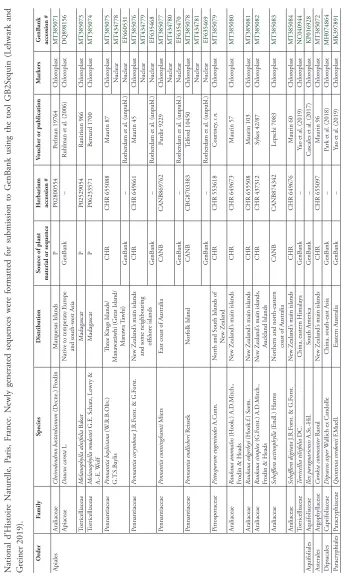
sume that morphological coherence is an accurate indication of monophyly within each species, and hence only one sample per species was considered. For the chloroplast DNA phylogeny, I also included representatives of five families of Apiales, and four closely re-lated orders according to recent whole-plastid DNA phylogenies of land plants as an out-group (e.g. Magallón et al. 2015, Li et al. 2019). I included newly generated sequences of the apialean families Araliaceae Juss. (6 species), Pittosporaceae R.Br. (1 species) and Torricelliaceae Hu (2 species), and of the order Asterales (1 species), along with previ-ously published sequences downloaded from GenBank of two other families of Apiales, Apiaceae Lindl. and Torricelliaceae, and of three other orders, Aquifoliales, Dipsacales and Paracryphiales (1 species each); see Table 1 for details. I was not able to generate nor could I find whole-plastid DNA sequences for the remaining two families of Apiales, Griseliniaceae Takht. and Myodocarpaceae Doweld. For the nuclear DNA phylogeny, newly generated sequences of the 18S–26S repeat region for Pennantia were obtained from the same samples used to generate the chloroplast DNA sequences. The sequences newly generated for this study were obtained either from field collections that were dried in silica gel and processed in the lab within three months of collection (Maurin collec-tions in Table 1), or from herbarium specimens. I was not able to obtain sequences of the 18S–26S nuclear DNA repeat region from Torricelliaceae. The sampling plan for chloroplast DNA and the 18S–26S nuclear DNA repeat region is given in Table 1. At the time of submission of this paper, a whole chloroplast DNA sequence purported to be of
Torricellia angulata Oliv. was available on GenBank (accession NC031509/KX648359); it was disregarded because it appears to derive from a member of Rosales. A second Torri-cellia chloroplast genome sequence (NC040944), from T. tiliifolia DC., was included.
DNA extraction
DNA from the samples of Pennantia corymbosa, Raukaua anomalus (Hook.) A.D.Mitch., Frodin & Heads and Schefflera digitata J.R.Forst. & G.Forst. was extracted using a CTAB-based protocol (Doyle and Dickson 1987) modified as in Smissen and Heenan (2007) to include a phenol:chloroform extraction and recovery using spin columns (Zymo IIC, Zymo Research, Orange County, California). The DNA of the other sam-ples was extracted following the DNA tissue protocol of the Maxwell 16 instrument (Promega, Madison, Wisconsin) and further purified by phenol/chloroform extraction and recovery in spin columns. Detailed step-by-step protocols are available upon re-quest. The DNA concentration of the extracts was measured using the Qubit (Thermo Fisher Scientific, Waltham, Massachusetts) dsDNA high-sensitivity assay protocol.
Library preparation and sequencing
Tab
le 1.
S
ampling plan of this study
, with v
oucher information and G
enB
ank accession numbers. S
amples sor
ted alphabetically b
y or
der name then species name.
CANB = A
ustralian N
ational H
erbarium (CANB), Canberra, A
ustralia; CHR = Allan H
erbarium (CHR), Lincoln, N
ew Z
ealand; P = H
erbarium of the M
uséum N ational d ’H istoir e N atur elle, P aris, F rance. N
ewly generated sequences w
er
e formatted for submission to G
enB
ank using the tool GB2S
equin (Lehwar
k and
G
reiner 2019). Order
Family
Species
D
istribution
Sour
ce of plant
material or sequence
H
erbarium
accession #
Voucher or publication
M ar kers G enB ank accession # Apiales Araliaceae Cheir odendr on bastar dianum (D ecne.) F rodin M ar quesas I slands P P02800554 Perlman 19764 Chlor oplast MT385071 Apiaceae D aucus car ota L. N ativ
e to temperate E
ur ope and south-w est Asia G enB ank –
Ruhlman et al. (2006)
Chlor oplast DQ898156 Torricelliaceae M elanophylla alnifolia B aker M adagascar P P02529054 Ranirison 966 Chlor oplast MT385073 Torricelliaceae M elanophylla modestei
G.E. Schatz, Lo
wr y & A.-E. W olf M adagascar P P06233571 Bernar d 1700 Chlor oplast MT385074 Pennantiaceae Pennantia baylisiana (W .R.B.O liv .) G.T .S.B aylis Thr
ee Kings I
slands/ M anawatāwhi (G reat I sland/ M anawa T awhi) CHR CHR 655088 M aurin 87 Chlor oplast MT385075 N uclear MT434778 G enB ank – Rother
dam et al. (unpubl.)
N uclear EF660531 Pennantiaceae Pennantia cor ymbosa J.R.F
orst. & G.F
orst.
N
ew Z
ealand
’s main islands
and some neighbouring
offshor e islands CHR CHR 649661 M aurin 45 Chlor oplast MT385076 N uclear MT434779 G enB ank – Rother
dam et al. (unpubl.)
N uclear EF635468 Pennantiaceae Pennantia cunninghamii M iers
East coast of A
ustralia CANB CANB869762 Pur die 9229 Chlor oplast MT385077 N uclear MT434780 G enB ank – Rother
dam et al. (unpubl.)
N uclear EF635470 Pennantiaceae Pennantia endlicheri R eissek N or folk I sland CANB CBG8703383 Telfor d 10450 Chlor oplast MT385078 N uclear MT434781 G enB ank – Rother
dam et al. (unpubl.)
N uclear EF635469 Pittosporaceae Pittospor um eugenioides A.C unn. N or
th and S
outh I slands of N ew Z ealand CHR CHR 553618 Cour tney , s.n. Chlor oplast MT385079 Araliaceae Raukaua anomalus (H ook.) A.D.M itch., Fr
odin & H
eads
N
ew Z
ealand
’s main islands
CHR CHR 649673 M aurin 57 Chlor oplast MT385080 Araliaceae Raukaua edger leyi (H ook.f .) S eem. N ew Z ealand
’s main islands
CHR CHR 655508 M aurin 103 Chlor oplast MT385081 Araliaceae Raukaua simplex (G.F orst.) A.D.M itch., Fr
odin & H
eads
N
ew Z
ealand
’s main islands,
Auckland I slands CHR CHR 437312 Sykes 42/87 Chlor oplast MT385082 Araliaceae Scheffler a actinophylla (E ndl.) H arms N or
thern and nor
th-eastern
coast of A
ustralia CANB CANB874342 Lepschi 7083 Chlor oplast MT385083 Araliaceae Scheffler a digitata J.R.F
orst. & G.F
orst.
N
ew Z
ealand
’s main islands
CHR CHR 649676 M aurin 60 Chlor oplast MT385084 Torricelliaceae Torricellia tiliifolia DC.
China, eastern H
imalaya
G
enB
ank
–
Yao et al. (2019)
Chlor oplast NC040944 Aquifoliales Aquifoliaceae Ilex par aguariensis A.S t.-H il. South America G enB ank –
Cascales et al. (2017)
Chlor oplast KP016928 Asterales Argophyllaceae Cor okia cotoneaster Raoul N ew Z ealand
’s main islands
CHR CHR 655097 M aurin 96 Chlor oplast MT385072 D ipsacales Caprifoliaceae Dipsacus asper W
allich ex Candolle
China, south-east Asia
G
enB
ank
–
Par
k et al. (2018)
Chlor oplast MH074864 Paracr yphiales Paracr yphiaceae Q uintinia v er donii F .M uell. Eastern A ustralia G enB ank –
Yao et al. (2019)
Chlor
oplast
manufacturer’s instructions (Reference Guide, #15027987 v01, January 2016) except that I halved the quantities of reagents and the target amount of input DNA. Libraries of the other samples were prepared using Illumina TruSeq Nano DNA Library Prep kits, according to the manufacturer’s instructions (Reference Guide, # 15041110 Rev. D, June 2015), again using halved reagent quantities and target input DNA; genomic DNA was fragmented using a Covaris ME220 Focused-ultrasonicator (settings: 75 s duration – 40 W peak power – 25% duty factor – 50 cycles per burst). The concentra-tion and size range of libraries were measured with a LabChip GX Touch HT (Perkin Elmer). Libraries were enriched for chloroplast DNA using a custom MYBaits kit (Ar-bor Biosciences, Ann Ar(Ar-bor) modified from Stull et al. (2013) as detailed in Smissen et al. (in press) using the manufacturer’s instructions (version 3.02, July 2016 or ver-sion 4.01, April 2018). Illumina HiSeq shotgun sequencing was carried out by Otago Genomics using paired end 2 × 125 bp reads.
Chloroplast DNA assembly and annotation
Reads were first trimmed using Trimmomatic v. 0.38 (Bolger et al. 2014) with the fol-lowing settings: ILLUMINACLIP:[path/to/NexteraPE-PE.fa for Pennantia corymbosa,
Raukaua anomalus and Schefflera digitata, TruSeq3-PE-2.fa for the others]:1:30:10 SLIDINGWINDOW:10:20 MINLEN:40. The reads of the Pennantiaceae and Torri-celliaceae samples were then mapped to Torricellia tiliifolia (NC040944), the closest sequence to Pennantia available in GenBank at the time the mappings were performed (July 2019) that was both verified and published. Mapping was performed with BWA, using the BWA-MEM algorithm (Li 2013). The quality of the best resulting sequence,
P. cunninghamii, was then improved (in terms of coverage, HQ% and number of am-biguous bases) by remapping its reads against a consensus sequence from the initial mapping against the Torricellia sequence. Finally, reads from all the other samples were mapped against the remapped P. cunninghamii sequence. The same process was followed for Araliaceae with the sequence of Schefflera actinophylla (Endl.) Harms, first mapped to the GenBank reference Schefflera heptaphylla (L.) Frodin (NC029764), Pittosporum eugenioides A.Cunn. first mapped to Torricellia tiliifolia (NC040944), and Corokia co-toneaster Raoul first mapped to Llerasia caucana (S.F.Blake) Cuatrec. (NC034821).
The resulting sequences, except Melanophylla modestei G.E. Schatz, Lowry & A.-E. Wolf, were of good overall quality (Suppl. material 1: Table S1): on average the HQ% was 98.4 (range: 93.7 – 99.9) and the percentage of ambiguous bases was 1.2% (range: 0.2% – 6.2%). Mean coverage ranged from 124 to 10,804. The Melanophylla modestei
Standley 2013) plugin in Geneious Prime 2019.2.1, (2) transferring the annotations of the GenBank references to the improved references, and (3) aligning the other sequences to their corresponding improved references, again with MAFFT within Geneious Prime, and transferring the annotations across. Annotations were manually checked.
18S–26S nuclear ribosomal DNA repeat region assembly and annotation
In the absence of a complete 18S–26S nuclear ribosomal DNA repeat region for Api-ales, I built a chimeric 18S–26S nuclear DNA repeat region from several GenBank sequences. I concatenated the 18S rRNA sequence of Melanophylla alnifolia Baker
(AJ236002), the ITS1, 5.8 S RNA, and ITS2 sequences of Pennantia cunninghamii
(EF635470), and the 26S rRNA sequence of Pittosporum fairchildii Cheeseman
(AF479192), in that order. The structure of the resulting chimeric 18S–26S nuclear
DNA repeat region is provided in Suppl. material 1: Fig. S1. I then mapped the off-target reads from the chloroplast DNA mappings of the shotgun sequencing data of my herbarium and fresh samples to this chimeric nuclear DNA reference.
The quality of the resulting assemblies was rather variable. There was no clear relationship between the number of reads available to map and the number of reads actually mapped to the chimeric reference (Suppl. material 1: Table S2). The mapping of the two Melanophylla species failed; the mapping of the four sequences of Pennantia
was satisfactory for P. baylisiana, P. cunninghamii and P. endlicheri (HQ% > 86% and ambiguities < 7%), but less so for P. corymbosa (HQ% = 51.0%, and ambiguities = 29.1%). Because of the variable quality of my newly reconstructed 18S–26S nuclear DNA repeat region sequences, I aligned them together with the longest sequences of the 18S–26S nuclear DNA repeat region available on GenBank for the four Pennantia
species, as a control of the identity of my newly generated sequences for the phyloge-netic analyses. Some statistics regarding these sequences discussed later in the paper were obtained with MEGA X (Kumar et al. 2018).
Data partitioning
Sixty protein-coding sequences (CDS, 46,051 sites) from the long and short single copy regions were used for the chloroplast DNA analyses (see list in Suppl. material 1: Table S3); coding rRNA, which was located in the inverted repeats, was not considered. CDS were partitioned into 1st + 2nd codon position on the one hand (30,701 sites), and
3rd codon position on the other hand (15,350 sites). For the nuclear DNA analyses, the
Phylogenetic analyses and chloroplast DNA tree calibration
Phylogenetic analyses were conducted with the BEAST suite v. 2.5.2 (Bouckaert et al. 2019). Each of the four partitions was assigned its own evolutionary model using bModelTest (Bouckaert and Drummond 2017) to average the best-fitted nucleotide models. A relaxed clock with rates drawn from an exponential distribution (Drum-mond et al. 2006) was associated to each partition. The MCMC chains were run for 250 million generations and sampled once every 25,000 generations for chloroplast DNA, and for 50 million generations sampled once every 5,000 generations for nucle-ar DNA. The influence of tree prior choice on the phylogeny and dating was assessed by repeating the analysis under both the Yule model (Yule 1925) and the Birth-Death model (Gernhard 2008). These analyses were run on the CIPRES platform (Miller et al. 2010). The proper convergence of the chains and the determination of the burnin that would maximise their effective sample size (ESS) was examined with Tracer v. 1.7.1 (Rambaut et al. 2018); the ESS of a parameter represents the number of effec-tively independent samples from the posterior distribution of the parameter, and there-fore how strong its estimation is: values above 200 are considered satisfactory (BEAST Developers 2017). Three independent runs per analysis (i.e. per combination of Birth-Death or Yule model with chloroplast DNA or nuclear DNA) were started from dif-ferent seeds and combined with LogCombiner v. 2.5.2 (Bouckaert et al. 2019). The combined sampled trees from each analysis were then summarised in TreeAnnotator v. 2.5.2 (Bouckaert et al. 2019) with their selected burnin.
The chloroplast DNA phylogeny was calibrated using two fossils and one secondary calibration. Firstly, I assigned the age of the earliest confirmed fossils of Torricellia, which are ca. 48 My old (Manchester et al. 2017), to the minimum crown age of Torricelli-aceae, using an offset exponential distribution (Mean = 20.0, Offset = 48.0), resulting in a wide prior with a 2.5% quantile of 48.5 My, a 97.5% quantile of 122 My, and a mean of 68 My. Secondly, I assigned the age of Paleopanax oregonensis Manchester fos-sils, which are considered from the Middle Eocene (Manchester 1994), to the minimum crown age of Araliaceae, following Magallón et al. (2015) and Li et al. (2019); I used an offset exponential distribution (Mean = 20.0 and Offset = 37.8), resulting in a wide prior with a 2.5% quantile of 38.3 My, a 97.5% quantile of 112 My, and a mean of 57.8 My. Finally, the estimated age of Apiales in recent Angiosperm-wide phylogenies (Magallón et al. 2015, Li et al. 2019) is about 80–81 My old, with a maximum interval of about [70,95] My; I therefore assigned an offset lognormal distribution with M = 33.0, S = 0.2, and Offset = 48.0 to the crown age of the Apiales species, resulting in a prior with a 2.5% quantile of 69.9 My, a 97.5% quantile of 95.9 My, and a mean of 81.0 My.
replicates. The chloroplast DNA phylogeny was rooted by fixing the four non-Apiales sequences as outgroups, while no outgroup was set for the nuclear DNA phylogeny.
Finally, the six resulting trees (chloroplast DNA or nuclear DNA, with BEAST2/ Birth-Death model, BEAST2/Yule model or RAxML) were first formatted in FigTree v. 1.4.4 (Rambaut 2018) and then refined in Inkscape v. 0.92.3. Given the much larger number of sites in the chloroplast DNA dataset compared to the nuclear DNA dataset, a combined analysis was not conducted as its results would have been skewed towards what was observed with chloroplast DNA alone; moreover, the topologies of both phylogenies were congruent. The detailed settings and parameters used for the phylo-genetic analyses are in the BEAST2 and RAxML files provided in Suppl. material 2.
Results
Dated chloroplast DNA phylogeny
The combination of the chains run under the Birth-Death model or the Yule model resulted in an Effective Sample Size (ESS) > 200 for all their parameters. The tree had the same topology and was very well supported within the ingroup Apiales under both models, all the node posterior probabilities (PP) being equal to 1. Moreover, the same topology was obtained for the chloroplast DNA tree built with RAxML, with 100% bootstrap support within Apiales. The tree resulting from the Birth-Death model is shown in Fig. 2, and the trees resulting from the Yule model and the RAxML analysis in Suppl. material 1: Fig. S2 and Fig. S3 respectively.
In the phylogeny presented in Fig. 2, the relationships between the families of Apiales that were included in the analysis conformed to contemporary ideas about the relationships among Apiales families (Stevens 2017). Here, the crown age of Pennantia
was estimated at 9.5 My, with an HPD of [2.6,19.5] My. Within Pennantia, the Aus-tralian species P. cunninghamii was sister to the rest of the genus. Then, P. baylisiana, from the Three Kings Islands/Manawatāwhi, was sister to a clade formed by the New Zealand species P. corymbosa and the Norfolk Island species P. endlicheri.
Undated 18S–26S nuclear DNA repeat region phylogeny
nuclear DNA phylogeny primarily by examining the Birth-Death model tree (Fig. 3), while providing the Yule model and RAxML trees in Suppl. material 1: Fig. S4 and Fig. S5 respectively. In the absence of suitable outgroup sequences, the RAxML nuclear DNA tree was rooted to make P. cunninghamii sister to the other species of Pennantia, in accordance with the topology of the chloroplast DNA tree presented in this study and of the ITS tree of Keeling et al. (2004).
The percentage of identical sites between the two samples of each species was ≥ 98.7%. There were relatively few parsimony-informative sites in the nuclear DNA alignment: only 35 out of 538 (6.5%) sites in the ITS1/ITS2 partition and 0 out of 272 in the rRNA parti-tion. The two samples of each species were recovered as sisters, usually with strong support: PP = 1 for P. cunninghamii and P. baylisiana, PP = 0.97 for P. corymbosa, but PP = 0.75 only for P. endlicheri. Moreover, the topology of this tree was congruent with that of the tree based on chloroplast DNA (Fig. 2), with strong support (PP = 0.99) for the clade P. corym-bosa + P. endlicheri but weak support for the clade P. corymbosa + P. endlicheri + P. baylisiana
(PP = 0.64), although the latter had 100% bootstrap support in the RAxML analysis. This phylogeny was also congruent with the one reported by Keeling et al. (2004), built with
the maximum likelihood option of PAUP* 4.0b (Swofford 2002), and showing compara-ble bootstrap values for equivalent nodes in the case of the present RAxML analysis.
Discussion
Congruence between chloroplast and nuclear DNA phylogenies
Phylogenies based on chloroplast DNA markers and the 18S–26S nuclear DNA repeat region indicate the same relationships among the four species of Pennantia. They are also congruent with the ITS phylogeny of Keeling et al. (2004), confirming the rela-tionships they inferred among the four species. The relatively low support values that were observed for some clades in the 18S–26S nuclear DNA repeat region could result from the limited amount of variation of this region, or more probably from the loss of sites during the phylogenetic analyses due to the presence of ambiguities: the sequences I generated from the samples of P. endlicheri and P. corymbosa have a percentage of am-biguities of 16.3% and 6.9% respectively (while all the other sequences have ≤ 0.5% of ambiguities), after trimming the sequences. Conflicting tree topologies did not seem to be in play in this case given the paucity of parsimony-informative sites in this 18S–26S nuclear DNA repeat region.
Crown age of Pennantiaceae and age of its most recent common ancestor (MRCA) with Torricelliaceae
The age of the MRCA of Pennantiaceae and Torricelliaceae (which is the crown age of Apiales) was estimated about 86.7 My, with an HPD of [73.3,100.9] My. This mean estimate is consistent with some of the previous dated phylogenies that include this MRCA: 73.6 My (Li et al. 2019), 80.8 My (Magallón et al. 2015) and 91.39 My (Tank et al. 2015); however, it is more recent than the 117.0 My indicated by Nicolas and Plunkett (2014), which might be explained by their use of an Araliaceae fossil about the same age as the one I used to date a node that is internal to Araliaceae.
The mean crown age of Pennantiaceae was estimated to be 9.5 My with an HPD of [2.6,19.5] My, which is slightly older than the previous estimate for Pennantia of 6.6 My with an HPD of ca. [1.6,15.8] My suggested by Nicolas and Plunkett (2014). The fact that I used more conservative priors than they did for the MRCAs of Arali-aceae and TorricelliArali-aceae may explain my older estimates. The difference in priors on the crown age of Araliaceae was mentioned above. Moreover, their priors were tightly constrained around old ages compared to mine, e.g. for the crown age of Torricel-liaceae they used a prior with a 95% HPD of [55.8,58.7] My, while my prior had a 95% HPD of [48.5,122] My. I allowed the possibility for relatively older posterior dates than the estimated age of the fossils so as to account better for the fact that fossils can only represent the youngest possible age of the clade to which they are associated; older fossils might yet exist and be discovered. Nevertheless, the results of both sets of analyses suggest that Pennantia diversified within the last 20 My. The present analysis also shows that the diversification of the ancestors of the extant New Zealand, Three Kings Islands/Manawatāwhi and Norfolk Island species is much more recent, starting about 4.2 Mya with an HPD of [1.1,8.8] My.
Relationships within Pennantia
The present phylogenies also supported the placement by Miers (1852) of Pen-nantia cunninghamii in a monotypic section Dermatocarpus, which was maintained by Gardner and de Lange (2002) on morphological grounds. P. cunninghamii indeed has unique morphological features compared to the rest of the genus. For example, its domatia form pits while those of the other species are pockets (although shallow and sometimes absent in P. endlicheri), and its ovary is longitudinally ridged and thus ap-pears to be formed by three carpels while the ovary of the other species is barrel-shaped and barely furrowed. Here, the results of the phylogeny based on chloroplast sequences were consistent with this infrageneric classification, placing P. cunninghamii sister to all the other Pennantia species with a posterior probability of 1. The nuclear DNA phylogeny presented here, in the absence of outgroups to Pennantia, does not explicitly support this idea, but it is consistent with it. The sister group relationship between P. cunninghamii and the rest of the genus was well supported by the ITS phylogeny of Keeling et al. (2004, bootstrap values ≥ 96%).
Conclusions
The analysis of chloroplast genome sequences supports previous phylogenetic results based on nuclear DNA in suggesting that Pennantia cunninghamii is sister to the rest of the genus. Moreover, it strongly supports previous nuclear DNA analyses in placing P. baylisiana as sister to the clade P. endlicheri + P. corymbosa rather than sister to P. endlicheri
alone, with which it has sometimes been considered conspecific (e.g. Mabberley 2017). This is consistent with previous studies based on morphology, which concluded that P. baylisiana should be recognised as a distinct species. The dated phylogeny presented here suggests that Pennantia diversified within the last 20 My, and possibly as recently as 2.6 My ago. It also suggests that divergences among the ancestors of the three species of sec-tion Pennantia, now distributed on Norfolk Island, Three Kings Islands/Manawatāwhi and the main islands of New Zealand, happened over the last 9 My and as recently as 0.1 My ago. However, the island endemism of each Pennantia species and the lack of close outgroups and of information about ancestral distribution areas prevents the inference of confident biogeographical scenarios regarding the origin of the distribution of the extant species. Finally, this study has shown that the use of a chimeric reference sequence to uti-lise off-target reads from target enrichment libraries that are usually discarded can provide useful data for phylogenetic analysis. Although the quality of such mappings can be quite variable, as demonstrated here, the low marginal cost of this procedure makes it worth exploring in genome-based research using shotgun sequencing techniques.
Acknowledgments
of Conservation, the Maungatautari Ecological Island Trust and the iwi Waikato Tai-nui, Ngāti Rangi and Mōkai Pātea for sampling permits and agreements in New Zea-land; the herbaria CHR, CANB and P for leaf samples. This research is supported by the Royal Society of New Zealand – Te Apārangi through Marsden contract 16-UOW-029; and the Faculty of Science and Engineering of the University of Waikato through FSEN Student Trust Fund (# P102218 SoS/PG Support).
References
Baylis G (1977) Pennantia baylisiana (Oliver) Baylis comb. nov. New Zealand Journal of Bota-ny 15(2): 511–512. https://doi.org/10.1080/0028825X.1977.10432558
Baylis G (1989) Pennantia baylisiana (W. Oliver) Baylis. New Zealand Botanical Society News-letter 15: 13. https://doi.org/10.1080/0028825X.1977.10432558
BEAST Developers (2017) Effective Sample Size (ESS) | BEAST Documentation. Available from: https://beast.community/ess_tutorial [accessed April 9, 2020]
Beever R, Davidson G (1999) Pennantia baylisiana project. Auckland Botanical Society Journal 54. Bolger AM, Lohse M, Usadel B (2014) Trimmomatic: A flexible trimmer for Illumina sequence
data. Bioinformatics (Oxford, England) 30(15): 2114–2120. https://doi.org/10.1093/bio-informatics/btu170
Bouckaert RR, Drummond AJ (2017) bModelTest: Bayesian phylogenetic site model averaging and model comparison. BMC Evolutionary Biology 17(1): 42. https://doi.org/10.1186/ s12862-017-0890-6
Bouckaert R, Vaughan TG, Barido-Sottani J, Duchêne S, Fourment M, Gavryushkina A, Heled J, Jones G, Kühnert D, De Maio N, Matschiner M, Mendes FK, Müller NF, Ogilvie HA, du Plessis L, Popinga A, Rambaut A, Rasmussen D, Siveroni I, Suchard MA, Wu C-H, Xie D, Zhang C, Stadler T, Drummond AJ (2019) BEAST 2.5: An advanced software plat-form for Bayesian evolutionary analysis. PLoS Computational Biology 15(4): e1006650.
https://doi.org/10.1371/journal.pcbi.1006650
Byng JW, Bernardini B, Joseph JA, Chase MW, Utteridge TM (2014) Phylogenetic relation-ships of Icacinaceae focusing on the vining genera. Botanical Journal of the Linnean Soci-ety 176(3): 277–294. https://doi.org/10.1111/boj.12205
Cascales J, Bracco M, Garberoglio MJ, Poggio L, Gottlieb AM (2017) Integral phylogenomic approach over Ilex L. species from southern South America. Life (Chicago, Ill.) 7: 47.
https://doi.org/10.3390/life7040047
Chandler G, Plunkett G (2004) Evolution in Apiales: Nuclear and chloroplast markers together in (almost) perfect harmony. Botanical Journal of the Linnean Society 144(2): 123–147. Dawson J, Lucas R (2012) Field Guide to New Zealand’s Native Trees. Craig Potton.
de Lange PJ, Heenan PB, Norton DA, Rolfe JR, Sawyer JWD (2010) Threatened Plants of New Zealand. Canterbury University Press, Christchurch, 471pp.
Doyle JJ, Dickson EE (1987) Preservation of plant samples for DNA restriction endonuclease analysis. Taxon 36(4): 715–722. https://doi.org/10.2307/1221122
Gardner RO, de Lange PJ (2002) Revision of Pennantia (Icacinaceae), a small isolated genus of Southern Hemisphere trees. Journal of the Royal Society of New Zealand 32(4): 669–695.
https://doi.org/10.1080/03014223.2002.9517715
Gardner RO, de Lange PJ, Davidson G (2004) Fruit and seed of Pennantia baylisiana (Pen-nantiaceae). New Zealand Botanical Society Newsletter 76: 21–23.
Gernhard T (2008) The conditioned reconstructed process. Journal of Theoretical Biology 253(4): 769–778. https://doi.org/10.1016/j.jtbi.2008.04.005
Kårehed J (2001) Multiple origin of the tropical forest tree family Icacinaceae. American Jour-nal of Botany 88(12): 2259–2274. https://doi.org/10.2307/3558388
Kårehed J (2003) The family Pennantiaceae and its relationships to Apiales. Botanical Journal of the Linnean Society 141(1): 1–24. https://doi.org/10.1046/j.1095-8339.2003.00110.x
Katoh K, Standley DM (2013) MAFFT multiple sequence alignment software version 7: Im-provements in performance and usability. Molecular Biology and Evolution 30(4): 772– 780. https://doi.org/10.1093/molbev/mst010
Katoh K, Misawa K, Kuma K, Miyata T (2002) MAFFT: A novel method for rapid multi-ple sequence alignment based on fast Fourier transform. Nucleic Acids Research 30(14): 3059–3066. https://doi.org/10.1093/nar/gkf436
Keeling D, Gardner R, de Lange P (2004) An inferred molecular phylogeny from nrDNA ITS se-quences for Pennantia (Pennantiaceae). New Zealand Botanical Society Newsletter 76: 24–27. Kumar S, Stecher G, Li M, Knyaz C, Tamura K (2018) MEGA X: Molecular evolutionary
genetics analysis across computing platforms. Molecular Biology and Evolution 35(6): 1547–1549. https://doi.org/10.1093/molbev/msy096
Lehwark P, Greiner S (2019) GB2sequin-A file converter preparing custom GenBank files for data-base submission. Genomics 111(4): 759–761. https://doi.org/10.1016/j.ygeno.2018.05.003
Li H (2013) Aligning sequence reads, clone sequences and assembly contigs with BWA-MEM. arXiv preprint arXiv:1303.3997.
Li H-T, Yi T-S, Gao L-M, Ma P-F, Zhang T, Yang J-B, Gitzendanner MA, Fritsch PW, Cai J, Luo Y, Wang H, van der Bank M, Zhang S-D, Wang Q-F, Wang J, Zhang Z-R, Fu C-N, Yang J, Hollingsworth PM, Chase MW, Soltis DE, Soltis PS, Li D-Z (2019) Origin of angiosperms and the puzzle of the Jurassic gap. Nature Plants 5(5): 461–470. https://doi. org/10.1038/s41477-019-0421-0
Mabberley DJ (2017) Mabberley’s plant-book: a portable dictionary of plants, their classi-fication and uses. No.Ed. 4. Cambridge University Press, Cambridge, UK. https://doi. org/10.1017/9781316335581
Magallón S, Gómez‐Acevedo S, Sánchez‐Reyes LL, Hernández‐Hernández T (2015) A meta-calibrated time‐tree documents the early rise of flowering plant phylogenetic diversity. The New Phytologist 207(2): 437–453. https://doi.org/10.1111/nph.13264
Manchester SR (1994) Fruits and seeds of the Middle Eocene nut beds flora, Clarno Forma-tion, Oregon. Paleoutographica Americana 58: 1–205.
Manchester SR, Collinson ME, Soriano C, Sykes D (2017) Homologous fruit characters in geographically separated genera of extant and fossil Torricelliaceae (Apiales). International Journal of Plant Sciences 178(7): 567–579. https://doi.org/10.1086/692988
Miller MA, Pfeiffer W, Schwartz T (2010) Creating the CIPRES Science Gateway for inference of large phylogenetic trees. Ieee, 1–8. https://doi.org/10.1109/GCE.2010.5676129
Nicolas AN (2009) Understanding evolutionary relationships in the Angiosperm order Apiales based on analyses of organellar DNA sequences and nuclear gene duplications. PhD thesis. Virginia Commonwealth University
Nicolas AN, Plunkett GM (2009) The demise of subfamily Hydrocotyloideae (Apiaceae) and the re-alignment of its genera across the entire order Apiales. Molecular Phylogenetics and Evolution 53(1): 134–151. https://doi.org/10.1016/j.ympev.2009.06.010
Nicolas AN, Plunkett GM (2014) Diversification times and biogeographic patterns in Apiales. Botanical Review 80(1): 30–58. https://doi.org/10.1007/s12229-014-9132-4
Park I, Yang S, Kim WJ, Noh P, Lee HO, Moon BC (2018) Authentication of herbal medicines
Dipsacus asper and Phlomoides umbrosa using DNA barcodes, chloroplast genome, and
sequence characterized amplified region (SCAR) Marker. Molecules (Basel, Switzerland) 23(7): 1748. https://doi.org/10.3390/molecules23071748
Qiu Y, Li L, Wang B, Xue J, Hendry TA, Li R, Brown JW, Liu Y, Hudson GT, Chen Z (2010) Angiosperm phylogeny inferred from sequences of four mitochondrial genes. Journal of Systematics and Evolution 48(6): 391–425. https://doi.org/10.1111/j.1759-6831.2010.00097.x
Rambaut A (2018) FigTree version 1.4.4. Computer program distributed by the author. Avail-able from: http://tree.bio.ed.ac.uk/software/figtree/ [accessed November 27, 2018] Rambaut A, Drummond AJ, Xie D, Baele G, Suchard MA (2018) Posterior summarization in
Bayesian phylogenetics using Tracer 1.7. Systematic Biology 67(5): 901–904. https://doi. org/10.1093/sysbio/syy032
Ruhlman T, Lee S-B, Jansen RK, Hostetler JB, Tallon LJ, Town CD, Daniell H (2006) Complete plastid genome sequence of Daucus carota: Implications for biotechnology and phylogeny of angiosperms. BMC Genomics 7(1): 222. https://doi.org/10.1186/1471-2164-7-222
Sleumer H (1970) The identity of Plectomirtha Oliv. with Pennantia JR & G. Forster (Icaci-naceae). Blumea 18: 217–218.
Smissen R, Heenan P (2007) DNA fingerprinting supports hybridisation as a factor explain-ing complex natural variation in Phormium (Hemerocallidaceae). New Zealand Journal of Botany 45(2): 419–432. https://doi.org/10.1080/00288250709509723
Smissen RD, Breitwieser I, de Lange PJ (in press) Pseudognaphalium (Asteraceae) diversity in New Zealand revealed by DNA sequences with notes on the phylogenetic relationships of plants from the Hawaiian Islands referred to Pseudognaphalium sandwicensium. Plant Systematics and Evolution.
Stamatakis A (2014) RAxML version 8: A tool for phylogenetic analysis and post-analysis of large phylogenies. Bioinformatics (Oxford, England) 30(9): 1312–1313. https://doi. org/10.1093/bioinformatics/btu033
Stevens P (2017) Apiales. Angiosperm Phylogeny Website. Version 14. Available from: http://
www.mobot.org/MOBOT/research/APweb/orders/apialesweb.htm [accessed April 4, 2020]
sequencing of angiosperm plastid genomes. Applications in Plant Sciences 1(2): 1200497.
https://doi.org/10.3732/apps.1200497
Swofford D (2002) PAUP*: Phylogenetic Methods Using Parsimony (* and other methods), version 4.0b. Sinauer, Sunderland, Massachusetts.
Tank DC, Donoghue MJ (2010) Phylogeny and phylogenetic nomenclature of the Campani-lidae based on an expanded sample of genes and taxa. Systematic Botany 35(2): 425–441.
https://doi.org/10.1600/036364410791638306
Tank DC, Eastman JM, Pennell MW, Soltis PS, Soltis DE, Hinchliff CE, Brown JW, Sessa EB, Harmon LJ (2015) Nested radiations and the pulse of angiosperm diversification: In-creased diversification rates often follow whole genome duplications. The New Phytologist 207(2): 454–467. https://doi.org/10.1111/nph.13491
Winkworth RC, Lundberg J, Donoghue MJ (2008) Toward a resolution of Campanulid phy-logeny, with special reference to the placement of Dipsacales. Taxon 57: 53–65.
Wright A (1989) Pennantia baylisiana fruiting on Great Island. New Zealand Botanical Society Newsletter 15: 16.
Yao G, Jin J-J, Li H-T, Yang J-B, Mandala VS, Croley M, Mostow R, Douglas NA, Chase MW, Christenhusz MJ, Soltis DE, Soltis PS, Smith SA, Brockington SF, Moore MJ, Yi T-S, Li D-Z (2019) Plastid phylogenomic insights into the evolution of Caryophyllales. Molecular Phylogenetics and Evolution 134: 74–86. https://doi.org/10.1016/j.ympev.2018.12.023
Yule GU (1925) II. A mathematical theory of evolution, based on the conclusions of Dr. J. C. Willis, F. R. S. Philosophical Transactions of the Royal Society of London. Series B, Con-taining Papers of a Biological Character 213(402–410): 21–87. https://doi.org/10.1098/ rstb.1925.0002
Supplementary material 1
Figs S1–S5; Tables S1–S3
Author: Kévin J. L. Maurin Data type: figures and tables
Copyright notice: This dataset is made available under the Open Database License
(http://opendatacommons.org/licenses/odbl/1.0/). The Open Database License
(ODbL) is a license agreement intended to allow users to freely share, modify, and use this Dataset while maintaining this same freedom for others, provided that the original source and author(s) are credited.
Supplementary material 2
BEAST2 and RAxML files
Author: Kévin J. L. Maurin Data type: molecular data
Copyright notice: This dataset is made available under the Open Database License
(http://opendatacommons.org/licenses/odbl/1.0/). The Open Database License
(ODbL) is a license agreement intended to allow users to freely share, modify, and use this Dataset while maintaining this same freedom for others, provided that the original source and author(s) are credited.