Phylogeography of Koramius charltonius (Gray, 1853) (Lepidoptera:
Papilionidae): a case of too many poorly circumscribed subspecies
Stanislav K. Korb
1, Zdenek F. Fric
2, Alena Bartonova
21 Institute of Biology, Komi Science Center, Ural Division of the Russian Academy of Sciences, Kommunisticheskaya 28, 167982 Syktyvkar, Russia; [email protected]
2 Institute of Entomology, Biology Centre, Academy of Sciences of the Czech Republic, Branisovska 31, 370 05 Ceske Budejovice, Czech Republic; [email protected]
http://zoobank.org/670C4AB9-A810-4F7E-A3FC-B433940CFD67
Received 2 January 2016; accepted 3 October 2016; published: 27 October 2016 Subject Editor: Thomas Schmitt.
Abstract.Koramius charltonius (Gray, 1853) (Lepidoptera: Papilionidae) is distributed in the mountains of Central Asia. We analysed genetic and phylogeographic patterns throughout the western part of its range using a mitochondrial marker (COI). We also analysed the wing pattern using multivariate statistics. We found that the species contains several unique haplotypes in the west and shared haplotypes in the east. The haplotype groups do not correspond to the wing pattern and also the described subspecies do not correspond to either the haplotypes or the groups circumscribed by the wing pattern. Currently, there are more than ten subspecies of K. charltonius in Central Asia; based on our analyses we suggest a reduction to only five of them. The fol -lowing nomenclatural changes are applied: (1) K. charltoniusaenigma Dubatolov & Milko, 2003, syn. n., K. charltoniussochivkoi Churkin, 2009, syn.n., and K. charltoniusalrashid Churkin & Pletnev, 2012, syn. n. are new synonyms ofK. charltoniusromanovi (Grum-Grshimailo, 1885); (2) K. charltoniusmarusya Churkin & Pletnev, 2012, syn. n., K. charltoniuseugenia Churkin, 2009, syn. n., K. charltoniusanjuta Stshetkin & Kaa -bak, 1985, syn. n., and K. charltoniusmistericus Kaabak, Sotchivko & Titov, 1996, syn. n. are new synonyms ofK. charltoniusvaporosus (Avinov, 1913); and (3) K. charltoniussafronovi Korb, Shaposhnikov, Zatakovoy & Nikolaev, 2013, syn. n. is a new synonym ofK. charltoniusvoigti (Bang-Haas, 1927).
Introduction
The systematics of Parnassiinae (Papilionidae, Lepidoptera) is complicated and has been a
sub-ject of many debates. The first classification was created by Austaut (1889) based on the sphragis structure (sphragis is a part of female genitalia, formed after copulation). The next classification was based on wing venation and was published by Stichel (1906). At the same time, other classifi
-cations based on male genitalia and wing pattern were created (Moore 1902; Sokolov 1929; Bryk 1935). This classification treated species-groups as separate genera or subgenera. The last geni
-talia-based classification was created by Korshunov (1988, 1990); he erected four generic-group taxa and built a new system for the subfamily. Kreuzberg and Dyakonov (1990) divided the ‘genus
Parnassius’ into six separate (sub)genera (unable to decide between the two, they used this term)
based on larval host-plant alkaloids. Many other modifications of the Parnassiinae classification
were made based on wing pattern, genitalia structures, immature stages and/or host-plants
groups. Katoh et al. (2005) made the same conclusions. Nazari and Sperling (2007) and Nazari et
al. (2007) showed that Hypermnestra and Parnassius form sister groups. They also found that the Parnassius ancestor originated in the Iranian Plateau and Central Asia. Michel et al. (2008) placed Baronia Salvin, 1893 into Parnassiinae and divided Parnassius into eight subgenera; the same di-vision (but without placing Baronia inside Parnassiinae) was made by Omoto et al. (2008). Korb
(2012) divided Parnassius into six genera based on male genitalia, host plants, and molecular data. Using all the available data on Parnassiinae and published phylogenetic trees, we can conclude
that 1) directions in trophic evolution in Parnassiinae (Kreuzberg and Dyakonov 1990) are similar to those in morphological evolution; and that 2) all morphological modifications in male genitalia
are synapomorphic (i.e., every group having characteristic features is monophyletic) (these mor-phological groups correspond to published molecular groupings – for more details about male
genitalia in Parnassiinae see Korb 2012).
Based on these conclusions, we follow the Parnassiinae classification developed by Sokolov (1929), Bryk (1935), Eisner (1974), Korshunov (1988, 1990), Korb (2012) and other authors, treating species-groups or subgenera as stand-alone genera, and we adopt the idea that the classifi -cation should be based on all available morphological and molecular data, rather than on selection
of only one “taxonomically important” set of characters. Below is the list of taxa that we recognize
as genera, together with their diagnostic features.
Genus Driopa Korshunov, 1988. Diagnostic characters: primary host-plants are Fumariaceae;
saccus well developed; uncus and tegumen connection solid; gnathos present; valva without harpa,
no caudal branches, no chaetae; sphragis massive, sclerotized, and occupying more than 3 abdom -inal tergits. In cladograms as a separate clade or sister to Koramius (see for example Omoto et al.
2004; Korb 2012).
Genus Parnassius. Diagnostic characters: primary host-plants are Crassulaceae, secondary
host-plants are Fumariaceae; uncus and tegumen connection not solid; saccus reduced; valva with
a massive harpa; sphragis not massive, occupying fewer than 3 abdominal tergits. In cladograms always as separate clade.
Genus Tadumia Moore, 1902. Diagnostic characters: host-plants are Crassulaceae or Fumar -iaceae; gnathos present; valva divided into sclerotised basal lobe with long harpa and non-scle-rotised caudal lobe; uncus massive, sclenon-scle-rotised; sphragis weakly sclenon-scle-rotised. In cladograms always close to Koramius.
Genus Kreizbergius Korshunov, 1990. Diagnostic characters: host-plants are Scrophulariaceae;
sphragis absent; uncus with only one lobe; uncus and tegumen connection solid; valva small, scale-shaped; phallus very long and curved (almost 90 degrees). In cladograms always as separate clade. Genus Sachaia Korshunov, 1988. Diagnostic characters: primary host-plants are Fumariaceae;
subscaphium present; uncus consisting of two separate lobes; saccus massive and with two parts; sphragis skinny. In cladograms most often clustering with Kreizbergius, but sometimes as separate
Genus Koramius Moore, 1902. Diagnostic characters: host-plants are Fumariaceae; gnathos
absent; uncus with direct connection to tegumen; harpa located in the median part of valva; valva with sets of chaetae; saccus cylindrical; sphragis tube-shaped. In cladograms always as separate clade. Divided into two subgenera: Koramius – with a two-lobed tube-shaped sphragis, short uncus (shorter than tegumen) and short harpa (less than half of valval length); Kailasius Moore, 1902 – with a one-lobe tube-shaped sphragis, long uncus (equal length or longer than tegumen) and long
harpa (longer than half of valval length). See male genitalia in Figs 1–3.
Koramius charltonius (Gray, 1853)
Koramius charltonius (Gray, 1853) (=Parnassius charltonius) is one of the most enigmatic
but-terfly species from the Central Asian mountains and as such it appears to be of never-ending in
-terest to butterfly collectors. Almost every known population has been described as a standalone subspecies, making one wonder whether this is a case of taxonomic inflation, similar to what is
seen in other species of the genus Parnassius (Rose 1995). The species belongs, according to
Bryk (1935), Korshunov (1988, 1990), Korb (2012) and many other authors, to the genus Kora-mius, subgenus Kailasius together with K. autocrator (Avinov, 1910), K. inopinatus (Kotzsch, 1940), K. davydovi (Churkin, 2006), and K. loxias (Püngeler, 1901) (Omoto et al. 2004; Michel et al. 2008; Condamine et al. 2012; Korb 2012). All of them are distributed in the area of Central
Asian mountains.
The mountains of Central Asia represent a biodiversity hotspot between rather poor arid
low-lands and quite rich mountainous habitats (Kohler and Maselli 2009). The area consists of several mountain ranges (Alai, Tian Shan, Hindukush, Pamir, Karakoram and Kunlun) and is connect
-ed to the Himalayas. Central Asia experienc-ed several cooling and aridification events since the Eocene-Oligocene Transition (cf. Zhang et al. 2014). The area was also an important crossroad between Asia via Iranian and Anatolian plateaus and the Mediterranean region (Manafzadeh et al. 2014). Finally, the mountains were essential for the ancestral distribution of many species now occurring further north (e.g., Kleckova et al. 2015) and also played an important role as refugia
for northern species during glacial periods (Zhang et al. 2013). Michel et al. (2008) documented in several species of the genus Koramius that the mitochondrial lineages show a geographically structured latitudinal pattern.
Although there are several different species concepts, there is some agreement among practicing systematists on what constitutes a species. However, the same cannot be said for subspecies, but as the discussion about subspecies concept is not the aim of our study, we follow the one by Braby et al. (2012): “the definition of subspecies [should] be restricted to extant animal groups that com -prise evolving populations representing partially isolated lineages of a species that are allopatric,
phenotypically distinct, and have at least one fixed diagnosable character state, and that these char
-acter differences are (or are assumed to be) correlated with evolutionary independence according
to population genetic structure”. The main conclusion is simple: if it is impossible to extract even a single distinguishable feature for a whole population, this is not a distinct subspecies.
We use Koramius charltonius as an example of a species with many described subspecies of
uncertain or unstable status. From Central Asia, subspecies have been described from almost all
locations where the species was found in the last 20 years. The distribution is probably wider than known and could correspond to a distribution of its host-plants, Corydalis stricta Steph. & Fisch.
Figure 1. Male genitalia of Driopa mnemosyne (Linnaeus, 1758) from different locations: A – Kirghizia, Suusamyrtoo Mts., right shore of Suusamyr River, 2300 m; B – Russia, Caucasus, Teberda; C – EU, Slovakia, Boleraz; D – Kirghizia, Kirghiz Mts., Issyk-Ata Valley, 2000 m; E – Kirghizia, Alai Mts., Kul-Kush Valley;
Recently Churkin and Michel (2014) sequenced a number of specimens of K. charltonius from various mountain ranges and they split the species into two separate species, K. charltoniussensu stricto and K. romanovi (Grum-Grshimailo, 1885). They also reassigned various subspecific names into these two species. However, we argue that their conclusions are unsupported by their own mo -lecular data, since K. charltonius appears deeply paraphyletic in the published phylogenetic tree.
First lineage to branch off is a sample of K. c.voigti (Bang-Haas, 1927) from Afghanistan, the next
branch is Chinese K. c. charltonius (the type population!) and only after this there is a separation of K. c. romanovi. Also, differences in genitalia can be artefacts as proposed for instance by Stradom
-sky (2005). He showed that if the genitalia slide is not prepared in a uniform way of pressing the glass top onto its glass base, even specimens taken from the same population will show differences in genitalia features. In the genitalia figures by Churkin and Michel (2014), it can be seen that these micropreparations are not pressed: they have very characteristic light reflection parts which can
be seen only if light falls directly on a liquid drop (without a glass top) where genitalia are located
simply because the surface is not as flat as when the preparation is pressed. Therefore, in our opin -ion these genitalia pictures and their analysis are untrustworthy. We researched the male genitalia variability in Parnassiinae: Driopa mnemosyne (Linnaeus, 1758) (over 200 dissected specimens), Parnassius apollonius (Eversmann, 1843) (over 100 dissected specimens), Parnassius tianschan-icus Oberthür, 1879 (over 50 dissected specimens), Koramius delphius (Eversmann, 1843) (over
100 dissected specimens), Lingamius hardwickii (Gray, 1831) (over 50 dissected specimens), as well as all other species inside this group (1–20 dissected specimens), and no variability has been
found (Korb 2012). In Fig. 1 (specimens from different localities) and Fig. 2 (specimens from the
same locality), this lack of variability can be seen from several examples of male genitalia. Koramius charltonius’ (Fig. 4) range includes north-western Nepal, western-most Tibet, the
mountains in north-western India and northern Pakistan, north-eastern Afghanistan, Tajikistan, and
southern Kyrgyzstan (Kocman 2009: 124). According to Weiss (1991), 18 subspecies of charltoni-us were recognized by the end of the 20th century. Since publishing of his book, in the last 25 years,
11 new subspecies have been added, a ratio close to one new subspecies per two years: ljudmilae
(Lesin and Kaabak 1991), mistericus (Kaabak et al. 1996), aenigma (Dubatolov and Milko 2003), bamianicus (Heinkele 2003), eugenia, sochivkoi, varvara (Churkin 2009), platon (Sotchivko and
Kaabak 2011), marusya, alrashid (Churkin and Pletnev 2012), safronovi (Korb et al. 2013). Ten of these 11 taxa have been described from the countries Tajikistan and Kyrgyzstan. Korb and Bolsha -kov (2011: 19–20) listed nine subspecies in these countries (taxon sochivkoi has been synonymised with romanovi;Korb and Bolshakov 2011).
Many described taxa belonging to K. charltonius are very difficult to place into a logical system because differences described in original descriptions begin to disappear in larger series. The wing
pattern and even wing venation in Parnassiinae are very variable and cannot be used for taxon
dif-ferentiation without statistical support (Korb 2012). Not even one description of a new subspecies
of K. charltonius was based on statistically supported features (no statistical analysis based on the type or non-type series was ever made). Due to the high commercial interest, the subspecies situation is unclear and complicated, but it also gives us enough material to study a Central Asian species with fragmented distribution in high mountains suspected to have full interpopulation
iso-lation because of the island effect. Below is the list of subspecific names of Koramius charltonius
in Central Asia (without synonymisations). For the distribution of type localities, see Fig. 5 (num
Figure 5. Distribution map of Koramius charltonius (Gray, 1853) in Central Asia. Black circles – type lo -calities of described subspecies with no DNA sampled by us (mined from GenBank); black circles with grey ovals – type localities with sampled specimens (paratypes or topotypes). For numbers see Table 2.
1) aenigma Dubatolov & Milko, 2003. Type locality: “Kyrghyzstan, east from the Alai valley, right bank of the Kyzylsuu river at its confluence with the Koksuu river, loess-pebble bluff, 2900 m”.
2) alrashid Churkin & Pletnev, 2012. Type locality: “NE Alai, Gulcha river”.
3) anjuta Stshetkin & Kaabak, 1985. Type locality: “East Pamir, Mynkhadzhim mountain gorge, 4200 m”.
4) deckerti Verity, 1907. Type locality: “Kaschmir, 4200–4800 m”.
5) eugenia Churkin, 2009. Type locality: “Tadjikistan, Muksu R.”.
6) ljudmilae Lesin & Kaabak, 1991. Type locality: “Tadzhikskaya SSR, Gissarsky Mts., Di
-akhan-Dara upper stream 40 km N of Shakhrinav, 3700 m”.
7) marusya Churkin & Pletnev, 2012. Type locality: “Tajikistan, Obikhingou r.”.
8) mistericus Kaabak, Sotchivko & Titov, 1996. Type locality: “Tadjikistan, South-East Pamirs, western spurs of Sarykolsky Mts Ridge, Dunkeldyk Lake, rocky crumbling slope, 4300 m above
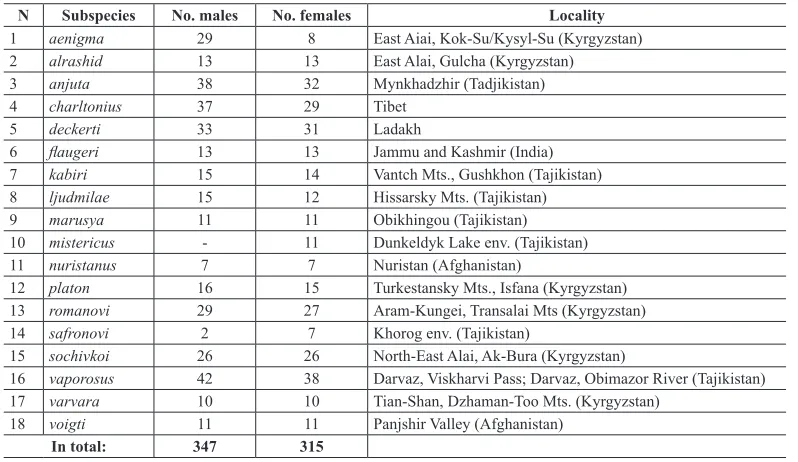
5 deckerti 33 31 Ladakh
6 flaugeri 13 13 Jammu and Kashmir (India)
7 kabiri 15 14 Vantch Mts., Gushkhon (Tajikistan)
8 ljudmilae 15 12 Hissarsky Mts. (Tajikistan)
9 marusya 11 11 Obikhingou (Tajikistan)
10 mistericus - 11 Dunkeldyk Lake env. (Tajikistan)
11 nuristanus 7 7 Nuristan (Afghanistan)
12 platon 16 15 Turkestansky Mts., Isfana (Kyrgyzstan)
13 romanovi 29 27 Aram-Kungei, Transalai Mts (Kyrgyzstan)
14 safronovi 2 7 Khorog env. (Tajikistan)
15 sochivkoi 26 26 North-East Alai, Ak-Bura (Kyrgyzstan)
16 vaporosus 42 38 Darvaz, Viskharvi Pass; Darvaz, Obimazor River (Tajikistan)
17 varvara 10 10 Tian-Shan, Dzhaman-Too Mts. (Kyrgyzstan)
18 voigti 11 11 Panjshir Valley (Afghanistan)
In total: 347 315
9) platon Sotchivko & Kaabak, 2011. Type locality: “SW Kyrgyzstan, Turkestansky Mts. Range,
Sarkat River, 1500 m above s. l.”.
10) romanovi Grum-Grshimailo, 1885. Type locality: “Transalai” (by the lectotype). Actually
type locality shown in the original description located in mountainous pass near Katta-Karamuk village, South Kyrgyzstan.
11) safronovi Korb, Shaposhnikov, Zatakovoy & Nikolaev, 2013. Type locality: “Tajikistan, South-West Pamir, Shakhdarinsky Mts., 35–45 km N of Khorog, 3700 m”.
12) sochivkoi Churkin, 2009. Type locality: “North-East Alai, Ak-Bura River, 2600–2700 m”.
13) vaporosus Avinov, 1913. Type locality: “Bukhara, Darvaz, Viskharvi Pass”.
14) varvara Churkin, 2009. Type locality: “Kyrgyzstan, Dzhaman-Too Mts., Karasu R., …2900 m”.
Recently the phylogeography of several Parnassiinae species has been studied using DNA mark-ers (Gratton and Sbordoni 2005; Gratton et al. 2006, 2008; Todisco et al. 2010, 2012). Almost all published research concerning Parnassiinae phylogeography supports the refugial theory of their
dispersal across the Palaearctic Region. From these studies it is obvious that species associated
with open habitats (Parnassius apollo (Linnaeus, 1758) and P. corybas Fischer von Waldheim, 1824 complex) were more widely distributed during glacial periods, whereas Driopa mnemosyne (Linnaeus, 1758) had a more restricted distribution during the cold phases. Our data on K. charlto-nius, which also inhabits open habitats, supports these conclusions too.
Material and methods
Specimen samplingFor this study, we selected populations known from Central Asia (we use this term to refer to the countries of Kazakhstan, Kyrgyzstan, Tajikistan, Turkmenistan, and Uzbekistan). No special atten -tion to selec-tion of phenotypes has been done; rather, we paid much more atten-tion to the reliability of localities for our specimens than to the external features, based on the principle that if a spec-imen originates from the locality which is now treated as an area of a certain subspecies, it must have this subspecies’ features (including the COI sequence). All sequenced specimens are depicted
in Fig. 4. The species is distributed also in Afghanistan, Pakistan, Tibet and India; however, it is not
easy to get fresh material from these countries. We did use several samples from these locations to see how they are connected to our delimited area and we included samples of K.charltonius from
GenBank (mainly from publications of Omoto et al. 2004; Katoh et al. 2005; Michel et al. 2008; Churkin and Michel 2014; Tables 2, 3) and also other taxa as outgroups and for calibration points
(Hypermnestrahelios (Nickerl, 1846), Koramius stoliczkanus (Felder & Felder, 1865), K. acdestis (Grum-Grshimailo, 1891), K. augustus (Fruhstorfer, 1903), K. imperator (Oberthür, 1883), K. in-opinatus (Kotzsch, 1940), K. autocrator (Avinov, 1913), K. loxias (Püngeler, 1901)) (Table 4). To
overcome the problem with potentially incorrect collecting information for the taxonomic part of our work, in cases of uncertainty we restricted our data to the type material and we omitted material
from GenBank. We also investigated the type material deposited in various collections to compare
it with our available specimens. Used material originated from the following collections: collected
specimens by the first author (SK); private collections of Dr L.V. Kaabak (Moscow, Russia), Mr V.V. Titov (Zheleznodorozhny, Russia), Mr Y.B. Kosarev (Nizhny Novgorod, Russia); collections
of the following institutions: Zoological Museum of Moscow University (Moscow, Russia),
Zo-ological Institute of the Russian Academy of Sciences (St. Petersburg, Russia), Finnish Natural History Museum (Helsinki, Finland), British Natural History Museum (London, UK), Museum für Naturkunde an der Humboldt-Universität zu Berlin (Berlin, Germany).
The type specimens of the following K. charltonius taxa have been studied: aenigma (paratypes,
1 ♂, 1 ♀), anjuta (holotype ♂, paratypes 3 ♂, 3 ♀), charltonius (syntype 1 ♀), eugenia (paratypes
2 ♂, 2 ♀), ljudmilae (holotype ♂), mistericus (holotype ♂, paratypes 3 ♂, 3 ♀), platon (paratypes
2 ♂, 2 ♀), romanovi (paralectotypes 1 ♂, 1 ♀), safronovi (complete type series), sochivkoi
(para-types 1 ♂, 1 ♀), vaporosus (lectotype ♂), varvara (paratype ♂).
Additional material studied (all topotypes): aenigma (12 ♂, 6 ♀), alrashid (2 ♂), anjuta (14 ♂, 6 ♀), eugenia (2 ♂), ljudmilae (2 ♂, 1 ♀), mistericus (32 ♂, 12 ♀), platon (26 ♂, 26 ♀), romanovi
(112 ♂, 43 ♀), sochivkoi (12 ♂, 2 ♀), vaporosus (56 ♂, 42 ♀); also non-topotypic material have
been studied for morphometric analysis (see Table 1 for the number of specimens and origin).
Morphology and multivariate statistics
The genitalia in Parnassiinae do not show much variability and the majority of the taxa were de-scribed using only wing pattern. Therefore we selected ten wing pattern characteristics for males
and females for 18 subspecies described from Central Asia. In total, we measured 347 males and
315 females (Table 1). The wing characteristics were: (1) postdiscal belt on forewing (complete
or incomplete, coded as dummy variable; PosBe); (2) colour of discal and discoidal spots (black/
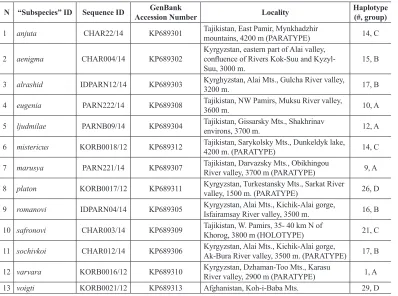
Suu, 3000 m.
3 alrashid IDPARN12/14 KP689303 Kyrghyzstan, Alai Mts., Gulcha River valley, 3200 m. 17, B
4 eugenia PARN222/14 KP689308 Tajikistan, NW Pamirs, Muksu River valley, 3600 m. 10, A
5 ljudmilae PARNB09/14 KP689304 Tajikistan, Gissarsky Mts., Shakhrinav environs, 3700 m. 12, A
6 mistericus KORB0018/12 KP689312 Tajikistan, Sarykolsky Mts., Dunkeldyk lake, 4200 m. (PARATYPE) 14, C
7 marusya PARN221/14 KP689307 Tajikistan, Darvazsky Mts., Obikhingou River valley, 3700 m (PARATYPE) 9, A
8 platon KORB0017/12 KP689311 Kyrgyzstan, Turkestansky Mts., Sarkat River valley, 1500 m. (PARATYPE) 26, D
9 romanovi IDPARN04/14 KP689305 Kyrgyzstan, Alai Mts., Kichik-Alai gorge, Isfairamsay River valley, 3500 m. 16, B
10 safronovi CHAR003/14 KP689309 Tajikistan, W. Pamirs, 35- 40 km N of Khorog, 3800 m (HOLOTYPE) 21, C
11 sochivkoi CHAR012/14 KP689306 Kyrgyzstan, Alai Mts., Kichik-Alai gorge, Ak-Bura River valley, 3500 m. (PARATYPE) 17, B
12 varvara KORB0016/12 KP689310 Kyrgyzstan, Dzhaman-Too Mts., Karasu River valley, 2900 m (PARATYPE) 1, A 13 voigti KORB0021/12 KP689313 Afghanistan, Koh-i-Baba Mts. 29, D
WcRSpot); (4) red spots on hindwing upperside (amount; RedHWU); (5) black submarginal oval spots on hindwing upperside (amount; BSubmHWU); (6) number of violet centres in black spots on hindwing upperside (VcBSpot); (7) configuration of middle red spot on hindwing upperside
(oval/rounded, as a dummy; MRedS_ov/MRedS_ro); (8) colour of middle red spot on hindwing upperside (black/grey, coded as a dummy; MRedS_black/MRedS_grey); (9) ratio of width in
api-cal part of marginal/submarginal belt on forewing upperside (PosBelInc); and (10) suffusion of central vein and central red spot on hindwing upperside (present/absent; dummy; HWU_NoSu/ HWU_BlSu). We use these characteristics as predictors for inter-subspecific differences between two taxa. For the calculations we used Canonical Correspondence Analysis, which allows testing of explanatory variables on multidimensional ordination data, and the Forward Selection approach
until the variability explained by the variables cannot be improved. We ran two separate analyses
for males and for females in CANOCO for Windows ver. 4.5 (Leps and Smilauer 2003) with the
Monte Carlo permutation test (999 permutations).
DNA sequencing and molecular data processing
DNA extraction, PCR and sequencing were carried out according to the protocols described in
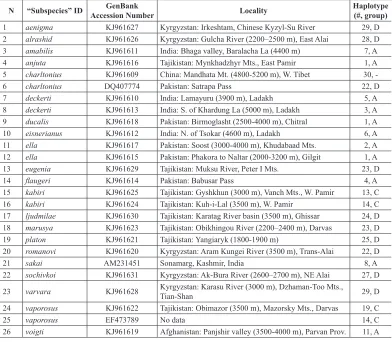
-Table 3. Samples of K. charltonius from GenBank used in current study.
N “Subspecies” ID Accession NumberGenBank Locality Haplotype (#, group) 1 aenigma KJ961627 Kyrgyzstan: Irkeshtam, Chinese Kyzyl-Su River 29, D 2 alrashid KJ961626 Kyrgyzstan: Gulcha River (2200–2500 m), East Alai 28, D 3 amabilis KJ961611 India: Bhaga valley, Baralacha La (4400 m) 7, A
4 anjuta KJ961616 Tajikistan: Mynkhadzhyr Mts., East Pamir 1, A
5 charltonius KJ961609 China: Mandhata Mt. (4800-5200 m), W. Tibet 30,
-6 charltonius DQ407774 Pakistan: Satrapa Pass 22, D
7 deckerti KJ961610 India: Lamayuru (3900 m), Ladakh 5, A
8 deckerti KJ961613 India: S. of Khardung La (5000 m), Ladakh 3, A 9 ducalis KJ961618 Pakistan: Birmoglasht (2500-4000 m), Chitral 1, A 10 eisnerianus KJ961612 India: N. of Tsokar (4600 m), Ladakh 6, A 11 ella KJ961617 Pakistan: Soost (3000-4000 m), Khudabaad Mts. 2, A 12 ella KJ961615 Pakistan: Phakora to Naltar (2000-3200 m), Gilgit 1, A
13 eugenia KJ961629 Tajikistan: Muksu River, Peter I Mts. 23, D
14 flaugeri KJ961614 Pakistan: Babusar Pass 4, A
15 kabiri KJ961625 Tajikistan: Gyshkhun (3000 m), Vanch Mts., W. Pamir 13, C 16 kabiri KJ961624 Tajikistan: Kuh-i-Lal (3500 m), W. Pamir 14, C
17 ljudmilae KJ961630 Tajikistan: Karatag River basin (3500 m), Ghissar 24, D
18 marusya KJ961623 Tajikistan: Obikhingou River (2200–2400 m), Darvas 23, D
19 platon KJ961621 Tajikistan: Yangiaryk (1800-1900 m) 25, D
20 romanovi KJ961620 Kyrgyzstan: Aram Kungei River (3500 m), Trans-Alai 22, D
21 sakai AM231451 Sonamarg, Kashmir, India 8, A
22 sochivkoi KJ961631 Kyrgyzstan: Ak-Bura River (2600–2700 m), NE Alai 27, D 23 varvara KJ961628 Kyrgyzstan: Karasu River (3000 m), Dzhaman-Too Mts., Tian-Shan 29, D
24 vaporosus KJ961622 Tajikistan: Obimazor (3500 m), Mazorsky Mts., Darvas 19, C
25 vaporosus EF473789 No data 14, C
26 voigti KJ961619 Afghanistan: Panjshir valley (3500-4000 m), Parvan Prov. 11, A
tochrome Oxidase subunit I. Sequencing was partly conducted in the Biology Centre of the Czech Academy of Sciences, and partly at the Nizhny Novgorod State University.
For the sequence processing, phylogenetic analysis, and producing a timed-tree we used the software BioEdit (Hall 1999), MEGA 6 (Tamura et al. 2013), MrBayes 3.2.4 (Ronquist et al. 2012), and BEAST v. 1.8.0 (Drummond et al. 2013). Maximum Likelihood tree was computed in MEGA
(ML: test of phylogeny is bootstrap method (10000 replications); Tamura-Nei model; uniform
rates and use all sites; ML heuristic method – NNI; branch swap filter very strong; codons included 1st+2nd+3rd+non-coding), and Bayesian trees in MrBayes (best substitution model was select
-ed by MrModelTest v.2.2. as GTR+G+I; we ran the program for 10,000,000 generations, with 4 chains). In BEAST we applied a molecular clock using four calibration points from Condamine et
of illustrations was done in Corel Draw X4 and Photoshop CS6. Statistical calculations were made
by StatSoft STATISTICA for Windows.
We ended up excluding several samples from Churkin and Michel (2014) from the final phy -logenetic and haplotype analyses because after inclusion of these samples, some of them did not
cluster with our samples of the same subspecies/origin (Figs 7, 8). We cannot exclude the possibil
-ity that their data are good, but there are also two alternative explanations: first, laboratory mistake, and second, locality labelling mistake. Because we suspect an error at some level, we decided to
exclude these samples (KJ958545, KJ958546, KJ958547, KJ958548, KJ958549).
Results and discussion
Morphometric analysesThe majority of our measured wing characteristics poorly separated subspecies of K. charltonius.
The only excluded variable from the final model was the colour of MRedSp in males (for sin
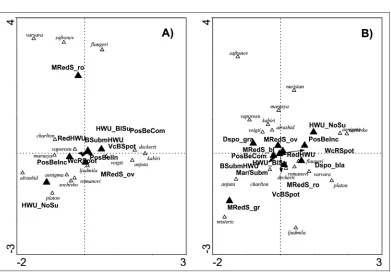
-gle-term tests, see Table 5). The models were highly significant both for males (first canonical axis: eigenvalue=0.855, F=20.013, p>0.001; all axes: trace= 3.919, F=14.635, p<0.001) and females (first canonical axis: eigenvalue=0.877, F=16.541, p<0.001; all axes: trace=5.181, F=13.327, p<0.001). Wing pattern elements explain 26.13% of variability between subspecies in males and 30.48% of variability in females. Males of varvara, safronovi and flaugeri form a cluster,
char-acterized by round MredS; another cluster of males of kabiri, deckerti, anjuta and voigti is
char-acterised by PosBeCom, PosBelIn and VcBSpot. Males of alrashid, platon, aenigma, sochivkoi, romanovi, marusya, and to some extent also charltonius, are characterised by HWU_NoSu and WcRSpot (Fig. 6A). A very different pattern is seen in females, where none of the male clusters are found (Fig. 6B). One female group is formed by anjuta, safronovi and mistericus and is character-ised by grey MredS. Another group is formed by alrashid, charltonius, and to some extent also by
5 K. charltonius (wrongly determined as inopinatus) EF473790 Afghanistan
6 K. inopinatus AM231453 Afghanistan
7 K. autocrator AM231454 Afghanistan
8 K. autocrator EF473788 Tajikistan
9 K. autocrator DQ351029 Tajikistan
10 K. loxias AM231452 Kyrgyzstan
11 K. loxias EF473791 Kyrgyzstan
12 K. augustus AM231456 China
13 K. imperator DQ407775 China
14 K. imperator EF473793 China
Table 5. Single term tests of wing pattern analyses for males and females of K. charltonius from CCA with 999 Monte Carlo permutations.
Males Females
F p F p
PosBeCom 14.67 0.001 10.12 0.001
PosBeInc 14.67 0.001 10.12 0.001
Dspo_black 0.82 0.589 15.26 0.001
Dspo_gray 0.82 0.589 15.26 0.001
WcRSpot 11.87 0.001 14.49 0.001
RedHWU 15.81 0.001 12.92 0.001
BSubmHWU 3.43 0.002 4.17 0.001
VcBSpot 12.18 0.001 13.66 0.001
MRedS_ov 16.44 0.001 13.91 0.001
MRedS_round 16.44 0.001 13.91 0.001
MRedS_black NA NA 8.95 0.001
MRedS_grey NA NA 8.95 0.001
PosBelInc 18.55 0.001 16.04 0.001
HWU_NoSuff 12.33 0.001 4.13 0.001
HWU_BlSuff 12.33 0.001 4.13 0.001
sister to Koramius inopinatus + (K. autocrator + K. loxias). A surprise is that one specimen of K. inopinatus (Genbank Accession Number EF473790, from Omoto et al. 2004) goes inside of charl-tonius (potential causes are introgression, hybridization, or misidentification), while the second
specimen of this species groups with K. autocrator + K. loxias (Fig. 7).
K. ch. charltonius from Tibet, i.e. the nominotypical subspecies,is sister to all the other pop-ulations of K. charltonius, which are split into two clades (ML tree; this is also supported by the network analysis and thus we prefer this arrangement), or with K. ch. voigti sister to other Central
Asian populations (BI tree). With this exception, the BI and ML trees are very similar despite low support for the main clades. One clade is formed by populations from east Tajikistan and Kashmir (haplotype group A in Fig. 7; ssp. ljudmilae, sakai, eugenia and a paratype of marusya) plus sur-prisingly varvara from an isolated area in Kyrgyzstan. The next clade is formed by populations from Kyrgyzstan (Alai and Turkestansky Mts.) (haplotype group B in Fig. 7; platon, alrashid, sochivkoi and romanovi) as well as by close and genetically indistinguishable populations from the northern “main” mountain ranges of the Central Asian mountains, from Pamir to Tibet (haplotype
groups C and D in Fig. 7; voigti, safronovi, mistericus, vaporosus, anjuta, aenigma and charltonius s.str.). Only populations from the eastern part of the species’ range differ from the other popula
-tions. Multiple specimens from the same subspecies cluster with specimens of different subspecies
in alrashid, romanovi, vaporosus etc. In ljudmilae, voigti and charltoniuss.str. different specimens even belong to different clades.
Haplotype network analysis shows high haplotype divergence (Fig. 8). In total there are 30 hap -lotypes, which can be separated into several clusters. There are distant connections between
south-ern (Tajikistan + Kashmir) and Kyrgyz populations and much shorter connections in haplotype rich northern and north-eastern populations. The first offshoot of K. charltonius on the phylogenetic trees, K. ch. charltonius, with our default settings does not belong to the same network. First
haplotype group (A) is widely distributed across the species range. The second haplotype group
is restricted to southern Kyrgyzstan. The third group is distributed in Tajikistan and Afghanistan,
whereas the fourth group is again shared between a vast part of the species area.
The messiness of the phylogenetic relationships among these putative taxa is reflected in the
messiness of the systematics of this species. Clearly, using the phylogenetic tree, it is impossible to circumscribe separate subspecies and this result supports our conclusions about the unrealistic number of subspecies of K. charltonius. On the other hand, the haplotype network visualizes the
grouping and connections between the populations and it can be used for taxonomic
interpreta-tions, as it was done recently, for example, by Pazhenkova et al. (2015).
Taxonomic implications
Even when we take into account the differences between ML and BI trees, we see that the number
Figure 7. The Bayesian inference (BI) and maximum likelihood (ML) trees of Koramius charltonius and closely related taxa. Outgroups are shown in grey. The colours represent the four haplotype lineages.
subspecies groups and these groups are scattered across the tree. On the other hand, the subspe-cies form several clusters according to the geography (see the type localities of all subspesubspe-cies of K. charltonius described from Central Asia in Fig. 5) as well as genetic clusters (Fig. 7), but the genetic differences inside the clusters are very small, with over 50% of sequenced specimens having a barcode pairwise distance smaller than 0.2% between them. The overall mean distance between samples was only 0.00141. Unfortunately, because of the low number of individuals per
Figure 8. The haplotypes network of Koramius charltonius in Central Asia, median-joining, constructed us-ing only verified sequences. Haplotype group A – red dots; group B – red circles; group C – black dots; group D – grey dots. See text for details.
The genetic distances were marginally positively correlated with geographic distances (Mantel test, r = 0.271, p = 0.071), but they were not correlated with morphological distances (r = 0.051,
p = 0.324). Even when we made comparison with only males (r = -0.021, p = 0.567) or females (r = 0.082, p = 0.253), we did not find any correlation. Also, when comparing morphology distance matrices for males and females, we did not find a correlation (r = -0,001, p = 0.481). Thus the dif -ferences between these subspecies are not real; for some specimens it is not possible to identify to which subspecies of K. charltonius they belong without having geographical data. Recognizable
phenotypes are present only in subspecies romanovi, varvara, and platon. Additionally, it is possi-ble to identify some groups of subspecies according to the wing pattern.
Based on the results of our examinations, we propose a preliminary subspecific division of K. charltonius in Central Asia. It is possible that it will be necessary to further reduce the number of subspecies in the future because there is no clear pattern in phylogenetic trees. We used the haplo-type network and morphometric data as a basis for the following division:
a) varvara, characterised by island-distribution in the Inner Tian-Shan (it is possible that this
sub-species name will be synonymized after further investigation).
b) romanovi, characterized by distribution in the Alai and Transalai Mts. The southern border
Transalai Mts., the eastern border is at the beginning of the Zeravshan River Valley. Syno-nyms: aenigma Dubatolov & Milko, 2003, syn. n., sochivkoi Churkin, 2009, alrashid Churkin & Pletnev, 2012, syn. n.
c) platon, characterized by distribution in the north-eastern limit of the species range in Central
Asia (Turkestansky Mts.) and by the mid-altitude mountainous vertical distribution (1500– 2100 m). This kind of vertical distribution is unusual for this species and makes a notable ecological isolation from other known populations.
d) ljudmilae, characterized by the distribution in the south-eastern limit of the species distribution in Central Asia (Hissarsky Mts.). There are long distances (over 200 km) to its other closest
known populations.
e) vaporosus, characterized by distribution in east, central and north-west Pamir and Darvaz. The
borders of this subspecies are Alichur River in the south, highland plains of East Pamir in the east, the high-mountainous plain starting from the southern slope of Transalai Mts. in the
north, and the eastern slopes of Darvaz Mts. in the west. Synonyms: marusya Churkin & Plet-nev, 2012, syn. n., eugenia Churkin, 2009, syn. n., anjuta Stshetkin & Kaabak, 1985, syn. n., mistericus Kaabak, Sotchivko & Titov, 1996, syn. n.
f) voigti, distributed in West Pamir and Afghan Badakhshan. The northern border is in the Akademii
Nauk Mts. and adjacent glaciers. Synonym: safronovi Korb, Shaposhnikov, Zatakovoy &
Nikolaev, 2013, syn. n.
Phylogeography
We present the phylogenetic relationships of populations of Koramius charltonius based on one mitochondrial gene from the western part of its range. Whereas two haplotype groups (A and D)
are widely distributed throughout the range, two other haplotype groups (B and C) indicate a sep
-aration of larger historical areas by vicariance, first in isolated sections of the westernmost parts
of the area (isolation of platon and ljudmilae), then separation of voigti, and then separation of the southern (vaporosus) and northern (romanovi) branches with deckerti in between. Shatravin (2000)
summarized the history of the Pleistocene glaciation in the Pamirs and Tian-Shan (mountainous Central Asia), which consisted of three parts: first Pleistocene stage (about 74,000–70,000 years ago), second Pleistocene stage (about 54,000–52,000 years ago), and third Pleistocene stage (about 24,000–22,000 years ago).
The observed pattern suggests that the species had a wide distribution in Central Asia in the
past, at least up to the southern ridges of Tian-Shan (probably wider). The first Pleistocene stage
divided the area of the K. charltonius ancestor into several large areas separated by high mountain
ridges, which were covered by glaciers: e.g., Alai and Transalai, Sary-Kol etc. (Shatravin 2000). Further separations followed in the second and third stages and inter-stage times. This is supported by larger differences between subspecies: the most ancient ones are located in the northern parts of the species area and have the COI-differences of about 1% (varvara, platon).
These results indicate a shrinking of the original range, with western populations becoming isolated due to the gradual drying of the mountains rather than dispersal. Also, it is evident that the eastern populations are not really genetically isolated and thus the majority of the described
since they are concordant with geography. Also, our findings are similar to the findings of Michel et al. (2008), who, however, worked on the specific level, whereas we focused more deeply on
the populations.
Many of the new subspecies descriptions are frequently inadequately erected, based rather on partial data than on systematic comparison of large series and using adequate analyses. Even worse, many of such subspecies might have been established only to increase the price of the
insect specimens on the market. However, these taxa are still valid in the sense of the zoological
nomenclature. Taxonomists must acknowledge every described taxon, they must place it in its
correct position or synonymize it, and we have done our best with this difficult case based on all
the currently available data.
Acknowledgements
We are thankful to Mr V.V. Titov (Zheleznodorozhnyi, Russia) for granting most of used material for DNA studying; we also thankful to Mr P. Egorov (Almaty, Kazakhstan) for the same. We thank Dr A.V. Sviridov (Moscow State University, Zoological Museum, Moscow, Russia), Dr S.Yu. Sinev and Dr A.L. Lvovsky (Zoological Institute of the Russian Academy of Sciences, St.-Petersburg, Russia), Dr W. Mey (Museum für Naturkunde, Berlin, Germany) for giving access to study of curated collections. For providing materials for study we are greatly indebted also to Mr D.A. Pozhogin (Nizhny Novgorod, Russia), Mr A.A. Shaposhnikov (Podolsk, Russia), Mr A.A.Zatakovoi (Nizhny Novgorod, Russia), Dr L.V. Kaabak (Moscow, Russia). We are indebted to M. Nuss and Z. Varga for reviews of an earlier version, which helped us improve our text. We are tankful to J. Rota for final editing of the manuscript. M. Sweney helped with linguistic corrections. The sequencing was supported by Czech Science Foundation (GA CR) (14-36098G), by the University of South Bohemia (168/2013/P) and by the Nizhny Novgorod State University (contract 22-11-2013/c).
References
Austaut JL (1889) Les Parnassiens de la faune paléarctique. Ernst Heyne Ferlag, Leipzig.
Braby MF, Eastwood R, Murray N (2012) The subspecies concept in butterflies: has its application in tax -onomy and conservation biology outlived its usefulness? Biological Journal of the Linnean Society 106: 699–716.
Bryk F (1935) Lepidoptera Parnassiidae Pars II (Subfam. Parnassiinae). Das Tierreich 65: 1–790.
Churkin S (2009) Notes on Parnassius Latreille, 1804 from Tian-Shan and Alai. Part 3: Parnassius charltonius Gray, 1852 (Lepidoptera, Papilionidae). Atalanta 40: 411–434.
Churkin S, Pletnev VA (2012) New data about Parnassius charltonius Gray, 1852 (Lepidoptera, Papilionidae). Atalanta 43: 95–105.
Clement M, Posada D, Crandall K (2000) TCS: a computer program to estimate gene genealogies. Molecular Ecology 9: 1657–1660. https://doi.org/10.1046/j.1365-294x.2000.01020.x
Drummond AJ, Suchard MA, Xie D, Rambaut A (2012) Bayesian phylogenetics with BEAUti and the BEAST 1.7. Molecular Biology And Evolution 29: 1969–1973. https://doi.org/10.1093/molbev/mss075
Dubatolov VV, Milko DA (2003) A new subspecies of Parnassius (Kailasius) charltonius Gray, 1852 from Kyrghyz Kashgaria (Lepidoptera, Papilionidae). Atalanta 34: 435–439.
Eisner C (1974) Parnassiana Nova XLIX. Die Arten und Unterarten der Baroniidae, Teinopalpidae und Parnas -siidae (Erster teil) (Lepidoptera). Zoologische Verhandelingen 135: 1–96.
Fric Z, Dickinson R, Fetouh G, Larsen TB, Schön W, Wiemers M (2014) First record of the cycad blue, Chilades pandava, in Egypt – a new invasive butterfly species in the Mediterranean region and on the African con -tinent (Lepidoptera: Lycaenidae). African Entomology 22: 315–319. https://doi.org/10.4001/003.022.0205 Folmer O, Black M, Hoeh W, Lutz R, Vrijenhoek R (1994) DNA primers for amplification of mitochondrial
cytochrome c oxidase subunit I from diverse metazoan invertebrates. Molecular Marine Biology and Bio -technology 3: 294–299. https://doi.org/10.1111/j.1365-2311.1944.tb01217.x
Ford EB (1944) Studies on the chemistry of pigments in the Lepidoptera, with references to their bearing on systematics. 4. The classification of the Papilionidae. Transactions of the Royal Entomological Society of London 94: 201–223.
Gratton P, Sbordoni V (2005) Conservation genetics and phylogeography of Parnassius mnemosyne. Pensoft Series Faunistica 52: 41–44.
Gratton P, Todisco V, Sbordoni V (2006) Filogeografia comparata di Parnassius apollo e P. mnemosyne. Un contributo genetico-molecolare alla biogeografia dell’Appenino. Biogeographia 27: 277–289.
Gratton P, Konopiński MK, Sbordoni V (2008) Pleistocene evolutionary history of the Clouded Apollo ( Par-nassius mnemosyne): genetic signatures of climate cycles and a ‘time-dependent’ mitochondrial substitu -tion rate. Molecular Ecology 17: 42–48.
Hall TA (1999) BioEdit: a user-friendly biological sequence alignment editor and analysis program for Windows 95/98/NT. Nucleic Acids Symposium Series 41: 95–98.
Hancock DL (1983) Classification of the Papilionidae (Lepidoptera): a phylogenetic approach. Smithersia 2: 1–48.
Heinkele P (2003) The distribution of Parnassius charltonius, Gray 1853 in Afghanistan including the de-scription of a new subspecies (Lepidoptera, Papilionidae). Lambillionea 103: 517–520.
Higgins LG (1975) The classification of European butterflies. Collins, London.
Hiura I (1980) A phylogeny of the genera of Parnassiinae based on analysis of wing pattern, with description of a new genus (Lepidoptera: Papilionidae). Bulletin of the Osaka Museum of Natural History 33: 71–85. Igarashi S (1984) The classification of the Papilionidae mainly based on the morphology of their immature
stages. Tyô to Ga 34: 41–96.
Kaabak LV, Sotshivko AV, Titov VV (1996) A new subspecies of Parnassius charltonius Gray, 1853 from the Sarykolsky mountain ridge in Tajikistan (Lepidoptera, Papilionidae). Atalanta 27: 195–198.
Katoh T, Chichvarkin A, Yagi T, Omoto K (2005) Phylogeny and evolution of butterflies of the genus Par-nassius: inferences from mitochondrial 16S and ND1 sequences. Zoological Science 22: 343–351. https:// doi.org/10.2108/zsj.22.343
Kleckova I, Cesanek M, Fric Z, Pellisier L (2015) Diversification of the cold-adapted butterfly genus Oeneis related to Holarctic biogeography and climatic niche shifts. Molecular Phylogenetics and Evolution 92: 255–265. https://doi.org/10.1016/j.ympev.2015.06.012
Koçak AÖ (1989) Description of the genus Adoritis (gen. n.) with notes on other closely related groups in Parnassiinae (Papilionidae, Lepidoptera). Priamus 4: 163–170.
Korb SK, Shaposhnikov AA, Zatakovoy АА, Nikolaev AS (2013) About the first finding of Koramius ( Kaila-sius) charltonius (Gray, 1853) (Lepidoptera: Papilionidae) in the South-West Pamirs territory with descrip-tion of a new subspecies. Eversmannia 35: 3–4.
Korshunov YP (1988) New butterflies (Lepidoptera, Rhopalocera) from Khakassia, Tuva and Yakutia. Tak -sonomiya zhivotnikh Sibiri, 65–80.
Korshunov YP (1990) New genera of the subfamily Parnassiinae Swainson, 1840. Chlenistonogie i gelminty, 99–105.
Kreuzberg AVA, Dyakonov AL (1993) The chemistry of trophic relationships within subfamily Parnassiinae (Lepidoptera, Papilionidae). Bulletin Moskovskogo Obstshestva Ispytatelei Prirody. Biology 98: 3–14. Leps J, Smilauer P (2003) Multivariate analysis of ecological data using CANOCO. Cambridge University
Press, Cambridge.
Lesin VV, Kaabak LV (1991) A new subspecies of Parnassius charltonius Gray (Lepidoptera, Papilionidae) from Gissar Mts. Bulletin of the Moscow Nature Researchers Society, Biology 96: 74–77.
Manafzadeh S, Salvo G, Conti E (2014) A tale of migrations from east to west: the Irano-Turanian floris -tic region as a source of Mediterranean xerophytes. Journal of Biogeography 41: 366–379. https://doi. org/10.1111/jbi.12185
Michel F, Rebourg C, Cosson E, Descimon H (2008) Molecular phylogeny of Parnassiinae butterflies (Lepi -doptera: Papilionidae) based on the sequences of four mitochondrial DNA segments. Annales de la Société entomologique de France (N.S.) 44: 1–36.
Moore F (1902) Rhopalocera. Family Nymphalidae, Riodinidae, Papilionidae. Lepidoptera Indica 5: 1–248. Munroe E (1961) The classification of the Papilionidae (Lepidoptera). Canadian Entomologist Suppl. 17: 1–51. Nazari V, Sperling FA (2007) Mitochondrial DNA divergence and phylogeography in western palaearctic
Parnassiinae (Lepidoptera: papilionidae): How many species are there? Insect Systematics and Evolution 38: 121–138. https://doi.org/10.1016/j.ympev.2006.06.022
Nazari V, Zakharov EV, Sperling FAH (2007) Phylogeny, historical biogeography, and taxonomic ranking of Parnassiinae (Lepidoptera, Papilionidae) based on morphology and seven genes. Molecular phylogenetics and evolution 42: 131–156.
Omoto K, Katoh T, Chichvarkin A, Yagi T (2004) Molecular systematics and evolution of the “Apollo” but -terflies of the genus Parnassius (Lepidoptera: Papilionidae) based on mitochondrial DNA sequence data. Gene 326: 141–147. https://doi.org/10.1016/j.gene.2003.10.020
Omoto K, Yonezawa T, Shinkawa T (2008) Molecular systematics and evolution of the recently discovered “Parnassian” butterfly (Parnassius davydovi Churkin, 2006) and its allied species (Lepidoptera, Papilion-idae). Gene 330: 1–9.
Pazhenkova EA, Zakharov EV, Lukhtanov VA (2015) DNA barcoding reveals twelve lineages with properties of phylogenetic and biological species within Melitaea didymasensu lato (Lepidoptera, Nymphalidae). ZooKeys 538: 35–46. https://doi.org/10.3897/zookeys.538.6605
Pototski A, Salo S (2012) On the genus Kailasius F. Moore (Lepidoptera, Papilionidae) in the Middle Asia. Lepinfo 20: 86–91.
Rose K (1995) Zur Unterarten-Inflation in der Gattung Parnassius (Lepidoptera, Papilionidae). Nachrichten des entomologischen Vereins Apollo N.F 16: 243–252.
Sbordoni V (2010) Strength and limitations of DNA barcode under the multidimensional species perspective. Tools for Identifying Biodiversity: Progress and Problems, 275–280.
Shatravin VI (2000) Reconstruction of the Pleistocene and Holocene glaciations of the Tian-Shan and Pamir: new results. Pamir and Tian- Shan: Glacier and Climate Fluctuations during the Pleistocene and Holocene. International Workshop, July 22-23, 2000: 12–19.
Sochivko AV, Kaabak LV (2011) A new subspecies of Parnassius charltonius Gray, 1852 from the Turke-stansky mountains ridge (Lepidoptera, Papilionidae). Nachrichten des entomologischen Vereins Apollo N.F 32: 39–45.
Sokolov GN (1929) Male genitalia structure in Parnassius Latr. Russkoe entomologicheskoe obozrenie 23: 60–75.
Stichel HFEJ (1906) Beitrag zur Kenntnis der Lepidopteren-Gattung Parnassius Latr. Berliner entomolo -gische Zeitschrift 51: 81–94.
Tamura K, Stecher G, Peterson D, Filipski A, Kumar S (2013) MEGA6: Molecular Evolutionary Genetics Analysis version 6.0. Molecular Biology and Evolution 30: 2725–2729. https://doi.org/10.1093/molbev/ mst197
Todisco V, Gratton P, Cesaroni D, Sbordoni V (2010) Phylogeography of Parnassius apollo: hints on taxon-omy and conservation of a vulnerable glacial butterfly invader. Biological Journal of the Linnean Society 101: 169–183. https://doi.org/10.1111/j.1095-8312.2010.01476.x
Todisco V, Gratton P, Zakharov EV, Wheat CW, Sbordoni V, Sperling AH (2012) Mitochondrial phylogeog -raphy of the Holarctic Parnassius phoebus complex supports a recent refugial model for alpine butterflies. Journal of Biogeography 39: 1058–1072. https://doi.org/10.1111/j.1365-2699.2011.02675.x
Vodolazhsky DI, Stradomsky BV (2008) Phylogenetic analysis of subgenus Polyommatus (s. str.) Latreille, 1804 (Lepidoptera: Lycaenidae) based on mtDNA markers. Part I. Caucasian Entomological Bulletin 4: 123–130.
Weiss JC (1991) The Parnassiinae of the World. Sciences Nat, Venette.
Zhang HX, Zhang ML, Sanderson SC (2013) Retreating or standing: responses of forest species and steppe species to climate change in arid Eastern Central Asia. PLoS ONE 8(4): 1–12. https://doi.org/10.1371/ journal.pone.0061954
Zhang M, Hao X, Sanderson SC, Byalt VV, Sukhorukov AP, Zhang X (2014) Spatiotemporal evolution of Reaumuria (Tamaricaceae) in Central Asia: insights from molecular biogeography. Phytotaxa 167: 89–103. https://doi.org/10.11646/phytotaxa.167.1.5