Digital Commons @ George Fox University
Doctor of Ministry Theses and Dissertations
1-1-2018
Narrative-Based Visual Theology for Oral Learning
Pastor Training
Raymond Neu [email protected]
This research is a product of the Doctor of Ministry (DMin) program at George Fox University.Find out more about the program.
This Dissertation is brought to you for free and open access by the Theses and Dissertations at Digital Commons @ George Fox University. It has been accepted for inclusion in Doctor of Ministry by an authorized administrator of Digital Commons @ George Fox University. For more information, please [email protected].
Recommended Citation
GEORGE FOX UNIVERSITY
NARRATIVE-BASED VISUAL THEOLOGY FOR
ORAL LEARNING PASTOR TRAINING
A DISSERTATION SUBMITTED TO
THE FACULTY OF PORTLAND SEMINARY
IN CANDIDACY FOR THE DEGREE OF
DOCTOR OF MINISTRY
BY
RAYMOND NEU
PORTLAND, OREGON
Portland Seminary George Fox University
Portland, Oregon
CERTIFICATE OF APPROVAL ________________________________
DMin Dissertation
________________________________ This is to certify that the DMin Dissertation of
Raymond Neu
has been approved by
the Dissertation Committee on February 28, 2018
for the degree of Doctor of Ministry in Semiotics and Future Studies.
Dissertation Committee:
ii Copyright © 2018 by Raymond D. Neu All Rights Reserved
Bible Trekkingä is owned by Ray Neu.
Holy Bible, New American Standard Bible, La Habra, CA: Lockman Foundation, 2011. Holy Bible, New International Version, USA: Biblica, 2011.
iii Dedication
Dedicated to all those to whom God sent His most important message yet who did now have the skill or opportunity to read it.
You were never required to read it; only to hear and obey.
And to those who will share the sacred stories with them, may we speak, sing, draw, dramatize and dance so they will understand.
Dedicated also to my wife, Becki, who has cheered, cajoled, reminded, encouraged, challenged and loved me through this entire process and continues to do so,
for the sake of those who have not yet heard His stories. I love you.
“Faith comes by hearing and hearing by the word of Christ.” Romans 10:17 (NASB)
"Blessed...are those who hear the word of God and obey it." Luke 11:28 (NIV)
“Jesus used many similar stories and illustrations to teach the people as much as they could understand. In fact, in his public ministry he never taught without using parables;
but afterward, when he was alone with his disciples, he explained everything to them.” Mark 4:33-34 (NLT)
May you be blessed in your hearing of His stories; May you be blessed in your obedience to His stories;
May you be blessed as tellers of His stories, For that is why you were called and chosen.
iv
PREFACE ... vii
ABSTRACT ... x
SECTION 1: ORAL LEARNERS: A PREDOMINANT GLOBAL REALITY ... 1
Who and Where Are Most of the Oral Learners? ... 2
What Are the Circumstances of Their Lives? ... 3
“Big Business” is Not Unaware of Their Plight ... 5
Distinctions Between Literate And Oral Learners ... 8
How May An Oral Learning Pastor Be Prepared Educationally? ... 11
SECTION 2: THOSE WHO ARE ORAL LEARNERS BY PREFERENCE ... 14
Generational Shifts in the Western World ... 14
Decline in Literacy ... 14
Increase in Global Compassion and Action ... 16
Increase in Digital Dominance and Social Media ... 20
Awareness and Growth of Orality Based Solutions ... 22
Understanding Oral Learners ... 26
SECTION 3: REENGAGING ANCIENT-NEW METHODOLOGIES ... 31
Extrapolating Orality Based Solutions ... 31
Understanding What Worked and Why ... 31
Applying the Principles ... 46
A Rebirth of Hieroglyphics as Visual Teaching Tools ... 61
Customizing Local Content Curriculum ... 61
Creating Culturally Adaptive Visual Mnemonics ... 76
SECTION 4: THE ARTIFACTS ... 90
Artifact Specification Sheet ... 111
Artifact / Tier 1 – Designed for Non-Literate Primary Oral learners ... 112
Artifact / Tier 2 – Designed for Low Literate Primary Oral learners ... 113
Artifact / Tier 3 – Bible Story App, Low Orality Reliance, Semi-Literate ... 114
POSTSCRIPT ... 115
v List of Figures
Figure 1: Artist's Rendition of SES Network’s O3b mPower Constellation. Credit: SES 6
Figure 2: Image Credit: Google/X Company, Project Loon ... 7
Figure 3 ... 17
Figure 4: Intersections and Opportunities ... 22
Figure 5: All People are Oral Learners ... 28
Figure 6: A Book of Hours, prepared for French noblewoman Yolanda de LaLaing ... 33
Figure 7 ... 34
Figure 8: Christ on Lake Geneva by Konrad Witz ... 36
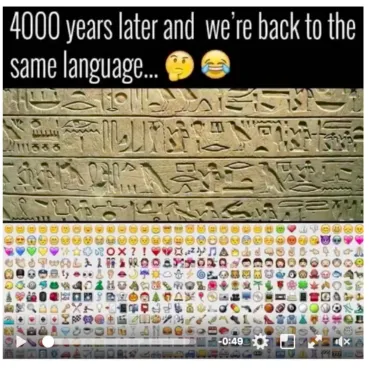
Figure 9: Emojis as Hieroglyphics ... 57
Figure 10: Prayer for the American Farmer ... 58
Figure 11: ‘WhatsApp’ Story of Job ... 59
Figure 12: Narrative, Visual Oral Training Process ... 60
Figure 13: Basic Christian Beliefs StudyMap ... 65
Figure 14: Church as a Tree ... 67
Figure 15: Australia ‘Church as Rock’ ... 68
Figure 16: Peruvian Story Gourd Carving ... 78
Figure 17: Baptism of Jesus StudyMap ... 84
Figure 18: Baptism of Jesus StudyMap with Icons ... 86
Figure 19: Hand Drawn Baptism of Jesus StudyMap ... 87
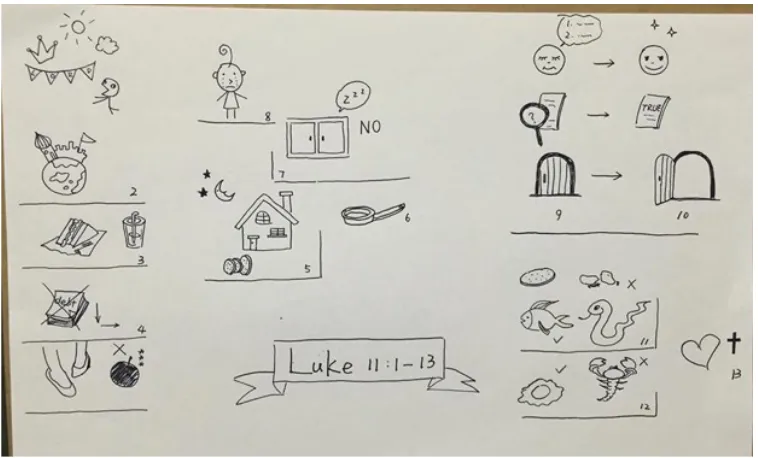
Figure 20: Student’s StudyMap of Luke 11:1-13 ... 88
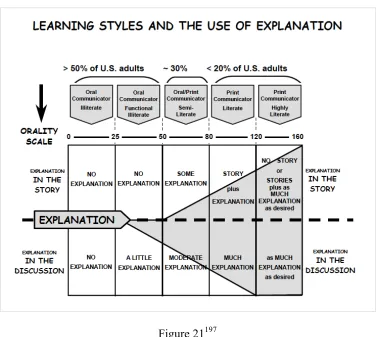
Figure 21 ... 91
Figure 22: Essentials Icons Final Order ... 93
Figure 23: Essentials Icons on Dice ... 98
Figure 24: Essentials Icons on Bracelet and Necklace ... 99
Figure 25: Jesus Film Headscarf ... 101
Figure 26: Baptism of Jesus ... 102
Figure 27: Jesus Film Headscarf on Woman ... 103
Figure 28: Bible Trekking Screen Shots 1 ... 105
Figure 29: Bible Trekking Screen Shots 2 ... 106
Figure 30: Bible Trekking Screen Shot 3 ... 107
Figure 31: Bible Trekking Screen Shots 4 ... 108
Figure 32: Bible Trekking Screen Shot 5 ... 109
Figure 33: Bible Trekking Screen Shots 6 ... 110
Figure 34: Tier 1 Artifact ... 112
Figure 35: Tier 2 Artifact in French ... 113
Figure 36: Tier 3 Artifact ... 114
Figure 37: Essentials Icons Final Order ... 117
Figure 38: Jesus Film Headscarf – Portuguese ... 125
Figure 39: Essentials Icons Original ... 139
Figure 40: Essentials Icons Named ... 140
Figure 41: Essentials Icons Edited Order ... 146
Figure 42: Essentials Icons New Design ... 147
vi
vii PREFACE
Deep in the humid jungle of southern Belize, local pastors would faithfully gather
and politely listen as this ‘Gringo’ professor did his best to teach them all the good things
a pastor should know. After years of going on missions’ trips to Belize, I had become
quite familiar with the people and culture, so much so that it made it an easy transition
when my wife and I moved there for a five-year stint as the local extension education
professor. I was teaching people in a known language, in a culture I was familiar with,
with content I knew well and was proficient in teaching. I was using what I thought were
relatively clear illustrations, at an assumed appropriate level of English. I was even
asking for feedback as to their understanding, doing all the good things a teacher should
do. Until that day...the day I learned that I was failing miserably!
What did I learn? Knowing the language is not the same as knowing the proper
way to teach. Teaching should be presented in the way the students, in this case, adult
pastors, prefer to learn. Knowing something of the culture does not mean that the
knowledge will be applied properly in all situations. Knowing the content does not
necessarily equate to knowing the best way to present the content. Wisdom cannot be
obtained without a thorough transfer of knowledge. Knowledge cannot be transferred
successfully if it is not understood properly, which includes the abilities to receive, retain
and integrate that knowledge. I learned that relatively clear illustrations only exist in my
mind; that without proving that the receptors can understand and restate the illustration
and its purpose, it was just a meaningless story. I learned that I had no idea what the
appropriate level of English was and that my questions seeking to know if the students
viii
says or not. Whenever I asked, ‘Do you understand?’ all heads nodded affirmatively
because that was the cultural response. I would find out later; they had almost no clue
what I was saying.
The painful realization came when I asked them to turn in a take home test from
two weeks prior. No one moved. When I persisted, they all stared at the floor. I waited.
Finally, a woman spoke up, “Brother, there were some words we did not understand.”
“Okay,” I said, eager to fix the now identified problem, “Just tell me what you did not
understand.”
In the first of the four questions, they did not know the word ‘important.’ My
heart sank as I knew that in the second question I had used the word ‘significant.’ This
was repeated for each question as there was at least one word in each which they did not
understand. After some discussion, I asked if they would be interested in having an
English language class. This was met with great enthusiasm, so the next week I brought
my wife back. Becki is a very thorough homeschooling grandma who brought along
some third and fourth grade readers. After an hour of speaking with the group, listening
carefully and assessing, Becki asked each one to indicate on the blackboard how many of
her words they understood that morning. On a written numeric scale of zero to ten, they
each marked their answers, which were consistently at seven to eight.
Then, my wife, who loves me and supports me, did the most unbelievable thing.
She asked the group this question, “Now, not for today, but when Pastor Ray is teaching,
ix
sad, sad truth that they only understood two to three out of every ten of my words. I
wanted to cry. I immediately realized that this was my problem to fix.
This led me on a journey for which I am most grateful. In seeking better ways to
teach the Mayan, Kekchi, Hispanic and Creole students in front of me, I learned to
communicate in ways that truly made a difference. Together, we found that interactive
oral storytelling with discussion was incredibly beneficial. Not only were the students
able to understand me, but they also were able to easily recall the material and capably
use it in their villages and ministries. The other very significant difference was that this
experience changed me – forever. My poor habits of assuming that I was communicating
properly have been corrected by those who may be much less literate but are also much
better versed in alternative literacies and oralities. Their needs and our discoveries and
x
In the realms of popular education, literates hold the day, yet they are not the
majority. Even in our highly-advanced world, non-literates or oral communicators, still
comprise the largest class of potential learners awaiting an education. The problems they
face are complicated and challenging. Physical and financial access to education stop
most oral communicators before they even start. If they had access to a local educational
institution, more massive hurdles await, including literacy itself followed closely by lack
of attention to the learning styles of oral learners.
Yet there is hope. When educators determine to address the unique needs and
challenges faced by the non-literate world majority, new schemas arise. This paper
examines some of those efforts while focusing on one segment of oral societies, those
individuals in spiritual leadership, pastors. Oral learning pastors bear the significant
burden of providing spiritual guidance in a field where this knowledge is usually gained
through literate means.
I will offer a clear explanation of the problems faced by these leaders, what means
and methods have been attempted to reach them in the past as well as more recent efforts
to address more appropriate andragogic methods. This paper will explore learning style
preferences for oral communicators while giving attention to field tested methods
examined in the last thirty years. A review of ancient oral communications brought into
modern practice will demonstrate effective models of verbal and visual teaching and
learning. An emphasis on theological accuracy and reproducibility will present
compelling evidence that oral learners represent the largest untapped resource of the
1 SECTION 1:
ORAL LEARNERS: A PREDOMINANT GLOBAL REALITY
Sunil is a former Hindu. His reason for living has been rearranged through a
simple answer to a very specific prayer! Jesus has become real, elevated Himself over all
of the other family gods and transformed Sunil’s life. Now, Sunil’s greatest desire is to
continue to lead the small group of friends who are joining in his growing faith. Unable
to read, he struggles to know what to tell them. While in the market, Sunil overhears a
preacher on the radio. This man and his message must be important since he is on the
radio. He pretends to be examining some of the goods in the stall while listening
diligently. Sunil hears the preacher yelling “HOLINESS IS WEARING WHITE
CLOTHES!” Sunil is overjoyed to have received a message that he can share with his
group. He now plans to stop at a tailor shop on the way home.
While this story is hopefully not true, it is representative of the realities faced by
oral learners as many such scenarios play themselves out every day around our world.
Lausanne Committee for World Evangelism reported in 2004 that there were more than
four billion people who either cannot, do not or prefer not to read.1 Dr. Grant Lovejoy’s
research suggests “5.7 billion people in the world are oral communicators because either
they are illiterate, or their reading comprehension is inadequate.” 2 Who are these people?
What are the circumstances of their lives? Are they really that much different than
1 David Claydon, ed., Lausanne Occasional Paper No. 54, Making Disciples of Oral Learners,
2004, accessed February 6, 2018, http://www.lausanne.org/docs/2004forum/LOP54_IG25.pdf, 22.
2 Grant Lovejoy, “The Extent of Orality: 2012 Update 1,” 2012, accessed February 6, 2018,
everyone else, simply lacking the ability to read? What significant differences are there
between oral learners and literate learners? Are these the only two categories in which all
people may be classified? We will explore these distinctions and their impacts in social,
educational and spiritual dimensions. Specifically, we will explore the impact on oral
learners who desire to serve as pastors or spiritual leaders in communities without the
aids of literate sources of education.
What is oral learning or orality, as it is often called? “Orality is thought and verbal
expression in societies where the technologies of literacy, especially writing and print, are
not familiar to most of the population.”3
Who and Where Are Most of the Oral Learners?
All people are oral learners, though not everyone is also a literate learner. That is
to say that, with the exception of those who cannot speak or do not learn through speech,
that nearly everyone who can speak is an oral learner. It is among our first experiences as
children, the sounds which we begin to imitate which surround us and inform our world.
In general, the majority of oral learners today are such due to a lack of education. They
have not had access to or opportunity to be taught to read and write. Some are in this
condition because their language has no written code. Most of those who do not read and
lacked opportunity are found in developing nations. Their life situation either from
personal poverty or governmental lack of provision did not include literate education.
3 Charles Madinger, ed., “Oralities & Literacies – Communicating Christ Among Oral Cultures,”
3
The majority of these developing nations are found in the Global South4, portions of
Africa, parts of Asia, India and the Middle East.5
What Are the Circumstances of Their Lives?
Oral learners are disadvantaged in situations requiring literacy. They are
advantaged in situations not requiring literacy. Some would suggest that they are not
disadvantaged within their own social systems, but only when they interact with literates.
Yet, is this true in all circumstances? Are there not times of economic upheaval, health
challenges, manmade or natural disasters in which non-literates are at disadvantages? If
this is true, what cooperative efforts exist between literate and oral communicators?
Literacy programs, health initiatives, economic and political initiatives and quantum
leaps in telecommunications are some of the steps which have been taken to bridge the
communication gap in instances requiring literacy. Our first example comes from the
political realm:
In 2003, Pete McLain and Charles Madinger were early employees at an NGO startup called Voice for Humanity. VFH had invented a digital audio player which was used in the first free and fair democratic elections in the country of
Afghanistan, where most of the population could not read. They worked with locals in Afghanistan to produce and record 16 hours of stories, songs and dramas in 8 languages. These recordings were loaded onto 68,000 digital audio players for people to listen to in small groups. These groups discussed the recordings and were better able to grasp the principles that would make democracy work in their country. Over 6 months, 3 million people heard these recordings and the impact on the elections was unmistakably positive.6
4 “Global South,” accessed February 7, 2018, https://en.wikipedia.org/wiki/Global_South. 5 European Community Development Assistance Committee, Organisation For Economic
Co-Operation And Development, I-99, accessed February 7, 2018, www.oecd.org/development/peer-reviews/1935386.pdf.
6 Voice for Humanity, “Our Story,” Spoken, accessed February 7, 2018,
This initiative demonstrates the unique opportunities which can develop when creative
literates are faced with opportunities and challenges among oral communicators. In many
countries where oral communicators are prevalent, there are additional infrastructure
challenges as well. Telecommunications is a major consideration in many countries. The
advance of cellular service models has been beneficial as expensive landlines no longer
need to be installed.
Another example of how technology can be used to help bridge the
communication gap between literates and oral communicators is found in healthcare.
Qualitative research was conducted in Mpumalanga, South Africa in 2014 examining the
use of mobile phones in regard to healthcare information and services in low-resourced
settings. “This study investigated the use of mobile phones among patients with chronic
diseases, pregnant women, and health workers to enhance primary healthcare in rural
South Africa.”7
We found that some health workers and patients used their own mobile phones for healthcare, bearing the cost themselves. Patients used their mobile phones to remind themselves to take medication or attend their clinic visits, and they appreciated receiving voice call reminders. Some patients and health workers accessed websites and used social media to gather health information but lacked web search strategies. The use of the websites and social media was intermittent due to lack of financial ability to afford airtime among these patients and health workers. Many did not know what to search for and where to search. Doctors have developed their own informal mobile health solutions in response to their work needs and lack of resources due to their rurality.8
Once again, the innovative uses of technology are assisting in ways that offer tremendous
assistance to those who are disadvantaged in some ways. While mobile phones are
7 Donald W. Light, Review Essay: “Doctors Without Borders: Humanitarian Quests, Impossible
Dreams of Médecins Sans Frontières,” Renee C. Fox, Social Science & Medicine 198 (2014): 140.
5
helping, they also present additional challenges, as heard from the next two patients who
were interviewed, a young pregnant woman and an elderly woman:
“When I go to Google, I will write a question and then the answer will come out. I choose any answer, then read it.” Many patients and health workers repeatedly suggested that they were unsure of where to search for the information they required. Patients also discussed their inability to read or understand websites written in English.9
I prefer Shangaan because it's my mother tongue and there are other words that I will not understand if it is in English.10
Access to available information is good, if it can be found, is reliable and can be
understood. When inaccessible, due to cost, unreliable due to incorrect, non-vetted
information or simply because it is written or written in an unknown language, it is much
less beneficial. In discussing potential solutions and needs, the survey stated: “The
bottom-up use of mobile phones has been evolving to fill the gaps to augment primary
care services in South Africa; however, barriers to access remain, such as poor digital
infrastructure and low digital literacy.”11 The advantages of such technology as aids
between literates and oral communicators are becoming more evident, yet large portions
of our world are still cut off from being connected. However, that too is changing.
“Big Business” is Not Unaware of Their Plight
O3b is an effort to reach the ‘Other 3 Billion’ people who are beyond the regular
reach of cellular service for phones or internet. Greg Wyler founded O3b Networks
Limited in 2007 with a view to creating a global satellite system capable of providing cell
and internet service to those places on the earth yet to be reached. SES invested heavily
into this effort, contracting with Boeing Satellite Systems International to literally blanket
the world with internet signals “to provide internet access to the ‘Other 3 Billion’ in the
world who have been left out because they’re too remote or too poor to get connected.”12
What is the effective reach of these satellites? “The seven mPower satellites will cover
400 million kilometers. Collar said the goal will be for the system to eventually reach
any point on Earth.”13
Figure 1:
Artist's Rendition of SES Network’s O3b mPower Constellation. Credit: SES
International Telecommunications Union is just one company who is
leveraging these emerging technological advances to create opportunities all over the
globe. ITU’s website, which demonstrates one aspect of their diversity by being
12 Alan Boyle, “Boeing to Build Seven ‘Super-Powered’ Satellites for SES’ O3b Broadband
Network,” September 11, 2017,accessed January 31, 2018, https://www.geekwire.com/2017/boeing-mpower-satellite-ses-o3b/.
13 Caleb Henry, “SES Building a 10-terabit O3b ‘mPower’ Constellation,” September 11, 2017,
7
available in six languages, lists two hundred and thirty-five global projects assisting
in a wide variety of initiatives. Many of these projects benefit those who are on the
outer edges of society.
In any good race, there is more than one runner. Such is the case in the global
internet provider race as well. Another contender is Google, whose ‘Loon Balloons’
approach the situation in a slightly different manner. During devastating flooding in
Peru and the hurricane which obliterated Puerto Rico, Google’s Project Loon was able
to place special weather balloons high into the stratosphere while providing internet
for the countries who lost their infrastructure. “More than one hundred sixty GB of data
has been sent to people over a combined area of forty thousand square kilometers— that’s
roughly the size of Switzerland — and enough data to send and receive around thirty
million WhatsApp messages, or two million emails.”14
Figure 2:
Image Credit: Google/X Company, Project Loon
14 Loon Balloons, “And the 2016 Golden Balloon Goes to...” Google, December 20, 2016,
What do all of these technological marvels have to do with oral learners? Simple.
Oral learners live primarily in the same areas these companies are working so diligently
to reach. Opportunity will soon be knocking or ringing through their phones. Will this be
true for all oral learners who have a phone? Let’s recall that one use of phones is for oral
communication. Being connected to others who can share information about healthcare,
food and work availability can be very valuable for those who have been previously
isolated. Yet, not all oral learners are the same. Some have limited capacity to understand
written words which opens another realm of possibilities for them; namely, texts and
short messages, such as those used in WhatsApp and other digital and social media.
Another opportunity for this increasing communication horizon is visual communications
through video, emojis and symbols.
Distinctions Between Literate and Oral Learners
Do all literates communicate at the same level or in the same manner? Do all oral
communicators understand each other equally well? What about when literates and oral
learners attempt to communicate with each other? Certainly, there are challenges and
limitations when considering written communication. Is this the same for visual, verbal or
symbols? “Measuring literacy is not just a matter of saying who can read and who cannot.
Literacy skills are needed at many different levels, from writing one’s name on a form, to
understanding instructions on a medicine bottle, to the ability to learn from reading
books.”15 Until they are made aware of the differences, many people believe that spoken
15 Literacy Assessment and Monitoring Programme of the UNESCO Institute for Statistics,
9
communication works equally well in any circumstance since it does not rely on someone
else’s ability to read. Many ministries accept the posted literacy rates of foreign countries
without realizing that there are a wide variety of definitions for ‘literate.’
Christian groups who unwittingly accept governments’ literacy statistics at face value are likely to perpetuate a tragic mistake. They will believe that the people to whom they minister are more literate than they actually are. They will continue to train their workers to use literate teaching and preaching approaches. Oral people will not grasp the literate teaching, but they will be reluctant to admit that there is a problem or tell what the problem is. Ministry leaders may conclude that people are spiritually unresponsive when the real culprit is the literate form of teaching that the teachers are using.16
Should ministry leaders not seek to discover the reasons behind what they think they are
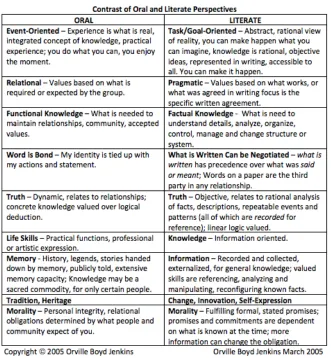
observing, they follow these assumptions and be lead to improper conclusions. The
following comparison chart may help explain some of the differences between oral and
literate learners.
16 Grant Lovejoy, “The Extent of Orality: 2012 Update 1,” 2012, Accessed February 6, 2018, 17,
Table 1:
Contrast of Oral and Literate Perspectives17
Ministry leaders who become aware of, then adapt their teaching methodologies
to these factors will greatly increase their effectiveness when communicating with oral
learners. Dr. Lovejoy, who has researched the field of orality a great deal, offers this
valuable insight, “Ministries who adjust their approach to the literacy level of their group,
whatever that level may be, can expect improved communication, more learning, and
more life change among the hearers. Extensive research among Christian outreach in
Muslim communities found that incorporating an oral communication strategy into their
17 Dr. Orville Jenkins, “Stories and Storytelling: Reclaiming our Oral Heritage,” June 26, 2006,
11
work with oral cultures was associated with seeing 4.4 times more churches
established.”18
How May An Oral Learning Pastor Be Prepared Educationally?
Ironically, the greatest concentrations of oral learners live in the same areas
experiencing the greatest numerical growth for The Church. The Global Survey on
Theological Education, published in 2013, listed this as the first of their top findings,
“There are not enough theological schools in the regions of the world where Christianity
is growing rapidly (Africa, Latin America, and parts of Asia).”19 This creates a challenge
as well as an opportunity. Part of the challenge is found in adequate educational
opportunities for those who would lead the many churches which develop each year.
Regionally placed educational institutions are not able to produce enough pastors to
match the numeric growth. When asked the following question, “‘What are the most
important elements in a program of preparation and/or formation for Christian ministry?’
Experiential education was named consistently in the narrative responses as the basic
requirement in preparation for ministry.”20 The Global Survey went on to reveal, “Other
elements named frequently as ‘most important’ in preparation for ministry include
Biblical understanding, spirituality, discipleship and mentoring, and partnerships with
congregations.”21 While the top priority in these areas of rapid church growth are for
18 Grant Lovejoy, “The Extent of Orality: 2012 Update 1,” 2012, Accessed February 6, 2018, 17,
https://orality.imb.org/files/1/1255/Lovejoy--Extent%20of%20Orality%202012.pdf.
19 “Global Survey on Theological Education,” GlobeTheoLib online library - Globethics, June
2013, accessed February 3, 2018, http://www.globethics.net/web/gtl/research/global-survey.
practical, experiential learning, meetings those needs is not as easy to see as there are
inherent differences between literate based education and oral learning styles. “In light of
oralities approach of practical thinking against abstract patterns, consideration should be
given made to include practical content even to the theoretical divisions of theological
and biblical divisions, linking its content to practical aspects in the learner’s context.”22
A growing response from literates who listen to oral learners and pay attention to
content, contextualization and differing worldviews is to adapt their teaching into oral
friendly models. This is emphasized by Willis and Snowden, “...the obvious conclusion
that the majority of the world population prefers to learn by oral means over print or any
other literate forms of learning.”23 What has been long known and practiced in orality in
many countries, including the African continent, has been challenged by the growth and
expansion of Western style education.
Over the centuries, the predominant mode of teaching and learning for the majority of African people has been through Orality. Thus, Africa has poetry, storytelling, art (music and dance), and apprenticeship or mentoring as key avenues for educating the next generations of adults. But the dawn of Western oriented education over the last two centuries has gradually replaced most of the oral, informal African educational approach.
This is true for both secular and theological programs.24
This was echoed by the leader of one denomination who stated after seeing the impact of
orality upon a group of his leaders, “We are Africans. We are oral people. This is who we
22 Charles Madinger, ed., “Oralities & Literacies – Communicating Christ Among Oral Cultures,”
International Orality Network, 2012, accessed February 3, 2018, 44, https://orality.net/content/oralities-literacies-chapter-9-communicating-christ-among-oral-cultures/.
23 Avery T. Willis and Mark Snowden, Truth that Sticks: How to Communicate Velcro Truth in a
Teflon World (Colorado Springs, CO: NavPress, 2010), 27-28.
24 Charles Madinger, ed., “Oralities & Literacies – Communicating Christ Among Oral Cultures,”
13
are. We lost it as we felt forced to pursue western models of education in order to keep
up. However, we need to return to our roots.”25 He recognized the effect a reemergence
of orality had upon his leaders and since then has taken strides to reintroduce oral
methods of teaching and instruction into their educational models. After having gone
through orality training, one elderly man expressed his gratitude when he said, “Thank
you for giving us back our dignity.”26
We have shared how literate communicators may better understand oral
communicators. Each functions in different modes of communication, social interaction
and thinking. As these factors are continually examined, understood and applied,
improvements to communication will continue to develop. We need to examine one more
phenomenon which has developed first among more literate communicators, then seek to
understand its potential impact.
25 Interview with the author, Johannesburg, South Africa, September 2015.
26 As told from denominational leader in conversation after an event in Nairobi, Kenya, March
14
THOSE WHO ARE ORAL LEARNERS BY PREFERENCE
“Tell me a story long and true We aren't what we say we are what we do”27
Generational Shifts in the Western World
Decline in Literacy
In the West, the more recent generations have experienced rapid changes. We
have at least a generation or two who have been raised in constant contact with media
through television, gaming, and 24/7 connectivity to the web. The youngest generation in
the West has never known a time without these technological marvels. What impact does
this have upon literacy in the West? The statistics suggest that there is a significant
negative impact and that it is growing. “The rate of decline in literary reading is
accelerating.”28 “(From 1982 to 2002), young adults (18-34) have declined from being
those most likely to read literature to those least likely.”29
Is it possible to determine the reasons for this dramatic drop in literacy in a
country which ranks high in education? While the survey suggested that it may not be
possible to directly pin the decline in literacy to the increase in electronic media, the
timing of the two occurrences cannot be overlooked. “The decline in reading correlates
27 Phillip Phillips and David Harris, Tell Me a Story, The World from The Side of the Moon, Sony
Phillip /ATV Music Publishing LLC, Universal Music Publishing Group.
28 Dana Gioia, Chairman, “Reading at Risk: A Survey of Literary Reading in America,” June
2004, accessed February 2, 2018, 5, https://www.arts.gov/sites/default/files/ReadingAtRisk.pdf.
15
with increased participation in a variety of electronic media, including the Internet, video
games, and portable digital devices.”30
Another confirming view of the decreasing trend for reading in the U.S. can be
found in a 2012 report from the U.S Department of Education. The Program for the
International Assessment of Adult Competencies uses the International Adult Literacy
Survey and the Adult Literacy and Lifeskills Survey to examine key statistics in the U.S.
and twenty-two other countries.31 All of the participating countries are highly developed,
educationally advanced and economically stable nations. These surveys look at literacy,
numeracy and problem solving in technology-rich environments. In each of the areas
measured, the U.S. ranked lower than the majority of other countries, with the lowest
comparative ranking being in numeracy.
However, all is not lost. While the U.S. is dropping in literature caused, in part, at
least, by the increase in personal technology devices, those devices are creating a new
skillset for many Americans. It’s not just Americans either, as countries around the world
have embraced the trends towards personal devices and global connectivity. This trend
offers hope towards new opportunities.
Indian television producer, Pritish Nandi, published an article titled “Will
Technology Usher in an Era of Illiteracy?” He hints at a direction for our future, “New
technology will no longer divide the world into literate and illiterate people but will bring
everyone together in a common platform where the ability to read and write will no
longer matter. You will have a new world where people will need an entirely different
30 Ibid., 7.
31 “Literacy, Numeracy, and Problem Solving in Technology...” National Center for Education
kind of skills set to succeed.”32 How will this develop into a common platform where
literates and oral learners can communicate more freely, perhaps even equally? We will
explore more of this idea and its possibilities throughout this paper. Specifically, we will
examine the role of visual aids as teaching tools, aids in crafting communication and as
memory markers which are able to be created and understood by users on both sides of
the equation. It is quite likely that further answers will come from those whose entire
lives have been immersed in the technological advantages we are seeing today. They will
become the creators of mechanisms and solutions which we have not yet thought to
consider. In the meantime, we can continue to lay a foundation for the vision of teaching
oral learners without requiring literacy.
Increase in Global Compassion and Action
Along a different track towards helping to make improvements in our world, the
UN Sustainable Development Summit adopted seventeen holistic goals aimed at
improving our world across nearly all aspects of human life, including care of the planet
on which we live. While they cover all people in developing areas, these goals definitely
overlap many societies which are filled with oral learners. The goals are shown in the
infographic below.
32 David Claydon, ed., A New Vision, a New Heart, a Renewed Call, Lausanne Occasional Papers
17
Figure 333
Many organizations are involved in working towards meeting these goals. One
which has invested considerable thought into how these sustainable development goals
may be addressed is Globethics.net. Their stated purpose is:
Globethics.net is a global network on ethics with 144,000 registered participants (August 2015) from over 200 countries and territories... with a wealth of
resources and news of programmes on responsible leadership and other topics carried out with a broad base of partners around the world, including nine regional programme partners and over 40 national contacts. Our aim is to contribute to a more just, sustainable and peaceful world through ethical orientation. This means promoting values-driven decisions and actions, especially those of current and future leaders as decision-makers.34
33 Stéphanie Thomson, ed., “What are the Sustainable Development Goals?” World Economic
Forum, September 16, 2015, accessed February 3, 2018. https://www.weforum.org/agenda/2015/09/what-are-the-sustainable-development-goals/.
34 “Ethics and the Sustainable Development Goals SDGs 2015-2030,” August 21, 2015, accessed
February 3, 2018, 1,
They created a very thorough report based on studying and evaluating all seventeen of the
goals, indicating on a four part scale in which they noted their own potential involvement
in contributing towards progress on each of the goals. The aims of this endeavor are far
beyond the scope of this paper. However, one touch point is found in education. The
stated education goal is “Ensure inclusive and equitable quality education and promote
lifelong learning opportunities for all” and one subset goal is stated as: “...by 2030 ensure
that all youth and at least x% of adults, both men and women, achieve literacy and
numeracy.”35 In their appeal for help, Globethic.net acknowledges an interesting situation
in that they feel there is an overabundance of information in this particular area coming
from the West; “—too much information is coming from westerns sources, little attention
is given to scholars in the south.”36
They make an appeal for those in the Global South to make contributions;
however, it is limited to PhD candidates.37 This aspect of their appeal reveals a potential
oversight both in not offering education in ways appropriate for oral learners nor offering
input from those in the Global South who are adept at communicating through all manner
of oral means and may have valuable field-based input for some of the Sustainable
Development Goals. Could this create an opportunity for those in the West who are
familiar with such oral communications, to become a bridge, linking the highly literate
researchers with the highly oral field personnel? This is one of the purposes we will
19
continue to explore, the potential for linking literate and oral communicators in
meaningful ways.
We are examining two factors here which collide nicely. The shift away from
literature into digital devices and the growing awareness of our roles as global citizens.
There are perhaps an untold number of organizations dedicated to helping others both
locally and globally. We cannot examine the entire scope of humanitarian work, but for
our purposes, we can highlight one as an example of how citizens of their home countries
are willing to help those in need, wherever they may be found. The title of Renée Fox’
book may tell the story on its own, Doctors Without Borders: Humanitarian Quests,
Impossible Dreams of Médecins Sans Frontières. Fox looked at needs and limitations and
decided to do something about both. The effort she began has grown to become quite a
legacy and testament to humanitarianism.
When needed and called into action, most of the volunteers serving with Doctors
Without Borders come from within their own country, but there are also critical staff who
come from other international locations because of a common desire to “...realize ‘a new
world order’ of medical care that embodied humanitarian intervention and the duty to
interfere, bearing witness to human rights violations even as they treated their victims.”38
This ‘duty to interfere’ leads these volunteers to “run scores of unique missions in
high-risk situations, with ‘persistent national borders.’”39 They are not alone as many people
believe in their mission and share in other ways. “Over half a million people contribute
$10 or $20 to MSF each month, while others contribute larger sums each year, because
38 Donald W. Light, Doctors Without Borders (New York: Springer Science+Business Media,
2015), 384.
MSF has come stand for a deeper humanism that stirs people’s souls, a vision of a better
life and a better world.”40 Similar humanitarian efforts exist in practically every area of
need. Certainly the opportunity exists to combine efforts to reach oral learners in a
variety of ways.
Increase in Digital Dominance and Social Media
To further understand this shift from local to global concern, let’s consider two
queries asked by Leif Wenar of the University of Sheffield. The first is, “What morality
requires of us in a world of poverty and inequality depends both on what our duties are in
the abstract, and on what we can do to help.”41 The second consideration is, “What we as
individuals need to know is how to fulfil our duties to the distant poor. We need to know
what we must actually do.”42 Khanna suggests why these considerations have taken on
new dimensions. “Connectivity has replaced division as the new paradigm of global
organization. Human society is undergoing a fundamental transformation by which
functional infrastructure tells us more about how the world works than political
borders.”43 Wenar’s questions continue to capture the attention of more people in our
digitally connected world. Evidence of the impact of the collision between these
questions and the reduction of static borders is seen not only in organizations like Doctors
40 Ibid.
41 Leif Wenar, “What We Owe to Distant Others,” Politics, Philosophy and Economics (Thousand
Oaks, CA: Sage Publications, 2003), 283.
42 Ibid., 284.
43 Parag Khanna, Connectography: Mapping the Future of Global Civilization (New York:
21
Without Borders but in others as well. Some of today’s millennials are missionaries
without ever leaving their favorite coffee hangout.
Larry Dossey suggests, “We yearn for unity with one another. The recent
explosion of interest in genealogy, the study of one's family origins, can be seen as a
hunger for oneness expressed through the attempt to restore historic connections.”44
Dossey suggests other expressions of this hunger for oneness,
Consider the popularity of ‘flash mobs,’ which did not exist until recently, in which groups of people appear to emerge spontaneously to perform, sing, and dance in unison, evoking happiness and delight in the crowds around them. Flash mobs are a kind of celebration of unity and connectedness between people of all strata and cultures. The emergence of the crowd-funding phenomenon reflects the same instinct—the coming together of a great many people to finance a
worthwhile project.45
Even amid the strife seen in our world, people are still drawn to people in beneficial ways
such as these. Flash mobs and digitally driven crowd-funding are examples of high
technology combining with high touch, the human element. How do each of these factors
we’ve examined come together? Given the creativity of mankind, there are certainly a
myriad of ways that have been, are being and will be expressed. For the sake of this
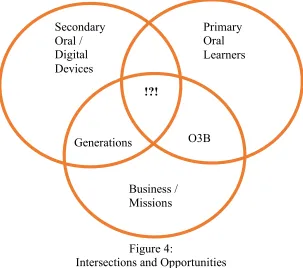
paper, the illustration below may help to visually depict the merging of our three major
areas of focus.
44 Larry Dossey, “Our Identity Crisis and a Solution: The One Mind,” EXPLORE: The Journal of
Science and Healing 12, no. 6 (November/December 2016): 395, accessed February 4, 2018, doi:10.1016/j.explore.2016.08.008.
One unique aspect about these social phenomena is that they can be initiated by
anyone, anywhere. Today’s digitally connected generations have used these factors to
widen their gaze and bring many segments of our world closer together. Could these
empathetic factors also be utilized in developing better communications between literate
and oral learners? What might their efforts look like? What factors beyond those we have
already discussed might impact their efforts to understand each other, then improve their
methods of communication? Time will tell.
Awareness and Growth of Orality Based Solutions
Innovations are often formed at ground zero, in the field, closest to where the
need exists. Such was the case for the modern day orality movement as well. We do not
have the space available here to track and report on the growth of this movement but we
will take a look at observations made by those who have studied the process. Dr. Tom Secondary
Oral / Digital Devices
Primary Oral Learners
Business / Missions
O3B Generations
!?!
Figure 4:
23
Steffen has participated as a missionary in the Philippines, studied extensively and taught
on missiology and orality as a professor of Intercultural Studies in the Cook School of
Intercultural Studies at Biola University. One of the many contributions he has made into
this field is a paper, “Chronological Communication of the Gospel Goes from Country to
City.”46
The South East Asia Leadership conference held in Thailand in 1981 became the seminal moment when McIlwain’s chronological model would spread beyond the shores of the Philippine Islands to around the world within New Tribes Missions. Leaders returned to their respective fields of ministries and began to implement the chronological model designed for multiplying tribal churches that remain true to the Bible. Eventually, McIlwain would entitle his model Chronological Bible Teaching (CBT). While no one anticipated or expected it, a modern-day
movement was just born. This did not go unnoticed by David Hesselgrave, who in Scripture and Strategy (1994) identified CBT as one of major contributions to missions in the twentieth century.47
Steffen tracks more than seventy organizations aimed at reaching oral learners. Looking
further into just one of those, the International Orality Network (ION), gives us another
perspective on how far this field is expanding. ION began in 2004 after the specific need
for making disciples of oral learners was identified at the Laussanne Congress on World
Evangelism. ION describes themselves as “...an affiliation of agencies and organizations
working together with the common goal of making God’s Word available to oral learners
in culturally appropriate ways that enable church planting movements everywhere. ION
has since grown to be a global network of over 2,000 organizations.”48
46 Tom Steffen, Chronological Communication of the Gospel Goes from Country to City, March
18, 2011, accessed January 27, 2018, http://www.chiang-mai-orality.net/resources/Chronological.pdf.
47 Ibid.
From missionaries seeking a way to better communicate the truths of the Gospel
to tribal people without knowledge of the Bible, to thousands of organizations comprising
tens of thousands of people, the awareness of oral learning methods has indeed become a
movement. It has moved beyond the simple telling of Bible stories to “include
genealogies, song, art, symbols, drama, pictures, audiovisual, audio players, radio, film,
television, webisodes.”49 As seen in this list, orality is not limited to non-readers on far
flung locations on our globe. Orality is a form of communication which finds expression
in many ways. An increasing number of people are identifying themselves as oral
communicators by preference. Once again, Steffen helps us to see that “... reaching oral
learners finds the geographical lines between country and city quickly blurred. Primary
orality soon morphs into secondary orality, and vice versa, across the world and across
time.”50
There are, in fact, many models of orality now being employed. Chronological
Bible Storying, (CBS) as it is now called, is just one of those ways. As we consider the
amount of content the listeners would absorb in this model of teaching, the question
comes to mind, wondering how those who cannot write could possibly retain all of this
information.
Steffen offers an explanation, “The orality movement has moved beyond telling
stories with strong exposition to include focused questions, dialogue/conversation,
retelling the story, drawing pictures, composing songs, dramatizing. The power of the
49 Tom Steffen, Chronological Communication of the Gospel Goes from Country to City, March
10, 2011, Accessed January 27, 2018, 22, http://www.chiang-mai-orality.net/resources/Chronological.pdf.
25
visual to portray is now much more appreciated.”51 Each of these elements serves a role
in helping to cement the narrative teaching content into the memories of oral learners.
Intentional dialogue focused on discovering truths and personal insights from the stories
is a tremendously valuable tool in creating memorable moments from the stories. This
process is essentially the same as many people have experienced when participating in
written inductive Bible study, except this is all done orally. One truth which applies to
both styles of inductive study is that personal discoveries are the insights most strongly
remembered. Open dialogue produces many such discoveries.
Retelling of stories and dramatizing are additional means of repeating, revisiting
and reimagining the stories. These simple techniques are valuable means for oral learners
as they are methods of repetition. Immediate retelling of stories after having listened to
the original is both a test and a confirmation that the story has been heard. When this is
done together in pairs or small groups, the public telling and correcting not only locks the
details of the story into individual memories but into the collective community as well.
Dramatizing stories enhances this aspect even further while it may also add elements of
fun in addition to the visual representation and exploration of the story.
Lastly, drawing pictures or reflecting on how available pictures may express the
story and the creation of local songs are very strong mnemonics. Pictures may stay in the
mind for years and well-crafted songs may become permanent. Studies even among
Alzheimer’s patients have shown significant impact using music as therapy. “In music
therapy, an increase in attention span was observed, and an improvement in expressive
language and in short and long-term memory, as evidenced by the ability to learn and
recall the names of the others members of the group as well as past life experiences.”52
Throughout this paper we will explore different aspects of oral communications to
understand how these various factors may contribute to new models of teaching as well
as greater appreciation of the uniqueness’s of the learning styles of those different from
us. The wisdom from both sides of the spectrum, literates and oral learners, suggests that
for obtaining, retaining and reproducing such content, visual imagery is a key.
Understanding Oral Learners
“...Jesus taught his disciples to pray in the Aramaic of daily communication rather than in the classical Hebrew of written texts.”53
Willis Ott discusses oral learners in Chapter Ten of Oralities and Literacies. He
points out an opportunity, “God has given our privileged generation many gifts that no
other generation has known the combination that we have including, but not limited to: a)
a widening expertise for exegeting the Scriptures, b) a widening permission for
translators that they may communicate the Scriptures meaningfully, c) a widening access
and use of hand-held audio devices all over the world, d) an availability of economically
feasible equipment for recording and editing audio files, e) a widening knowledge of how
52 Melissa Brotons and Patricia Marti, “Music Therapy with Alzheimer's Patients and Their Family
Caregivers: A Pilot Project,” Journal of Music Therapy 40, no. 2(Summer 2003): 145.
53 Kenneth E. Bailey, Jesus through Middle Eastern Eyes: Cultural Studies in the Gospels
27
humans communicate and how individuals convince others of new ideas.”54 In short, Ott
has outlined that we have a unique opportunity based on increased ability to handle the
Scriptures in a variety of ways, increased technology to deliver scriptural messages and
increased awareness of how people think and learn.
In demonstrating connections between some of these opportunities, Ott makes the
statement, “It is important that communicators recognize that everyone in the world
learns by means of what they hear. Not only that, but also most prefer to learn by
listening. Most people are also visual learners.”55 We have discussed the fact that the
majority of people worldwide are primary oral learners and that the next largest group
after that are oral learners by preference, or secondary oral learners. The majority of these
people are also visual learners, which is readily observable in the number of users of
visually driven digital technology devices. Ott offers the following illustration to visually
depict these categories.
54 Charles Madinger, ed., “Oralities & Literacies – Communicating Christ Among Oral Cultures,”
International Orality Network, 2012, accessed February 6, 2018, 60, https://orality.net/content/oralities-literacies-chapter-9-communicating-christ-among-oral-cultures/.
Figure 5:
All People are Oral Learners56
In the overlap of primary and secondary oral learners, there is an opportunity to
increase communication between them through intentionally embracing their oral and
visual preferences. What is needed in order to create methods and tools which will help
primary oral learners is to pay attention to some of the guidelines discovered as best
practices by those actively studying this field.
Kenneth Bailey’s offers some insights based upon different levels of oral
exactness. We will look at his suggestions and then seek to apply these to the use of
visual teaching tools. Formal for retelling of Scripture stories, informal controlled oral
tradition for retelling accounts of theology as guided by the pictures. Bailey is an expert
in Middle Eastern culture, so his examples are from within those cultures.
Bailey identifies three forms of oral tradition. The first, informal uncontrolled oral tradition, has no identifiable teacher, no identifiable student, and no structure in which material is transmitted. It is represented by Middle Eastern rumor
transmission. The second, formal controlled oral tradition, has a clearly identified teacher, a clearly identified student, and a clearly identified block of material which is memorized and passed on. It is represented by the memorization of the
56 Charles, Madinger, ed., “Oralities & Literacies – Communicating Christ Among Oral Cultures,”
29
Qur’an by Muslim sheiks or the memorization of extensive liturgies in Eastern Orthodoxy.57
In the examples of humanitarian work which we have discussed so far, Bailey’s first form
of oral tradition could be used sufficiently. While the information to be shared is
important, the order of how that information is shared is not always as vital. An example
could be found in explaining to non-literate villagers about the reasons to boil water to
control spread of disease. While there are steps that should be done in order, a fair
amount of the information may be shared casually, in natural conversation, rather than
listed out in a literate, linear manner. When approaching Scripture from the sense of
theological learning, some would advocate for Bailey’s second form, the formal
controlled oral tradition. Those who do so suggest that the very nature of the Scriptures
demand that they be shared in exactitude matching their choice of Bible translation.
However, as Ott has stated, we live in an era of ‘widening permission for translators’ to
create forms of the Scriptures which are appropriately crafted for the listening audience.
Bailey has one more for us to examine:
Between these two forms of transmission is what Bailey calls informal controlled oral tradition. It is informal in its setting—often the gathering of villagers in the evening for the telling of stories and the recitation of poetry—and there is no set teacher or specifically identified student. The transmission of the material,
however, is controlled by the community using three levels of flexibility. There is no flexibility in the recitation of poems or proverbs, and there is total flexibility in the telling of jokes and casual news. Between these two poles is a level of
flexibility which allows for some individual interpretation of the tradition. Into this latter category fall parables, stories, and historical narratives important to the life of the community. The teller is permitted a degree of flexibility to reflect his/her own style and interests, but the main lines of the story cannot be changed. Bailey concludes by noting that the Synoptic Gospels include primarily the same literary forms preserved by this sort of oral tradition.58
57 K. E. Bailey, “Informal Controlled Oral Tradition and the Synoptic Gospels,” Asia Journal of
Theology 5 (1991): 36-37.
This third form, the informal controlled oral tradition is where most missions
organizations fall in terms of translating, crafting and developing biblical messages for
oral learners. There is a bit of divergence between these agencies on how much flexibility
can be used between the total non-flexible and the degree of permission. However, in the
field, many of these decisions are worked out based upon a combination of worldview
perspectives and an available language database. Two examples may suffice in offering
an explanation. In world areas which have never seen snow, to translate biblical
references to ‘snow’ exactly would not be possible, so alternatives from within the
cultural conditions which would accurately explain the concept intended in the passage.
The other factor for many languages is that the available word count in their language
draws from a relatively small pool. In these cases, the translators and message crafters’
task become a bit more complicated. In order to convey the message as intended, yet with
31 SECTION 3:
REENGAGING ANCIENT-NEW METHODOLOGIES
“Stories have many uses, often intertwining, from the use of educating values and serving as history books, to the preservation of culture and the soul.”59
Extrapolating Orality Based Solutions
Understanding What Worked and Why
If it is agreeable that visual images can be beneficial for communicating and even
training oral learners, the next question will be, “What types of visuals are acceptable?”
To answer this, we will look first at a couple of common assumptions about oral learners.
In examining these assumptions, we will learn something about the attitudes many
literates hold towards literates. We will also learn about the capabilities of
non-literate oral learners.
Assumption 1: They Only Understand Simple Line Drawings60
A common misconception is that because oral learners do not read that they must
also be of a lower intelligence quotient than their literate counterparts.61 This is simply
not true. Oral learners possess a different mental skill set. This does not make them
intellectually inferior. This is highlighted in the educational maxim: “Everybody is a
59 Shannon Smith, “Native Storytellers Connect the Past and the Future ...” accessed February 8,
2018, http://cojmc.unl.edu/nativedaughters/storytellers/native-storytellers-connect-the-past-and-the-future.
60 Diane Pamela Smith, “Visual Art and Orality,” Dharma Deepika (January 2007): 11. 61 Gerd Baumann, The Written Word: Literacy in Transition: Wolfson College Lectures 1985,
genius. But if you judge a fish by its ability to climb a tree, it will live its whole life
believing that it is stupid.”62 What is beneficial about this quip is to consider the
comparison being made between two supposedly equal participants. Yet, we cannot fail
to see the inadequacies of such a challenge.
As simplistic as this seems, this is comparable to how some literates view their
oral learning colleagues. It follows that when highly educated literates consider the use of
visuals in teaching oral learners, they may assume that the images can only be the
simplest line drawings.63
History has not always followed this assumption. During the Middle Ages, a
period of widespread low literacy, the Church would post pictures on the walls to “stir
devotion, reminding the faithful of the suffering of the Son of God, the cleansing power
of his blood, and the time they will spend being purged of sin.”64
62 Supposedly, Einstein said this, but no one, including the brilliant minds at Princeton, could
validate this statement. That the literates cannot verify this is of little concern.
63 Diane Pamela Smith, “Visual Art and Orality,” Dharma Deepika (January 2007): 11. 64
33
Figure 6:
A Book of Hours, prepared for French noblewoman Yolanda de LaLaing65
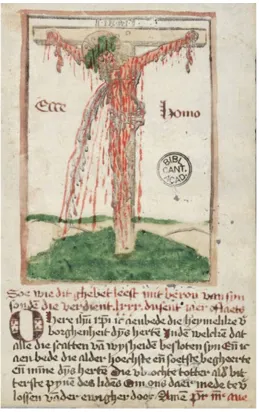
This image is a challenge to those who hold to the ‘simple line drawings’
limitation. The purpose of this image, as well as the woodcut which is shown below, was
to motivate the people to pray the Prayer of the Sacred Heart of Christ. Doing so was
worth a reduction of 80,000 years in Purgatory. This would have been highly
motivational to everyone, especially oral learners, to study, understand and apply the
message of this image to their own eternal destiny. The complexities of this image, which
cannot easily be understood without considerable explanation, do not align with this
theory, although the required prayer was fairly short.66
Figure 767
66 Prayer of the Sacred Heart of Christ: “O most holy heart of Jesus, fountain of every blessing, I
adore you, I love you, and with lively sorrow for my sins I offer you this poor heart of mine. Make me humble, patient, pure and wholly obedient to your will. Grant, Good Jesus, that I may live in you and for you. Protect me in the midst of danger. Comfort me in my afflictions. Give me health of body, assistance in my temporal needs, your blessing on all that I do, and the grace of a holy death. Amen.,” accessed
December 31, 2017, http://www.catholic.org/prayers/prayer.php?p=231.
67 Ecce Homo, Sacred Art, Pinterest, accessed December 31, 2017,
35
It is easy enough to challenge this assumption that oral learners cannot understand
complex images by simple tests. One way to test this is to observe images which they
create. Are they simple? Complex? Multilayered? Do their visuals carry messages? Can
we understand them? Another test is to share various images with them, then ask what
thoughts they have when viewing these images. These conversations may reveal that
there is room for a wider understanding of the visual literacy of oral learners.
Assumption 2: They Cannot Understand Dimensional Perspectives68
This theory says that non-literates are not capable of understanding complex
drawings, incomplete images or perspective in drawings.69 While this may seem
reasonable, it also has limitations. One way to explain this is by a comparison in the
world of literates. Not all who read, do so at the same level. Some are adept at divining
the deeper meanings of Shakespearean poetry, while others’ capacities are reached
viewing graphic novels.
The same is true for oral learners. Some are capable of simple Aboriginal
drawings, which primarily use line drawings and shapes. Others can ‘read’ “…painted
narratives (which have) become important sources of knowledge about local mythology,
deities, heroes, epics, folktales and customs.”70
68 Diane Pamela Smith, “Visual Art and Orality,” Dharma Deepika (January 2007): 11. 69 J. O. Terry, James Byron Slack, and Steve Evans, Chronological Bible Storying: An
Introduction to the Oral Communication of the Bible (Johannesburg: International Publications Services, 1996), 76.
70 Charu Smita Gupta, Indian Folk and Tribal Paintings (New Delhi, India: Lustre/Roli Books,
It is clearly not a simple issue to understand, as evidenced in the comments about
the painting of Christ on Lake Geneva by Konrad Witz.71
Figure 8:
Christ on Lake Geneva by Konrad Witz
71 Peter Marshall, The Oxford Illustrated History of the Reformation (Oxford, UK: Oxford