R E S E A R C H
Open Access
New inclusion sets for singular values
Jun He
*, Yan-Min Liu, Jun-Kang Tian and Ze-Rong Ren
*Correspondence: [email protected] School of Mathematics, Zunyi Normal College, Zunyi, Guizhou 563006, P.R. China
Abstract
In this paper, for a given matrixA= (aij)∈Cn×n, in terms ofriandci, where
ri= n
j=1,j=i|aij|,ci= n
j=1,j=i|aji|, some new inclusion sets for singular values of the
matrix are established. It is proved that the new inclusion sets are tighter than the Geršgorin-type sets (Qi in Linear Algebra Appl. 56:105-119, 1984) and the Brauer-type sets (Li in Comput. Math. Appl. 37:9-15, 1999). A numerical experiment shows the efficiency of our new results.
MSC: 15A18; 15A57; 65F15
Keywords: singular value; matrix; inclusion sets
1 Introduction
Singular values and the singular value decomposition play an important role in numerical analysis and many other applied fields [–]. First, we will use the following notations and definitions. LetN:={, , . . . ,n}, and assumen≥ throughout. For a given matrix
A= (aij)∈Cn×n, we defineai=|aii|,si=max{ri,ci}for anyi∈Nandu+=max{,u},uis a
real number, and where
ri:=
n
j=,j=i
|aij|, ci:=
n
j=,j=i |aji|.
In terms ofsi, the Geršgorin-type, Brauer-type and Ky Fan-type inclusion sets of the matrix singular values are given in [, , , ], we list the results as follows.
Theorem If a matrix A= (aij)∈Cn×n,then
(i) (Geršgorin-type,see[])all singular values ofAare contained in
C(A) :=
n
i=
Ci withCi=(ai–si)+, (ai+si)
∈R; ()
(ii) (Brauer-type,see[])all singular values ofAare contained in
D(A) :=
n
i= n
j=,j=i
z≥ :|z–ai||z–aj| ≤sisj
; ()
(iii) (Ky Fan-type,see[])letB= (bij)∈Rn×nbe a nonnegative matrix satisfying bij≥max{|aij|,|aji|}for anyi=j,then all singular values ofAare contained in
E(A) :=
n
i=
z≥ :|z–ai| ≤ρ(B) –bii
.
We observe that all the results in Theorem are based on the values ofsi=max{ri,ci},
ifrici orrici, all these singular value localization sets in Theorem become very crude. In this paper, we give some new singular value localization sets which are based on the values ofriandci. The remainder of the paper is organized as follows. In Section , we
give our main results. In Section , a numerical experiment is given to show the efficiency of our new results.
2 New inclusion sets for singular values
Based on the idea of Li in [], we give our main results as follows.
Theorem If a matrix A= (aij)∈Cn×n,then all singular values of A are contained in
(A) :=(A)∪(A),
where
(A) := n
i=
σ≥ : σ–|aii| ≤ |aii|ri(A) +σci(A)
and
(A) := n
i=
σ≥ : σ–|aii| ≤ |aii|ci(A) +σri(A).
Proof Letσ be an arbitrary singular value ofA. Then there exist two nonzero vectors
x= (x,x, . . . ,xn)Tandy= (y,y, . . . ,yn)Tsuch that
σx=A∗y and σy=Ax. ()
Denote
|xp|=max|xi|, ≤i≤n, |yq|=max|yi|, ≤i≤n.
Now, we assume that|xp| ≤ |yq|, theqth equations in () imply
σxq–aqqyq= n
j=,j=q
ajqyj, ()
σyq–aqqxq=
n
j=,j=q
Solving foryqwe can get
σ–aqqaqqyq=aqq n
j=,j=q
ajqyj+σ
n
j=,j=q
aqjxj. ()
Taking the absolute value on both sides of the equation and using the triangle inequality yield
σ–|aqq| |yq| ≤ |aqq| n
j=,j=q
|ajq||yj|+σ
n
j=,j=q
|aqj||xj|. ()
Then we can get
σ–|aqq| ≤ |aqq|cq(A) +σrq(A).
Similarly, if|yq| ≤ |xp|, we can get
σ–|app| ≤ |app|rp(A) +σcp(A).
Thus, we complete the proof.
Remark Since
|aii|ri(A) +σci(A)≤|aii|+σsi
and
|aii|ci(A) +σri(A)≤|aii|+σsi,
the results in Theorem are always better than the results in Theorem (i).
Theorem If a matrix A= (aij)∈Cn×n,then all singular values of A are contained in
(A) :=(A)∪(A)∪(A), where
(A) :=
i=j
σ≥ :
σ–|aii| σ–|ajj| ≤|aii|ri(A) +σci(A)|ajj|rj(A) +σcj(A),
(A) :=
i=j
σ≥ :
σ–|aii| σ–|ajj| ≤|aii|ci(A) +σri(A)|ajj|cj(A) +σrj(A),
(A) :=
i=j
σ≥ :
and
(A) :=
i=j
σ≥ :
σ–|aii| σ–|ajj| ≤|aii|ri(A) +σci(A)
|ajj|cj(A) +σrj(A)
.
Proof Letσ be an arbitrary singular value ofA. Then there exist two nonzero vectors
x= (x,x, . . . ,xn)Tandy= (y,y, . . . ,yn)Tsuch that
σx=A∗y and σy=Ax. ()
Denoteωi=max{|xi|,|yi|}. Letqbe an index such thatωq=max{|ωi|,i∈N}. Obviously,
ωq= . Letpbe an index such thatωp=max{|ωi|,i∈N,i=q}.
Case I: We supposeωq=|xq|,ωp=|xp|, similar to the proof of Theorem , theqth
equa-tions in () imply
σ–|aqq| ωq≤ |aqq| n
j=,j=q
|aqj||yj|+σ
n
j=,j=q |ajq||xj|
≤
|aqq| n
j=,j=q |aqj|+σ
n
j=,j=q |ajq|
ωp. ()
Similarly, thepth equations in () imply
σ–|app| ωp≤
|app| n
j=,j=p |apj|+σ
n
j=,j=p |ajp|
ωq. ()
Multiplying inequalities () with (), we have
σ–|app| σ–|aqq| ≤|app|rp(A) +σcp(A)|aqq|rq(A) +σcq(A).
Case II: We supposeωq=|yq|,ωp=|yp|, similar to the proof of Theorem , theqth
equa-tions in () imply
σ–|aqq| ωq≤ |aqq| n
j=,j=q
|ajq||yj|+σ
n
j=,j=q |aqj||xj| ≤ |aqq| n
j=,j=q |ajq|+σ
n
j=,j=q |aqj|
ωp. ()
Similarly, thepth equations in () imply
σ–|app| ωp≤
|app| n
j=,j=p |ajp|+σ
n
j=,j=p |apj|
ωq. ()
Multiplying inequalities () with (), we have
Case III: We supposeωq=|yq|, ωp=|xp|, similar to the proof of Theorem , theqth
equations in () imply
σ–|aqq| ωq≤ |aqq| n
j=,j=q
|ajq||yj|+σ
n
j=,j=q |aqj||xj|
≤
|aqq| n
j=,j=q |ajq|+σ
n
j=,j=q |aqj|
ωp. ()
Similarly, thepth equations in () imply
σ–|app| ωp≤
|app| n
j=,j=p |apj|+σ
n
j=,j=p |ajp|
ωq. ()
Multiplying inequalities () with (), we have
σ–|app| σ–|aqq| ≤|app|rp(A) +σcp(A)|aqq|cq(A) +σrq(A).
Case IV: We supposeωq=|xq|,ωp=|yp|, similar to the proof of Cases I, II, III, we can
get
σ–|app| σ–|aqq| ≤|app|cp(A) +σrp(A)|aqq|cq(A) +σrq(A).
Thus, we complete the proof.
Remark Since
|aii|ri(A) +σci(A)
|ajj|rj(A) +σcj(A)
≤|aii|+σ|ajj|+σsisj,
|aii|ci(A) +σri(A)|ajj|cj(A) +σrj(A)≤|aii|+σ|ajj|+σsisj,
|aii|ri(A) +σci(A)|ajj|cj(A) +σrj(A)≤|aii|+σ|ajj|+σsisj
and
|aii|ri(A) +σci(A)
|ajj|cj(A) +σrj(A)
≤|aii|+σ|ajj|+σsisj,
the results in Theorem are always better than the results in Theorem (ii). We now establish comparison results between(A) and(A).
Theorem If a matrix A= (aij)∈Cn×n,then
σ(A)∈(A)⊆(A).
If (|aii|ri(A) +zci(A))(|ajj|cj(A) +zrj(A)) = , then
z–|aii| =
or
z–|ajj| = .
Therefore,z∈(A)∪(A). Moreover, if (|aii|ri(A) +zci(A))(|ajj|cj(A) +zrj(A)) > , then
from inequality (), we have
|z–|aii|| |aii|ri(A) +zci(A)
|z–|a jj||
|ajj|cj(A) +zrj(A)≤. ()
Hence, from inequality (), we have that
|z–|a ii|| |aii|ri(A) +zci(A)
≤
or
|z–|a jj|| |ajj|cj(A) +zrj(A)
≤.
That is,z∈(A) orz∈(A), i.e.,z∈(A).
Similarly, ifzis any point of(A) or(A), we can get
σ(A)∈(A)⊆(A)
and
σ(A)∈(A)⊆(A).
Thus, we complete the proof.
3 Numerical example
Example Let
A=
. .
.
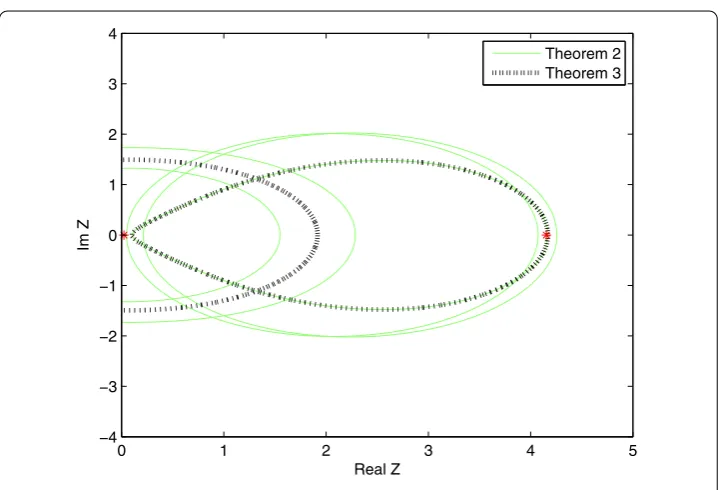
The singular values ofAareσ= . andσ= .. From Figure , it is easy to see
Figure 1 Comparisons of Theorem 1(i), Theorem 1(ii) and Theorem 2 for Example 1.
Figure 2 Comparisons of Theorem 2 and Theorem 3 (3) for Example 1.
4 Conclusion
[image:7.595.118.479.372.617.2]Competing interests
The authors declare that they have no competing interests.
Authors’ contributions
All authors contributed equally to this work. All authors read and approved the final manuscript.
Acknowledgements
He is supported by the Science and Technology Foundation of Guizhou province (Qian ke he Ji Chu [2016]1161); Guizhou Province Natural Science Foundation in China (Qian Jiao He KY [2016]255); the Doctoral Scientific Research Foundation of Zunyi Normal College (BS[2015]09). Liu is supported by the National Natural Science Foundation of China (71461027); Science and Technology Talent Training Object of Guizhou Province Outstanding Youth (Qian ke he ren zi [2015]06); Guizhou Province Natural Science Foundation in China (Qian Jiao He KY [2014]295); 2013, 2014 and 2015 Zunyi 15851 Talents Elite Project Funding; Zhunyi Innovative Talent Team (Zunyi KH(2015)38). Tian is supported by Guizhou Province Natural Science Foundation in China (Qian Jiao He KY [2015]451); the Science and Technology Foundation of Guizhou province (Qian ke he J zi [2015]2147). Ren is supported by the Science and Technology Foundation of Guizhou province (Qian ke he LH zi [2015]7006).
Publisher’s Note
Springer Nature remains neutral with regard to jurisdictional claims in published maps and institutional affiliations.
Received: 31 January 2017 Accepted: 14 March 2017
References
1. Qi, L: Some simple estimates of singular values of a matrix. Linear Algebra Appl.56, 105-119 (1984) 2. Li, LL: Estimation for matrix singular values. Comput. Math. Appl.37, 9-15 (1999)
3. Brualdi, RA: Matrices, eigenvalues, and directed graphs. Linear Multilinear Algebra11, 143-165 (1982)
4. Golub, G, Kahan, W: Calculating the singular values and pseudo-inverse of a matrix. SIAM J. Numer. Anal.2, 205-224 (1965)
5. Horn, RA, Johnson, CR: Matrix Analysis. Cambridge University Press, Cambridge (1985) 6. Horn, RA, Johnson, CR: Topics in Matrix Analysis. Cambridge University Press, Cambridge (1991)