E
C Volum
e 4
, Issue 1
, 2015
DANTE, “THE GRANDEST FIGURE OF WORLD LITERATURE”
Mihaela Irimia1
Abstract: In 1921 the Romanian review Transilvania published a celebratory issue
as a homage to Dante, marking the sexcentenary of the great Florentine’s death. It came out three years after the Great Union of the Romanian Principalities in 1918, the year in which the Romanian canonical poet George Coşbuc died. The issue carried texts on the ethnogenesis of the Romanians and focused on the Latinity of their language and culture. It also expressed thanks to the Sfetea brothers for permission to print Coşbuc’s version of Inferno I. The integral translation of The Divine Comedy by the same author came out in the mid-1920 through the early 1930, though the three canticles had been his main literary concern since the 1890s. Regarded by the Transylvanian Romanian intellectuals as “the grandest figure of world literature”, Dante became Coşbuc’s most outstanding project and his copious commentary to the Divine Comedy in Italian features as a choice philological
study in Romanian literature.
Key words: celebratory, homage, ethnogenesis, union, Romanian translation,
Latinity
Founded in 1868 in Braşov/Kronstadt, the Romanian-speaking review
Transilvania was enthused with patriotic ardour and asserted itself as a tribune of
Romanian intellectuals in the principality of the same name. In the bicephalous empire established by the 1867 Austro-Hungarian Compromise, "Transilvania"cultivated revolutionary ideals upheld by the political and cultural elite of ’48 who had found their Romanian
national identity confirmed by the 1859 Union of Wallachia and Moldavia. Formally proclaimed the United Principalities in 1862, these were Transylvania’s counterparts beyond the Carpathian forests (trans silva) in the process of nationstate building. In 1866 a modern Constitution came into being, promulgated by Prince Carol I, crowned King of Romania in 1881. In 1877 the review had moved its headquarters to Sibiu/Hermannstadt, sensitive to the effervescent national spirit at the time of Romanian independece from the Ottoman Empire. The whole latter half of the nineteenth century witnessed groundbreaking developments in the three historical principalities and "Transilvania" acted as a faithful mirror to
1 University of Bucharest.
E
C Volum
e 4
, Issue 1
, 201
5
Romanian modernity
In the making. An momentous event took place in Alba Iulia on December 1, 1918: the Great Union, or else, the birth of the fully-fledged nationstate. (Fig. 1)2 A special issue was dedicated to the occasion which brought together the energy, passion and sense of sacrifice of Romanians all over Greater Romania.
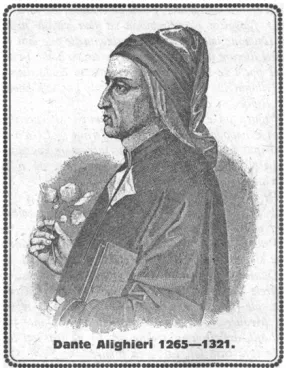
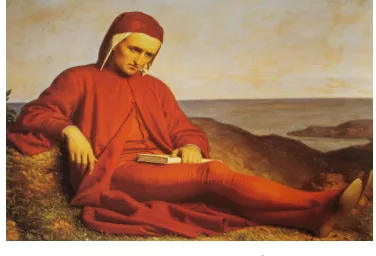
In celebration of the sexcentenary of Dante’s death, "Transilvania" published a special issue in September 1921 (Fig. 2)3. The tone of its eulogy sounded like a mix of Enlightenment and Romantic principles, with universal truths echoing as progress in historical becoming. It may not be immaterial to compare Heinrich Wilhelm Tischbein’s painting showing
Goethe in the Roman Campagna (1787) with Domenico Petarlini’s Dante in esilio
(the 1860s) – two European canonical writers perceived in historically challenging contexts. The nearly one hundred years extending between the two works could be called a hundred years of solitude. In the former (Fig.3), Neo-Classic poise reads
in the protagonist casting a confident look on the surrounding landscape strewn with things of beauty, joys forever, his contemporary age bridged across the centuries with the foundational times of mythical Europe. Here is, acclaimed in the poet’s present, the glory of world civilization securing his belonging to eternal high culture:
Europa maxima. Goethe, the
self-proclaimed exemplary Grand Tourist, reclines on his right elbow wrapped up in a Roman toga which skillfully reveals his white stockings and buckled shoes at one end and his shirt frill at the other: the present displayed in comfortable historic grandeur, Neo-Classicism in/as Classicism. His visual embrace of the distance confirms his poise: an outward look fed on physical ruins raised to the emblematic power of cultural firmness. In the latter (Fig. 4)4, a pensive Dante
2http://documente.bcucluj.ro/web/bibdigit/periodice/transilvania/1918/BCUCLUJ_FP_2799
96_1918_049_001_012.pdf
3 TRANSILVANIA BCUCLUJ_FP_279996_1921_052_009
4 Transilvania, Sept. 1921 issue at
http://www.google.ro/imgres?um=1&sa=N&biw=1280&bih=827&hl=ro&tbm=isch&tbnid Fig. 2. Dante
E
C Volum
e 4
, Issue 1
, 2015
reminding one analeptically of the melancholy Renaissance stance, the lunatic, the lover and the poet, all of imagination one compact, proleptically grows into the typical Romantic spirit. He dwells in solitude, lonely as a cloud: withdrawn, head hanging with a problematic tilt, his look laden with melancholy, finding no support in an art-free natural landscape. Gone is the classic clutter filling the spaces of our cultural
edifice and making us feel at home in our long-inhabited house of fame. Sitting on almost barren land, Dante rests his right elbow on a somewhat greener mound, his left hand clasping a closed book. His medieval costume is intensely red, sending the message of his paradigmatic sacrifice, his look inward-going, his despair impossible to ignore. This is the food of Romantic zest: Dante, the visionary bard, is here as insignia of national identity and unity bearing the message of Garibaldi’s Italy, validating it half a millennium after his own actual exile. His individual misery turned collective accomplishment, his Florentine despair turned Italian hope. His individual solitude reinforces communal belonging in a telling rereading
of Inferno I, 1-3:
Nel mezzo del cammin din nostra vita
Mi ritrovai per una selva oscura,
Che la diritta via era smarrita. (emphasis added)
Our national fate is to be deciphered through my [the poet’s] personal trajectory via a metonymic relationship with echoing effects – Auerbach’s conviction that Dante, the one religious poet of all religious poets, is the poet of the secular world: the modem European form of mimesis of historical occurrence through art (212).
The Dantean sexcentenary commemorated by "Transilvania" was couched in language speaking for itself: Dante is, perhaps, the grandest figure of world literature. Along the centuries he eternizes poetry and thought, supreme expressions of human value (698). At the back of any educated Romanian reader’s mind must have sounded the seventeenth-century adage We come from Rome recalling Wallachian and Moldavian chroniclers’ passion for ethnogenesis in the easternmost extreme of Latinity. They sounded nostalgic for original Roman
=VohQ8nMe_bOJ1M%3A&imgrefurl=http%3A%2F%2Fwww.ilgiornaledellarte.com%2F articoli%2F2011%2F3%2F106914.html&docid=Nz1lXgX61vGAaM&imgurl=http%3A%2 F%2Fwww.ilgiornaledellarte.com%2Fimmagini%2FIMG20110228114005864_900_700.jp
E
C Volum
e 4
, Issue 1
, 201
5
splendour brought back to life by uomini universali writing in the vernacular. Schooled in Polish seats of culture, these chroniclers were brought up on Latin-written texts which functioned as an opening to western culture. They could read Christian identity other than in Cyrillic script,5 the language of the Eastern Orthodox Church. They found it inscribed in letters that overtly showed the Latin substance of their mother tongue. This was only too necessary to underline in the
Transilvania editorial board’s conception: As a small Latin isle, here in the East,
we have thought it our duty to dedicate these few pages to the most illustrious representative of Latinity (698). To put it in a nutshell, Dante was an uncompromising guarantor of Romanian culture’s own origin and appurtenance among Europe’s and the world’s Latin cultures.
But, while he was regarded as the upholder of Latinity at national level, whether Italian or Romanian, Dante was brought to the fore as the grandest figure of world literature (698) and culture on premises of matchless omniscience. The reasoning behind was, once again, a sui generis mix of Enlightenment and Romantic ideals. From the essentialist perspective, he was deemed the eternal repository of world poetry and thought, but also valorized as the precursor of philosophical doctrines that were to give life to humanism (umanesimo). This whig view of history smacking of Romantic optimism with evolution, progress and success as signs of the unavoidable better future could not fit a better historical moment than that of modern nationhood and the accomplished modern nationstate. Here was the famous Florentine at the antipodes of his own troubled life, torn between political factions, falling foul of the local authorities, a lifelong exile in his own land. Instead, Transilvania, a review applauding Latin grandeur from within the onetime mountainous national borders, acclaimed him for having opened up the horizons of the widest Italian literary movement (Risorgimento) and consecrated the Italian language in an admirable poem which had braved time unadulterated. Alongside Homer’s poems and the Bible, Alighieri’s trilogy stood like an eternal rock. Such an embodiment of dignified identity could only make of Dante the symbol of century-old Italy’s glory, of Italy the light house of Latinity, and, again, of the lofty Florentine the sun to which everybody looked up in awe.
1921 marked three years since the Great Union of the Romanian Principalities. Within months of this crucial event in the lives of all Romanians, George Coşbuc (1866-1918), a seminal name in the history of Dantean translations into Romanian, died an untimely death. In three years’ time Coşbuc’s crafty and erudite translation of the Divine Comedy was to be printed and circulated in cultivated circles as a masterpiece itself. In 1921, again, the Moldavian-born historian Vasile Pârvan (1882-1927) wrote in his Idei şi forme istorice (Ideas and
5 Used by the Christian Orthodox Church, the Cyrillic alphabet was the official script in
E
C Volum
e 4
, Issue 1
, 2015
Historical Forms) about the Latin idea as the pivot of intellectual and moral
development of the Romanian spirit (32).
The whole nineteenth century paved the way to this. In the 1820s, Ion Eliade Rădulescu, a classic of the generation of ’48, authored the first Gramatica
românească (Romanian Grammar) (1828) and embarked upon establishing modern
periodicals in his mother tongue. Educated in Greek-speaking schools in Bucharest, Eliade underwent a personal sea change in terms of cultural identity which stands in a relation of metonymic correspondence with Romanian culture in the mid-1800s. He had been brought up on the locally produced Alixăndria (The Life of
Alexander) at the crossroads of Cyrillic script and Neo Greek taste for narratives, to
eventually aspire to put in place a bibliotheca universalis and make Romanian literature stand on an equal footing with the Greco-Roman tradition. He led an indefatigable campaign for the Romanian language and its Latinity and coined an artificial Italianite Romanian, to prove its exclusively Latin character! His contemporaries were little surprised to see him in public wrapped up in a Roman toga (like Goethe in the Campagna). Instrumental in phasing out the transition alphabet, Eliade operated the irreversible shift to all-Latin script in a fundamental text of world literature, Byron’s Don Juan, Cantos I and II, translated into Romanian from the French intermediary. His lifetime struggle for Latinity found recognition in his Principie de Orthographia Romana (Principles of Romanian
Orthography), printed in 1870, which confirmed him as the father of modern
literary Romanian. Like Petarlini’s Dante, Eliade favoured a Romantic cosmic embrace and an apposite Mesianic tone, as can be seen from his grandiose plan of processing world history and literature in works like Biblice (Biblical Matters),
Evangelice (Evangelical Matters), Patria sau Omul social (The Fatherland, or
Social Man), Omul individual (Individual Man). Most of this remained a utopian
dream according George Călinescu, to the most prominent literary historian in Romanian culture: Eliade’s work would have thus been more than a Légende des
Siècles, a true Divine Comedy (Dante never ceased haunting him), with a literal,
didactic, and anagogic meaning (Călinescu 141), for, we are told, he dreamed of providing the great modern Bible with an apocalypse, so comprehending the whole of history, from the fall of man to his regeneration in the eternal city (Călinescu 141).
With a reformed cultural agenda, Eliade did dream of a world library in his own Romanian translation covering the cornerstone names of western philosophy and literature and thus making Romanian culture modern: Plato, Aristotle, Bacon, Descartes, Spinoza, Locke, Leibniz, Berkeley, Hume, Kant, Fichte, Schelling, Hegel, The Bible, Sappho, The Divine Comedy, Orlando furioso, Gerusalemme
liberata, Don Quijote, Boileau, Voltaire, Lamartine, Chateaubriand, Byron, Hugo.
E
C Volum
e 4
, Issue 1
, 201
5
Per me si va ne la città dolente Prin mine se duce-n cetatea dolente, per me si va ne l’etterno dolore, Prin mine se duce-n eterna durere, per me si va tra la perduta gente. Prin mine se duce-n pierduta gente;
Giustizia mosse il mio alto fattore; Justiţia mişcă p-al meu înalt factor, fecemi la divina podestate, Făcutu-m-a divina potestate, la somma sapienza e ’l primo amore. Nalta sapienţă ş-amorul primare.
Dinanzi a me non fuor cose create, Nainte de mine n-au fost create se non etterne, ed io etterno duro. Decât eterne, şi-n etern eu dur. Lasciate ogni speranza, voi ch’entrate. Lăsaţi orice speranţă voi ce intraţi.
Eliade’s version was published in his 1870 Curs intreg de poesie generale
(Comprehensive Course of General Poetry), III, Part II, under the heading Epicele
(Epic Poetry) as the most excellent illustration of genre. The language worked into
the translated text is at once far-fetched and aimed at serving a cause. The sophisticated Romanian will have no problem grasping its every single lexeme, while the average native speaker of the language will find it weird, but not remotely impossible to understand. Neologisms like dolente, gente, potestate,
factor retrievable in cultivated derivatives or historical evolutions in current use
now add local colour, (eu) dur makes sense, though aberrant from the standard
durez form, while Lăsaţi orice speranţă voi ce intraţi is a hundred per cent spoken
Romanian even today. To Eliade’s mind, Dante was one of the most remarkable authors ever whose writings had contributed to great feats of civilization, the shaping of the human mind and heart, and the perfection of humankind.
A number of names, whether of conspicuous importance or scarcely any standing relevance for Romanian culture, extend between Eliade Rădulescu and George Coşbuc, two undeniable canonical writers. Among them are philosopher, poet and politician Vasile Conta (1845-1882), the Austrian-born and German-educated Veronica Micle (1850-1889), a poet whose post mortem fame owes more to her affaire with the national poet Mihai Eminescu than to her aesthetic brilliance, Alexandru Macedonski (1854-1920), poet, playwright and literary critic, promoter of French Symbolism in Romanian culture, Nicolae Iorga (1871-1940), outstanding polymath, historian, literary critic, poet and dramatist, but also a towering personality in western universities as well as in political life, killed in cold blood by an Iron Guard commando, in 1940, for having opposed their extremist positions. Between 1883 and 1888 Maria Chiţu signed prose translations of the
Inferno and the Purgatorio, accompanied by commentaries of debatable
philological worth. Her version has remained a time-yellowed rendition for the occasional researcher interested in the reception phenomenon. In 1906 Nicu Gane, liberal politician and prominent freemason, sent to the print his own translation of
the Inferno in Alexandrine verse, republished in 1907 in the Revista idealistă (The
Idealistic Review). Alexandru Macedonski’s drama Moartea lui Dante Alighieri
E
C Volum
e 4
, Issue 1
, 2015
accomplishment. Călinescu saw something of Dante’s galvanizing solemnity, of Byron’s wildness and Blake’s mystic joviality travers[ing] this strange cabotin’s poetry (Călinescu 141). The Death of Dante Alighieri is an experimental play with the title character as an alter ego of the playwright: political imbroglios, public moral corruption, disgust and weariness sound the Dantean note in an atmosphere of World War I confusion and frustration. Most impressive is the voice of the dying Dante-Macedonski suffering from Weltschmerz, a Francophobe, a stranger in his own country, fostering the only satisfaction of having accomplished his mission of writing a grand epic.
The Dantean sexcentenary Transilvania issue extended thanks to the Sfetea brothers for permission to publish Coşbuc’s version of Inferno I. The first terzina went as follows:
Pe când e omu 'n miezul vieţii lui M’aflam într’o pădure ‘ntunecată,
Căci dreapta mea cărare mi-o perdui.6
in which the deceased Romanian poet’s epic force can hardly pass unnoticed by the educated reader. Soon the integral Romanian version was to come out edited by Ramiro Ortiz, professor of Italian language and literature at the University of Bucharest. The celebratory issue also carried The Life and Work of Dante and
Dante’s Political Ideas by Ioan Georgescu, composed in the best Laertian
doxographic tradition observed by nineteenth-century highbrows and Iter animae
Dantis in Deum by Ortiz.
The common denominator was doubtless George Coşbuc, a turning point of the turn of the century in Romanian letters in Transylvania and in Romania as such. Born in a Greek Catholic family with a long clerical tradition, he was the son of priest Sebastian held in high esteem by the Hordou parish in Bistriţa-Năsăud County. With fourteen generations of Catholic clergymen in the family, Sebastian Coşbuc was an avid reader of literary texts of religious nature or inspiration. If we give credit to Ortiz, the priest stirred his son to purchase an edition of Dante’s
Divine Comedy, in which the Italian master, he had learnt, progressed across Hell,
Purgatory and Heaven. George soon fulfilled his father’s will and felt equally fascinated by the text, if not more. Classified as an outstanding exponent of petty provincial and rustic Romanticism (Călinescu 501), Coşbuc was educated at the Năsăud-based Liceul Românesc (Romanian Lycaeum), now Colegiul Naţional George Coşbuc (George Coşbuc National College). He pursued his education at the University of Cluj and became a passionate member of the 1870 founded Virtus
Romana Rediviva literary society. An acute sense of Romanian, so Latin cultural
identity grew into a steady component of his vision, in both his original poetic and in his impressive translator’s career. His Sanskrit Anthology assembling Rig Veda hymns, fragments from the Mahabharata and Ramayana, as well as Kalidassa’s
6 Dante, Divina Comedie, trad. de G. Coşbuc; a c. di Ramiro Ortiz. Bucureşti: Cartea
E
C Volum
e 4
, Issue 1
, 201
5
Abhignānashākuntala, currently known as Sakontala, had been based on thorough
readings and interpretations, at times, of German intermediaries. They produced an unprecedented effect upon publication, in 1897, coming as they did from a poet with an acute sense of national Romanian cultural identity, whose sensibility pointed to Latin sources. In 1896 he had published the ever first Romanian version of Virgil’s Aeneid and a rendition of Byron’s Mazeppa. The first decade of the twentieth century saw such foundationalist texts of European literature rendered into Romanian by his pen as Dante’s famous Tanto gentile… sonnet (1902), fragments from The Odyssey (a new translation on which he spent varying intervals from 1902 to 1918), Terence’s Eunuchus (1908) andSchiller’s Don Carlos (1910).
His encounter with The Divine Comedy though was by far the most challenging experience. It started with the German translation by Karl Eitner (1889) which he had provided for his father. This was a decisive moment of his prolonged Wander/Lehrjahre. He felt an elective affinity with Alighieri and, like Eliade Rădulescu in the generation preceding his, Coşbuc made of his personal a touchstone collective Dantean experience. In Italy the Shelleys had found in Dante their everyday spiritual food. In his Defence of Poetry Percy Bysshe eventually concluded that Shakespeare, Dante and Milton (to confine ourselves to modern writers) are philosophers of the very loftiest power (Shelley 27). Along the same lines he maintained that the poetry of Dante may be considered the bridge thrown over the stream of time, which unites the modern and ancient world (Shelley 61). Likewise, at the age of twenty five – nel mezzo del cammin di [sua biografica] vita – the Romanian poet was already spending long hours over the German edition to find the best possible Romanian equivalent. In 1895 he had started publishing these first attempts while he was freshly and happily married to Elena Sfetea. A new phase in the poet’s life started, with his brother-in-law, Constantin Sfetea, a tireless publisher and bookshop network owner, instrumental in making the poet’s original and translated texts available to a wide readership. The last twenty five years of Coşbuc’s life were literally dedicated to The Divine Comedy. His integral translation of the one hundred canticles and commentary – a genre in its own right – are now considered the best achievement of his whole creation. As if to confirm the otherworldliness of this his poetic coronation, Coşbuc’s Divina Comedie was published post mortem. For his personal, yet so nationally motivated destiny, the Great Union of Romania and Transylvania occurred post mortem.
E
C Volum
e 4
, Issue 1
, 2015
When he made Coşbuc’s acquaintance at Tismana, he had almost finalized his study Per la storia della cultura italiana in Rumania (1916), based on research at the Romanian Academy Library. It had been his intellectual challenge to identify traces of Italic rather than merely Italian culture in the life, literature and arts of the Romanians. Ortiz had identified the mother-idea of the whole of Romanian culture [in] the Roman idea, a discovery and gift of the Italian Renaissance (6) traversing Romanian culture from the early seventeenth to the late eighteenth century in its gradual assumption of a recognizable Occidental shape. Ortiz and Coşbuc, both based in Bucharest at the time, performed a daily ritual at Tismana: long ramblings in the morning, leisuirely lunch treats in the early afternoon followed by a short siesta, and then prolonged late hours of debates on philosophical and philological subjects, of which Dante and Dantean matters always in the forestage. This was when Ortiz discovered in Coşbuc a man of impressive erudition and cultural subtlety. Ortiz spent the 1916-1919 interval back in Italy and, after returning to Romania, founded the Roma (Rome) review in 1921, the year of the Dantean sexcentenary. In 1924 he inaugurated the Istituto Italiano di Cultura di Bucarest (the Italian Culture Institute in Bucharest). Four years later he gained recognition as translator into Italian of the Romanian national poet Mihai Eminescu, and in 1933 he became honorary member of the Romanian Academy, his own symbolic Rome-Romania identitary equation.
To both Coşbuc and Ortiz Dante as philosopher and also poet was the modern accomplishment of the Homer–Virgil–Dante triumvirate of western civilization and preserver of the profoundest civilizatory spirit, the Roman spirit. Coşbuc was only to reiterate the need of a minor literature to integrate a crucial foreign work in its native cultural circuit in order to fulfill the literary life of the day. He proclaimed his own Romanian closer to Dante’s Italian than modern Italian itself! Pondering on the fairly popular belief that Dante had learnt Latin with the help of his own mother tongue, Coşbuc gradually built his own Italianite Romanian (like Eliade before) for use not so much in his translation, but rather in his commentary. He developed a fruitful cooperation with Octavian Domide, canon of the Greek Catholic Diocese in the provincial town of Gherla, Cluj County. Domide was sent his half-Italian half-Romanian and quite often Romanian-Italian commentary and became Coşbuc’s professional translator for a final Italian version. The full text of the overall commentary bearing a Romanian title,
Comentariu la Divina Comedie (Commentary toThe Divine Comedy) yet written in
Italian, came out in two volumes, as late as 1963 (I. Tavola tonda) and 1965 (II. La
gente sotto larve) edited by Alexandru Duţu and Titus Pîrvulescu.
1921, the Dantean sexcentenary, was the cusp between 1918, George Coşbuc’s death, and the publication of his Divina Comedie. Ready for the print in 1924, Infernul came out the next year, with Purgatoriul and Paradisul through the late 1920s, all three with introductory studies and commentaries by Ramiro Ortiz. All three canticles had been his main literary preoccupation since the mid-1890s.
E
C Volum
e 4
, Issue 1
, 201
5
a final version could be accepted and he would not come back on it. Suffice it to mention that the Francesc da Rimini–Paolo Malatesta episode and the whole
Inferno V went through twelve versions. He regarded the Dantean terzina as some
kind of sacred verse form and observed its rigours with utmost exactness, a particularly difficult enterprise in such a highly inflected language as Romanian, the only Romance language with enclitic rather than proclitic definite articles, a luxuriant verb and noun paradigm, when it comes to conjugations and declensions, and a lexically very productive idiom in terms of derivatives. Duţu remarks, in the track of Ortiz’s description of Coşbuc’s Dantean spirit, that the Transylvanian poet supplied a world literature dimension to Romanian literature, (1985: xx) by endowing it with his colossal translation.7
Anecdotal literary history has it that Coşbuc postponed rendering The
Odyssey into his own poetic Romanian in favour of pursuing his Dantean
trajectory. Materials stored in the Romanian Academy Library comprise manuscripts classified in six fat folders, spare manuscripts and notes, some on loose copybooks or sheets, and other notes by the poet-translator. The 1899-1900 winter which Coşbuc spent in Bucharest was completely devoted to the Inferno. The final version of Canto V came out on 25 December, 1918, months after his premature departure from this world, while Canto I published by the 1921 "Transilvania" issue is one of the final, but not the absolutely final version.
For a taste of mature literary Romanian, here is the gate to hell inscription, again, with Eliade’s and Coşbuc’s solutions as parallel mirrorings of the original
(Inf. I, 1-9):
Per me si va ne la città dolente per me si va ne l’etterno dolore, per me si va tra la perduta gente.
Giustizia mosse il mio alto fattore; fecemi la divina podestate, la somma sapienza e ’l primo amore.
Dinanzi a me non fuor cose create, se non etterne, ed io etterno duro. Lasciate ogni speranza, voi ch’entrate.
Prin mine se duce’- cetatea dolente, Prin mine mergi la cuibul întristării, Prin mine se duce-n eterna durere, prin mine mergi la vecinic plâns fierbinte Prin mine se duce-n pierduta gente; prin mine mergi la neamul dat pierzării.
Justiţia mişcă p-al meu înalt factor, Justiţia mişcă pe-al meu părinte,
7 G. Coşbuc. Opere alese, VII, Traduceri, Ed. Gh. Chivu, Preface and comentaries by A.
E
C Volum
e 4
, Issue 1
, 2015
Făcutu-m-a divina potestate, puterea cea divină m-a durat, Nalta sapienţă ş-amorul primare. iubirea primă şi suprema minte. Nainte de mine n-au fost create Când eu n-am fost, nimic n-a fost creat, Decât eterne, şi-n etern eu dur. ci vecinic tot: şi-n veci voi fi durată. Lăsaţi orice speranţă voi ce intraţi. Să lase-orice speranţă cine-a-ntrat.
Placed in the context of Coşbuc’s ample commentary, his translation acquires yet another dimension. Unlike what had been the case of Virgil’s Aeneid or the
Sanskrit Anthology, The Divine Comedy faced him with a whole labyrinth of
cultural sedimentation. He found this labour rewarding and never felt fatigued to soldier on out of its meanders. The Coşbuc archive donated by his widow to the Romanian Academy betrays assiduous investigation of commentaries from more than German and Italian sources. It is particularly striking to see the erudite’s frequent struggle with and opposition to apparently unproblematic interpretations. Of all these, the most stupefying one is his conviction that Dante had embarked upon his ultramundane journey on the Friday evening before Palm Sunday, and concluded his paradigmatic experience on Easter Sunday 1298, rather than 1300. Coşbuc’s hermeneutic offer requires some attention. Abandoned in 1914 in yet another fit of perfectionism, the Commentary was resumed in 1915 to remain n uninterrupted concern to its author’s dying day. It is made up of A. Dati
cronologici, B. Dati storici, C. Dati astronomici, D. Dati rituali, E. Dati scientifici.
Corroborated among themselves and resorted to for every narrative or argumentative articulation of the text, these supply a comprehensive picture of the religious imaginary of Dante’s day. Their linguistic vehicle ranges from bookish literary Romanian to Romanian-Italian or Italian only. Irrespective of linguistic expression, it points to the genuine Continental writer (Duţu 1998: x) that their signatory was.
E
C Volum
e 4
, Issue 1
, 201
5
From a theoretical perspective, Coşbuc’s Dantean contribution to Romanian literature and culture requires, it seems to us, a few significant considerations mainly of the History of Ideas and Translation Studies order. The Coşbuc archive testifies to this belated Romantic’s understanding of literature in its historical dynamism (Breslin 371) that Auerbach was later to define as aesthetic historicism: we grasp epochs and societies not simply and not only in terms of natural phenomena, but rather, and more forcibly, in intimate relation to and depending on intellectual and historical factors. Romanticism, first of all a discovery of the mysteries of the world (…) [with] nothing so mysterious, so enigmatic, so wonderful as Time (Poulet 3), infuses his erudite commentary. Coşbuc senses the historically oriented differentiation that ‘period and periodization’ (…) are by mak[ing] a break in historical continuity (Perkins 134). He grasps it in Dante the philosopher who is also a poet, and a Christian one, who grapples with myth and allegory in historical context. He bends over the Dantean text as a late nineteenth-century translator-exegete who has lived through a world war and senses that our modern mind is disinclined to face (…) myth directly, that [w]e face it historically and talk about what men once believed (Singleton 497). His awareness of myth descending into allegory and eventually into mere history also underlies his linguistic sensibility. He accepts Dante’s use of a mixed style (…) [letting] the content find its own natural expression (Iannucci 8), the way, for instance, we identify it in Inferno V’s sense of concreteness never summoned up in the previous cantos (Fig. 5) (Terza 53). As a modern translator, Coşbuc fathoms his own cultural, linguistic, moral and emotional potential from within his own modern legacy. Translation theory, these days, can be a repository for ideologies of unification (…), it can also be a site of resistance to them (Bistué 162). A dense network concentrating varieties of cultural imaginary, literary expression, societal and professional roles, intimate and public values concur to produce a translator in his/her contingent givenness. Our poet-translator is sensitive to what has been called the intercultural phenomenon of the first magnitude known as translation (Levefre 10), which he serves with the Romantic activist’s engagement in national assertion and national specificity. Like creators in the long nineteenth century – in preceding, his own, or further generations – he can put canonical writers of world literature to the Romantic/modern business of identifying historico-cultural difference. His own modern relativization of time as history rather than universally acknowledged time reads in his nuanced linguistic solutions provided for highly emotional passages like Francesca’s or Arnaud Daniel’s confession, and, like Dante himself, he is sensitive to authorial time enter[ing] represented time (...) [as a] departure mark[ing] the beginning of a pivotal destruction of epic distance (Wacker 127).
E
C Volum
e 4
, Issue 1
, 2015
Here is the modern valorization of cultural values supplanting the inherited idea of the unity of the heroic past by formal closure. With solid Catholic readings at the back of his mind, and a poetic proclivity for humble everyday life, Coşbuc makes clever use of the lowly language of mothers and nurses, the sermo humilis that is more significantly attuned to the example of Christ’s speech in Scripture than perhaps to anything else (Hollander 27). He does this with the same smoothness with which he provides a countryside type of address in his Sanskrit Anthology or
his Aeneid, whenever humble speech is required for the sake of the text’s integrity.
He fares not far from Carey, with whom he shares a subtle sense of cultural identity
because he writes in the name of the national spirit, because he finds in Dante the
national poet avant la letter (Carey 350).
WORKS CITED
Alighieri, Dante. Divina Comedie, traducere despre originalu de Maria P. Chiţu, Vol. 1-2. Craiova: Tipo-Litografia Naţională Ralian şi Ignat Samitca, 1883-1888.
___. Divina Comedie: Infernul, traducere în versuri de N. Gane. Iaşi: Editura Librăriei Nouă Iliescu, Grossu & Comp., 1906.
___. Dante. Divina Comedie, trad. de G. Coşbuc; a c. di Ramiro Ortiz. Bucureşti: Cartea Românească, 1924-1927.
___. Divina Comedie: Infernul, trad. De Ion A. Tundrea, cu o pref. de N. Iorga. Bucureşti: Casa Şcoalelor, 1945.
___. Divina Comedie: Infernul, a c. di George Buznea. Bucureşti: Editura Univers, 1965.
___. Divina Comedie, în româneşte de Eta Boeriu. Bucureşti: Editura pentru Literatură Universală, 1965.
___. Opere minore, Introd., tabel cronologic şi note introd. de Virgil Cândea. Bucureşti: Univers, 1971.
___. Divina Comedie: Infernul, Purgatoriul, Paradisul, În traducerea lui George Coşbuc, a c. di de Ramiro Ortiz. Iaşi: Polirom, 2000. Print.
Auerbach, Erich. Dante, Poet of the Secular World. Trans. Ralph Manheim. Chicago: University of Chicago Press, 1961. Print.
Bistué, Beleén. "The Task(s) of the Translator(s): Multiplicity as Problem in Renaissance European Thought". Comparative Literature Studies. Vol. 48. No. 2, 2011, 139-164. Print.
Breslin, Charles. "Philosophy and Philology: Auerbach and Aesthetic Historicism".
Journal of the History of Ideas. Vol. 22. No. 3, Jul.-Sept., 1961, 369-381.
Print.
Carey, Henry. "The Vision; Or Hell, Purgatory, and Paradise of Dante Alighieri".
"The North American Review. Vol. 62, No. 131, Apr., 1846, 323-350.
Print.
E
C Volum
e 4
, Issue 1
, 201
5
Coșbuc, George. Opere alese, VII, Traduceri, Ediţie critică de Gh. Chivu, Prefaţă şi comentarii de Alexandru Duţu, Dante, Divina Comedie, I, Infernul. Bucureşti: Editura Minerva, 1985. Print.
___. Opere alese, IX, Comentariu la Divina Comedie, Ediţie critică de Gh. Chivu, Prefaţă şi comentarii de Alexandru Duţu, Dante, Divina Comedie, I,
Infernul. Bucureşti: Editura Minerva, 1998. Print.
___. Comentariu la Divina Comedie I Tavola tonda, Text stabilit, traducere şi studiu introductiv de Alexandru Duţu şi Titus Pîrvulescu, un cuvînt înainte de Alexandru Balaci. Bucureşti: Editura pentru Literatură, 1963. Print. ___. Comentariu la Divina Comedie II La gente sotto larve, Text stabilit, traducere
şi studiu introductiv de Alexandru Duţu şi Titus Pîrvulescu, un cuvînt înainte de Alexandru Balaci. Bucureşti: Editura pentru Literatură, 1965. Print.
Della Terza, Dante. "Inferno V: Tradition and Exegesis". Dante Studies, with the Annual Report of the Dante Society. No. 99 (1981): 49-66. Print.
Hollander, Robert. "Why Did Dante Write the Comedy?" "Dante Studies,"with the Annual Report of the Dante Society, No. 111 (1993): 19-25. Print.
Iannucci, Amilcare A. "Dante’s Theory of Genres and the ‘Divina Commedia’".
Dante Studies, with the Annual Report of the Dante Society. No. 91
(1973): 1-25. Print.
Lefevre, Andreé. "Introduction: Comparative Literature and Translation".
Comparative Literature."Vol. 47, No. 1, Winter, 1995, 1-10. Print.
Ortiz, Ramiro. Per la storia della cultura italiana in Romania. Bucarest: Sfetea, 1916. Print.
Pârvan, Vasile. Idei şi forme istorice. Bucureşti: Editura Cartea Românească, 1921. Print.
Perkins, David, "The Construction of ‘The Romantic Movement’ as a Literary Classification". Nineteenth-Century Literature. Vol. 45, No. 2, Sep., 1990, 129-143. Print.
Petarlini, Domenico. Dante in esilio. Circa 1860. Oil on canvas.
Poulet, Georges. "Timelessness and Romanticism". Journal of the History of Ideas. Vol. 15, No. 1, Jan., 1954, 3-22. Print.
Shelley, Percy Bysshe. A Defenceof Poetry, Edited by Mrs. Shelley. Indianapolis: The Bobbs-Merrill Company, 1904. Print.
Singleton, Charles S. "Dante and Myth". Journal of the History of Ideas. Vol. 10, No. 4, Oct., 1949, 482-502. Print.
"Transilvania: Revista Asociaţiunii pentru literatura română şi cultura poporului român." An XLIX, 1 Decemvrie v. 1918, Nr. 1-12. Print.
"Transilvania."Anul LII, Septemvrie 1921, Nr. 9. Print.
Tischbein, Heinrich Wilhelm. Goethe in the Roman Campagna. 1787. Oil on canvas.
http://commons.wikimedia.org/wiki/File:Johann_Heinrich_Wilhelm_Tisch bein_-_Goethe_in_the_Roman_Campagna_-_WGA22717.jpg
Wacker, Norman. "Epic and the Modern Long Poem: Virgil, Blake, & Pound."