Vol
u
me 2, Issue
2
, 2013
POLITICAL SATIRE ON TELEVISION:
HOW POLITICAL SATIRE ENCOURAGES CRITICAL
AWARENESS OF POLITICAL ISSUES
AND CONTRIBUTES TO THE FORMATION OF A CIVIC
CULTURE
Francesca Ruggieri1
Abstract: This study examines the nature of political satire on UK and Italian Television, starting from the phenomenon of popular politics. It takes a new approach to the concept of political activity that needs to be revised to fit with our continuously evolving culture, the one dominated by popular media. Political satire, in particular, plays an important role in the “New Political Television” providing a level of truthfulness that cannot be accessed by traditional news programs (Jones, 2005).
Keywords: satire; politics; citizenship; pop politics; television; democracy; active citizen; information;political awareness; civic culture.
1. Introduction
The aim of this study is to examine the nature of political satire on UK and Italian Television. It is not easy to define this concept in the two national contexts: first of all, there is a limited amount of relevant material on this topic, secondly the concept of political satire is so very complex as a result of its long and diverse history. Therefore, to carry on the investigation, it will be necessary to take into consideration the international studies which have been carried out in this sector and in particular in the U.S.A.
I will contextualize political satire within the phenomenon of popular politics, drawing on the work of earlier international scholars, such as Postman, Kellner and Putnam, as well asrecent ones, such as Van Zoonen, Jones and Holbert. I will then analyze the phenomenon of political satire on television as has been appraised by those scholars who have discussed the existent relationship between politics, television and audience, in terms of democratic citizenship. In particular, I will use the research conducted by Jones and Gray on some American TV programs.
Through the analysis of the satirical English program “Yes, Prime Minister” and the Italian one “Italialand”, the questions I will ask are: how does political satire – in particular, irony and jokes – encourage critical awareness of political issues? To what extent does satire contribute to the formation of a civic awareness?
This research work allows an understanding of a fascinating and highly topical area of interest that has been overlooked for a long time. Existing sociological and political studies have focused for a long time on the direct forms
1
Vol
u
me 2, Issue 2
, 2013
of political communication and have seen the media as the cause of passive citizenship.
The following section of this paper is developed in different stages, in order to investigate to which extent political satire on TV, is a new form of democracy. In particular political satire is contextualized within the wider phenomenon of pop politics and therefore it is considered in its connection with politics. Moreover the genre will be defined in relation to the television context and the audience.
2. Definitions of pop politics
What is the meaning of pop politics? How does it act on the audience?
First of all, it is necessary to give a definition to the concept of “Pop Politics”. Baym believes that in the last few years it has been possible to observe:
“A wider turn toward discursive integration: the emergence of a media environment defined by the collapse of previous distinctions among once-differentiated genres, social practices, and discursive fields. In this environment, politics and popular culture, information and entertainment, laughter and argument, the real and the surreal have become deeply inseparable, fluidly interlaced in differing discursive blends on a nightly basis.”2
In particular according to Mazzoleni, Pop Politics “means that events and personalities, stories and words that belong to the political environment become, thanks to the media and in particular to television, arguments of interest, discussion and entertainment.”3
For many scholars who study the phenomena, democracy is in decline in America.The primary threat is not any particular administration or political platform. The most serious threat, insidious because of its banality, comes from the modern media and in particular from television. Several books that have dealt with this subject – such as “Amusing Ourselves to Death” by Neil Postman4, “Television and the Crisis of Democracy” by Douglas Kellner5and “Bowling Alone” by Robert Putnam6 - criticize the impact that media have on the civic culture and on the public sphere.
2 Baym, Geoffrey. “Representation and the politics of play: Stephen Colbert’s better know a
district”. Political Communication, 24.4 (2007): 359-376. Web. 23 February 2013.
3 Mazzoleni, Gianpietro, Sfardini, Anna. Pop Politics: da “Porta a Porta” a “L'Isola dei
famosi”. Bologna: Il Mulino, 2009. Print.
4 Postman, Neil. Amusing Ourselves to Death: Public Discourse in the Age of Show
Business. USA: Penguin, 1985. Print.
5 Kellner, Douglas. Television and the Crisis of Democracy. Boulder, CO: Westview Press,
1990. Print.
6 Putnam, Robert. Bowling Alone: The Collapse and the Revival of American Community.
Vol
u
me 2, Issue
2
, 2013
These authors collectively argue that television has transformed the United States from an active, engaged and informed country, into a nation of passive, noncritical pseudo-citizens, increasingly cynical and easily manipulated by media and political elites. However the perspective of this group of authors is quite dated.
Instead of blaming the TV and the other modern media, academics like Van Zoonen7 and Jones8 try to find possible democratic moments within political entertainment. Their intent is just to find positive, active, thoughtful, democratic moments in contemporary media.9
In particular, Van Zoonenin “Entertaining the Citizen” tries to demonstrate how entertainment can provide a context to contemplate the concept of citizenship and how it becomes the environment in which citizenship can flourish.10
According to the author, pop politics means both pop representation of political events and of its protagonists and the use of pop codes by the politic actors.
Van Zoonen insists on the positive influence of the convergence between politics and popular culture, which she believes strengthens democratic awareness and political citizenship.And television, in this process, is considered as the main source of popular culture because it provides more entertainment to the audience than any other medium.
Jones in “Entertaining Politics” focuses his attention on what he calls new
political television: television that uses satire, humor and common sense arguments
to analyze current political topics, specifically “Politically Incorrect” with Bill Maher, “The Daily Show” with Jon Stewart and “Dennis Miller Live”.
Like Van Zoonen, Jones wonders if what she referred to as the modernist ideal of citizenship is no longer the norm, or if it ever was. Perhaps the problem is not that television and popular culture are turning us into vapid, disengaged pseudo-citizens, but that the model of the rational, engaged, fully informed citizen does not take into consideration new ways in which citizens can actually participate in politics.
Jones demonstrates that the new political television encourages an active civic participation in political activity, as is confirmed by analyzing audience engagement for “Politically Incorrect”. The audience members view the show as more representative of their political fears and apprehension that are not currently being addressed by political and media elites.
Thus, according to Jones, new political television provides interesting and relevant reasons to think and talk about politics.
7 Van Zoonen, Liesbet. Entertaining the Citizen.When Politics and Popular Culture
Converge. Lanham, MD: Rowman and Littlefield, 2005. Print. 8
Cf. Jones, Jeffry, 2005.
9Warner, Jamie. Rev. of “Entertaining Politics: New Political Television and Civic
Culture”. Popular Communication: The International Journal of Media and Culture, 4.1 (2006): 67-69. Web 18 February 2013
10
Vol
u
me 2, Issue 2
, 2013
Also Holbert11 has similar perspectives in his article “A typology for the study of entertainment television and politics”. His empirical reveals that audience members actively engage the sociopolitical messages offered via entertainment content thanks to the individual-level of selectivity and they ultimately interpret it in a political context.
The next section will therefore analyse political satire in more depth and particularly in relation to how it acts on citizens.
3. Political satire on television
3.1. The definition of political satire
This section focuses on the importance of political satire as a form of pop politics. It aims to understand what makes satire a politically important form of critique, and how it is distinguished from other comedic forms.
As a form of political discourse, two of the most important components of this definition are the verbal attack that in some way passes judgment on the object of the attack. So it is the ability to attack power and pass judgment on the powerful that makes satire a particularly potent form of political communication.12
Therefore satirists see their job as helping “to distinguish right from wrong in society and willing to attack the wrong without reservation.”13
3.2. An underused genre
In “Satire TV: Politics and Comedy in the Post-Network Era”14, Gray and
Jones want to underline the relationship between television comedy, politicians and political process. According to these authors television satire is flourishing in the post-network era.
Thus, whereas news more often presents politics as something to learn, satire not only offers meaningful political critiques, but also encourages viewers to play with politics, to examine it, test it and question it rather than simply consume it as information or truth. Satire TV offers viewers a means for playful engagement with politics that has been sorely missing15.
3.3 Satire, television and audience
While satire has no requirement to be funny, television networks and producers generally expect it to be, seeing it as another form of ‘comedy’, “that
11Holbert, Lance. “A typology for the study of entertainment television and politics”.
AmericanBehavioral Scientist, 49.3 (2005):436-453.Web. 20 February 2013.
12 Gray, Jonathan, and Jones, Jeffrey. P. Satire Tv: politics and comedy in the post-network
era. New York: New York University Press, 2009. Print.
13 Highet, G. Quoted in Drawn to Extremes: The Use and Abuse of Editorial Cartoons by
Chris Lamb. New York: Columbia University Press, 2004. Print. 14 Cf. Gray, Jonathan, and Jones, Jeffrey.P., 2009.
15
Vol
u
me 2, Issue
2
, 2013
should be comprised of the same textual features and produce the same audience reactions as a sitcom or variety show.”16
But satire is a much more complicated process that:
“Asks that its audience engage in a dialogue of a special kind. In addition to making associations, the audience is expected to assimilate the special mixture of aggression, play, laughter, and judgment that is set before it.”17
Furthermore, satire tends to require a heightened state of awareness and mental participation in its audience that network television infrequently demands. It provides important narrative critiques that enable democratic discourse and deliberation, rather than news that for years theorists have tended to emphasize.18
Satire is something that entertains, makes us think critically, something that comes from us as an audience looking for a laugh, as citizens desiring meaningful engagement with public life. Gradually, satire TV has crept up on the news as one of the preeminent genres used to understand varied political realities in the early twenty-first century.
Satire has been, for a long time, an underused genre. It has been criticized, along with television, to make spectators passive citizens uninvolved in political life. However, new American studies, demonstrate how this genre is actually a new tool of democracy, able to turn the audience into an active maker of political contents.
In spite of that, the studies of political satire and its effect on the audience, are still presenting some shortfalls in empirical research. Particularly in Italy and in the UK, none of the scholars investigated the subject in such a deep way as did Jones in the US. Therefore this research tries to remedy these gaps in the field of proof to which extent effectively satire can be considered as a new tool of democracy within the two national contexts.
4. Italy and the UK: two different perspectives on democracy
After a deep understanding of the American scenario, it has been interesting to compare it with the results of my research conducted in Italy and the UK. With this work I want to prove how the “new political television”19creates a new political awareness among the audience. In particular my research is developed in the attempt to answer to two main researchable questions:
- How does political satire – in particular, irony and jokes – encourage
critical awareness of political issues?
16
Cf. Gray, Jonathan and Jones Jeffrey P., 2009, p. 13.
17 Test, George. A. Satire: Spirit and Art. Tampa: University of South Florida Press, 1991,
p.131. Print.
18 Cf, Jones, Jeffry P., 2005
19
Vol
u
me 2, Issue 2
, 2013
- To what extent does satire contribute to the formation of a civic awareness?
Therefore it can be said that this kind of research is focused on the qualitative aspect rather than on the quantitative one.
This work is developed on the focus group methodology, a good way to ask members about their perceptions and opinions towards the viewing of the chosen program. It allows to direct observation of to what extent the members of the group believe that political satire is an important tool of democracy.
After the projection of a satirical program and through the questions that the moderator asked, the members were encouraged to discuss and compare their opinions with the other members.
Therefore it was possible to verify how the sample reacted to the satirical programs and establish to what extent the initial hypothesis of my research has been justified or contradicted.
4.1 Focus Group Structure
On the day of the data collection, the program chosen for the discussion was presented to the participants. In particular I showed an episode of “Italialand” to the Italian group and one of “Yes, Prime Minister” to the English one.
The focus groups, composed of 6 people, started with a dichotomous questionnaire where the participants were asked to answer the political issues later presented in the episode shown. The members of the two focus groups were asked to put a tick on one of the two possible responses: “true” or “false”, in order to have a general idea of the initial preparation of the participants on the topics to be discussed, and afterwards check the new level of preparation they achieved at the end of the discussion.
After the questionnaire, the Italian and the English samples were shown to an episode of the two shows chosen for the research, in order to open, at a later stage, the discussion.
4.2 The discussion
The first part of the investigation addressed general topics such as the existing relationship between politics, television and satire on the one hand and the role of the viewers considered as active citizens on the other.
The second session of the focus group included more specific questions inherent in the episode and the political issues developed during the program. Thanks to the discussion it was possible to observe which were the points that influenced more the members, how their awareness on specific subjects was changed and how the interaction and the discussion made them feel an active part in the political process.
Vol
u
me 2, Issue
2
, 2013
4.3 Italian group
Italy is clearly facing a deep crisis, that is not just economic, but it is also concerning the political leadership and, indeed, the idea of democracy. A program like “Italialand” by Maurizio Crozza, represents exactly the new political television that Jones describes. In fact, after the viewing of the show, the sample of people involved in the focus group increased its awareness on political and economic issues.
The transmission of Maurizio Crozza, can be considered a hybrid between entertainment and satirical one-man show. It is one of the few cases in Italy, even more if you consider that is transmitted from a theater and not from a television studio.
The comedian, with a strong charisma, conducts the entire show with a great capacity of entertainment and satirical invective directed at politicians in office. He successfully entertains the audience, encouraging theirlaughter with sharp jokes and imitations. Crozza simulates the politicians, taking on their physical appearances and behavior with great versatility and creatingparadoxical gags.
Crozza, therefore, with his incredible mime, creates a show that can entertain, but at the same time criticize and ridicule the political protagonists of Italy.
Moreover, from the dichotomous questionnaire, it emerged that the episode was also really useful to improve the knowledge of the spectators about political issues.
Below is a chart with the answers given in the dichotomous questionnaire before and after the projection of the episode of “Italaland”.
As can be observed from the table, after the viewing the participants had considerably increased their knowledge. At the end of the program all members gave the right answers to the questionnaire. It means that the program really helped them to improve their political awareness regarding Italian politics.
One of the participants said: “This program is even better than our TV news” and another continued: “Yes, I agree. TV news is fictional, fake, it’smade to support the politicians, whereas this program is authentic. It shows the scandals that are behind the power”. Another one said: “This comedian represents the Italians, our distrust in the institutions, our desire to change”. In other words, as Gray and Jones would affirm, this program is clearly an important tool of democracy. The use of the pop codes becomes an important form of political communication: the audience feels represented in its ideas and in its needs, the political satire leads to an active civic participation.
Vol
u
me 2, Issue 2
, 2013
BEFORE THE
PROJECTION AFTER THE PROJECTION
TRUE FALSE TRUE FALSE DON’T
KNOW
CORRECT ANSWER
1) Italy is involved in
the economic crisis. 6 0 6 0 TRUE
2) The Lega Party used public money for personal interests.
4 2 6 0 TRUE
3) Italy has the highest corruption in Europe.
1 5 6 0 TRUE
4) Article 18 of the Constitution hasn’t been changed.
3 3 0 6 FALSE
5) In Italy there is an increasing number of people that are evading taxes.
5 1 6 0 TRUE
6) The new political party “5 Stelle” took 10% of votes at the last political elections.
3 3 6 0 TRUE
7) The “Lega” Party won the last political elections.
2 4 6 0 FALSE
8) Italy has the higher
debt in the EU. 4 2 0 6 FALSE
9) Italians pay 150 million Euros each year for the life annuity of the Members of the Parliament.
1 5 6 0 TRUE
10) The Minister Giovanardi suggests anti-homosexuality policy.
2 4 6 0 TRUE
11) The Italian public debt doesn’t exceed the allowed threshold.
1 5 0 6 FALSE
Vol
u
me 2, Issue
2
, 2013
4.4. English group
On the other side there is English satire. Unlike the Italian satirical programs, the English ones are more moderate: they don’t attack directly the corrupted system, but they make fun of the politicians in a moderate way. English sarcasm is always masked, caustic but never offensive, humorous but not satirical.
“Yes, Prime Minister” is a satirical sitcom where all the characters are fictional and they just evoke the real leaders. It is a series of political satire that had been broadcast since 1980 on BBC 2 and more recently this year a new series. Each episode is about some of the main political and economic issues that affect the UK, but they are presented in a fictional context.
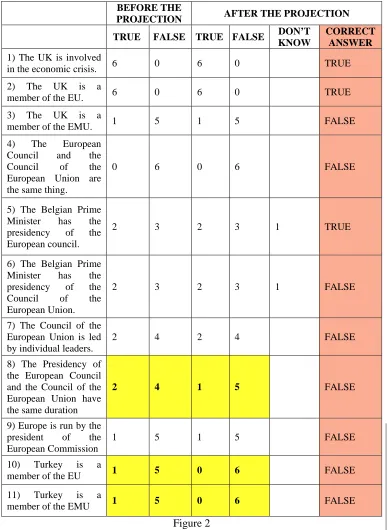
However, instead of what happened in Italy, this program didn’t have such a strong impact on the political knowledge of the spectators. In fact the chart below shows how the political awareness of each participant didn’t improve significantly after the episode.
As it can be observed, after the projection the participants had increased their knowledge just in a small part. Only one member changed her opinion on statement eight, ten and eleven during the course of the projection. However the general improvement is really low if considering the number of the participants and the number of questions.
Hence, this initial result seems to show that the thesis of Jones, Van Zoonen and Holbert failed: apparently the new political television has lost, in the UK, its capacity to present us with innovative ways to be politically engaged.
As one of the participant of the focus group said: “these satirical programs are entertaining, but they’re definitely not new tools of democracy. They make me laugh, but they don’t improve my political knowledge!”.Referring to this sample, TV is still interesting just because of the news programs or because of the political debates. However they consider the new media as the new democratic tools that make them active citizen, active makers of contents.
Another member of the group explains: “anything that stimulates some degree of political interest, I think, is a good idea. […] The general public don’t know what the politicians […] are up to and an interest in political issues is good, but if you are not in possession of all of facts, then you can only be scratching the surface and this is in the best in the interest of politicians and the establishment, and for you to not understand.
However satirical programs make you laugh, they sensitize you in a way […]. They stimulate the interest because they are humorous, but actually they don’t help you to bring your investigation much further!”.
Vol
u
me 2, Issue 2
, 2013
BEFORE THE
PROJECTION AFTER THE PROJECTION
TRUE FALSE TRUE FALSE DON’T
KNOW
CORRECT ANSWER
1) The UK is involved
in the economic crisis. 6 0 6 0 TRUE
2) The UK is a
member of the EU. 6 0 6 0 TRUE
3) The UK is a
member of the EMU. 1 5 1 5 FALSE
4) The European Council and the Council of the European Union are the same thing.
0 6 0 6 FALSE
5) The Belgian Prime Minister has the presidency of the European council.
2 3 2 3 1 TRUE
6) The Belgian Prime Minister has the presidency of the Council of the European Union.
2 3 2 3 1 FALSE
7) The Council of the European Union is led by individual leaders.
2 4 2 4 FALSE
8) The Presidency of the European Council and the Council of the European Union have the same duration
2 4 1 5 FALSE
9) Europe is run by the president of the European Commission
1 5 1 5 FALSE
10) Turkey is a
member of the EU 1 5 0 6 FALSE
11) Turkey is a
member of the EMU 1 5 0 6 FALSE
Vol
u
me 2, Issue
2
, 2013
5. Conclusion
This research has allowed me to investigate a field of interest quite new in England and in Italy, that led to compare the findings within the two national contexts, with the International ones.
The aim of my work was to understand how political satire encourages a critical awareness of political issues and how it contributes to the formation of a civic culture.
According to Livingstone20, the citizen should be observed by its prospective of spectators, “Being a member of the media audience is starting to be an essential way to perceive the public life.”21 From this point of view, according to Mazzoleni22, pop politics can be considered as a civic resource, able to reconcile the spectator with the politics and to put political information in the social network.
Satire is therefore an important component of pop politics that adapts itself and has been adapted to television’s needs. In other words, satire can be considered as an essential tool that informs about political and social issues.
From the qualitative analysis I conducted on the two samples, it emerged a clear difference between the Italian and the English role of satire. On the one hand the Italian findings confirmed the international studies to which I referred, on the other hand, on a first sight, it looked like the English findings were in contrast with my initial thesis.
In Italy, even if satire had a lot of restrictions – due to the control of the politicians –it seems that the genre remains an important tool to fight the abuse of power. In fact the Italian public has shown a preference for the personification of an idea or a political speech rather than abstract representations. Leaders with their personality traits, their manners and idiosynchrasies, their tics and weaknesses, have become the privileged object of media interest, which make it the target of good-natured irony or biting satire, sometimes up to excess.
Therefore the programs of political satire are perhaps the ones more allowed to go overboard with the emphatic representation of politicians and of their deeds.
Contrary to the Italian point of view, English people declared to find political satire an old tool of democracy, that has been important, but now it is just a form of entertaining. Maybe this change can be blamed on the public broadcast services, that, in order to compete with the private networks, have deprived satire of its original contents. Therefore satire could have lost its depth, maintaining just a humorous form. The English spectators wouldn’t find any answers to their political uncertainties; neither would they increase their political awareness. In other words the model of a new political television23 wouldn’t exist.
20
Livingstone, Sonia. “Audience research at the crossroad.The ‘imperial audience’ in media and cultural theory.” European Journal of Cultural Studies, vol.I, II (1998).
21 Cf. Livingstone, Sonia (1998), pp. 34-35.
22 Cf. Mazzoleni, Gianpietro, Sfardini, Anna, 2009.
23
Vol
u
me 2, Issue 2
, 2013
However, at this point, it is interesting to show how, on the other side, the behavior of the participants of the English group were almost opposite to what they affirmed.
The program of political satire showed, stimulated a great discussion among the participants. They often referred to what was mentioned in the episode and they frequently changed their opinions about relevant political issues.
In conclusion my research demonstrated how, in any case, satirical programs make the spectators active citizens, involved in the political issues, even though they seem to be not conscious about that. The reason of this discrepancy maybe lies in the differences existing between English and Italian satire.
Anyway satire, in both contexts, despite the cultural peculiarities, not only offers meaningful political critiques, but also encourages viewers to play with politics, to examine it, test it and question it rather than simply consume it as information or “truth”.24
5.1. Recommendations for further study
This investigation has left a wide opening for further research. First of all, in order to improve the study and achieve a deeper comprehension of political satire within the UK and Italian television context, it should be repeated taking into account a wider sample of satirical programs broadcasted on the national channels. This quantitative research could be useful to check to what extent political satire programs have a relevant role in the national schedules.
Furthermore it would be interesting to choose some of the most representative satirical programs in the UK and Italian schedules and analyze them in order to consider the different formats they adopt and to examine the differing impacts they have on viewers.
Finally the study could be conducted on a younger audience in order to investigate if young people still consider political satire as an important tool of democracy, bearing in mind the increasing use of social media.
WORKS CITED
Baym, Geoffrey. “Representation and the politics of play: Stephen Colbert’s better know a district”. Political Communication, 24.4 (2007): 359-376. Web. 23 February 2013.
Baym, Geoffrey, and Jones, Jeffrey.P. “A Dialogue in Satire News and the Crisis of Truth in Postmodern Political Television.” Journal of Communication Inquiry, 34.3 (2010): 278-294. Web 25 February 2013.
Delli Carpini, Michael, and Williams, A.Bruce.“ ‘Fictional’ and ‘non-fictional’ television celebrates earth day (or, politics is comedy plus pretense).” Cultural Studies, 8 (1884): 74-98.Web. 21 February 2013.
Gray, Jonathan, and Jones, Jeffrey. P. Satire Tv: politics and comedy in the post-network era. New York: New York University Press, 2009. Print.
24
Vol
u
me 2, Issue
2
, 2013
Highet, G.Quoted in Drawn to Extremes: The Use and Abuse of Editorial Cartoons by Chris Lamb. New York: Columbia University Press, 2004. Print.
Holbert, Lance. “A typology for the study of entertainment television and politics”. American Behavioral Scientist, 49.3(2005):436-453.Web. 10 February 2013. Jones, Jeffrey.P. Entertaining Politics. New Political Television and Civic Culture,
Lanham, MD: Rowman& Littlefield, 2005. Print.
Kellner, Douglas. Television and the Crisis of Democracy. Boulder, CO: Westview Press, 1990. Print
Livingstone, Sonia. Audience research at the crossroad.The “imperial audience” in media and cultural theory.European Journal of Cultural Studies, vol.I, II.(1998). Web. 19 February 2013.
Mazzoleni, Gianpiero, Sfardini, Anna. Pop Politics: da “Porta a Porta” a “L'Isola dei famosi”. Bologna: IlMulino, 2009. Print.
Postman, Neil. Amusing Ourselves to Death: Public Discourse in the Age of Show Business. USA: Penguin, 1985. Print.
Putnam, Robert. Bowling Alone: The Collapse and the Revival of American Community, New York: Simon & Schuster, 2002. Print.
Test, George, A. Satire: Spirit and Art. Tampa: University of South Florida Press, 1991. Print.
Van Zoonen, Liesbet. Entertaining the Citizen.When Politics and Popular Culture Converge. Lanham, MD: Rowman and Littlefield, 2005. Print.