*Corresponding author: Keyvan Tadayon, Ph.D,
Depart-ment of Microbiology, Razi Vaccine and Serum Research Institute (RVSRI), Agricultural Research, Education and Extension Organization (AREEO), Karaj, Iran.
Tel: +98-2634502892 Fax: +98-2634552194 Email: [email protected]
Molecular typing methods used in studies of
Mycobacterium tuberculosis
in Iran: a systematic review
Hassan Ravansalar1, Keyvan Tadayon2,3*, Kiarash Ghazvini1
1Antimicrobial Resistance Research Center, School of Medicine, Mashhad University of Medical Sciences,
Mashhad, Iran
2Department of Microbiology, Razi Vaccine and Serum Research Institute (RVSRI), Karaj, Iran
3Agricultural Research, Education and Extension Organization (AREEO), Karaj, Iran
Received: February 2016, Accepted: April 2016
ABSTRACT
Background and Objectives: Molecular typing methods are important and useful tools to assess the transmission, diversity of strains and differentiation between new infections and relapses which can effectively help in controlling infections. The aim of this study was to evaluate the molecular typing methods which have been used in Iran. By evaluating the results and discriminatory power of each method, we can assign appropriate weight to each technique and ultimately offer a common strategy for future epidemiological studies.
Methods: We searched several databases to identify studies addressing Mycobacterium tuberculosis molecular epidemiol-ogy in Iran. Hunter-Gaston discrimination index (HGDI) was used to evaluate the discriminatory power in each method. Relevant articles were selected and analyzed; HGDI index was calculated for each technique.
Results: The most common genotyping methods used in the articles were RFLP, MIRU-VNTR, spoligotyping, PFGE and RAPD-PCR. The most frequently techniques were IS6110-RFLP, MIRU-VNTR and spoligotyping alone or in combination. The highest discrimination power (average HGDI: 0.9916) was obtained by RFLP followed by MIRU-VNTR (average HGDI: 0.9638) and spoligotyping (average HGDI: 0.9041) respectively.
Conclusion: Combination of MIRU-VNTR with spoligotyping can be recommended for large-scale genotyping in Iran. It
seems appropriate to consider spoligotyping as the first technique for screening followed by other techniques with higher
discrimination power such as MIRU-VNTR or IS6110-RFLP.
Keywords: Mycobacterium tuberculosis, Molecular epidemiology, Genotyping, HGDI, RFLP, MIRU-VNTR, Spoligotyping
REVIEW
AR
TICLE
INTRODUCTION
Mycobacterium tuberculosis is one of the most
people developed TB out of which 1.5 million lost their lives due to this disease. The WHO report in 2014 showed the number of people with TB was on the rise; the report also emphasized that the number of MDR-TB had increased in the past two decades (3). As Iran is in close proximity to high-prevalence countries, prevention of the spread of tuberculosis cases particularly MDR-TB is one of the priorities of the country (4).
The use of methods that can identify and track TB transmission is helpful in controlling the disease.
Planning for TB control needs an identification of the
sources of infection and the spread of disease. With the development of molecular epidemiology in recent years, the possibility of studying the epidemiology
of infectious diseases has increased significantly. For
understanding the path for disease transmission, mo-lecular epidemiology studies are essential in order to prevent the spread of disease (5). Therefore, genotyp-ing techniques are powerful tools for identifygenotyp-ing the outbreak, contact tracing, and studying the diversity of strains. Also, increasing knowledge in this area may be considered as an effective way to prevent transmission (6).
Many different molecular epidemiology tech-niques have been proposed for identifying the genet-ic relationship between different strains of
Mycobac-terium tuberculosis and bovis (6-8). M. tuberculosis
has very conserved genome; as little nucleotide di-versity was reported in their genome, this organism is genetically monomorphic (9). Although genome of
M. tuberculosis complex is highly conserved in
com-parison to other bacterial pathogens, some variation does exist (10, 11).
Today, there are various methods for genotyping of
M. tuberculosis which is called fingerprinting tech
-niques. Genotyping methods can be briefly classified
as follows:
1) Sequence-based standard methods such as whole genome sequencing.
2) Non Sequence-based methods: these methods
are generally classified into two categories:
A) Non-amplified methods (gel- based techniques)
such as Pulsed Field Gel Electrophoresis (PFGE) and Restriction Fragment Length Polymorphism (RFLP)
B) Amplified methods (PCR-based genotyping
methods) such as spoligotyping, Mycobacterial In-terspersed Repetitive Unit-Variable Number Tandem
Repeat (MIRU- VNTR), Random Amplified Poly -morphic DNA Polymerase chain reaction
(RAPD-PCR), Repetitive element palindromic PCR (REP-PCR).
Often these techniques are based on the tive sequences (6). There are two types of repeti-tive units, interspersed repeats (IR) (Direct Repeats [DR], insertion sequence-like repeats [IS]) and tan-dem repeats (TR) (variable-number tantan-dem repeats [VNTR]) (10, 11). Each method has some advantages and disadvantages (6, 9, 12, 13).
OBJECTIVES
The aim of this study was to evaluate the molecu-lar typing methods used in Iran. By evaluating dis-criminatory power of each method and comparing the results, we can assign appropriate weight to each technique and propose a common strategy for future epidemiological studies. Hunter-Gaston Discrimina-tion Index (HGDI) was used to evaluate the Discrim-inatory Power for each method (12).
METHODS
Search strategy. We searched several databases such as PubMed, Web of Science, Scopus, Iran
Me-dex, Google Scholar, and Scientific Information Da -tabase (SID) to identify studies addressing M.
tuber-culosis molecular epidemiology in Iran. Keywords
that were selected for this research were: molecular epidemiology, tuberculosis and Iran. Moreover, to search for articles that were published in Persian, the corresponding Persian keywords were used.
Having the search conducted, 25 articles in English and 9 Persian articles were shortlisted; while others were excluded from the study due to lack of relevance or unavailability. Papers either contained HGDI in-dex or the information necessary to calculate this index; we reviewed the selected articles and used the already existing indexes or calculated the index based on the data extracted from the articles. The indexes were calculated according to the following equation:
D= 1- .
Where N is the total number of strains in the sam-ple population, s is the total number of types de-scribed, and nj is the number of strains belonging to
the lowest and largest discriminatory power indexes are represented by 0 and 1, respectively. Assessing and determining the discriminatory power of the mo-lecular epidemiology is important because based on the results of this study, a more powerful tool can be selected for the genotyping research.
RESULTS
After evaluating all articles, 34 relevant articles (Published from 2000 to 2014) were selected for anal-ysis (Diagram 1). All 34 articles contained informa-tion necessary to calculate HGDI index. As presented in Diagram 1, molecular typing techniques frequent-ly used in Iran were RFLP (IS6110, PGRS and DR),
MIRU-VNTR, spoligotyping, PFGE and RAPD-PCR. The majority of the methods used in the liter-ature were spoligotyping with 18 studies followed by IS6110-RFLP and MIRU-VNTR with 9 and 7 cases respectively.
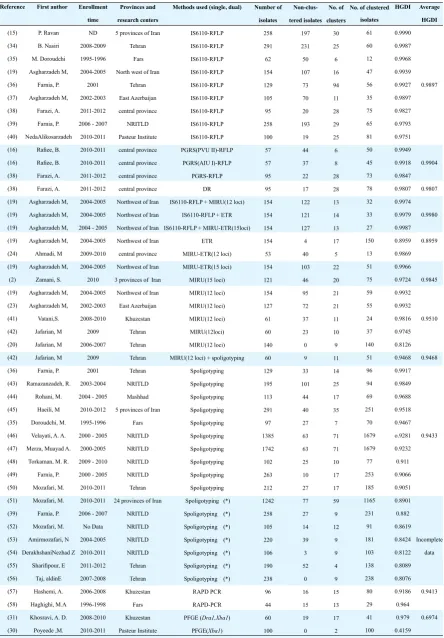
Our search demonstrated that IS6110 - RFLP had the highest HGID (an average HGID of 0.9897), fol-lowed by Polymorphic GC-rich Repetitive Sequences (PGRS) - RFLP (average HGID: 0.9904) and MI-RU-VNTR (average HGID: 0.9638) and spoligotyp-ing (average HGID: 0.9433) and the lowest discrim-ination power (average HGDI: 0.6974) was obtained for PFGE. In most studies, a combination of two or three methods was used. The combination of two or more methods showed higher HGDI values than sin-gle method. HGDI values in each method were almost
Diagram 1. Number of methods and articles reviewed in the study
Table 1. Comparative analysis of genotyping methods of Mycobacterium tuberculosis published by Iranian scientists. Reference (15) (34) (35) (19) (36) (37) (38) (39) (40) (16) (16) (38) (38) (19) (19) (19) (19) (24) (19) (2) (19) (23) (41) (42) (20) (42) (36) (43) (44) (45) (35) (46) (47) (48) (49) (50) (51) (39) (52) (53) (54) (55) (56) (57) (58) (31) (30) First author P. Ravan B. Nasiri M. Doroudchi Asgharzadeh M, Farnia, P. Asgharzadeh M, Farazi, A. Farnia, P. NedaAlikosarzadeh Rafiee, B. Rafiee, B. Farazi, A. Farazi, A. Asgharzadeh M, Asgharzadeh M, Asgharzadeh M, Asgharzadeh M, Ahmadi, M Asgharzadeh M, Zamani, S. Asgharzadeh M, Asgharzadeh M, Vatani,S. Jafarian, M Jafarian, M Jafarian, M Farnia, P. Ramazanzadeh, R. Rohani, M. Haeili, M Doroudchi, M. Velayati, A. A. Merza, Muayad A.
Torkaman, M. R. Farnia, P. Mozafari, M. Mozafari, M. Farnia, P. Mozafari, M. Amirmozafari, N DerakhshaniNezhad Z Sharifipour, E Taj, aldinE Hashemi, A. Haghighi, M.A Khosravi, A. D. Poyeede ,M. Enrollment time ND 2008-2009 1995-1996 2004-2005 2001 2002-2003 2011-2012 2006 - 2007 2010-2011 2010-2011 2010-2011 2011-2012 2011-2012 2004-2005 2004-2005 2004 - 2005 2004-2005 2009-2010 2004-2005 2010 2004-2005 2002-2003 2008-2010 2009 2006-2007 2009 2001 2003-2004 2004 - 2005 2010-2012 1995-1996 2000 - 2005 2000-2005 2009 - 2010 2000 - 2005 2010-2011 2010-2011 2006 - 2007 No Data 2004-2005 2010-2011 2011-2012 2007-2008 2006-2008 1996-1998 2008-2010 2010-2011 Provinces and research centers 5 provinces of Iran
Tehran Fars North west of Iran
Tehran East Azerbaijan central province NRITLD Pasteur Institute central province central province central province central province Northwest of Iran Northwest of Iran Northwest of Iran Northwest of Iran central province Northwest of Iran 3 provinces of Iran
Northwest of Iran East Azerbaijan Khuzestan Tehran Tehran Tehran Tehran NRITLD Mashhad 5 provinces of Iran
Fars NRITLD NRITLD NRITLD NRITLD Tehran 24 provinces of Iran
NRITLD NRITLD NRITLD NRITLD Tehran Tehran Khuzestan Fars Khuzestan Pasteur Institute
Methods used (single, dual)
IS6110-RFLP IS6110-RFLP IS6110-RFLP IS6110-RFLP IS6110-RFLP IS6110-RFLP IS6110-RFLP IS6110-RFLP IS6110-RFLP PGRS(PVU II)-RFLP PGRS(AIU I)-RFLP PGRS-RFLP DR IS6110-RFLP + MIRU(12 loci)
IS6110-RFLP + ETR IS6110-RFLP + MIRU-ETR(15loci)
ETR MIRU-ETR(12 loci) MIRU-ETR(15 loci) MIRU(15 loci) MIRU(12 loci) MIRU(12 loci) MIRU(12 loci) MIRU(12loci) MIRU(12 loci) MIRU(12 loci) + spoligotyping
Spoligotyping Spoligotyping Spoligotyping Spoligotyping Spoligotyping Spoligotyping Spoligotyping Spoligotyping Spoligotyping Spoligotyping Spoligotyping (*) Spoligotyping (*) Spoligotyping (*) Spoligotyping (*) Spoligotyping (*) Spoligotyping (*) Spoligotyping (*)
RAPD PCR RAPD-PCR PFGE (Dra1,Xba1)
PFGE(Xba1)
Number of isolates 258 291 62 154 129 105 95 258 100 57 57 95 95 154 154 154 154 53 154 121 154 127 61 60 140 60 129 195 113 291 97 1385 1742 102 263 212 1242 258 105 220 106 190 238 96 44 60 100 Non-clus-tered isolates 197 231 50 107 73 70 20 193 19 44 37 22 17 122 121 127 4 40 103 46 95 72 37 23 0 9 33 101 44 40 27 63 63 25 10 27 77 27 14 39 3 52 0 16 15 19 0 No. of clusters 30 25 6 16 94 11 28 29 25 6 8 28 28 13 14 13 17 5 22 20 21 21 11 10 9 11 14 25 17 35 7 71 71 10 17 17 59 9 12 9 9 4 9 15 13 17 2
close to 100%. Results are presented in Table 1.
DISCUSSION
Different typing methods demonstrated a wide range of discrimination power. HGDI values were from 0.4159 up to 0.9990. We used HGDI index to assess the discriminatory power of molecular typing techniques. Each genotyping method has a different value for this index in different articles depending on various parameters such as number and distribution of samples (14). A minimum of HGDI value more than 0.90 is desired for a test to distinguish among related organisms (12). The analysis of HGDI values for each typing method in this study showed that IS6110-RFLP had the highest HGDI value of 0.9990 and the low-est HGDI belonged to PFGE with an average value of 0.4159. The analysis of HGDI values for IS6110 -RFLP showed an average of 0.9897 ranging from 0.9990 to 0.9751. The highest value was achieved by
the analysis of isolates obtained from five provinces of
Iran (15), and the lowest of them was obtained from Tehran Province (16). The major advantage of this method is the higher discriminatory power it provides but it suffers from the long time required and technical
difficulties in conducting. Furthermore, IS6110-RFLP has low discriminatory power in strains with fewer than 6 copy number of IS6110 sequences (13, 17).
PGRS fingerprinting in terms of technical and other
conditions were similar to IS6110-RFLP. HGDI val-ues are also similar to IS6110-RFLP. Also, it has been
proven that PGRS fingerprinting is useful for differen -tiating M. tuberculosis strains with less than six copies of IS6110 that cannot be successfully examined by IS6110 fingerprinting (1, 18).
In the present study, MIRU-VNTR showed high HGDI average value of HGDI = 0.9638 after RFLP. In this study, maximum HGDI value for MIRU-VNTR was 0.9966 (19) and the lowest was 0.8126 (20). The discriminatory power of MIRU-VNTR technique de-pends on the number and type of selected loci, in ad-dition to the number and distribution of samples (21). The highest HGDI value for MIRU-VNTR in Iran has been reported by Asgharzadeh and colleagues who used a 15-locus MIRU-VNTR typing method (19). Barlow et al. believe that the use of 12 appropriate loci in MIRU-VNTR will provide high discriminato-ry power (22). Asgharzadeh et al. (23) and Ahmadi et al. (24) who used the 12 loci MIRU-VNTR, obtained
HGDI indexes 0.9932 and 0.9869, respectively. In both articles, ETR and MIRU loci have been used. It seems that little difference in the discriminatory pow-er of these two studies was related to sample size (127 samples versus 53 samples).
The advantages of MIRU-VNTR are high discrim-inatory power, high reproducibility (25) and the abil-ity to create a numeric code for each isolate which facilitate its tracing in the database as well as ease and cost-effectiveness. Due to these advantages, this method has become a favorite method for epidemio-logical and phylogenetic researchers. Thus, Supply et al. proposed a 15-locus system as a new standard for routine epidemiological discrimination of M. tubercu-losis isolates and a 24-locus system as a high-resolu-tion tool for phylogenetic studies (21). The simultane-ous use of two techniques enhances the discriminatory power. In a relevant study, Asgharzadeh et al. showed that the combination of IS6110 and MIRU-VNTR had the greater discriminatory power than either method alone (19). In another study, Barlow et al. obtained
similar findings (22).
The third most widely used technique in the arti-cles we reviewed was spoligotyping, and the average HGDI value for spoligotyping was 0.9041, the highest HGDI average value was 0.9917 and the lowest was 0.8076. However, because the results of some papers
were incomplete, or they were identified only up to
the super family level, the value of HGDI was lower in these articles (marked with * in Table 1). Therefore, considering only the articles with full data on the cal-culations, the average HGDI for this technique will be 0.9433.
As observed, the discriminatory power of spoligo-typing was less than the two other techniques. The reason for the lower discriminatory power of this method is that it targets only a single genetic locus, in-cluded less than 0.1% of the M. tuberculosis complex genome (26). An important advantage of spoligotyp-ing is its sensitivity which can be performed by 10 fg of chromosomal DNA, equivalent to DNA from 2-3 bacterial cells (27), so that the method can be directly performed on clinical samples, without the need for prior culture. Moreover, spoligotyping has proven to be practical for typing on nonviable samples such as
paraffin-embedded tissue sections or Ziehl-Neelsen
stained slides (28, 29).
aforemen-tioned techniques. The lowest discrimination power was represented by PFGE (average HGDI= 0.6974). In this review, the discrimination power of PFGE was low because in one manuscript, Poyide et al. used only one restriction enzyme (Xba1) and obtained extreme-ly low discrimination power (HGDI value = 0.4159) (30). Although in another study conducted by Khos-ravi et al., they used two restriction enzymes (Dra1
and Xba1) and the discrimination power was higher (HGDI value = 0.9790) (31).
In general, each typing system has its own
advan-tages and disadvanadvan-tages, and it is difficult to decide
clearly which of them is superior to others. But an ideal molecular typing method must comply with the needs of researchers in terms of performance feasi-bility as well as analytical standards (26). The per-formance parameters included technical simplicity or ease of implementation, repeatability, robustness, time and cost-effectiveness. Another special advantage of the method was that it can be standardized and the re-sults would be easily interpretable. The rere-sults should simply be comparable with the results of other labo-ratories as well as global databases. Another attractive advantage of a technique is its capability to be per-formed directly on clinical samples (26).
Analytical parameters include the level of genetic differentiation and stability of markers. A general rule is that the higher discriminatory power of the method, the more reliable the results obtained. It has been
con-firmed that discriminatory power of a molecular mark -er relates directly to its stability. Half-life of
IS6110-RFLP profile is much shorter than the profile of spoli -gotyping (about 3 to 8 years in RFLP compared to spoligotyping with more than 50 years). The half-life
of MIRU-VNTR is slightly longer than RFLP profiles
and shorter than spoligotyping. The half-life of a de-sirable molecular marker should be short enough to separate unrelated samples from each other and on the
other hand be long enough to be able to find the rela -tionship between epidemiological samples (26). Selecting a genotyping method, in compliance with good discriminatory power, also depends on the type of research. A technique with high discriminato-ry power with short half-life of genetic pattern (e.g. RFLP and MIRU-VNTR techniques) is more useful to distinguish reactivation from reinfection, while a method with a long half-life of genetic pattern (such as spoligotyping) is more useful for global strain tracking and evolutionary studies. Therefore, it is better to per-form typing with a combination of these techniques.
Gold standard for M. tuberculosis genotyping was IS6110-RFLP, but it needs to change to MIRU-VNTR technique because of its similar discriminatory power in addition to feasibility, time and cost-effectiveness as well as the interpretation of results. More impor-tantly, the PCR-based typing methods require fewer bacteria and can be performed in a shorter period of time. Thus, many researchers have focused on the MI-RU-VNTR method as a standard technique.
Spoligotyping method has attracted the attention of researchers because of simplicity and cost-effec-tiveness in addition to the advantage that the results are expressed as positive or negative, according to the presence or absence of the spacers (digital format)
(32). However spoligotyping will not be sufficient to
be used alone in the epidemiological studies. There-fore, spoligotyping is recommended to be used as a
first-line screening test, followed by techniques with
higher discriminatory power such as MIRU-VNTR or IS6110-RFLP (33). Also, it should be emphasized that the present study was limited to techniques reported in Iran. Therefore, the number of articles relating to some methods was too low. There are other genotyp-ing techniques used by researchers around the world which were not included in this article.
CONCLUSION
According to the present study, combination of MI-RU-VNTR with spoligotyping can be recommended for large-scale genotyping in Iran. It seems
appropri-ate to consider spoligotyping as the first techniques
for screening followed by other techniques with high-er discrimination abilities such as MIRU-VNTR or IS6110-RFLP.
ACKNOWLEDGEMENT
The authors would thank the research team who helped in completing this project.
REFERENCES
tuberculosis in Central Province of Iran. Tuberc Res Treat 2014; 195287.
2. Zamani S, Aflaki M, Fooladi AAI, Darban-Sarokhalil
D, Bameri Z, Khazaee S, et al. MIRU-VNTR analysis of the Mycobacterium tuberculosis isolates from three provinces of Iran. Scand J Infect Dis 2013; 45:124-130. 3. WHO. Global tuberculosis report 2015. World Health
Organization Geneva [Switzerland]. 2015.
4. Nasiri MJ, Dabiri H, Darban-Sarokhalil D, Rezadehba-shi M, Zamani S. Prevalence of drug-resistant tubercu-losis in Iran: systematic review and meta-analysis. Am J Infect Control 2014 Nov;42(11):1212-1218.
5. Asgharzadeh M, Samadi Kafil H, Pourostadi M. Source case identification and control of tuberculosis
by molecular epidemiology. J Mazandaran Univ Med Sci (Persian) 2014; 24 (115):181-92.
6. Moström P, Gordon M, Sola C, Ridell M, Rastogi N. Methods used in the molecular epidemiology of tuber-culosis. Clin Microbiol Infect 2002; 8:694-704. 7. Tadayon K, Forbes K, Soleimani D, Pajoohi RA,
Marh-mati B, Javidi J, et al. A review of the contemporary knowledge of bovine tuberculosis and government pol-icy in Iran. Vet Microbiol 2011; 151:192-199.
8. Tadayon K, Mosavari N, Feizabadi MM. An epidemio-logical perspective on bovine tuberculosis spotlighting facts and dilemmas in Iran, a historically zebu-domi-nant farming country. Iran J Microbiol 2013; 5:1-13. 9. Comas I, Homolka S, Niemann S, Gagneux S.
Ge-notyping of genetically monomorphic bacteria: DNA sequencing in Mycobacterium tuberculosis highlights the limitations of current methodologies. PLoS One
2009 Nov 12;4(11):e7815.
10. Mathema B, Kurepina NE, Bifani PJ, Kreiswirth BN. Molecular epidemiology of tuberculosis: current in-sights. Clin Microbiol Rev 2006 Oct;19(4):658-685.
11. Schurch AC, van Soolingen D. DNA fingerprinting
of Mycobacterium tuberculosis: from phage typing to whole-genome sequencing. Infect Genet Evol 2012; 12:602-609.
12. Hunter PR, Gaston MA. Numerical index of the dis-criminatory ability of typing systems: an application of Simpson's index of diversity. J Clin Microbiol 1988; 26:2465-2466.
13. Rozo-Anaya JC, Ribon W. Molecular tools for Myco-bacterium tuberculosis genotyping. Rev Salud Publica (Bogota) 2010 Jun;12(3):510-521.
14. Asgharzadeh M, Samadi Kafil H. Current trends in
molecular epidemiology studies of Mycobacterium tu-berculosis . Biotechnol Mol Bio. Rev 2007; 2:108-115. 15. Ravan P, Farnia P, Amirmozafari N, Taghavi K,
Ah-madi M, Masjedi MR, et al. Molecular epidemiology
analysis of TB in five regional states of Iran. Tanaffos
2013; 12:26-30.
16. Rafiee B, Mosavari N, Farazi AA, Nazari R, Kesha
-varz R, Tadayon K. DNA fingerprinting of Mycobac-terium tuberculosis isolates of pulmonary tuberculosis patients in Markazi province by PGRS-RFLP method.
AMUJ 2012; 15(6):35-44 (In Persian).
17. Rafiee B, Mosavari N, Ghani S, Sadeghi D, Keshavarz
R, Tadayon K. Molecular Characterization of Myco-bacterium bovis Isolates with High Copy Number of IS6110 by Restriction Fragment Length Polymorphism.
ZJRMS 2014:70-72. (In Persian)
18. Yang ZH, Ijaz K, Bates JH, Eisenach KD, Cave MD. Spoligotyping and polymorphic GC-rich repetitive
se-quence fingerprinting of Mycobacterium tuberculosis
strains having few copies of IS6110. J Clin Microbiol
2000; 38:3572-3576.
19. Asgharzadeh M, Kafil HS, Roudsary AA, Hanifi GR.
Tuberculosis transmission in Northwest of Iran: using MIRU-VNTR, ETR-VNTR and IS6110-RFLP meth-ods. Infect Genet Evol 2011;11:124-131.
20. Jafarian M, Farnia P, Mozafari M, Ahmadi M, Masjiedi M, Velayati A. Comparison of the genetic convergence degree of Mycobacterium tuberculosis (TB) strains isolated from patients infected with TB by MIRU-VN-TR technique. ZUMS Journal 2011; 19:25-36. (In Per-sian)
21. Supply P, Allix C, Lesjean S, Cardoso-Oelemann M, Rusch-Gerdes S, Willery E, et al. Proposal for stan-dardization of optimized mycobacterial interspersed repetitive unit-variable-number tandem repeat typing of Mycobacterium tuberculosis. J Clin Microbiol 2006; 44:4498-4510.
22. Barlow RE, Gascoyne-Binzi DM, Gillespie SH, Dick-ens A, Qamer S, Hawkey PM. Comparison of variable number tandem repeat and IS6110-restriction fragment length polymorphism analyses for discrimination of high- and low-copy-number IS6110 Mycobacterium tuberculosis isolates. J Clin Microbiol 2001; 39:2453-2457.
23. Asgharzadeh M, Khakpour M, Salehi TZ, HS K. Use of miru-vntr typing to study Mycobacterium tubercu-losis isolates from East Azarbaijan province of Iran.
PJBS 2007; 10:3769-3777.
24. Ahmadi M, Tadayon K, Mosavari N, Farazi A, Arjo-mandzadegan M, Keshavarz R, et al. Mycobacterium tuberculosis genotyping by MIRU-VNTR method. J Gorgan Uni Med Sci 2015; 17(1):97-106.
25. Kremer K, Arnold C, Cataldi A, Gutierrez MC, Haas WH, Panaiotov S, et al. Discriminatory power and re-producibility of novel DNA typing methods for Myco-bacterium tuberculosis complex strains. J Clin Micro-biol 2005; 43:5628-5638.
27. Kulkarni S, Sola C, Filliol I, Rastogi N, Kadival G. Spoligotyping of Mycobacterium tuberculosis isolates from patients with pulmonary tuberculosis in Mumbai, India. Res Microbiol 2005; 156:588-596.
28. Driscoll JR, McGarry MA, Taber HW. DNA typing of a nonviable culture of Mycobacterium tuberculosis
in a homeless shelter outbreak. J Clin Microbiol 1999; 37:274-275.
29. Van der Zanden A, Hoentjen A, Heilmann F, Weltevre-den E, Schouls L, Van EmbWeltevre-den J. Simultaneous detec-tion and strain differentiadetec-tion of Mycobacterium tuber-culosis complex in paraffin wax embedded tissues and
in stained microscopic preparations. Molecular Pathol-ogy 1998; 51(4):209-214.
30. Mohammad Poyeede , Esmaeil Jabarzade , Morteza
Masoumi , Reza Ranjbar , Zeynab Ahmadi , Saifi M.
Pulsed Field Gel Electrophoresis and Genetic Diversity in Mycobacterium tuberculosis. Iran J Clin Infect Dis
2013; 18:21-26. (In Persian)
31. Khosravi AD, Vatani S, Feizabadi MM, Abasi Mon-tazeri E, Jolodar A. Application of Pulsed Field Gel Electrophoresis for study of genetic diversity in Myco-bacterium tuberculosis strains isolated from tuberculo-sis patients. Jundishapur J Microbiol 2014; 7(5):e9963. 32. Kremer K, van Soolingen D, Frothingham R, Haas
WH, Hermans PW, Martin C, et al. Comparison of methods based on different molecular epidemiologi-cal markers for typing of Mycobacterium tuberculosis
complex strains: interlaboratory study of discrimina-tory power and reproducibility. J Clin Microbiol 1999; 37:2607-2618.
33. Goguet de la Salmoniere YO, Li HM, Torrea G, Bun-schoten A, van Embden J, Gicquel B. Evaluation of spoligotyping in a study of the transmission of My-cobacterium tuberculosis. J Clin Microbiol 1997; 35:2210-2214.
34. Nasiri B. Evaluation and molecular comparison of My-cobacterium tuberculosis strains isolated from Iranian and Afghan immigrants in Tehran. Iran J Med Micro-biol 2014;8:22-27. (In Persian)
35. Doroudchi M, Kremer K, Basiri EA, Kadivar MR, Van Soolingen D, Ghaderi AA. IS6110-RFLP and spoligo-typing of Mycobacterium tuberculosis isolates in Iran.
Scand J Infect Dis 2000; 32:663-668.
36. Farnia P, Mohammadi F, Masjedi MR, Varnerot A,
Zarifi AZ, Tabatabee J, et al. Evaluation of tuberculosis
transmission in Tehran: using RFLP and spoligotyping methods. J Infect 2004; 49:94-101.
37. Asgharzadeh M, Shahbabian K, Majidi J, Aghazadeh AM, Amini C, Jahantabi AR, et al. IS6110 restriction fragment length polymorphism typing of Mycobacte-rium tuberculosis isolates from East Azerbaijan Prov-ince of Iran. Mem Inst Oswaldo Cruz 2006;101:517-521. 38. Farazi A, Jabbariasl M, Tadayon K, Mossavar N,
Kes-havarz R, Hoseini Sd, et al. Comparison of the genetic convergence between Mycobacterium strains by three RFLP-based methods in central province of Iran. Iran J Basic Med Sci 2014; 17:401-405.
39. Farnia P, Masjedi MR, Varahram M, Mirsaeidi M, Ah-madi M, Khazampour M, et al. The recent-transmis-sion of Mycobacterium tuberculosis strains among
Ira-nian and Afghan relapse cases: a DNA-fingerprinting
using RFLP and spoligotyping. BMC Infect Dis 2008; 8:109.
40. Neda Alikosarzadeh , Esmail Jabbarzadeh , Elham Sa-farpoor , Ahmad Reza Bahrmand , Morteza Masoumi , Ali Karimi , et al. Molecular typing of Mycobacterium tuberculosis by IS6110-RFLP Method. Iran J Clin In-fect Dis 2013; 18:29-36. (In Persian)
41. Vatani S, Khosravi A, Feizabadi M, Jolodar A. Study of genetic diversity in Mycobacterium tuberculosis by us-ing mycobacterial interspersed repetitive unit: Variable number tandem repeat typing in Khuzestan Province, Iran. Afr J Microbiol Res 2011; 5:1549-1556.
42. Jafarian M, Aghali-Merza M, Farnia P, Ahmadi M, Masjedi MR, Velayati AA. Synchronous comparison of Mycobacterium tuberculosis epidemiology strains by “MIRU-VNTR” and “MIRU-VNTR and spoligo-typing” technique. AJMB 2010;2:145-152.
43. Ramazanzadeh R, Farnia P, Amirmozafari N, Ghazi F, Ghadertotonchi Z, Kamran J, et al. Comparison be-tween molecular epidemiology, geographical regions and drug resistance in Mycobacterium tuberculosis
strains isolated from Iranian and Afghan patients. Che-motherapy 2006; 52:316-320.
44. Rohani M, Farnia P, Nasab MN, Moniri R, Torfeh M, Amiri MM. Beijing genotype and other predominant
Mycobacterium tuberculosis spoligotypes observed in Mashhad city, Iran. Indian J Med Microbiol 2009; 27:306-310.
45. Haeili M, Darban-Sarokhalil D, Fooladi AAI, Javad-pour S, Hashemi A, Siavoshi F, et al. Spoligotyping and drug resistance patterns of Mycobacterium tuberculo-sis isolates from five provinces of Iran. Microbiology Open 2013; 2:988-996.
46. Velayati AA, Farnia P, Mirsaeidi M, Reza Masjedi M. The most prevalent Mycobacterium tuberculosis
superfamilies among Iranian and Afghan TB cases.
Scand J Infect Dis 2006; 38(6-7):463-468.
47. Merza MA, Farnia P, Salih AM, Masjedi MR, Ve-layati AA. The most predominant spoligopatterns of
Mycobacterium tuberculosis isolates among Iranian, Afghan-immigrant, Pakistani and Turkish tuberculosis patients: a comparative analysis. Chemotherapy 2010; 56:248-257.
Iranian and Afghan immigrants: A cluster-based study.
J Clin Diag Res 2014; 8(9):DC05-8.
49. Farnia P, Masjedi MR, Mirsaeidi M, Mohammadi F, Jallaledin G, Vincent V, et al. Prevalence of Haarlem I and Beijing types of Mycobacterium tuberculosis
strains in Iranian and Afghan MDR-TB patients. J In-fect 2006; 53:331-336.
50. Mozafari M, Farnia P, varahram M. Evaluation of spoligotyping pattern of Mycobacterium tuberculosis
strains isolated from Tehran province in 90-89. Nafas
2013; 1(1):27-32. (In Persian)
51. Mozafari M, Farnia P, Afraei M, Derakhshani-Nezhad Z, Masjedi MR, Velayati AA. Molecular diversity of
Mycobacterium tuberculosis strains indifferent prov-inces of Iran. Iran J Microbiol 2013;5:366-373. 52. Mozafari M, Farnia P, Jafarian M, Razavi Deligani M,
Kazempour M, Masjedi M, et al. Comparison of My-cobacterium tuberculosis Beijing genotype with other
Mycobacterium tuberculosis strains Using MIRU-VN-TR method. Iran South Med 2012;15(1):1-12.
53. Amirmozafari N, Ramezanzadeh R, Farnia P, Ghazi F. The frequency of Beijing genotype of Mycobacterium tuberculosis isolated from tuberculosis patients. RJMS
2006; 13:7-17.
54. Derakhshani Nezhad Z, Sheikolslami F, Farnia P, Dei-lami Khiabani Z, Ramazanzadeh R, Kazempoor M,
et al. Identification and genetic diversity of etambutol
resistant strains of Mycobacterium tuberculosis by
al-lelic-specific PCR and spologiotyping. J Ardabil Univ Med Sci 2012; 12(3):248-55. (In Persian)
55. Sharifipour E, Nasiri M, Farnia P, Mozafari M, Irani
S. Evaluation of molecular diversity of Mycobacterium tuberculosis strains by polymorphisms in RD Regions.
J Mycobac Dis 2014; 4(153):2161-1068.
56. Tajadin A, Farnia P, Kargar M, Nawrozi J,
Ramazanza-deh R, Ahmadi M, et al. Identification of Mycobacteri-um tuberculosis beijing genotype using three different molecular methods. Koomesh 2009; 11(1):7-14. (In Per-sian)
57. Hashemi A, Shojaei H, Heidarieh P, Aslani MM, Naser AD. Genetic diversity of Iranian clinical isolates of My-cobacterium tuberculosis. New Microbiol 2012;35:61-65.