Copyright © 2011 IJECCE, All right reserved
An Analysis of Cryptosystems Using Elliptic Curve
Cryptography
Shipra Shukla1, Dharmendra Lal Gupta2, Anil Kumar Malviya3, Sarvottam Dixit4
1Pursuing M.Tech in Deptt. of Computer Science & Engineering ,K N I T, Sultanpur, U.P., India. email: [email protected] 2
Research Scholar, Deptt. of Computer Science & Engineering, Mewar University, Chittorgarh, Rajasthan, India. email: [email protected]
3Associate Professor, Deptt. of Computer Science & Engineering ,K N I T, Sultanpur, U.P., India email:[email protected] 4Professor, Mewar University , Chittorgarh, Rajasthan, India
email: [email protected]
Abstract - The true impact of any public-key cryptosystem can only be evaluated in the context of a security protocol. Secure communication is an intrinsic requirement in any transaction. It is very important to implement cryptosystems securely against the attacks. Elliptic Curve Cryptography (ECC) is coming forth as an attractive public key cryptosystem for mobile/wireless environments compared to traditional cryptosystems like RSA and DSA. ECC fits well for an efficient and secure encryption scheme because it provides better security with smaller key sizes, which results in faster computations, lower power consumption, as well as memory and bandwidth savings. However, the digital signature is the indispensable way to ensure the security of web services and has great significance in practical applications. By using a digital signature algorithm we can provide authenticity and validation to the electronic document. ECDSA and ECDH use the concept of ECC. In this article we present ECC and most popular algorithms such as RSA, ECDH, ECDSA and ECPP and a comparative study of all these algorithms have been done.
Keywords–Digital Signature, ECDSA, ECDH, ECC, ECPP.
I. INTRODUCTION
Secure communication is an essential requirement for many popular online transactions such as e-commerce, stock trading and banking. These transactions employ a combination of public-key and symmetric key cryptography to authenticate participants and guarantee the integrity and confidentiality of information in transit. For any new security technology to be widely adopted, it must be integrated into end-user applications like email and web browsing. Interoperable standards, both at the algorithm (ECDH, ECDSA) and protocol levels are essential prerequisites. Most importantly, the new technology must demonstrate a compelling value proposition to offset the cost and inconvenience of migration.
Elliptic Curve Cryptography (ECC), proposed independently in 1985 by Neal Koblitz [15] and Victor Miller [3], has been used in cryptographic algorithms for a variety of security purposes such as key exchange and digital signature.ECC is emerging as an attractive alternative to traditional public-key cryptosystems such as RSA, DSA, and DH. Compared to traditional integer based public-key algorithms; ECC algorithms can achieve the same level of security with much shorter keys. For example, 160-bit Elliptic-curve Digital Signature Algorithm
(ECDSA) has a security level equivalent to 1024-bit Digital Signature Algorithm (DSA). Because of the shorter key length, ECC algorithms run faster, require less space, and consume less energy. More specially, ECC offers equivalent security with smaller key sizes, in less computation time and with less memory. As a result, ECC offers higher throughput on the server side [7] and smaller implementations on the client side. By saving system resources ECC is particularly well suited for small devices such as mobile phones, PDAs and smart cards.
ECC technology is ready for deployment as, in addition to its technical merits, standards have been put in place and reference implementations have been made available. Several standards have been created to specify the use of ECC. The US government has adopted the Elliptic Curve Digital Signature Algorithm (ECDSA, the Elliptic Curve variant of DSA) and recommended a set of curves.
Additional curves for commercial use were recommended by the Standards. Now a day’s various applications such as banking, sale-purchase and stock trading are increasing day by day and emphasizing on electronic transaction to minimize the operational cost and increasing the services. This need has lead to the development of the new concept of electronic document that can be generated, processed and stored in computers and transmitted over net. The information transmitted over these documents can be sensitive and thus need to be protected by the intruders and malicious third parties. Traditionally in paper document this kind of protection is provided by the written signature and thus it authenticate the document for the communicating parties. For electronic documents this facility is provided by the means of DIGITAL SIGNATURE, by using a digital signature algorithm we can provide authenticity and validation to the electronic document [4].
Authenticity is the process of certifying the sender of the document while verification is the process of certifying the content of the document. Thus digital signature must provide following features:
It must be easy to generate and retain the copy of digital signature.
It must be computationally infeasible to forge a digital signature.
It must authenticate and verified the document
Copyright © 2011 IJECCE, All right reserved Since digital signature is just a sequence of zeroes and
ones must be a bit pattern that depends on the message being signed (it must used some information that is unique to the sender) Digital signature can guarantee message integrity and authenticity in an open network [9]. In order to generate the signature sender first calculate the digest of the message using a hash function. In practice instead of using the whole message, a hash function is applied to the arbitrary sized message plus some private information held by sender which will generate fixed sized output. Commonly used hashed functions are MD5 and SHA [8]. Then the sender encrypts the digest with his private key to generate the signature. Receiver first decrypts the sender’s signature into a digest using the sender’s public key. Then the receiver calculate the digest from the sender’s message and compare it with the decrypted digest if they matches then this message is indeed from the sender and unaltered. There are three types of commonly used digital signature algorithm: RSA, DSA and ECDSA.
The rest of the paper is organized as follows, Section 2 describes about related work. In Section 3 ECC have been shown thoroughly and in section 4 we briefly describe RSA. ECDSA and ECDH relevant algorithms have been described in section 5. ECPP has been described in section 6. In Section 7, we have given our observation in ECC algorithms. Section 8 concludes the article and tells about future work
.
II.RELATED WORK
This section reviews some of the most relevant previous contributions in implementations of various cryptosystems. The capabilities of cryptosystems such as of RSA and Diffie-Hellman are inadequate due the requirement of large number of bits. The cryptosystem based on Elliptic Curve Cryptography (ECC) is becoming the recent trend of public key cryptography.
S. Maria Celestin Vigila et al. [16] have described about the implementation of ECC by first transforming the message into an affine point on the Elliptic Curve (EC), over the finite field GF(p). The process of encryption/decryption of a text message has been used. It is almost infeasible to attempt a brute force attack to break the cryptosystem using ECC.
V. Miller [3] has described about various types of elliptic curves and their basic implementation. Public key processor supports both the RSA and ECC cryptosystems and other algorithms such as DSA or DH which could be easily supported through firmware without requiring any hardware modifications. The RSA algorithm uses modular exponentiation which can be implemented through repeated
multiplication and squaring. The equivalent core function for the ECC cryptosystem is called point multiplication.
Anoop Ms [10] has provided a significant work on ECC. A double and add algorithm for point multiplications over fields GF(p) and Montgomery Scalar Multiplication [6] for point multiplications over fields GF(2m). Projective coordinates are used for GF (2m) and mixed coordinates for
GF(p)[1].
Bin Yu [18] says that, the cryptosystem of elliptic curve had been put forward by Miller and Koblitz solely in 1985. The cryptosystem of elliptic curve owns three special advantages in terms of recent research: 1.It has larger flexibility when it chooses groups; 2. there wouldn’t be any effective sub-index arithmetic to attack it if the cryptosystem of elliptic curve is suitably chosen; 3. it has a short key
III. OVERVIEW OFECC
Some public key algorithm may require ‘Domain Parameter’ i.e. a set of predefined constants to be known by all the devices taking part in the communication.
A.Basic Equation of ECC:
The mathematical operations of ECC are defined over the elliptic curve.
y2= x3+ ax + b, where 4a3+ 27b2≠0 (1) Each value of the ‘a’ and ‘b’ gives a different elliptic curve. All points (x, y) which satisfies the above equation plus a point at infinity lies on the elliptic curve. The public key is a point in the curve and the private key is a random number. The public key is obtained by multiplying the private key with the generator point G in the curve. The generator point G, the curve parameters ‘a’ and ‘b’, together with few more constants constitutes the domain parameter of ECC. Commonly-used elliptic curves are defined in either a prime field GF (p) or a finite field of characteristic two GF (2m), which is also called a binary field [10].
The elliptic curves over binary field are of special interest to cryptography because the operations in a binary field are faster and easier to implement than those in prime fields.
B.Discrete Logarithm Problem:
The security of ECC lies on the difficulty of Elliptic Curve Discrete Logarithm Problem. Let P and Q be two points on an elliptic curve. Given P and Q, it is computationally infeasible to obtain k, if k is sufficiently large. The core arithmetic of ECC is Q=kp, which is called elliptic scalar multiplication. The result Q is a point on the elliptic curve and is the sum of k copies of point P. Elliptic multiplication can be expressed as a sum of serial elliptic addition and elliptic doubling. k is the discrete logarithm of Q to the base P.
Hence, the main operation involved in ECC is point multiplication that is multiplication of a scalar k with any point P on the curve to obtain another point Q on the curve.
C.Point multiplication:
In point multiplication a point P on the elliptic curve is multiplied with a scalar k using elliptic curve equation to obtain another point Q on the same elliptic curve i.e. Q=kP. According to Bin Yu [17], If we add the same points together, then we can get P+P+… +P is KP, which is called
Copyright © 2011 IJECCE, All right reserved Point multiplication is achieved by two basic elliptic curves
operations.
• Point addition, adding two points S and T to obtain another point U i.e., U = S + T.
• Point doubling, adding a point S to itself to obtain another point U i.e. U = 2S.
Point addition and doubling are explained in sections D and E respectively.
D. Point addition:
Point addition is the addition of two points S and T on an elliptic curve to obtain another point U on the same elliptic curve.
Fig 3.4 Point addition
Geometrical explanation:
Consider two points S and T on an elliptic curve as shown in figure 3.4. (a).
If T≠-S then a line drawn through the points S and T will intersect the elliptic curve at exactly one more point–U. The reflection of the point–U with respect to x-axis gives the point U, which is the result of addition of points S and T. Thus on an elliptic curve U = S + T.
If T = -S the line through this point intersect at a point at infinity O. Hence S + (-S) = O. This is shown in figure 3.4. (b). O is the additive identity of the elliptic curve group. A negative of a point is the reflection of that point with respect to x-axis.
E. Point doubling:
Point doubling is the addition of a point S on the elliptic curve to itself to obtain another point U on the same elliptic curve.
Geometrical explanation:
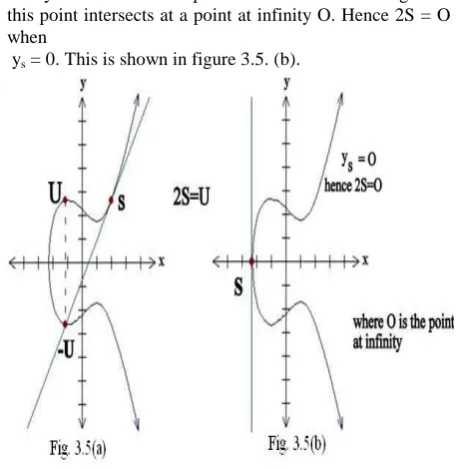
To double a point S to get U, i.e. to find U = 2S, consider a point S on an elliptic curve as shown in figure 3.5. (a). If y coordinate of the point S is not zero then the tangent line at S will intersect the elliptic curve at exactly one more point –U. The reflection of the point –U with respect to x-axis gives the point U, which is the result of doubling the point S. Thus U = 2S.
If y coordinate of the point S is zero then the tangent at this point intersects at a point at infinity O. Hence 2S = O when
ys= 0. This is shown in figure 3.5. (b).
Fig 3.5 Point Doubling
F. Finite Fields
The elliptic curve operations defined above are on real numbers. Operations over the real numbers are slow and inaccurate due to round-off error. Cryptographic operations need to be faster and accurate. To make operations on elliptic curve accurate and more efficient, the curve cryptography is defined over two finite fields.
Prime field FP Binary field F2m
The field is chosen with finitely large number of points suited for cryptographic operations. Section G and H explains the Elliptic Curve operations on finite field. The operations in these sections are defined on affine coordinate system.
Affine coordinate system is the normal coordinate system [1], that each point in the coordinate system is represented by the vector (x, y)
G. EC on Prime field Fp:
The equation of the elliptic curve on a prime field Fp : y2mod p= x3+ ax + b mod p, where, 4a3+ 27b2mod p≠0(2)
Copyright © 2011 IJECCE, All right reserved However, the algebraic rules for point addition and point
doubling can be adapted for elliptic curves over Fp.
H. EC on Binary field F2m
The equation of the elliptic curve on a binary field F2 m
y2+ xy = x3+ ax2+ b, where b≠ 0 (3) Here the elements of the finite field are integers of length at most m bits. These numbers can be considered as a binary polynomial of degree m–1.
In binary polynomial the coefficients can only be 0 or 1. All the operation such as addition, subtraction, division, multiplication involves polynomials of degree m – 1 or lesser. The m is chosen such that there is finitely large number of points on the elliptic curve to make the cryptosystem secure. SEC [5] specifies curves with m ranging between 113-571 bits.
The graph for this equation is not a smooth curve. Hence the geometrical explanation of point addition and doubling as in real numbers will not work here. However, the algebraic rules for point addition and point doubling can be adapted for elliptic curves over F2
m [6].
I. Elliptic Curve Domain parameters:
Apart from the curve parameters a and b, there are other parameters that must be agreed by both parties involved in secured and trusted communication using ECC. These are domain parameters. The domain parameters for prime fields and binary fields are described below. Generally the protocols implementing the ECC specify the domain parameters to be used.
1) Domain parameters for EC over field Fp:
The domain parameters for Elliptic curve over Fpare p, a, b, G, n and h, p is the prime number defined for finite field Fp. a and b are the parameters defining the curve
y2mod p= x3+ ax + b mod p (4)
G is the generator point (xG, yG), a point on the elliptic curve chosen for cryptographic operations. n is the order of the elliptic curve. The scalar for point multiplication is chosen as a number between 0 and n–1.h is the cofactor where h = #E (Fp)/n. #E (Fp) is the number of points on an elliptic curve.
2) Domain parameters for EC over field F2m The domain parameters for elliptic curve over F2
m are m, f(x), a, b, G, n and h. m is an integer defined for finite field F2m.
The elements of the finite field F2 m
are integers of length at most m bits. f(x) is the irreducible polynomial of degree m used for elliptic curve operations and a and b are the parameters defining the curve
y2+ xy = x3+ ax2+ b (5)
G is the generator point (xG, yG), a point on the elliptic curve chosen for cryptographic operations, n is the order of the elliptic curve. The scalar for point multiplication is chosen as a number between 0 and n–1. h is the cofactor where h = #E (F2
m
)/n. #E (F2 m
) is the number of points on an elliptic curve.
IV. RSA: RIVEST, SHAMIR, ADLEMAN ALGORITHM RSA operations are modular exponentiations of large integers with a typical size of 512 to 2048 bits. RSA encryption generates a cipher text C from a message M based on a modular exponentiation C =Me mod n. Decryption regenerates the message by computing M=Cd mod n. Among the several techniques that can be used to accelerate RSA, we specially focused on those applicable under the constraints of 8-bit devices.
V.EC CRYPTOGRAPHY
An overview of EC cryptographic algorithms for key agreement and digital signature are explained below.
A. ECDSA - Elliptic Curve Digital Signature Algorithm:
Signature algorithm is used for authenticating a device or a message sent by the device. For example consider two devices A and B. To authenticate a message sent by A, the device A signs the message using its private key. The device A sends the message and the signature to the device B. This signature can be verified only by using the public key of device A [2]. Since the device B knows A’s public key, it can verify whether the message is indeed send by A or not. ECDSA is a variant of the Digital Signature Algorithm (DSA) that operates on elliptic curve groups. For sending a signed message from A to B, both have to agree up on Elliptic Curve domain parameters. Sender ‘A’ have a key pair consisting of a private key dA (a randomly selected integer less than n, where n is the order of the curve, an elliptic curve domain parameter) and a public key QA= dA* G (G is the generator point, an elliptic curve domain parameter). An overview of ECDSA process is defined below in 5.1.A and 5.1.B
1) Signature Generation
For signing a message m by sender A, using A’s private key dA
1. Calculate e= HASH (m), where HASH is a cryptographic hash function, such as SHA-1
2. Select a random integer k from [1,n− 1]
3. Calculate r = x1 (mod n), where (x1, y1) = k * G. If r= 0, go to step 2
4. Calculate s= k-1(e +dar)(mod n) 5. If s=0, goto step 2
6. The signature is the pair (r,s)
2) Signature Verification
For B to authenticate A's signature, B must have A’s public key QA
1. Verify that r and s are integers in [1, n− 1].If not, the signature is invalid.
2. Calculate e = HASH (m), where HASH is the same function used in the signature generation
3. Calculate w = s−1(mod n)
4. Calculate u1=ew(modn) and u2= rw(mod n) 5. Calculate (x1, y1) = u1G + u2QA
6. The signature is valid if x1 = r(mod n), invalid , otherwise
Copyright © 2011 IJECCE, All right reserved ECDH is a key agreement protocol that allows two parties to
establish a shared secret key that can be used for private key algorithms. Both parties exchange some public information to each other. Using this public data and their own private data these parties calculates the shared secret [8]. Any third party, who doesn’t have access to the private details of each device, will not be able to calculate the shared secret from the available public information. An overview of ECDH process is defined below for generating a shared secret between A and B using ECDH, both have to agree up on Elliptic Curve domain parameters. The domain parameters are defined in section 3.9. Both end have a key pair consisting of a private key d (a randomly selected integer less than n, where n is the order of the curve, an elliptic curve domain parameter) and a public key. G is the generator point, an elliptic curve domain parameter. Q = d * G
Let (dA, QA) be the private key - public key pair of A and (dB, QB) be the private key - public key pair of B. 1. The end A computes K = (xK, yK) = dA* QB 2. The end B computes L = (xL, yL) = dB* QA 3. Since dAQB= dAdBG=dBdAG=dBQA
4. Therefore K=L and hence xy=xl, Hence the shared secret key is xK.
Since it is practically impossible to find the private key dAor dBfrom the public key K or L, it’s not possible to obtain the shared secret for a third party.
VI. ELLIPTIC CURVE PRIMALITY TESTING: The implementations of several public key cryptosystems require the ability to build large primes as fast as possible. Elliptic curve primality testing technique is among the quickest and most widely used algorithm in primality proving. One of the most recent algorithms is due to Atkin [14], uses elliptic curve and generalizes most old theorems of Fermat and primality testing.
The concept of using elliptic curves in factorization had been developed by H.W. Lenstra in 1985 [13], and the implications for its use in primality testing (and proving) followed quickly.
The Atkin algorithm looks as follows.
(1) Select a curve C, with an integer m such that: • if indeed n is prime, then m = #C(Z/nZ);
• m has a proper divisor q≥ ( 2which is probably a prime.
(2) Now pick a point P ∈ C (Z/nZ) until (m/q). P has z-coordinate in (Z/nZ)*
Check that indeed q · m· P = O. (3) Prove recursively that q is prime.
VII. COMPARISION OF ECC WITH OTHER ALGORITHM
We know the security of ECC with the 160-bit key size is the same with that of RSA with 1024-bit key size. The security of ECC relies on the difficulty of solving the Elliptic Curve Discrete Logarithm Problem (ECDLP), i.e. finding k, given P and Q = kP. The problem is
computationally intractable for large values of k. In 2007, Chung et al. [11] proposed an ID-based digital signature scheme on elliptic curve cryptosystem (ECC). They claimed that their scheme is secure because it is based upon the difficulty of elliptic curve discrete logarithm problem (ECDLP)
Among other things, this makes it possible for two entities to agree on a shared secret across an insecure communication channel without revealing that secret to an eavesdropper. This secret can then be used as a key to encrypt/decrypt sensitive information. Each entity generates a key pair and sends its public key. Each entity multiplies its private key with the other's public key to compute a shared secret.
Based on above algorithms some observations have been presented here RSA Algorithm is based on Integer factorization. The mathematical problem in RSA is we have a given a number N and we find its prime factors. The best known method for solving (running time) for RSA is number field sieve, exp [1.923(log n)1/3 (log log n)2/3] (sub-exponential).
There are two discrete logarithms e.g. DSA and DH. These are based on mathematical problem in which a given a given prime number N and number g and h and we find x such that h= gxmodN. The best known method for solving (running time) is number field sieve exp [1.923(log n)1/3(log log n)2/3] (Sub-exponential).
Elliptic curve discrete logarithm uses two algorithms i.e. ECDH and ECDSA. The mathematical problem which is used in ECDH and ECDSA is that we have given an elliptic curve and points P and Q we find k such that Q=kP. The best known method for solving (running time) is Pollard rho algorithm, and number field sieve is ec√(log p)(log log p) (fully-exponential).
Elliptic curve primality proving can be done by Atkin algorithm. The basic mathematical problem is in ECPP is that we have given a number N which can be proved prime by using this algorithm. Complexity of ECPP is O ((log n) 5+€
) for some€>0. Hence ECC provides better approach as well as security from any other cryptosystem.
VIII.CONCLUSION ANDFUTURE WORK
Copyright © 2011 IJECCE, All right reserved Jen-Ho Yang et al.[12] find that Chung’s scheme has a
security flaw, and thus a feasible attack is possible on Chung et al.’s [11] scheme. They proposed attack is based on the technique for solving the linear Diophantine equation. Using the proposed technique, an attacker can easily obtain the signer’s secret key without facing the difficulty of ECDLP. There is a wide scope in providing secure transaction by using less no. of bits in keys so that any type of attack will be very difficult.
R
EFERENCES[1] H. Cohen, A. Miyaji, and T. Ono., “Efficient elliptic curve exponentiation using mixed coordinates”. In ASIACRYPT “Advances in Cryptology”, volume 1514 of Lecture Notes in
Computer Science, pages 51-65, Springer, 1998.
[2] ANSI X9.62, “Elliptic Curve Digital Signature Algorithm” (ECDSA), American Bankers Association, 1999.
[3] V.Miller, “Use of elliptic curves in Cryptography”, Volume
218/1986, Springer, 1986
[4] U.S. Department of Commerce, National Institute of Standards
and Technology, “Digital SignatureStandard (DSS)”, Federal Information Processing Standards Publication FIPS PUB 186-2, January 2000.
[5] Certicom Research, SEC 2: “Recommended Elliptic Curve
Domain Parameters”, Standards for Efficient Cryptography,
Version 1.0, September 2000.
[6] S. Chang Shantz, “Euclid's GCD to Montgomery Multiplication to the Great Divide”, Technical report, Sun Microsystems
Laboratories TR-2001-95, June 2001.
[7] L. Badia, “Real World SSL Benchmarking”, Rainbow
Technologies Whitepaper, Available at http://www.rainbow.com/insights/whitePDF/RealWorldSSLBen chmarking.pdf, Sep. 2001
[8] T. Dierks and C. Allen, “The TLS Protocol -Version 1.0.”,IETF RFC 2246, Available at http://www.ietf.org/rfc/rfc2246.txt, January 1999.
[9] C. Coarfa, P. Druschel and D. Wallach, “Performance Analysis of TLS Web Servers”, Network and Distributed Systems Security Symposium ’02, San Diego, California, Feb. 2002.
[10] Anoop MS, Elliptic Curve Cryptography, “An Implementation
Guide”, Available at
http://hosteddocs.ittoolbox.com/AN1.5.07.pdf, January 2007. [11] Y. F. Chung, K. H. Huang, F. Lai, and T. S. Chen, “ID based
Digital Signature Scheme on Elliptic Curve Cryptosystem”,
Computer Standards and Interfaces, Vol. 29, 2007, pp. 601-604.
[12] Jen-Ho Yang and Chin-Chen Chang,“Cryptanalysis of ID-Based Digital Signature Scheme on Elliptic CurveCryptosystem”8th International Conference on Intelligent Systems Design and Applications, 2008.
[13] Jr., A. K.; Lenstra and Jr. H. W, “Algorithms in number
theory”, Handbook of Theoretical Computer Science: Algorithms
and Complexity (Amsterdam and New York: The MIT Press) pp-673–715.
[14] Atkin, A. O. L. and Morain, F. “Elliptic Curves and Primality Proving” Math. Comput. 61, 29-68, 1993.
[15] N.Koblitz, Elliptic Curve Cryptosystems, Mathematics of
Computation, volA8, 1987, pp.203 -209.
[16] S. Maria Celestin Vigila and K. Muneeswaran“Implementation of Text based Cryptosystemusing Elliptic Curve Cryptography” IEEE transaction 2010.
[17] Bin Yu, “Establishment of elliptic curve
cryptosystem” Information Theory and Information Security
(ICITIS), IEEE International Conference on, 2010.
[18] Bin Yu, “Method to Generate Elliptic Curves Based on CM
Algorithm”,Information Theory and information security, IEEE
International Conference, 2011.
A
UTHOR’
SP
ROFILEShipra Shukla
was born in Kanpur, (U.P.), and India. She received the B.Tech. degree in Computer Science and Engineering in 2010 from Pranveer Singh Institute of Technology, Kanpur, India. She is currently pursuing M.Tech in Computer Science and Engineering from Kamala Nehru institute of Technology Sultanpur, U.P. India. Her one research paper has been published in International Journal.
Dharmendra Lal Gupta
is currently working as an Assistant Professor in the Department of Computer Science & Engineering at Kamla Nehru Institute of Technology, Sultanpur (U.P.) India. and he is also pursuing his Ph.D. in Computer Science & Engineering from Mewar University, Chittorgarh (Rajasthan). He received B.Tech.(1999) from Kamla Nehru Institute of Technology (KNIT) Sultanpur, in Computer
Science & Engineering, M.Tech. Hon’s (2003) in Digital Electronics and
Systems from Kamla Nehru Institute of Technology (KNIT) Sultanpur. His research interests are Cryptography and Network Security, Software Quality Engineering, and Software Engineering.
Dr. Anil Kumar Malviya
is an Associate Professor in the Computer Science & Engg.Department at Kamla Nehru Institute of Technology, (KNIT), Sultanpur. He received his B.Sc. & M.Sc. both in Computer Science from Banaras Hindu University, Varanasi respectively in 1991 and 1993 and Ph.D. degree in Computer Science from Dr. B.R. Ambedkar University, Agra in 2006.He is Life Member of CSI, India. He has published about 25 papers in International/National Journals, conferences and seminars. His research interests are Data mining, Software Engineering, Cryptography & Network Security.
Dr. Sarvottam Dixit