DOI: 10.5098/hmt.14.4 ISSN: 2151-8629
1
Frontiers in Heat and Mass Transfer
Available at www.ThermalFluidsCentral.org
MHD FLOW OF CARREAU NANOFLUID EXPLORED USING
CNT OVER A NONLINEAR STRETCHED SHEET
P.S.S.Nagalakshm∗andN.Vijaya
DepartmentofMathematics,KoneruLakshmaiahEducationFoundation,DeemedtobeUniversity,Vaddeswaram,Guntur,Andhra
Pradesh-522502,India
ABSTRACT
In the present investigation is to magnetohydrodymaics (MHD) radiative flow of an incompressible steady flow of Carreau nanofluid explored with carbon nanotubes. The boundary layer flow and heat transfer to a Carreau nanofluid model over a non- linear stretching surface is introduced. The Carreau model, adequate for many non-Newtonian fluids is used to characterize the behavior of the fluids having shear thinning properties and fluids with shear thickening properties for numerical values of the power law exponent n. The modeled boundary layer conservation equations are converted to non-linear coupled ordinary differential equations by a suitable transformation.R language with bvp solver was adopted to obtained numerical solutions of the resulting equations by using the Runge-Kutta method along with shooting technique. This analysis reveals many important physical aspects of flow and heat transfer. Computations are performed for different values of the stretching parameter(m),the Weissenberg number (We) and the Prandtl number (Pr).The obtained results show that the velocity of shear thinning fluid is depressed by the Weissenberg number while contrasting behavior for the shear thickening fluid is observed. A comparison with previously published data in limiting cases is performed and they are in excellent agreement.
Keywords:Shear thinning and Shear thickening,Radiation,Runge-Kutta method,R language.
1. INTRODUCTION
It is renowned fact that the magnetohydrodynamic (MHD), which is the science of motion of electrically conducting fluids, is one of the thrust areas of modern research. The elementary examples of electrically con-ducting fluids include plasmas, liquid metals (mercury or liquid sodium) and electrolytes. The basic theme of MHD is that if an electrically con-ducting fluid is placed in magnetic field then motion of fluid may create a force called electromotive force. The electromotive force has the ability to induce current. Ever since then, this field has a broad spectrum of sci-ence and engineering, specifically in geophysics, fusion reactors, disper-sion of metals, modern metallurgy and MHD generators etc. Moreover, MHD flows are of immense concern in problems related with physiolog-ical fluids.Pavlov(1974) was the pioneer who discussed the influence of magnetic field on MHD flow past a stretching surface. Another eminent contribution was given by Andersson(1992) who examined the MHD flow of a viscous fluid. Nanofluids can be described as a colloidal sus-pension of nanoparticles (1–100 nm) scattered uniformly in a base fluid. The nanoparticles are made from materials that are chemically stable like metals, oxides ceramics, carbides and non metals such as graphite and carbon nanotubes. Nanotubes are affiliates of the fullerene structural fam-ily. Their name arises from their long, resonating edifice with the ram-parts formed by one-atom-thick sheets of carbon,called graphene. These sheets are rolled at specific and discrete (“chiral”) angles, and the combi-nation of the rolling angle and radius decides the nanotube properties;for
†
Corresponding author. Email: [email protected]
example,whether the individual nanotube shell is a metal or semicon-ductor. Nanotubes are categorized as single-walled nanotubes (SWNTs) and multi-walled nanotubes (MWNTs). The commonly used base fluids are ethylene, water, oils and lubricants. Choi (1995) who was working with a group of Argonne National Laboratory USA,introduced the term Nanofluid. Nanofluids enhance the thermophysical properties of the base fluids used. Nanofluids have a wide range of practical applications, they can be used as smart materials to work as heat valve to control the flow of heat. Advanced electronic gadgets experience thermal management chal-lenges from reduction of accessible surface area for heat and high level of heat generation. These challenges can be avoided by either increasing the capacity of heat transfer or by finding an optimum geometry of cool-ing appliances. Due to their high thermal conductivity and increased heat transfer coefficient, nanofluids can be used for liquid coolant of computer processors. In presence of magnetic field, nanofluids have several engi-neering, industrial and biomedical applications such as cooling of nuclear reactors by liquid sodium and induction flow meter, magnetogravimet-ric separations, smart fluids for vibration damping, aerodynamic sensors magnetic drug targeting, nanocryosurgery and nanodrug delivery.
transport owing to their extensive applications in numerous genetic and developed progressions, materials and motorized engineering. Numer-ous materials, for instance biomedical flows, splashes, bio-fluids in ge-netic material and polymers are identified as non-Newtonian fluids. The non-Newtonian Carreau fluid model is the combination of Newtonian and power-law models. This fluid model is capable of describing both shear thinning and shear thickening phenomena. In spite of all such con-centrations, innumerable investigators are quiet engaged to scrutinize the analysis of non-Newtonian liquids under diverse prospective. Rheologi-cal equations from molecular network theories was presented byCarreau (1972). Hydromagnetic natural convection from an isothermal inclined surface adjacent to a thermally stratified porous medium has been stud-ied byChamkha(1997). "Unsteady flow and heat transfer on a semi-infinite flat plate with an aligned magnetic field (Takharet al.,1999)". "Unsteady three-dimensional MHD-boundary-layer flow due to the im-pulsive motion of a stretching surface (Takharet al.,2001)". Magne-tohydrodynamic three dimensional flow and heat transfer over a stretch-ing surface in a viscoelastic fluid was explored by Ahmad and Nazar (2011). Boundary layer flow and heat transfer to Carreau fluid over a nonlinear stretching sheet was presented byKhan and Hashim(2015). Numerical simulation of water based magnetite nanoparticles between two parallel disks were simulated by Haqet al.(2016). Impact of non-linear thermal radiation and gyrotacticmicroorganisms on the Magneto-Burgers nanofluid were studied by Khanet al.(2017). A microscopic study of MHD fractional inertial flow through Forchheimer medium were shown by Anwar and Rasheed(2017). Carbon nanotubes significance in Darcy-Forchheimer flow were established by Hayatet al.(2018). Lu et al.(2018) investigated the effect of a numerical treatment of MHD ra-diative flow of Micropolar nanofluid with homogeneous-heterogeneous reactions past a nonlinear stretched surface. "Unsteady squeezing car-bon nanotubes based nano-liquid flow with Cattaneo–Christov heat flux and homogeneous–heterogeneous reactions (Luet al.,2019)". Numer-ical study of Carreau nanofluid flow past vertNumer-ical plate with the Catta-neo–Christov heat flux model was shown byVasu and Ray(2019).
The objective of present investigation is to discuss the boundary layer flow and heat transfer of Carreau nanofluid model over a non-linear stretching surface. We obtained the boundary layer equations for the velocity field of the Carreau nanofluid explored with CNT. This model which, in comparison with the Newtonian case involves three additional dimensionless parameters, allows the characterization of a wide variety of shear-thinning fluids. The numerical method namely Runge-Kutta shoot-ing method is used to solve the non-linear governshoot-ing problem. The ob-tained results for both the fluid velocity and its temperature are presented for different values of parameters entering in the problem. The effects of engineering parameters, like the Weissenberg number (We), the power law index n and the Prandtl number (Pr) on the local skin friction and local Nusselt number are presented numerically in tabular form.
2. MATHEMATICAL FORMULATION
Consider the problem of an incompressible two dimensional flow of a generalized non Newtonian fluid, namely Carreaue nanofluid, due to a stretching sheet which coincides with the plane y=0. It is assumed that the flow being confined to y >0. A uniform magnetic field B0is applied
paral-lel to the y-axis . The induced magnetic field is neglected for small mag-netic reynold number. Heat and mass transfer characteristics are taken into account in the presence of thermal radiation and thermophoresis ef-fects. The uniform temperature of the surface Twis larger than ambient
fluid temperature T∞and it is moving with nonlinear velocity Uw. The
species concentration at the surface Cw and ambient concentration C∞
are constants. The following governing equations are introduced (Khan and Hashim,2015)
∂p ∂x+
∂q
∂y = 0 (1)
p∂p ∂x+q
∂p ∂y =νnf
∂2p
∂x2 1 +τ 2
∂p ∂y
2!(
n−1
2 )
+νnf(n−1)τ2
∂p ∂y
2
∂2p
∂x2 1 +τ 2
∂p ∂y
2!(
n−3
2 )
−σnf
ρnf
B2p+g(βT(T −T∞) +βC(C−C∞))
(2)
p∂T ∂x +q
∂T ∂y
(ρcp)nf =knf
∂2T ∂y2 +µnf
∂p ∂y
2
−σnf
ρnf
B2p2
+16σ s
T∞3
3ks
∂2T ∂y2
(3)
p∂C ∂x +q
∂C ∂y =D
∂2C ∂y2 −
∂
∂y(VT(C−C∞)) (4)
where p and q are the velocity components in x and y directions respectively ,νnf kinematic nanofluid viscosity ,τ material time
con-stant, n expression power law index ,ρnf density of nanofluid, knf
ther-mal conductivity of nanofluid ,σnf electrical conductivity of nanofluid
, g the gravitational accelerationβT and βC thermal expansion
coeffi-cients of temperature and concentration , cpspecific heat ,σsthe
Stefan-Boltzmann constant , ksthe mean absorption coefficient , D the
diffu-sion coefficient and B nonlinear uniform magnetic field VT the
ther-mophoretic velocity defined as
B=B0x( m−1
2 ), VT=−k1 ν
Tref
∂T
∂y (5)
where k1is the thermophoretic coefficient, Trefis the reference
temper-ature.
Corresponding boundary conditions are
p=pw(x) =bxm, q= 0, T =Tw, C=Cw at y= 0
p→0, T →T∞, C→C∞ as y→ ∞
(6)
where b and m are positive real numbers relating to the stretching sheet.
Nanofluid parameters are defined as
νnf =
µnf
ρnf
,
ρnf = (1−φ)ρbf +φρCN T,
µnf =
µbf (1−φ)2.5,
(ρcp)nf = (1−φ)(ρcp)bf+φ(ρcp)CN T,
knf
kbf
=(kCN T+ 2kbf)−2φ(kbf−kCN T) (kCN T+ 2kbf) +φ(kbf −kCN T)
,
σnf
σbf
= 1 + 3(σCN T−σf)φ
(σCN T+ 2σbf)−(σCN T−σbf)φ
(7)
Now introducing the following dimensionless variables for stream func-tion, temperature, concentration and the independent variable as:
ψ=
r
2bνbf
m+ 1x (m−21)
f(η), η=yx(m2−1)
s
b(m+ 1) 2νbf
,
p=∂ψ
∂y, q=− ∂ψ ∂x
θ(η) = (T−T∞) (Tw−T∞)
, h(η) = (C−C∞) (Cw−C∞)
DOI: 10.5098/hmt.14.4 ISSN: 2151-8629
Using the above variables into Eqs. (1)–(4) and boundary conditions (6) , governing equations are reduced as ordinary differential equations as follows
P1
P2
(1 +nW e2x(f 00
)2)(1 +W e2x(f 00
)2)n−23f000
−P3
P1
l1M f0+γl1(θ+N h)−β(f02) +f f00= 0
(9)
(1 + 4 3P5
R)θ00+P4
P5
(P rθ0f0)
+P1
P5
P rEc(f00)2−P3
P5
M l1EcP r(f0)2= 0
(10)
h00+Sc(f h0)−τsSc(hθ00+θ0h0) = 0 (11)
and the corresponding boundary conditions
f(0) = 0 , f0(0) = 1 , θ(0) = 1 , h(0) = 1 at η= 0
f0(η) = 0 , θ(η) = 0 , h(η) = 0 as η→ ∞
(12)
where prime denotes differentiation with respect toη,
β= 2m
m+ 1, l1= 2
m+ 1, W ex=
(m+ 1)τ2x3m−1
2νf
b3
0.5
,
γ= Grx
Re2 x
, Grx=
βT(Tw−T∞)x3
ν2 f
, Rex=
uwx
νf
,
P r=µcp
k , Ec=
u2w (cp)f(Tw−T∞)
, Sc=νf
D,
M= σfB 2 0
bρf
, N =βC(Cw−C∞)
βT(Tw−T∞)
,
R=4σ s
T∞3
ksk , τ s
=−k1(Tw−T∞)
Tref
(13)
Some nanofluid parameters are
P1= 1
(1−φ)2.5, P2=
(1−φ) +φρCN T ρbf
,
P3= 1 +
3(σCN T−σbf)φ (σCN T+ 2σbf)−(σCN T−σbf)φ
P4=
(1−φ) +φ(ρcp)CN T
(ρcp)bf
,
P5=
(1−φ) + 2φ kCN T kCN T−kbf
lnkCN T+kbf 2kbf
(1−φ) + 2φ kbf kCN T−kbf
lnkCN T+kbf 2kbf
(14)
Engineering parameters likeskin friction coefficient Cfx, local Nussult
Nuxand Sherwood Shxnumbers are defined as
Cfx=
τw
ρfp2w
, N Ux=
xqw
kf(Tw−T∞)
, Shx=
xjw
D(Cw−C∞) (15)
in whichτw, qw, and jwdenote the surface shear stress, the surface heat
flux and the surface mass flux respectively. Here
τw=µnf
∂p ∂y 1 +τ
2
∂p ∂y
2!(n−21)
y=0
,
qw=−knf
∂T ∂y
y=0
, jw=−D ∂C ∂y y=0 (16)
In dimensionless coordinates one can express that
Re0.5x Cfx=
m+ 1 2
0.5
(1 +we2x(f 00
)2)n−21(1−φ)−2.5f00(0),
Re−x0.5N ux=−
m+ 1 2
0.5
P5θ0(0),
Re−x0.5Shx=−
m+ 1 2
0.5
h0(0)
(17)
3. NUMERICAL METHOD FOR SOLUTION
The nonlinear differential Eqs. (9) to (11) with boundary conditions (12) have been solved numerically using Runge–Kutta fourth order method along with shooting technique using bvp solver package in R software. Thus, Eqs. (9) to (11) have been converted into first-order equations as follows:
g01=g2
g02=g3
g03=
β(g2)2−g1g3+PP3
2l1M g2−l1γ(g4+N g5)
P1
P2(1 +nwe
2
x(g3)2)(1 +we2x(g3)2) n−3
2
g04=g5
g05=
−P4
P5(P rg5f1)−
P1
P5P rEc(g3)
2 +P3
P5M l1EcP r(g2)
2
(1 + 4 3P5R)
g06=g7
g07=−Sc(g1g7) +τsSc(g6g 0 5+g7g5)
(18)
whereg1=f, g2=f0, g3=f00, g4=θ, g5=θ0, g6=h, g7=h0.
(19)
Boundary conditions (12) becomes,
g1(0) = 0, g2(0) = 1, g4(0) = 1, g6(0) = 1
g2(∞) = 0, g4(∞) = 0, g6(∞) = 0
(20)
In view of the above boundary conditions, out of seven only four ini-tial conditions are known and solution procedure is begun by three iniini-tial guesses ofg3(0),g5(0),g7(0)with the shooting method iteration to
as-sure the iteration convergence required to satisfy asymptotically bound-ary conditions at infinity. Thus, in the present study the value ofη=ηmax
is taken to be 10 and step-size is taken to be∆η=0.01 with relative error tolerance 10−5.
4. RESULTS AND DISCUSSION
The behavior of different variables for the velocity, thermal field, nanopar-ticles concentration, skin friction coefficient and local Nusselt and Sher-wood numbers are investigated through plots.
4.1. Accuracy assessment
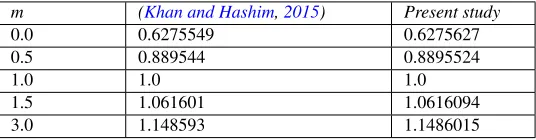
Accuracy of the present results are compared with results mentioned in Khan and Hashim(2015). In the absence of nanoparticles, Magnetic pa-rameters, Weissenberg number, local buoyancy parameter, Eckert num-ber, Schmidt numnum-ber, radiation parameter, these comparisons are found to be in excellent agreement as shown in tables 1 and 2.
4.2. Dimensionless velocity
velocity. Fig. 2 is plotted in order to examine the influence of magnetic field on Carreau nanofluid velocity for shear thickening fluid. It is clear from figures that the Carreau nanofluid velocity is a decreasing function of applied magnetic field. The inciting values of magnetic field param-eter reflect higher values of Lorentz force. Since this force is resistive in nature, the Carreau nanofluid particles faced resistance and hence a decline in velocity curves appeared. Fig. 2 also shows that the velocity profile is increasing function ofγ due to this boundary layer increases. Invetigators observe that all curves move to zero at the threshold value of
ηis 4.7. Forη= 0 the velocities have the same values since there is no slip condition between the nanofluid and the surface and it is due to the boundary condition at the wall.
4.3. Dimensionless temperature
Fig. 3 potrayed the behavior of radiation parameter(R), Prandtl number (Pr), and magnetic parameter(M). Thermal field and layer thickness are increasing functions of R. As expected, heat is produced due to radiation process in the working fluid, so the temperature field enhances. Temper-ature for Prandtl number (Pr) is drawn in Fig. 3 . Here both temperTemper-ature and layer thickness are diminished for larger Pr. Physically higher Pr lead to lower thermal diffusivity which results in the reduction of thermal field. Fig. 3 clearly indicates that the temperature and layer thickness are increased for larger magnetic parameter M. Physically higher magnetic parameter increases heat transfer coefficient which enhances the fluid temperature. Fig. 4 delineates temperature variation via Weissenberg number (we). For larger Weissenberg number (we) both temperature and layer thickness is decreased. In fact, less heat is produced through ran-dom motion of the fluid particles due to larger Weissenberg number (we) variable and consequently the temperature decreases. Invetigators ob-serve that thermal boundary layers move to zero at the threshold value of
ηis 5.7. Forη= 0 the temperature remains the same due to the boundary condition at the wall.
4.4. Dimensionless concentration
Graphical illustration for concentration against Schmidt number (Sc), ther-mophoretic parameter(τs ) are captured in Fig. 5. It is revealed that
concentration and related layer thickness are decayed for larger Schmidt number (Sc). Schmidt number (Sc) is the ratio of momentum to mass diffusivities. For enhancement of Schmidt number, the mass diffusivity diminishes which is responsible in reduction of concentration.Boundary layer of concetration decreases with increasing thermophoretic parameter shown in the figure. Outcomes of generative/destructive chemical reac-tionγ on concentration field are delineated in the figure. There is an enhancement in fluid concentration in view of destructive chemical reac-tion variable. Investigators observe that boundary layers of concentrareac-tion move to zero at the threshold value ofηis 5.7. Forη= 0 the concentration remains the same due to the boundary condition at the wall.
4.5. Dimensionless Engineering parameters
Behaviors of magnetic parameter(M), Weissenberg number(We) on skin friction coefficient, local Nusselt number, and local Sherwood number are disclosed in Table.3 .
4.6. Different Base fluids and Carbon nanotubes
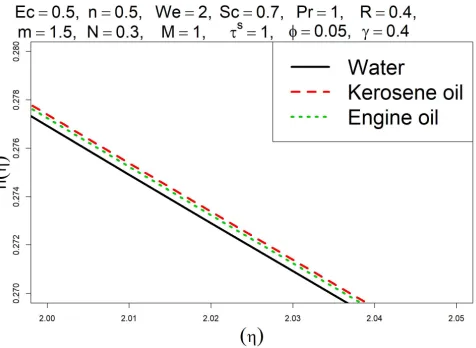
Figs. 6-7 shows that the momentum boundary layer of water based single-walled carbon nanotube is more when compared to kerosene and engine oil at both shear thinning and shear thickening fluid. Figs. 8-9 depict that the thermal boundary layer of water is more when compared to remaining base fluids in both shear thinning and shear thickening cases. Figs. 10-11 represent that concentration boundary layer of water is less when com-pared to the remaining base fluids in shear thinning but in shear thicken-ing the concentration of boundary layer increases. Momentum boundary layer of water based multi-walled carbon nanotube is more when com-pared to kerosene and engine oil at both shear thinning and shear
thick-ening fluid as shown in Figs. 12-13. Figs. 14-15 depict that the thermal boundary layer of water is more as compared to remaining base fluid in both shear thinning and shear thickening cases.Figs. 16-17. represents concentration boundary layer of water is less with reference to the re-maining base fluids in shear thinning but in shear thickening the concen-tration of boundary layer increases.
Fig.1 Velocity profile for Shear thinning and Shear thickening fluid with
Weissenberg number (We)
Fig.2VelocityprofileforShearthickeningfluidwithMagnetic parame-ter(M), and Local buoyancy parameter(γ)
DOI: 10.5098/hmt.14.4 ISSN: 2151-8629
Fig. 4Temperature profile for Shear thickening and Shear thinning fluid with Weissenberg number (We)
Fig. 5Concentration profile for thermophoretic parameter(τs),Schmidt number(Sc), and Local buoyancy paramete(γ)
Fig. 6Velocity profile for Shear thinning fluid with SWCNT
Fig. 7Velocity profile for Shear thickening fluid with SWCNT
Fig. 8Temperature profile for Shear thinning fluid with SWCNT
Fig. 10Concentration profile for Shear thinning fluid with SWCNT
Fig. 11Concentration profile for Shear thickening fluid with SWCNT
Fig. 12Velocity profile for Shear thinning fluid with MWCNT
Fig. 13Velocity profile for Shear thickening fluid with MWCNT
Fig. 14Temperature profile for Shear thinning fluid with MWCNT
DOI: 10.5098/hmt.14.4 ISSN: 2151-8629
Fig. 16Concentration profile for Shear thinning fluid with MWCNT
Fig. 17Concentration profile for Shear thickening fluid with MWCNT
Table 1A Comparison of the values off00(0)with n = 1.0 , We=0.0 , M=0.0 ,γ=0.0 , Pr=1.0 , Ec=0.0 , Sc=0.0 , R=0.0 ,φ=0.0 for different values of m.
m (Khan and Hashim,2015) Present study
0.0 0.6275549 0.6275627
0.5 0.889544 0.8895524
1.0 1.0 1.0
1.5 1.061601 1.0616094
3.0 1.148593 1.1486015
Table 2A Comparison of the values ofθ0(0)with n = 1.0,We=0.0,M=0.0,
γ=0.0,Pr=1.0,Ec=0.0,Sc=0.0,R=0.0,φ=0.0 for different values of m.
m (Khan and Hashim,2015) Present study
0.2 0.610202 0.6102159
0.5 0.595201 0.5952237
1.5 0.574730 0.5747717
3.0 0.564662 0.5647180
10.0 0.554951 0.5549518
Table 3Engineering parameters.
M m=1,we=3.0 Re0.5x Cfx Re0.5x Cfx
Pr=1.0,N=0.3, n<1 n>1 0.0 γ=0.4,Ec=0.5, -0.6972142 -1.078309 0.3 Sc=0.7,τs=0.3, -0.7764511 -1.249008
0.6 τs=0.3, -0.8461109 -1.409071 0.8 φ= 0.05 -0.8883215 -1.510718 we m=1,M=3.0, Re0.5x Cfx Re0.5x Cfx
Pr=1.0,N=0.3, n<1 n>1 2.0 γ=0.4,Ec=0.5, -0.9520452 -1.271478 3.0 Sc=0.7,τs=0.3, -0.8572339 -1.354897 3.5 τs
=0.3, -0.8192214 -1.392846 4.0 φ= 0.05 -0.7862717 -1.428434 M m=1,we=3.0 Re−x0.5Nux Re−x0.5Nux
Pr=1.0,N=0.3, n<1 n>1 0.0 γ=0.4,Ec=0.5, 0.3741720 0.4515941 0.3 Sc=0.7,τs=0.3, 0.3542758 0.4706764 0.6 τs=0.3, 0.3274603 0.4864306
0.8 φ= 0.05 0.3071349 0.4956823 we m=1,M=3.0, Re−x0.5Nux Re−x0.5Nux
Pr=1.0,N=0.3, n<1 n>1 2.0 γ=0.4,Ec=0.5, 0.4060392 0.4836219 3.0 Sc=0.7,τs=0.3, 0.3760004 0.4990199 3.5 τs=0.3, 0.3630353 0.5056448 4.0 φ= 0.05 0.3513489 0.5116711 M m=1,we=3.0 Re−x0.5Shx Re−x0.5Shx
Pr=1.0,N=0.3, n<1 n>1 0.0 γ=0.4,Ec=0.5, 0.5992370 0.6526943 0.3 Sc=0.7,τs
=0.3, 0.5699964 0.6406981 0.6 τs=0.3, 0.5418290 0.6297297 0.8 φ= 0.05 0.5238310 0.6229667 we m=1,M=3.0, Re−0.5
x Shx Re−x0.5Shx
Pr=1.0,N=0.3, n<1 n>1 2.0 γ=0.4,Ec=0.5, 0.5897155 0.6324397 3.0 Sc=0.7,τs=0.3, 0.5750112 0.6416226
3.5 τs=0.3, 0.5688794 0.6455807 4.0 φ= 0.05 0.5634512 0.6491782
5. CONCLUSIONS
MHD flow of Carreau nanofluid explored using CNT over a nonlinear stretched sheet with thermal radiation ,buoyancy and magnetic parame-ters has been studied. This investigation has explored that threshold value of momentum boundary layer is less than the threshold value of thermal and concentration boundary layers because of the effect of radiation and Local buoyancy parameter.
It was observed that the velocity profile diminished for n<1 and the contrary was true for n>1 with increasing value of Weissenberg num-ber (we). Moreover opposite behavior was observed for the tempera-ture and concentration profiles. The temperatempera-ture and thermal boundary layer thickness was decreased by the increasing Prandtl number (Pr). In-creasing phenomenon of Schmidt number leads to low nanopartilce con-centration.Investigators observed that radiation is one of the cause to re-duce the boundary layer of Concentration with Local buoyancy paramter relative to thermophoretic parameter. Investigators noticed that due to thermal conductivity and specific heat of Water, water based carbon nan-otube(SWCNT and MWCNT) profiles are enhanced when compared to the remaning base fluids except at concentration profile, because of ther-mophoretic parameter.
Nu-merical Simulations were obtained by bvp solver using R-Software.
ACKNOWLEDGEMENTS
Investigators are extremely thankful to Koneru Lakshmaiah Education Foundation and Jawaharlal Nehru Architecture and Fine Arts University for giving a lot of support during this research work at the Department of Mathematics , Koneru Lakshmaiah Education Foundation,Guntur and Department of Digital Technology, Jawaharlal Nehru Architecture and Fine Arts University,Hyderabad.
NOMENCLATURE
x,y Cartesian coordinates
p,q Velocity components inx,ydirections respectively
B Magnetic field intensity
B0 Constant magnetic field intensity
g Gravitational acceleration
T Temperature of the flow field
C Species concentration
Tw Temperature at the wall
T∞ Temperature of the fluid outside the boundary layer
Tref Reference temperature
Cw Concentration at the wall
C∞ Concentration outside the boundary layer
D Diffusion coefficient
VT Thermophoretic velocity
k1 Thermophoretic coefficient
cp Specific heat
knf Thermal conductivity of nanofluid
kbf Thermal conductivity of basefluid
kCN T Thermal conductivity of CNT
ks Mean absorption coefficient
wex LocalWeissenberg number
Grx Local Grashof number
Rex Local Reynolds number
P r Prandtl number
Ec Eckert number
Sc Schmidt number
M Magnetic parameter
N Concentration buoyancy parameter
R Radiation parameter
n Power law index
m,b positive real numbers relating to the stretching
Greek Symbols
ρ Fluid density
γ Local buoyancy parameter
τ Material time constant
βT Thermal expansion coefficients of temperature
βC Thermal expansion coefficients of Concentration
σs
Stefan-Boltzmann constant
νnf Coefficient of kinematics viscosity of nanofluid
µnf Coefficient of viscosity of nanofluid
µbf Coefficient of viscosity of basefluid
φ Nanoparticle volume fraction
σnf Electrical conductivity of nanofluid
σbf Electrical conductivity of basefluid
σCN T Electrical conductivity of CNT
ψ Stream function
η Similarity variable
θ Dimensionless fluid temperature
h Dimensionless fluid Concentration
τs Thermophoretic parameter
REFERENCES
Ahmad, K., and Nazar, R., 2011, “Magnetohydrodynamic three dimen-sional flow and heat transfer over a stretching surface in a viscoelastic fluid.”J Sci Technol,3, 1–14.
https://publisher.uthm.edu.my/ojs/index.php/JST/article/view/195.
Andersson, H., 1992, “MHD flow of a viscoelastic fluid past a stretching surface.”Acta Mech,95, 227–230.
https://doi.org/10.1007/BF01170814.
Anwar, M., and Rasheed, A., 2017, “A microscopic study of MHD fractional inertial flow through Forchheimer medium.”Chin J Phys,55, 1690–703.
https://doi.org/10.1016/j.cjph.2017.05.011.
Carreau, P., 1972, “Rheological equations from molecular network theo-ries,”Trans Soc Rheol 1972,16, 99–127.
https://doi.org/10.1122/1.549276.
Chamkha, A., 1997, “Hydromagnetic natural convection from an isother-mal inclined surface adjacent to a therisother-mally stratified porous medium.”
Int J Eng Sci,35, 975–86.
https://doi.org/10.1016/S0020-7225(96)00122-X.
Haq, R., Noor, N., and Khan, 2016, “Numerical simulation of water based magnetite nanoparticles between two parallel disks.”Adv Powder Tech-nol,27, 1568–75.
https://doi.org/10.1016/j.apt.2016.05.020.
Hayat, T., Rafique, K., Muhammad, T., Alsaedi, A., and Ayub, M., 2018, “Carbon nanotubes significance in Darcy-Forchheimer flow,” Re-sults Phys 2018,8, 26–33.
https://doi.org/10.1016/j.rinp.2017.11.022.
Khan, M., and Hashim, 2015, “Boundary layer flow and heat transfer to Carreau fluid over a nonlinear stretching sheet.”AIP Advances,5, 107– 203.
https://doi.org/10.1063/1.4932627.
Khan, M., Irfan, M., and ., W.K., 2017, “Impact of nonlinear thermal radi-ation and gyrotactic microorganisms on the Magneto-Burgers nanofluid.”
Int J Mech Sci,130, 375–82.
https://doi.org/10.1016/j.ijmecsci.2017.06.030.
Lu, D., Li, Z., Ramzan, M., Shafee, M., and Chung, J., 2019, “Un-steady squeezing carbon nanotubes based nano-liquid flow with Catta-neo–Christov heat flux and homogeneous–heterogeneous reactions.”Sci Rep 2018,9, 169–178.
https://doi.org/10.1007/s13204-018-0899-1.
Lu, D., Ramzan, M., Ahmad, S., Chung, J., and Farooq, U., 2018, “A nu-merical treatment of MHD radiative flow of Micropolar nanofluid with homogeneous-heterogeneous reactions past a nonlinear stretched sur-face.”Sci Rep 2018,8, 12431.
https://doi.org/10.1038/s41598-018-30965-x.
Pavlov, K., 1974, “Magnetohydrodynamic flow of an incompressible vis-cous fluid caused by the deformation of a plane surface.” Magnetohydro-dynamic,10, 146–148.
http://doi.org/10.22364/mhd.
Takhar, H., Chamkha, A., and Nath., G., 1999, “Unsteady flow and heat transfer on a semi-infinite flat plate with an aligned magnetic field,”Int J Eng Sci 1999l,37, 1723–36.
DOI: 10.5098/hmt.14.4 ISSN: 2151-8629
Takhar, H., Chamkha, A., and Nath, G., 2001, “Unsteady three-dimensional MHD-boundary-layer flow due to the impulsive motion of a stretching surface.”Acta Mechl,146, 59–71.
https://doi.org/10.1007/BF01178795.
Vasu, B., and Ray, A., 2019, “Numerical study of Carreau nanofluid flow past vertical plate with the Cattaneo–Christov heat flux model.” IntJNu-merMethods Heat Fluid Flow 2019,29, 702–723.