In Pursuit of Excellence in Science
6OL.O$ECEMBERs)33.
ASM
Science Journal
5(2) 201
1
ReSeARch ARticleS
Preparation and characterization of carboxylic-functionalized
Multi-walled carbon Nanotubes 91
L.K. Zakiyah, M.M. Gui, R.S. Foo, A.R. Mohamed and S.P. Chai
Impact of Landfills on Groundwater in Selangor, Malaysia 101
S. Suratman, I. Tawnie and A. Sefei
effect of Nickel and Platinum Addition on the thixotopic
Behaviour of lead-free Solder Paste 109
R. Durairaj, K.C. Leong, L. Chia Wea and M.C. Wong
Cortical Spreading Depression during Repeated Stimulation —
a Magnetoencephalographic Study 115
T. Begum, F. Reza and J.M. Abdullah
Review
Manufacturing Process Variability: A Review 123
M.A. Djauhari
Impact of Climate Change on Animal Production in Asia:
Coping with Challenges for Agricultural R&D 138
C. Devendra
contents
ASM Sc. J.
Volume 5(2), 2011
Price (2 issues)
Malaysia: RM100 (Individual) RM200 (Institution)
Other Countries: USD50 (Individual) USD100 (Institution)
INTERNATIONAL ADVISORY BOARD
Ahmed Zewail (Nobel Laureate)
Richard R. Ernst (Nobel Laureate)
John Sheppard Mackenzie
M.S. Swaminathan
EDITORIAL BOARD
Editor-in-Chief/Chairman: Md. Ikram Mohd Said
Abdul Latiff Mohamad
Chia Swee Ping
Ibrahim Komoo
Lam Sai Kit
Lee Chnoong Kheng
Looi Lai Meng
Mashkuri Yaacob
Mazlan Othman
Mohd Ali Hashim
Francis Ng
Cover:
Climate changes will have significant major effects on animal production. This is reflected in reduced performance, multifunctionalty and contribution to stable livelihoods. The hardest hit will be an estimated 85% of the 470 million global total of resource-poor small farms, small farmers, landless and agricultural labourers. These individuals are largely illiterate, have little or no access to credit, markets, information, risk-sharing tools, and property rights. The available production resources in the farm are put to maximum use in traditional systems that just enable subsistence living, and with reasonable weather, income from the sale of farm produce. An example is the use of animal manure to fertilise crop land in the face of high prices for inorganic fertilisers (Figure 1, pp. 144). With the many constraints, these farmers have limited ability to adapt to the new technology and farming practices that can mitigate the negative effects of climate change. Adaptation to rising temperatures and changing weather patterns is therefore crucial to the food security of millions of farmers.
Climate change impact therefore further exacerbates the complex interactions with the environment. Type of production system is also an important consideration. While stall feeding arrangements enable some control over stress, ruminants in the more extensive systems are more vulnerable mainly because of feed scarcity. Ability to cope and adapt to climate change will be particularly challenging, and important. Goats for example, prefer and flourish in hot dry environments such as the semi-arid AEZs conditions, rapidly multiply resulting in overstocking, ownership of larger flocks, and possible soil and environmental degradation. Improved soil and agronomic practices are important strategies to promote carbon sequestration in integrate systems with ruminants, and therefore merit urgent development priority (Figure 2, pp. 144).
Cover illustation—from the article entitled Impact of Climate Change on Animal Production in Asia: Coping with Challenges for Agricultural R&D (pp. 139–150).
In Pursuit of Excellence in Science
6OL.O$ECEMBER s)33.
© Academy of Sciences Malaysia
All rights reserved. No part of this publication may be reproduced in any form or by any means without permission in writing from the Academy of Sciences Malaysia. The Editorial Board, in accepting contributions for publications, accepts no responsibility
for the views expressed by authors.
ASM Science Journal is listed and indexed in Scopus. Published by the Academy of Sciences Malaysia
The Academy of Sciences
Malaysia (ASM)
The Academy of Sciences Malaysia (ASM) was established, under the Academy of Sciences Act 1994
which came into force on 1 February 1995, with the ultimate aim to pursue excellence in science. Thus the mission enshrined is to pursue, encourage
and enhance excellence in the field of science,
engineering and technology for the development of
the nation and the benefit of mankind.
The functions of the Academy are as follows:
•
To promote and foster the development of science, engineering and technology•
To provide a forum for the interchange of ideas among scientists, engineers and technologists•
To promote national awareness, understanding andappreciation of the role of science, engineering and technology in human progress
•
To promote creativity among scientists, engineers and technologists•
To promote national self-reliance in the field ofscience, engineering and technology
•
To act as a forum for maintaining awareness on thepart of the Government of the significance of the
role of science, engineering and technology in the development process of the nation and for bringing national development needs to the attention of the scientists, engineers and technologists
•
To analyse particular national problems and identify where science, engineering and technology can contribute to their solution and accordingly to make recommendations to the Government•
To keep in touch with developments in science,engineering and technology and identify those developments which are relevant to national needs to bring such developments to the attention of the Government
•
To prepare reports, papers or other documents relating to the national science, engineering and technology policy and make the necessary recommendations to the Government•
To initiate and sponsor multi-disciplinary studies related to and necessary for the better understanding of the social and economic implications of science, engineering and technology•
To encourage research and development andeducation and training of the appropriate scientific,
engineering and technical man power
•
To establish and maintain relations between the Academy and overseas bodies having the same oralmost similar objectives in science, engineering and
technology as the Academy
•
To advise on matters related to science, engineering and technology as may be requested by the Government from time to time; and•
To carry out such other actions that are consistent with the 1994 Academy of Sciences Act as may be required in order to facilitate the advancement of science, engineering and technology in Malaysia, and the well being and status of the Academy.The Academy is governed by a Council. Various Working Committees and Task Forces are charged with developing strategies, plans and programmes in line with
the Academy’s objectives and functions.
The functions of the Council are:
•
To formulate policy relating to the functions of the Academy•
To administer the affairs of the Academy•
To appoint such officers or servants of the Academyas are necessary for the due administration of the Academy
•
To supervise and control its officers and servants•
To administer the Fund; and•
To convene general meetings of the Academy todecide on matters which under this Act are required to be decided by the Academy.
The Academy has Fellows and Honorary Fellows. The Fellows comprise Foundation Fellows and Elected Fellows. The Academy Fellows are selected from the ranks of eminent Malaysian scientists, engineers and
technocrats in the fields of medical sciences, engineering
sciences, biological sciences, mathematical and physical sciences, chemical sciences, information technology and science and technology development and industry.
The Future
Creativity and innovation are recognised the world over as the key measure of the competitiveness of a nation. Within the context of K-Economy and the framework of National Innovation System (NIS), ASM will continue to spearhead efforts that will take innovation
and creativity to new heights in the fields of sciences,
ReseaRch aRticles
Preparation and characterization of carboxylic-functionalized
Multi-walled carbon Nanotubes 91
L.K. Zakiyah, M.M. Gui, R.S. Foo, A.R. Mohamed and S.P. Chai
Impact of Landfills on Groundwater in Selangor, Malaysia 101 S. Suratman, I. Tawnie and A. Sefei
effect of Nickel and Platinum addition on the thixotopic
Behaviour of lead-free solder Paste 109
R. Durairaj, K.C. Leong, L. Chia Wea and M.C. Wong
Cortical Spreading Depression during Repeated Stimulation —
a Magnetoencephalographic Study 115
T. Begum, F. Reza and J.M. Abdullah
Review
Manufacturing Process Variability: A Review 123
M.A. Djauhari
Impact of Climate Change on Animal Production in Asia:
Coping with Challenges for Agricultural R&D 138
C. Devendra
contents
EDuCAtIon FoRuM
a transformational Role for our varsities 151
A.R. Omar
RESEARCh oVERVIEw
Space Research Areas and Capacity needs – Gaps, Issues and Challenges 153 R. Varatharajoo
CoMMEntARy
Development of hybrid Rice for Food Security in the world 157 Long-Ping Yuan
wildlife Rescue and Rehabilitation Center: Do we need one in Malaysia? 159 S. Vellayan
nEwS FoCuS
Algae, the next Palm oil 165
Ahmad Ibrahim
no Stopping Rare Earths Expansion 166
Ahmad Ibrahim
Integrated Approach to Fight Diseases 167
C.P. Ramachandran
AnnounCEMEntS
Mahathir Science Award Foundation 169
Joint G8+ science academies’ statement on water & health 170
Carbon nanotubes (CNTs) are one of the allotropes of carbon and are members of the fullerene structural family (Daniel et al. 2007). CNTs possess many outstanding properties such as superb mechanical strength, excellent electronic properties and chemical inertness apart from having large surface areas and are ultra-light (Yang et al. 2007; Feng et al. 2008). These properties have inspired researchers to
put CNTs into application in various fields, for example as
electrode materials, polymer composites, electrochemical biosensors and many more (Feng et al. 2007; Wang & Lin 2008). The fact that CNTs are hydrophobic structures, however, has caused quite a problem when it comes to their development. Considering the surface of CNTs as inert also limits certain applications (Chen & Shimizu 2008). Nevertheless, these problems can be easily overcome by functionalizing them with oxygen-containing groups, mainly carboxyl and hydroxyl, to increase their solubility in aqueous or organic solvents as well as to provide some areas where the polymers can anchor themselves to the CNTs (Balasubramanian & Burghard 2005).
Functionalization of CNTs can be done in two ways: covalent attachment and non-covalent attachment (Balasubramanian & Burghard 2005; Daniel et al. 2007). Covalent functionalization is based on the chemical bond formation between functional groups and CNTs, whereas
non-covalent functionalization is achieved by forming van der Waals bonds between the functional groups and the tube walls using methods such as adsorption, entrapment and wrapping (Goyanes et al. 2007; Harris 2009). The two methods of functionalization have their own advantages and disadvantages. Covalent functionalization has been observed to be able to provide higher stability, accessibility and selectivity due to the way functional groups attach themselves to the CNTs (Daniel et al. 2007). By undergoing the oxidizing treatment, these carboxylic acids are more likely to attach themselves at the CNTs’ caps and defect sites on the sidewalls as they are more reactive compared to the rest of the area due to the presence of the dangling or open bonds (Yang et al. 2007; Yun et al. 2007). However, the oxidation treatment of CNTs with acids and/or covalently attached biomolecules into the functionalized CNTs may alter their electronic properties since these properties rely heavily on the structure and diameter of CNTs (Daniel et al. 2007). In fact, several researchers have reported that chemically oxidized CNTs with carboxylic acids may induce more damage on the sidewalls and increase the defect sites depending on the type of acids and parameters used (Chen et al. 2005; Goyanes et al. 2007; Shieh et al. 2007). Although this will increase the reactivity and solubility of CNTs as more dangling bonds are created and more carboxylic residues can be attached, it is regarded as
Preparation and Characterization of
Carboxylic-functionalized Multi-walled Carbon Nanotubes
L.K. Zakiyah1, M.M. Gui1, R.S. Foo1, A.R. Mohamed2 and S.P. Chai2
The functionalization of pristine CNTs is necessary for carbon nanotubes (CNTs) to be fully utilized, with the aim of increasing the nanotube reactivity and solubility in aqueous solutions. In this study, multi-walled carbon nanotubes (MWCNTs) were functionalized with a carboxylic group as this was an important step prior to application. The carboxylic group-functionalization was conducted through acid treatment, using sulphuric and nitric acids mixed at a ratio of 3:1 (v/v) and sonication for 30 min under different temperatures and time durations. The functionalization conditions of 50ºC 5 h and 60ºC 3 h were identified to be most suitable for introducing a carboxylic group onto the nanotube surfaces. The percentage of total weight loss due to the carboxylic group on the MWCNTs treated at 50ºC 5 h and 60ºC 3 h obtained from the thermogravimetric analysis was 13.26% and 13.76%, respectively. For both samples, peaks corresponding to the carboxylic
group were identified in the FT-IR spectra. The changes in the morphology of the treated MWCNTs were also
observed under SEM analysis.
Key words: Functionalization; carbon nanotubes; carboxylic groups; scanning electron microscopy; acid
treatment; sonication; oxidation; FTIR; TGA
ASM Sci. J., 5(2), 91–100
1School of Engineering, Monash University, Jalan Lagoon Selatan, 46150 Bandar Sunway, Selangor, Malaysia
2School of Chemical Engineering, Universiti Sains Malaysia, Engineering Campus, Seri Ampangan, 14300 Nibong Tebal, SPS Pulau
Pinang, Malaysia
ASM Science Journal, Volume 5(2), 2011
92
disadvantageous situation for the development of certain applications such as electrochemical biosensors (Daniel et al. 2007).
In comparison, non-covalent functionalization is much less damaging since it is capable of attaching desired molecules to CNTs without forming any chemical bonds, thus the CNTs can retain their original properties (Harris 2009). The problem with this type of functionalization is most of the methods used require high skills and rare equipment thus limiting the commercialization potential of these methods. Since the bonding depends on the van der Waals forces alone, these methods may provide lesser stability than the covalent functionalization methods (Goyanes et al. 2007). It is well documented that although covalent methods are much cheaper and easier to apply, they can be tricky as well. On the other hand, non-covalent methods may be suitable for applications such as biosensors but they are not exactly cost effective and simple to do. Therefore, it is critical to develop a better way to conduct covalent functionalization without damaging the CNT structures as they are more advantageous in term of commercial production and manufacturing cost.
In this present study, a procedure combining the sonication and oxidation methods was utilized to develop the carboxylic-functionalized CNTs. The purpose of sonication was mainly to increase the dispersibility of CNTs in the solutions which in turn reduced the agglomeration of CNTs. Various conditions of temperature and time were set as parameters in order to study the effect of these two factors on the functionalization process. The developed carboxylic-functionalized CNTs were characterized
by Fourier Transform infrared spectroscope (FT-IR),
thermogravimetric analyzer (TGA), and scanning electron microscope (SEM).
Materials aNd Methods
MWCNTs used for this study were synthesized from Co-Mo/MgO catalyst in a horizontal rotary reactor. An amount of 30 mg of MWCNTs were added into a mixture of 30 ml sulphuric acid (98% purity) and 10 ml of nitric acid (70% purity). The mixture was sonicated in a water bath at room temperature (25ºC) for 30 min and then heated and stirred
under a reflux condition. Table 1 shows the conditions for
which the MWCNTs were treated. Once the acid treatment was completed, the mixture was cooled down to room temperature and diluted with distilled water. The diluted
mixture of acid and MWCNTs were filtered with 0.2 µm nylon membrane filter. When all the diluted mixture was filtered, the residue was washed with distilled water until the
pH became neutral. The washed residue was then scraped
off the nylon membrane filter and dried in an oven at a
temperature of 105ºC. The characterizations of the treated
MWCNTs were done by FT-IR (Nicolet iS10), SEM (FEI
Qunta 200) and TGA (TA Q50). For preparing the samples
for the FT-IR analysis, the dried samples of MWCNTs were
mixed with KBr powder at a ratio of 1:20 (v/v), ground and compressed at 8 tons by a manual hydraulic jet to form a transparent, thin pellet. TGA was then performed on the samples to quantitatively analyze the weight loss due to the functional groups attached on the MWCNTs upon heating (Kim et al. 2010; Mamba et al. 2010). For TGA, the treated
MWCNTs were flushed with purified air or nitrogen gas at
a heating rate of 10ºC/min from ambient temperature up to 900ºC. The TGA thermogram was analyzed for the presence of functional groups such as carboxylic and hydroxyl groups on the MWCNTs by calculating the weight loss at
the specific temperature range.
Table 1. Acid treatment conditions.
Sample Temperature (ºC) Time (hr)
1 50 1
2 50 3
3 50 5
4 60 1
5 60 3
6 70 1
7 70 3
8 70 5
results aNd disCussioN
Characterization of Pristine MWCNts
FT-IR analysis was performed on the pristine MWCNTs so
as to analyze the functional groups attached to the surface
prior to any acid treatment. Figure 1 shows the FT-IR
spectrum of the pristine MWCNTs. The spectrum of the pristine MWCNTs displayed in Figure 1 shows the peaks for the OH and C=O groups. The relatively broad and strong OH peak at 3440 cm–1 attributed to the inherent moisture of
the KBr powder and for the atmospheric moisture present on the MWCNTs (Kim et al. 2007; Datsyuk et al. 2008; Men et al. 2008; Chokoli et al. 2009). In addition, the weak peak of C=C at the wavenumber of 1570 cm–1 shows the
characteristic of CNT skeleton (Jiang et al. 2009; Mamba et al. 2010), whereas the C-H peaks which appeared in between 2980 cm–1 and 2840 cm–1 indicate that the pristine
MWCNTs contain defects which may have been formed when they were produced (Chokoli et al. 2009;
Rosario-Castro et al. 2009).
To analyze the carbon content and purity of the pristine
MWCNTs, TGA was conducted under purified air. Figure
2 shows the TGA thermogram for the pristine MWCNTs. It was shown that 0.96% of the total weight of the pristine MWCNTs was the moisture content. It is well accepted that
OH
C-H
C= O
CO2 C=C
A
bs
or
ba
nc
e
(a
.u
.)
3500 3000 2500 2000 1500 1000 500
Wavenumber (cm- 1)
0.96 % moisture 1.73% amorphous carbon
66.8% CNTs
W
ei
gh
t (
%
)
20 40 60 80 100 120
200 400 600 800 1000
0
Temperature (ºC) OH
C-H
C= O
CO2 C=C
A
bs
or
ba
nc
e
(a
.u
.)
3500 3000 2500 2000 1500 1000 500
Wavenumber (cm- 1)
0.96 % moisture 1.73% amorphous carbon
66.8% CNTs
W
ei
gh
t (
%
)
20 40 60 80 100 120
200 400 600 800 1000
0
Temperature (ºC)
Figure 1. FT-IR spectrum of pristine MWCNTs.
ASM Science Journal, Volume 5(2), 2011
94
amorphous carbon oxidizes in the temperature range of 100ºC – 500ºC. From the TG curve, the amorphous carbon content in the pristine MWCNTs was found to be 1.73%. The weight loss in the temperature range of 500ºC – 700ºC, corresponding to the MWCNTs content, was determined to be 66.8%.
The SEM images of the pristine MWCNTs are shown in Figure 3. The SEM micrograph of the pristine MWCNTs
at low magnification showed bulky rock-like pristine MWCNTs and at higher magnification, the pristine
MWCNTs were shown to be similar to bundles of unaligned and highly coiled ropes.
Characterization of treated MWCNts
Fourier transform infrared spectroscopy. The spectra of the treated MWCNT samples based on the temperature are shown in Figures 4–6. From Figure 4, both the
FT-IR spectra for the MWCNTs treated at 50ºC 3 h and 50ºC 5 hr show quite similar peaks albeit with different intensity. The peak at 3440 cm–1 indicate the presence of
the OH stretching mode of water molecules present in the MWCNTs and/or KBr powder during the analysis (Yu et al. 2008; Jiang et al. 2009). If the carboxylic group was present, there should be a C=O stretching vibration band at 1630 cm–1 and OH bending vibrations between 1390
cm–1 and 1280 cm–1 (Rosario-Castro et al. 2009). As shown
in Figure 4, these two bands were present, indicating that the OH stretching band was indeed assigned to the COOH group. In addition, the band at around 1100 cm–1 is
contributed by the C-O stretching vibrations of the COOH group (Kim et al. 2010). It is also noted that these peaks increase as the functionalization duration increases.
Furthermore, the FT-IR spectra also showed that
the C=C and C-H stretching modes increased after functionalization. The C=C stretching mode is reported to be assigned to the MWCNT graphitic layers near the defect sites (Yu et al. 2008) whereas the increase in the C-H stretching may be explained by the attachment of alkyl groups onto the surface of MWCNTs and the increase in defect sites can be due to oxidation of the acid mixture (Men et al. 2008). Therefore, the weak absorption intensity of these two modes in the 3-hour spectrum indicated that at 3 h, the functionalization effect was marginal. The characteristics as mentioned previously were typically observed in the oxidized MWCNTs as reported in many
papers and therefore confirming the attachment of hydroxyl
and carboxyl groups on the surface of MWCNTs (Daniel et al. 2007; Shieh et al. 2007; Men et al. 2008; Yu et al. 2008; Jiang et al. 2009; Kim et al. 2010).
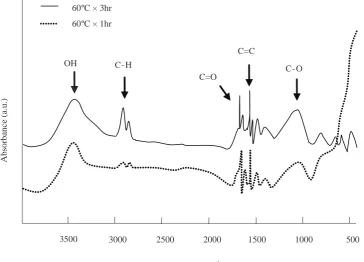
Figure 5 shows the FT-IR spectra for the MWCNTs
treated at 60ºC for 1 h and 3 h. The main peaks corresponding to the carboxylic group can also be observed in Figure 5. As the treatment time increased, the intensity of these
peaks became sharper. Among the MWCNTs treated under 60ºC, the best sample was observed to be the one treated for 3 hours. For treatment at 70ºC, it was discovered that along with the appearance of carboxylic group peaks, a strong and sharp peak appeared at the wavenumber of 1390 cm–1 as shown in Figure 6. This particular peak,
however, only started to appear when the MWCNTs underwent the treatment for both 3 h and 5 h. This peak was reported to be the S=O stretching vibrations of the grafted sulphonic acid group (-SO3H) (Peng et al. 2005; Zhao et al. 2010). Since the sulphonic group was not one of the desired groups for this study, further characterization on the samples treated at 70ºC was not considered. From Figures 4 and 5, it was clear that the best samples were MWCNTs treated at the temperatures of 50ºC for 5 h and 60ºC for 3 h. These samples were further analyzed using SEM and TGA.
Thermogravimetric analysis. The functional groups attached on the MWCNTs were determined quantitatively by performing TGA under a nitrogen atmosphere. The TGA thermograms for the MWCNTs treated at 50ºC 5 h and 60ºC 3 h are shown in Figures 7 and 8, respectively. From Figure 7, it is observed that the major weight loss occurred in stage 1 (9.41%) at temperatures up to 100ºC, signifying a high content of moisture in the treated MWCNTs (Shieh et al. 2007; Chen et al. 2008; Yu et al. 2008; Chokoli et al. 2009). The second stage (temperatures 100ºC – 350ºC) contributed to the second highest weight loss of 8.78% which was reported to be due to the decarboxylation of carboxylic group (Datsyuk et al. 2008; Chokoli et al. 2009). The weight loss of 4.48% of the third stage was caused by the elimination of the hydroxyl groups, whereas the loss at the last stage (temperatures above 500ºC) was attributed to the degradation of disordered or amorphous carbons (Datsyuk et al. 2008). By combining the weight loss in stage 2 and 3, the total weight loss due to carboxylic group on the MWCNTs treated under this condition was calculated to be 13.26%. The thermogram shown in Figure 8 highly resembles the one shown in Figure 7, suggesting a consistency in the oxidation behaviour of the carbon structures. Compared to the MWCNTs treated at 50ºC for 5 h, the amount of carboxylic group undergoing decarboxylation process in this sample was slightly higher at a weight loss of 8.95%.
On the other hand, the higher weight loss caused by the disordered carbons in MWCNTs treated at 60ºC 3 hr also signifies that there were more defect sites in this sample
and the defects were most likely caused by the insertions of the functional groups (Osorio et al. 2008). By combining the weight loss due to decarboxylation of carboxylic group and the degradation of hydroxyl group, the total weight loss due to the carboxylic group on the MWCNTs treated under this condition was observed to be 13.76%. This result showed that compared with the MWCNTs under the condition of 50ºC 5 h, MWCNTs treated at 60ºC 3 h had a marginally higher percentage of attached carboxylic
50ºC × 5hr
50ºC × 3hr
OH C-H
C=O
C=C C-O
A
bs
or
ba
nc
e
(a
.u
.)
3500 3000 2500 2000 1500 1000 500
Wavenumber (cm–1)
50ºC × 5hr
50ºC × 3hr
OH C-H
C=O
C=C C-O
A
bs
or
ba
nc
e
(a
.u
.)
3500 3000 2500 2000 1500 1000 500
Wavenumber (cm–1)
Figure 3. (a) Low-magnified and (b) high-magnified SEM micrographs of pristine MWCNTs.
Figure 4. FT-IR spectra of MWCNTs treated at 50ºC.
OH C-H
C=O C=C
C-O
60ºC × 3hr
60ºC × 1hr
A
bs
or
ba
nc
e
(a
.u
.)
OH
C-H
C=O
C=C SO3H
C-O
70ºC × 1hr
70ºC × 3hr
70ºC × 5hr
A
bs
or
ba
nc
e
(a
.u
.)
3500 3000 2500 2000 1500 1000 500
Wavenumber (cm–1)
3500 3000 2500 2000 1500 1000 500
Wavenumber (cm–1)
OH C-H
C=O C=C
C-O
60ºC × 3hr
60ºC × 1hr
A
bs
or
ba
nc
e
(a
.u
.)
OH
C-H
C=O C=C SO3H
C-O
70ºC × 1hr
70ºC × 3hr
70ºC × 5hr
A
bs
or
ba
nc
e
(a
.u
.)
3500 3000 2500 2000 1500 1000 500
Wavenumber (cm–1)
3500 3000 2500 2000 1500 1000 500
Wavenumber (cm–1)
Figure 5. FT-IR spectra of MWCNTs treated at 60°C.
Figure 6. FT-IR spectra of MWCNTs treated at 70°C.
9.41%
8.78%
4.48%
7.56%
W
ei
gh
t (
%
)
60 70 80 90 100 110
200 400 600 800 1000
0
Temperature (ºC)
8.79 %
8.95%
4.81%
9.78%
W
ei
gh
t (
%
)
60 70 80 90 100 110
200 400 600 800 1000
0
Temperature (ºC) 9.41%
8.78%
4.48%
7.56%
W
ei
gh
t (
%
)
60 70 80 90 100 110
200 400 600 800 1000
0
Temperature (ºC)
8.79 %
8.95%
4.81%
9.78%
W
ei
gh
t (
%
)
60 70 80 90 100 110
200 400 600 800 1000
0
Temperature (ºC)
Figure 7. TG curve of MWCNTs treated at the condition 50ºC x 5 h.
ASM Science Journal, Volume 5(2), 2011
98
group. This showed that temperature had a greater impact on the functionalization compared to the treatment time.
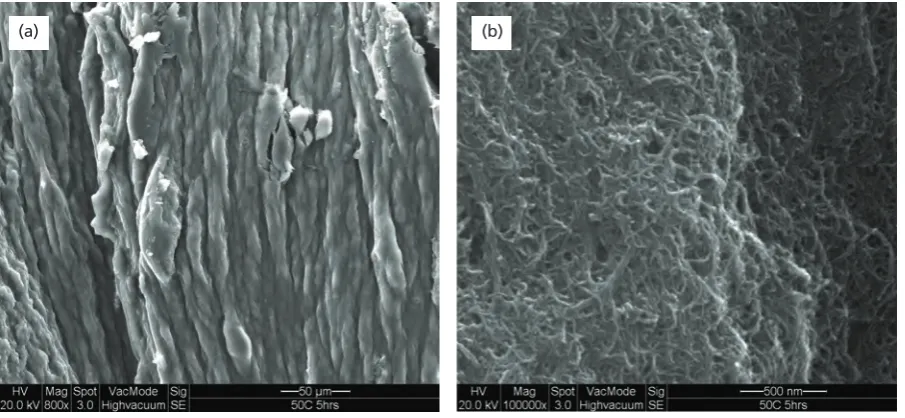
Scanning electron microscopy. Figures 9 and 10 show the SEM micrographs for the samples treated at 50ºC 5 h and 60ºC 3 h, respectively. The SEM micrographs of the samples taken at low magnification showed MWCNTs
which appeared to stick together to form a shape similar to a collection of rods. This might be caused by the presence of the intermolecular hydrogen bonding of the carboxylic
groups attached on the MWCNTs surface (Shieh et al.
2007). At higher magnification and compared to the pristine
MWCNTs in Figure 3, the treated MWCNTs appear to
be more aligned and the bundles are denser (Rosca et al.
2005). This observation is in agreement with the findings reported by other groups (Rosca et al. 2005; Shieh et al. 2007; Jiang et al. 2009; Kim et al. 2010). It should be noted the micrographs of treated MWCNTs were more blurred than those of the pristine MWCNTs. This observation was reported to be caused by the decrease in the treated
Figure 10. (a) Low-magnification and (b) high-magnification SEM micrographs of MWCNTs treated at condition 60ºC x 3 h. Figure 9. (a) Low-magnification and (b) high-magnification SEM micrographs of MWCNTs treated at condition 50ºC x 5 h.
(a) (b)
(a) (b)
L.K. Zakiyah: Preparation and Characterization of Carboxylic-functionalized Multi-walled Carbon Nanotubes
MWCNTs’ electrical conductivity due to the presence of the newly attached carboxylic groups (Daniel et al. 2007). Thus, the SEM which works by scanning the electrons emitted from a specimen would display a more blurred
image. In both Figures 9 and 10, there were no significant damages identified on the structure of the MWCNTs after
the acids functionalization.
CoNClusioNs
The functionalization of MWCNTs via acid treatment was proven to be simple with minimal chance of error. The results showed that carboxylic group was introduced on the
surface of MWCNTs, as evidenced by the FT-IR spectra. From the FT-IR analysis, the two samples of MWCNTs
treated at the conditions of 50ºC 5 h and 60ºC 3 h were observed to be the best among other acid treatment conditions investigated in this study. The
results obtained from the TGA have also confirmed
this observation. From TGA, the carboxylic groups attached to the MWCNTs were found to be 13.26% for MWCNTs treated at 50ºC 5 h and 13.76% for MWCNTs treated at 60ºC 3 h. The morphology changes in both samples of the treated MWCNTs were also analyzed by SEM and it was concluded that there
was no significant damage to the MWCNT structure after
the functionalization.
aCkNoWledgMeNts
We would like to thank the Monash University through the Monash Internal Seed Fund (A/C no: E-2-09) and the Ministry of Higher Education through the Fundamental
Research Grant Scheme (FRGS) (Ref no: FRGS/2/2010/ TK/MUSM/03/4) for their financial support.
Date of submission: May 2011 Date of acceptance: December 2011
refereNCes
Balasubramanian, K & Burghard, M 2005, ‘Chemically
functionalized carbon nanotubes’, Small, vol. 2, pp. 180–
192.
Chen, GX, Kim, HS, Byung, HY & Yoon, JS 2005, ‘Controlled functionalization of multiwalled carbon nanotubes with
various molecular-weight Poly(L-lactic acid)’, Journal of
Physical Chemistry B, vol. 109, pp. 22237–22243.
Chen, GX & Shimizu, H 2008, ‘Multiwalled carbon nanotubes grafted with polyhedral oligomericsilsesquioxane and its
dispersion in poly(L-lactide) matrix’, Polymer, vol. 49, pp.
943–951.
Chokoli, AN, Wan, J, Feng, JT, Amirian, M, Sui, JH & Cai, W 2009, ‘Functionalization of multiwalled carbon nanotubes
for reinforcing of poly(L-lactide-co-ε-caprolactone)
biodegradable copolymers’, Applied Surface Science, vol.
256, pp. 170–177.
Daniel, S, Rao, TP, Rao, KS, Rani, SU, Naidu, GRK, Lee, HY & Kawai T 2007, ‘A review of DNA functionalized/grafted
carbon nanotubes and their characterization’, Sensors
and Actuators B, vol.122, pp. 672–682.
Datsyuk, V, Kalyva, M, Papagelis, K, Parthenios, J, Tasis, D, Siokou, A, Kallitsis, I & Galiotis, C 2008, ‘Chemical
oxidation of multiwalled carbon nanotubes’, Carbon, vol.
46, pp. 833–840.
Feng, M, Han, H, Zhang, J & Tachikawa, H 2008,
Electrochemical sensors based on carbon nanotubes, Academic Press.
Goyanes, S, Rubiolo, GR, Salazar, A, Jimeno, A, Corcuera, MA & Mondragon, I 2007, ‘Carboxylation treatment of multiwalled carbon nanotubes monitored by infrared and ultraviolet spectroscopies and scanning probe
microscopy’, Diamond & Related Materials, vol. 16, pp.
412–417.
Harris, PJF 2009, Carbon nanotube science, University Press
Cambridge, United Kingdom.
Jiang, X, Gu, J, Bai, X, Lin, L & Zhang, Y 2009, ‘The influence of acid treatment on multi-walled carbon nanotubes’,
Pigment & Resin Technology, vol. 38, pp. 165–173.
Kim, SH, Kim, JW, Im, JS, Kim, YH & Lee, YS 2007, ‘A comparative study on properties of multi-walled carbon nanotubes (MWCNTs) modified with acids and
oxyfluorination’, Journal of Fluorine Chemistry, vol. 128,
pp. 60–64.
Kim, HC, Kim, SK, Kim, JT, Rhee, KY & Kathi, J 2010, ‘The effect of different treatment methods of multiwalled carbon nanotubes on thermal and flexural properties of
their epoxy nanocomposites’, Journal of Polymer Science:
Part B:Polymer Physics, vol. 48, pp. 1175–1184.
Mamba, G, Mbianda, XY, Govender, PP, Mamba, BB & Krause, RW 2010, ‘Application of multiwalled carbon nanotube-cyclodextrin polymers in the removal of heavy
metals from water’, Journal of Applied Sciences, vol. 10,
pp. 940–949.
Men, XH, Zhang, ZZ, Song, HJ, Wang, K, & Jiang, W 2008, ‘Functionalization of carbon nanotubes to improve the tribological properties of poly(furfuryl alcohol) composite
coatings’, Composites Science and Technology, vol. 68,
pp. 1042–1049.
Osorio, AG, Silveira, ICL, Bueno, VL & Bergmann, CP 2008,
‘H2SO4/HNO3/HCL — Functionalization and its effect
on dispersion of carbon nanotubes in aqueous media’,
Applied Surface Science, vol. 225, pp. 2485–2489.
Peng, F, Zhang, L, Wang, H, Lv, P & Yu, H 2005, ‘Sulfonated carbon nanotubes as a strong protonic acid catalyst’,
Carbon, vol. 43, pp. 2397–2429.
Rosario-Castro, BI, Contes, EJ, Lebron-Colon, M, Meador, MA, Sanchez-Pomales, G & Cabrera, CR 2009, ‘Combined electron microscopy and spectroscopy characterization of as-received, acid purified, and oxidized HiPCO single-wall
carbon nanotubes’, Materials Characterization, vol. 60,
ASM Science Journal, Volume 5(2), 2011
100
Rosca, ID, Watari, F, Uo, M & Akasaka, T 2005, ‘Oxidation
of multiwalled carbon nanotubes by nitric acid’, Carbon,
vol. 43, pp. 3124–3131.
Shieh, YT, Liu, GL, Wu, HH & Lee, CC 2007, ‘Effects of polarity and pH on the solubility of acid-treated carbon nanotubes
in different media’, Carbon, vol. 45, pp. 1880–1890.
Wang, J & Lin, YH 2008, ‘Functionalized carbon nanotubes
and nanofibers for biosensing applications’, Trends in
Analytical Chemistry, vol. 27, pp. 619–626.
Yang, W, Thordarson, P, Gooding, JJ, Ringer, SP & Braet, F 2007,‘Carbon nanotubes for biological and biomedical
applications’, Nanotechnology, vol. 18, pp. 1–12.
Yu, H, Jin, Y, Peng, F & Wang, H 2008, ‘Synthesis and characterization of sulfonated single-walled carbon nanotubes and their performance as solid acid catalyst’,
Journal of Solid State Chemistry, vol. 181, pp. 432–438.
Yun, YH, Dong, Z, Shannov, V, Heineman, WR, Halsall, HB, Bhattacharya, A, Conforti, L, Narayan, RK, Ball, S & Schulz, MJ 2007,‘Nanotubes electrodes and biosensors’,
Nanotoday, vol. 2, pp. 30–37.
Zhao, D, Yi, BL, Zhang, HM & Yu, HM 2010, ‘MnO2/SiO2
-SO3H nanocomposite as hydrogen peroxide scavenger
for durability improvement in proton exchange
membranes’, Journal of Membrane Science, vol. 346, pp.
143–151.
Groundwater is a major source of water for various uses in Selangor and it is especially important for industrial purposes. It is also regarded as the potential future water source for public water supply in Selangor. The Kelang and Langat river basins are the locations of the major users of groundwater in Selangor. The presence of high numbers of landfill sites is seen to increase the risk of groundwater contamination. As such a study was performed to assess the landfill sites and their operating status in Selangor. It was also conducted to evaluate the impact of landfills on groundwater and surface water systems. However, due to the limited financial resources, a very thorough investigation was not possible; as such, the number of samples collected and parameters analysed were restricted to a minimum.
In Malaysia, sanitary landfills are generally classified into five levels (Department of Local Government 2006). They are:
Level 0: Open dumping
Level 1: Controlled tipping
Level 2: Sanitary landfill with a bund and daily soil cover
Level 3: Sanitary landfill with leachate recirculation system; and
Level 4: Sanitary landfill with leachate treatment facilities.
This paper presents some of the study findings related to the impact of landfills on water resources, especially on groundwater. Evaluation of the extent of pollution at landfills was made and the immediate remedial measures to be taken have been suggested.
OBJECTIVES OF THE STUDY
Considering the importance of groundwater resources and the presence of a large number of landfills in the state, the state of Selangor was chosen for the study which was carried out in 2009. The study was carried out to assess and evaluate the extent of pollution of groundwater as well as
Impact of Landfills on Groundwater in
Selangor, Malaysia
S. Suratman1*, I. Tawnie1 and A. Sefei1
A study to determine the impact of leachate from operating and closed landfills into the surface water and groundwater systems in the state of Selangor was conducted in the year 2009. Groundwater was a major source of water for various uses in Selangor, Malaysia and was especially important for industrial purposes. The presence of high numbers of landfill sites was seen to have increased the risk of groundwater contamination. There were 20 landfill sites in the state of Selangor and seven of them were still operating and 13 closed. The landfills are classified into four categories, which were: (a) landfills operating at critical stages without controls to prevent pollution into the environment; (b) open dumpsites that have the capacity to continue to accept waste but needed to be upgraded to manage leachate and gas; (c) landfills that were closed but no safety closure plan was carried out; and (d) engineered landfills with up to date technologies. As most of the landfills were built prior to 1989, they were not subjected to the Environmental Impact Assessment requirements, hence, they were being poorly managed and were badly sited. The non-engineered sites had no proper pollution controls such as cover materials, liner materials, groundwater monitoring wells, leachate collection ponds and treatment, and methane gas collection pipes. This study revealed that the surface water and groundwater at and nearby the landfill sites were contaminated at various levels due to the landfill sites and operation. A comparison between the current quality of surface water and groundwater with their respective standards and background levels was carried out to survey the trend of the contamination. However, the limited financial resources hindered a very thorough investigation and restricted the number of samples collected and parameters analysed.
Key words: groundwater, landfill, contamination; quality; surface water; leachate; impact; water resources; pollution; remedial measures
ASM Sci. J., 5(2), 101–107
1National Hydraulic Research Institute of Malaysia, Lot 5377, Jalan Putra Permai, 43300 Seri Kembangan, Selangor
ASM Science Journal, Volume 5(2), 2011
102
surface water at landfills and to select the most critical sites especially in terms of water quality which would require immediate attention for remedial measures to be taken. The three main objectives of the study were:
a. To carry out desktop study on the environmental status of operational and closed landfills (rehabilitated or abandoned);
b. To assess the impact of leachate into the surface and groundwater systems; and
c. To recommend remedial measures for the protection of surface and groundwater systems.
OVERVIEW OF THE LANDFILLS
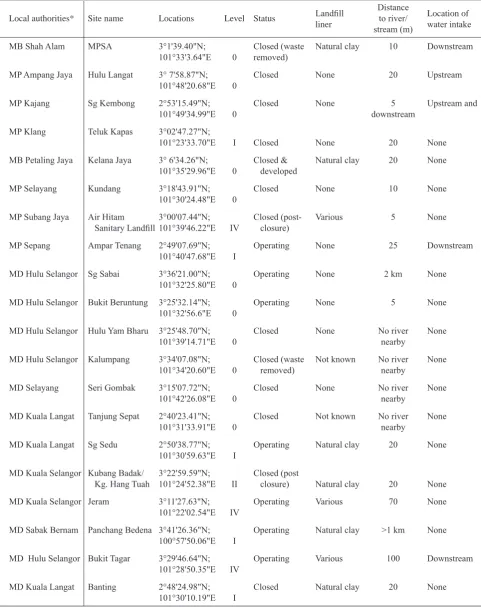
There were 20 landfill sites in the state, seven of which were still operating and 13 were closed. Most of the landfills could be classified as Level 0 or 1. The engineered landfills (Level 4) were very few but one more was scheduled to be built in Tanjung Dua Belas, Banting. Figure 1 shows the location of all the landfills in Selangor.
The landfills were either sited on alluvial deposits comprising of unconsolidated coarse grain sand, clays and peat, metasedimentary deposits of Devonian to Carboniferous age (300–400 million years old) or granitic rocks of Triassic age (200–250 million years old). The alluvial deposits were regarded as one of the promising aquifers in Selangor.
The landfills were located in five major river basins: Sg. Selangor (7); Sg. Klang (5); Sg. Langat (6); Sg. Bernam (1) and Sg. Buloh (1). None were located in the Tengi River Basin. Most of the landfills were sited very close (<100 m) to rivers or streams.
Most of the landfills in Selangor were built and being operated without proper monitoring facilities and pollution controls such as liner materials, groundwater monitoring wells, leachate collection and treatment ponds, and methane gas ventilation pipes. They were not subject to the requirements of Environmental Impact Assessment (EIA) because they were built prior to 1989 when the EIA requirement was enacted (Department of Environment 1997). They were not properly managed, resulting in the leachate produced by the landfill being allowed to seep into the ground (no liner materials) as well as flow into the nearby drainage or river (Figure 2) without any treatment. Only 25% were equipped with monitoring wells to monitor groundwater quality.
MATERIALS AND METHODS
Information regarding landfill sites such as construction details, operational status, geological characteristics and water quality were obtained from reports, technical papers,
manuals, guidelines and research theses from various government agencies, universities and private organisations (Noraini 2003; Agamuthu 2001; Mohd. Nazan 1994; Bahaa-elDin et al. 2003; JICA 2001; Omar et al. 1999; Wan Zuhairi 2000; Bahaa-elDin et al. 2008; Abdul Rahim S. et al. 2006, 2008; Bahaa-elDin 2005; Nasiman and Mohd Nazan 1997; Ahmad Fariz M. et al. 2009; Universiti Malaya 2007); the data sources concerning landfill operations in Malaysia included Agamuthu & Fauziah (2011), Choong (2001), Consumers’ Association of Penang (2001), Department of Environment (2004), Fauziah and Agamuthu (2005) and Norlailatul, Z. et al. (2005). Site reconnaissance was carried out from February to August 2009 to verify and update the existing information and data. During the field investigations, landfill inventories (basic information, environmental impact conditions and landfill utilisation after closure) and sampling of surface water, groundwater and leachate were carried out within the vicinity of selected landfills, depending on availability of facilities. A number of landfills were not equipped with monitoring wells and as a result groundwater samples could not be collected from these sites.
The sampling technique, sample preservation and analytical procedures followed the standard methods recommended (APHA 1995, APHA 2005). Data on the composition of leachate was important to determine its potential impact on the quality of nearby surface water and groundwater. This leachate often contained a high concentration of organic matter and inorganic ions including heavy metals (Chian & DeWalle 1976). In carrying out the landfill inventories, questionnaires were also distributed to 11 local authorities to collect information on the current condition of landfills, environmental impact conditions, land utilisation after closure including landfill closure and monitoring. Interviews with 10 residents living relatively near the landfills were also conducted. In-situ analysis for dissolved oxygen (DO), pH, temperature, salinity and conductivity using YSI multi-parameters to evaluate the current status of water and leachate quality was performed. Heavy metals were analysed using Inductively Coupled Plasma Mass Spectrophotometry (ICPMS) at Universiti Kebangsaan Malaysia. Ammoniacal nitrogen (NH3-N), phosphate, nitrate and sulphate were analysed using a portable spectrophotometry model HACH DR 2800.
Out of 20 landfills, only five sites (Kelana Jaya, Air Hitam, Ampar Tenang, Jeram and Bukit Tagar) were equipped with groundwater monitoring wells and hence sampling activities for groundwater were done only at these landfill sites. Surface water from the nearby streams/ rivers and leachate was also collected for chemical analysis to determine the effect of leachate on water resources. Due to limited funding, samples were collected only once. Table 2 shows the quality of leachate, the effect of landfill (leachate) on the groundwater and the surface water quality from those five landfills. Results from the chemical analysis
S. Suratman et al.: Impact of Landfills on Groundwater in Selangor, Malaysia
Table 1. List and status of landfills in Selangor (modified from NAHRIM 2009).
Landfill Distance Location of Local authorities* Site name Locations Level Status liner to river/ water intake
stream (m)
MB Shah Alam MPSA 3°1'39.40"N; Closed (waste Natural clay 10 Downstream 101°33'3.64"E 0 removed)
MP Ampang Jaya Hulu Langat 3° 7'58.87"N; Closed None 20 Upstream 101°48'20.68"E 0
MP Kajang Sg Kembong 2°53'15.49"N; Closed None 5 Upstream and
101°49'34.99"E 0 downstream
MP Klang Teluk Kapas 3°02'47.27"N;
101°23'33.70"E I Closed None 20 None MB Petaling Jaya Kelana Jaya 3° 6'34.26"N; Closed & Natural clay 20 None
101°35'29.96"E 0 developed
MP Selayang Kundang 3°18'43.91"N; Closed None 10 None 101°30'24.48"E 0
MP Subang Jaya Air Hitam 3°00'07.44"N; Closed (post- Various 5 None Sanitary Landfill 101°39'46.22"E IV closure)
MP Sepang Ampar Tenang 2°49'07.69"N; Operating None 25 Downstream 101°40'47.68"E I
MD Hulu Selangor Sg Sabai 3°36'21.00"N; Operating None 2 km None 101°32'25.80"E 0
MD Hulu Selangor Bukit Beruntung 3°25'32.14"N; Operating None 5 None 101°32'56.6"E 0
MD Hulu Selangor Hulu Yam Bharu 3°25'48.70"N; Closed None No river None
101°39'14.71"E 0 nearby
MD Hulu Selangor Kalumpang 3°34'07.08"N; Closed (waste Not known No river None 101°34'20.60"E 0 removed) nearby
MD Selayang Seri Gombak 3°15'07.72"N; Closed None No river None
101°42'26.08"E 0 nearby
MD Kuala Langat Tanjung Sepat 2°40'23.41"N; Closed Not known No river None
101°31'33.91"E 0 nearby
MD Kuala Langat Sg Sedu 2°50'38.77"N; Operating Natural clay 20 None 101°30'59.63"E I
MD Kuala Selangor Kubang Badak/ 3°22'59.59"N; Closed (post
Kg. Hang Tuah 101°24'52.38"E II closure) Natural clay 20 None MD Kuala Selangor Jeram 3°11'27.63"N; Operating Various 70 None
101°22'02.54"E IV
MD Sabak Bernam Panchang Bedena 3°41'26.36"N; Operating Natural clay >1 km None 100°57'50.06"E I
MD Hulu Selangor Bukit Tagar 3°29'46.64"N; Operating Various 100 Downstream 101°28'50.35"E IV
MD Kuala Langat Banting 2°48'24.98"N; Closed Natural clay 20 None 101°30'10.19"E I
ASM Science Journal, Volume 5(2), 2011
104
Table 2. Leachate quality and effect of landfill (leachate) on the groundwater and surface water quality from selected landfill (equipped with groundwater monitoring wells) in Selangor (after NAHRIM 2009).
Landfills Groundwater Surface water Leachate
Kelana Jaya Slightly contaminated. Class III Most parameters are less than Cr, Ba, Pb, Fe, As and Hg are Coliform exceeds the the Effluents of Standard B except slightly higher than the standard. INWQS Class III limit. for BOD, COD and TSS.
Air Hitam Slightly contaminated. BOD, COD, TSS, Sulphide, BOD, COD, TSS, Sulphide, Nitrate, Cr, Cd, Pb, Fe and Se are Cd, Cr, Pb, Fe, oil and grease Cd, Cr, Pb, Fe, oil and grease are slightly higher than the standard. are higher than the Effluents higher than the Effluents of
of Standard B. Standard B.
Ampar Tenang Contaminated. Contaminated Most parameters are less than
TDS, nitrate, Cr, Cd, Pb, Fe and Se (Class III). the Effluents of Standard B exceeded the standard. Increase in BOD, nitrate, As, except for BOD, COD, As, Cr,
Mn, Pb, Fe, Cu and Zn. Fe and Zn. Jeram Very slightly contaminated. Not available Not available
BOD, COD, Fe, Pb, Cr, Zn, Hg and Ba are above background data.
Bukit Tagar Not contaminated. Class III Not available All parameters below the standard
except Fe (natural condition).
Location map of Selangor
River (Sg.) Labu
Leachate
Figure 1. Operational status of identified landfill sites in Selangor (data from NAHRIM 2009).
S. Suratman et al.: Impact of Landfills on Groundwater in Selangor, Malaysia
of groundwater, surface water and leachate quality were analysed and evaluated by comparing them using [Leachate] - Effluent Quality (Sewage and Industrial Effluents) Regulations, 1979 in Environmental Quality Act, 1974; [Surface water] - Interim National Water Quality Standards for Malaysia (INWQS), (Department of Environment 1995a); and [Groundwater] – Guidelines for Raw Drinking Water Quality Benchmark for Groundwater Quality (Ministry of Health 2000) and Malaysian Environmental Impact Assessment Guidelines for Groundwater and/or Surface Water Supply Project (Department of Environment 1995b). The INWQS was developed by the Department of Environment and it classified inland water quality into 5 classes: domestic water supply, fisheries and aquaculture, irrigation, livestock, and recreation; each with its own set of biological, chemical and physical parameters. Chemical analysis results from Jeram (analytical reports for June and July 2006 obtained from Institute Biological Sciences, Science Faculty, University of Malaya) and Bukit Tagar landfills (KUB-Berjaya Enviro Sdn. Bhd. 2007; 2008) were referred to standard and background data obtained from EIA reports of these landfills (Kerajaan Negeri Selangor 2007 and Perunding Utama 2004).
RESULTS
The results from chemical analysis showed that the leachate from Kelana Jaya, Air Hitam and Ampar Tenang exceeded the parameter limits for Standard B of Effluent Quality (Sewage and Industrial Effluents) Regulations, 1979 in the Environmental Quality Act, 1974. Groundwater quality
from selected landfills equipped with monitoring wells indicated chemical oxygen demand (COD), biological oxygen demand (BOD), total dissolved solids (TDS), Cd, Cr, Cu, Pb, Fe, As and Hg slightly exceeded the standards for the raw drinking water quality benchmark for groundwater quality and background data except for the Bukit Tagar landfill. Data of surface water quality for samples taken from streams/rivers adjacent to the landfill sites showed that certain parameters were higher than those of the standards and were thus classified as polluted according to INWQS except for the Bukit Tagar landfill which had a proper leachate drainage system and gas extraction facilities.
DISCUSSION
Groundwater quality from groundwater monitoring wells of the five landfill sites showed that the values for various parameters were higher than that of standard values. This indicated that the groundwater within and surrounding the landfills was contaminated by the leachate. More than 70% of the landfills were located within 100 m from the stream/ river. The water quality of the rivers adjacent to the landfill sites was slightly polluted and classified under Class III of INWQS classification. The leachate quality from most of the landfills exceeded Standard B of Effluents Limits by the DOE.
Clean-up measures were recommended to prevent further movement of contaminant into the groundwater and surface water systems as well as to ensure environmental sustainability. Action such as waste removal, construction
Location map of Selangor
River (Sg.) Labu
Leachate
ASM Science Journal, Volume 5(2), 2011
106
of containment walls and pumping of contaminated groundwater might need to be considered. It was also recommended that specific guidelines and standards to address issues related to landfill be established. Several landfill sites such as Sg. Kembong, Ampar Tenang, Sg. Sedu, and Bukit Beruntung were recommended for safe closure since they had surpassed the operation capacity. The Sg. Kembong, Ampar Tenang, Sg. Sedu landfills were also located in areas with high groundwater development potential. Further study on the closed Kelana Jaya landfill was required in order to determine the extent of risk to human health posed by the landfill to know the degree of contamination as the site was already developed into a residential area.
Date of submission: May 2011 Date of acceptance: December 2011
REFERENCES
Abdul Rahim S, Bahaa-elDin EAR, Wan Zuhairi WY & Umar Hamzah 2006, 'Mapping of contamination plumes at municipal solid waste using geoeletric imaging technique:
case study in Malaysia', Journal of Spatial Hydrology, vol.
6, no. 2, pp. 13–22.
Abdul Rahim S, Wan Zuhairi WY, Abdul Ghani, R & Bahaa-elDin EAR 2008, 'Assessment of soil contamination beneath a municipal solid waste disposal site in Dengkil, Selangor', in Proceedings of Blacksea International Symposium, Giresun, Turkey, August 25–29, pp. 290–296.
Agamuthu, P 2001, 'Heavy metals contamination of soil-derived interstitial water in the coastal regions of
Selangor Malaysia', Malaysian Journal of Science, vol. 20,
pp. 127–134.
Agamuthu, P & Fauziah, SH 2011, Challenges and issues in moving towards sustainable landfilling in a transitory
country, Malaysia Journal Waste Management Research,
vol. 29, pp. 13–19.
Ahmad Fariz, M, Wan Zuhairi, WY, Mohd Raihan, T & Abdul Rahim, S 2009, 'Groundwater and soil vulnerability in the
Langat Basin Malaysia', European Journal of Scientific
Research, vol. 27, no. 4, pp. 628–635.
APHA 1995, Standard methods for the examination of water
and waste water 19th edn, Baltimore: Port City Press.
APHA 2005, Standard methods for the examination of
water and waste water, 18th edn, Washington, American Health Assoc, AWWA, MPCE.
Bahaa-elDin, EAR 2005, ‘The migration of inorganic contaminants from landfill sites into the soil and groundwater systems’, MSc dissertation, Universiti Kebangsaan Malaysia, Bangi.
Bahaa-elDin, EAR, Wan Zuhairi, W Y, Abdul Rahim, S & Abdul Ghani, MR 2003, 'Geo-environmental sampling:
how good is a good practice?', Geological Society of
Malaysia Bulletin, vol. 46, pp. 443–446.
Bahaa-elDin, EAR, Yusoff, I, Abdul Rahim, S, Wan Zuhairi, WY & Abdul Ghani, MR 2008, 'Heavy metal contamination
of soil beneath a waste disposal site at Dengkil, Selangor,
Malaysia', Soil & Sediment Contamination, vol. 17, pp.
449–466.
Chian, SK & DeWalle, FB 1976, 'Sanitary landfill leachate
and their treatment', Journal Environmental Engineering
Division, vol. 102, pp. 411–431.
Choong, SC 2001, ‘Sanitary landfills: toward sustainable development’, Lund University International Master’s Programme in Environmental Studies and Sustainability Science, MSc dissertation, LUMES, <www.lumes.lu.se/ database/alumni/00.01/theses/choong_shu_chun.pdf>.
Consumers’ Association of Penang 2001, Malaysia country
report, waste not Asia 2001, Taipei, Taiwan, <www. jaringmetal.com/resource/wastemalaysia.pdf>.
Department of Environment 1995a, Water quality criteria
and standard for Malaysia, Ministry of Science and Technology, Malaysia.
Department of Environment 1995b, Environmental impact
assessment guideline for groundwater and/or surface water supply projects (1995), Ministry of Science and Technology, Malaysia.
Department of Environment 1997, Guidelines for municipal
solid waste and sewerage treatment and disposal projects, Ministry of Science and Technology, Malaysia.
Department of Environment 2004, Malaysia — executive
summary of the EIA for the proposed municipal solid waste sanitary landfill in Beroga 2004, <www.elaw.org/ node/1949>.
Department of Local Government 2006, The technical
guideline for sanitary landfill: design and operation, Ministry of Housing and Local Government Malaysia.
Fauziah SH & Agamuthu, P 2005, 'Pollution impact of MSW
landfill leachate', Malaysian Journal of Science, vol. 24,
no. 1, pp. 31–37.
JICA 2001, The Study on sustainable groundwater resources
and environmental management for Langat Basin in Malaysia, Japan International Cooperation Agency (JICA) in association with Minerals and Geoscience Department of Malaysia, Kuala Lumpur, Malaysia.
Kerajaan Negeri Selangor 2007, DEIA for the proposed
sanitary landfill at Mukim Jeram, Kuala Selangor, Selangor, Kerajaan Negeri Selangor Darul Ehsan.
KUB-Berjaya Enviro Sdn. Bhd. 2007, 9th quarter (October–
December 2006), 10th quarter (January-March 2007) and 13th quarter (October–December 2007) environ-mental monitoring report for Bukit Tagar sanitary landfill, Sungai Tinggi, Daerah Hulu Selangor, Selangor Darul Ehsan.
KUB-Berjaya Enviro Sdn. Bhd. 2008, 14th quarter (January–
March 2008) environmental monitoring report for Bukit Tagar sanitary landfill, Sungai Tinggi, Daerah Hulu Selangor, Selangor Darul Ehsan.
Ministry of Health 2000, National guidelines for raw drinking
water quality, Engineering Services Division, Ministry of Health Malaysia, Putrajaya.
Mohd Nazan, A 1994, Hydrogeological investigation of the
proposed pusat pentadbiran persekutuan Perang Besar,
ASM Science Journal, Volume 5(2), 2011
Minerals and Geoscience Department of Malaysia, Kuala Lumpur, Malaysia.
NAHRIM 2009, Desktop study on groundwater
contamination at landfill sites in Selangor, Final Report, Volume I-III, Prepared for National Hydraulic Research Institute of Malaysia, Seri Kembangan, Selangor by UKM Pakarunding.
Nasiman, S & Mohd Nazan, A 1997, 'Alluvial Aquifer in
Selangor: a threatened water resource', Journal of
research, vol. 10, no. 3/4, pp. 195–201.
Noraini, S 2003, 'Groundwater quality assessment using
remote sensing and related databases', Geological Society
of Malaysia Bulletin, vol. 46, pp. 209–216.
Norlailatul, ZMR, Wan Zuhairi, WY, Abdul Rahim, S & Abdul Ghani, MR 2005, 'Characteristics of leachate at the Air
Hitam sanitary landfill in Puchong, Selangor', Geological
Society of Malaysia Bulletin, vol. 51, pp. 41–46.
Omar, CR, Jaafar, R & Hassan, H 1999, 'Engineering geology and earthwork problem associated with highway construction in soft soil as Sg. Rasau, Dengkil, Selangor',
Geological Society of Malaysia Bulletin, vol. 45, pp. 174– 186.
Perunding Utama 2004, Detailed environmental impact
assessment for the Bukit Tagar sanitary landfill, Sungai Tinggi, Daerah Hulu Selangor, Selangor Darul Ehsan.
Universiti Malaya 2007, Kajian penilaian pencemaran dan
geoteknik kawasan bekas tapak pelupusan sisa pepejal Kelana Jaya, Petaling Jaya, Laporan, Majlis Bandaraya Petaling Jaya.
Wan Zuhairi, WY 2000, ‘An investigation of natural
Environmentally conscious manufacturing is becoming a very important objective for the electronics industry. It is highly desirable to minimize the environmental impact of electronic manufacturing processes. The electronics industry is being forced to eliminate lead from products, due to the undeniable evidence of lead toxicity. Strict legislation to ban the use of lead-based solders was an inevitable driving force for the development of lead-free solder alloys. Therefore, lead-lead-free solder pastes are perceived as interconnection material for electronic packaging for the next generation (Ifran & Kumar 2008). These lead-free solders are mostly based on Sn-containing binary and ternary alloys. Among them, the Sn–Ag system is one of the earliest commercially available lead-free solders and it has been recommended for general-purpose use as substitutes for Sn–Pb eutectic solder.
The assembly of these devices requires the printing of very small paste deposits consistently from pad to pad, and from board to board. The paste printing process is the paramount process in the electronic manufacturing industry and it does account for some 60% of assembly defects (Mangin 1991), and it is estimated that up to 87% of
the reflow soldering defects are caused by stencil printing
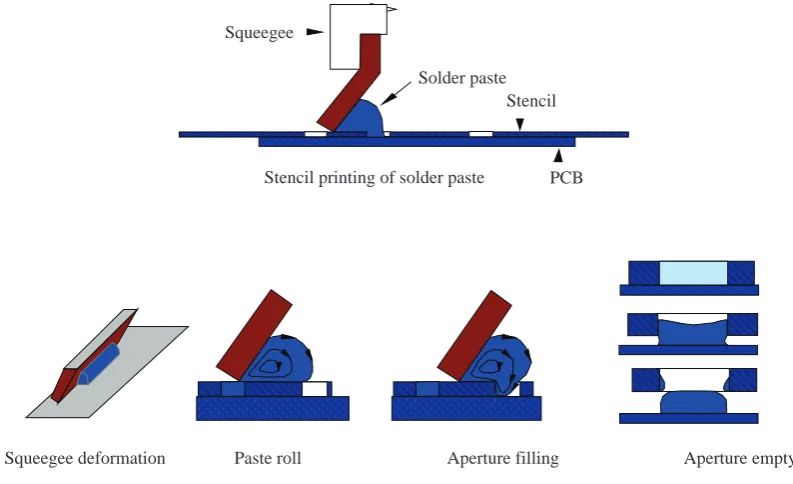
defects (Okuru et al. 1993). As shown in Figure 1, the key sub-processes in the solder paste printing process include
the paste roll in front of the squeegee, the aperture filling
and aperture emptying stages. During stencil printing, the paste develops a rolling action in front of the squeegee,
filling the apertures in the stencil some distance ahead of
the squeegee. The squeegee then shears off the paste in the apertures as it moves over the stencil. It is known that during the printing process, the squeegee generates hydrodynamic pressures in the paste roll that injects the paste into the apertures. Once the print stroke is completed, the board is separated mechanically from the stencil. Separation of stencil and printed circuit board (PCB) or substrate occurs after the squeegee move across the stencil and the substrate is then separated mechanically from the stencil.
The paste printing process is known to be controlled by a number of process parameters which can be divided into four groups: printer; stencil; environmental and paste parameters (Haslehurst & Ekere 1996). Some of these
parameters are fixed (e.g. stencil) while the paste properties
such as viscosity are constantly changing during the print cycle. The key physical sub-processes include: (i) paste pre-print treatment; (ii) squeegee deformation; (iii) paste
Effect of Nickel and Platinum Addition on the
Thixotopic Behaviour of Lead-free Solder Paste
R. Durairaj*1, K.C. Leong1, L. Chia Wea1 and M.C. Wong1
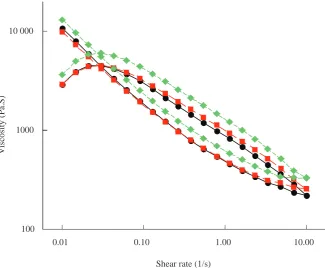
Lead-free solder paste printing processes account for the majority of assembly defects in the electronic manufacturing industry. In the stencil printing process, the solder paste must be able to withstand low and high shear rates which result in continuous structural breakdown and build-up. This study investigated the effect of the addition of nickel and platinum powders to the thixotropic behaviour of lead-free Sn/Ag/Cu solder pastes using the structural kinetic model. A hysteresis loop test and constant shear test were utilized to investigate the thixotropic behaviour of the pastes using parallel plate rheometry at 25ºC. In this study, the shear rates were increased from 0.01 s–1 to 10 s–1 and the second curve was a result of decreasing the shear rate from 10
s–1 to 0.01 s–1. For the constant shear test, the samples were subjected to five different shear rates of 0.01s–1,
0.1s–1, 1s–1, 10s–1 and 100s–1. The constant shear rate test was designed to study the structural breakdown and
build-up of the paste materials. From this investigation, the hysteresis loop test was shown to be an effective test method to differentiate the extent of structural recovery in the solder pastes. All the pastes showed a high
degree of shear thinning behaviour with time. This might be due to the agglomeration of particles in the flux that prohibited paste flow under low shear rate. The action of high shear rate would break the agglomerates into smaller pieces which facilitated the flow of pastes, thus viscosity was reduced at high shear rate.
Key words: Rheology; lead-free; solder paste; thixotropic; hysteresis loop; mechanical properties; shear rates;
ASM Sci. J., 5(2), 109–114
1Department of Mechanical and Material Engineering,Faculty of Engineering and Science, Universiti Tunku Abdul Rahman, Jalan