Research Journal
Volume 10, No. 30, June 2016, pages 19–23
DOI: 10.12913/22998624/62733 Research Article
COOPERATIVE COMMUNICATION WITH SCHEME SELECTION
Seyed Vahid Mortezavi Zadeh1, Bmehdi Fartash2
1 Department of Computer Engineering, Islamic Azad University, Arak Branch, Arak, Iran, e-mail: m-fartash@
iau-arak.ac.ir
ABSTRACT
In this paper, a new cooperation scheme is provided that implements the advantages of both DF and AF schemes to enhance the performance in wireless networks. We suppose that nodes can access the channel information and based on this, the coopera-tion scheme is selected and applied. This algorithm is repeated when channel states
have an effective variety. We apply this strategy to a single relay system with square MQAM signals where optimum power allocation is employed. Simulations and com
-parisons verify that symbol-error-rate (SER) performance can be improved properly.
Keywords: cooperative communication, channel information, symbol error rate, am
-plify and forward, decode and forward.
INTRODUCTION
Recently, cooperative communications has
been proposed for wireless networks [1-7]. The basic idea is that in addition to the direct
trans-mission, there may be other nodes that can relay
the source information to the destination and
di-versity is enhanced. Various practical schemes have been proposed to exploit the benefits of
cooperation among nodes. These schemes are
usually classified into two categories: amplify-and-forward (AF) and decode-amplify-and-forward (DF) [1]. In AF, a relay node simply amplifies and re -transmits the signal waveform received from a
source. In DF, the received signal in relay node
is demodulated and decoded before
transmis-sion. Due to the possibility of decoding error,
DF can stop the cooperation scenario when this
error probability is high. This can be determined by several methods like the source to relay chan
-nel quality information that is provided to nodes. Each scenario has its benefits and we can choose
a cooperation scheme that is suitable for
net-work conditions. AF requires low implementa
-tion complexity at the relay, and operates under all source-relay (S-R) channel conditions. How
-ever, AF also amplifies the noise power at the
same time. Otherwise, DF can achieve a higher
quality and performance when the S-R channel is good and the signal can be decoded correctly at the relay node [5, 8].
In [9], the symbol-error-rate (SER) perfor
-mance of uncoded cooperation systems with ei -ther DF or AF cooperation protocols was
inves-tigated. Since the closed-form SER formulation is complicated, its asymptotically tight approxi
-mations at high signal-to-noise ratios (SNR) with PSK and square QAM constellations were de
-rived. Based on these analyses, an asymptotically
optimum power allocation procedure has been proposed.
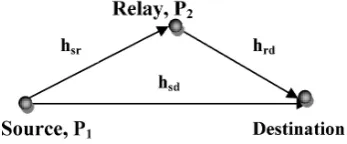
In this paper, a simple relay channel is consid -ered as shown in Figure 1 in which the channel
co-efficients are assumed to be circularly symmetric
Gaussian distributed, and independent from each
other. Furthermore, square MQAM constellations
are used in nodes and power allocation scheme is optimum [9]. Based on channel information,
relay node selects the appropriate cooperation
scheme and send its decision to destination. This algorithm is repeated when information of
chan-nels have an effective variety.
Fig. 1. A simplified cooperation model
SYSTEM MODEL
We consider a cooperation strategy with two
Phases. In Phase 1, the source broadcasts its data to the desired destination, and other neighboring
nodes simultaneously. In Phase 2, the neighbors help the source by forwarding the information re
-ceived in Phase 1. They may decode the re-ceived data and forward it, or amplify and forward it. We
suppose that in both phases, all users transmit sig-nals through orthogonal channels using TDMA,
FDMA or CDMA schemes. For simplicity, we
focus on a two-user cooperation scheme called
relay channel.
In Phase 1, the source broadcasts its data to
both the destination and the relay. The received signals y_sd and y_sr at the destination and the relay are, respectively:
(1)
(2)
in which P1 is the transmitted power from the
source, x=(x1+j x2 ) is the transmitted data symbol with average energy Pav [10], nsd and nsr are addi-tive noises, and hsd and hsr are the channel
coef-ficients from the source to destination and relay, respectively. They are modeled as zero-mean,
complex Gaussian random variables with
vari-ances σsd2 and σ
sr2 respectively. The noise terms nsd and nsr are also zero-mean complex Gaussian random variables with common variance N0. In
Phase 2, with DF protocol, the relay forwards the correctly decoded symbol with power P2 to the
destination with a similar modulation type, or stays idle otherwise. The received signal at the destination in Phase 2 becomes :
(3)
where P ̃2 = P2 if the relay decodes the transmit
-ted symbol correctly, and P ̃2 = 0 otherwise. In (3), hrd is the channel coefficient from the relay to the destination, and it is modeled by a
zero-mean, complex Gaussian random variable with
variance σrd2. The noise term n
rd is also assumed
a zero-mean complex Gaussian random variable with variance N0. In practice, we may apply an SNR threshold at the relay. If the received SNR is higher than the threshold, then the symbol is correctly decoded with a high probability. De
-tails of threshold optimization at the relay can
be found in [11].
With AF scenario, the relay amplifies the re -ceived signal and forwards it to the destination with transmitted power P2 in Phase 2. The re -ceived signal at the destination in this Phase is
specified by:
(4)
where hrd is the channel coefficient from the re
-lay to the destination and nrd is an additive noise,
with the same statistical models as in (3). More explicitly yrd :
(5)
where:
(6)
Under the assumption that nsr and nrd are
inde-pendent, the equivalent noise component, n’rd, is
a zero-mean complex Gaussian random variable
with variance:
[10].
In both the DF and AF cooperation protocols,
the channel coefficients hsd, hsr and hrd are assumed
independent and the mobility and positioning of
the nodes are incorporated into the channel
statisti-cal model. The channel coefficients are assumed to
be estimated at the receiver, not at the transmitter. The destination combines the received
sig-nals from the source in Phase 1 and relay in Phase 2, and extracts the transmitted symbols using maximal-ratio combining (MRC) pro
-cedure [12]. In both protocols we fix the total transmitted power P:
COOPERATIVE SCHEME SELECTION
In this section, we propose a new
coopera-tion strategy to reduce SER. With this assumpcoopera-tion
that nodes can access to the channel information,
relay can gain the conditional symbol error prob
-ability of both DF and AF schemes.
With the knowledge of the channel
coef-ficients hsd and hrd, the destination extracts the
transmitted symbols by combining ysd from the
source and yrd from the relay with MRC receiver. In square M-QAM constellations, the minimum achievable conditional SER (at destination) can be expressed as:
(8)
(9)
(10)
in which and
is Marcum Q-function [13-14]. γ1,DF and γ2,DF
rep-resent the SNR values of the first and second phase of DF scenario and γAF is the SNR value of AF cooperation strategy all are measured in the input of the receiver. Furthermore we apply the
optimum power allocation schemes to achieve the
optimum SER.
Based on this result, relay implements one that less conditional symbol error probability belongs it. This strategy increase the CPU over -loads. In some situations performance
enhance-ment is more significant than CPU overloads or we can handle this overload. So we choose this scheme and apply it.
Furthermore we can apply SER and its tight approximations of it instead of conditional sym
-bol error probability to reduce the calculations of this strategy. Studies in [14] and [10] suggest good and tight approximations of SER when we
access to perfect and imperfect channel
informa-tion respectively.
We should notice that relay in each transmis -sion must send destination node that what
strat-egy is selected. We can perform this with one control bit from relay to destination. This can
transmit within data frame or carry along a se -cure channel.
SIMULATION RESULTS
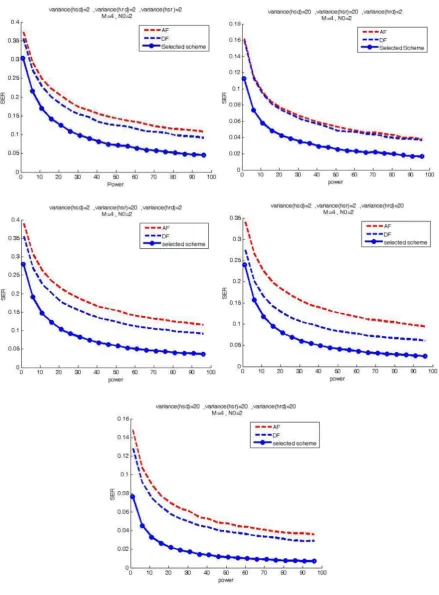
We illustrate the performance of the proposed selected scheme algorithm through computer simulations. In all simulations, we assumed a
co-operation system with the variance of the noise is 1 (i.e., N0= 2). Without less of generality in all simulation we consider a cooperation system with 4-QAM signals.
At first, we compare the resultant SER of the proposed scheme with pure DF and AF strategy. From Figure 2, we observe that the performance of
this selection scheme is improved with optimum
power allocation in different channel qualities.
CONCLUSION
In this paper, a simple relay channel is con
-sidered in which the channel coefficients are assumed to be circularly symmetric Gaussian
distributed, and independent from each other.
We then propose a new cooperation strategy to reduce SER. Our proposed scheme is based on this assumption that relay node can access to the
channel information, therefore it can calculate
the conditional symbol error probability of both DF and AF strategies. Then relay node selects the
appropriate cooperation scheme and send its de-cision to destination. This algorithm is repeated
when information of channels have an effective variety. Simulations verify this strategy can im
-prove SER of cooperation network.
REFERENCES
1. Laneman J.N., G.W. Wornell, Distributed
space-time coded protocols for exploiting cooperative
di-versity in wireless networks, IEEE Transaction on Information Theory, 49, 2003, 2415–2525.
2. Laneman J.N., D.N.C. Tse, G. W. Wornell, Co
-operative diversity in wireless networks: efficient protocols and outage behavior, IEEE Transaction on Information Theory, 50, 2004, 3062–3080. 3. Sendonaris A., E. Erkip, B. Aazhang, User co
-operation diversity- Part I: system description, IEEE Transaction on Communications, 51, 2003, 1927–1938.
-eration diversity- Part II: implementation aspects and performance analysis, IEEE Transaction on Communications, 51, 2003, 1939–1948.
5. Hunter T.E., A. Nosratinia, Diversity through coded cooperation, IEEE Transaction on Wireless Communication, 5, 2006, 283–289.
6. Hunter T.E., A. Nosratinia, Performance analysis of coded cooperation diversity, IEEE Interna
-tional Conference on Communications, 4, 2003, 2688–2692.
7. Janani M., A. Hedayat, T. E. Hunter, A. Nosratinia, Coded cooperation in wireless communications:
space-time transmission and iterative decoding,
IEEE Transactions on Signal Processing, 52, 2004, 362–371.
8. Stefanov A., E. Erkip, Cooperative coding for wireless networks, IEEE Transaction on Commu
-nications, 52, 2004, 1470–1476.
9. Su W., A.K. Sadek, K.J.R. Liu, Cooperative Com
-munication Protocols in Wireless Networks: Perfor
-mance Analysis and Optimum Power Allocation,
Springer Science + Business Media LLC, 2007. 10. Basiri Abarghouei M., A.M. Doost Hoseini, Co
-operative communication with imperfect channel
information: Performance analysis and optimum power allocation, Physical Communication, 4, 2011, 144–155.
11. Siriwongpairat W.P., T. Himsoon, W. Su, K. J. R. Liu, Optimum threshold-selection relaying for decode-and-forward cooperation protocol, in: Pro
-ceeding IEEE Wireless Communications and Net
-working Conference, Las Vegas, NV, April 2006, 1015–1020.
12. Brennan D.G., Linear diversity combining tech
-niques, In Proceedings of the IEEE, 19 (2), 2003, 331–356.
13. Simon M.K., M. Alouini, A unified approach to the performance analysis of digital communication over generalized fading channels, in: Proceedings of the IEEE, 86 (9), 1998, 1860–1877.
14. Proakis J.G., Digital communications, 4th ed., Mc