Research Journal
Volume 11, Issue 3, September 2017, pages 253–260
DOI: 10.12913/22998624/76583 Research Article
STRUCTURE AND CONSTRUCTION ASSESSMENT OF THE SURFACE LAYER
OF HARDFACED COATING AFTER FRICTION
Krzysztof Dziedzic1, Michał Pashechko2, Marcin Barszcz1, Jerzy Józwik3
1 Lublin University of Technology, Electrical Engineering and Computer Science Faculty, Institute of Computer
Science, 36B Nadbystrzycka Str., 20-618 Lublin, Poland, e-mail: [email protected], [email protected]
2 Lublin University of Technology, Fundamentals of Technology Faculty, Department of Fundamental of
Technology, 38 Nadbystrzycka Str., 20-618 Lublin, Poland, e-mail: [email protected]
3 Lublin University of Technology, Mechanical Engineering Faculty, Department of Production Engineering, 36
Nadbystrzycka Str., 20-618 Lublin, Poland, e-mail: [email protected]
ABSTRACT
The paper presents an analysis of the surface layer of Fe-Mn-C-B-Si-Ni-Cr alloy coat-ing after friction with C45 steel. The coatcoat-ings were obtained by arc weldcoat-ing (GMA).
Flux-cored wires were used as a welding material. The flux-cored wires had a diam -eter of 2.4 mm. The tribological assessment was performed with the Amsler tribotester under dry friction conditions at unit pressures 10 MPa. The use of XPS spectroscopy
allowed deep profile analysis of the surface layer. Based on the obtained results devel-oped model of the surface layer for friction couple, hardfaced coating obtained from Fe-Mn-C-B-Si-Ni-Cr alloy – C45 steel. It was observed that the operational surface layer (OSL) of hardfaced coatings contained oxides (B2O3, SiO2, NiO, Cr2O3, FeO, Fe3O4, Fe2O3), carbides (Fe3C, Cr7C3) and borides (FeB, Fe2B).
Keywords: coatings, hardfacing, surface layer, wear, structure.
INTRODUCTION
Development of new materials is frequently focused on increasing their mechanical, tribologi-cal and corrosion and wear-resistance character-istics [1÷6]. Recently, surface modification of engineering materials has become a fast devel-oping field of materials science. One of the most frequently used methods of regenerating machine parts is pad welding, or applying a layer of liquid metal on the regenerated object [7÷9]. The cur-rently used materials are obtained on the basis of Fe, Ni, Co, Ti with additions of various chemical elements, including: Si, Cr, B, Mn, V, Ti, Mo, W, Nb affecting their mechanical, tribological and corrosive properties [10÷14]. At the time of tion, the surface layer of materials used for fric-tion couples is subject to continuous change due to external forces such as unit pressure, movement
speed, temperature, environment, etc. [4÷6]. An important part of tribological studies is to under-stand the structure of the surface layer and chang-es observed during friction. A feedback effect can be observed between the friction structure and properties of the surface layer. Tests conducted on friction surfaces must accurately determine the nature of all relevant information necessary for a surface analysis which aims to help enquir-ers undenquir-erstand tribological mechanisms, and thus improve the friction process while reducing wear on the machine elements [15÷19].
Currently, there is a distinction between nological and operational surface layers. A tech-nological surface layer (TSL) is defined as a sur -face layer created as a result of deliberate actions in the course of technological processes, such as hardfacing. Its properties depend, among other things, on the technology used in the manufac-Received: 2017.05.15
use of lubricants [20÷21].
Different models of surface layers that we know today differ from each other mainly in the degree of detail. An indicative fact is that their creators assume a zone-based construction. The difference between the actual OSL and the theo -retical model consists in the fact that certain zones do not exist or do not interpenetrate in the actual layer [1, 22÷23].
It was also observed that, in many cases, the field of machine construction and operation has shifted from examining the reliability of machines at the macro level to a comprehensive approach at the level of mechanisms employed during pro-cesses that destroy the materials used for kin-ematic pairs of various machines. Contemporary methods of characterization enable (microscopic) imaging and (spectroscopic) analysis of the sur-face of materials used for friction couples. One of the most useful techniques of depth profiling, that makes it possible to identify different elements that exist within a sample and analyse their bonds, is the X-ray photoelectron spectroscopy (XPS). Binding energy values of characteristic photoelec-tron peaks are tabulated. This makes it possible to conduct quantitative and qualitative analyses of chemical composition of the surface layer. The ad-vantage of this method is the possibility of detect-ing chemical elements havdetect-ing an atomic number Z>2 [24÷25]. A common method involving the use of a scanning electron microscope and an en-ergy dispersive X-Ray spectrometer (SEM/EDS) allows detection and identification of chemical
coating is shown in Table 1. The hardness of the coating is 49 HRC.
Tribometer was used for tribological exami-nation. The basic parameters characterising the friction node were as follows:
• type of contact: distributed, flat (in a pin-on disc system),
• the connection of pin-on disc friction pair is created by a rotating disc and sample be-ing pressed onto it (sample shape: 10x10 mm square, disc diameter 90 mm, hardness 52 HRC, material: steel C45,
• type of movement: sliding friction (velocity 0.4 m/s),
• unit pressure: 10 MPa,
• duration of a single tribological test: 6 hours. A scanning electron microscope FEI Quanta 3D FEG was used for the examination of topog-raphy of the friction surface. The images of the wear scar were recorded in a High Vacuum mode (pressure <6⋅10-4 Pa) with 30 kV.
The use of XPS spectroscopy allowed deep profile analysis of the surface layer (change of el -ements’ proportions towards the inside of the material) for much bigger areas of the alloy [26]. A multi-chamber analytical system UHV by Pre-vac was used for the examination. Configuration of the UHV analytical system enables examina-tion of the chemical state and composiexamina-tion of near-surface layers in high vacuum conditions. The ob-tained data come from a sample layer made up to several atom layers, which enables the control of even subtle changes of the texture and chemical
Table 1. Chemical composition of Fe-Mn-C-B-Si-Ni-Cr coating
Element (wt.%)
Mn C B Si Ni Cr Fe
nature of the surface of the analysed materials. The samples were cut out using an electro-ero-sion method and then cleansed with acetone. The sample size was 10×10×2 mm. The sample was then exposed to monochromatic X-ray emitted by an MX-650 Gammadata Scienta lamp with an Al anode. The spectroscopy chamber enabled analy-sis with the resolution <1 meV. The base pressure in the chamber during the measurement was 4×E-9
mbar or higher. Consecutive surface layers were removed via etching with argon ions Ar+ and XPS
analysis was conducted upon each of them. The spectra were recorded from ca. 2×5 mmarea. In this way the following layers were analysed: the surface and depths of 5, 10, 15, 20, 50, 100, 200 and 600 nm. The sputtering velocity was calcu-lated from the following equation:
(1)
where: z/t - sputtering velocity, M - molecular mass, r - density of the material, NA - Avo-gadro’s constant, e - electron charge, S - sputtering efficiency, jp - density of the ion current
The chemical composition was determined by identification and measurement of the intensity of spectra lines in the XPS spectra [21].
RESULTS AND DISCUSSION
The average mass loss of samples after tribo-logical tests with a 10 MPa unitary pressure and
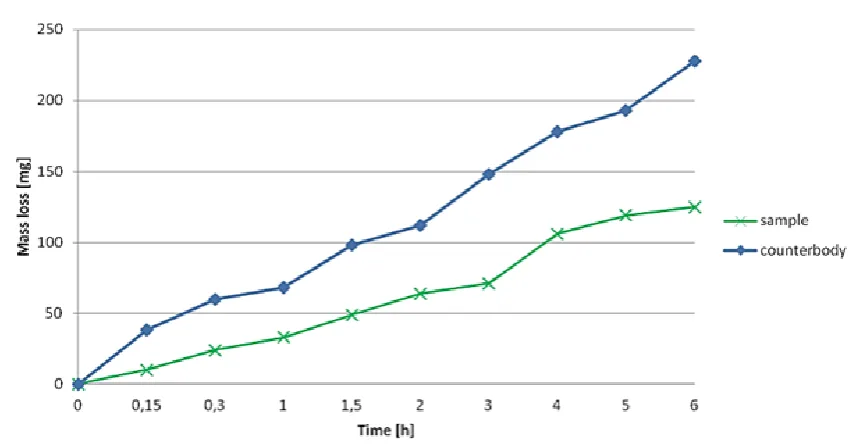
examination time of 6 hours was 125 mg. The mass loss of coating and counterbody presents Figure 2. At the same time, the average mass loss of counterbodies was 228 mg. The average wear coefficient was 0.59.
The SEM view of the coating surface after friction is shown in Figure 3. The surface after friction has a “flake-layer” composition. Numer-ous wear traces are visible on the surface.
Quantitative and qualitative analyses of chem-ical composition of the surface layer of coatings obtained from Fe-Mn-C-B-Si-Ni-Cr alloy after tribological studies were made with the use of
Fig. 2. Mass loss of coating (sample) and counterbody
Fig. 3. Surface view of eutectic alloy coating after
a)
b)
d)
e)
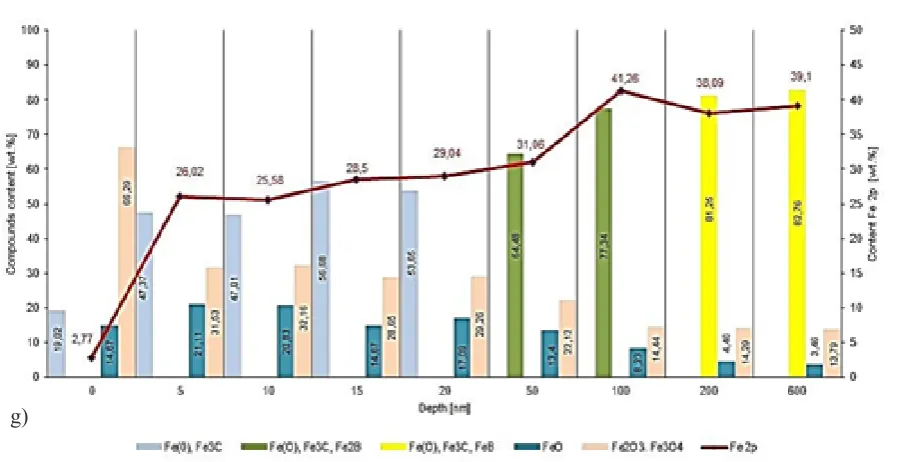
the XPS technique. The interpenetrating surfaces of the friction couple were protected by oxygen, carbon, chromium, boron and silicon compounds. The presence of compounds such as oxides (B2O3, SiO2, NiO, Cr2O3, FeO, Fe3O4, Fe2O3), carbides (Fe3C, Cr7C3)and borides (FeB, Fe2B) was ob-served on the basis of the characteristic energy of bonds present on the surface layer of Fe-Mn-C-B-Si-Ni-Cr coating. The content of carbon C 1s was the highest on the surface (57.51% at.). Its content decreased with increasing depth. The increased amount of C, H, OH, C=O, C-O-C, O-C=O carbon compounds was observed on the surface and in the surface friction layer. The content of Fe3C and Cr7C3 (Fig. 4a) increased with depth. The content of boron B 1s was the highest at a depth of 5-10 nm (5.47% at.) and 600 nm (8.83% at.). The number of boron atoms was higher in the coating after friction (Fig. 4b). Boron in the form of a B2O3 compound occurred at a depth of approximately 50 nm. Along with increasing depth the content of B2O3 decreased, while the content of FeB and Fe2B increased. The content of Si 2s was the highest at a depth of 20 nm and amounted to 7.02% at. (Fig. 4c). Silicon in the form of a SiO2 compound occurred at a depth of approximately 200 nm. Along with increasing depth the content of SiO2 decreased, while the content of Si 2s increased. The con-tent of Cr 2p chromium in OSL after friction was lower than in the coating (Fig. 4d). Chromium in
the form of a Cr2O3 compound occurred at a depth of approximately 50 nm. At depths of more than 50 nm, it was observed mainly in the form of a metallic chromium. Nickel occurred mainly in a metallic form and as NiO (Fig. 4e). In contrast, oxygen O 1s was predominantly observed in the form of metal oxides and in C-OH, C=O, C-O-C, O-C=O groups (Fig. 4f). Iron Fe2p was mainly observed in a metallic form or as FeO, Fe3O4, Fe2O3 and Fe3C, FeB, Fe2B compounds (Fig. 4g).
An increased content of carbon and oxygen was detected on the surface of the counterspeci-men made of C45 steel. It decreased with in-creasing depth. The content of iron, on the other hand, increased. The operational surface layer of the counterspecimen contained mainly iron ox-ides and chromium oxide (Cr2O3). Carbon was detected in the form of Fe3C, and C-C, C-H, C-OH, C-O-C, C=O, -CO3 compounds. Silicon was detected at depths ranging from 20 to 50 nm (maximum – 1.36% at.).
In the work [13] the results of studies of Fe-Mn-C-B-Si-Ni-Cr alloys analyzed in other con-ditions were presented. They also were used to develop the model of the operating surface layer.
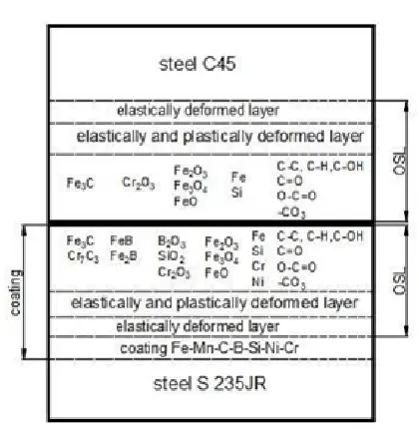
The following generalized OSL model (shown in Figure 5) was proposed on the basis of the obtained results and literature data. The chemi-cal composition of the operational surface layer varied with depth. Deeper layers were generally characterized by the presence of less complex
Fig. 4. Distribution of elements and chemical compounds in hardfaced coating after tribological tests: a) C, b) B, c) Si, d) Cr, e) Ni, f) O, g) Fe
inorganic compounds. The surface layer of hard-faced coatings contained oxides (B2O3, SiO2, NiO, Cr2O3, FeO, Fe3O4, Fe2O3), carbides (Fe3C, Cr7C3) and borides (FeB, Fe2B). Elastically and plasti-cally deformed zones, which were the result of unit pressures, were observed during the course of friction. Another zone was deformed elastically. The structure of the welding coating obtained of XRD (X-ray diffraction) investigation consists of alloyed austenite Fe(Ni,Cr) (matrix phase), manganese-iron carbide Fe0,4Mn3,6C (reinforcing phase) and Fe2B, Cr7C3, (dispersion phase) [11-13]. Boundaries between individual zones were not as clear as shown in the figure. Their thickness and presence depend on operating conditions.
CONCLUSIONS
This paper focuses on the examination of chemical composition of the friction surfaces Fe-Mn-C-B-Si-Ni-Cr hardfacing coatings. The composition of the coatings (wt.%) is as fol-lows: Mn-7.29; C-1.63; B-1.79; Si-2.46; Ni-17.68; Cr-16.24; Fe-rest. The average mass loss of samples after tribological tests was 125 mg. The average wear coefficient was 0.59. The sur-face of the coating after friction is most often of “flake-layer” composition with traces of mi -crocutting. The chemical composition of the ma-terial’s surface layer change with depth, which has been investigated by XPS analysis. At the surface and in the near-surface layer of
Fe-Mn-C-B-Si-Ni-Cr coating has been confirmed the presence of such compounds as oxides (B2O3, SiO2, Cr2O3, FeO, Fe3O4, Fe2O3), carbides (Fe3C, Cr7C3), borides (FeB, Fe2B), as well as impuri-ties of organic carbon compounds. This com-pounds increases wear resistance of coatings created from Fe-Mn-C-B-Si-Ni-Cr all.
REFERENCES
1. Burakowski T., Wierzchoń T.: Inżynieria
powierz-chni metali, WNT, Warszawa 1995.
2. Dziedzic K., Zubrzycka-Wróbel J., Józwik J.,
Barszcz M., Siwak P., Chałas R.: Research on tri -bological properties of dental composite materials. Advances in Science and Technology Research Journal, 2016, 32, 10, 144–149.
3. Gualco A., Svoboda H., Surian E.: Study of abra-sive wear resistance of Fe-based nanostructured hardfacing, Wear, 2016, 360, 14–20.
4. Józwik J., Dziedzic K., Usydus I., Raos P., Krolczyk G.M.: HS 6-5-2 steel surface layer development in
carbonitoring with zeroflow method. Tehnicki Vjesn -ik – Technical Gazette, 2016, 5, 23, 1405–1409. 5. Krolczyk J.B., Gapinski B., Krolczyk G.M.,
Sa-mardzic I., Maruda R.W., Soucek K., Javadi Y., Le-gutko S., Nieslony P., Stas L.: Topographic Inspec-tion as a Method of Weld Joint Diagnostic, Tehnicki Vjesnik – Technical Gazette, 2016, 23, 1, 301–306. 6. Kumar R., Chattopadhyaya S., Hloch S., Krolczyk
G., Legutko S.: Wear Characteristics and Defects analysis of Friction Stir Welded joint of Alumin-ium alloy 6061-T6, Maintenance and Reliability, 2016, 18, 1, 128–135.
7. Correa E.O., Alcântara N.G., Valeriano L.C.,
Barbe-do N.D., Chaves R.R.: The effect of microstructure
on abrasive wear of a Fe-Cr–C-Nb hardfacing alloy deposited by the open arc welding process, Surface & Coatings Technology, 2015, 276, 479–484. 8. Feldshtein E., Józwik J., Legutko S.: The influence
of the conditions of emulsion mist formation on the
surface roughness of AISI 1045 steel after finish
turning. Advances in Science and Technology Re-search Journal, 2016, 10, 30, 144–149.
9. Napiórkowski J., Pękalski, G. Kołakowski K.: Badanie struktur i zużywania powłok napawa
-nych w glebowej masie ściernej, Tribologia, tarcie, zużycie, smarowanie, 2012, 3, 111–117.
10. Liu H., Song Z., Cao Q., Chen S., Meng Q.: Micro-structure and properties of Fe-Cr-C hardfacing al-loys reinforced with TiC-NbC, Journal of Iron and Steel Research, 2016, 23, 3, 276–280.
11. Pashechko M., Dziedzic K., Barszcz M.: Study of the structure and properties of wear-resistant eutec-tic Fe-Mn-C-B-Si-Ni-Cr coatings, Powder Metal-lurgy and Metal Ceramics, 2013, 7-8, 52, 469–476.
Fig. 5. Model of the surface layer for friction couple, hardfaced coating obtained from
faults of the single-phase induction motor using
thermal images, MoASoS and selected classifiers,
Measurement, 2016, 93, 86–93.
17. Nieslony P., Krolczyk G.M., Zak K., Maruda R.W., Legutko S.: Comparative assessment of the mechanical and electromagnetic surfaces of explo-sively clad Ti–steel plates after drilling process. Precision Engineering, 2017, 47, 104 –110.
18. Novák M., Náprstková N., Józwik J.: Analysis of
the surface profile and its material share during the
grinding Inconel 718 alloy, 2015, 9, 26, 41–48.
botechnika, Wyd. i Zakład Poligrafii Instytutu
Technologii Eksploatacji, Radom 2000.
24. Kurzydłowski K., Lewandowska M.: Materiały inżynierskie konstrukcyjne i funkcjonalne, PWN,
Warszawa 2010.
25. Mandrino D., Podgornik B.: XPS investigations of
tribofilms formed on CrN coatings, Applied Sur -face Science, 2017, 396, 554–559.