Technology (IJRASET)
Fault node recovery in wireless sensor networks
using FNR
Sandeep N Kulkarni, Asst Prof Anita Dixit2
#
Information Science, VTU
Abstract— Some WSN by lots of immobile node and with the restricted energy and while not further charge of energy. Whereas extension of the many sensing element nodes and their operation. Therefore it is normal. Unactive nodes miss their communication in network. for this we tend to proposes a fault node recovery (FNR) rule to boost the lifespan of a wireless sensing element network (WSN) once a number of the sensing element nodes finish off, either as a result of they not have battery energy or they need reached their operational threshold. Exploitation the FNR rule may end up in fewer replacements of sensing element nodes and additional reused routing ways. Thus, the rule not solely enhances the WSN lifespan however additionally reduces the value of commutation the sensing element nodes. Within the simulation, the planned rule will increase the quantity of active nodes up to eight.7 times. the quantity of active nodes is increased three.16 times on the average when commutation a mean of thirty two sensing element nodes for every calculation. Therefore, the FNR rule not solely replaces sensing element nodes, however additionally reduces the cost and reuses the foremost routing ways to extend the WSN lifespan.
Keywords— Grade Diffusion, Directed Diffusion, FNR Wireless, Sensor network, Smart Sensors
I. INTRODUCTION
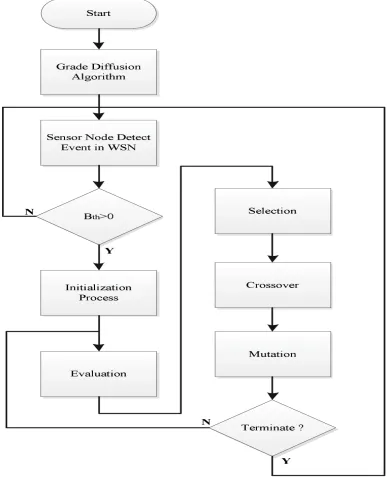
A wireless device network could be a assortment of device nodes organized into a cooperative network WSN area unit accustomed collect knowledge from the atmosphere. A device network consists of multiple detection stations known as device nodes, every of that is little, light-weight and transportable. The nodes within the network area unit connected via Wireless communication channels. every node has. capability to sense knowledge, method the information and send it to remainder of the nodes or to Base Station. These systems region unit limited by the hub battery proposes a flaw hub recuperation (FNR) algorithmic system for WSNs upheld the evaluation dispersion algorithmic project joined with the hereditary algorithmic project. The stream outline is demonstrated. The FNR algorithmic project makes the evaluation worth, directing table, neighbour hubs, and payload worth for each gadget hub exploitation the evaluation dissemination algorithmic system. inside of the FNR algorithmic project, the amount of non-functioning gadget hubs is computed all through the remote gadget system operation, furthermore the parameter Bth is figured. The FNR algorithmic project makes the evaluation worth, steering table, an accumulation of neighbor hubs, and payload worth for each gadget hub, exploitation the evaluation dissemination algorithmic system.
The gadget hubs exchange the occasion information to the sink hub in keeping with the GD algorithmic project when occasions appear. At that point, Bth is computed in keeping with in the FNR algorithmic system. The quantity of non-functioning device nodes is calculated throughout the wireless device network operation, and also the parameter Bth is calculated. the FNR algorithmic program creates the grade worth, routing table, a collection of neighbour nodes, and payload worth for every device node, victimisation the grade diffusion algorithmic program. The device nodes transfer the event knowledge to the sink node in keeping with the GD algorithmic program once events seem. Then, Bth is calculated in keeping with in the FNR algorithmic program. If Bth is larger than zero, the algorithmic programs are invokedand replace non-functioning device nodes by purposeful nodes elite by the genetic algorithmic program. Then the wireless device network will still work as long because the operators area unit willing to exchange sensors.
Technology (IJRASET)
II. RELATEDWORK
The traditional approaches to sensing element network routing include the directed diffusion (DD) algorithmic program and therefore the grade diffusion (GD) algorithmic program. The algorithmic program planned in this paper relies on the GD algorithmic program, with the goal of commutation fewer sensing element nodes that square measure down or have depleted batteries, and of reusing the utmost variety of routing methods.
These optimizations can ultimately enhance the WSN period and scale back sensing element node cost. A Directed Diffusion algorithmic program a series of routing algorithms for wireless sensor networks are planned in recent years. Conferred the Directed Diffusion algorithm program. The goal of the doctor\'s degree algorithmic program is to cut back the info relay transmission counts for power management. The doctor\'s degree algorithmic program may be a query-driven transmission protocol.
The collected knowledge is transmitted as long as it matches the question from the sink node. Within the doctor\'s degree algorithmic program, the sink node provides the queries within the kind of attribute-value pairs to the opposite sensing element nodes by broadcasting the question packets to the whole network. later, the sensing element nodes send the data back to the sink node only if it fits the queries’. Grade Diffusion algorithmic program H. C. Shih et al. conferred the Grade Diffusion (GD)algorithm in 2012 to boost the ladder diffusion algorithmic program using pismire colony improvement (LD-ACO) for wireless sensing element networks . The GD algorithmic program not solely creates the routing for each sensing element node however conjointly identifies a group of neighbour nodes to cut back the transmission loading. every sensing element node can choose a sensing element node from the set of neighbours nodes when its grade table lacks the nodes able to performed the relay. The GD algorithmic program can even record some data relating to the data relay. Then, a sensing element node will choose a node with a lighter loading or additional accessible energy than the opposite nodes to perform the additional relay operation. That is, the GD algorithmic program updates the routing path in real time, and therefore the event knowledge is so sent to the sink node quickly and properly. Whether the doctor\'s degree or the GD algorithmic program is applied, the grade creating packages or interested question packets should 1st be broadcast. Then, the sensing element nodes transfer the event knowledge to the sink node, in line with the algorithmic program, once appropriate events occur.
III.PROPOSEDSYSTEM
Fault node recovery (FNR) algorithmic program for WSNs bolstered the evaluation dissemination algorithmic system joined with the hereditary algorithmic project. The stream diagram is demonstrated in Fig The FNR algorithmic system makes the evaluation worth, directing table, neighbor hubs, and payload worth for each gadget hub abuse the evaluation dispersion algorithmic project. inside of the FNR algorithmic system, the quantity of nonfunctioning gadget hubs is computed all through the remote gadget system operation, and in this way the parameter Bth is figured reliable. There are five steps within the genetic algorithm: data formatting,Evaluation, Selection, Crossover, and Mutation.Descriptions of the steps follow.
A. Initialization
Information design In the information form step,the hereditary algorithmic principle produces chromosomes, and each body is A normal arrangement. the amount of chromosomes is chosen by populace measure, that is laid out by the client. Every chromosome may be a blend determination, and consequently the body length is that the scope of locator hubs that ar exhausted or nonfunctioning. the climate inside of the qualities ar either zero or one. An one implies that the hub should get supplanted, and a zero suggests that the hub won\'t get supplanted.
B. Evaluation
In general, the fitness worth is calculated in line with a fitness perform, and also the parameters of the fitness perform are the chromosome’s genes. However, we have a tendency to cannot place genes directly into the fitness perform within the FNR rule, because the genes of the body area unit merely whether or not the nodeshould get replaced or not. within the FNR rule, the goal is also to apply the foremost routing methods and to interchange the fewest sensor nodes. Hence, the amount of routing methods offered ifsome nonfunctioning device nodes area unit replaced is calculated,
C. Selection
Technology (IJRASET)
sex pool. The more regrettable chromosomes are erased, and new chromosomes are done to switch them once the hybrid step.
D. Crossover
The hybrid is utilized inside of the hereditary algorithmic principle to change the individual body. amid this algorithmic guideline, we tend to utilize the one-point hybrid procedure to frame new chromosomes 2 individual chromosomes range unit browsed the sexual movement pool give 2 new chromosom tyke. A hybrid point is picked between the essential and last qualities of the guardian people. At that point, the division of each person on either part of the hybrid design is changed and link to frame kid. The rate of choice is shaped in accordance with the roulete-wheel decision furthermore the wellness values.
E. Mutation
[image:4.612.130.517.226.703.2]The change step can present attributes not found in the unique people and keeps the GA from meeting too quick.
Technology (IJRASET)
IV.CONCLUSION
In real wireless sensing element networks, the sensing element nodes use battery power provides and therefore have restricted energy resources. Additionally to the routing, it\'s vital to analysis the improvement of sensing element node replacement, reducing the cost, and reusing the foremost routing methods once some sensing element nodes are non-functional. This project proposes a fault node recovery formula for WSN supported the grade diffusion formula combined with a genetic formula. The FNR formula needs replacement fewer sensing element nodes and reuses the foremost routing methods, increasing the WSN lifetime and reducing the replacement cost.
REFERENCES
[1] J. A. Carballido, I. Ponzoni, and N. B. Brignole, “CGD-GA: A graph based genetic algorithm for sensor network design,” Inf. Sci., vol. 177, no. 22, pp. 5091– 5102, 2007.
[2] F. C. Chang and H. C. Huang, “A refactoring method for cache-efficient swarm intelligence algorithms,” Inf. Sci., vol. 192, no. 1, pp. 39–49, Jun. 2012. [3] S. Corson and J. Macker, Mobile Ad Hoc Networking (MANET): Routing Protocol Performance Issues and Evaluation Considerations. New York,NY, USA: ACM, 1999.
[4] M. Gen and R. Cheng, Genetic Algorithms and Engineering Design. New York, NY, USA: Wiley, 1997.
[5] Z. He, B. S. Lee, and X. S. Wang, “Aggregation in sensor networks with a user-provided quality of service goal,” Inf. Sci., vol. 178, no. 9, pp. 2128–2149, 2008. [6] J. H. Ho, H. C. Shih, B. Y. Liao, and S. C. Chu, “A ladder diffusion algorithm using ant colony optimization for wireless sensor networks,” Inf. Sci., vol. 192, pp. 204–212, Jun. 2012.
[7] J. H. Ho, H. C. Shih, B. Y. Liao, and J. S. Pan, “Grade diffusion algorithm,” in Proc. 2nd Int. Conf. Eng. Technol. Innov., 2012, pp. 2064–2068.
[8] T. P. Hong and C. H. Wu, “An improved weighted clustering algorithm for determination of application nodes in heterogeneous sensor networks,” J. Inf. Hiding Multimedia Signal Process., vol. 2, no. 2, pp. 173–184, 2011.
[9] C. Intanagonwiwat, R. Govindan, D. Estrin, J. Heidemann, and F. Silva, “Directed diffusion for wireless sensor networking,” IEEE/ACM Trans.Netw., vol. 11, no. 1, pp. 2–16, Feb. 2003.