Sprains and Strains
ROBERT W. WADDELL, M.D.
Virginia Beach Orthopedic Associates, Inc., Virginia Beach, Virginia. and Instructor, Orthopedic Surgery. Eastern Virginia Medical School, Norfolk. Virginia
There is a tendency for many physicians to Jump sprains and strains into one category and to consider all of them minor injuries. This is far from true and it is hoped that this discussion will result in a better understanding of the difference between the two, more accurate diagnosis, and more effective treat ment.
A strain is damage to a muscle tendon unit. A first-degree, or mild, strain is one in which there is no disruption of fibers. There is usually some well-local ized edema. Treatment need only be that of rest and protection against stress until the patient becomes more comfortable. A second-degree, or moderate. strain is one in which there is damage to the fibers of the muscle tendon unit. There may be some loss of strength in addition to localized edema. Treatment usually consists of rest, ice, elevation, and occasion ally antispasmodics and immobilization. A third-de gree strain, or severe strain, is one in which there is complete rupture of the muscle tendon unit with marked Joss of strength and extensive edema. Early diagnosis is essential in order to institute the proper treatment as soon as possible. Surgical repair will often be necessary in third-degree injuries.
A sprain is a ligamentous injury from overstress. A first-degree, or mild, sprain is one in which a few of the fibers are torn. There will be localized edema and hematoma formation, but no apparent Joss of strength can be detected. Treatment is symptomatic. A second-degree, or moderate, sprain is one in which there is partial tearing of the ligament with some Joss of strength. A second-degree sprain should be im mobilized and complete recovery can usually be ex-This is an edited transcription of a lecture given by Dr. Waddell al the 28th Annual Stoneburner Lecture Series, 11 April. 1975. al the Medical College of Virginia, Richmond.
174
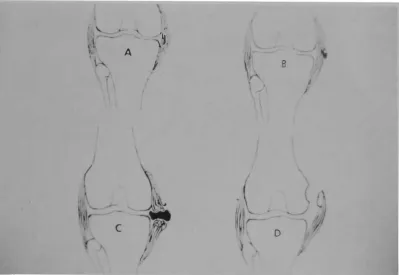
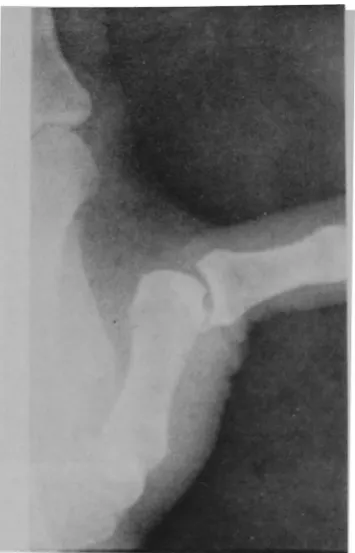
pected. A third-degree, or severe, sprain is one in which there is complete disruption of the ligamentous structure (Fig IC). Often there will be a palpable defect, and marked edema will be present. Abnormal motion of the joint can usually be detected, especially if one injects the joint with a local anesthetic prior to examination. X-rays should always be made and of particular importance are stress x-rays. These will prove to be of great value in deciding whether or not the injury is second or third degree. Again, injection of an anesthetic into the joint makes it much easier to carry out an accurate stress x-ray. This type of injury is always treated by rigid immobilization and occa sionally surgical repair.
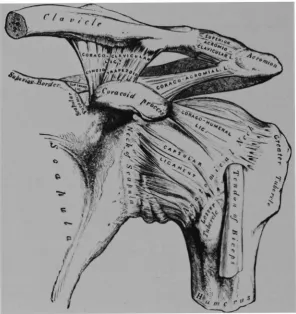
The acromioclavicular joint is retained by the coracoacromial, the acromioclavicular, and the cora
coclavicular ligaments (Fig 2). First-degree sprains of this joint are treated symptomatically. Second-degree with partial tearing usually results in slight superior displacement of the distal clavicle. This can be very adequately treated with an acromioclavicular strap fashioned in the office by placing a felt pad under the elbow. then applying an adhesive strap from the el bow to the AC joint while at the same time exerting some downward pressure across the distal end of the clavicle. The arm is then fastened to the body in a Yelpeau fashion. Commercial acromioclavicular har nesses are also available. This type of treatment usu ally is very eff
ective, but it should be carried out for a period of six weeks and the joint protected from addi tional stress for several weeks longer. Third-degree acromioclavicular sprains result in complete dis ruption of the joint with gross displacement superi orly of the distal clavicle (Fig 3). There will always be marked hematoma formation, point tenderness, and the patient will have significant functional Joss.
(
C
A
I I.
i
175
"
l
8
JD
Fig I-Sequence showing degrees of sprain. A. First-degree sprain "ith minimal bleeding: B. Second-degree sprain with more fibers torn: C. Third-degree sprain with complete disruption: D. Third-degree injury with avulsion fracture. (l'rom O'Donoghue. Treatment oj Injuries to Athletes. p 75, 1970. with permission from author and W. 8. Saunders Company.)
normal motion can be demonstrated by grasping the clavicle at the middle third and then moving it ante riorly and posteriorly. The pathologic motion at the distal end of the clavicle can readily be perceived. Stress x-rays are sometimes helpful and are made by having the patient stand upright and hold heavy weights in both hands. This will usually demonstrate the separation. In younger people, it is advisable to surgically repair the acromioclavicular ligaments and stabilize the joint until healing has taken place. The results from this type of treatment are uniformly good. In an older patient, an acromioclavicular strap would be adequate management.
The glenohumeral joint is one of our most un stable joints and as a result is frequently injured. It is reinforced by a strong musculotendinous structure called the rotator cuff. This is composed of the sub scapularis, supraspinous, in fraspinous, and teres minor muscles. First-degree strains of this joint are
treated symptomatically. Second-degree strains are treated by immobiliLation for a period of four weeks. A third-degree injury with dislocation is treated for a period of six weeks in a shoulder immobilizer. Ante rior subluxations frequently occur as a result of ab duction and external rotation stress. Capsular tearing results and the head rides over the glenoid rim and then relocates spontaneously. The history is ex tremely important in diagnosing this particular in jury. When this injury takes place, it results in tearing of the anterior portion of the shoulder capsule, but the force stops short of causing complete dislocation. Im mobilization for a period of six weeks is in order to allow for capsular healing.
176
Fig 2-Detail of clavicle. (Note strong reinforcing ligaments of the acromioclavicular joint.)
prior to and after reducing the dislocation, and x-rays should be made before and after manipulation. Avul sion fractures or the greater tuberosity are frequently associated with shoulder dislocations and usually do not influence treatment.
Posterior dislocations of the shoulder are ex tremely rare and a routine anteroposterior x-ray may be misinterpreted as showing a normal glenohumeral relationship. A transthoracic lateral x-ray is essential to make this diagnosis. The use of intravenous Rob axin'"' and Demerol·� can be extremely helpful when reducing a dislocated shoulder. Longitudinal traction with gentle abduction usually results in relocation. In the event that this fails to accomplish relocation, the Kocher maneuver can be carried out.
Strains of the arm do occur. First- and second degree types present no particular problems in
diag-nosis or treatment. Third-degree strains involving complete disruption are major injuries and in general should be treated by surgical repair. Rupture of the biceps muscle is one of the most common types of third-degree strains about the arm.
el-Arr orn,oc 1ov1c u 10 r ligaments <torn)
Split ,n pectorol11 no, muKle
•
177
Fig 3-Complcte dislocation or the acromioclavicular joint.
bow and re-x-ray the joint in IO to 14 days. Many times a linear supracondylar elbow fracture will be apparent on the second series of x-rays.
A nursemaid's elbow is frequently encountered in the Emergency Room in the toddler. This occurs because the radial head is small at this stage of devel opment and longitudinal stress results in partial sub luxation of the radial head from beneath the annular ligament. The child presents with a painful elbow and will not move the arm. X-rays are negative. Reloca tion is simple and can be accomplished by placing the thumb directly over the radial head and supinating the forearm as it is flexed at the elbow. A pop or click can usually be felt beneath the thumb, indicating that the radial head has slipped back under the annular ligament. The child should then be immobilized in a cuff and collar for a period of seven days.
A third-degree elbow sprain with dislocation results in damage to the collateral and capsular liga ments. Fractures are frequently associated and neuro vascular damage may be seen. This is truly a surgical emergency and should receive priority over many other types of injuries. Reduction can usually be accom plished without general anesthesia. The patient is given a narcotic and the joint is occasionally injected with a local anesthetic. Longitudinal traction is
178
rT/nar t'nllnteral ligament Radial rullatrral ligament
Pisom tfacarpal l'iwh11mnte
Ham ulu, of ham ate
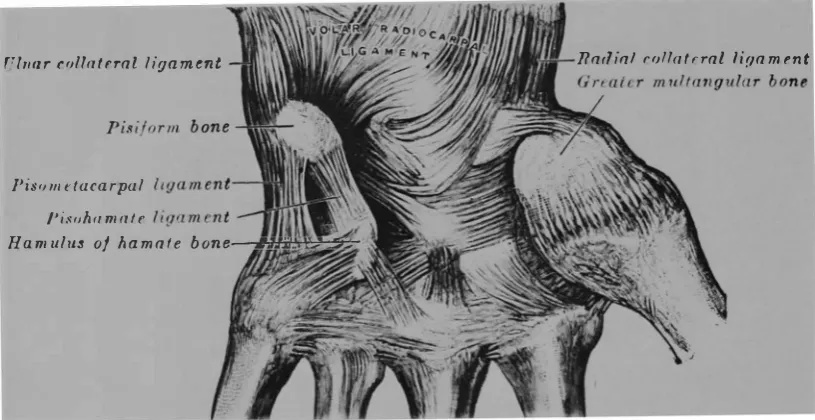
bone--lil'l:lil�:.J-::2:-Fig 5-Detail of ligamentous structure of the wrist.
plied until the coronoid process of the ulna slips over the humeral condyle. When this is accomplished, gentle flexion usually results in relocation. Swelling is often marked with these injuries and great care should be used in immobilizing the extremity with anything that might impair circulation. A posterior plaster splint is usually adequate for initial immobili zation and is safer than a circular cast. The joint should be immobilized for a period of three weeks.
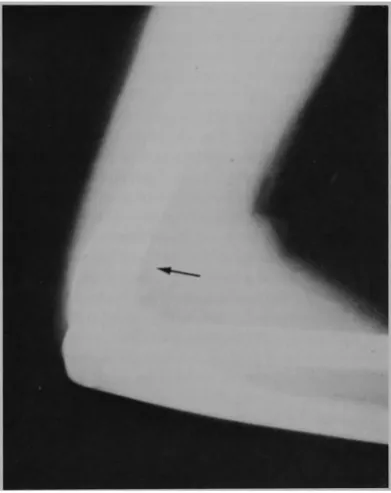
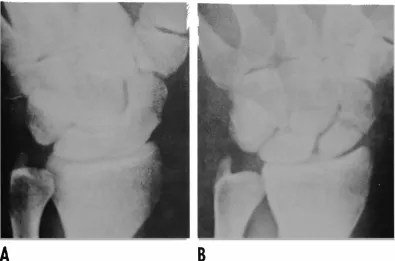
Sprains of the wrist are infrequent but are fre quently diagnosed. Most are tendon or bone injuries and are not ligamentous injuries. The ligamenlous structure about the wrist is extremely dense and is stronger than the bony structures (Fig 5). The physi cian should always examine the anatomical snuff box for swelling or tenderness. Many times, even with negative x-rays, a fracture of the carpal navicular will be present. Should there be snuff box tenderness, the hand, wrist, and forearm are immobilized in a gaunt let type of cast for IO to 14 days, and additional x rays are obtairied al that time to definitely establish the diagnosis (Fig 6). Subluxations and dislocations about the wrist do occur. If there is no associated fracture, four weeks of immobilization after reduc tion is usually adequate.
The carpometacarpal joints are stabilized mainly by their ligamentous structure. First-degree sprains
179
A
B
Fig 6-X-ray of wrist. A. Initial x-ray thought to be negative. B. X-ray 14 days later showing a fracture of the carpal navicular. (From O'Donoghue. Treatment of Injuries 10 Athletes. p 203. 1970, with permission from author and W. B. Saunders Company.)
dislocations, the force should not be applied long itudinally. Instead, it should be applied in an upward direction with the physicians's finger pushing distally at the base of the proximal phalanx. The flexion is then carried out and relocation usually occurs.
The proximal interphalangeal joints are most of ten injured by hyperextension, causing volar plate damage, or abduction and adduction injuries, caus ing collateral ligament damage. All sprains of this joint should be splinted. Abnormal motion should be determined and in the event that this is in question stress films again will be found lo be helpful. Surgical repair of third-degree injuries is sometimes indicated. The distal interphalangeal joint is most often injured by a football or baseball striking the end of the finger and causing acute flexion. The extensor tendon is avulsed from its insertion al the base of the distal phalanx. The patient will be unable to completely extend the distal phalanx and may develop a swan neck type of mechanical derangement. X-rays may show an avulsion fracture. This injury can be treated
conservatively with a malleable aluminum splint bent in the position seen in Figure 8. The splint should be changed weekly and should remain snugly applied to the finger for a period of six weeks.
180
Fig 7-Posili\'c stress x-ra) �hO\\ing rupture of the ul11�1r i..:oll..lh.:ral ligament or the thumb. (From O'Donoghut:. Trearment of In
juries to ArhleteJ. p 228. 1970. with pcrmi�sion from �1uthor �ind W. B. Saunders Company.)
such as chronic bursitis. excessive calcilication. and nonunion of the avulsed fragment can occur. First and second-degree strains about the thigh are rela tively common and are usually not signilicant as long as they are properly diagnosed and treated pro tectively. Third-degree strains. or complete ruptures of the quadriceps or hamstring muscles. usually re quire surgical repair.
The knee is one of our most vulnerable joints. Anatomically. it is unstable and receives its stability from the anterior and posterior cruciate ligaments. the joint capsule. and the superlicial and deep medial and lateral collateral ligaments. Again. knowing the mechanism or injury will prove lo be invaluable in making an accurate diagnosis. The physician also wants lo know how severe the injury appeared to be initially. Was the injured person able to bear his weight'1 Did he note a deformity al the time of injury''
Was there giving away, popping, or locking of the joint. and was it associated with immediate or de layed swellingry In examining the knee joint, the physi cian should carefully note any deformities, the condi tion of the skin, and the point of maximum tenderness. The extent and location of swelling and the presence of an effusion should also be deter mined. Manipulation is then carried out to check the range of motion, determine whether or not any mo tions are painful. and to note abnormal motion in the medial, lateral. anterior, posterior, and rotary planes. The knee should first be examined in extension. One hand stabilizes the medial femoral condyle, while the other exerts pressure against the lower tibial area (Fig 9 ). This maneuver checks the medial capsule, the medial collateral. and to some extent the anterior cruciate ligaments for stability. The joint is then flexed 30° and the same maneuver is carried out. Instability in flexion indicates a more isolated injury to the medial collateral ligament. Reverse the pro cedure to test the lateral collateral ligament and cap sule. With the patient on his or her back, and the knees flexed to 90°, the foot is then fixed under the examiner's leg in a neutral position and both hands
Fig 8-Malkahk finger splint shaped und applied for the treat
181
Fig 9-Chcck ing the stability of the medial knee joint in extension.
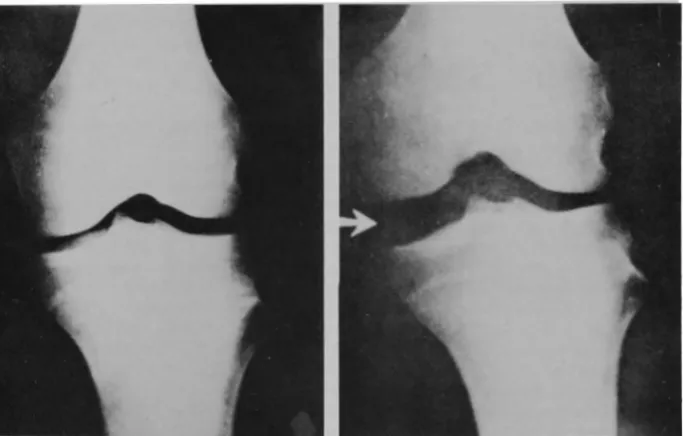
are placed over the medial and lateral tibia, just be low the knee joint. Force is then exerted anteriorly and posteriorly. Abnormal anterior laxity indicates anterior cruciate instability while abnormal posterior laxity indicates posterior cruciate instability. In addi tion, the foot should be externally rotated and stabi lized against the table by the examiner's leg and, again, the anterior-posterior force should be applied. Rotary or anterolateral instability is indicative of me dial capsular disruption, although tears of the ante rior cruciate and medial collateral ligaments increase the rotary instability (Fig 10). The uninjured knee should always be compared with the injured side, since many individuals have loose knee joints that are not considered to be pathologic. Routine x-rays should be obtained and occasionally a tunnel view will be important in determining whether or not an osteochondral fracture has occurred. Stress x-rays are extremely helpful in deciding whether or not third degree tearing has occurred (Fig 11 ).
In first-degree knee injuries, good results are
usu-ally obtained by treating the joint with rest, com pressive dressings, ice packs, and elevation. Second degree sprains initially are treated by aspirating the hemarthrosis, if one exists, occasionally inject ing an anesthetic and hyaluronidase, and then ap plying compressive dressings and ice packs. Later the knee can be immobilized in a plaster cast. Restora tion of muscular tone should never be overlooked during the latter phases of treatment. Third-degree injuries are best treated by surgical repair if the joint opens more than ten degrees with stress. Neglecting such an extensive injury causes extreme disability to the patient and will invariably result in the premature development of traumatic osteoarthritic changes as well as severe functional weakness.
182
Fig 10-The slocum test for rotary instability (see text).
183
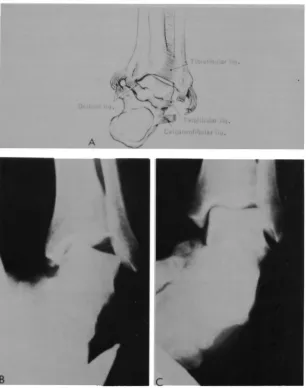
Fig 12-A. Diagrammatic illustration of the deranged ligaments of the la1eral ankle joint; 8 and C. Comparable .x-ray appearance with stress. (From O'Donoghue. Treatment of Injuries to Athletes. p 466. 1970. with permission from author and W. B. Sanders Company.)
the physician cannot help but note the gross deform ity about the knee joint if the patella has not been reduced. After reduction, the physician should pay particular attention to the presence of tenderness and swelling about the medial aspect of the joint. This is suggestive of tearing of the medial capsule. Immobili zation in a plaster cylinder cast for six weeks is the treatment of choice. Inadequate treatment often re sults in poor capsular healing and recurrent dis locations. Should the dislocation become recurrent,
little can be gained by continued immobilization after the second or third dislocations.
Strains of the leg are common and present no particular problem in management unless they hap pen to be third degree, such as rupture of the Achilles tendon. Surgical repair is then indicated.
anatomy of the ligamentous structures about the ankle joint in order to make an accurate diagnosis. On the medial side, the primary retaining ligaments are the deltoid and the posterior talotibial ligaments. On the lateral side of the joint, the calcaneofibular, the anterior talofibular. and the anterior tibiofibular ligaments are the primary retaining forces. Posteri orly. the tibiofibular and the posterior talofibular liga ments serve as additional anchors. Inversion sprains make up approximately 85% of the sprain-type in juries to the ankle joint. In first-degree ankle sprains, the physician will note minimal swelling. tenderness. and no apparent loss of strength. X-rays are usually negative. Symptomatic treatment only is indicated. A second-degree injury with partial tearing will present as a rather painful joint associated with moderate swelling, which should be well localized, and loss of strength. Again, x-rays are usually negative. Treat ment should be vigorously pursued and if a hemarth rosis is present. aspiration may be indicated. Occasion ally. hyaluronidase can be of value when injected into the joint or hematoma. Compressive dressings. ice, elevation, and protection from weight bearing is suggested as the initial phase of treatment. Sub sequently, a cast should be applied for a period of four weeks and the ankle should be protected by strapping for an additional two weeks. A third-degree ankle sprain is a serious and significant injury and if not properly managed will result in considerable dis ability for the patient. When this injury occurs. pain
and swelling will be marked. The patient will be unable to tolerate any weight bearing and on exam ination marked loss of strength will be apparent as well as abnormal motion. Stress x-rays, with the ankle being stressed in inversion and eversion, are extremely helpful and will be positive if the injury is third degree (Fig. 12). Fractures will occasionally be associated with this injury. In the younger individual, many third-degree ankle sprains are treated by surgi cal repair. If nonsurgical care is in order, a third degree sprain may be treated initially with the same regimen as for the second degree with the exception that the cast is applied for six weeks and the ankle is protected by strapping for an additional two weeks.
The management of sprains and strains is not difficult. A history of the mechanism of injury is in valuable in determining what structures might have been injured. Careful examination with particular at tention being paid to abnormal motion is essential. Stress x-rays should always be made if there is a question as to whether or not the injury is severe enough to be classified as a third-degree injury. Once the injury has been graded. management presents no particular problem.
Figures 2 "nd 5 "re reproduced with permission rrom Grny's
Anatomy of the H11111a11 Body. 29th edition. 1973. p 321 and p 333. rcspcclively.