R E S E A R C H A R T I C L E
Open Access
Accounting for individual differences and timing
of events: estimating the effect of treatment on
criminal convictions in heroin users
Jo Røislien
1,2*, Thomas Clausen
1, Jon Michael Gran
2and Anne Bukten
1Abstract
Background:The reduction of crime is an important outcome of opioid maintenance treatment (OMT). Criminal intensity and treatment regimes vary among OMT patients, but this is rarely adjusted for in statistical analyses, which tend to focus on cohort incidence rates and rate ratios. The purpose of this work was to estimate the relationship between treatment and criminal convictions among OMT patients, adjusting for individual covariate information and timing of events, fitting time-to-event regression models of increasing complexity.
Methods:National criminal records were cross linked with treatment data on 3221 patients starting OMT in Norway 1997–2003. In addition to calculating cohort incidence rates, criminal convictions was modelled as a recurrent event dependent variable, and treatment a time-dependent covariate, in Cox proportional hazards, Aalen’s additive hazards, and semi-parametric additive hazards regression models. Both fixed and dynamic covariates were included.
Results:During OMT, the number of days with criminal convictions for the cohort as a whole was 61% lower than when not in treatment. OMT was associated with reduced number of days with criminal convictions in all time-to-event regression models, but the hazard ratio (95% CI) was strongly attenuated when adjusting for covariates; from 0.40 (0.35, 0.45) in a univariate model to 0.79 (0.72, 0.87) in a fully adjusted model. The hazard was lower for females and decreasing with older age, while increasing with high numbers of criminal convictions prior to application to OMT (all p < 0.001). The strongest predictors were level of criminal activity prior to entering into OMT, and having a recent criminal conviction (both p < 0.001). The effect of several predictors was significantly time-varying with their effects diminishing over time.
Conclusions:Analyzing complex observational data regarding to fixed factors only overlooks important temporal information, and naïve cohort level incidence rates might result in biased estimates of the effect of interventions. Applying time-to-event regression models, properly adjusting for individual covariate information and timing of various events, allows for more precise and reliable effect estimates, as well as painting a more nuanced picture that can aid health care professionals and policy makers.
Keywords:Maintenance treatment, Criminal activity, Time-to-event, Recurring event, Time-dependent covariate, Dynamic covariate
* Correspondence:[email protected]
1SERAF, Norwegian Centre for Addiction Research, University of Oslo,
Kirkeveien 166, 0407 Oslo, Norway
2Department of Biostatistics, Institute of Basic Medical Sciences, University of
Oslo, Boks 1122 Blindern, 0317 Oslo, Norway
Background
Experimental setups and randomized controlled trials have been invaluable to the medical research revolution over the past decades. However, not all diseases and in-terventions lend themselves to stylized setups, and com-plex observational data is often the only available source of information. An analytical challenge is the often large heterogeneity between individuals in treatment regimes and the timing of various events. HIV patients drift in and out of treatment [1,2], cancer patients may, or may not, have multiple relapses [3,4] and drug users will change their drug preferences, be enrolled in various treatments, drop out, overdose or die, at varying stages during the course of treatment [5-8]. Nevertheless, ac-curate and reliable estimates of the effect of often costly interventions are still essential, both for health care pro-fessionals and policy makers.
Heroin users as a group have been found to engage in high levels of criminal activity [9-12], and the reduction of crime is an important aspect of maintenance treat-ment [13]. Several observational studies have found that opioid maintenance treatment (OMT) reduces the level of criminal activity among heroin users [5,14,15]. Esti-mating of the effect of OMT is however complicated, as OMT patients differ greatly in characteristics and dur-ation of engagement with treatment. Studies have found that patients cycle in and out of treatment, often for multiple episodes [16]. Retention in treatment has con-sistently been found to be associated with crime out-come [13,17], and longer continuous periods in OMT has been associated with improved outcomes [17].
Individual covariate information and timing of events is however rarely taken into account in OMT research, or when studying criminal activity in heroin users. Focus has been on simple cohort counts and incidence rates, and criminal events grouped based on retrospectively defined criteria conditioned on the termination date of the study [12,18]. This is problematic for several reasons. Firstly, this approach only studies outcomes at a mean group level, not taking intra-individual behavior into ac-count, both with relation to criminal activity and treat-ment history. Further, without individual based regression models, confounders cannot be properly adjusted for, or associations tested for statistical significance. Finally, not adjusting for censoring introduces bias of unknown direc-tion and magnitude.
Time-to-event analysis, traditionally referred to as sur-vival analysis, is a cornerstone of modern medical statis-tical analysis, including the seminal work by Cox [19,20]. Over the past decades the field of time-to-event analysis has developed rapidly, and increasingly more complex situations can now be analyzed within the statistical framework of counting processes [21,22]. Approaching the analysis of criminal activity in OMT patients as a set
of individual counting processes allows for modeling of individual time courses, with criminal activity as a recurrent event outcome, treatment as a time-dependent covariate, and adjustment for possible confounding variables, both fixed, dynamic, and with time-varying effects.
The purpose of this work was to estimate the relation-ship between OMT and criminal convictions among her-oin users on OMT when adjusting for individual covariate information and timing of events, fitting time-to-event re-gression models of increasing complexity. We fit univari-ate and multiple Cox proportional hazards, Aalen’s additive hazards and semi-parametric additive hazards re-gression models, exploring whether increased model com-plexity paint a more nuanced picture of the situation than has previously been reported. We find that simple analyses might overestimate the effect of treatment, while includ-ing too much detail on the overall process might result in corresponding underestimation.
Methods Data material
Complete records on all 3221 patients who started OMT in Norway from September 1997 through December 2003 were cross linked with official national criminal records from the Norwegian crime statistics (Statistics Norway) December 2007, with information including date of crime and offence details. The last study day was 31 December 2003, thus being the censoring time for all patients, be-sides the 135 patients who died before this, who were cen-sored at their time of death. The data has been analyzed previously, and a full description on the study settings and participants can be found elsewhere [8,12,18].
The Norwegian crime statistics from 1995 to 2003 provide data on date of all crimes registered by the po-lice in the period, penal code and various prosecution decisions. All convictions are decisions finding a person guilty of a crime in the court of law. In our study, only formal final convictions were included in the analysis. Similarly, convictions on use and possession of illegal drugs were excluded from the analysis, as these data would potentially be particularly influenced by the seve-rity of their drug dependence. We focus here on ‘crime days’; any day with one or more criminal convictions was considered a‘crime day’.
The patients had from one to six treatment episodes of various lengths. Due to relatively few long observation times, the various time-to-event models were fitted only up until 6 years from application to the OMT programme.
Ethics
Directorate of Health and the Police Directorate. Files were merged and made anonymous by Statistics Norway.
Statistical methodology
A crude estimate of treatment effect was calculated as the total number of days with criminal convictions in and outside of OMT, divided by the corresponding total number of risk days, that is, the incidence rate. Corre-sponding confidence intervals were calculated using the non-parametric bootstrap [23].
Following a recent publication on temporal changes in criminal convictions in OMT patients [24] we also calcu-lated the day-by-day mean number of days with criminal convictions in and outside of OMT separately in the follow-ing manner. Suppose thatmindividuals are observed over time. Let ms
t denote the total number of individuals with treatment statussat timetandNi(t) the number of events
at timetfor theith process. Then the sample mean at time
tfor treatment statussunder study is^μsð Þ ¼t 1
ms t
X
ms t
Nið Þt . A cubic smoothing spline was fitted to this temporal sam-ple mean to ease the interpretation.
We then fitted various time-to-event regression models with increasing model complexity as described below.
Counting processes
The flexible mathematical framework of counting pro-cesses is specifically designed for handling time-to-event data on an individual level [21,22]. It encompasses statis-tical techniques like the Kaplan-Meier plot and the log-rank test, as well as Cox proportional hazards and Aalen’s additive hazards multiple regression models, which allow for the adjustment of various types of covariates. In the present study the outcome variable, day with a criminal activity leading to conviction, is a recurrent event. Further, as treatment is not fixed at baseline, but varies over time, it was included as a time-dependent covariate.
Fixed covariates
Gender and age at time of application to OMT were added in the regression models as fixed covariates, along with variables describing criminal activity prior to appli-cation and criminal activity while on waiting list for OMT. The latter two variables are described below.
Data on criminal convictions from three years prior to application to treatment was included in the material as covariate information, categorized into three categories; patients with no convictions during the pre-treatment period (n = 769), 1–27 convictions (n = 2097), and more than 27 convictions (n = 355).
A natural candidate estimator for the criminal inten-sity while on waiting list for OMT is the number of days with criminal convictions divided by total number of
days while on waiting list. However, as some individuals in the cohort spent zero days on waiting this variable was undefined for these individuals. The variable was also strongly zero-inflated as the majority of individuals had zero crime days while on waiting list. We thus in-cluded the dichotomous variable ‘criminal conviction while on waiting list: yes/no’as a marker for criminal ac-tivity while on waiting list for OMT.
Dynamic covariates
In order to incorporate the dynamic nature of the problem under study in the analysis, we added two time-dynamic covariates. A dynamic covariate is a type of internal covariate, intermediate between the fixed covariate and the outcome, and may “steal” some of the effect from the fixed covariate, e.g. treatment [22,25]. Using dynamic covariates together with fixed covariates thus requires some caution.
A possibility when modeling the dynamic nature of re-current events, e.g. criminal convictions, is to include dynamic covariates of the kind ‘time since previous event’ [22]. In our study, however, several individuals had no criminal convictions throughout the observa-tional period, leaving such a variable undefined for sev-eral individuals in the cohort. Alternatively, counting the number of events within a recent time window, e.g. last 30 days, also captures some of the dynamics. This vari-able was well-defined in our data, but was strongly zero-inflated. We thus included the dichotomous variable
‘one or more days with criminal conviction last 30 days: yes/no’as a dynamic variable in the analyses.
Multiple treatment episodes, as compared to reten-tion in treatment, has been found to be associated with increased criminal activity, and we thus wanted to in-clude the accumulated number of treatments as a dy-namic variable in the regression models. However, while individuals had from one through six treatments, relatively few individuals had more than two treat-ments, and including this as a categorical variable with six ordinal levels led to a breakdown in the model fit-ting procedures. We thus added as a dynamic variable a dichotomous marker of whether the accumulated num-ber of treatments was more than one.
Cox proportional hazards model
Aalen’s additive hazards model
A typical deviation from the Cox model is that the effect of covariates change with time; a treatment might have one effect initially, which is later weakened. Two well-known reasons for such diminishing effects are aging measurements and frailty [22]. Aging means that baseline variables become less representative over time, and their effect thus smaller. The concept of frailty, on the other hand, is that, as time goes by, the individuals left in the study are less “frail”, e.g. died or dropped out. Hence, when comparing treatments, the remaining individuals in both groups will be less and less likely to experience an event the higher the initial risk, and the treatment effect will decrease with time. Frailty models aim to account for such unobserved heterogeneity between groups.
Whether a treatment effect is time-varying or constant with time might often itself be the main research ques-tion in an analysis. An alternative to the Cox model, which does not condition on constant proportional haz-ard over time, is Aalen’s additive hazards model [27]. Here covariate effects are allowed to vary freely over time. Rather than the hazard rate, the target for such an analysis is cumulative regression functions. These are plotted against time to give a description of how the co-variates influence the outcome over time, and it is the change in the cumulative functions, i.e. the slope, that is of primary interest. Dynamic analysis of recurrent event data using the additive hazards model has been sug-gested in the statistical literature previously [28].
Semi-parametric additive hazards model
A useful sub-class of the additive hazards model is the semi-parametric additive hazards model [29]. Here the ef-fect of some covariates is allowed to vary with time, while the effect of other covariates is assumed to be constant.
Calculations
The statistical analysis was performed in R 2.12 [30]. The Cox proportional hazards regression models were fitted using packagecoxph, based on the counting process for-mulation of Andersen and Gill [19]. Aalen’s additive haz-ards and semi-parametric additive hazhaz-ards regression models were fitted using packagetimereg, based on the work of Martinussen and Scheike [31]. The effect of the recurrent criminal events and time-dependent treatment covariate on an individual level was controlled for using robust estimation [32]. P-values below 0.05 were consid-ered statistically significant.
Results Incidences
The number of crime days per 1000 days for when in OMT and not was 1.16 and 3.87, respectively, giving an incidence ratio (95% CI) of 0.39 (0.36, 0.41). That is, for
the cohort as a whole there is approximately 60% fewer days with criminal convictions when in treatment. Per-forming subgroup analysis of incidence ratios for men and women separately, we find similar incidence ratios for both groups, with 0.39 (0.36, 0.41) for men and 0.41 (0.36, 0.46) for women. That is, the relationship between treatment and criminal convictions appears to be similar for both genders. Women are generally considerably less criminally active than men, and performing subgroup analysis for in and out of treatment separately, we find incidence rate ratios of criminal convictions for women as compared to men to be 0.50 (0.45, 0.56) for when in treatment and 0.48 (0.43, 0.53) otherwise. That is, men generally have twice as many days with criminal convic-tions as do women, whether in treatment or not.
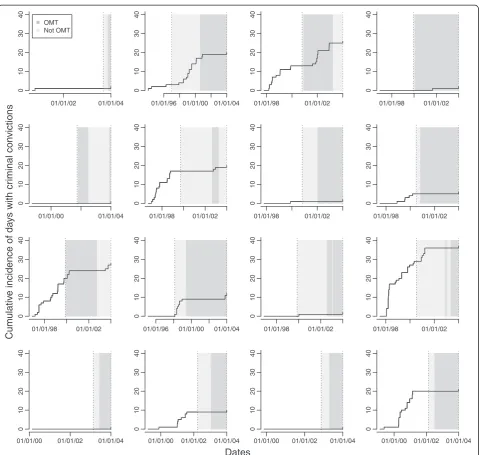
The day-by-day number of days with criminal convic-tions per individuals at risk throughout the observational period appears to be markedly lower when the individuals in the cohort are in treatment as compared to when they are not (Figure 1). The cumulative incidence for 16 ran-dom individuals demonstrates large individual differences not accounted for in the crude analyses above (Figure 2).
Cox proportional hazards model
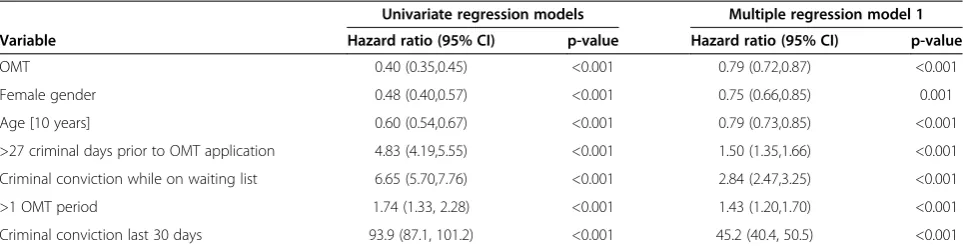
Results from Cox proportional hazard regression models with crime days as a recurrent event and treatment as a time-dependent explanatory variable is shown in Table 1. We fitted univariate models for all eight covariates and three multiple models with increasing number of covari-ates. In univariate analysis, being in treatment more than halves the hazard for criminal convictions, HR (95% CI) 0.40 (0.35, 0.45). Older age and being female also reduces the hazard for criminal convictions, while many criminal convictions prior to application, criminal convictions while on waiting list, more than one OMT-episode, and criminal convictions past 30 days all increase the hazard for criminal convictions. All univariate estimates are how-ever attenuated when adjusting for other covariates in multiple regression models. In the full model with all eight covariates, fixed and dynamic, being in treatment is es-timated to reduce hazard for criminal convictions by approximately one fifth, HR (95% CI) 0.79 (0.72, 0.87). This is substantially less than in the unadjusted ana-lysis. Results from Cox proportional hazards regression models should however be interpreted with care, as the models fail the test for the assumption of proportional hazards (not shown).
Aalen’s additive hazards model
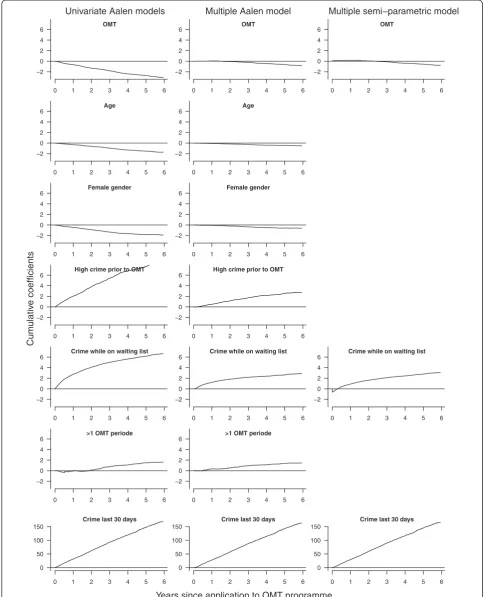
statistical tests show that all variables are highly statisti-cally significant in all models (all p < 0.001). The effects of treatment, criminal convictions while on waiting list and criminal conviction past 30 days are significantly time-varying (all p < 0.05). All univariate estimates are attenuated when adjusting for other covariates in mul-tiple regression models (Figure 3).
Semi-parametric additive hazards model
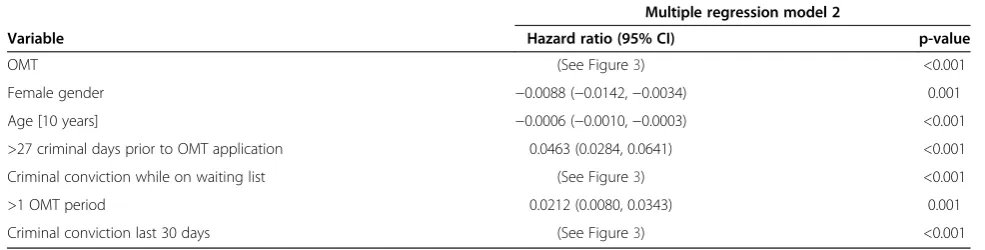
Results from Aalen’s additive hazards regression model indicate that the effect of age, gender criminal activity prior to OMT and accumulated number of treatments can be assumed to be constant over time. Results from the corresponding semi-parametric additive hazards regres-sion model are shown in Table 2 and Figure 3. All vari-ables are strongly statistically significant (all p < 0.005). The evidence of time-varying effects of treatment, crim-inal convictions while on waiting list and crimcrim-inal convic-tion past 30 days is strengthened (all p < 0.025).
Discussion
In the present study we have fitted various time-to-event regression models in order to explore the relationship between opioid maintenance treatment (OMT) and criminal convictions in heroin users. Previous analyses have focused on simple incidence rates and subgroup analyses [18]. We refine these results by replacing simple cohort averages with estimates from regression models
in prospective time, adjusting for individual covariate in-formation and timing of events. While these effect esti-mates not necessarily representcausaleffects, they are a marked improvement over mere counts. Notably, even the simplest of these time-to-event models might be considered relatively complex in the larger body of the research literature in the field, being the first study of OMT data to include both a recurrent event outcome and a time-dependent treatment variable.
Simple, unadjusted analyses are a natural first step in any data analysis. However, it must still be a first step in the right direction. When analyzing timed events, unless every individual under study has been allowed sufficiently time to experience the event(s) or not, time-to-event data will be censored at a time selected by the analyst. Not ac-counting for this censoring will result in a bias of un-known direction and magnitude. While the mathematical framework of counting processes automatically adjust for this, other, simpler, approaches do not. Defining categories like in-treatment, between-treatments and after treatment, when people can have an unknown number of treatments and be eligible for more treatments for an unknown amount of time, implies using information from the fu-ture; whether a non-treatment period is “in-between” or
“after”treatment(s) depends on the end-date of the study, i.e. the censoring date. Applying time-to-event regression models helps to improve the quality of the information ex-tracted from data like this.
Years since application to OMT programme
Number of cr
iminal con
victions per people at r
isk
0 1 2 3 4 5
0
0.005
0.01
0.015
0.02
Not in treatment In treatment
Not in treatment (cubic spline) In treatment (cubic spline)
In the OMT data under study, the naïve incidence rate ratio estimate indicate about 60% fewer criminal convic-tions while in treatment as compared to not in treat-ment, for both men and women. The individual based unadjusted Cox model also shows strong effect of treat-ment, with being in treatment reducing HR for criminal convictions by more than 50%. However, this result is strongly attenuated in the full model, adjusting for fixed demographic covariates and dynamic covariates. Indeed, in the full model the estimated reduction in HR for crim-inal conviction when in treatment is reduced to about one third, to approximately 20%. Crude, unadjusted estimates
of the effect of OMT should consequently be interpreted with care.
It is worth noting that the reduction of the estimated effect of treatment is not mainly due to adjusting for traditional covariates such as age and gender, but when adjusting for covariates related to the particular problem under study, such as baseline crime, current crime and accumulated number of treatment periods. The two lat-ter are dynamic covariates, and such inlat-ternal covariates are known to“steal”some of the effect of the fixed co-variates, e.g. treatment [22]. If the research goal is the overall effect of treatment, adjusting for previous Figure 2Individual cumulative incidence of criminal convictions.Cumulative incidence of criminal convictions (crime days) for 16 random individuals in opioid maintenance treatment (OMT) from application to OMT (left dotted line) to study end December 31st2003 (right dotted
criminal activity can be misleading, as the result is an estimate of the directeffect of treatment, not thetotal
effect. If however the effect of the covariate, such as previous criminal activity, is of potential interest per se, such adjustment is causally interesting; adding co-variates adds to the understanding of the processes and mechanics of the situation under study. That is, what covariates to adjust for or not depends on the research question, and more complex models should be handled with care.
Note that the outcome measure in the present ana-lysis, day with criminal conviction, is not merely an event, but an activity, setting the analysis apart from the analysis of, say, relapse of tumors. When analyzing things we do, that is, events that are partly, or fully, a personal choice, rather than something that merely hap-pens to us, the inclusion of covariates should be given extra thought.
The Cox model is a widely used time-to-event model in medical research. However, while many real survival data meet the assumption of proportional hazards, this assumption does not generally hold. It is well-known in the statistical literature that a common feature in time-to-event studies is that covariates “age”, i.e. their effect weakens over time [22]. A treatment might have an ef-fect initially, but the efef-fect wears off as time passes, or it takes some time before an intervention has effect. Such time-varying effects are not naturally easily discovered in the Cox model, but there are workarounds [22]. The Cox model is also known to have problems with some dynamic covariates [22]. While stratifying is a common way of resolving such issues with the Cox model, there are problems with this approach in the data under study. Firstly, stratifying on a variable makes it impossible to estimate the effect of that variable. As a primary aim in this methodological study was to explore the relationship between treatment and criminal convictions, stratifying on treatment groups was not a preferable alternative. Sec-ondly, with repeated events there might be time-varying effects other than those caused by differences between
strata; evenwithinstrata there might be time-varying co-variate effects. In this study related for instance to the fact that treatment can start, and stop, at different times, and for a different number of times for each individual.
Aalen’s additive model easily handles dynamic covari-ates and covaricovari-ates with time-varying effects [28], with the latter being immediately apparent in the accompany-ing plots. Interpretaccompany-ing results is somewhat less straight-forward, as it is the gradients in plots of cumulative regression functions that are central, not straightforward tabulated, fixed numbers. Thus, in the absence of time-varying effects, a simpler approach might be preferred. The semi-parametric additive hazards model allows for a mixture, with the effect of some covariates being allowed to vary with time, while the effect of others is assumed to be constant. In our data such a model appears to be the best of both worlds, correctly accounting for the time-varying effects, while strengthening the results from the constant terms. Note that multiple-state-models [33,34] might also be a fruitful alternative for this type of data, along with recent developments within the field of causal inference [35,36].
Estimation of causal effects from observational data has been given a lot of attention in recent years. In his 2010 Armitage lecture Aalen focuses on the value of integrating longitudinal data and survival analysis when trying to understand treatment effects [37], and has also discussed a dynamic viewpoint to causality, mediation and time [38]. The traditional way of unraveling direct and indirect ef-fects, by comparing exposure effects in regression models with and without the mediator, will often produce flawed results, among others due to confounding from time-dependent covariates [39]. More sophisticated methods are thus needed. A counterfactual approach to within-individual causal effects has been taken in an analysis of whether marriage reduces crime [40], studying 500 high-risk boys, incorporating extensive time-varying covariates. The fact that substance related questions, such as the issue of a causal relationship between il-legal drug use and selling and violent behavior, still Table 1 Cox proportional hazards regression models
Univariate regression models Multiple regression model 1
Variable Hazard ratio (95% CI) p-value Hazard ratio (95% CI) p-value
OMT 0.40 (0.35,0.45) <0.001 0.79 (0.72,0.87) <0.001
Female gender 0.48 (0.40,0.57) <0.001 0.75 (0.66,0.85) 0.001
Age [10 years] 0.60 (0.54,0.67) <0.001 0.79 (0.73,0.85) <0.001
>27 criminal days prior to OMT application 4.83 (4.19,5.55) <0.001 1.50 (1.35,1.66) <0.001
Criminal conviction while on waiting list 6.65 (5.70,7.76) <0.001 2.84 (2.47,3.25) <0.001
>1 OMT period 1.74 (1.33, 2.28) <0.001 1.43 (1.20,1.70) <0.001
Criminal conviction last 30 days 93.9 (87.1, 101.2) <0.001 45.2 (40.4, 50.5) <0.001
OMT
0 1 2 3 4 5 6
−2 0 2 4 6
Age
0 1 2 3 4 5 6
−2 0 2 4 6
Female gender
0 1 2 3 4 5 6
−2 0 2 4 6
High crime prior to OMT
0 1 2 3 4 5 6
−2 0 2 4 6
Crime while on waiting list
0 1 2 3 4 5 6
−2 0 2 4 6
>1 OMT periode
0 1 2 3 4 5 6
−2 0 2 4 6
Crime last 30 days
0 1 2 3 4 5 6
0 50 100 150
OMT
0 1 2 3 4 5 6
−2 0 2 4 6
Age
0 1 2 3 4 5 6
−2 0 2 4 6
Female gender
0 1 2 3 4 5 6
−2 0 2 4 6
High crime prior to OMT
0 1 2 3 4 5 6
−2 0 2 4 6
Crime while on waiting list
0 1 2 3 4 5 6
−2 0 2 4 6
>1 OMT periode
0 1 2 3 4 5 6
−2 0 2 4 6
Crime last 30 days
0 1 2 3 4 5 6
0 50 100 150
OMT
0 1 2 3 4 5 6
−2 0 2 4 6
Crime while on waiting list
0 1 2 3 4 5 6
−2 0 2 4 6
Crime last 30 days
0 1 2 3 4 5 6
0 50 100 150
Years since application to OMT programme
Cum
ulativ
e coefficients
Univariate Aalen models Multiple Aalen model Multiple semi−parametric model
remains unresolved, despite a vast number of empirical studies, has been attributed to methodological weak-nesses that prevent causal inference [41]. However, whether a causal model approach can indeed be taken in addiction and crime research is unclear, as both basic and applied research on the relationships among drug use and crime readily illustrates threats to the val-idity of causal inference, as even the issue of temporal order remains unanswered: Which comes first, drug useorcrime? [42].
In our data including variables on the dynamics of the situation under study helped uncover other important variables than treatment. While refining the estimate of the relationship between treatment and criminal convic-tions was the main aim of the study, the analysis showed that the strongest predictor by far was criminal convic-tions past 30 days. That is, while criminal activity is rela-tively uniformly distributed for the cohort as a whole, as indicated by the rate ratio estimates, with a reduced level while in treatment, on an individual level criminal convic-tions are clustered. One should consequently be particu-larly aware of individuals who have recently committed a criminal offence, as these individuals are in the high risk group of committing a new offence – irrespectively of whether they are currently in treatment or not. Clinically many of these individuals might be considered as having an antisocial personality, hence a specific trait that charac-terizes them both inside and outside of treatment.
The introduction of the simple idea of counting events in treatment and non-treatment groups has been invalu-able for the advancement of medical research. However, it is not merelywhetheran event occurs that holds infor-mation, but often as muchwhenit occurs. Including this additional attribute in the analysis will however often dramatically increase the analytical complexity. Reliable estimates of treatment effects are however still crucial in order to paint a truthful picture of the various associa-tions in the data set under study. Statistical methods for analyzing complex time-to-event data are well-known in the statistical literature, and the flexible framework of
counting processes can model situations far more com-plex than what is common in the medical research litera-ture. Such models are still relatively rare in the medical research literature, despite the necessary computer code being freely available.
Conclusions
For time-to-event data, be it complex observational drug treatment data as presented here, treatment of chronic diseases or other observational data, regression models based on the framework of counting processes can han-dle large heterogeneity among individuals, both in expo-sures, treatment regimes and outcomes, as well as paint a more nuanced picture of the situation by adjusting for fixed and dynamic covariates, and time-varying con-founding effects, ultimately providing more precise and reliable information that can aid health care profes-sionals and policy makers.
Competing interests
The authors declare that they have no competing interest.
Authors’contributions
JR performed the statistical analyses and drafted the manuscript. JR, TC, JMG and AB all contributed to the discussions about the topic, revision of the manuscript, and to the final approval of the manuscript.
Acknowledgements
The authors would like to thank all the Norwegian OMT centers for providing lists of all patients. We would also like to thank Statistics Norway (SSB) who performed the cross-linking of data. A special thanks to Pål H. Lillevold (SERAF, University of Oslo) for helping cleaning and preparing data for analysis.
Received: 30 September 2013 Accepted: 6 May 2014 Published: 17 May 2014
References
1. Sudre P, Rickenbach M, Taffé P, Janin P, Volkart AC, Francioli P, Swiss HIVCS: Clinical epidemiology and research on HIV infection in Switzerland: the Swiss HIV Cohort Study 1988–2000.Schweiz Med Wochenschr2000, 130(41):1493–1500.
2. Røysland K, Gran JM, Ledergerber B, von Wyl V, Young J, Aalen OO: Analyzing direct and indirect effects of treatment using dynamic path analysis applied to data from the Swiss HIV Cohort Study.Stat Med2011, 30(24):2947–2958.
Table 2 Parametric terms of semi-parametric additive hazards model
Multiple regression model 2
Variable Hazard ratio (95% CI) p-value
OMT (See Figure3) <0.001
Female gender −0.0088 (−0.0142,−0.0034) 0.001
Age [10 years] −0.0006 (−0.0010,−0.0003) <0.001
>27 criminal days prior to OMT application 0.0463 (0.0284, 0.0641) <0.001
Criminal conviction while on waiting list (See Figure3) <0.001
>1 OMT period 0.0212 (0.0080, 0.0343) 0.001
Criminal conviction last 30 days (See Figure3) <0.001
3. Moncino MD, Falletta JM:Multiple relapses of clostridium difficile-associated diarrhea in a cancer patient: successful control with long-term cholestyramine therapy.J Pediatr Hematol Oncol1992,14(4):4.
4. Pestalozzi BC, Holmes E, de Azambuja E, Metzger-Filho O, Hogge L, Scullion M, Láng I, Wardley A, Lichinitser M, Sanchez RIL, Müller V, Dodwell D, Gelber RD, Piccart-Gebhart MJ, Cameron D:CNS relapses in patients with HER2-positive early breast cancer who have and have not received adjuvant trastuzumab: a retrospective substudy of the HERA trial (BIG 1–01).Lancet Oncol2013, 14(3):244–248.
5. Gossop M, Marsden J, Stewart D, Rolfe A:Patterns of improvement after methadone treatment: 1 year follow-up results from the National Treatment Outcome Research Study (NTORS).Drug Alcohol Depend2000, 60(3):275–286.
6. Gossop M, Marsden J, Stewart D, Treacy S:Change and stability of change after treatment of drug misuse: 2-year outcomes from the National Treatment Outcome Research Study (UK).Addict Behav2002,27(2):155–166. 7. Hser YI, Hoffman V, Grella CE, Anglin MD:A 33-year follow-up of narcotics
addicts.Arch Gen Psychiatry2001,58(5):503–508.
8. Clausen T, Anchersen K, Waal H:Mortality prior to, during and after opioid maintenance treatment (OMT): a national prospective cross-registry study.Drug Alcohol Depend2008,94(1–3):151–157.
9. Keene J:A case-linkage study of the relationship between drug misuse, crime, and psychosocial problems in a total criminal justice population. Addict Res Theory2005,13(5):489–502.
10. Bennett T, Holloway K:The causal connection between drug misuse and crime.Br J Criminol2009,49(4):513–531.
11. Adamson SJ, Sellman JD:The pattern of intravenous drug use and associated criminal activity in patients on a methadone treatment waiting list.Drug Alcohol Rev1998,17(2):159–166.
12. Bukten A, Skurtveit S, Gossop M, Waal H, Stangeland P, Havnes I, Clausen T: Engagement with opioid maintenance treatment and reductions in crime: a longitudinal national cohort study.Addiction2012,107(2):393–399. 13. Ball JC, Ross A:The Effectiveness of Methadone Maintenance Treatment:
Patients, Programs, Services, and Outcome.New York: Springer; 1991. 14. Marsch LA:The efficacy of methadone maintenance interventions
in reducing illicit opiate use, HIV risk behavior and criminality: a meta-analysis.Addiction1998,93(4):515–532.
15. Oliver P, Keen J, Rowse G, Ewins E, Griffiths L, Mathers N:The effect of time spent in treatment and dropout status on rates of convictions, cautions and imprisonment over 5 years in a primary care-led methadone maintenance service.Addiction2010,105(4):732–739.
16. Bell J, Burrell T, Indig D, Gilmour S:Cycling in and out of treatment; participation in methadone treatment in NSW, 1990–2002.Drug Alcohol Depend2006,81(1):55–61.
17. Dolan KA, Shearer J, White B, Zhou J, Kaldor J, Wodak AD:Four-year follow-up of imprisoned male heroin users and methadone treatment: mortality, re-incarceration and hepatitis C infection.Addiction2005,100(6):820–828. 18. Havnes I, Bukten A, Gossop M, Waal H, Stangeland P, Clausen T:
Reductions in convictions for violent crime during opioid maintenance treatment: a longitudinal national cohort study.Drug Alcohol Depend 2012,124(3):307–310.
19. Andersen PK, Gill RD:Cox’s regression model for counting processes: a large sample study.Ann Stat1982,10(4):1100–1120.
20. Cox DR:Regression models and life-tables.J Roy Stat Soc B Met1972, 34(2):187–220.
21. Andersen PK:Statistical Models Based on Counting Processes.New York: Springer; 1993.
22. Aalen OO, Borgan Ø, Gjessing HK:Survival and event history analysis: a process point of view.New York: Springer; 2008.
23. Efron B, Tibshirani RJ:An Introduction to the Bootstrap.London: Chapman & Hall; 1993.
24. Bukten A, Roislien J, Skurtveit S, Waal H, Gossop M, Clausen T:A day-by-day investigation of changes in criminal convictions before and after entering and leaving opioid maintenance treatment: a national cohort study.BMC Psychiatry2013,13(1):262.
25. Kalbfleisch JD, Prentice RL:The statistical analysis of failure time data. Hoboken: John Wiley & Sons; 2002.
26. Grambish PM, Therneau TM:Proportional hazards tests and diagnostics based on weighted residuals.Biometrika1994,81(3):515–526.
27. Aalen OO:A model for nonparametric regression analysis of counting processes. InMathematical Statistics and Probability Theory Lecture Notes in Statistics. Volume 2, edn.New York: Springer-Verlag; 1980:1–25.
28. Fosen J, Borgan Ø, Weedon-Fekjær H, Aalen OO:Dynamic analysis of recurrent event data using the additive hazard model.Biom J2006,48(3):381–398. 29. McKeague IW, Sasieni PD:A partly parametric additive risk model.
Biometrika1994,81(3):501–514.
30. Team RDC:R: A Language and Environment for Statistical Computing.Vienna, Austria: R Foundation for Statistical Computing; 2011.
31. Martinussen T, Scheike TH:Dynamic Regression Models for Survival Data. New York: Springer; 2006.
32. Cook RJ, Lawless JF:The statistical analysis of recurrent events.New York: Springer; 2007.
33. Andersen PK, Keiding N:Multi-state models for event history analysis. Stat Methods Med Res2002,11(2):91–115.
34. Commenges D:Multi-state models in epidemiology.Lifetime Data Anal 1999,5(4):315–327.
35. Hernán MA, Robins JM:Estimating causal effects from epidemiological data.J Epidemiol Community Health2006,60(7):578–586.
36. Hernán MA, Hernández-Díaz S, Werler MM, Mitchell AA:Causal knowledge as a prerequisite for confounding evaluation: an application to birth defects epidemiology.Am J Epidemiol2002,155(2):176–184.
37. Aalen OO:Armitage lecture 2010: understanding treatment effects: the value of integrating longitudinal data and survival analysis.Stat Med 2012,31(18):1903–1917.
38. Aalen OO, Røysland K, Gran JM, Ledergerber B:Causality, mediation and time: a dynamic viewpoint.J Roy Stat Soc A Sta2012,175(4):831–861. 39. Kristensen P, Aalen OO:Understanding mechanisms: opening the“black box”
in observational studies.Scand J Work Environ Health2013,39(2):121–124. 40. Sampson RJ, Laub JH, Wimer C:Does marriage reduce crime? A
counterfactual approach to within-individual causal effects.Criminology 2006,44(3):465–508.
41. Phillips MD:Assessing the impact of drug use and drug selling on violent offending in a panel of delinquent youth.J Drug Issues2012,42(3):298–316. 42. Maxfield MG, Babbie R:Basics of research methods for criminal justice and
criminology.3rd edition. Belmont: Wadsworth/Cengage Learning; 2011.
doi:10.1186/1471-2288-14-68
Cite this article as:Røislienet al.:Accounting for individual differences and timing of events: estimating the effect of treatment on criminal convictions in heroin users.BMC Medical Research Methodology
201414:68.
Submit your next manuscript to BioMed Central and take full advantage of:
• Convenient online submission
• Thorough peer review
• No space constraints or color figure charges
• Immediate publication on acceptance
• Inclusion in PubMed, CAS, Scopus and Google Scholar
• Research which is freely available for redistribution