Available at www.ijsred.com
Mathematical Modelling of Solar Radiation Effects on Loamy Soil
Temperature with Spatial Dependent Thermal Conductivity
Olaleye Olalekan Ayodeji*, Alabi Peter Ayo** and Alade Abigail Folashade***
*(Department of Statistics, The Federal Polytechnic, P.M.B. 231, Ede, Osun State, NigeriaEmail: [email protected])
** (Department of Statistics, The Federal Polytechnic, P.M.B. 231, Ede, Osun State, Nigeria Email: [email protected])
*** (Department of Statistics, The Federal Polytechnic, P.M.B. 231, Ede, Osun State, Nigeria Email: [email protected])
---
************************
---Abstract:
A mathematical modelling of the effects of solar radiation alongside some important parameters was examined on the temperature of loamy soil. The thermal conductivity of the soil was taken to be linearly varying with position and the boundary condition is also considered to be varying exponentially. The dimensional energy equation was reduced to non-dimensional form using some set of dimensionless parameters. Two phase perturbation method was then employed to reduce the equation from partial differential equation to ordinary differential equation and then solved analytically. The effects of emerging physical parameters which include the solar radiation parameter and the internal heat generation parameter among others were examined on the loamy soil temperature and the numerical results were computed and displayed on graphs using Matlab R2009b. The model revealed that the mounting solar radiation increases the temperature of the loamy soil.
Keywords — Internal heat, loamy soil, mathematical modelling, perturbation method, solar radiation, thermal conductivity.
---
************************
---I. INTRODUCTION
The study of heat transfer generally is a very important one which has a vast area of applications ranging from agriculture, to industries, to science and technology. There are quite number of things that affect the growth of crops out of which the soil in which they planted plays a vital role in this. The nature and properties of these soils directly influence both the germination and growth of the crops planted on them. Yet, there are also some factors that possess ability to influence these properties of the soils. According to Ritter [1], these factors include the parent material, climate, topography, organisms, and time. As a result, researchers have worked diligently to understand
how these factors affects the soils in order to know which crop is suitable for each soil type and the appropriate time for such crops to be planted. For instance, Ajeet et al. [2] studied the Impact that a long-term zero till wheat would have on physical properties of soil and the productivity of wheat under rice–wheat cropping system. They observed that when there was a decrease in the disturbance and crop residual cover on the surface of zero tillage system, the physical properties of the soil were improved. Moreover, the organic carbon, field water capacity, aggregation and the aeration status in the soils increased when a long-time zero tillage system is practiced
Ghimire et al [3] used light and heavy soils in the Chitwan valley of Nepal to know the effects of
www.ijsred.com
tillage and crop residual management on soil organic carbon. Their result revealed that on carbon sequestration on Baireni soil, the practice of crop residue management does not have any significant while on Rampur soil the same crop residue management had significant effect.
The list goes on and on. Rajan [4] studied Soil organic carbon sequestration as affected by tillage, crop residue, and nitrogen application in rice–wheat rotation system. Amrollah [5] surveyed the properties of clay-loam soil. Dec et al [6] examined the soil management effects on their thermal properties.
Thus, this work focused on mathematical modelling of solar radiation effects on loamy soil temperature with spatial dependent thermal conductivity
II. MATHEMATICALFORMULATION The equation is one dimensional unsteady heat equation. The z – axis is taken to the vertical axis and it considered to be inside the soil. The radiation is from solar source in the direction along the gravity and directly toward the surface of the soil. The suction velocity and the boundary condition are taken to be varying with time. The soil is also assumed to be a optically thin environment. Under the above conditions, using the Boussinesq’s approximation, the governing equations in dimensional form is modelled to be:
Continuity equation
0
* *
=
∂
∂
z
w
(1)
Energy equation
)
(
* *0 * * 2 *
* 2 *
* * *
*
∞
−
+
∂
∂
−
∂
∂
=
∂
∂
+
∂
∂
T
T
Q
z
q
z
T
k
z
T
w
C
t
T
C
rp
p
ρ
ρ
(2) Subject to:
* *
)
(
* **
* i t
w
w
T
T
e
T
T
=
+
γ
−
∞ ω atz
=
0
(3)* *
∞
→
T
T
asz
→
∞
(4)where,
z
* being the dimensional depth of the soil is perpendicular toy
*.t
*andw
* are the time and thesuction velocity respectively.
T
*,T
w* and * ∞T
are the temperature, the wall temperature and the freestream temperature respectively.
ρ
,C
p,k
and * rq
are density, specific heat capacity, thermal conductivity and the Radiative heat flux respectively.The second term at the right hand side of equation (2) is the radiative heat flux and it’s defined by Krishna and Reddy [7] to be:
)
(
4
2 * * **
∞
−
=
∂
∂
T
T
z
q
rα
(5)α
being the absorption coefficient.From equation (1), the time-dependent suction velocity as used by Nwaigwe [8] is given as
)
1
(
**0
* i t
Ae
w
w
=
−
+
ε
ω (6)As used by Mohammed [9], the following dimensionless parameters are used,
* *
* *
∞ ∞
−
−
=
T
T
T
T
w
θ
,w
z
w
z
* 0
=
,w
w
t
t
2 0 *
=
, 20 *
w
w
ω
ω
=
(7) where w0, A and
ω
are the initial suction velocity, the suction parameter and the frequency of oscillation respectively. The negative sign signifies that the suction is towards the surface of the ground. A andε
are very small such thatε
A<<1.Substituting equations (5), (6) and (7) into (2);
θ
θ
ρ
θ
ε
θ
ωQ
R
z
k
C
w
z
Ae
t
pt i
+
−
∂
∂
=
∂
∂
+
−
∂
∂
22 2
1
)
1
(
(8)Moreover, according to Akinpelu et al [10], the spatial dependent thermal conductivity is given as
n
z
k
k
=
0(
1
+
∂
)
(9)Taking the case when the value of n is 1, so that the thermal conductivity will vary linearly with position (the soil depth), the thermal conductivity then becomes;
)
1
(
0
z
k
www.ijsred.com
0
,
z
and
k
β
are the variable thermal conductivity parameter, loamy soil depth and the constant thermal conductivity.Equation (8) then becomes:
θ
θ
β
θ
θ
ε
θ
ωQ
R
z
z
z
P
z
Ae
t
rt i
+
−
∂
∂
+
∂
∂
=
∂
∂
+
−
∂
∂
22 2 2 2
1
)
1
(
(11)Subject to:
t i
e
ωγ
θ
=
1
+
atz
=
0
(the ground surface) (12)0
→
θ
asz
→
∞
(13)where,
0
k
C
w
P
r=
ρ
p (the Prandtl number)2 0 2 2
4
w
w
R
=
α
θ
(the radiation parameter), and2 0 0
w
C
w
Q
Q
p
ρ
=
(the internal heat generationparameter)
III. METHODOFSOLUTION
Equation (11) which is a second order partial differential equation could not be reduced with only one phase perturbation method which can be easily solved together with the boundary values. Thus, two phase perturbation method is employed.
The assumed solution is given as;
)
(
)
(
)
,
(
z
t
θ
0z
ε
e
i tθ
1z
θ
=
+
ω (14)Substituting equation (14) alongside its first and second differentials into the equation (11), and taking the order of epsilon neglecting higher order
)
(
ε
2o
,2 0
0 0
0
′′
+
β
z
θ
′′
+
P
rθ
′
+
P
rQ
θ
=
P
rR
θ
(15)0 1
1 1
1
β
θ
θ
(
ω
)
θ
θ
θ
′′
+
z
′′
+
P
r′
+
P
rQ
−
i
=
−
P
rA
′
(16) For the second phase perturbation, as used by Umavathi [11], the variable thermal conductivity parameter is used as the perturbation parameter and it’s given as;01 00
0
θ
βθ
θ
=
+
(17)11 10 1
θ
βθ
θ
=
+
(18)Substituting this alongside its first and second differentials into the equations, and taking the order
of beta neglecting higher order
o
(
β
2)
,2 00
00
00
′′
+
P
rθ
′
+
P
rQ
θ
=
P
rR
θ
(19)00 01
01
01
θ
θ
θ
θ
′′
+
P
r′
+
P
rQ
=
−
z
′′
(20)00 10
10
10
θ
(
ω
)
θ
θ
θ
′′
+
P
r′
+
P
rQ
−
i
=
−
P
rA
′
(21)01 10
11 11
11
θ
(
ω
)
θ
θ
θ
θ
′′
+
P
r′
+
P
rQ
−
i
=
−
z
′′
−
P
rA
′
(22) The primes represent ordinary differentiation with respect z.
Solving equations (19) – (22) analytically,
3 2
1 00
2 1
C e C e
C m z+ m z + =
θ (23)
z m m z m z
m
e C z C
e C z C e
C
) ( 9 8
7 6 5
01
1 2 2 4
) (
) (
− +
+ + + =
θ
(24)
z m m z
m z
m
e C e C e
C11 12 13 ( )
10
1 2 2
6 −
+ +
=
θ
(25)z m m z
m
z m z
m z
m
e C z C e
C z C
e C e C z C e
C
) ( 20 19 18
17
16 15
14 31
11
1 2 6
4 2
8
) (
) (
) (
−
+ + +
+
+ +
+ =
θ
(26)
IV. RESULTSANDDISCUSSION
The numerical results of the models developed were obtained using Matlab software. The effects of some physical parameter that emerged were examined on the temperature of loamy soil and presented on graphs. The thermal conductivity of the loamy soil was adopted from Gary [12] which he gave to be 0.52 Btu/ft hr 0F. The flowing parametric values were adopted in the work except/otherwise stated.
Pr=0.71, Q=0.1,
2 π
ω= , ε = 0.01, t = 1.0,
www.ijsred.com
0 0.2 0.4 0.6 0.8 1
0 2 4 6 8 10 12 14
Soil depth
T
e
m
p
er
at
ur
e
R=0.50 R=0.55 R=0.60 R=0.65
Fig. 1 Temperature profile for different values of radiation parameter, R at increasing depth of the soil.
0 0.2 0.4 0.6 0.8 1
0 2 4 6 8 10 12 14 16
Soil depth
T
em
pe
ra
tu
re
Q=0.10 Q=0.11 Q=0.12 Q=0.13
Fig. 2 Temperature profile for different values of the internal heat generation parameter, Q at increasing depth of the soil.
0 0.2 0.4 0.6 0.8 1
0 2 4 6 8 10 12 14
Soil depth
T
em
pe
ra
tu
re
Pr=0.71 Pr=0.80 Pr=0.85 Pr=0.90
Fig. 3 Temperature profile for different values of the Prandtl number, Pr at increasing depth of the soil.
0 0.1 0.2 0.3 0.4 0.5 0.6 0.7 0.8 0.9 1 0
2 4 6 8 10 12 14
Soil depth
T
em
pe
ra
tu
re
t=1.00 t=1.10 t=1.20 t=1.30
z=0.08 (approx)
www.ijsred.com
0 2 4 6 8 10
0 0.5 1 1.5 2
Time
T
em
pe
ra
tu
re
w=pi/4 w=pi/3 w=pi/2 w=pi
Fig. 5 Temperature profile for different values of the frequency of oscillation.
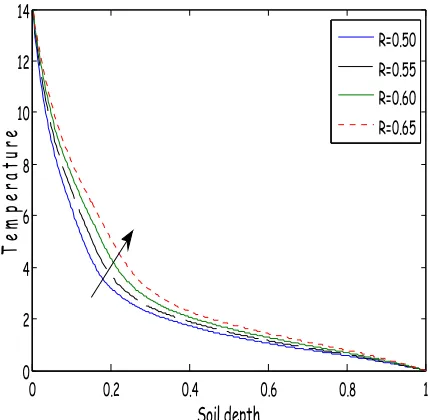
Figure 1 depicts the temperature profile for different values of radiation parameter, R as the depth of the soil increases. It is observed that as the radiation parameter increases, the temperature of the loamy soil also increases.
In figure 2, which represents the temperature profile for different values of internal heat generation parameter, Q as the depth of the soil increases, it is discovered that the increasing internal heat also boost the temperature of the loamy soil.
On the other hand, according to figure 3 which shows the temperature profile for different values of Prandtl number, Pr as the depth of the soil increases, the result revealed that the soil temperature decreased with increasing Prandtl number.
Figure 4 is temperature profile for different values of time, t as the depth of the soil increases. When all other physical parameters are constant, close to the surface of the soil, the time factor seems not to have any significant effect on the temperature of the soil. But as the depth increases, and the time goes on, the temperature of the soil begins to drop. This becomes more and more obvious at increasing depth.
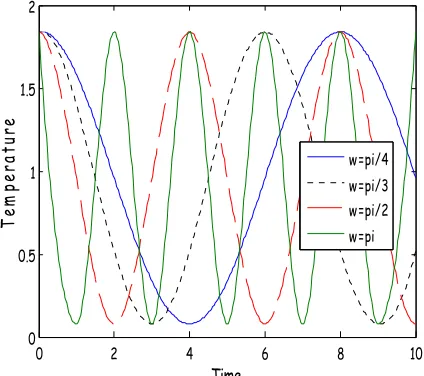
Figure 5 presents the temperature profile for different values of the frequency of oscillation against the time. At a particular (or constant) depth,
with other parameters being constants, the temperature fluctuates with time. Meanwhile, as the frequency of the oscillation increases, so the period of oscillation decreases.
V.CONCLUSIONS
The mathematical modelling of the effects of solar radiation on the temperature of loamy soil using spatial dependent thermal conductivity was investigated. It is evident that the solar radiation has a significant effect on the soil temperature. As the intensity of the sun rises, so the soil temperature is enhanced.
ACKNOWLEDGMENT
The heading of the Acknowledgment section and the References section must not be numbered.
Causal Productions wishes to acknowledge Michael Shell and other contributors for developing and maintaining the IEEE LaTeX style files which have been used in the preparation of this template. To see the list of contributors, please refer to the top of file IEEETran.cls in the IEEE LaTeX distribution.
REFERENCES
[1] Ritter Michael E. (2006). “The Physical Environment: an Introduction
to Physical Geography”. Retrieved at:
https://www.earthonlinemedia.com/ebooks/tpe_3e/soil_systems/soil__ development_soil_forming_factors.html.
[2] Ajeet Singh, V.K. Phogat, Rita Dahiya, S.D. Batra, “Impact of long-term zero till wheat on soil physical properties and wheat productivity under rice–wheat cropping system,” Soil & Tillage Research, 140: 98– 105, 2014.
[3] R. Ghimire, K.R. Dahal, J.G. Lauren, J.M. Duxbury and S.C. Shah, “Tillage and crop residue management effects on soil organic carbon content of light and heavy soils of chitwan valley, Nepal,” J. Inst. Agric. Anim. Sci. 28:27-32, 2007.
[4] M. Wegmuller, J. P. von der Weid, P. Oberson, and N. Gisin, “High resolution fiber distributed measurements with coherent OFDR,” in
Proc. ECOC’00, 2000, paper 11.3.4, p. 109.
[5] Amrollah Ghader, “Clay-loam soil thermal properties survey,”
International Journal of Advanced and Applied Sciences”. 1(6): 31 – 36, 2014.
[6] D. Dec, J. Dorner and R. Horn, “Effect of soil management on their thermal properties,” Journal of Plant Nutrition and Soil science, 9(1): 26 – 39, 2009.
[7] Krishna M. Veera and Reddy M. Gangadhar, “MHD Convective
Rotating flow past an oscillating porous plate with Chemical Reaction and Hall Effects”. IOP Conf. Series: Materials Science and Engineering (p. 149), 2016. IOP Publishing.
[8] C. Nwaigwe, “Mathematical Modeling of Ground Temperature with
www.ijsred.com
[9] Mohammed Ibrahim S., “Radiation Effects on Mass Transfer Flow through a Highly Porous Medium with Heat Generation and Chemical Reaction,” ISRN Computational Mathematics, 2013.
[10] F.O. Akinpelu, R.M. Alabison and O.A. Olaleye, “Variations in Ground Temperature in the Presence of Radiative Heat Flux and Spatial-Dependent Soil Thermophysical Property,” International Journal of Statistics and Applied Mathematics, 2 (1), 57-63, 2016.
[11] Gary Reysa (2015), “Ground Temperatures as a Function of Location,
Season and Depth,” Build it Solar, The Renewable Energy Site for
Do-It-Yourselfers. Retrieved at:
www.builditsolar.com/Projects/Cooling/EarthTemperatures.htm APPENDIX Q P P P
m =− r + r − r
4 2 2 1 − + −
= P P PQ
m r r r
4 2 2 2 Q P P P
m =− r + r − r
4 2 2 3 − + −
= P P PQ
m r r r
4 2 2 4 ) ( 4 2 2
5 P Q iω
P P
m =− r + r − r −
− − + − = ( ) 4 2 2
6 P Q iω
P P
m r r r
) (
4 2
2
7 P Q iω
P P
m =− r + r − r −
− − + − = ( ) 4 2 2
8 P Q iω
P P
m r r r
Q R C 2 3 = z m e C C 1 3 1 − − = 3 1
2 1 e C C
C = +γ iωt − −
Q P m P m m e C C r r t i + + − − = 2 2 2 2 2 3 6 ) 1
( γ ω
Q P m P m C P C m C r r r + + − − = 2 2 2 6 6 2 7 2
(
)
Q P m m P m m C m m m m m m C rr − +
+ − − − + = ) ( ) ( ) ( 1 2 2 1 2 3 2 2 1 2 1 2 1 8 Q P m m P m m C P C m m C r r r + − + − − − − = ) ( ) ( ) ( 2 1 2 2 1 2 8 8 1 2 9 )
( 7 9
5 C C
C =− +
) ( ) 1 ( 2 2 2 3 2 12 ω γ ω i Q P m P m e C Am P C r r t i r − + + − − = ) ( ) ( ) ( ) ( 1 2 2 1 2 3 1 2 13 ω i Q P m m P m m C m m A P C r r r − + − + − − − = )
( 12 13
11 C C
C =− +
) ( 2 2 2 6 2 12 2 2 14 ω i Q P m P m C Am P C m C r r r − + + − − = ) ( 2 ) ( 2 2 2 14 14 2 6 7 2 15 ω i Q P m P m C P C m C C m A P C r r r r − + + − − + − = ) ( 4 2 4 5 4 16 ω i Q P m P m C Am P C r r r − + + − = ) ( 6 2 6 11 2 6 17 ω i Q P m P m C m C r
r + −
+ − = ) ( 2 6 2 6 17 17 6 18 ω i Q P m P m C P C m C r r r − + + − − = ) ( ) ( ) ( ) ( ) ( 1 2 2 1 2 8 1 2 13 2 1 2 19 ω i Q P m m P m m C m m A P C m m C r r r − + − + − − − − − =
(
)
) ( ) ( ) ( ) ( 2 ) ( 1 2 2 1 2 19 19 1 2 8 9 1 2 20ω
i Q P m m P m m C P C m m C C m m A P C r r r r − + − + − − − − + − − = )( 15 16 18 20
31 C C C C