Patil Varsha et al, International Journal of Computer Science and Mobile Applications, National Conference on “The Things Services and Applications of Internet of Things”, Gandhi Institute for Education and Technology (GIET) Baniatangi, 23-24 March 2018, pg. 13-19
ISSN: 2321-8363 Impact Factor: 5.515
An Optimized use of Smart Air
Conditioner using Cognitive IOT
Patil Varsha
1*, Bade Kranti
2, Bendale Yashashree
3 1 Computer Engineering, SIESGST, Nerul, Navi Mumbai, MaharashtraE_Mail : [email protected]
2 Computer Engineering, SIESGST ,Nerul, Navi Mumbai, Maharashtra E_Mail : [email protected]
3 Computer Engineering, SIESGST ,Nerul, Navi Mumbai, Maharashtra E_Mail : [email protected]
* Corresponding Author : [email protected]
Abstract
Now days, the largest power consumed by heating and cooling Air conditioners which is widely used in residential and commercial buildings. Energy utilization of Electronic equipment is large especially in Air Conditioning. At the same time, we need to able to efficiently manage the temperature of AC.
Wastage of energy e.g. Sometimes few people are seating a cabin or room and temperature is chilled. Sometimes there is a large people seating in a cabin and temperature is normal or not chilled, Sometime do happen that we forget to switch off the AC, general human behavior, due to this there is waste of energy and improper temperature management. If the number of people increases in a room then automatically the room temperature should get decrease. And if the number of people is less than the room temperature should increased or remain default temperature.
Therefore it is important to optimize the energy consumption of air conditioning. Keywords— Cognitive IOT, Raspberry Pi, Temperature Sensor, PICamera , Database
1. Introduction
Now days for comfortable and quality lifestyle, the use of Smart Air Conditioning (AC) is increasing tremendously. As infrastructure and buildings are growing, the use of ACs is also increasing proportionally. This also resulted in more power consumption. In both developed and developing countries, electricity power is also a problem. Therefore, it becomes important to decrease the energy consumption of ACs in both residential and commercial buildings. AC is an electrical appliance that regulates the room temperature and increases the comfort of the environment. AC consists of internal and external units and performs heating and cooling functions utilizing the evaporation and condensation properties of the refrigerant gas it contains. There are many key features of smart air conditioner. These includes smart phone application to access the all settings, controlling the temperature, controlling fan speed, controllable timer and control settings from outdoor places.
Patil Varsha et al, International Journal of Computer Science and Mobile Applications, National Conference on “The Things Services and Applications of Internet of Things”, Gandhi Institute for Education and Technology (GIET) Baniatangi, 23-24 March 2018, pg. 13-19
ISSN: 2321-8363 Impact Factor: 5.515
2. Related Work
Internet of thing is an emerging technology and can be useful in various application such as building automation, health care, agriculture, Environmental monitoring, food monitoring, etc [2]. The IoT allows objects to be sensed or controlled remotely across existing network infrastructure [3].
IoT devices can be used to monitor and control the mechanical, electrical and electronic systems used in various types of buildings (e.g., public and private, industrial, institutions, or residential) [3]. Application of the IoT extends to all aspects of transportation systems (i.e. the vehicle, the infrastructure, and the driver or user). Dynamic interaction between these components of a transport system enables inter and intra vehicular communication, smart traffic control, smart parking, electronic toll collection systems, logistic and fleet management, vehicle control, and safety and road assistance [4] The concept of smart air conditioning is to control the temperature depending upon the people in the room, building etc. IoT improve occupant comfort and efficient operation of building systems[5].
3. Proposed Method
To optimize the usage of electricity consumption of air conditioner. This Paper proposes IoT based real time temperature control system for air conditioners. Meanwhile, it is able to monitor the real-time power consumption datasets using two modules.
Input Module
Data Gathering is the first step in any IoT Application. Input module collects two types of data, one is the no of occupants in the room and current temperature. It can be stored in the database for processing
1. Interfacing of camera with PI
Pi Camera will capture faces of the people entering in the room. People Counter developed using Python and OpenCV Library.
Live PiCamrea videos are processed. Our focus is on extracting the sizes and moving patterns of persons entering in the room. Depending upon motion histograms of frame difference images, we classify histograms for detected movements. Phase correlation and probabilistic correlation is applied to determine a people count. If camera produces still images, proposes a solution, which identifies people by background extraction of the camera image. A non-background object is recognized, and its size is estimated and compared to previously established bounds of people’s pixel dimensions. A people count is derived from the results of this analysis.
2. Temperature Sensor
Patil Varsha et al, International Journal of Computer Science and Mobile Applications, National Conference on “The Things Services and Applications of Internet of Things”, Gandhi Institute for Education and Technology (GIET) Baniatangi, 23-24 March 2018, pg. 13-19
ISSN: 2321-8363 Impact Factor: 5.515
AC Regularization Unit
1. On-Off Control of the Fixed Frequency Air-Conditioner
Fixed frequency means that the compressor of the air conditioner operates in the fixed rotation speed. The relationship between the rotation speed of motor and electrical frequency can be described as:
Speed(rpm)=120×fp(1−d)
where f is the electrical frequency, p is the magnetic poles of motor, d is the rotary slip difference (d = 0) under zero loading). The indoor temperature is kept stable by turning the compressor on and off, when the motor operates in the fixed rotation speed and the indoor air conditioning load is less. This operating method is also mentioned as On-Off control.
Under the On-Off control structure, the fixed frequency air conditioner turns on the compressor when the return air temperature raises than the set one, it means indoor load increases, and turns it off on the contrary.
2. Smart Control based on decision parameters
The definition of “smart control” is the control methodology, based on the multiple collected information, able to predict the demand of air conditioning space and adjust the output of air conditioner in advance.
The design of the smart control is different from other On- Off control logic. Based on the multiple information from the multiple sensors, camera, and network, the air conditioner is able to provide the proper response by the FFT function of the predictive control before the demand occurs. This will solve the present problems of unstable temperature and energy waste.
Air conditioner: Our aim is to design automate the Air conditioner temperature control system. Set the AC temperature to the correct level according to the output of microcontroller and optimize the usage. So Indoor temperature can be controlled depending on the occupants in the room and current temperature conditions. This involves the temperature regularization unit of the system.
External conditions: This temperature regularization system may get affected by certain external factors such as window or door opening for long time. This issue can also be solved by sending some alert messages.
If the temperature on the particular room is above certain range then the AC in that room will start up and during this time the AC in the other room will remain switched off.
• When the temperature goes below 25 degree in the room where AC is already on will be switched off automatically.
CIOT Framework
Cognitive IoT enables us to learn from, and infuse intelligence into, the physical world to transform business and enhance the human experience.
Cognitive IOT is the combination of data integration by smart sensors and the actions performed by the devices.
Patil Varsha et al, International Journal of Computer Science and Mobile Applications, National Conference on “The Things Services and Applications of Internet of Things”, Gandhi Institute for Education and Technology (GIET) Baniatangi, 23-24 March 2018, pg. 13-19
ISSN: 2321-8363 Impact Factor: 5.515
2. When the 4 people enter in the room and if its temperature(T1) > 30 degree then AC will be switched on and continue to run till temperature becomes 25 degree.
3. When the people entering in the room increases and if more than 4 people inside the room again temperature is lowers to 22 degree.
4. As if all are leaving the room and camera will send an image. People counting algorithm will
T1=TEMPERATURE of the room
Fig. 1.Flowchart of Input Module
Fig.2. AC Regularization Unit
Patil Varsha et al, International Journal of Computer Science and Mobile Applications, National Conference on “The Things Services and Applications of Internet of Things”, Gandhi Institute for Education and Technology (GIET) Baniatangi, 23-24 March 2018, pg. 13-19
ISSN: 2321-8363 Impact Factor: 5.515 COMPONENTS
• MICROCONTROLLER (Raspberry Pi 3)
• POWER SUPPLY UNIT
• RELAY DRIVER CIRCUIT AND COUNTER
• AIR CONDITIONER
• TEMPERATURE SENSOR
• SOFTWARE REQUIREMENTS
PI CAMERA MODULE
Raspberry Pi Board [7]
The Raspberry Pi Camera Board has designed add-on module for Raspberry Pi hardware. It attaches to Raspberry Pi hardware through a custom CSI interface. The sensor has high megapixel native resolution in still capture mode. In video mode it supports capture resolutions up to 1080p at 30 frames per second.
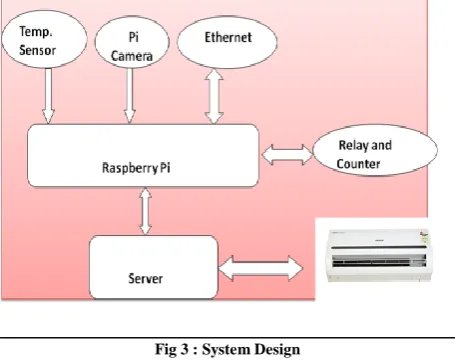
Fig 3 : System Design
The camera module is light weight and small making it an ideal choice for mobile projects.
Temperature Sensor (LM35) [7]
Working Principle-
It has linear relationship between output voltage & Celsius temperature scale.
Patil Varsha et al, International Journal of Computer Science and Mobile Applications, National Conference on “The Things Services and Applications of Internet of Things”, Gandhi Institute for Education and Technology (GIET) Baniatangi, 23-24 March 2018, pg. 13-19
ISSN: 2321-8363 Impact Factor: 5.515
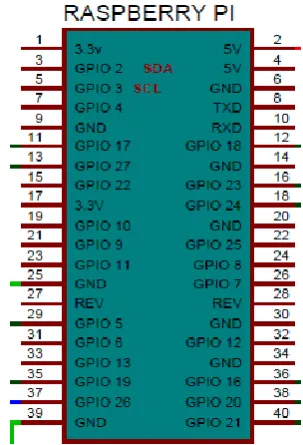
Fig No. 4 Microcontroller (Raspberry Pi)
Fig. 5.Temperature Sensor
4. Implementation Details
ALGORITHM
1. Start
2. Initialize the raspberry Pi board. 3. Assign memory using stream. 4. Check for option 1 or option 2. 5. If option = 1 (video input) Set the resolution of Pi camera
i. Capture image from camera. ii. Create OpenCV image. 6. If option = 2 ( .jpg file )
i. Read stored .jpg file. 7. Load cascade file for detecting faces 8. Convert image from colour to grey scale. 9. Detect faces in the image.
10. Before counting faces, generate the reset pulse.
Patil Varsha et al, International Journal of Computer Science and Mobile Applications, National Conference on “The Things Services and Applications of Internet of Things”, Gandhi Institute for Education and Technology (GIET) Baniatangi, 23-24 March 2018, pg. 13-19
ISSN: 2321-8363 Impact Factor: 5.515 13. If count is zero Turn Off AC Unit
14. If count <4 and Temperature > 30 Turn On AC unit and set temperature to 25 degree 15. If count > 4 and Temperature > 25 Turn On AC unit and set temperature to 22 degree 16. Else Go to start.
5. Conclusion
With growing technology development and urbanization the energy consumption is one of the major problem. In home, schools, college, offices, hotels most of the electricity is occupied by the air conditioner. In this work, smart air conditioner control method is proposed. In this method cognitive IoT (Internet of Things) are used to control the air conditioner. By using this method we can control the air conditioner. we can increase or decrease the temperature of the air conditioner. This helps to save the energy of the Electricity and temperature of AC balances according to the room temperature.
References
[1] Qihui Wu, Senior Member, IEEE, Guoru Ding, Student Member, IEEE, Yuhua Xu, Student Member, IEEE, Shuo Feng, Zhiyong Du, Jinlong Wang, Senior Member, IEEE, and Keping Long, Senior Member, IEEE “Cognitive Internet of Things:A New Paradigm Beyond Connection”
[2] Sarker, Subhamay, Mithun Chakraborty, and Anindita Banerjee. "Low Cost Embedded System/Android Based Smart Home Automation System Using Wireless Networking." International Journal of Electronics and Communication Engineering. ISSN: 0974-2166
[3] Cheng, C. C., & Lee, D. (2016). Enabling Smart Air Conditioning by Sensor Development: A Review. Sensors, 16(12), 2028
[4] Hong, Y. Y., Chang, W. C., Chang, Y. R., Lee, Y. D., & Liu, P. W. (2016). Optimal scheduling of energy consumptions for air conditioners in a smart community with renewable. In Power and Energy Engineering Conference(APPEEC), 2016 IEEE PES AsiaPacific (pp. 385-391). IEEE.
[5] Javed, A., Larijani, H., Ahmadinia, A., & Gibson, D. (2016). Smart random neural network controller for HVAC using cloud computing technology. IEEE Transactions on Industrial Informatics.
[6] Pandikkumar,P.L.Lavanya,R.Nandhitha,T.Karishma ,“Smart Air Conditioning web controller system” March 2017ISSN: 2348 – 8549,SSRG IJECE
[7] Badhan Hemangi, 2K. Nikhita ,“People counting system using raspberry pi with opencv” International Journal for Research in Engineering Application & Management (IJREAM) ISSN : 2494-9150Vol-02, Issue01, APR.
A Brief Author Biography
Prof. Varsha Patil – Prof. Varsha Patil is associated with Department of Computer Engineering, SIESGST, Nerul, Navi Mumbai, Maharashtra
Prof. Kranti Bade – Prof. Kranti Bade is associated with Department of Computer Engineering, SIESGST, Nerul, Navi Mumbai, Maharashtra