51
UDC 330
Forming of the regional institutions of spatial development of the Russian Federation∗
Alexander I. Tatarkin
Institute of Economics, Ural Branch of the Russian Academy of Sciences
620014, Russian Federation, Sverdlovsk region, Yekaterinburg, Moskovskaya st. 29 Member of the Russian Academy of Sciences, Professor
E-mail: [email protected]
Abstract. This paper reviews the ability and willingness of regions and municipalities to upgrade spatial development using a systemic approach to the selection of program-project priorities and institutions of market development. The potential of individual factors and institutions in the areas of systemic modernization of regions and territories is reviewed; the need for program-project upgrade of the federal structure of the Russian Federation is substantiated. New institutions of regional development – self-development of the regions and municipalities, the formation of business area, program-project planning, spatial development etc. are proposed.
Keywords: spatial development; sources; factors and institutions of program-project management of modernization processes; self-development of regions and areas as the most effective institution of a federal structure of society; cluster and program-project planning strategy and management of spatial development.
The transition of the Russian state to the innovational socially-oriented scenario of economic development is possible with a serious increase of the role of science in the advanced development of those sectors of domestic economy, which determine its specialization in the global economic system and allow implementing of national competitive advantages to the maximum extent. This approach requires implementation of a set of interconnected transformations of resources, time and stages of modernization both of sectoral and territorial nature. The latter should include the need for transition to a new model of spatial development and management of the Russian economy, which will allow, on the one hand, creating a framework of regional (republic, region, province, country) and territorial (city, district) focal points for economic growth that will create and transfer innovational impulses of modernization and economic development to neighboring entities. On the other hand, to control these processes basing on market institutions, bringing peripheral and outlying regions and territories to the path of rapid and sustainable development [1. Pp. 19-30].
Modernization mission of agglomerative associations
At the stage of post-crisis recovery of the Russian economy, the need to strengthen the role of science in the justification of the "smooth" transition from regional policy to the new alignment of
its type, appropriate to the federal structure of Russia, to enhance the processes of innovational
development and the formation of its social orientation, increases. There is a need to increase, not decrease the research intensity and capacity of the decisions in all areas of social development. We consider the ideology of this transition in addressing a full range of problems on creating a market environment in the Russian space which is favorable for the development.
The problem of active and purposeful formation of the institutional environment by the state through the system of market and more progressive institutions of development and norms that contribute to the creation of a polycentric spatial structure of the national economy aggravates. This means formation not of one-two, but of a multiple framework of economic growth centers, which include most countries of Europe, as well as China have become parts of virtually all the
52
major regions and major cities, and that contributes to the network effect around these centers. The development impetus should be given also to small and medium sized cities in the development, as well as their inclusion into agglomerations and other peripheral and outlying areas. Among these centers, which can now fulfill this mission, we name the following ones: Moscow, St. Petersburg, Yekaterinburg, Chelyabinsk, Samara, Togliatti, Nizhny Novgorod, Volgograd, Vologda, Kazan, Ufa, Novosibirsk, Tomsk, Omsk, Krasnoyarsk, Irkutsk, Khabarovsk and Vladivostok agglomerations, plus the agglomeration of southern Rostov region and Krasnodar territory [34. Pp. 239-252].
We consider the question as essential, whether the flywheel of agglomeration benefits should start at the individual and the most prepared for agglomerational association centers. Or, by targeting at large-scale effect, to operate across the spectrum of already formed or forming agglomerations by connecting to their operation of new, previously not involved into agglomerational subcontractions territory. Doubts and delayed actions are due, in our opinion,
first of all, to the lack of a clear answer to the question of the effectiveness of agglomerational
cooperation. It is stated, in particular, that the effect is usually monopolized by large centers with serious growth potential. Second, due to the lack of serious scientific researches (methods, concepts and regulations) to establish and "launch" agglomerational associations and their focus on systemic development of territories within the agglomeration areas. Unfortunately, there is no interest of the power structures of regions to attract serious research teams to create, "launch" and scientifically support agglomerational agreements. Without this, the organizers constantly face the problems that cannot be solved solely proactive, relying only on the practical knowledge and experience.
In principle, we can assume that a large-scale strategy at the initial phase will include activation of a limited number of agglomeration associations, to the launch of which all levels of government will be connected, as well as the financial resources including federal ones, plus regional scientific community and the public. But each agglomeration has an individual character and cannot be formed as a "carbon copy", without serious scientific study and scientific support, even in the interest of minimizing the possible risks of loss of benefits. It is necessary to pre-determine the mechanisms of diffusion (distribution, transmission) of positive experience to other regions and territories, because the market cannot do it independently. Its missionary role is in preserving and deepening the unevenness as a natural result of market competition between regions and territories for maximizing the impact and revenue. The lack of effective diffusion mechanisms is a serious reason of unsuccessful modernization in many countries; it is particularly noticeable in Russia during the market reforms in some sectors and areas (education, health, housing services and utilities, etc.).
Distinguishing and maintaining the centers is an important, but not the only one problem to be solved. The search for new territorial sources and institutions of competitiveness growth is necessary. In developed countries, including the European Union, which is known for its long traditions in the field of regional policy, a strategy focused on the introduction of the idea of territorial cohesion and, therefore, a balanced approach to territorial development was formulated and implemented. European countries recognized innovational development as a scientific fact of economic growth and not only through major cities. The efforts of the Chinese leadership are activated to enhance the role of peripheral and outlying areas in the development problems by the expansion of their infrastructure capabilities. Exactly this approach will allow paying attention to urban agglomerations in Russia as the new centers of innovational development that can be an
impetus for the development of regions and territories on the basis of development institutions update and formation of new centers to generate competitiveness:
•of outlying areas as spokesmen and translators of Russian geopolitical interests in
border relations with other countries;
•of peripheral areas and small towns as required participants of cluster projects and
solutions, which are born in large regional and territorial centers and agglomerations, which will turn these areas into the centers of economic development of region-wide scale;
•of rural territories as emerging centers of competitiveness arising on the basis of the
53
processing of agricultural products to the industrial production will boost the competitiveness of these areas to a greater extent than of urban ones.
These areas can become a new source of no less ambitious competitiveness along with the major cities. The new regional policy should be aimed at realizing the potential of these areas for continued development and updating of their integration with the cities and regional centers of innovation. But this requires, in our view, on the one hand, increasing the role of the human factor in the socio-economic space and all the social development at all levels of the social hierarchy. For the Russian government and the population there is a need to recall Adam Smith's assessment of the market system, as given by him in his work «An Inquiry into the Nature and Causes of the Wealth of Nations». He believed, and this statement is supported by most experts, that the market economic system works best in communities made up of "economic individuals" with the ability to think and act proactively and creatively, to make decisions in the interest of the public, not just the individual gains.
On the other hand, – to promote the role of the state and its organs of power in the regulation
of spatial development of Russia with an active connection of federal, regional and local institutions and mechanisms to these processes.
Human factor role in spatial development
The new regional policy should be based on human-friendly institutional development
paradigm.
For our country, the most important imperative is forcing the entire spectrum of investments into human capital, in the first place, its innovative components. This is the new paradigm of
human-friendly socio-economic development of the XXI century. Today the understanding has
become an axiom that the key and the only active and future-oriented factor for successful implementation of the resource potential of the Russian Federation becomes socially and economically motivated, professionally and civically active human potential. Qualitative characteristics of the country's population, their active innovational and pioneering position may be the dominant factor in determining the contours of its future development.
One of the major challenges of sustainable development of regional economy is the absence and/or reduction of the impact of incentive component of an effective high-performance labor. This is especially true for peripheral regions with large agricultural areas and territories of the traditional natural resources usage of indigenous peoples.
Fundamental changes in the socio-economic system during the reform period led to a radical transformation of the conditions for proceeding motivational processes. A significant part of the enterprises is more focused on the strategy of coercion, using a strong negative motive for the
current stage of possible dismissal and unemployment. This model of motivation forms an attitude to labor only as a mean of obtaining material benefits and uses only the lower levels of motivation, without considering the potential focus on innovational and pioneering initiative and responsibility for the fate of the country, enterprise and region - one's place of residence and are
the reference signs of labor and civil activity and engagement.
That is why in the current state of regional policy update it would be appropriate to discuss the possibility of scaling up the effect of increasing the motivation of labor activity on key issues, such as:
•formation of standards of decent and high productive labor in the regions and municipalities;
•development of the corporate culture of relations between administration and employees, businesses and the population of cities and settlements in the regions;
•usage of stimulating potential of social technologies implemented in the legal and economic framework based on following the principles of reasonableness, fairness and awareness;
•expanding the capacity of employees in regions and municipalities focused on proactive and creative work.
The driving force of the Russian economy and society should be the anchorage on the
54
regional development priorities, including regards to problematic areas aimed at improving their sustainable functioning based on self-organization, self-support and self-government should
be defined.
The question of determining self-developing regional (municipal) economic system is complex and controversial. Without going into a detailed analysis of existing approaches, we suggest our own version:
Under the self-development of regional economies we understand strategically sustainable
ability of the region and its people in the current macro environment in the community to provide the expanded reproduction of the gross regional product for the available capacity of their own resource capabilities and revenue sources for the implementation of both macroeconomic objectives and national priorities, as well as the intra-regional target plants of systemic character.
Self-development of a regional economic system requires two system-building symptoms: •Internal self-sufficiency of regional economic system capable of providing long-term sustainability of regional development (material and financial resources, human resources, market institutions, targeted programs, strategies and plans);
•Favorable external conditions that could, if taken together, provide a balanced sustainable self-development of regional and territorial socio-economic systems on the strategic perspective.
Of crucial importance is the readiness of the regions and localities to take responsibility for self-development of regional and territorial economic systems, as well as the leadership of the federal center to create a favorable socio-political and macro-economic conditions for the successful use of the institute of self-development for the benefit of spatial arrangement of the regions of the Russian Federation.
System-preserving and backbone role of external conditions, warranties and factors on the processes of formation and functioning of the self-developing regions is seen in the following. If the
internal self-sufficiency of the regional economic system provides a source for its sustainable development and reproduction of the GRP, simple or advanced, then the external conditions are designed to create and reproduce the socio-political, legal, macroeconomic and external economic environment capable of providing the most complete and efficient use of regional capacity and resources to implement general federal and regional targets, ensuring stability and security of the Russian Federation as a whole.
The definition of the territorial self-sustaining social and economic system proposed for the discussion allows, first, to determine the criteria for self-development in the form of an annual GRP growth rate from its own resources, initiative of enterprise managers and the population of these areas. It is possible to argue about the proposed definition and criteria and provide further arguments for and against the proposed criterion. But the estimations on 83 federal subjects give reason to believe that 20-25 subjects are ready to operate in a mode of self-sufficiency. Another 30-35 of the federal subjects are close to this status with the improvement in macroeconomic conditions. For example, the remote (peripheral, border) regions traditionally receive grants for reimbursement of transportation costs, subsidies on agriculture complex support continue to exist, which can be controlled to minimize the objective of purchasing prices for agroindustrial production and legislation limiting the number of intermediaries between farmers and consumers. In addition to funding through federal programs, the practice of subsidizing the majority of regions in the development of transport and other infrastructure, issues of social protection of certain categories of the population is continued, thereby preserving the dependency behavior of management and population of the subsidized regions. Although the solution to this problem exists and it is supported by most experts, it is being blocked by the Ministry of Finances. Its essence is to increase the share of regions and municipalities in the consolidated budget revenues of Russia from 34-37 to 50-55 percent, as it was during the presidency of B. N. Yeltsin and as is the case in other countries with a federal form of government.
Second, to turn the regions and municipalities into the real (working, earning and
55
of its territory with optimal usage of its potential, human and entrepreneurial opportunities - creativity, innovation and entrepreneurship.
The scientific literature is full of intensive discussions on systematic subordination of federal, regional and local strategies and priorities [22. P.75]. There are different versions suggested on their subordination and systemic character, but the most agree on one thing: the initiative municipalities and regions achieve better results than the more economically powerful, but less active. More recently, not the most economically developed subjects of the federation have been leaders in innovational development (Tomsk region), foreign investment (Kaluga region) and formation of air transport infrastructure (Sverdlovsk region). To be fair, it is necessary to say that regions and municipalities get a minimum from these initiatives, passing the benefits of the initiatives into the federal treasury.
Obviously, in the process of systemic modernization of the Russian economy it is necessary, focusing on the system of general federal priority of spatial development, to take into account and increase their awareness of the production and use of socio-economic characteristics and advantages of the region, encouraging and motivating them to lead and compete among themselves for the mobilization of resources for development. Similarly, the regions should build relationships with municipalities and businesses that operate in the region.
Formation of regional institutes of spatial development
One of the priorities of regional economic policy, positively proven in developed countries, is the formation of new forms of spatial organization of the economy through the creation of business
areas within the region and/or municipalities as one of the real institutions of regional-production
self-development.
The typical examples of formed business areas that have received approval in the global and domestic practice and science are technologic cities, industrial parks, special economic zones, technologic parks and industrial, transportation and logistics centers, specialized trade and storage areas and other business territories that can be formed anywhere in the region or municipality or created if there are relevant objective and subjective conditions. In all of this, the most promising
is the formation of a business area within the boundaries of a municipality (city or district), which is able to systematically and comprehensively develop the potential of the territory for the
benefit of its citizens on the principles of self-sufficiency and self-development.
The implementation of a new regional policy is possible only on the basis of the
establishment, implementation and transformation of different kinds of market development institutions. In this case, the institutions should be sufficiently varied and provide a
multi-targeted focus of regional development. The first group of institutions may be connected to the direct action of the state to implement key provisions of the regional policy, especially with regard to problematic areas. These institutions may include: housing and utilities reform fund, fund for financial support of subjects of the Russian Federation, regional finance reform fund, regional development fund, etc. The second group includes institutions that provide stimulation measures of innovational development of the areas: creation of special economic zones, business areas, and others innovational cities. The third group of institutions can be focused on the changes (implementation and enhancement) of technology for regional planning and management. The list of such institutions usually includes revolving funds by focusing on the implementation of project management in the regions and municipalities, indicative planning, etc. The fourth group of institutions is aimed at enhancing the business communities in the format of strengthening horizontal linkages, including through the cluster forms of business development, public-private partnership, project planning, etc. Especially promising is the institute of clustered development of territories and the region as a whole.
56
The cluster approach allows us to "bind" the center and the environment through closer inter-firm cooperation, the establishment of common labor markets, technologies and knowledge, and increase the availability of facilities to make use of shared resources, reduce overall costs and form synergetic interaction effect. All members of the cluster gain competitive advantage under the influence of the combined effect of synergies scale. In addition, the cluster contributes to the development of relations in the horizontal network integration and cooperation, exchange of experience, diffusion of modernization initiatives and others, as well as partnership among
business - government - science - education [10; 11; 12; 13; 24].
The integrative nature of the cluster approach as an institution of regional development is seen in the possibility of comprehensive solutions to many problems of the federal, regional and
local levels: the implementation of a regional strategy aimed at improving the competitiveness of
the regional economy and businesses, and therefore the country as a whole, industrial policy based on the formation of optimal branch-wise (typical) structure and advanced technological modes, the development of an innovational model of regional development and the formation of a basis for a competitive environment, small and medium business interacting with large business; regional infrastructural development, growth of basic and applied science, raising the educational level of workers etc.
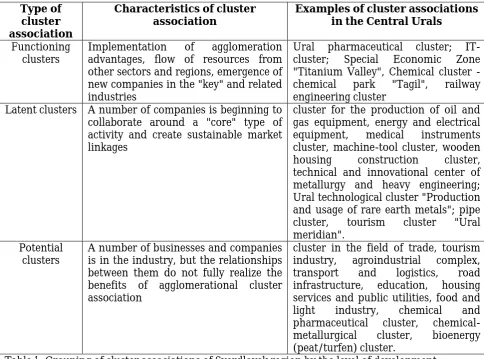
Institutional approach to regional development enabled the Institute of Economics, Ural Branch of the Russian Academy of Sciences, together with the regional government not only to formulate the basic provisions of the cluster policy for industrialized regions, but also to differentiate its tasks to separate groups of clusters: functioning, latent and potential (See Table 1).
Type of cluster association
Characteristics of cluster
association Examples of cluster associations in the Central Urals
Functioning
clusters Implementation of agglomeration advantages, flow of resources from other sectors and regions, emergence of new companies in the "key" and related industries
Ural pharmaceutical cluster; IT-cluster; Special Economic Zone "Titanium Valley", Chemical cluster - chemical park "Tagil", railway engineering cluster
Latent clusters A number of companies is beginning to collaborate around a "core" type of activity and create sustainable market linkages
cluster for the production of oil and gas equipment, energy and electrical equipment, medical instruments cluster, machine-tool cluster, wooden housing construction cluster, technical and innovational center of metallurgy and heavy engineering; Ural technological cluster "Production and usage of rare earth metals"; pipe cluster, tourism cluster "Ural meridian".
Potential
clusters A number of businesses and companies is in the industry, but the relationships between them do not fully realize the benefits of agglomerational cluster association
cluster in the field of trade, tourism industry, agroindustrial complex, transport and logistics, road infrastructure, education, housing services and public utilities, food and light industry, chemical and pharmaceutical cluster, chemical-metallurgical cluster, bioenergy (peat/turfen) cluster.
Table 1: Grouping of cluster associations of Sverdlovsk region by the level of development
57
performance, endogenous innovations and active promotion of it by government agencies at various levels.
According to a study conducted together with the regional government, the Concept of the cluster policy of the Central Urals up to 2020. It was approved by the Governor of Sverdlovsk region on April 11, 2011.
Not without a reason, individual authors consider that for the formation of effective institutions and monitoring of their functioning, the existing "control system needs to be complemented with institutions - intermediaries at all levels, providing interaction between administrations, business, science and civil society". According to the Member of the RAS V. M. Polterovich, that mission "could be completed by regional economic development agencies" along with the clusters [28. P. 17-29].
Program-project possibilities of spatial modernization of a territory
The organizational basis for the implementation of the regional policy and regional development, the management of these processes, along with regional economic development agencies can be the program-project approach, a federal institute of spatial planning which is able to meet the modern needs of the globalizing economy.
An example case of planned management of spatial development demonstrates England - the country with more than two hundred year history of market development.
In March 2012, the UK government published a draft document on the further progress of the planned management of spatial development under the title "Framework of National Planning Policy", which prescribed not only procedures for the development of plans, coordination of national, regional and local priorities, socio-economic development of the subject terms of protecting the environment and promoting sustainable growth. In the introduction to the published document, Planning Minister Hon Greg Clark noted the following: "The planning is designed to promote sustainable development. A better life for you does not mean the deterioration of life for future generations... Sustainable development associated with positive growth rates, making available economic, environmental and social progress both for the current and for future generations. The planning system helps to do this. Sustainable development should be a guide to going forward without delay - the presumption in favor of sustainable development, which is the basis for each plan and for each solution, should be kept... " [33. P. 169].
Before the adoption of the draft, this document was discussed a few months in scientific journals and public newspapers, and has received a positive evaluation both from the professionals and the society.
The mechanism for implementing regional policy is usually associated with the definition of its strategic priorities and therefore a growing need for the development and approval of the
Concept (key directions) of the regional policy of the Russian Federation as part of the
socio-economic development of the Russian Federation until 2030.
On the basis of the strategic priorities of the regional policy of the Russian Federation (up to 4-5), it is reasonable to develop appropriate programs to address the most complex issues of regional development. The solution of specific problems should be based solely on the
program-project approach.
The pioneer in usage of program-project development of the areas was the city of Yekaterinburg, which was the first in the Russian Federation to adopt on the 10th of June, 2003 the Decision of the City Council "Strategic Plan of Yekaterinburg" [15]. According to the estimation of the Mayor, and now a Member of the Federation Council, A. M. Chernetskiy, urban development plan was elaborated and implemented on the basis of three brand new practices of innovation for the Russian Federation, that required significant changes of management mentality and city leaders, as well as business and the city's population [15. P.3]. First, the motto of development, consultation and implementation of the plan was the idea "to think strategically and act together". Exactly this idea was the starting point for the development of the Strategic Plan and connection in
a one document for programming all strategic priorities with the project initiative of its population. Second, Strategic Plan since the moment of its development was a city-wide document.
program-58
project development of Birmingham (UK). The Strategic Plan was a broad public discussion that has considered and taken into account a lot of suggestions and wishes of residents, state and federal agencies. This allows us to consider the strategic plan of the city as program-project
creativity of the urban community.
Third, strategic direction of the development plan of Yekaterinburg on sustainable improvement of the quality of life of citizens. All eight program areas of the plan and the majority
of the more than a hundred business projects are devoted to this purpose. The first program direction of the plan is "Preservation and development of human potential" - opens the program of actions, and the eighth - "The master plan of the city of Yekaterinburg - a city for the people" completes the program actions of the city community in the development of Yekaterinburg. Also noteworthy is the final section of the plan - "The mechanism of the strategic plan implementation", the essence of which can be summed up with these words: "Working on the result and not closing to the innovations" [15. P. 3].
The strategic plan of the city in its content is scientifically grounded and, at the same time, is a document which is based on the needs of the practice, taking into account specific and comprehensive needs of the city and its competitive capabilities. In this case, it is characterized by high level of innovations aimed at solving the problems of restructuring the economy, accelerated development of industrial and social infrastructure, etc.
The advantage of program-project approach in market conditions can be considered not only innovative and pioneering participation of the citizens in the development of strategic plans and constant public control of the implementation of program priorities. This is important, but it is not the only one virtue. Program-project approach allows, on the one hand, combining the possibility of using a single document for the development of planning and administrative and market-based initiatives, the administrative resource and enterprise, plus consistently meet the needs of the urban integration of government, science, business and public opinion. On the other hand - to distribute the load to finance programs and projects between the budget of the city, businesses and the public, which not only significantly reduces the total costs and increases the effect of the implementation of business projects, but also reduces the load on the regional and federal budgets [16. P. 24].
Positive evaluation of the Strategic Plan of Yekaterinburg implementation in 2003-2008 required some adjustments in the part of review of most program parameters to increase. After nearly a two-year debate (between 2008 and 2010.), in 2010 an updated Strategic Plan of Yekaterinburg up to 2025 was approved by the City Duma [17]. Some refinements were made on the timing and direction of changes, priorities were adjusted and the project part of the plan was seriously revised. The number of projects has been brought to almost 130. Business activity in project financing increased markedly – up to 45 percent or more of the total value of projects is funded and implemented by private business.
The application of the methods of program-project management allows a more informed definition of goals and planning the best innovational, investment and other activities of regions and territories, including the territories of the new economic development [18; 35. P.57-69]. Project management provides an opportunity to more fully consider the project risks, to optimize the usage of available resources and avoid conflict situations, to control the execution of the plan, to analyze actual performance and make timely correction in the course of work, to store, analyze and use the accumulated experience in the successful future projects.
Over the passed years, much has changed in relation of the citizens to the problems of the city and its development opportunities in the public interest, taking into account public suggestions and wishes. The reasons for this are seen in the following. First, a creative approach to the design and implementation of the strategic plan will allow the city to "promote" to the leading positions among the Russian million cities on most socially significant figures (see table) [32. P. 12-14; 20. P. 10-11].
59
Cities Indicators Ye ka te ri nb ur g N ov os ib ir sk N iz hn iy N ov gor od Sam ar a Ch el yab in sk U fa O m sk K az an R os tov -on -Do n V ol gog ra d Pe rm K ra sn noy ar sk Sa in t Pe te rsb ur g M os cow Populatio n size at the end ofthe year, thousand people 3 , 1346 1 , 1411 9 , 1391 5 , 1497 4 , 1286 6 , 1263 1 , 1139 3 , 1169 5 , 1091 2 , 1143 8 , 1029 4 , 1082 8 , 1134 5 , 1156 0 , 1116 4 , 1145 6 , 1051 5 , 1091 8 , 1020 8 , 1018 2 , 990 0 , 1001 - - - Investme nts into fixed assets, billion rubles 100,8 36,8 63,2 29,9
71,0
23,5 30,3 53,7 23,8 54,3 34,0 43,5
46,4 24,8
107,7
52,1 29,4 21,3 30,5 14,7 39,86 34,2 - - -
Retail trade turnover per capita, thousand rubles 560,9
149,1 286,4 96,0 241,2
90,2 219,0 98,3 259,4 105,4 337,6 130,9
193,1 81,4
301,3
109,3 273,2 118,3 198,6 78,3 270,45 134,5 - - -
Housing constructi on, thousand m2 1050,2
735,3 1029,8 827,9 393,8 443,3
746,5
228,8 752,4 512,3
702,2 521,1 391,1 723,4 942,7 729,6 895,1
707,4 253,6 388,9 406,6 426,1 - - -
Average monthly salary, rubles
29544
14026 25937 11806 2458
1 1018
8
23186
11376 23420 11106 25125 11916
21951 10812
21878
9773 23806 10587 20264 9801 24989,7 12468 - - - The number of births, per thousand * - - - The number of deaths, per thousand * - - - Natural increase (decrease ) of populatio
n, per 1 000 residents * - - - Budgetar y supportab ility of million cities in 2011, thousand rubles per capita
21,8 24,8 20,4 16,2 25,6 17,4 12,8 26,8 22,4 12,0 22,0 28,0 88,1 133,8
* In the numerator of all million cities except Yekaterinburg - indicators of 2010.
Second, people's interest in the city and its development priorities can be assessed, in our
60
Population migration in Yekaterinburg, persons
2001 2002 2003 204 2005 2006 2007 2008 2009 2010 2011
arrived 1993316732174792350625479270882538823871222202317841976
10000
15000
20000
25000
30000
35000
40000
45000
The usage of project management of a territory allowed to accelerate the implementation of effect-targeted model of management [5. P. 30], which ensures development and gives the possibility to:
•To use the most effective institutions of spatial development at all levels, seamlessly coordinating abilities and interests of all levels of government, business and the public with one document;
•To get measurable results of each objective, each service and activity;
•To "calculate" the number and quality of services and activities that will be provided to the population of the region (territory) when defining the goal;
•To assess the impact on performance change in terms of changes in the budget plan
indicators up or down;
•To "receive" socially significant results for the people of the region from delivering the concrete services;
•To evaluate the performance of agencies and institutions work on the basis of analysis of their costs relative to their results;
•To determine for each of the tasks of socio-economic development of the territory its real
value of achievement, as well as implementation tools and persons responsible for the implementation.
At the level of regions and municipalities, the usage of project approach requires two conditions. First, the project must be built in the complex areas of strategic planning documents and logically follow from the goals and objectives of the strategic plan (strategy) of the region (municipal entity) development. In other words, these projects have to become strategic projects built in the logical chain of federal strategic planning management of spatial development;
Secondly, strategic projects at this approach turn into specific mechanisms (institutions) of
61
The proposed approach allows focusing the projects on the effective coordination of all project developers, which can be refined on the basis of careful planning and determination of very specific activities and sources of funding for each of the participants in these projects. Only in this case the plans, programs and projects become documents of public consent, in the implementation of which not only the initiators and participants are interested, but also the entire population of the municipal entity and the region.
References:
1. Tatarkin A.I. The historic mission of a median region in the modernization of Russian economy. «Federalism». 2011. № 1. Pp. 19-30.
2. Berger J.M. The Chinese model of development. — «World Economy and International Relations». 2009. № 9. Pp. 73-81.
3. Starchevoy M. A new human model for economic science. «Questions of Economics», 2011. № 4, Pp. 76-87.
4. Tatarkin A.I., Tatarkin D.A. Dialectics of formation and functioning of the self-developing regional economic systems. — «Federalism». 2009. № 4. Pp. 77-99.
5. Tatarkin A.I., Doroshenko S.V. Region as a self-developing socio-economic system: crossing the crisis. Economy of Region. 2011. № 1. Pp. 15-23.
6. Self-developing socio-economic systems: Theory, methodology and forecasting estimates. Edited by Member of the RAS A. I. Tatarkin. In two volumes. Moscow, «Ekonomika». 2011. Volume 1: Theory and methodology of formation of self-developing socio-economic systems. 308 p. Volume 2: Problems of resource provision for the self-development of socio-economic systems. 386 p.
7. Bochko V.S. Integrative strategic development of areas (theory and methodology). Yekaterinburg: Institute of Economics, Ural Branch of the Russian Academy of Sciences. 2010. 316 p.
62
9. Tatarkin A.I., Vazhenin S.G., Danilov N.I. Organizational and economic basics for the creation of business and regional production and territorial associations (PTA). Sverdlovsk, Institute of Economics, Ural Branch of the USSR Academy of Sciences, 1989. 147 p.
10. Lavrikova Yu.G. Clusters: strategy of formation and development in the economic space of a region. Yekaterinburg, Institute of Economics, Ural Branch of the Russian Academy of Sciences. 2008. 271 p.
11. Tatarkin A.I., Lavrikova Yu.G. Cluster policy in the region. — «Industrial Policy in the Russian Federation». 2008. № 8. P. 11-19.
12. Ivashova S. Complex building in big cities: cluster model of governance. — «Problems of theory and practice of management». 2011. № 4. P. 60-65.
13. Pacific Russia — 2030: Scenary forecasting for regional development. Edited by the Member of the RAS P. A. Minakir. Khabarovsk, FEB RAS Publ. 2010. 399 p.
14. Zakharchuk E. A., Pasynkov A. F. Features and properties of self-developing social and economic systems. Economy of Region. 2010. № 4. Pp. 32-39.
15. Strategic Plan of Yekaterinburg. Yekaterinburg, «Gorod» Publ. 2003. 192 p.
16. Korolyuk E. Modern Russian economy: strategic orientation and economic space. — «Problems of the theory and practice of management». 2011. № 4. P. 18-25.
17. Strategic Plan of Yekaterinburg. Yekaterinburg. As approved by the City Duma on 26.10.2010. Yekaterinburg, «Gorod» Publ. 2010. 284 p.
18. Strategy of economic development of underinvestigated areas of the Ural Soviet territory. Edited by the Member of the RAS A. I. Tatarkin. Yekaterinburg, Institute of Economics, Ural Branch of the Russian Academy of Sciences. 2011. 520 p.
19. Zakharchuk E.A., Pasynkov A.F., Nekrasov A.A. Classification of regions of the Russian Federation according to the criteria of self-development. Economy of Region. 2011. № 3. Pp. 54-63.
20. The results of socio-economic development of the municipal entity «Yekaterinburg City» in 2010. Yekaterinburg. Strategic Planning Committee. 2011. 181 p.
21. Leonov S.N., Sidorenko O.V. Foreign experience of regional management. Khabarovsk, IEI FEB RAS Publ. 2011. 144 p.
22. Bakhlova O.V. Development scenarios of territorial system of Russia«. — «Federalism». 2012. № 2. P. 69-78.
23. Tatarkin A.I., Romanova O.A., Grebenkin A.V., Akberdina V.V. Economic and technological development: methodology of diagnosis and prediction. Moscow, Nauka. 2011-2012. 398 p.
24. Tatarkin A., Lavrikova Yu., Vysokinskiy A. Development of economic space based on cluster principles. — «Federalism». 2012. № 1. P. 45-60.
25. Belkin V.N. Formation of competitive human capital of an enterprise. Yekaterinburg: Institute of Economics, Ural Branch of the Russian Academy of Sciences Publ., 2012. 400 p.
26. Sukharev O.S. Structural analysis of the economy. Moscow, «Finances and Statistics» Publ. 2012. 261 p.
27. Leksin V.N. Efficiency and effectiveness of the regional and municipal authorities: the purpose and possibilities of correct estimation. — «Region: Economics and Sociology». 2012. № 1. Pp. P. 3-41.
28. Polterovich V.M. Regional institutions of modernization. — «Economic Science of Contemporary Russia». 2011. № 4. P. 15-29.
29. Xin L. On the Chinese model. — «The World of Changes.» 2011. № 1. Pp. 83-89.
30. Koshcheev N. A proper economy in Russia does not exist. — «Our money». 2012. № 5. Pp. 40-41.
31. Problems of sustainable development of socio-economic systems. Edited by Member of the RAS A.I. Tatarkin and V.V. Krivorotov. Moscow, «Ekonomika». 2012. 596 p.
32. The results of socio-economic development of the municipal entity «Yekaterinburg City» in 2011. Yekaterinburg. Department of Economics. 2012. 198 p.
33. Krasnopolsky B.Kh. Spatial-economic planning: The UK experience (On the report «Framework of National Planning Policy»). — «Spatial Economics.» 2012. № 2. P. 168-173.
63
35. Chuzhmarov A.I. The development of public-private partnerships in terms of the North. Moscow, Econ-inform. 2012. 167 p.
УДК 330
Формирование региональных институтов пространственного развития Российской Федерации
Александр Иванович Татаркин
Институт экономики УрО РАН, Россия
620014, Свердловская область, г. Екатеринбург, ул. Московская, 29 академик РАН, профессор
E-mail: [email protected]
Аннотация. Оцениваются возможности и готовность регионов и муниципалитетов трансформировать пространственное развитие использованием системного подхода к выбору программно-проектных приоритетов и институтов рыночного развития. Рассмотрен потенциал отдельных факторов и институтов в системной модернизации регионов и территорий, обоснована потребность в программно-проектной модернизации федеративного устройства Российской Федерации. Предложены новые институты регионального развития – саморазвитие регионов и муниципалитетов, формирование бизнесс территории, программно-проектное планирование пространственного развития и др.