Management of Digital Libraries: Challenges and Opportunities
Redefining the Contemporary Information Professional’s Role
Raymond Wafula Ongus , T. D. Kemparaju ,Constantine Matoke
Nyamboga & M. Veerabasavaiah Department of Library and Information Science
Bangalore University,
Abstract:
This paper examines digital libraries principally from the management perspective. For the purpose of appreciating the intrinsic concepts involved, it starts with a comprehensive discussion of definitions, followed by basic principles pertaining to digital libraries. Next, it gives a glimpse into a wide-ranging spectrum of reasons as to why digital libraries are mushrooming predominantly in the developed world and also in a few developing countries. Reasons for the management of these types of libraries are also brought into view. Core competencies expected of digital librarians are outlined, in the wake of the new and continuously dynamic technological dispensation. The paper stresses the need for a paradigm shift in information management strategies, in as far as digital libraries are concerned. This is considered to be crucial if at all information professionals are to gain maximum mileage, in their noble mission of satisfying evolving user needs. Urgent attention ought to be directed towards managing of digital libraries, as a means of enabling contemporary information professionals to assert their unique role in society, not only as information gatekeepers but as information gateways, as well.
Keywords/Descriptors: Digital libraries management, Digital
Introduction
It goes without saying that, in modern times, the development and proliferation of digital libraries is giving rise to momentous transformations in the generation, access, utilization, dissemination and also the management of information resources. The introduction of a novel technology, such as digitization of information resources, tends to warrant a number of training requirements for the earmarked staff, due to demands for effective and efficient management of the new technology. Training needs may arise either directly from the knowledge, skills and attitudes needed to operate the new technology or from the ‘spin-off’ effects that may have changed working practices and influenced social interactions and relationships. Thus a need to change the management style and specific roles within the organizational structure would be necessary, in order to promote the openness and speed that normally accompanies such new technologies, of which digital libraries are included.
Definition of Digital Libraries
Over a period of time, many proponents have forwarded various definitions of digital libraries and still more continue to emerge each day. According to Waters (1998) the partner institutions in the Digital Library Federation (DLF) realized in the course of developing their program that they needed a common understanding of what digital libraries are if they were to achieve the goal of effectively federating them. So they crafted the following definition, with the understanding that it might well undergo revision as they worked together:
“Digital libraries are organizations that provide the resources, including the specialized staff, to select, structure, offer intellectual access to, interpret, distribute, preserve the integrity of, and ensure the persistence over time of collections of digital works so that they are readily and economically available for use by a defined community or set of communities”.
Arms (2000, 2) defined the digital library as:
“A managed collection of information with associated services, where the information is stored in digital formats and is accessible over a network”.
** Note the crucial part of the aforementioned definition, which recognizes that fact that the information is managed.
Bawden and Rowlands (1999), on the other hand, defined the digital library as:
“…a library / information space, located in either a physical or virtual space, or a combination of both, in which a significant proportion of the resources available to users of that service exist only in digital form”.
2
The definition, which came up in the course of the 1994 Institute of Electrical and Electronics Engineers Conference on Artificial Intelligence Applications (IEEE CAIA), emphasizes both the technical and service oriented aspects of digital libraries. It states as follows:
“A digital library is an assemblage of digital computing, storage and communication machinery together with the content and software needed to reproduce, emulate and extend the services provided by conventional libraries based on paper and other material means of collecting, cataloguing, finding and disseminating information. A full service digital library must accomplish all essential services of traditional libraries and also exploit the well-known advantages of digital storage, searching and communication”.
It is instructive to note that the terms ‘digital library’ and ‘electronic library’ or ‘virtual library’ may have, at one time, been somewhat synonymous and therefore used interchangeably. However the former term, namely ‘digital library’, currently represents the more modern or expansive approach. Moreover, another term, namely ‘hybrid library’ is taken to be cognizant of a continuum between the concept of the conventional library and that of the digital library, where electronic and paper-based information services are alongside each other (Pinfield et al., 1998). The aim of the hybrid library is to encourage end-user resource discovery and information use in a variety of formats and from a number of local and remote sources in a seamlessly integrated way.
In a nutshell, user communities with a higher propensity of utilizing information resources housed in digital libraries are likely to include: scholars, researchers, professionals in various fields of specialization, students, teachers (including university lecturers of all shades) and the general public.
Principles underlying the functionality of digital libraries
According to Lesk (1997, 1-2), digital libraries apparently give their users powers that they did not previously possess in as far as traditional libraries are concerned. With digital libraries, it is now possible for one to search for any word or phrase and it can be accessed over the world and reproduced without error! Digital libraries address traditional problems of finding information, of delivering it to users and of preserving it for posterity. In so doing, digital information takes less space than paper-based information and thus may help libraries to reduce cost.
Deegan and Tanner (2002, 22) proposed some general principles characterizing digital libraries. They comprise the following:
(i) Digital libraries are managed collections of digital objects;
(ii) Digital objects are created or collected according to principles of collection development;
(iv) Digital objects are treated as long-term stable resources and appropriate processes are applied to ensure their quality and survivability.
So, what does it take to establish a fully functional digital library?
(i) Knowledgeable staff:
Any organization that intends to establish a digital library must have a sustainable arsenal of suitably knowledgeable and skilled staff. The specific details of their knowledge and skills will be duly expounded in later section of this paper. However it suffices to say that they must be hardworking and committed individuals, loyal to their parent organization, ready and eager to continuously learn new activities pertaining to information technology with particular emphasis on digital libraries and must have the tenacity to apply whatever they learn in their workplace. Above all, they must be compassionate and extremely sensitive to the information needs of the clientele they serve.
(ii) Provision of digital content:
The digital library must contain information resources. It may either be new material prepared digitally from scratch (i.e. born digital), or it may be old material, converted into digital form (i.e. digitized). It may be bought, donated or converted locally from previously purchased library stock. Digital content then needs to be stored and retrieved. Information is widely found as text stored as characters and images acquired using optical scanners. These images are frequently scans of printed pages, as well as illustrations or photographs. More recently, audio and video, plus interactive material are accumulating rapidly in the digital form both newly generated and converted from older material. Copyright aspects also have to be carefully considered, at this stage, and everything has to be carried out without contravening the existing laws on fair use of information resources, in this regard.
(iii) Searching of digital information resources:
After storing information in a digital library, mechanisms ought to be in place for one to accurately identify and locate the piece of information sought.
According to Wikipedia (April 2006), most digital libraries provide a search interface, which allows information resources to be found. These resources are typically deep Web (or invisible Web) resources, since search engine crawlers cannot locate them. Some digital libraries create special pages or sitemaps to allow search engines to find all their resources. Digital libraries frequently use a protocol developed by the Open Access Initiative namely, the Open Access Initiative Protocol for Metadata Harvesting (OAI-PMH) to expose their metadata to other digital libraries and search engines like Google can also use the same to find the deep Web resources. There are two general strategies for searching a federation of digital libraries:
4
(b) Searching previously harvested metadata.
Distributed searching typically involves a client sending multiple search requests in parallel to a number of servers in the federation. The results are gathered, duplicates either eliminated or clustered, and the remaining items sorted and presented back to the client. Scalability (the capability of the system to increase total throughput under increased load emanating from added resources, typically hardware) and performance issues tend to plague distributed searching for large federations of digital libraries. Protocols like Z39.50 (a client server protocol for searching and retrieving information from remote computer databases) are frequently used in distributed searching.
Searching over previously harvested metadata requires the pooling of metadata collected from every digital library in the federation. This solution scales better than distributed search, but it introduces the problem of data freshness; digital libraries need to be re-harvested on a periodic basis to discover new and updated resources. OAI-PMH is frequently used by digital libraries for harvesting metadata.
(iv) Retrieval of digital information resources:
Retrieval systems are necessary for users to obtain the information they require from the digital libraries. Though it is relatively straightforward in the case of textual information resources, it may be a subject of research for pictures sounds and videos. Whatever the case, retrieved information must be delivered to the user. A digital library must also have some form of preservation mechanism. In that way, there has to be a means of ensuring that what may be available today is still available tomorrow.
(v) Interoperability:
Digital libraries are at the heart of interrelationships between several information service-related disciplines like library management, archives management, museum management, document management, knowledge management and e- commerce systems. This brings about the need for the different kind of systems to talk to each other. This situation is depicted in Figure 1 below:
Archive management
systems
Museum management
Figure 1: Functional overlap of various management systems in relation to digital libraries. (Adapted from Deegan and Tanner (2002, 139)).
Miller (2000) defined the term ‘interoperability’ as:
“… the ongoing process of ensuring that the systems, procedures and culture of an organization are managed in such a way as to maximize opportunities for exchange and reuse of information, whether internally or externally”.
Interoperability, in digital libraries, allows organizations and communities to retain their specialist practices, while putting high-level standards and protocols in place for sharing information. Achieving interoperability is difficult as it requires resources creators, users, funding agencies, systems and resource managers to agree on the development of standards and formats for information interchange that may not map exactly onto their established practices.
(vi) Sustainable funding:
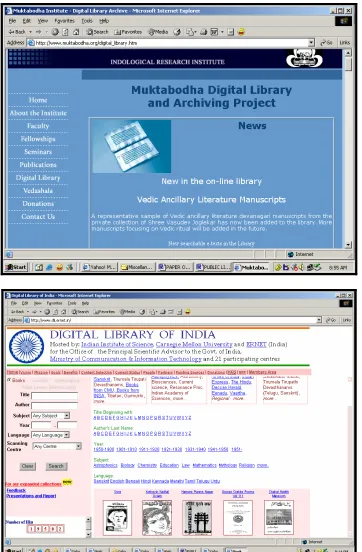
Figure 2: Examples of three successful Digital library projects set up in India (Adapted from: http://www.vidyanidhi.org.in/,
8
The growing impact and subsequent user awareness of information and communication technologies (ICTs), Web technologies and database technologies have compelled libraries to resort to digital library technology in order to render more effective information services. With the exponential growth of e-resources, it has become imperative for library and information professionals to redefine their function of disseminating information to the respective users (Ongus and Nyamboga, 2004). The following are some of the encouraging factors that have nudged the information society towards developing of digital libraries, as purported by Hariharan et al. (2002) and also Deegan and Tanner (2002, 30-35):
• Information can be saved digitally and therefore renders immediate access to high demand and frequently used items;
• There is enhanced intellectual control along with new finding tools and support searching capabilities;
• Links are provided to access bibliographical tools;
• Manipulation of text and images is improved by enabling the enhancement of digital images in terms of size, sharpness, colour, contrast noise reduction and so on;
• Duplication of digital resources is easy;
• The new potential of conserving fragile/precious originals while presenting surrogates in more accessible forms, is provided;
• The potential for integration into teaching materials by presenting the critical mass of reading materials is provided;
• The burden or cost of delivery is reduced;
• There is encouragement of use by providing enhanced resources in the form of widespread dissemination of unique collections;
• There is ‘virtual reunification’, allowing dispersed collections or materials that are related to one another to be brought together, even if they are scattered among many locations;
• More than one user can make use of use a single information resource, simultaneously;
• Provides timely access; • Saves physical storage space;
• Capable of supporting and creating multimedia information resources thus allowing the simultaneous integration of different media (i.e. images, graphics, sounds, videos and so on);
• No mutilation of pages due to high use or otherwise, can occur;
• There is an increased use of library resources and Web-based resources through Internet or Intranet, making it easy to receive or transfer information both from as well as to any part of the Internet, instantly;
• Supports resource sharing among libraries by providing efficient and seamless access to materials held remotely;
• There is the possibility of several libraries forming a consortium or consortia of access to bibliographic databases, abstracts, full text journals and even e-books online, by spending only a nominal amount.
As the case with everything in life, disadvantages always accompany advantages of any given issue. The following can be listed as the setbacks that are likely arise when creating digital libraries:
• The initial cost of digitization and preservation files is prohibitive. This comes about due to the relatively high cost of purchasing the required hardware and software for setting up the library;
• Special training is required and thus special skills to set up and maintain the digital library;
• The user has to accept the media, there by making user sensitization a crucial factor to be considered. This is because the authenticity and credibility, hence acceptance of the digitized information resources may have a lot to be desired; • Bandwidth problem in accessing multimedia resources and full-text journals is a
major communication barrier (particularly in a large majority of the third world countries);
• Scanning and electronically storing the original documents of the entire paper-based collection is time consuming and labour intensive;
• Intellectual Property Rights (IPR) issues may not be clearly interpreted or correctly applied and enforced in different parts of the world;
• Some librarians are wary of the new technology and hence may be reluctant to adopt changes.
Need for specialized staff to manage digital libraries
10
generations of graduates who are technologically savvy and have the capability to rise up to the occasion when called upon to do so.
Specifically, digital librarians are required for the purposes outlined below, among a host of emerging functions:
• To manage digital libraries;
• To organize the digital knowledge and information resources;
• To disseminate digital information from computer-held digital information; • Provide digital reference services and other electronic information services; • To provide knowledge mining from the emerging knowledge warehouses;
• To handle the tasks of mass digitization, digital storage process and digital preservation;
• To provide universal access and retrieval of digital knowledge, ultimately access to all knowledge resources available in digital form;
• To catalogue and classify digital objects and digital knowledge.
Admittedly, the contemporary information professional has numerous challenges to contend with, in the pursuit of satisfying the ever-changing information requirements of his/her clientele. The modern emphasis is on value-for-money concepts, accuracy, and timelines in information provision, among many other issues. In another school of thought, there is a belief that the information professional who manages a digital library is, in fact a knowledge manager. In that regard, Davenport, Delong and Beers (1998) highlighted that knowledge management is carried out with a view to:
• Creating knowledge repositories; • Improving access to knowledge; • Creating a knowledge environment; • Managing knowledge as an asset.
It is worth noting that in the developed world, suitably skilled professionals have attained the critical mass of expertise in constructing, stocking, managing, maintaining, evaluating and upgrading digital libraries. However the truth of the matter is that the very opposite scenario is apparent in most of the developing nations. Not much guidance, facilitation and empowerment seems to be forthcoming to the library and information service professionals in that part of the world. They are therefore rendered incapable of replicating such type of ‘hi-tech’ services in their own respective countries, to suit their own user populace. At best they may develop hybrid libraries, but even these are marred with problems such as underdeveloped publishing culture among the local intellectuals, lack of sufficient and sustainable funding, poor telecommunication infrastructure, unstable electrical power supply, untrained library staff, reluctant management, uninformed users as well as general lack of political goodwill, just to mention but a few. All these factors have inadvertently aggravated the broadening of the all too familiar chasm, nowadays commonly referred to as the ‘digital divide’.
In the digital era, ‘information objects’ like books, journals, newspapers, electronic documents, images, multimedia packages, databases and so on, can be accessed in diverse ways. According to Choudhary and Chand (2002), a barrage of threats beleaguers libraries and information professionals, of which include the overwhelming fast pace of technological innovations. The threats are quite daunting and real. Their impact on the future survival of traditional libraries in the digital era is potentially devastating, since they, together with the information professionals who manage them are placed under perpetual siege, as Figure 2 below illustrates.
Figure 3: Threats afflicting traditional libraries and their management.
As a result of the adversities depicted above it has become imperative to bring into play the concept of adjusted professional competencies, which are specially tailored to suit digital librarians. Nyamboga and Ongus (2004) view this option as a way of compelling contemporary and future library and information science professionals to fit into the modern knowledge management tasks that confront them in the information technology driven era.
Treats due to Service Oriented Challenges
Treats due to Unforeseen Challenges
Treats due to Preservation and Archive Related
Challenges Treats due to
Technological Challenges
Treats due to Managerial
Challenges
Traditional libraries and their librarymanagement
12
Subsequently, as Sreenivasulu (2000) observed, the competency of a digital librarian is represented by different sets of skills, attitudes and values that enable him/her to work as a digital information professional or, if one may prefer, a digital knowledge worker and digital communicator. He proposed the following skills and competencies that a properly qualified digital librarian ought to demonstrate:
• A good command of various Internet skills beyond the level of an ordinary user, including online searching and Web publishing;
• Knowledge and command of multimedia, digital technology and digital media processing techniques;
• Knowledge and skills of handling digital information systems, online and optical information involving the management of a CD-ROM / DVD-ROM network station and the conversion of print media into digital media;
• Networking knowledge of using both internal and external networks, including the establishment of personal networks, intranets, external knowledge resources and extranets.
Tennant (1999) also identified several skills that are supposed to personify the digital librarian’s knowledge reservoir. Some of them inevitably coincide with the ones outlined above.
¾ Optical Character Recognition (OCR): Scanning a printed will capture an image but in order to make it searchable, a good knowledge of OCR technology is required.
¾ Imaging technologies: Digital librarians must be aware of the various ways in which surrogates of physical items (for example, journal articles) can be captured. They must be familiar with the typical manipulation required to edit and save it different formats;
¾ Markup language: Digital librarians should have the knowledge of Hypertext Markup Language (HTML) and also a suitable combination of other Web authoring tools (such as SGML, XML, Scripting languages e.g. JavaScript or VBScript, DreamWeaver, Macromedia Flash and so on);
¾ Cataloguing and metadata: Digital objects require organization and description. Digital librarians must understand the ways in which metadata can be captured. They should be familiar with standards such as Machine Readable Catalogue (MARC), Anglo American Cataloguing Rules II (AACR II), Z39.50 protocol, Dublin Core and so on;
¾ Indexing and database technology: Digital librarians must be familiar with a variety of tools from simple and easy indexing and searching tools to complex relational or object oriented database systems;
¾ User interface design: The digital librarian should be able to write the functional specifications and work with other knowledgeable professionals to achieve the desired goal of developing a user-friendly computer interface with the library automation system, in case the library has one;
¾ Web technology: Digital librarians must know their way around the Internet and be well versed in Web technology;
¾ Project management: Digital library projects need skilled management. Digital librarians should be good communicators and relate well with people both inside as well as outside the organization. Projects initiated need to be completed on time and within the stipulated budget.
Conclusion
With the merger between computer science, library and information science, public relations and management disciplines in digital libraries, one can effectively proclaim that indeed, the future is already here with us! The management of digital libraries demands the invoking of revolutionary skills and techniques, previously not commonly applied in traditional libraries. Librarians and other information professionals must brace themselves to offer novel proactive information services. They also have to keep learning new tricks to make their service provision as attractive to actual as well as potential information users, for as long a time as possible. Just to quote Hastings and Tennant (1996):
“Digital librarians must thrive on change. They should read constantly (but selectively) and experiment endlessly. They need to love learning, be able to self-teach and be inclined to take risks. And they must have a keen sense of both the potentials and pitfalls of technology”.
Opportunities of digital libraries and, by extension, digital librarianship are vast and pretty obvious at this point. The gains too are innumerable. To concur with Chowdhury and Chowdhury (2003, 285-286), it is fitting to say that while computers and the Internet are primary tools on which digital libraries are built, a variety of technological, computer and communication skills, and information organization and retrieval skills are required of the people who manage them. Once that requirement is satisfied, information use and access would be much more democratized. We would be able to find ourselves in a scenario whereby the right digital information is available to the right user, to serve the right purpose, in the right situation, and at the right time.
14 References
Arms, W. (2000). Digital libraries. Cambridge, MA: MIT Press, p.2.
Bawden, David and Rowlands, Ian. (1999). Understanding digital libraries: towards a conceptual framework. (British Library Research and Innovation report No. 170). London: British Library Research and Innovation Centre.
Choudhary, Pravin Kumar and Chand, Prakash. (2002). “Challenges for LIS professionals in the digital era”. In Library and Information Networking: Papers of the National Convention on Library and Information Networking (NACLIN), held at Cochin University of Science and Technology, Cochin (India), October 21-24, 2002. ed. by H. K. Kaul and M. D. Baby. New Delhi: DELNET-Developing Library Network, pp. 254-267.
Chowdhury, G. G. and Chowdhury, Sudatta. (2003). Introduction to digital libraries. London: Facet Publishing. p. 8. and pp. 285-286.
Davenport, T. H.; Delong, D. W. and Beers, M. C. (1998). “Successful knowledge management projects”. Sloan Management Review. Vol. 39 (No. 2), pp.43-57.
Deegan, Marilyn and Tanner, Simon. (2002). Digital futures: strategies for the information age. London: Library Association Publishing, p.22, pp30-35 and p.139.
Gladney, H. M. et al. (1994). Digital library: gross structure and requirements: reports from a March 1994 workshop. (Accessed on 21st April, 2006)
URL: http://www.csdl.tamu.edu/DL94/paper/fox.html
Hariharan, Chitra M. et al. (2002). “Developing a digital library in civil and structural engineering R&D institutions”. In Library and Information Networking: Papers of the National Convention on Library and Information Networking (NACLIN), held at Cochin University of Science and Technology, Cochin (India), October 21-24, 2002. ed. by H. K. Kaul and M. D. Baby. New Delhi: DELNET-Developing Library Network, pp. 68-87.
Hastings, K and Tennant, R. (1996). “How to build a digital librarian”. D-Lib Magazine. November 1996. (Accessed on 24th April 2006). URL:
http://www.dlib.org/dlib/november96/ucb/11hastings.html
Miller, P. (2000). “Interoperability: what is it and why should I want it? Ariadne, 24. (Accessed on 21st April 2006).
URL: http://www.ariadne.ac.uk/issue24/interoperability/intro.html
Nyamboga, C. M. and Ongus, R. W. (2004). “Incorporating digital libraries module in the curriculum for library and information science education”. In SIS 2004 – Digital Information Exchange: Pathways to Build Global Information Society. 22nd Annual Convention and Conference IIT- Madras, Chennai. 22-23 January 2004. ed. By H. Chandra, P. Pichappan and R. Kundra. Chennai: IIT Madras, pp. 221-227.
Ongus, Raymond W. and Nyamboga, Constantine M. (2004). “Digitizing a research library: Egerton University – Kenya”. SRELS Journal of Information Management. Vol. 41 (No.2), pp. 161-177.
Pinfield, Stephen et al. (26th June 2000). “Realizing the hybrid library”. D-Lib
Magazine, October 1998. URL: http://www.dlib.org/dlib/october98/10pinfield.html
Sreenivasulu, V. (2000). “The role of a digital librarian in the management of digital information systems”. The Electronic Library. Vol. 18 (No. 1), pp. 12-20. (Accessed on 23rd April 2006).
URL: http://www.emeraldinsight.com/10.1108/02640470010320380
Tennant, R. (1999). “Skills for a new millennium”. Library Journal. Vol. 124, p.139.
Waters, Donald J. (1998). “What are digital libraries?” CLIR Issues. No. 4 (July/August). (Accessed on 21st April, 2006)
URL: http://www.clir.org/PUBS/issues/issues04.html#dlf
Wikipedia. (April 2006). “Digital Library” In Wikipedia, the Free Encyclopedia. (Accessed on 20th April 2006).