C O M M E N T A R Y
Open Access
Scenario-based simulation training for the
WHO hand hygiene self-assessment
framework
Ermira Tartari
1,2,3, Carolina Fankhauser
1, Alexandra Peters
1, Buyiswa Lizzie Sithole
1,4, Funda Timurkaynak
1,
Sarah Masson-Roy
1, Benedetta Allegranzi
5, Daniela Pires
1,6and Didier Pittet
1*Abstract
The WHO
SAVE LIVES: Clean Your Hands
global hand hygiene campaign, launched in 2009 and celebrated annually on
the 5th of May, features specific calls to action seeking to increase engagement from stakeholders
’
collaborations in
hand hygiene improvement. WHO calls on everyone to be inspired by the global movement towards universal health
coverage (UHC). Infection prevention and control (IPC), including hand hygiene, is critical to achieve UHC as it has a
direct impact on quality of care and patient safety across all levels of the health services. In the framework of UHC, the
theme for 5 May 2019 is
“
Clean care for all
–
it
’
s in your hands
”
. In this context, the WHO has launched a global survey
to assess the current level of progress of IPC programmes and hand hygiene activities in healthcare facilities (HCFs)
worldwide. This involved the creation of two tools for healthcare facilities: the WHO Infection Prevention and Control
Assessment Framework (IPCAF) and the WHO Hand Hygiene Self-Assessment Framework (HHSAF). The objective of this
paper is to provide case scenario-based simulation for IPC specialists to simulate and fully assimilate the correct
completion of the HHSAF framework in a standardized format. The three case scenarios have been tested and are
proposed for the reader to assess the HHSAF of different HCFs in a variety of contexts, even in low-resouce settings.
They were designed for simulation training purposes to achieve standardization and interactive learning. These
scenarios are meant to be used by professionals in charge of implementing a hand hygiene improvement strategy
within their HCF, as well as for simulation and standardized training purposes prior to completing and submitting data
for the 2019 WHO Global Survey. Additionally, information provided by the use of the HHSAF can easily be translated
into action plans to support the implementation and improvement related to specific indicators of hand hygiene
promotion. We invite all HCFs to participate in the 2019 WHO global survey and monitor the level of progress of their
IPC programme and hand hygiene activities.
Keywords:
Simulation, Education, Infection prevention and control, Hand hygiene, Healthcare-associated infection,
Antimicrobial resistance, Multimodal promotion, Universal health coverage, Quality, Patient safety, World Health
Organization
Background
Too many of the vulnerable individuals admitted to
health-care settings develop a health-care associated
in-fection (HAI). This results in increased morbidity and
mortality, prolonged hospital stay, and financial losses
for health care systems [1,
2]. Additionally, prevention of
transmission and control of multidrug-resistant
organ-isms in health care settings are critical as the number of
antibiotics available to treat these infections is limited
[3]. Many of these issues could be prevented through
simple, low-cost infection prevention and control (IPC)
measures such as hand hygiene performed at critical
moments [4,
5].
The focus of the World Health Organization (WHO)
SAVE LIVES: Clean Your Hands
global campaign has
been to promote best hand hygiene practices as a key
component of achieving quality of care and patient
© The Author(s). 2019Open AccessThis article is distributed under the terms of the Creative Commons Attribution 4.0 International License (http://creativecommons.org/licenses/by/4.0/), which permits unrestricted use, distribution, and reproduction in any medium, provided you give appropriate credit to the original author(s) and the source, provide a link to the Creative Commons license, and indicate if changes were made. The Creative Commons Public Domain Dedication waiver (http://creativecommons.org/publicdomain/zero/1.0/) applies to the data made available in this article, unless otherwise stated.
* Correspondence:[email protected]
1Infection Control Programme and WHO Collaborating Centre on Patient
Safety, University of Geneva Hospitals and Faculty of Medicine, 4 Rue Gabrielle-Perret-Gentil, 1211 Geneva 14, Switzerland
safety [6–11]. This campaign, launched in 2009 and
cele-brated annually on the 5th of May, features specific calls
to action each year, and seeks to increase engagement
from stakeholders’
collaborations in strenghtening IPC
programmes and improving hand hygiene. This year’s
campaign theme is
“Clean care for all
–
it’s in your
hands”
[11] (https://www.who.int/infection-prevention/
campaigns/clean-hands/en/).
‘Health for All’
has been increasingly recognized in
international fora as a concept firmly based on equity.
Alongside a strong global momentum surrounding
universal health coverage (UHC), WHO calls on
everyone to contribute to the attainment of health for
all populations [12]. In the context of UHC, IPC with
hand hygiene as a fundamental measure, is a key
component in providing patient safety and high
qual-ity health services [12,
13].
The 2019 WHO global survey
The WHO global survey aims to assess the current level
of progress of IPC programmes and hand hygiene
activ-ities in HCFs in the context of the WHO
SAVE LIVES:
Clean Your Hands
annual hand hygiene global campaign
(https://www.who.int/infection-prevention/campaigns/
ipc-global-survey-2019/en/). The survey will be open
until July 2019, and WHO invites all HCFs to join. The
survey is based on the use of two tools at the HCF level:
the WHO Infection Prevention and Control Assessment
Framework (IPCAF) (https://www.who.int/infection-pre
vention/tools/core-components/IPCAF-facility.PDF?ua=
1) and the WHO HHSAF (https://www.who.int/gpsc/
country_work/hhsa_framework_October_2010.pdf?ua=1)
[14,
15]
The IPCAF is a validated assessment tool that
sup-ports the implementation of the WHO
recommenda-tions
on the
core
components of
effective
IPC
programmes [16] at the acute HCF level. The goal of the
framework is to assess the current IPC situation in
HCFs. It is especially focused on evaluating existing IPC
activities/resources, and identifying strengths and gaps
that can inform future policies. It can be considered as a
diagnostic tool for HCFs to detect relevant problems or
shortcomings that require improvement as well as
iden-tify areas where international standards and
require-ments can be met [16,
17].
The HHSAF is a systematic tool with which an
individual health-care facility can obtain a situational
analysis of its hand hygiene promotion and practices
[14,
15]. To guide future improvement WHO is
launch-ing the HHSAF again in 2019 as part of the WHO
glo-bal survey (the HHSAF was previously launched in
2011 and 2015) (https://www.who.int/infection-preven
tion/campaigns/ipc-global-survey-2019/en/).
Assesing the level of hand hygiene at your institution
Measuring, promoting, improving, and subsequently
sus-taining hand hygiene standards as quality indicators for
patient safety is essential [18]. To advance this agenda, it
is crucial to monitor where improvements have occurred
and gaps must be addressed in hand hygiene structures,
processes, resources, promotion and practices [19,
20].
WHO provides a range of tools and resources to
sus-tain hand hygiene improvement. One is the Hand
Hy-giene Self-Assessment Framework (HHSAF), which is a
validated tool used to quantify the status of hand
hy-giene promotion activities within healthcare facilities
worldwide [14,
15]. Launched by WHO in 2010, the
HHSAF is available in different languages; it remains the
most widely used tool and the only framework aimed at
tracking the level of progress of healthcare facilties in
the context of hand hygiene implementation. Structured
around the five components of the WHO Multimodal
Hand Hygiene Improvement Strategy (see
Appendix),
the HHSAF assesses the interventions implemented by
HCFs in the context of their adherence to WHO hand
hygiene guidelines and recommendations [18–20]. The
HHSAF analyses a number of factors within each of the
five components of the multimodal strategy and scores
institutions’
status as inadequate, basic, intermediate and
advanced, according to the number of points obtained
(see
Appendix). Additionally, it directs HCFs to the
WHO hand hygiene promotion tools and the template
action plans (available at
https://www.who.int/infection-prevention/tools/hand-hygiene/en/) that can be used to
make improvement plans according to the HHSAF score
and specific indicators identified as requiring attention.
Supporting hand hygiene education and training
To support education and training activities around the
global survey, WHO, together with the WHO
Collabor-ating Centre on Patient Safety, developed a body of
ma-terial including an educational video (available at
https://
www.youtube.com/watch?v=PDz8kxrPaMk&feature=you
tu.be), a promotional video (available at
https://www.
youtube.com/watch?v=UfH6ODLV3BI) and three case
scenario-based simulations (Tables
1,
2
and
3) for IPC
specialists to simulate and fully assimilate the correct
completion of the HHSAF framework in a standardized
format. Simulation in health care is widely used in
med-ical education as an active learning method and it has
been shown to have great potential [22–24].
The case scenarios presented here can be used by
pro-fessionals in charge of implementing a hand hygiene
im-provement strategy within their facility, as well as for
simulation and standardized training purposes prior to
completing and submitting data for the 2009 WHO
Glo-bal Survey. As proposed by the WHO Guide to
Imple-mentation, information provided through the use of the
HHSAF should be translated into action plans to
sup-port the implementation and improvement related to
specific indicators of hand hygiene promotion [19,
20].
HCFs worldwide should consider implementing a system
of continuous assessment of hand hygiene improvement
strategy [21] by utilizing the HHSAF tool systematically;
the current recommendation by WHO and experts is to
use it at least annually.
Information appropriate for each of the WHO
Multi-modal Hand Hygiene Improvement Strategy
compo-nents has been identified in the case scenarios (Tables
1,
2
and
3). In order to simulate the completion of the
HHSAF, they provide details regarding HH promotion
strategy for the evaluation of resources, promotion, and
practices within a given HCF. The three case scenarios
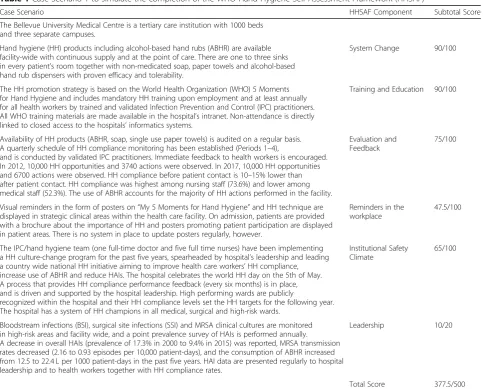
Table 1
Case Scenario 1 to simulate the completion of the WHO Hand Hygiene Self Assessment Framework (HHSAF)
Case Scenario HHSAF Component Subtotal Score
The Bellevue University Medical Centre is a tertiary care institution with 1000 beds and three separate campuses.
Hand hygiene (HH) products including alcohol-based hand rubs (ABHR) are available facility-wide with continuous supply and at the point of care. There are one to three sinks in every patient’s room together with non-medicated soap, paper towels and alcohol-based hand rub dispensers with proven efficacy and tolerability.
System Change 90/100
The HH promotion strategy is based on the World Health Organization (WHO) 5 Moments for Hand Hygiene and includes mandatory HH training upon employment and at least annually for all health workers by trained and validated Infection Prevention and Control (IPC) practitioners. All WHO training materials are made available in the hospital’s intranet. Non-attendance is directly linked to closed access to the hospitals’informatics systems.
Training and Education 90/100
Availability of HH products (ABHR, soap, single use paper towels) is audited on a regular basis. A quarterly schedule of HH compliance monitoring has been established (Periods 1–4),
and is conducted by validated IPC practitioners. Immediate feedback to health workers is encouraged. In 2012, 10,000 HH opportunities and 3740 actions were observed. In 2017, 10,000 HH opportunities and 6700 actions were observed. HH compliance before patient contact is 10–15% lower than after patient contact. HH compliance was highest among nursing staff (73.6%) and lower among medical staff (52.3%). The use of ABHR accounts for the majority of HH actions performed in the facility.
Evaluation and Feedback
75/100
Visual reminders in the form of posters on“My 5 Moments for Hand Hygiene”and HH technique are displayed in strategic clinical areas within the health care facility. On admission, patients are provided with a brochure about the importance of HH and posters promoting patient participation are displayed in patient areas. There is no system in place to update posters regularly, however.
Reminders in the workplace
47.5/100
The IPC/hand hygiene team (one full-time doctor and five full time nurses) have been implementing a HH culture-change program for the past five years, spearheaded by hospital’s leadership and leading a country wide national HH initiative aiming to improve health care workers’HH compliance, increase use of ABHR and reduce HAIs. The hospital celebrates the world HH day on the 5th of May. A process that provides HH compliance performance feedback (every six months) is in place, and is driven and supported by the hospital leadership. High performing wards are publicly
recognized within the hospital and their HH compliance levels set the HH targets for the following year. The hospital has a system of HH champions in all medical, surgical and high-risk wards.
Institutional Safety Climate
65/100
Bloodstream infections (BSI), surgical site infections (SSI) and MRSA clinical cultures are monitored in high-risk areas and facility wide, and a point prevalence survey of HAIs is performed annually. A decrease in overall HAIs (prevalence of 17.3% in 2000 to 9.4% in 2015) was reported, MRSA transmission rates decreased (2.16 to 0.93 episodes per 10,000 patient-days), and the consumption of ABHR increased from 12.5 to 22.4 L per 1000 patient-days in the past five years. HAI data are presented regularly to hospital leadership and to health workers together with HH compliance rates.
Leadership 10/20
Total Score 377.5/500
Abbreviations:ABHRAlcohol-based handrub,BSIBloodstream infections,HAIsHealthcare-associated infections,HHHand hygiene,MRSAMethicillin-resistant
took in consideration a range of HCFs around the world
in a variety of contexts, regardless of the resources
avail-able. Drawing from the information provided, a score is
assigned for each component and section. The sum of
the maximum values in each section is 100 points,
add-ing up to a maximum overall score of 500 points. Based
on the overall score, a HCF is then assigned to one of
four levels of hand hygiene implementation progress
(see
Appendix). The HCF presented in Table
1
scored as
Advanced
, and can therefore undergo further
Leadership
assessment according to twenty additional criteria, but
since only ten of them have been met, the HCF is not
classified as having reached the
Leadership
level.
Infor-mation for baseline evaluation of hand hygiene activities
Table 2
Case Scenario 2 to simulate the completion of the WHO Hand Hygiene Self Assessment Framework (HHSAF)
Case Scenario HHSAF
Component
Subtotal Score
St. Mary’s Teaching Hospital is a large tertiary care institution with 550 beds in rural Uganda. The hospital has 24 clinical wards, including radiology, laboratory, and pharmacy services.
One-liter ABHR bottles are mounted on the walls of the wards for ease of access. Mobile bottles are also placed on the trolleys used for ward rounds, in the reception area and in the treatment room area. The ABHR used was locally produced from sugar cane. Local ABHR production and quality control have proven to be feasible and satisfactory. Hand hygiene supplies are scarce. Only one or no functional sinks/taps were available in each ward. Portable water bottles and basins are an alternative for handwashing. Gloves, even non-sterile ones, are rarely
available. An action plan has recently been developed to improve the infrastructure in the hospital.
System Change 10/100
HH education and training for health workers is sporadic and mainly occurs upon initial employment. The training is provided by the IPC nurse who has received training from the Infection Control Africa Network (ICAN)
Training and Education
20/100
HH compliance rate is monitored by direct observations using the WHO hand hygiene monitoring tool,
however there is no established HH promotion strategy; observations are conducted annually. The HH compliance rate was very low. In 2015, the overall reported compliance was 9.2%, but by 2017 it had increased to 21.8%.
Evaluation and Feedback
10/100
The WHO‘How to handwash’,‘How to handrub’and‘My 5 Moments for Hand Hygiene’posters were only available in some of the hospital wards.
Reminders in the workplace
25/100
No IPC team, or experts in infection control is available in the country, although one part-time infection control nurse has been assigned infection control duties in the hospital. The director of nursing is committed to supporting hand hygiene improvement at St Mary’s hospital. Since 2017, the hospital is engaged in the WHOSave Lives Clean Your Handsannual campaign and is celebrating the 5th of May global HH day.
Institutional Safety Climate
15/100
Total Score 80/500
Abbreviations:ABHRAlcohol-based handrub,HHHand hygiene
Table 3
Case Scenario 3 to simulate the completion of the WHO Hand Hygiene Self Assessment Framework (HHSAF)
Case Scenario HHSAF
Component
Subtotal Score
The Ulwazi National Referral Hospital is a national referral and teaching tertiary care institution with 900 beds providing both primary and specialized health care (maternity, hemodialysis, intensive care units, medical and surgical specialties).
HH supplies (i.e. ABHR, soap and disposable towels) are scarce in the facility, with the availability of ABHR being confined to specialty areas such as Maternity, Hemodialysis and Intensive Care Units. The ABHR efficacy and tolerability have not been proven. The other wards use soap for handwashing and do not have disposable paper towels. Soap supplies are erratic and, at times, not available. The soap is very harsh to the skin. The wards have sinks with running water. The sinks are installed in the following areas in the ward:•1 in the nursing station•1 in the procedure/treatment room•2 sinks per ward (25 beds)•1 sink for the patient wash and toilet areas
System Change 10/100
HH training is done as part of in-service education, upon employment. When newly employed staff members are trained in HH, they enter their names and signatures in a register, kept as a record that all HCWs completed the training. Student nurses are given the HH training in their 1st and 3rd year of undergraduate education. The student nurses are attached for clinical practice in the hospital and have contact with the patients from the first year. The WHO leaflets on‘Glove Use Information’and“Hand Hygiene: Why, How and When”are available.
Training and Education
50/100
Audits to assess the availability and consumption of HH products is not performed, as the hospital lacks human resources. HH compliance rates are not monitored. The IPC nurse has not been trained as a hand hygiene compliance observer.
Evaluation and Feedback
0/100
Posters displaying the WHO‘My 5 Moments of Hand Hygiene’,‘How to Hand Rub’and‘How to handwash’are displayed next to all the hospital’s sinks.
Reminders in the workplace
50/100
The Ulwazu facility has registered for the WHOClean Care is Safer Careglobal campaign and is commemorating the Hand Hygiene Day every 5th of May.
Institutional Safety Climate
10/100
Total Score 120/500
within a lower income setting is presented in Table
2;
based on the overall score, the HCF would be assigned
as
Inadequate
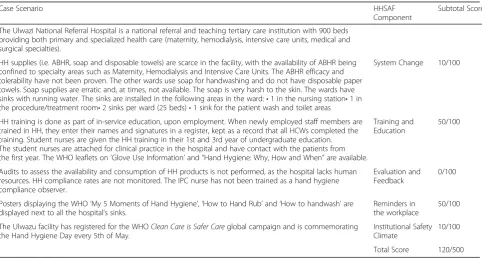
level of progress. The HCF in Table
3
is
assigned to
Basic
level, identifying the need for
signifi-cant improvement. The use of HHSAF over time will
en-able HCFs to keep track of their progress and
continuously set new targets for improvement.
Conclusion
The foremost objective of the WHO global annual
cam-paign is to prioritize IPC in health care and the global
health agenda, with hand hygiene assessment and
im-provement playing a fundamental role in ensuring
pa-tient safety. We invite all HCFs to be actively engaged in
this important endeavour and call upon all those who
can contribute towards achieving high-quality health
care and universal health coverage for the improvement
of public health worldwide.
“Clean care for all
–
it’s in your hands”
Abbreviations
HAI:Health-care associated infection; HCF: Health care facility; HHSAF: Hand Hygiene Self-Assessment Framework; IPC: Infection Prevention and Control; IPCAF: Infection Prevention and Control Assessment Framework; UHC: Universal Health Coverage; WHO: World Health Organization
Acknowledgements
We thank healthcare facilities for providing helpful information for the case scenarios.
Funding
This work is supported by the World Health Organization (WHO), Geneva, Switzerland, and the Infection Control Programme and WHO Collaborating Centre on Patient Safety (SPCI/WCC), University of Geneva Hospitals and Faculty of Medicine, Geneva, Switzerland; hand hygiene research activities at the SPCI/WCC are also supported by the Swiss National Science Foundation (grant no. 32003B_163262).
Availability of data and materials
Not applicable.
Declarations
The authors alone are responsible for the views expressed in this article and they do not necessarily represent the views, decisions or policies of the institutions with which they are affiliated. WHO takes no responsibility for the information provided or the views expressed in this paper.
Authors’contributions
All authors critically reviewed the contents of the manuscript and approved the final version. All authors did final editing and approval.
Ethics approval and consent to participate
Not applicable.
Consent for publication
Not applicable.
Competing interests
All listed authors declare no financial support, grants, financial interests or consultancy that could lead to conflicts of interest. Didier Pittet works with WHO in the context of the WHO initiative‘Private Organizations for Patient Safety–Hand Hygiene’. The aim of this WHO initiative is to harness industry strengths to align and improve implementation of WHO recommendations for hand hygiene in health care in different parts of the world, including in least developed countries. In this instance, companies/industry with a focus on hand hygiene and infection control related advancement have the specific aim of improving access to affordable hand hygiene products as well as through education and research.
Publisher
’
s Note
Springer Nature remains neutral with regard to jurisdictional claims in published maps and institutional affiliations.
Author details
1Infection Control Programme and WHO Collaborating Centre on Patient
Safety, University of Geneva Hospitals and Faculty of Medicine, 4 Rue Gabrielle-Perret-Gentil, 1211 Geneva 14, Switzerland.2Institute of Global Health, Faculty of Medicine, University of Geneva, Geneva, Switzerland. 3Department of Nursing, Faculty of Health Sciences, University of Malta,
Msida, Malta.4Infection Control Africa Network, Unit of IPC, Tygerberg Hospital, Cape Town, South Africa.5Infection Prevention and Control Global Unit, Department of Service Delivery and Safety, World Health Organization, Geneva, Switzerland.6Department of Infectious Diseases, Centro Hospitalar Lisboa Norte and Faculdade de Medicina da Universidade de Lisboa, Lisbon, Portugal.
Received: 13 March 2019 Accepted: 19 March 2019
References
1. Allegranzi B, Bagheri Nejad S, Combescure C, Graafmans W, Attar H, Donaldson L, et al. Burden of endemic health-care-associated infection in developing countries: systematic review and meta-analysis. Lancet. 2011; 377:228–41.
2. Marchetti A, Rossiter R. Economic burden of healthcare-associated infection in US acute care hospitals: societal perspective. J Med Econ. 2013;16:1399–404.
Appendix
Hand Hygiene Self-Assessment Framework
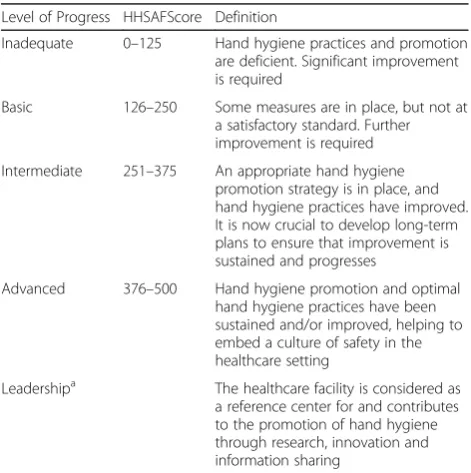
Table 4
Levels of Hand Hygiene Implementation Progress Defined
by the WHO Hand Hygiene Self-Assessment Framework (HHSAF)
Level of Progress HHSAFScore Definition
Inadequate 0–125 Hand hygiene practices and promotion
are deficient. Significant improvement is required
Basic 126–250 Some measures are in place, but not at
a satisfactory standard. Further improvement is required
Intermediate 251–375 An appropriate hand hygiene
promotion strategy is in place, and hand hygiene practices have improved. It is now crucial to develop long-term plans to ensure that improvement is sustained and progresses
Advanced 376–500 Hand hygiene promotion and optimal
hand hygiene practices have been sustained and/or improved, helping to embed a culture of safety in the healthcare setting
Leadershipa The healthcare facility is considered as
a reference center for and contributes to the promotion of hand hygiene through research, innovation and information sharing
a
3. World Health Organization. Evidence of hand hygiene to reduce transmission and infections by multi drug resistant organisms in health-care settings. 2014; Available at: (https://www.who.int/gpsc/5may/MDRO_ literature-review.pdf). Accessed 20 Feb 2019.
4. Pittet D, Allegranzi B, Sax H, Dharan S, Pessoa-Silva CL, Donaldson L, et al. Evidence-based model for hand transmission during patient care and the role of improved practices. Lancet Infect Dis. 2006;6:641–52.
5. Pittet D, Dharan S, Touveneau S, Sauvan V, Perneger TV. Bacterial contamination of the hands of hospital staff during routine patient care. Arch Intern Med. 1999;159:821–6.
6. World Health Organization. WHO guidelines on hand hygiene in health care: first global patient safety challenge clean care is safer care. Geneva: World Health Organization; 2009b.
7. World Health Organization. Global action plan on antimicrobial resistance. 2015; Available at:http://apps.who.int/iris/handle/10665/193736. Accessed 30 Jan 2019.
8. Sax H, Allegranzi B, Uckay I, Larson E, Boyce J, Pittet D. My five moments for hand hygiene’: a user-centred design approach to understand, train, monitor and report hand hygiene. J Hosp Infect. 2007;67:9–21. 9. Allegranzi B, Pittet D. Role of hand hygiene in healthcare-associated
infection prevention. J Hosp Infect. 2009;73:305–15.
10. Pittet D, Donaldson L. Clean care is safer care: a worldwide priority. Lancet. 2005;366:1246–7.
11. WHO | SAVE LIVES: Clean Your Hands. WHO Available at:http://www.who.int/ infection-prevention/campaigns/clean-hands/en/. (Accessed: 27 Feb 2019). 12. WHO | What is universal coverage?WHOAvailable at:http://www.who.int/
health_financing/universal_coverage_definition/en/. Accessed: 28 Feb 2019. 13. Storr J, Kilpatrick C, Allegranzi B, Syed SB. Redefining infection prevention
and control in the new era of quality universal health coverage. J Res Nurs. 2016;21(1):39–52.
14 World Health Organization. Hand Hygiene Self-Assessment Framework; 2010.https://www.who.int/gpsc/country_work/hhsa_framework_October_ 2010.pdf?ua=1. Accessed 22 Feb 2019.
15 Stewardson AJ, Allegranzi B, Perneger TV, Attar H, Pittet D. Testing the WHO hand hygiene self-assessment framework for usability and reliability. J Hosp Infect. 2013;83:30–5.
16 World Health Organization. Guidelines on core components of infection prevention and control programmes at the national and acute care facility level. 2016; Available at:https://www.who.int/infection-prevention/tools/ core-components/en/. Accessed 20 Feb 2019.
17 World Health Organization. Infection Prevention and Control Assessment Framework at the Facility Level; 2018https://www.who.int/infection-prevention/ tools/core-components/IPCAF-facility.PDF?ua=1. Accessed 22 Feb 2019. 18. Allegranzi B, Gayet-Ageron A, Damani N, Bengaly L, McLaws ML, Moro ML,
et al. Global implementation of WHO's multimodal strategy for improvement of hand hygiene: a quasi-experimental study. Lancet Infect Dis. 2013;13:843–51.
19. World Health Organization. Guide to implementation of the WHO multimodal hand hygiene improvement strategy. Geneva: World Health Organization; 2009a.
20. Allegranzi B, Pittet D. WHO Multimodal Promotion Strategy. In: Pittet D, Boyce J, Allegranzi B, editors. Hand Hygiene: A Handbook for Medical Professionals. Chichester: Wiley; 2017. p. 357–66.
21. Kilpatrick C, Tartari E, Gayet-Ageron A, Storr J, Tomczyk S, Allegranzi B, et al. Global hand hygiene improvement progress: two surveys using the WHO hand hygiene self-assessment framework. J Hosp Infect. 2018;100:202–6. 22. Nakamura I, Fujita H, Tsukimori A, Kobayashi T, Sato A, Fukushima S, Amano
K, Abe Y. Scenario-based simulation health care education for performance of hand hygiene. American journal of infection control. 2019;47(2):144–8. 23. Cartier V, Inan C, Zingg W, Delhumeau C, Walder B, Savoldelli GL.
Simulation-based medical education training improves short and long-term competency in, and knowledge of central venous catheter insertion: a before and after intervention study. Eur J Anaesthesiol (EJA). 2016;33(8):568–74. 24. Barsuk JH, Cohen ER, Feinglass J, McGaghie WC, Wayne DB. Use of