DEVELOPING AN ABAC-BASED GRANT PROPOSAL WORKFLOW MANAGEMENT SYSTEM
by
Milson Munakami
A thesis
submitted in partial fulfillment of the requirements for the degree of Master of Science in Computer Science
Boise State University
BOISE STATE UNIVERSITY GRADUATE COLLEGE
DEFENSE COMMITTEE AND FINAL READING APPROVALS
of the thesis submitted by
Milson Munakami
Thesis Title: Developing an ABAC-based Grant Proposal Workflow Management System
Date of Final Oral Examination: 13th October 2016
The following individuals read and discussed the thesis submitted by student Milson Munakami, and they evaluated his presentation and response to questions during the final oral examination. They found that the student passed the final oral examination.
Dianxiang Xu, Ph.D. Chair, Supervisory Committee Jyh-haw Yeh, Ph.D. Member, Supervisory Committee
Jidong Xiao, Ph.D. Member, Supervisory Committee
iv DEDICATION
v
ACKNOWLEDGEMENTS
I certainly did not get here by myself. Therefore, I want to thank all those who helped turned this dream into reality. I would like to express my sincere gratitude to all the people who supported me and made this thesis possible. First of all, I would like to extend my heartfelt gratitude to my wonderful advisor, Dr. Dianxiang Xu, who guided and walked me through this project. He is an excellent mentor and advisor. His invaluable advice, encouragement, motivation, and untiring guidance will help me in my future endeavor. I am also indebted to my committee members Dr. Jyh-haw Yeh and Dr. Jidong Xiao for their expert advice, help, and support.
vi
vii ABSTRACT
viii
ix
TABLE OF CONTENTS
DEDICATION ... iv
ACKNOWLEDGEMENTS ...v
ABSTRACT ... vii
LIST OF TABLES ... xii
LIST OF FIGURES ... xiii
LIST OF ABBREVIATIONS ... xiv
CHAPTER ONE: INTRODUCTION ...1
1.1 Background ...1
1.1.1 Attribute Based Access Control ...4
1.1.2 Case Study of a Workflow Management System ...5
1.1.3 Obligation and Delegation of Authority ...10
1.2 Problem Statement ...11
1.3 Objective ...14
1.4 Outline...16
CHAPTER TWO: RELATED WORKS ...17
2.1 Access Control ...17
2.2 XACML ...18
2.3 Obligation ...22
x
CHAPTER THREE: SYSTEM REQUIREMENTS ...25
3.1 Functional Requirements ...25
3.2 Security Requirements ...29
3.2.1 ABAC ...31
3.2.2 Obligation ...34
3.2.3 Delegation of Authority ...38
3.3 Access Control and Obligations in XACML ...45
3.4 Delegation in XACML ...47
CHAPTER FOUR: SYSTEM DESIGN AND IMPLEMENTATION ...49
4.1 Architecture...49
4.1.1 RESTful Services ...53
4.1.2 Database ...55
4.1.3 Morphia ...57
4.1.4 Balana ...57
4.2 Design and Implementation of Obligation Mechanism ...57
4.3 Design and Implementation of Delegation Mechanism ...62
CHAPTER FIVE: VALIDATION AND EVALUATION ...68
5.1 Testing...68
5.2 Results ...71
5.3 Threats to Validity ...71
CHAPTER SIX: CONCLUSION ...74
REFERENCES ...76
xi
Use Case Descriptions for GPWFMS ...82
APPENDIX B ...102
State Diagram of GPWFMS with Delegation ...103
APPENDIX C ...104
Attribute Metadata Definition ...105
APPENDIX D ...109
Functional and Access Control Requirements ...110
APPENDIX E ...151
Policy Requirement Description ...152
APPENDIX F...153
Policy Rule with Obligation...154
APPENDIX G ...155
XACML Request Format example ...156
APPENDIX H ...157
xii
LIST OF TABLES
Table 1 Generalized Use cases for GPWFMS ... 27
Table 2 Attribute Dictionary Definition ... 32
Table 3 Requirement for Add proposal by Tenured/Tenured-track Faculty ... 33
Table 4 Requirement for Delete proposal by PI ... 36
Table 5 Requirements for Approve by Department Chair ... 37
Table 6 Use Case for Department Chair Delegates Associate Chair. ... 42
Table 7 Security Rules formulated for GPWFMS ... 58
xiii
LIST OF FIGURES
Figure 1 Proposal workflow life cycle without Delegation ... 5
Figure 2 Grant Proposal Data Sheet Page 1 ... 8
Figure 3 Grant Proposal Data Sheet Page 2 ... 9
Figure 4 XACML Policy Language Model ... 20
Figure 5 High-Level Design of XACML Enforcement Architecture ... 21
Figure 6 Use Cases for GPWFMS with Delegation of Authority ... 28
Figure 7 Conceptual Delegation Model ... 41
Figure 8 A simple example of Delegation Process in GPWFMS ... 44
Figure 9 XACML Access Control Policy Rule without Obligations ... 46
Figure 10 XACML Access Control Policy Rule with Obligations ... 46
Figure 11 Static Delegation Access Control Policy Rule... 47
Figure 12 Dynamic Delegation Access Control Policy Rule ... 48
Figure 13 Modular Design of GPWFMS ... 50
Figure 14 GPWFMS Block diagram ... 51
Figure 15 Application Architecture of GPWFMS ... 52
Figure 16 Obligations Expression Format... 59
Figure 17 Obligation processing in GPWFMS ... 61
Figure 18 Delegation User Interface ... 63
Figure 19 Delegation processing in GPWFMS ... 65
xiv
LIST OF ABBREVIATIONS
WFMS Workflow Management System
GPWFMS Grant Proposal Workflow Management System ABAC Attribute Based Access Control
RBAC Role Based Access Control XML Extensible Markup Language
XACML eXtensible Access Control Markup Language DOA Delegation of Authority
SOA Service-Oriented Architecture OSP Office of Sponsored Programs
PI Principal Investigator
Co-PI Collaborative Principal Investigator IRB Institutional Review Board
REST REpresentational State Transfer API Application Programming Interface JSON JavaScript Object Notation
CHAPTER ONE: INTRODUCTION
With the advancement of cloud computing, Bring Your Own Device (BYOD) and Internet of Things (IoT), organizations are trying to adopt such new technologies to develop and implement autonomous workflow management systems (WFMSs). This digital transformation is bringing a new paradigm shift in the organization breaking the traditional approach of manual paper-based workflow management. Such online WFMSs focus on helping people to perform their tasks better and faster. However, the same level of security and automation is required by the organization along with promoting collaboration and information sharing among its stakeholders. As such fast-paced business processes are automated commonly referred as ‘workflow automation’ many security challenges need to be considered to streamline the work associated with each process step to make it more secure and flexible. Such dynamic and adaptive WFMS needs to provide a way to adapt to the vibrant and changing organizational needs to fulfill both system/functional and security requirements. As the threat landscape is changing and becoming more diverse and advanced, we need to architect, design, implement, and manage the security and privacy requirements in a way that allows users to focus on work and improve business operations rather than handling and tackling new security challenges associated with each task.
1.1 Background
aid and streamline business processes in numerous application domains such as office automation, finance, and banking, healthcare, telecommunications, manufacturing, and production [1][2]. In such distributed workflow system, which usually deals with multiple users, shared resources, and environments; this is even more crucial to secure its critical assets. A general objective of such workflow management systems is to support increased workflow automation and security requirements in complex real-world environments involving heterogeneous, autonomous, and distributed information systems [3].
The increasing interest in replacing paper-based workflow into internet based online workflow systems make it vulnerable to security attacks and threats from outsiders as well as from insiders. Using autonomous workflow systems can leverage significant advantages to organizations by reducing paperwork, accelerating collaborations and providing better Quality of Service (QoS) to their customers. To fulfill and address such fundamental driving force behind each organization, developers need to have a firm understanding of their business objectives as well as security requirements. Apparently, due to developers’ lack of understanding of business-oriented access control requirements, they can create many loopholes in the application. These security potholes can be easily exploited and impose high-security risks to the overall organizational goal.
need to be within the code, but rather can be created and maintained external to the application.
With this separation of authorization from the functional business process, however, modeling, designing, composing and testing of such applications become harder and time-extensive. As it involves diverse and distributed stakeholders accessing the same resources from different environments and ‘context’ that is beyond the predefined organizational boundaries in such application. There is always risks of sensitive information disclosure/leakage, unauthorized data access/breaches, identity theft and lack of privacy protection. Workflow processes can be complex and deal with more sensitive data across many different users that require varying degrees of information confidentiality and data security mechanisms. Such workflow applications need to provide a way to control the access to the information based on user’s authority, privacy levels and other various implicit contexts.
1.1.1 Attribute Based Access Control
The main challenging problem of cyber security is the protection of shared data from unauthorized users for which different access control models are introduced. The concept of role-based access control (RBAC) began with early user, and multi-application online systems pioneered in the 1970s [4]. The traditional RBAC model is insufficient in that it cannot describe fine-grained access constraints. It imposes many limitations for the granularity of permissions among distributed domains, resources, and users. It does not consider any other contextual information or object attributes except for role. From an enterprise perspective, RBAC is a passive access control model based on the direct assignment of roles and permissions that specify no time constraints, which can be exploited and can cause security threats. Such mechanism can be very messy and complicated if the organization has hundreds of thousands of users and similar roles that can lead to “role explosion”. Changes to these associations between roles with privileges and users with roles are frequent and explicit. Manual change management is required and causes an unwanted delay on business processes. Such manual revocation of the users from assigned roles can cause big overhead for the organization administration. Also, inability to do manual revocation may result in many unforeseen security risks and may not correctly reflect the business requirements.
authorization for activities is determined by analyzing attributes associated with the subject, object, action, and environment conditions. Due to its fine-grained nature, ABAC can be used to facilitate secure information sharing within the organization or federated environment. Unlike RBAC in which job function (role or identity) of a particular user defines an authority level, ABAC facilitates collaborative policy administration and auditing. ABAC explains not only WHO can access WHAT but also provides some additional context like WHEN, WHERE, WHY, and HOW. In simple words, ABAC relies upon the matching of attributes of the subject, attributes of the object, environment conditions, and their relationship with defined access control rules.
1.1.2 Case Study of a Workflow Management System
For this research work, we investigated ABAC model with the eXtensible Access Control Markup Language (XACML) Version 3.0 specification in a real-world application GPWFMS. In GPWFMS, we try to capture the real-world working process of University Grant Proposal Submission.
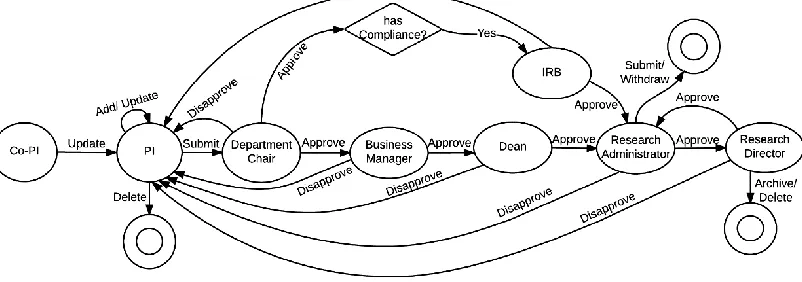
The regular activities in the proposal workflow life cycle are as shown in Figure 1.
First of all, a research grant proposal is written and initiated by a Principal Investigator (PI) by filling the proposal information and relevant supporting documentation.
It may include some Collaborative Principal Investigators (Co-PI) and Senior Personnel as co-authors or contributors. After getting the consent from each involved investigators, when the PI finds the proposal is ready to be submitted, he/she can submit it to the Department Chair for approval who will either return it or route it to the next phase in the workflow.
After being approved by the chair, it will await for being reviewed by the Business Manager, the Institutional Review Board (IRB) and the Dean. This process can get even more complex and complicated if the proposal involves investigators from multiple departments, particularly for multidisciplinary efforts. In such case, all departments' authoritative personnel need to review and approve its content. Anyone of them can obstruct the overall proposal workflow process and can cause an unprecedented delay in completion of proposal submission. Once the proposal is approved by the Dean as well as reviewed by IRB if it involves any compliance issues to comply with Federal, State, and University regulations, then it must be routed to the University Research Administrator who can disapprove or withdraw it or can approve it by routing it to the University Research Director. Research Director can either refuse or delete the whole proposal or can give final approval for submission. Finally, once it gets approval from the Research Director, University Research Administrator can submit the proposal. Then University Research Director can archive the
submitted proposal for future use.
ensure the pending task is completed on time, and all obligations are fulfilled before and after any action is performed. We can view this complex workflow as a multi-layered state machine which needs to fulfill pre-conditions and post-conditions in each state and some specific event triggers it from one state to another.
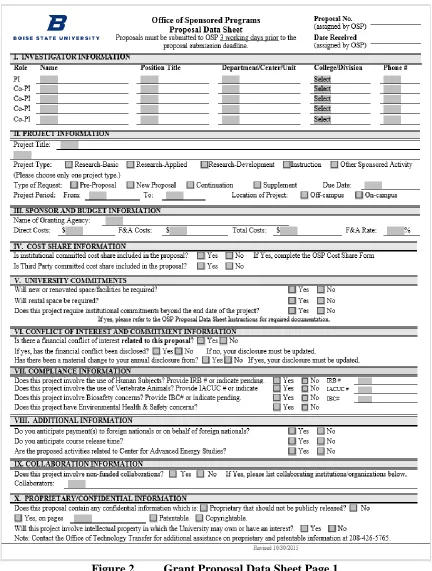
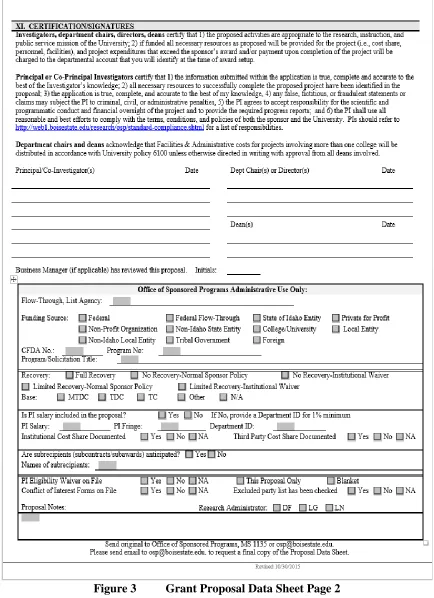
In a typical paper-based proposal management workflow, an authorized user such as faculty needs to fill-up a lengthy data sheet paper form as shown in Figure 2 and Figure 3, with proposal information and hands it to the next level user such as Department Chair. Workflow tasks like approving/disapproving a proposal, budget reviewing, etc. which involves user authorization can be time-consuming. During each phase, the user’s electronic signature plays a vital role as it indicates the consent from the user that corresponds to endorsement and commitment to the proposal. They can also request for revisions or additional information from the PI while reviewing the proposal. The most delaying factor usually is the length of time to reach a person and for that person to review the document. This task gets more complicated and tedious when the proposal involves other Co-PIs from different departments and need to be approved by authorized persons from each department. To convert such a tedious and time-consuming manual process into a flexible, reliable and more secure digital automated system is a challenge which respects the integrity of the workflow as shown in Figure 1 and Appendix B.
In GPWFMS, we automate this entire workflow lifecycle so that it is completely electronic and paperless. The new automated process saves time waiting for paperwork to traverse around the campus. It also provides a secure and central location to store and manage all relevant documentations. Organizations intended to enforce privacy and security regulations will have their access control policies and business rules based on functional and security requirements. The functional and security mechanisms such as privacy, access control, and usage control are defined and documented. These access level rules determine how proposal-related information is managed, processed, routed, and tracked to make decisions in every step. For example, one rule might be to have conditional routing of data and tasks based on the status of the proposal and user’s context.
The Unified Modeling Language (UML) based Use Case diagrams with their textual descriptions are used to formulate such requirements. These formal specifications are translated into eXtensible Access Control Markup Language (XACML) based authorization policies by utilizing fine-grained ABAC model. Thus, it requires verification and validation of the correct access to the requested resources using subject’s access levels which are determined by subject, action and resource’s attributes. Attributes may be considered characteristics of entities that may be predefined and pre-assigned a value by an authority. 1.1.3 Obligation and Delegation of Authority
such as system and user-level Obligations, Advice, Delegation of Authority (DOA), and Delegation of Obligations can be helpful so that the task can be completed on time.
Obligations are requirements that have to be fulfilled by the subject before (pre) or after (post) performing an action on a particular resource. For example, a pre-obligation requirement is that a user must sign the proposal with the current date time, initial and note before approving or disapproving it while it is waiting for his approval. As this need is to be fulfilled by a user, this is an example of user-level obligation. On the other hand, post-obligation is to notify all associated persons of that proposal about the change via email. The system performs such post-obligation as a system-level obligation. Moreover, in current existing workflow systems, there is no way we can impose obligations on any users based on policy rules.
Proposal workflow life cycle with complex delegation scenario is shown in Appendix B. Interestingly, issues of DOA can cause a critical security threat to the business as it provides more administrative authority to any new user (delegatee) in absence or consent of authority (delegator). Also, each delegation policy can have its obligation constraints known as delegation of obligations, which need to be enforced and fulfilled by the delegatee and the system.
1.2 Problem Statement
According to Workflow Management Coalition (WfMC), Workflow is defined as, “The automation of a business process, in whole or part, during which documents, information or tasks are passed from one participant to another for action, according to a
set of procedural rules” [5]. The WfMC has published a standardized security workflow
access/usage control, audit, data privacy, data integrity and non-repudiation. Such standards clearly emphasize the major security objective of any workflow system is to prevent the unauthorized access of classified information. Overall, the workflow modeling lacks research and standardization on how to design and implement a reliable and secure workflow specification.
In the study of workflow secure access control models, the task-based access control (TBAC) and role-based access control (RBAC) are most commonly considered and applied [6]. As WFMSs are used for critical and strategic applications, security is an essential and fundamental part of such systems. Many Web-based workflow applications enhance their safety via access control systems [7][8][9]. Our goal of this research work is to improve the existing secure software design model that mainly advocates for the use of TBAC, RBAC [6] and ABAC without the concept of DOA and Obligations. The primary focus of the security in such model is based on their role in the organization which can quickly restructure or change in dynamic enterprises; which means the client codes need to be reconfigured and modified. NIST [10] indicates ABAC as a recommended access control model for promoting information sharing among diverse and disparate organizations.
intra-boundaries access demands the system to support for continuous and collaborative business process that puts the business flows immediately and directly under the control of the people using the system. On the other hand, it needs to govern all security access control constraints via centralized and unified XACML policies.
The complexity of real-world workflow application requirements both functional and non-functional is revealing the limitations of the current security model design. The dominant traditional security access models are more discretionary and do not consider contextual information such as date, time, location and environments that allow intruders to bypass any defined security mechanisms easily. Existing state-of-art digital workflow solutions have security access controls hard coded at the application level, and also they do not specify complex access control constraints such as DOA and Obligations in policy level. Code-level access control logic making such systems rigid, incomplete, less secure and easy target to the security threats. When access decisions are embedded within the client applications, it makes it tough to update the decision criteria when the governing business rule changes. With such rigid software design patterns, it makes it harder to adapt any changes with the existing applications. Thus, there is a great need for flexibility in software design and implementation that supports dynamic changing of security policies based on DOA and obligation constraints. Improper design and implementation of such access control security constraints may increase critical complications.
business rules oriented user interfaces. Moreover, such interfaces can reflect the changing need of operations in future without the need of re-coding the application.
In particular, we need to investigate various security concerns in a complex environment of GPWFMS. One of the many outstanding technical challenges of adaptive WFMS is that it needs to unify people and resources with diverse features into a more cohesive way. A secure online workflow system needs to comply with all security requirements of the organizations alongside their system objectives and should safeguard all the sensitive information at any point of time. We can achieve this by integrating organizational access control policies throughout the workflow activities. However, this does not mean that it needs to imply many restrictive measures during each action from the user to make it more secure and robust. Such restrictions may degrade the usability or user acceptance of the overall system and also can impact the system’s performance.
1.3 Objective
These extensions in XACML standard are very helpful toward achieving sophisticated security features. However, it does not specify the kind of software design required to handle them properly. Such immaturity of XACML is making these new access control concepts less applicable and hence there are limited examples and implementations available. To the best of our knowledge, very few related work has been carried out in the real use case and implementation of such security model. Thus developed workflow management system can demonstrate a good use case for implementation of our proposed software design model that is simple to use and to administrate.
overhead. This model combines the advantages of the new fine-grained ABAC model along with other security access control constraints. Such combination reduces the risks of data breaches, sensitive data leakage and identity theft in an organization.
1.4 Outline
CHAPTER TWO: RELATED WORKS
2.1 Access Control
To accomplish security needs of any adaptive workflows, we can implement access control mechanisms [7][8][9]. According to National Institute of Standards and Technology (NIST) - “An access control method where subject requests to perform operations on objects are granted or denied based on assigned attributes of the subject,
assigned attributes of the object, environment conditions, and a set of policies that are
specified in terms of those attributes and conditions.” [10]. Access control is always
In distributed systems, models and languages have been widely investigated to specify access and management of control policies [14]. With the advent of web services based Service-oriented Architectures (SOA), these frameworks are enhanced to meet security of the distributed environment. A typical approach is to assign users to one or more roles, and then to grant security to those roles known as RBAC [4][6]. The system should be able to define access control to those roles at several levels. Unfortunately, these information security mechanisms are insufficient to address the complex security requirements that are more fine-grained and need to support different collaborative activities such as pre/post obligations and delegation of tasks.
Attribute-based access control is proposed as the perfect access model to overcome the shortcoming of traditional RBAC model. Movahednejad et al. [15] describe comparative evaluation and taxonomy of state-of-the-art approaches. Similarly, in other papers [16][17][18], authors have described the advantages and benefits of ABAC model. By contrast, our model makes it more fine-grained access control by supporting the contextual information i.e. time, location and environmental state for any user requests.
2.2 XACML
Use of XACML-based expressive access control policies is proposed to protect the access of resources in distributed systems that facilitates dynamic access control [19]. Herrmann [20] also explains about the design of a conceptual and logical evaluation context model based on XACML 3.0 specifications.
implementation of ABAC. Furthermore, XACML is a generic framework recognized by OASIS standard1 for access control which ideally provides standardization, expressiveness, modularity, interoperability, and efficiency [21][22]. The XACML specification defines a declarative fine-grained, attribute-based access control policy language, a reference architecture, and a processing model describing how to match access requests according to the stored policy rules. XACML standards address and determine how security authorization requests are handled internally.
An XACML policy P can be formalized using 5-tuple (S, R, A, C, Ob) [23], where S is a set of subjects, R is a set of resources, A is a set of actions, C is a set of permission conditions which can be evaluated to either true or false and Ob is a set of obligations. XACML architecture is a suitable choice for our model because of its:
i. Expressive power in expressing policies. ii. Computational simplicity in access algorithms.
iii. A natural language translation from business policies to access rules. iv. Standardized processing model which supports the externalization of the
access decision from the business logic.
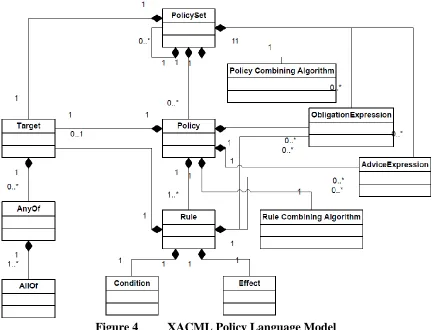
As shown in Figure 4, XACML Policy Language Model composes of many components. The policies may consist of different access control constraints in the form of policy sets, policies, decision rules, conditions, etc. for defining access level to the resources for a user.
The main elements of the XACML Policy Language model are:
1. Policy Sets: A policy set consists of one or more policies, other policy sets and a declaration for policy-combining algorithms.
2. Policies: A policy includes a set of rules, a resolution for appropriate rule-combining algorithms, a set of obligations and advice, and a target.
3. Rules: A Rule is the simplest unit of policy. A policy can comprise of one or many rules that can evaluate to Permit, Deny, Indeterminate, or Not Applicable.
Figure 4 XACML Policy Language Model
Each access control rule may consist of a condition, an effect, and a target to provide the fine-grained security.
• Conditions are statements about attributes that can evaluate either True, False or Indeterminate.
• Target in policy helps in determining whether or not a rule is relevant for a request.
• As a policy can have multiple rules, it is evident that it can generate different decisions based on different conflicting rules. To minimize that risk Rule-combining algorithms are used which resolve such conflicts and always try to outcome only one decision per policy.
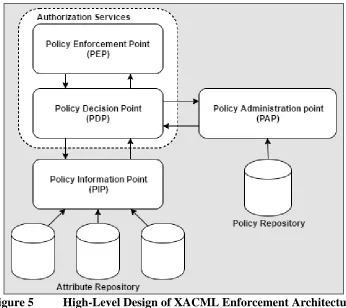
Figure 5 High-Level Design of XACML Enforcement Architecture
The XACML reference architecture as shown in Figure 5, highlights all the logical components of XACML as well as their internal interactions and authorization flows. It can be viewed as interactions of four top-level components as described below:
underlying infrastructures for policy and attribute storage. The policy repository stores the rules, policies, and policy sets that are used for access control.
• Policy Information Point (PIP) behaves as a metadata of attribute values (i.e. a resource, subject, environment conditions) and can be federated. • The Policy Decision Point (PDP) analyzes the resource access request with
the matching rules, policies, policy sets and returns a decision to the caller. • The Policy Enforcement Point (PEP) forwards the incoming request for access or authorization decision to the XACML context handler with a predefined format that specifies the details about the attributes of the subjects, resources, actions, and the environment. Placement of PEP directly influences the overall system performance.
• Once the policy is evaluated successfully, the PEP will either permit access or deny the access to the service requester for the requested resource and action. Also, the decision includes associated obligations and advice along with the reply if any.
2.3 Obligation
contextual permissions and obligations. Such usage control mechanisms are used while evaluating and enforcing the policies. Although, they lack the concept and support for dynamic changes in policies that are inevitable in today’s distributed systems. Elrakaiby et al. [26] had formalized the enforcement and management of obligation policies in which they had used the concepts of action specification languages and the Event Condition Action based on different states of obligations. Unlike general two types of obligations i.e. Pre and Post, in this article, they also identified Ongoing obligations which are activated
when resource usage starts. Also during the enforcement and fulfillment of usage-control obligations, these different types of obligations are enforced by validating and verifying different obligation states and state transitions.
2.4 Delegation of Authority
CHAPTER THREE: SYSTEM REQUIREMENTS
Before presenting the object-oriented system architecture, we are required to specify the functional and security requirements which the model aimed to satisfy and then outline the core principles that will be implemented during the design process. The proposed system design is architected and designed in such a way that every functionality is highly configurable so that it can support modification in requirements in the future. This step is similar to the traditional software engineering practice, where the security features are often built in an ad-hoc manner. In this principle, design model (business logic) and security model are treated as different tasks. Based on this low-level system specifications, the overall system operational and security requirements are collected as shown in Appendix D.
3.1 Functional Requirements
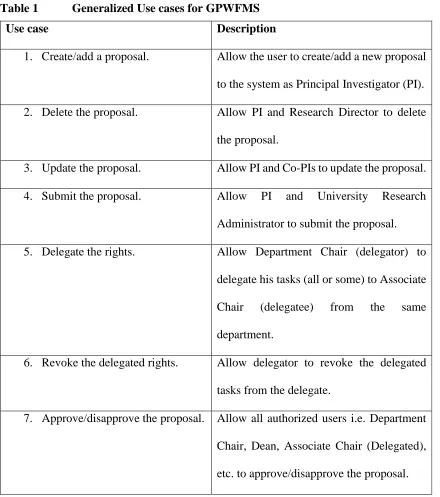
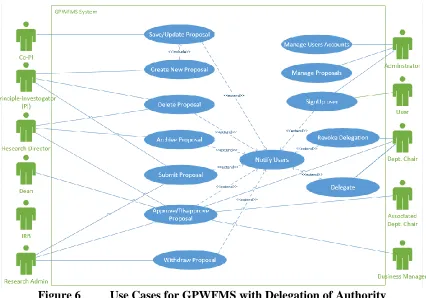
requirements are expressed in use cases. A use case is a graphical methodology used in system analysis to identify, clarify, and organize system requirements. The UML use case is used to explain a set of interactions between systems and users in a particular environment to achieve a specific goal. In GPWFMS environment, regular workflow system activities like to create, update, submit, delete, update, sign, delegate, revoke, approve, disapprove, withdraw, and archive a proposal during various phases are the typical proposal workflow functional needs. The proposal needs to be circulated to Department Chair, Business Manager, Dean, IRB, and University Research Administrator, University Research Director for review, approval, and signatures. Reasonable modifications to the proposal are permitted up to the submission. But, we need to make sure those tasks are visible only to the authorized users at any given time.
Table 1 Generalized Use cases for GPWFMS
Use case Description
1. Create/add a proposal. Allow the user to create/add a new proposal to the system as Principal Investigator (PI). 2. Delete the proposal. Allow PI and Research Director to delete
the proposal.
3. Update the proposal. Allow PI and Co-PIs to update the proposal. 4. Submit the proposal. Allow PI and University Research
Administrator to submit the proposal. 5. Delegate the rights. Allow Department Chair (delegator) to
delegate his tasks (all or some) to Associate Chair (delegatee) from the same department.
6. Revoke the delegated rights. Allow delegator to revoke the delegated tasks from the delegate.
7. Approve/disapprove the proposal. Allow all authorized users i.e. Department Chair, Dean, Associate Chair (Delegated), etc. to approve/disapprove the proposal.
Figure 6 Use Cases for GPWFMS with Delegation of Authority
These use cases describe the mapping between actors and entities for an application to fulfill all its functions. A use case diagram corresponds to one low-level view of a model of a system where every object is regarded as protected and every access to an entity that is not part of use case is considered unauthorized. Such use cases implicitly define an access policy that adheres to the principle of least privilege [35].
service is desirable which will alert and also sends an email to the corresponding users about any changes to their proposal and requires their attentions. These desired specifications usually help us to understand the business processes and how can we automate them by driving interactions between various participants and the system.
For example, once PI submit the proposal to Department Chair for approval then the “Submit” button should not be visible to the same user navigating same proposal next time, whereas the “Approve” button should be displayed when Department Chair logs into the system. Developers can perform this kind of assertion in code level with writing lots of conditional statements. Such hard-coded security statements introduce complication making the application more rigid to any future changes and maintenance tasks in business logic. At the same time, it increases lines of code that introduces more application-dependent errors and security loopholes in an application.
Such low-level system requirements ensure a consistent model for development and allow a developer to break down the monolithic applications into smaller modular services that can interact with each other. In GPWFMS, such RESTful (Representational State Transfer) Application Programming Interfaces (API)-based services are designed in such a way that it supports the pre-defined functional requirements in an efficient manner ensuring a high-quality business application. However, in these functional specifications, the underlying security measures of the services are not considered.
3.2 Security Requirements
problem with security requirements is that developers do not have expertise knowledge about secure software development. Beside this, security requirements are difficult to analyze and model [36] [37].
The potential attacks can occur not only from outsiders but also from within the system by the users who can misuse their assigned privileges. Such insider attacks can range from violating compliance goals, revealing confidential information, or altering workflow behavior. Therefore, to make the workflow system more secure along with fulfilling all the functional requirements, we need to assure that the proposed model meets essential goals of secure software design as explained below:
1. Confidentiality: The tasks (both normal and delegated) should not be disclosed to any other user. The private or sensitive personal and proposal information needs to be protected from unauthorized access or modification.
2. Integrity: Only authorized user can view whom the tasks that are assigned. Additionally, each activity needs to be validated and authorized as well as all the obligations (both pre and post responsibilities) accompany with that task must be enforced and fulfilled by the user during this process otherwise is not allowed.
3. Availability: All the tasks assigned to the user by the system or by another user (delegation) need to be visible and accessible to the user. Unless that privilege is forcibly revoked, expired or corresponding business rules are changed by the policy administrators.
the measures are recorded and logged. These audit logs will help to back-track activities quickly and can be very helpful during the forensic investigation. Therefore, the system requires providing facilities to easily create records and reports describing sensitive information including who and when any particular data was accessed.
3.2.1 ABAC
The least-privilege policy that is implicitly defined by use case specifications may not be sufficient to counter all security risks. ABAC using XACML access control policy is strongly recommended [38] to achieve above-mentioned high-level functional and non-functional (security) goals. First of all, the processing model needs to be identified and enforced an access control policy at the service side. These policies are defined and written according to the business standards and provide the guidelines for access control to the system. The information modeled in the requirement analysis phase can be immediately used to generate fine-grained ABAC policies. These requirements can be translated into plain English format as listed in Appendix E that makes the business rules easy to understand and translate into access control policy.
A simple access control rule can be expressed in the human readable format as: A “Tenured/Tenured-track faculty” is allowed to add a new “Whole Proposal”.
environmental, and more hidden contextual information, that are often expressed as attributes and their corresponding values. An attribute is a property of an object; an authorization credential is a statement or assertion about an attribute. In particular, a credential must be based on defined attributes for a subject and during each action which validates and matches the pre-defined policy constraints. Restrictive authorization and administration can be handled by the implementation of XACML security policies based on these attributes; that can establish who can view, edit, and authorize specific parts of the proposal.
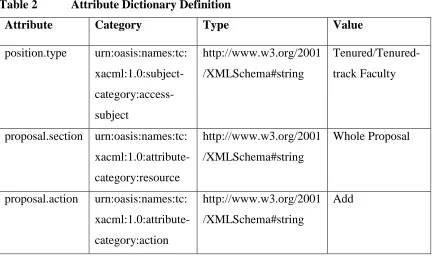
More detail metadata information about attributes and their corresponding category and potential values used in GPWFMS are listed in Appendix C. As shown in Table 2, for the defined access control rule, we can easily identify various attributes by looking into the pre-defined attribute metadata information.
Table 2 Attribute Dictionary Definition
Attribute Category Type Value
position.type urn:oasis:names:tc: xacml:1.0:subject- category:access-subject
http://www.w3.org/2001 /XMLSchema#string
Tenured/Tenured-track Faculty
proposal.section urn:oasis:names:tc: xacml:1.0:attribute-category:resource
http://www.w3.org/2001 /XMLSchema#string
Whole Proposal
proposal.action urn:oasis:names:tc: xacml:1.0:attribute-category:action
http://www.w3.org/2001 /XMLSchema#string
By comparing with the pre-defined attribute dictionary, for the given access control rule we can find out that the subject attribute is ‘position.type’ which has a value of ‘Tenured/Tenured-track faculty’, the action attribute is ‘Add’ and the resource attribute is ‘Whole Proposal’.
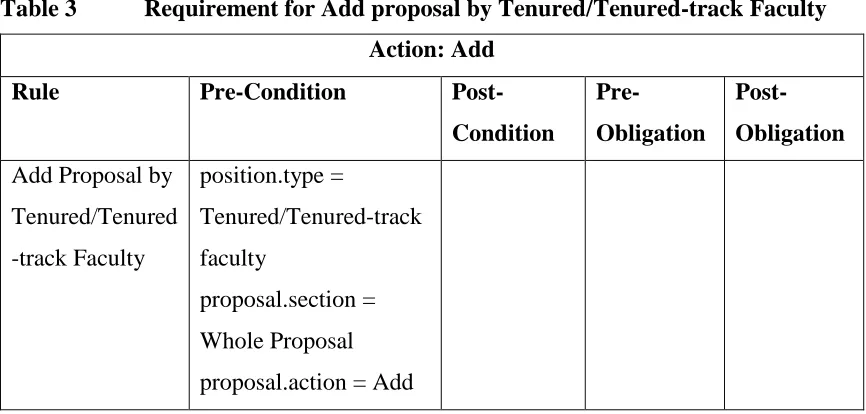
The above-mentioned system requirement can be tabulated as shown in Table 3.
Table 3 Requirement for Add proposal by Tenured/Tenured-track Faculty
Action: Add
Rule Pre-Condition
Post-Condition
Pre-Obligation
Post-Obligation
Add Proposal by Tenured/Tenured -track Faculty
position.type =
Tenured/Tenured-track faculty
proposal.section = Whole Proposal proposal.action = Add
The access control requirement as mentioned above specifies that the request of a Tenured/Tenured-track faculty to add a proposal will be allowed without any postconditions and attached obligation constraints. This kind of security requirement shows a normal access attempt by a user holding some pre-defined attributes to perform some actions on a secure resource.
to support federated attributes that are usually distributed in heterogeneous, distributed environment.
Such fine-grained access control produces a more secure and reliable system. Hence, it is desirable to have compact and adequate policies in the system that can satisfy all pre-defined requirements. These localized and unified security policies are used by the application to decide on any request from a user to perform actions on given resources depending on the provided contextual information. Using centralized security policies and mechanisms eliminates the tedious, repetitive, and labor-intensive manual procedures required to provision and manage security measures. The policy-driven system design will help to work seamlessly in its dynamically changing runtime environment.
3.2.2 Obligation
The proposed system needs to enforce any associated obligations before and after any tasks are performed. Severe security threats can occur if such constraints are not entirely implemented. There are two types of obligation Pre-obligation and Post-obligation; both are non-negotiable, and the system is required to enforce and apply them
thoroughly. Pre-obligation which specifies the responsibilities a user/system need to fulfill before accessing and performing any tasks on a resource. On the other side, Post-obligation refers to the user/system's accountability after the action is either permitted or denied.
example, the signing of a proposal is done by the user, so it is user obligation. On the other hand, sending an email is a system-level obligation performed by the system.
For example, another access control rule with having only post-obligation can be written in plain English format as below:
1. “PI” can “Delete” a “Proposal” when SubmittedByPI = NOTSUBMITTED and not been already deleted without any pre-obligation but with
Post-obligation: Send Email to all Investigators such as PI, CO-PIs, and Senior
Personnel.
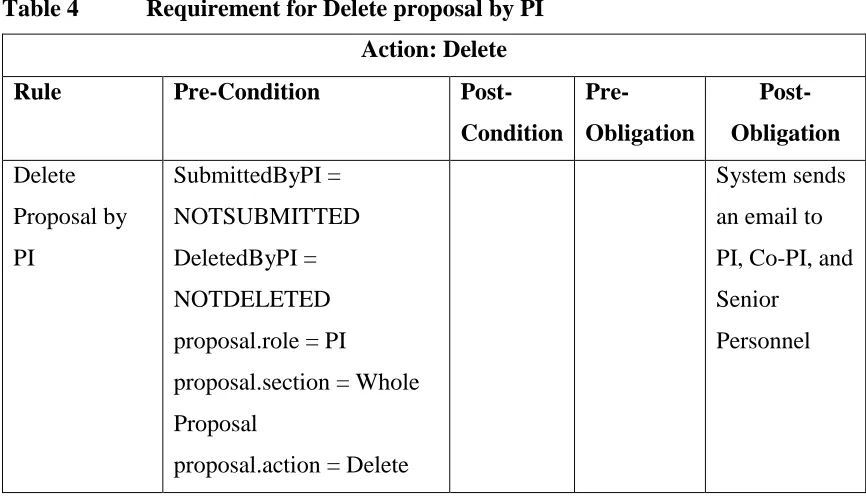
Here, the subject attribute is ‘proposal.role’ which has a value of ‘PI’, the action attribute is ‘Delete’, the resource attributes are ‘Whole Proposal’ and ‘READYFORAPPROVAL’ and needed pre-conditions are that the proposal has neither already been submitted nor deleted. Additionally, the system needs to fulfill some obligation constraints to complete this authorization request successfully. As we can see, neither PI nor the system has any pre-obligation, but the system needs to enforce and satisfy the defined post-obligation requirement after successful access of the proposal. As identified in the given policy rule, the system needs to send an email to PI, Co-PI, and Senior Personnel (post-obligation) after deletion of the proposal.
Table 4 Requirement for Delete proposal by PI
Action: Delete
Rule Pre-Condition
Post-Condition
Pre-Obligation
Post-Obligation
Delete Proposal by PI
SubmittedByPI = NOTSUBMITTED DeletedByPI = NOTDELETED proposal.role = PI
proposal.section = Whole Proposal
proposal.action = Delete
System sends an email to PI, Co-PI, and Senior
Personnel
The above-listed access control requirement describes the request of a user with proposal role of PI to delete a proposal that will be allowed if it is not yet submitted and removed. But while fulfilling this authorized access, the system needs to send an email to all associated PI, Co-PI, and Senior Personnel of that proposal.
Another access control constraint used in GPWFMS that involves both pre and post obligations as expressed and represented in the human readable format that follows:
2. “Department Chair” can “Approve” a “Proposal” when
ApprovedByDepartmentChair = READYFORAPPROVAL with Pre-obligation:
Chair needs to Sign it first and Post-obligation: Send Email to all Investigators
such as PI, CO-PIs, and Senior Personnel.
The authorization constraint as mentioned above with obligations constraints can be listed as shown in Table 5.
Table 5 Requirements for Approve by Department Chair
Action: Approve
Rule Pre-Condition
Post-Condition Pre-Obligation Post-Obligation Approve Proposal by Department Chair ApprovedByDepartmentChair = READYFORAPPROVAL position.title = Department Chair
proposal.section = Whole Proposal
proposal.action = Approve signedByAllChairs = true irbApprovalRequired = false
ApprovedBy DepartmentC hair = APPROVED ApprovedBy BusinessMan ager = READYFOR APPROVAL Department Chair signs the proposal System sends an email to PI, Co-PI, Senior Personnel, Business Manager
3.2.3 Delegation of Authority
Apart from standard functional features, GPWFMS also requires understanding the possibility of a potential obstruction in the workflow processes. GPWFMS allows some authorized users to delegate all or subset of their tasks/rights to another authorized person for completing the job on time. Besides, it needs to be flexible enough to support delegation requirements, such as delegation of authority, delegation of obligations, temporary delegation, transfer mode and revocation.
The key issue is evident in the real-world scenario such as how to model the DOA in which one user can hand over his/her authority to another user for a given period and allow for revoking that privilege afterward? In our proposed delegation model, we consider Human to Human delegation even though there are other forms of these delegations that exist including Human to Human, Human to Machine, Machine to Human and Machine to Machine [39]. The basic idea behind Human to Human delegation is that an authorized entity is allowed to forward his authority to another active object for timely completion of a task.
We tried to use and satisfy some of the salient characteristics that are mentioned in [39][40] to describe the behavior of our delegation model.
2. Permanence: “Permanence” describes the duration of delegated rights. In the proposed model, we allow the delegator to choose the limited date range so that delegation is only valid for that specified period. This temporary nature of delegation gives the system a level of security as the delegated policy will be inapplicable once the applied time is expired. Thus, manual revocation from the delegator is not necessary since auto-revocation is supported.
3. Totality: “Totality” characteristic defines the completeness of delegated rights i.e. partial delegation or total delegation [40]. In this model, we supported both types of totality features of delegation. If a delegator prefers the partial delegation, then the delegator can assign and select only a subset of access rights. This granular level permission based delegation refines the delegator's need. Such distinction of delegation rights allows the delegator to segregate the highly confidential tasks from others during delegation process and enable them to delegate based on trust level with delegatee. Such refinements prevent any unwanted risk of access due to handing over all available rights to delegator's subordinates.
4. Revocation: “Revocation” is used to take away delegated rights from delegatee in two ways namely; forced-revocation or auto-revocation [42]. Such revocation can be performed manually or automatically. In forced-revocation, a delegator can revoke delegated privileges any time whereas, in auto-revocation, delegated privileges automatically revoked upon expiry of duration. Both of such revocation is supported and implemented in the proposed delegation model.
administrator tasks and to coordinate collaborative work securely, especially with the increase in shared information and distributed systems. Apparently, the delegation of tasks/rights to another authorized user is a very useful real-world situation by which workflow continues to successful completion even in unwanted situations like user or resource unavailability or overloaded with tasks. The delegation of authority is an essential business requirement in an enterprise or organization where different users need to perform dynamic business processes in a heterogeneous computing environment. Without DOA, tasks cannot be divided among users which result in the individual user being overloaded with pending tasks.
The delegation need is based on business rules and can change over time, which can be stored in static delegation policy. For such dynamic transfer of responsibilities, the system needs to allow adding new dynamic delegation policy in the policy repository at runtime. Hence, the system needs to be secure enough to support and reflect dynamically added delegation policy rules. The proposed delegation model needs to support both static and dynamic access control policies.
Figure 7 Conceptual Delegation Model
As depicted in Figure 7, this delegation model constitutes of interactions among delegator, delegatee, resources, access rights/privileges. The delegation of tasks among users is a powerful technique for managing the complexity of modular and adaptive applications. The primary requirement of any delegation model is to specify who can delegate what? For example, a delegator can delegate only a subset of his rights at a given context.
An example of a static delegation rule used in GPWFMS is expressed and represented in the human readable format as:
“Department Chair” can “Delegate” his actions “Approve/Disapprove” to
“Associate Chair” from his own Department when ApprovedByDepartmentChair =
READYFORAPPROVAL.
Here, the subject attribute includes ‘Department Chair’, the action attribute is ‘Approve’ and the resource attribute is ‘READYFORAPPROVAL’ without any further constraints.
The above-mentioned complicated delegation scenario from GPWFMS can be illustrated in use case as shown in Table 6.
Table 6 Use Case for Department Chair Delegates Associate Chair.
Use case # UC-6
Use case name Department Chair Delegates Associate Chair of his/her own Department.
Actors Department Chair
Goal Department Chair Delegates Associate Chair of his/her own Department.
Preconditions 1. The actor has an account on the system.
2. The actor’s position title must be Department Chair.
Main Flow 1. The actor logged into the system. 2. The actor selects “Delegation” menu.
3. The actor selects “Add New Delegation” action.
5. The actor selects the “Delegate To” that is bind to delegate users based on policy rule specified such as User with position title of Associate Chair from his/her own Department.
6. The actor selects the “Delegate Actions” by selecting multiple checkboxes based on a policy defined for current actor’s context.
7. The actor selects the range of temporal delegation period using starting date and ending date for the delegation. 8. The actor fills the reason for the current delegation. 9. The actor saves the delegation information.
10.The system sends notifications to the selected delegatee and current delegator.
11.The system records that on the delegation audit log.
Post-condition 1. The system saves the delegation with correct data submitted by the actor.
2. The actor can access the delegation for edit and revocation.
Alternative
Flow
NONE
Exception
Flow
NONE
Recovery
Flow
NONE
rules for Associate Chair in the system as there are no pre-defined access control rules for users in that position title. Apparently, when the Associate Chair tries to perform any of these tasks, he is denied access.
Figure 8 A simple example of Delegation Process in GPWFMS
assistant once he comes back or anytime he wants. Delegation and Revocation are important concepts that are essential for modeling and reasoning dynamic distributed systems. Such delegation of authority feature is desired in any adaptive and dynamic workflow system which provides proper document routing and real-time decisions making.
3.3 Access Control and Obligations in XACML
In our proposed system design, a policy administrator or generator, who understands the organization’s security needs and business goals, can design customizable, XML-based access control policies, and host them in a central policy repository. To maintain proper authorization between different users and resources in GPWFMS, we have designed and implemented a series of XACML policy rules as shown in Appendix F.
Access control policy contains business rules defining overall functional and security specifications of the system. Besides, this policy also describes all actions applicable and available to a user based on given contextual information.
Figure 9 XACML Access Control Policy Rule without Obligations
Within such policy rules, we can define security constraints for each action so that each decision can reply along with required obligation needs. Then the application can quickly implement and enforce those obligation requirements. This new concept of constrained tasks to be followed before or after a request makes the software more secure and user more accountable.
For example, the access control specification listed in Table 5 can be converted into corresponding access control policy rule as shown in Figure 10.
3.4 Delegation in XACML
Our proposed model classifies XACML server-side delegation policies into two main categories:
Static Delegation Policy: This includes global administrative rules that define who can delegate what kind of actions to whom. That sort of policy is based on the business logic of an organization and can change in future. Such rules define some special rights assigned to users that enable writing and directly influence effective delegation policy in the system at runtime. These delegation administrative constraints confirm that the delegated rights accessible to the delegator and transfer of such rights are allowed. For instance, the delegation requirement listed as use case description in Table 6, can also be expressed with static delegation policy rule as shown in Figure 11. This kind of administrative delegation rule allows delegators to create dynamic delegation rules about individual sets of resources.
Dynamic Delegation Policy: This kind of administrative policy is created dynamically based on delegator’s requirements and also includes a rule to support revocation of delegation tasks by the principle delegator. For instance, this shown dynamic delegation rule allows an Associate Chair (delegatee) to perform Approve and Disapprove tasks (Actions) on the proposal (Resource) from the same department (Computer Science) as an authority (delegator) on given delegation period. The delegator maps a dynamic relationship between a delegatee and a resource so that system understands the dynamic delegation rules.
CHAPTER FOUR: SYSTEM DESIGN AND IMPLEMENTATION
The basic concept for workflow-enabled applications is the association of executable tasks with each step in the business process. To develop guidelines for the design of a workflow, we first need to understand an overview of the organizational needs that need to be satisfied in the workflow life cycle. Our proposed system design provides a holistic approach for implementing attribute-based access control in Service Oriented Architecture (SOA). With the rising popularity of distributed systems, the management of workflow for an organization, which involves different levels of users and resources, needs more time and effort. High level of collaboration and information sharing requires such systems to be more secure and reliable while utilizing all available organizational resources efficiently. Implementation and enforcement of secure access control mechanisms in an SOA environment are considered a complex challenge [43].
4.1 Architecture
aggregating loosely coupled or decoupled services as a sequencing process aligned with business goals.The data storage layer consists of a NoSQL database that allows persistent data access.
Figure 13 Modular Design of GPWFMS
As shown in Figure 13, GPWFMS is designed based on a scoped and modular approach for a typical 3-tier application architecture and to support the pre-defined system requirements. In this architectural pattern, the front end client can communicate with web services via REST call from the user interface layer. The business layer controls all functionalities of the application, and the data access layer allows the backend database to be connected with the application via a database Input/output (I/O) interface. We enforce policy based access control mechanisms in all three layers. Along with these steps, the system requirements for both security and functional are implemented and validated.
Figure 14 GPWFMS Block diagram
Figure 15 Application Architecture of GPWFMS
proposal documents. The ‘Delegation’ features include services, like delegating and revoking delegation are also supported. The system needs to handle task automation automatically, for this functionality the ‘Event Notification’ service sends email alerts to users with notification of the changes to the proposal. The ‘Process Monitoring and Reporting’ functionality allows monitoring currently available documents in the system. This service also enables users to create reports containing detailed information on current workload, future workload, obstructions, etc. based on “historic” processing data. The ‘File Service’ allows the user to upload and download files from the system. During each step, information about ‘Tracking and Logging of Activities’ are recorded and logged onto the system that supports non-repudiation security requirements.
To achieve a goal of designing a loosely coupled workflow management system, GPWFMS uses the following tools and techniques:
4.1.1 RESTful Services
JavaScript Object Notation (JSON). This flexible feature makes REST the ultimate choice for client-side development.
In GPWFMS, APIs are used to connect enforcement points which control access to sensitive information. Access control checks along with RESTful services help to prevent, detect and stop unwanted access to the system. Such web services are easy to develop and deploy. Additionally, they are usually lightweight, inexpensive to host and maintain. GPWFMS implements JAVA based RESTful web services (JAX-RS) to interact with the front-end client and backend database records via AJAX (Asynchronous JavaScript and XML). We create RESTful web services using the reference implementation of JAX-RS 2.0 i.e. Jersey which provides Client APIs to the front end.
Such RESTful web services abstract all the complex working mechanism of such access control by providing developers easy to use interfaces. This high-level abstraction allows developers to focus on business logic rather than understanding underlying complex security policies. The functional and security requirements are defined by XACML access control policies and using the XACML framework; the policy enforcement is implemented and achieved under this standard architecture. Additionally, each service is bound with underlying access control capabilities to make them more secure and to fulfill all functional and security requirements of the system.
security, reliability and to enforce access control based on user’s requests. In GPWFMS, user authentication relies on the identity of the user from the login context where a unique session token is assigned to a particular user to validate their credentials and persist till they switch their account or logs off the system.
4.1.2 Database
Contained within this system is a database that stores relevant entity’s information. To manage the attributes of every subject and object, they must have corresponding entries in a database that allows attribute retrieval and comparisons. The proposed robust architectural solution allows the system to generate, store and analyze enormous amounts of information with increased speed and scale. To overcome such data-driven requirements we choose, MongoDB2 was the best suited No-SQL backend database.
Traditional ‘relational’ database models store information in hierarchical rows and columns in a tabular format. However, such mappings and relationships are impossible in complex datasets harvested from vast and concurrent data streams. MongoDB is more document-oriented because each document is stored as JSON objects and as attribute-value pairs. With a document like structure, it allows quick retrieval and faster processing of data while making it more readable and scalable for the user.
Four primary database collections are used in GPWFMS, namely Users, Proposals, Notifications, and Delegations.
The User database collection holds the detailed information of a user as well as login information necessary to authenticate the user into the system during login.
User information includes the following data:
• User account data: A user account name and password.
• User detail information: A user’s given names, contact information (such as addresses, phone numbers, and email addresses), and departmental position/role information.
The Proposal database collection contains sensitive information for a proposal, including various critical information related to it. A general proposal includes:
• Project information: Proposal specific information, such as the project type, title, and date related information.
• Financial information: Budget details, sponsorship information, and cost sharing information.
• Investigator information: Details about PI’s, Co-PI’s and senior personnel. • Signature information: Signatures and notes from corresponding authorized
users.
The Notification database collection stores information regarding recent changes to the data (user, proposal, etc.) and notifies the appropriate users.
The Delegation database collection contains information about the delegator, delegatee, delegated actions, duration of delegation and the reason for the delegation.
collection so that revocation can be enforced based on the user authentication and the stored policy information.
4.1.3 Morphia
Morphia3 is a lightweight library for mapping Java objects to and from the MongoDB database. Morphia is an Open Source Fluent Query API that uses annotations and standards to interact with code and database. It adds a layer of abstraction between Datastore and Data Access Object (DAO) of Java application that makes working with Java exceedingly comfortable with MongoDB. It makes working with data in Java easy as it creates a data persistence interface in between. Morphia is MongoDB’s Java Persistence API (JPA4) which handles data access operations with less code. We can easily customize persistence and common data access patterns like Morphia’s datastore and DAO as per application’s need.
4.1.4 Balana
Balana5 is an open source XACML Implementation by WSO26 that supports XACML version 3.0 specifications and creates Policy Decision Point instances that can be embedded in web service level.
4.2 Design and Implementation of Obligation Mechanism
The architected solution prospect of the model is comprehensive and extensive with the use of latest XACML specification. In XACML v3.0 specification, the underlying evaluation context model and the authorization decision request format is generalized.
3 https://github.com/mongodb/morphia
4 https://en.wikipedia.org/wiki/Java_Persistence_API 5 https://github.com/wso2/balana
The total numbers of security access control rules defined in GPWFMS is shown in Table 7:
Table 7 Security Rules formulated for GPWFMS
No. of Access Control
Rules
No. of Rules with
Obligations
No. of Static
Delegation rules
Total
93 49 4 97
Depending on the nature of the obligation, it can be viewed as an additional restriction on the access right. An XACML obligation is an action to be performed before and after a particular event is triggered. Specifying obligations in access control policies is more secure and flexible than hard-wired in code-level. The ability to configure the obligation requirements externally in XACML policies enables a security administrator to activate or deactivate such security requirements dynamically without restarting or redeploying the running service. All associated obligations are replied along with the authorization decision in response to each system actions as shown in Appendix H. The actual interpretation of these obligation constraints is done by the developers and can be easily enforced and implemented in the client code.
Figure 16 Obligations Expression Format