DEMOGRAPHIC RESEARCH
VOLUME 37, ARTICLE 41, PAGES 1339
,
1350
PUBLISHED 26 OCTOBER 2017
http://www.demographic-research.org/Volumes/Vol37/41/ DOI: 10.4054/DemRes.2017.37.41
Descriptive Finding
Mortality selection among adults in Brazil:
The survival advantage of Air Force officers
Vanessa di Lego
Cássio M. Turra
Cibele Cesar
© 2017 Vanessa di Lego, Cássio M. Turra & Cibele Cesar.
This open-access work is published under the terms of the Creative Commons Attribution 3.0 Germany (CC BY 3.0 DE), which permits use, reproduction, and distribution in any medium, provided the original author(s) and source are given credit.
1 Introduction 1340
2 Data and methods 1341
2.1 Data 1341
2.2 Analytical approach 1342
3 Results 1343
3.1 Mortality patterns by age 1344
3.2 Mortality and place of birth among BAF officers 1345
4 Discussion 1347
Demographic Research: Volume 37, Article 41
Descriptive Finding
Mortality selection among adults in Brazil:
The survival advantage of Air Force officers
Vanessa di Lego1
Cássio M. Turra2
Cibele Cesar2
Abstract
BACKGROUND
The impact of extreme conditions on survival has been the focus of mortality studies using military data. However, in countries at peace, the military live in favorable conditions, being positively selected with respect to health. In this type of context, military data may help to improve our understanding of mortality differentials, particularly in countries where defective vital systems are still cumbersome for mortality studies.
METHODS
We estimate death rates for Brazilian Air Force (BAF) officers through Poisson regression models, compute life expectancies, and compare them with those of average Brazilians and people in low-mortality countries. We also examine causes of death and mortality differentials through a competing risks framework and Fine and Gray regression models.
RESULTS
BAF life expectancy is higher than that of the average Brazilian and comparable to Sweden, France, and Japan in 2000. Younger pilots have a higher risk of dying on duty when compared with other officers but experience lower mortality rates from other causes at advanced ages.
CONCLUSION
BAF officers are a population subgroup in Brazil with a life expectancy comparable to the one in advanced societies. There is no association between mortality and place of birth, which indicates that different childhood backgrounds did not affect BAF mortality differentials later in life.
CONTRIBUTION
This paper takes a novel approach focusing on a specific subgroup with lower mortality rates than the general population and good-quality longitudinal information available, a rarity in developing countries. We argue that this approach can be an interesting strategy to study mortality differentials in developing countries.
1. Introduction
A great deal of research has used military data to examine survival under extreme conditions, such as war and famine, as well as the mechanisms responsible for mortality differentials over the life cycle (Buzzell and Preston 2007; Costa and Kahn 2010; Horiuchi 1983). However, in countries that have not been involved in internal conflicts or foreign wars, military data may help to reveal the relation between life conditions and survival, particularly in places where substantial inequalities in health persist. In Brazil, a war-free country since World War II, military officers have to go through a strict health selection process during enlistment (BAF 2014). Also, they live in better conditions than the average citizen, enjoying stable economic status and having access to a high-quality diet, healthcare, education, and social support (Castro 2000; DoD 2015). At the same time, the military’s customary collection of vital data is particularly valuable in Brazil, where accurate data to measure mortality patterns among population subgroups is usually lacking (Turra, Renteria, and Guimaraes 2016).
Demographic Research: Volume 37, Article 41
2. Data and methods
2.1 Data
We collect data from the Air Force electronic pension fund system, tracking officers who joined the institution between 1947 and 1960 based on their service identification number. The database contains information on officers who 1) are still alive and retired, 2) died and whose families receive pension benefits, and 3) who died on duty (casualties) and did not support any designated beneficiary in the pension plan. We are not able to retrieve information for a minority group of officers composed of deceased individuals who did not die on duty and do not have beneficiaries on file. Nevertheless, we speculate this is a small subgroup since the military incentivizes officers to marry and have children. Officers with families benefit from subsidized housing, military school for children, and support services for their spouses while they are deployed or in night military patrols. In addition, officers can designate as beneficiaries not only spouses, but also children under the age of 21, older children if they are enrolled in college, children with permanent disability, daughters who are not married at the time of their death (until 2001), as well as parents who live below the poverty line or are mentally/physically dependent (Presidência da República do Brasil 1980).
For all officers, we record complete dates of enrollment, birth, and death (or end of follow-up set at June 30, 2013, the date of the last system update). Information on causes of death is available for two groups: deaths during military service (casualties) and other remaining causes of death. We also retrieve information on career type (aviator or administrative officer), which is a fixed choice upon enrollment that cannot change throughout training or thereafter. Place of birth is categorized according to two main geographic regions: northern states located in the northeast, north, and center-west parts of Brazil, and southern states located in the south and southeast regions. There are large regional inequalities in development within Brazil. Sanitary and health conditions are better in the southern states, which are also characterized by higher income and education levels than the northern states. Furthermore, despite the spread of the demographic and epidemiologic transitions throughout the country in the last decades, both mortality and fertility levels have been historically lower in the south.
and neurological exams, anthropometric measures, and hearing and sight tests. Also, candidates to become BAF officers cannot have diabetes or other 189 different health-related issues, and they also undergo physical conditioning tests that evaluate body strength and resistance for long hours in different sorts of deprivation contexts. There are additional criteria for pilots, who are tested for their ability to fly, peripherical sight, and motor coordination. They must not weigh under 58.65 kg or over 93.53 kg, must be between 164 cm and 187 cm tall, and need to meet other conditions (BAF 2014).
2.2 Analytical approach
To estimate the degree of mortality advantage among BAF officers, we first predict age-specific death rates using the coefficients of Poisson regression models that estimate the number of deaths during the follow-up period as a function of age and person-years of exposure (Rodríguez 2007). We measure age in 10-year age groups starting from 15‒24, with the exception of the last 5-year age interval, 75‒79. We also estimate life expectancy at different ages above 45, truncated at age 80, using life table methods (Preston, Heuveline, and Guillot 2001). The truncation at age 80 is necessary to make comparisons consistent with the average age of BAF officers at the end of the follow-up period.
We compare mortality estimates by age for BAF officers and six different populations, including adult males for Brazil (period and cohort estimates) and four low-mortality countries. For the Brazilian general population (period estimates), we use 2000 data drawn from official national statistics (IBGE 2012). Given that 60% of deaths of the 1947‒1960 BAF cohorts occurred between 1995 and 2013, the year 2000 is a good approximation of the mean year of death for officers. At the same time, it is a census year, when population counts are usually more reliable in Brazil. We also reconstruct the mortality experience of the 1935 birth cohort by using Brazil-specific data from the United Nations period life tables for the years 1950 to 2015 (United Nations, Department of Economic and Social Affairs 2015). The year 1935 corresponds to BAF officers’ mean year of birth. To estimate mortality rates for male populations living in low-mortality countries, we draw data for the year 2000 from the Human Mortality Database (HMD 2013). We add countries from three different continents: Chile, Sweden, France, and Japan.
Demographic Research: Volume 37, Article 41
underlying hazard by cause of death through the subdistribution hazard model (FG) (Fine and Gray 1999). The FG model allows us to control for region of birth and career type (pilot and administrator) simultaneously and thereby capture additional selection effects that may arise from career choice. The FG model is similar to the Cox regression model, with the difference that the former applies to the subhazard underlying the cumulative incidence function (CIF) (Rodríguez 2012) and has a weighting procedure in which individuals with an earlier competing event remain in the risk set (Geskus 2011). Since our concern is not specifically with modeling the cause-specific hazards but understanding if place of birth is associated with survival, the FG approach is more appropriate than the Cox regression, which gives the effect on the instantaneous risk of death. One disadvantage of using the FG approach is the difficulty in interpreting its results in terms of the magnitude of the effects. On the other hand, because the transformation is monotonic, positive coefficients indicate increases in the CIF, and negative ones indicate decreases (Rodríguez 2012). Since for the purposes of this study it suffices to know the direction of the effect, we did not have problems interpreting the results.
3. Results
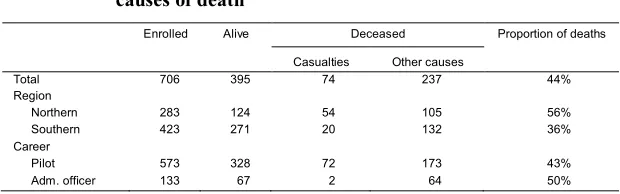
Table 1 shows the distribution of cohort members according to survival status and the variables used in our analysis. The results show that 44% of the cohort is alive by June 30, 2013. Among all deaths, 25% occurred on duty. In addition, while 56% of officers who were born on the northern region of Brazil died by the end of the follow-up period, only 36% among those born in the southern region died. Among the deceased, 13% died from casualties in the southern region, compared to 34% in the northern region. As for career, 43% of pilots died by the end of the study period, compared to 50% of the administrative officers.
Table 1: Descriptive characteristics by region of birth, career, and causes of death
Enrolled Alive Deceased Proportion of deaths
Casualties Other causes
Total 706 395 74 237 44%
Region
Northern 283 124 54 105 56%
Southern 423 271 20 132 36%
Career
Pilot 573 328 72 173 43%
3.1 Mortality patterns by age
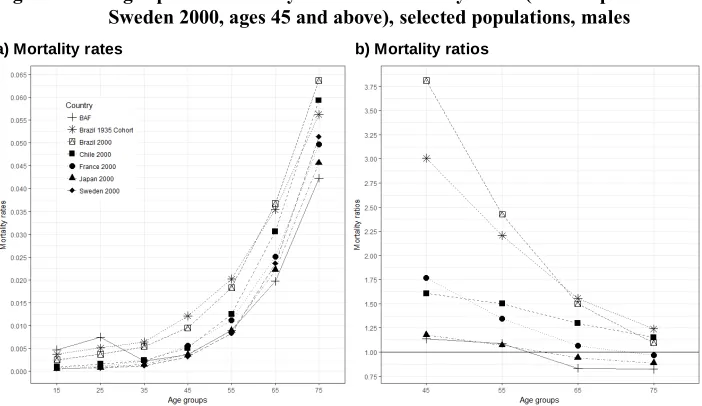
Figure 1a shows mortality rates by age groups for each population included in our analysis. The concentration of on-duty deaths at younger ages makes death rates in the age groups 15‒24 and 25‒34 higher for BAF officers than for any other population. This is true even when we compare BAF age-specific mortality rates with those for the 1935 Brazilian cohort, suggesting that the risk of dying on duty was not trivial during the period of analysis, despite Brazil’s conflict-free environment. However, after the age of 35, mortality rates for BAF officers become significantly lower than the rates for Brazilian men and comparable or even slightly lower than the rates for the average male living in low-mortality countries.
Figure 1: Age-specific mortality rates and mortality ratios (with respect to Sweden 2000, ages 45 and above), selected populations, males
a) Mortality rates b) Mortality ratios
Source:Diretoria de Saúde da Aeronáutica (DIRSA); Human Mortality Database (HMD); Instituto Brasileiro de Geografia e Estatística (IBGE), male life tables.
Demographic Research: Volume 37, Article 41
reducing towards Swedish levels at older ages. This distinct pattern confirms earlier analyses in suggesting a biased age pattern of adult mortality in Brazil (Turra 2012), probably caused by age misreporting at older ages. Among BAF officers, the age-specific mortality ratios are flatter and much closer to 1.00, resembling the patterns for Sweden, Japan, and France, countries that are known for having high-quality mortality data.
Consistently, life expectancy at age 45 for the average Brazilian men born in 1935 (25.9) is lower than the one for BAF officers (30.4). However, at age 75, the difference reduces substantially to only 0.2 years of life, reflecting the aforementioned distinct (and probably biased) downward pattern of mortality in the general population. Comparable results are found for Brazil in the year 2000, as shown in Table 2. On the other hand, in accordance with Figure 1, life expectancy by age is very similar for BAF officers and Swedish men. As a note of caution,it is worth emphasizing that the small number of cases for BAF officers results in large confidential intervals. Uncertainty translates into accumulated differences in life expectancy, particularly for ages 45–65, when military deaths are rarer.
Table 2: Truncated male life expectancies at age 80 for BAF officers, Brazil 2000, Brazil 1935 birth cohort, and Sweden 2000
Age 95% lower limit BAF Mean 95% upper limit Brazil 2000 Brazil 1935 birth cohort Sweden 2000
45 25.5 30.4 33.0 25.7 25.9 30.4
55 17.6 21.4 23.4 17.8 18.6 21.2
65 10.7 12.9 14.0 10.7 11.6 12.6
75 4.3 4.6 4.8 4.0 4.4 4.5
Source: HMD/ Human Mortality Database, available athttp://www.mortality.org/; IBGE (Instituto Brasileiro de Geografia e Estatística), male life tables available athttp://www.ibge.gov.br/.
3.2 Mortality and place of birth among BAF officers
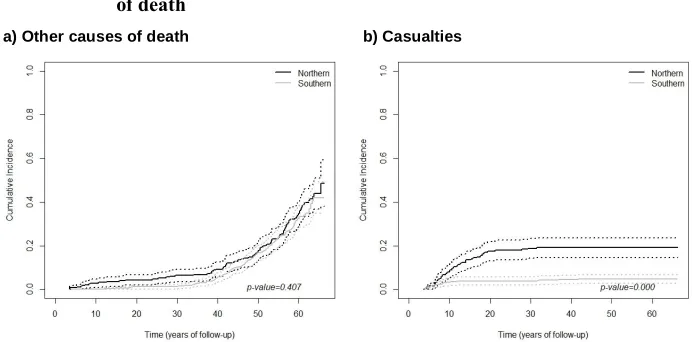
casualties, however, the incidence of death is statistically significantly higher in the northern region. The median time of follow-up is 10.78 years for officers born in the southern region compared to only 7.48 years for those from the northern states.
Figure 2: Cumulative incidence functions (CIF) by regions of birth and causes of death
a) Other causes of death b) Casualties
Source: Data retrieved from DIRSA/Air Force Health Center.
Demographic Research: Volume 37, Article 41
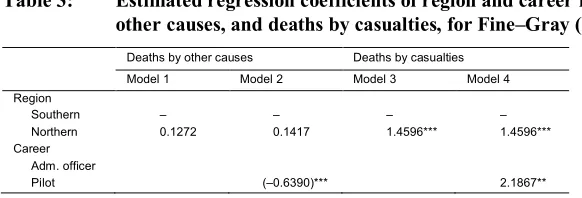
Table 3: Estimated regression coefficients of region and career for deaths by other causes, and deaths by casualties, for Fine‒Gray (FG) regression
Deaths by other causes Deaths by casualties Model 1 Model 2 Model 3 Model 4 Region
Southern ‒ ‒ ‒ ‒
Northern 0.1272 0.1417 1.4596*** 1.4596*** Career
Adm. officer
Pilot (‒0.6390)*** 2.1867**
Note: The size and sign of the regression coefficients reflect the ordering of the cumulative incidence curves. Positive coefficients indicate higher incidence curves for the variable category compared to the reference (ommited) group. *p<.05;**p<.01;***p<.001.
Source: Data retrieved from DIRSA/Air Force Health Center.
4. Discussion
In this study, we take a novel look at military data and its implications for research on mortality in Brazil. First, we show that BAF officers enjoy significantly longer lives than the general Brazilian male population. The experience of BAF officers – both in terms of levels and age patterns of mortality ‒ resembles the one for men living in low-mortality populations. Although we were not able to compare our estimates to those for similar selective groups in Sweden, the mere finding of ‘Swedish islands’ within Brazil is a valuable indicator of the size of inequalities in health in a large and heterogenous country. Our results also contribute to the discussion about the true age pattern of mortality when national data is defective. Whereas our sample is small and limited to a selective subgroup, age reporting for the military is more accurate than in other traditional mortality datasets.
2004), we need currently unavailable information on officers’ morbidity and family background.
It is unfortunate that Brazilian women have joined the forces only recently, limiting our analysis to men. But studies that focus on female health and mortality have already received more attention in Brazil, since women live longer and mortality data is of better quality for them. The current study examines Brazilian male mortality with improved data, contributing to the existing literature that has looked at the longevity of men elsewhere (Hayward, Pienta, and McLaughlin 1997; Rosero-Bixby 2008).
Demographic Research: Volume 37, Article 41
References
BAF (Ministério da Defesa, Comando da Aeronáutica, Diretoria de Saúde) (2014). Instruções técnicas das inspeções de saúde na aeronáutica (ICA 160-6/2014).
http://www.fab.mil.br/icas/ICA_160-6_MAR_2014.pdf.
Buzzell, E. and Preston, S.H. (2007). Mortality of American troops in the Iraq war.
Population and Development Review 33(3): 555–566.
doi:10.1111/j.1728-4457.2007.00185.x.
Castro, C. (2000). Interviewing the Brazilian military: Reflections on a research experience. In: International Oral History Association (ed.). XI International Oral History Conference. Istanbul: International Oral History Association: 110– 115.
Costa, D.L. and Kahn, M.E. (2010). Health, wartime stress, and unit cohesion: Evidence from Union Army veterans. Demography 47(1): 45–66.doi:10.1353/ dem.0.0095.
DoD (2015). Brazilian Ministry of Defense, Department of Defense (DoD) [online].
http://www.defesa.gov.br/arquivos/2015/mes12/tabela_de_soldos_militares_ ffaa.pdf.
Fine, J.P. and Gray, R.J. (1999). A proportional hazards model for the subdistribution of a competing risk. Journal of the American Statistical Association 94(446): 496‒509.doi:10.2307/2670170.
Geskus, R.B. (2011). Cause-specific cumulative incidence estimation and the Fine and Gray model under both left truncation and right censoring.Biometrics 67(1): 39–
49.doi:10.1111/j.1541-0420.2010.01420.x.
Hayward, M.D. and Gorman, B.K. (2004). The long arm of childhood: The influence of early-life social conditions on men’s mortality. Demography 41(1): 87–107.
doi:10.1353/dem.2004.0005.
Hayward, M.D., Pienta, A.M., and McLaughlin, D.K. (1997). Inequality in men’s mortality: The socioeconomic status gradient and geographic context.Journal of Health and Social Behavior 38(4): 313.doi:10.2307/2955428.
Horiuchi, S. (1983). The long-term impact of war on mortality: Old-age mortality of the First World War survivors in the Federal Republic of Germany. Population Bulletin of the United Nations 15(15): 80–92.
IBGE (Instituto Brasileiro de Geografia e Estatística) (2012). Pesquisa de orçamento familiares 2008–2009 [electronic resource]. Rio de Janeiro: IBGE.
http://www.sidra.ibge.gov.br/bda/orcfam/default.asp.
Presidência da República do Brasil (1980).Lei No 6.880, estatuto dos militares de 9 de
Dezembro de 1980. Brasília: Presidência da República do Brasil.
http://www.planalto.gov.br/ccivil_03/leis/L6880.htm.
Preston, S.H., Elo, I.T., Rosenwaike, I., and Hill, M. (1996). African-American mortality at older ages: Results of a matching study. Demography 33(2): 193– 209.doi:10.2307/2061872.
Preston, S.H., Heuveline, P., and Guillot, M. (2001). Demography: Measuring and modeling population processes. Oxford: Wiley-Blackwell.
Rodríguez, G. (2007). Generalized linear models: Lecture notes [electronic resource]. Princeton: Princeton University.http://data.princeton.edu/wws509/notes/. Rodríguez, G. (2012). Cumulative incidence [electronic resource]. Princeton: Princeton
University.http://data.princeton.edu/pop509/cumulativeIncidence.pdf.
Rosero-Bixby, L. (2008). The exceptionally high life expectancy of Costa Rican nonagenarians.Demography 45(3): 673–691.doi:10.1353/dem.0.0011.
Turra, C.M. (2012). Os limites do corpo: A longevidade em uma perspectiva demográfica.Revista UFMG 19(1): 156–181.https://www.ufmg.br/revistaufmg/
pdf/REVISTA_19_web_156-181.pdf.
Turra, C.M., Renteria, E., and Guimarães, R. (2016). The effect of changes in educational composition on adult female mortality in Brazil.Research on Aging
38(3): 283–298.doi:10.1177/0164027515620245.
United Nations, Department of Economic and Social Affairs (2015).World population prospects: The 2015 revision. New York: United Nations. https://esa.un.org/