* Corresponding author. Tel: +381 18500687 Fax: +381 18 588244 E-mail: [email protected] (M. Madić)
© 2014 Growing Science Ltd. All rights reserved. doi: 10.5267/j.ijiec.2014.9.003
International Journal of Industrial Engineering Computations 6 (2015) 33–42
Contents lists available at GrowingScience
International Journal of Industrial Engineering Computations
homepage: www.GrowingScience.com/ijiec
ANN modeling of kerf taper angle in CO
2laser cutting and optimization of cutting
parameters using Monte Carlo method
Miloš Madića*, Miroslav Radovanovića and Marin Gostimirovićb
aFaculty of Mechanical Engineering, University of Niš, A. Medvedeva 14, Niš, Serbia bFaculty of Technical Science, University of Novi Sad, Trg Dositeja Obradovića 6, Serbia
C H R O N I C L E A B S T R A C T
Article history: Received June 6 2014 Received in Revised Format September 9 2014
Accepted September 15 2014 Available online
September 22 2014
In this paper, an attempt has been made to develop a mathematical model in order to study the relationship between laser cutting parameters such as laser power, cutting speed, assist gas pressure and focus position, and kerf taper angle obtained in CO2 laser cutting of AISI 304 stainless steel. To this aim, a single hidden layer artificial neural network (ANN) trained with gradient descent with momentum algorithm was used. To obtain an experimental database for the ANN training, laser cutting experiment was planned as per Taguchi’s L27 orthogonal array with three levels for each of the cutting parameters. Statistically assessed as adequate, ANN model was then used to investigate the effect of the laser cutting parameters on the kerf taper angle by generating 2D and 3D plots. It was observed that the kerf taper angle was highly sensitive to the selected laser cutting parameters, as well as their interactions. In addition to modeling, by applying the Monte Carlo method on the developed kerf taper angle ANN model, the near optimal laser cutting parameter settings, which minimize kerf taper angle, were determined.
© 2015 Growing Science Ltd. All rights reserved Keywords:
CO2 laser cutting
Kerf taper Modeling Optimization
Artificial neural network Monte Carlo method
1. Introduction
Laser cutting is a thermal energy based advanced machining process which has many applications in industry where a variety of components in large numbers are required to be machined with high quality and close tolerance at low costs. The wide spectrum of industrial application of the laser cutting is due to its convenience of operation, high precision, small heat-affected zone (HAZ), minimum deformity, low cost, high product quality, high cutting speed, low level of noise, flexibility, ease of automation, etc. (Madić & Radovanović, 2013).
Of particular interest to companies using laser cutting are the maximization of the productivity and the subsequent quality of components made by the laser cutting process (Rajaram et al., 2003). There are different quality characteristics used for assessing the laser cut quality, wherein kerf quality characteristics, surface roughness, and size of the HAZ were mostly investigated. It has been reported in literature that the optimum parameter settings for one quality characteristic may deteriorate other quality characteristics. With a limited theoretical and practical background to assist in systematical selection, these parameters are usually set by previous experience in a time consuming trial and error procedure. However, this trial-and-error approach is extremely costly in terms of time and labor (Ciurana et al., 2009).
Hence, it is of great importance to exactly quantify the relationship between cut quality characteristics and laser cutting conditions through mathematical modeling and subsequently determine the near optimal laser cutting parameter settings via application of optimization algorithms. In the field of laser cutting, most of the time the optimal cutting conditions are determined using the Taguchi method (Prajapati et al., 2013) and by coupling response surface models (Sivarao et al., 2013) and ANNs models with different optimization and metaheuristic algorithms such as particle swarm optimization (Ciurana et al., 2009), genetic algorithm (GA) (Tsai et al., 2008), and simulated annealing (Chaki & Ghosal, 2011). The open literature reveals several research attempts based on ANNs such as for modeling and optimization of laser micromachining process (Ciurana et al., 2009; Biswas et al., 2010;
Dhara et al., 2008; Dhupal et al., 2007), selection of optimal laser cutting parameters through
integration of ANNs with GA (Tsai et al., 2008; Ghoreishi & Nakhjavani 2008), development of a
prediction model through integration with the Taguchi method (Yang et al., 2012) and parametric
modeling and optimization of lasox cutting (Chaki & Ghosal, 2011). The ANNs are the learning algorithms and mathematical models, which imitate the information processing capability of human brain and can be applied to non-linear and complex data, even if the data are imprecise and noisy (Raja et al., 2012). The ability of ANNs to capture any complex input-output relationships from limited data is very valuable in manufacturing processes, where huge experimental data for the process modeling is difficult and expensive to obtain (Karnik et al., 2008).
This paper aims at understanding the relations between the laser cutting parameters (laser power, cutting speed, assist gas pressure and focus position) and kerf taper angle obtained in CO2 laser cutting
of stainless steel. Back propagation (BP) ANN trained with gradient descent with momentum algorithm was applied to construct a mathematical model for the kerf taper angle. To obtain data for ANN training, the laser cutting experiment was conducted according to Taguchi’s L27 orthogonal array (OA)
experimental layout plan. Statistically assessed as adequate, the ANN model was then used to investigate the effect of the laser cutting parameters on the kerf taper angle by generating 2D and 3D plots. In addition to modeling, the kerf taper angle mathematical model was optimized. Although the aforementioned metaheuristic algorithms can provide acceptable results, its effective application, requires a substantial amount of parameter tuning. On the other hand, the Monte Carlo method has been proven efficient in optimization, but its application in solving machining optimization problems has been given less attention (Madić et al., 2014). Furthermore, to the authors’ knowledge, little work has been reported in the literature on optimization through integration of ANN models and the Monte Carlo method. Hence in this paper the near optimal laser cutting parameter settings that minimize kerf taper angle were identified by exploring the solution space of the developed ANN kerf taper model using the Monte Carlo method.
2. Experimental work
Table 1
Nominal chemical composition of AISI 304 stainless steel
Cr Ni C Mn Si S Fe
18.9 9.22 0.07 1.64 0.5 0.006 Balance
The experiment was performed using a ByVention 3015 CO2 laser cutting machine with a nominal
power of 2.2 kW at a wavelength of 10.6 µm, operating in CW mode. The cuts were performed with a Gaussian distribution beam mode (TEM00). In consideration of the numerous parameters that influence
the cutting process, some of the process parameters were kept constant throughout the experimentation. During conducting experiment trials, laser beam was focused through a lens of focal length of 127 mm and the distance between workpiece and nozzle was controlled at 1 mm. The nitrogen gas with 99.95 % purity was used as assist gas and it was passed through a conical shape nozzle (HK20) with nozzle diameter of 2 mm.
On the other hand, the laser cutting parameters such as the laser power (P), cutting speed (v), assist gas pressure (p), and focus position (f) were taken as controllable input parameters. Since it was assumed that the effects of laser cutting parameters on the kerf taper angle were complex and non-linear, the experiment was set up with parameters with more levels. The numerical values of control parameters at different levels are shown in Table 2. The value range for each parameter was chosen such that full cut for each parameter combination was achieved and by considering manufacturer's recommendation for parameter settings.
Table 2
Cutting parameters and their levels
Cutting parameter Unit 1 2 3 Level
Laser power, P kW 1.6 1.8 2
Cutting speed, v m/min 2 2.5 3
Assist gas pressure, p bar 9 10.5 12
Focus position, f mm -2.5 -1.5 -0.5
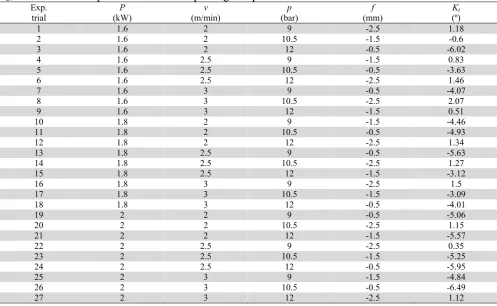
The experiment trials were conducted according to Taguchi’s L27 orthogonal array design matrix (Table
3). The L27 chosen consisted of 13 columns and 27 rows (experimental trials). Control parameters, laser
power, cutting speed, assist gas pressure and focus position were assigned to columns 1, 2, 5 and 9, respectively.
In this study, kerf taper angle was selected as the laser cut quality characteristic for modeling and optimization. Kerf taper angle is one of the most important cut quality characteristics in laser cutting since it determines the geometrical accuracy of the finished parts. Due to converging-diverging shape of laser beam profile the kerf taper angle always exists during laser cutting. The kerf taper angle (Kt) was calculated using the following formula:
180 2
d K K ) (
K w b
t (1)
where d is the workpiece thickness, and Kw and Kb represent the top and bottom kerf width,
Table 3
L27 matrix for the experiment and kerf taper angle experimental results Exp.
trial (kW) (m/min) (bar) (mm) (º) P v p f Kt
1 1.6 2 9 -2.5 1.18
2 1.6 2 10.5 -1.5 -0.6
3 1.6 2 12 -0.5 -6.02
4 1.6 2.5 9 -1.5 0.83
5 1.6 2.5 10.5 -0.5 -3.63
6 1.6 2.5 12 -2.5 1.46
7 1.6 3 9 -0.5 -4.07
8 1.6 3 10.5 -2.5 2.07
9 1.6 3 12 -1.5 0.51
10 1.8 2 9 -1.5 -4.46
11 1.8 2 10.5 -0.5 -4.93
12 1.8 2 12 -2.5 1.34
13 1.8 2.5 9 -0.5 -5.63
14 1.8 2.5 10.5 -2.5 1.27
15 1.8 2.5 12 -1.5 -3.12
16 1.8 3 9 -2.5 1.5
17 1.8 3 10.5 -1.5 -3.09
18 1.8 3 12 -0.5 -4.01
19 2 2 9 -0.5 -5.06
20 2 2 10.5 -2.5 1.15
21 2 2 12 -1.5 -5.57
22 2 2.5 9 -2.5 0.35
23 2 2.5 10.5 -1.5 -5.25
24 2 2.5 12 -0.5 -5.95
25 2 3 9 -1.5 -4.84
26 2 3 10.5 -0.5 -6.49
27 2 3 12 -2.5 1.12
3. Kert taper angle mathematical model
Modeling studies in laser cutting are the scientific ways to study the system behaviors and help us to
get a better understanding of this complex process (Syn et al., 2011). A mathematical model of a
system is the relationship between input and output parameters in terms of mathematical equations (Dubey & Yadava 2008). Although the regression models are very promising for practical applications, they are of limited applicatability and reliability in laser cutting modeling. Therefore, to establish a mathematical relationship between the kerf taper angle and the laser cutting parameters, a multilayer perceptron type ANN was selected.
3.1. ANN architecture and training
Four neurons at the input layer (for each of the cutting parameter), one neuron at the output layer for calculating kerf taper and only one hidden layer were used to define ANN architecture. The determine the number of hidden neurons the following equation was considered (Madić & Radovanović, 2013):
k ) k n ( m
T 1 (2)
at 0.1 and 0.9, respectively. The mean squared error at the end of the training process was found to be 0.00509298.
3.2. ANN model function and validation
After ANN training, the set of weights and biases of the developed ANN model were saved (Table 4), upon which explicit mathematical model for the kerf taper angle was developed.
Table 4
The weights and biases of the developed ANN model for the kerf taper angle
W1 W2 B1 B2
0.897 -1.197 -0.579 -0.356 0.131 -2.543 1.035
-0.649 -1.764 -1.406 3.705 -0.871 1.796
-0.094 -1.460 1.494 1.446 0.112 -0.001
-2.501 -0.831 -1.477 -0.430 0.897 -3.043
W1: weights between input and hidden layer; W2: weights between hidden and output layer; B1: biases of the hidden neurons; B2: bias of the output neuron
The mathematical equation for the prediction of the kerf taper angle is as follows:
1 1 649
1 2 28
4. e2 1 1 W2 B2 .
Kt XW B
(3)
where X is the column vector which contains normalized values of P, v, p and f. To test the prediction capability of the developed model, the trained ANN was initially tested by presenting 27 input data patterns, which were employed for the training purpose. Furthermore, 4 new experiment trials were conducted with cutting parameter levels which did not belong to the training data set (Table 5).
Table 5
Experiment trials for testing the ANN
Test no.
P
(kW)
v
(m/min)
p
(bar)
f
(mm)
Experimentally measured
ANN predicted
1 2 2.5 10.5 -2.5 1.18 1.15
2 1.8 2 12 -1.5 -5.25 -5.31
3 2 2.5 12 -1.5 -0.8 -0.81
4 1.8 3 10.5 -2.5 1.43 1.08
The effectiveness of training of the ANN model and its ability to predict correct values for unseen data can be given in a form of regression analysis where correlation coefficient R determines the correspondence between the ANN outputs and targets (Bajić et al., 2008). The R-values of 0.987 and 0.999 were obtained for the training and testing of the ANN model, respectively. These values indicate that the ANN model has high prediction accuracy and that it also has good generalization ability. Thus, the ANN model can be used to analyze the effects of the laser cutting parameters on the kerf taper, as well as to serve as a fitness function for the optimization of laser cutting parameters.
4. Effect of laser cutting parameters on the kerf taper angle
4.1. Main effect plots
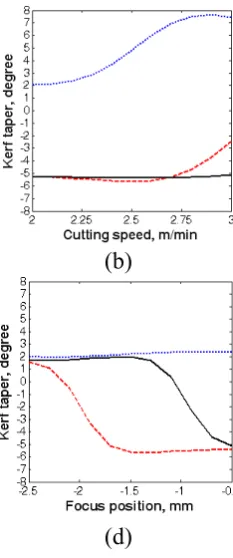
From Fig. 1a it can be seen that when all other parameters are kept at high level, an increase in the laser power results in a small linear decrease in the kerf taper angle. On the other hand, the effect of the laser power causes a non-linear change in the kerf taper angle. When all parameters are on low level, laser power in the (1.6 – 1.8 kW) range results in about ± 2º change in the kerf taper angle with the minimal value when using laser power of about 1.75 kW.
From Figs. 1b and 1c it is seen that an increase in the cutting speed and assist gas pressure results in nonlinear increase in the kerf taper angle and small linear increase when all other parameters are kept at high level. Further, as it could be seen, when all other parameters are at low level, increase in the cutting speed or assist gas pressure results in positive kerf taper angle. On the other hand, kerf taper angle has negative values.
In the case of the focus position (Fig. 1d), when all other parameters are kept at low level, the effect of the focus position has negligible influence on kerf taper angle change. On the other hand, the focus position has strong influence on kerf taper angle which can be related by nonlinear functional dependence. When all other parameters are kept at middle level, focusing the laser beam deep into the bulk of material is beneficial for obtaining small kerf taper angle. However, when using laser power of 2 kW, cutting speed of 3 m/min and assist gas pressure of 12 bar, focusing the laser beam up to the -1 mm results in small kerf taper angle.
(a) (b)
(c) (d)
Fig. 1. Effect of laser cutting parameters on kerf taper
4.2. Interaction effect plots
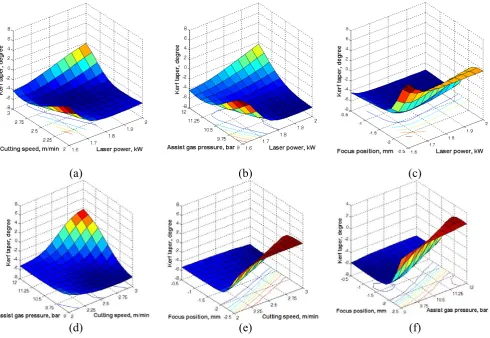
The results from Fig. 1 indicate that there are certain interactions between the laser cutting parameters and the kerf taper angle. In order to determine the interaction effects of the cutting parameters on the kerf taper angle, 3D surface plots were generated considering two parameters at a time, while the third and fourth parameter were kept constant at level 2 (Fig. 2).
From Fig. 2a, it can be seen that the minimal kerf taper angle would be obtained either by using high
power (P= 1.6 kW) in combination with low cutting speed (v= 2 m/min). A similar effect of the laser power can be observed in interaction with the assist gas pressure as shown in Fig. 2b. From Fig. 2c it can be seen that the minimal kerf taper angle is obtained by focusing the laser beam deep into the bulk of material (about f = -2 mm) independently from the laser power level. In the case of cutting speed and assist gas pressure interaction (Fig. 2d), it can be seen that higher cutting speed in conjunction with higher assist gas pressure is beneficial for minimizing the kerf taper angle. As shown in Fig. 2e, the interaction between the focus position and cutting speed results in a linear change in the kerf taper angle, and this is valid when focusing the laser beam beneath the half of the material thickness for all cutting speed values. A similar conclusion can be drawn from Fig. 2f in the case of focus position and assist gas pressure interaction.
Note that the plots in Fig. 1were generated by keeping the three parameters constant at low, center and high level. Similarly the 3D surface plots in Fig. 2 were generated considering two laser cutting parameters at a time, while the third and fourth parameter were kept constant at center level. However, finding an optimal set of the laser cutting parameter values to meet the desired kerf taper angle, calls for the parameter optimization in four-dimensional laser cutting parameter hyperspace.
(a) (b) (c)
(d) (e) (f)
Fig. 2. Effect of laser cutting parameter interactions on kerf taper
5. Optimization methodology
For effective utilization of the laser cutting processes, it is very important to find out the optimal combinations of their process parameters to achieve enhanced machining performance with high
can be difficult to use for engineers who are not experts in optimization theory and artificial intelligence.
The Monte Carlo method is an attractive and relatively simple technique which utilizes random numbers in simulation algorithm. The Monte Carlo method can be considered as a very general mathematical tool for solving a great variety of problems. The salient feature is that it offers a parameter free optimization procedure at low computation time and high effectiveness. The Monte Carlo optimization procedure was implemented in MS Excel which confirms the easiness of implementation. The details about the Monte Carlo, optimization problem formulation and results are discussed bellow.
5.1. Optimization problem formulation
The goal of the optimization process in this study is to determine the optimal laser cutting parameter values at which the minimum kerf taper angle (Kt) is obtained. An appropriate selection of cutting conditions should increase the product quality through minimizing kerf taper angle, increase the laser productivity and decrease the operation costs. Laser productivity and operation costs are in direct relation with the cutting speed and assist gas pressure, respectively. Therefore, the optimization problem can be formulated as:
bar 9 m/min 3 mm 5 . 0 mm 5 . 2 kW 2 kW 6 1 : subject to , , , f : minimize to : Find min max p p v v f P . f p v P K , f ,p ,v P t opt opt opt opt (4)For calculating kerf taper angle the ANN function given in Eq. 3 was employed.
5.2. Optimization solution with Monte Carlo
The optimization problem in Eq. 4 was solved with the Monte Carlo simulation using the following
procedure. The first step in the optimization procedure is the generation of random numbers ri,j
uniformly distributed in the range [0,1] using the function rand. To satisfy the limitations of the laser cutting parameters values, random numbers ri,j were used to generate random numbers qi,j uniformly distributed into the range of interest for each of the laser cutting parameter [ min
i
q , max
i
q ]. This was
accomplished using the following equation (Madić et al., 2014):
min
i max i j , i min i j ,
i q r q q
q (5)
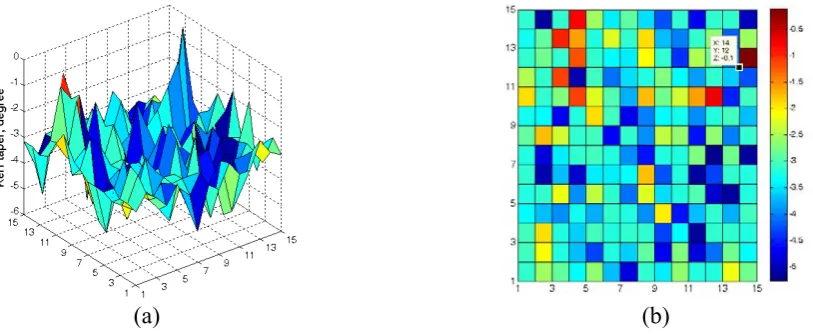
Therefore, for each laser cutting parameter, the randomized values which were uniformly distributed in the interval of interest were generated and subsequently the kerf taper angle was calculated using the ANN mathematical model. In the optimization procedure only 225 Monte Carlo simulations were performed since the acceptable near optimal solution was identified. The results of Monte Carlo simulation runs are plotted in Fig. 3. Each point in the graph corresponds to a particular input laser cutting parameter settings.
As shown in Fig. 3b, in the 168th Monte Carlo simulation run, the minimal value of kerf taper angle Kt
parameters: P=1.6 kW, v=3 m/min, p=9 bar and f= -1.966 mm. This was considered as an acceptable solution. Otherwise, the number of simulation runs would be increased.
(a) (b)
Fig. 3. Monte Carlo simulation runs (a) 3D view, (b) top view with identified near optimal solution
6. Conclusion
In this paper, ANN based mathematical model is developed in order to relate the laser cutting parameters i.e. laser power, cutting speed, assist gas pressure and focus position, and kerf taper angle in CO2 laser cutting of stainless steel. Experiment trials were performed according to Taguchi’s L27
experimental design and the obtained data was used for ANN training. Statistical results indicate that the ANN model can predict the kerf taper with good accuracy. By applying the Monte Carlo method, the optimal laser cutting parameter settings, which minimize kerf taper angle were determined. It was found that focusing the laser beam in about 2/3 of material thickness under the low assist gas pressure (9 bar) at combination of low laser power (1.6 kW) and high cutting speed (3 m/min), produced an acceptable kerf taper angle. The conclusions drawn can be summarized by the following points:
kerf taper angle is highly sensitive to the selected laser cutting parameters, as well as their interactions,
change in a given laser cutting parameter value can result in negative or positive kerf taper
angle, depending of the values of other parameters,
the influence of a given laser cutting parameter must be considered through interactions with
other laser cutting parameters,
the combined ANN-Monte Carlo approach is found to be very simple, easy to implement and
efficient for the optimization of CO2 laser cutting process.
Acknowledgements
This work was carried out within the project TR 35034 financially supported by the Ministry of Education and Science of the Republic of Serbia.
References
Bajić, D., Lela, B., & Živković, D. (2008). Modeling of machined surface roughness and optimization of cutting parameters in face milling. Metalurgija, 47(4), 331-334.
Chaki, S., & Ghosal, S. (2011). Application of an optimized SA-ANN hybrid model for parametric modeling and optimization of LASOX cutting of mild steel. Production Engineering, 5(3), 251-262. Ciurana, J., Arias, G., & Ozel, T. (2009). Neural network modeling and particle swarm optimization
(PSO) of process parameters in pulsed laser micromachining of hardened AISI H13 steel. Materials
and Manufacturing Processes, 24(3), 358-368.
Dhara, S. K., Kuar, A. S., & Mitra, S. (2008). An artificial neural network approach on parametric
optimization of laser micro-machining of die-steel. The International Journal of Advanced
Manufacturing Technology, 39(1-2), 39-46.
Dhupal, D., Doloi, B., & Bhattacharyya, B. (2007). Optimization of process parameters of Nd: YAG laser microgrooving of Al2TiO5 ceramic material by response surface methodology and artificial neural network algorithm. Proceedings of the Institution of Mechanical Engineers, Part B: Journal
of Engineering Manufacture, 221(8), 1341-1350.
Dubey, A. K., & Yadava, V. (2008). Laser beam machining—a review. International Journal of
Machine Tools and Manufacture, 48(6), 609-628.
Ghoreishi, M., & Nakhjavani, O. B. (2008). Optimisation of effective factors in geometrical specifications of laser percussion drilled holes. Journal of materials processing Technology, 196(1), 303-310.
Karnik, S. R., Gaitonde, V. N., Rubio, J. C., Correia, A. E., Abrão, A. M., & Davim, J. P. (2008). Delamination analysis in high speed drilling of carbon fiber reinforced plastics (CFRP) using artificial neural network model. Materials & Design, 29(9), 1768-1776.
Madić, M., & Radovanović, M. (2013). Application of RCGA-ANN approach for modeling kerf width
and surface roughness in CO2 laser cutting of mild steel. Journal of the Brazilian Society of
Mechanical Sciences and Engineering, 35(2), 103-110.
Madić, M., Kovačević, M., & Radovanović, M. (2014). Application of multi-stage Monte Carlo
method for solving machining optimization problems. International Journal of Industrial
Engineering Computations, 5(4), 647-659.
Prajapati, B. D., Patel, R. J., & Khatri, B. C. (2013). Parametric investigation of CO2 laser cutting of
mild steel and hardox-400 material. IJETAE, 3(4), 204-208.
Raja, T. V., Ruhil, A. P., & Gandhi, R. S. (2012). Comparison of connectionist and multiple regression approaches for prediction of body weight of goats. Neural Computing and Applications, 21(1), 119-124.
Rajaram, N., Sheikh-Ahmad, J., & Cheraghi, S. H. (2003). CO2 laser cut quality of 4130 steel.
International Journal of Machine Tools and Manufacture, 43(4), 351-358.
Samanta, S., & Chakraborty, S. (2011). Parametric optimization of some non-traditional machining processes using artificial bee colony algorithm. Engineering Applications of Artificial Intelligence,
24(6), 946-957.
Sha, W., & Edwards, K. L. (2007). The use of artificial neural networks in materials science based research. Materials & design, 28(6), 1747-1752.
Sivarao, S., Robert, M., & Samsudin, A. R. (2013). RSM Modelling and Optimization of CO2 Laser
Machining of Industrial PVC Foam. International Review on Modelling and Simulations, 6(4),
1339-1343.
Syn, C. Z., Mokhtar, M., Feng, C. J., & Manurung, Y. H. (2011). Approach to prediction of laser cutting quality by employing fuzzy expert system. Expert Systems with applications, 38(6), 7558-7568.
Tsai, M. J., Li, C. H., & Chen, C. C. (2008). Optimal laser-cutting parameters for QFN packages by
utilizing artificial neural networks and genetic algorithm. Journal of Materials Processing
Technology, 208(1), 270-283.
Yang, C. B., Deng, C. S., & Chiang, H. L. (2012). Combining the Taguchi method with artificial neural
network to construct a prediction model of a CO2 laser cutting experiment. The International
Journal of Advanced Manufacturing Technology, 59(9-12), 1103-1111.