In situ surface-enhanced Raman spectroscopic studies of formic acid electrooxidation on Pt-modified Pd thin films deposited on silica core-gold shell nanoparticle arrays
*Charles Kafui Dotse1 and Shouzhong Zou2
1Department of Chemistry and Biochemistry, Miami University, Oxford, OH 45056, USA 2
Department of Chemistry, American University, Washington, DC 20016, USA
Abstract
Surface-enhanced Raman spectroscopy (SERS) was used to study formic acid (FA) oxidation on trimetallic nanoparticles: Pt decorated Pd films on top of SiO2 core gold-shell nanoparticles
(SiO2@Au/Pd/Pt). The trimetallic nanoparticles showed high catalytic activity towards FA oxidation
above 0.1 V vs Ag/AgCl as compared to SiO2@Au/Pd and SiO2@Au/Pt and the activity depends on the
Pt coverage: the higher the Pt coverage, the lower the FA oxidation activity. The current studies augmented insight into electrocatalysis of FA oxidation and demonstrate the potential for multi-metallic nanoparticles in the design of catalysts for small organic molecules such as FA used in direct formic acid fuel cells (DFAFCs).
Keywords: Formate, formic acid, palladium, platinum, surface-enhanced Raman spectroscopy, Under potential deposition.
INTRODUCTION
Formic acid is a liquid at room temperature and dilute concentrations of FA are listed on US Food and Drug Administration list of food additives as being safe(Yu and Pickup, 2008). Direct formic acid fuel cells (DFAFCs) have attracted much attention recently due to several advantages of using FA as the fuel over hydrogen or methanol. DFAFCs are less sensitive to fuel 'crossover', have fast oxidation kinetics, and have a much higher theoretical cell voltage than hydrogen fuel cell or direct methanol fuel cells (DMFCs)(Fang et al., 2011).Even though DFAFCs have a lower volumetric energy density (2104 WhL-1) than neat methanol in DMFCs (which is 4690WhL-1), this is compensated for by the use of higher concentration of FA and thinner membranes enabled by the lower fuel crossover effect(Yu and Pickup, 2008), (Jiang et al., 2014).
The oxidation of FA takes place via a well-established dual pathway, namely the dehydrogenation (direct pathway) and dehydration (indirect pathway) ( Jiang et al., 2014). The direct pathway leads to the production of carbon dioxide (CO2) from an active intermediate through simple
decomposition of FA at open circuit or at high potentials via electrooxidation( Jiang et al., 2014). HCOOH → Active Intermediate → CO2+ 2H+ + 2e- (Electrooxidation) [1]
→ CO2 + H2 (Self dehydrogenation) [2]
The indirect pathway, however, produces carbon monoxide (CO) which acts as a poison especially on Pt electrode surfaces thereby blocking active sites for dehydrogenation pathways at low potentials( Jiang et al., 2014).
HCOOH → COad + H2O [3]
towards FA oxidation. However, their method of deposition of Pd shell and Pt cluster was solution based, in that they adjusted the molar ratios of these metal ions to Au seeds in solution making the thickness control of these metal films difficult and imprecise.
Several spectroscopic techniques such as infrared reflection absorption spectroscopy (IRAS) (Beden et al. 1983), (Kunimatsu, 1986), sum frequency generation (SFG)(Behrens et al., 2010) electron energy loss spectroscopy (EELS)(Toby et al., 1983),(Jeroro and Vohs, 2009), surface-enhanced infrared absorption spectroscopy (SEIRAS) with attenuated-total reflection (ATR) (Heinen et al., 2009) and so on have been used in previous studies to elucidate molecular speciation, bonding and reactivity of adsorbates on metal surfaces. These methods have provided valuable information and understanding of FA oxidation mechanism. Despite these progresses, the identification of the active intermediate has been a challenging task. Osawa et al.(Chen et al., 2006) used FTIR in the attenuated total reflection (ATR) configuration to identify the presence of adsorbed formate on the surface of the electrode at the same potential at which FA oxidation takes place, and therefore has been proposed as the active intermediate. Behm’s group(Chen, et al., 2006) combined FTIR-ATR with electrochemical mass spectrometry (DEMS) suggested that formate is not the main active intermediate.
In this current work, we employed an alternative method of metal film deposition, redox replacement method,(Brankovic et al.,, 2001). This method involved spontaneous irreversible redox process in which a copper adlayer obtained by underpotential deposition (UPD) is oxidized by a more noble metal cations which are reduced and spontaneously deposited. UPD is a deposition of usually one monolayer of metal onto a foreign metal electrode at potentials more positive than those necessary for bulk deposition. The driving force behind the spontaneous deposition is the positive difference between the equilibrium potential of the noble metal in contact with its solvated ions and the equilibrium potential of the UPD metal adlayer. Since the deposition of noble metals in most cases is an irreversible process their equilibrium potential is considered to be the potential where deposition actually starts. With this method, Pd forms uniform but textured monolayer and Pt forms a two-dimensional submonolayer consisting of nano-clusters. This method provides surface adlayer controlled growth, and effective for the design of catalyst monolayers with high precision in thickness and composition to deposit submonolayers of Pt on Pd (Brankovic et al., 2001). Our silica core-gold shell nanoparticles (SiO2@Au) provides high SERS enhancement because of their ability to
generate a strong local electromagnetic field (EM) as a result of the excitation of the collective electron resonance when an incident photon falls on it. Our particles have a much cleaned background, roughened surface and are of uniform thickness all of which contribute to their high SERS effect. The strong EM enhances the Raman scattering of any adsorbed molecule or metal film deposited on these core-shell nanoparticles. By taking advantage of the high SERS enhancement of our core-shell nanoparticles, our new trimetallic catalyst with unique electronic and morphological properties would provide insight into FA oxidation on Pd and Pt modified Pd surfaces and could be applicable to the design of catalysts for DFAFCs.
EXPERIMENTAL SECTION
Chemicals.Gold (III) chloride trihydrate (HAuCl4.3H2O, 99.9%), potassium hexachloroplatinate(IV)
(K2PtCl6, 99.99%), sodium hydroxide pellets (99.998%), 3-aminopropyltriethoxysilane (APTES, 99%),
tetrakis(hydroxymethyl)phosphonium chloride (THPC, 80% solution in H2O), tetraethyl orthosilicate
(TEOS, 99+%), palladium (II) chloride (PdCl2, 99.999%), copper sulphate (CuSO4) and L-ascorbic acid
(AA, 99+%) were all purchased from Sigma Aldrich (St Louis, MO). Potassium carbonate (K2CO3, ACS
certified) is from Fischer Scientific and sulfuric acid (H2SO4, double distilled, 98%), perchloric acid
(HClO4, double distilled, 70%) from GFS chemicals (Columbus, OH). Toluene (99.97%), FA (HCOOH,
88%) and ethanol (200 proof) are from Pharmco (Brookfield, CT). Semiconductor grade (99.997%) carbon monoxide was obtained from Spectra gas. All aqueous solutions were prepared using ultrapure water (18.2MΩ.cm, TOC < 5ppb) from Millipore water purification system (Milli-Q A10, Millipore, MA).
4.0 mL of ammonium hydroxide was mixed with 50 mL ethanol. 1.5 mL of TEOS was added dropwise and the solution stirred for about 10 hours giving SiO2 nanoparticles with a diameter of ca. 220 nm.
The surface of SiO2 nanoparticles were modified with APTES which allow the attachment of Au
nanoparticles via NH2 groups. Aqueous solutions of the small Au nanoparticles (2-3 nm in diameter)
were prepared by reduction of tetrachloroauric acid with THPC (Wang et al., 2007).In order to attach the small Au nanoparticles, 500 μL APTES-modified SiO2 nanoparticles was added to 50 mL 2-3 nm
Au nanoparticle solution and stirred for 24 hours. Thereafter, the SiO2@Au seeds were centrifuged
at 3800 rpm 8 times to remove any excess Au seeds in solution. SiO2@Au core shell nanoparticles
were synthesized by the addition of the following reagents: 1 mM ascorbic acid (AA) and K-gold solution (1.8 mM K2CO3 + 0.375 mM HAuCl4) in the ratio of AA/K-gold/SiO2@Au seeds (e.g. 2.64
mL/40 mL/4 mL)(Zeng, et al., 2011). The arrays of SiO2@Au core shell particles were formed by
water/oil interfacial entrapment procedure (Reincke et al., 2004). The nanoshell arrays were transferred onto the desired solid substrates such as Si wafer and glassy carbon electrodes for characterization. UV-vis absorption spectra of Au colloidal solutions were measured with an Agilent 8453 spectrometer and the core shell nanoparticles were characterized by scanning electron microscopy (Zeiss Supra 35 VP).
Preparation of Pd and Pt-coated Nanoshell Arrays.Pd and Pt-coated Au nanoshells surface were prepared by galvanic redox replacement (Brankovic et al., 2001). Basically, an atomic layer of copper was deposited by UPD on the nanoshell arrays in a solution made of 0.1 M H2SO4 + 5 mM CuSO4 at a
potential of 0.05 V for 10 mins. The copper adlayer was spontaneously replaced by immersing the arrays in deaerated 0.1 M HClO4 + 5 mM PdCl4 and 0.1 M HClO4 + 5 mM K2PtCl6 respectively for Pd
and Pt for 20 mins. The process was repeated multiple times to obtain submonolayers (SML) and monolayers (ML) of Pt and Pd respectively (Zeng et al., 2011).
Electrochemical Measurements.The electrochemical behavior of the nanoshell arrays were studied with cyclic voltammetry in a conventional two-compartment three electrode cell using an electrochemical analyzer (CHI 630, CH instruments, Austin TX). The counter electrode was made of a Pt wire and a Ag/AgCl (with saturated KCl) used as the reference electrode. Glassy carbon disk electrodes (with a diameter of 3 mm) obtained from CH instruments were used as the support for the nanoparticle arrays in the entire experiment. It was mechanically polished with fine grades of alumina powder (3 to 0.05μm) to achieve a mirror surface and sonicated in 100% ethanol for 3 mins. The electrochemical cell resistance was compensated for with the iR function via the software in the analyzer, and all experiments were carried out at room temperature (23 ± 1ºC)(Zeng et al., 2011), (Kumar and Zou, 2007).The formation of CO adlayer started by bubbling CO (>99.9% purity) over the working electrode for 15 mins at 0.0V in a deaerated 0.1M HClO4. It was followed by N2(g) purging
for 30 mins while maintaining the electrode potential at 0.0V. The CO stripping voltammograms were obtained between -0.2 and 1.0V at a scan rate of 0.05V/s. The electrochemical surface areas (ESA) for the Pd and Pt layers (see table 1 below) were obtained from the CO stripping charge by assuming that the charge for the oxidation of a monolayer of adsorbed CO is 420 μC/cm2(Wang et al., , 2009), (Dai and Zou, 2011). The procedure provides a more accurate way of determining ESA of nanocatalyst than using hydrogen adsorption/desorption charge because studies have shown that altered electronic properties of metals by alloying influence their adsorption behavior (Ahn and Kim, 2013). Stamenkovic and coworkers studied the composition of surfaces in an electrochemical environment to establish their adsorptive properties. They demonstrated by cyclic voltammetry that the surface coverage of underpotentially adsorbed hydrogen (Hupd) on Pt skin is about half that
Table 1: Summary of results of electrochemically active areas on Pd, Pt and Pt-modified Pd surfaces
Catalysts Area (CO Stripping) cm2
SiO2@Au/2MLPd 3.02
SiO2@Au/2MLPd/0.5MLPt 1.45
SiO2@Au/2MLPd/1.0MLPt 1.53
SiO2@Au/2MLPd/1.5MLPt 1.66
SiO2@Au/2MLPd/2.0MLPt 1.76
SiO2@Au/2MLPt 4.88
Surface-enhanced Raman spectroscopy measurements.All SERS measurements were conducted in a two-compartment three electrode glass cell with an optically flat glass disk as the window at the bottom. Raman spectra were collected with a micro probe system. Laser excitation was at 785 nm from a diode laser focused to a spot of 100 μm on the sample with a 20x microscope objective (NA 0.42). The Raman scattering was collected in a backscattering manner and directed to a monochromator through a fiber optic bundle. The power of laser at the sample was 20 mW. Raman shift axis calibration was done with a neon light. Typical acquisition time was 30s unless otherwise stated, while 1200 groove/mm grating was employed. The electrode potential for the Raman measurements was controlled by a voltammograph (CV27, BAS)(Gruenbaum et al., 2006).
RESULTS AND DISCUSSION
Synthesis and characterization of SiO2@Au arrays.The synthesis of SiO2@Au core shell
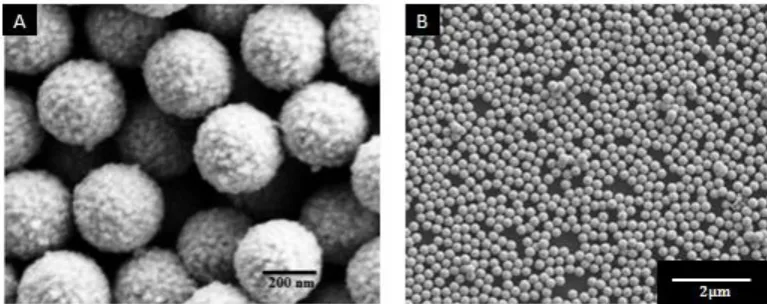
nanoparticles follows a modified approach by Halas and co-workers (Wang et al., 2007).Typical size of the silica core used was 220 nm and the thickness of the gold shell varied between 50 to 60 nm through multiple growth cycles. These dimensions gave the optimal SERS effect based on repeated experimental evidence with 785 nm laser excitation (Zeng et al., 2011). Next, a monolayer of the particles was formed via water/oil interfacial entrapment method and then loaded onto a glassy carbon electrode (Reincke et al., 2004). Figure 1A shows SEM images of silica core gold shell nanoparticles and Figure 1B displays the arrays of the SiO2@Au on a glassy carbon electrode.
Fig. 1.SEM image of [A] SiO2@Au nanoparticles and [B] SiO2@Au arrays on a glassy carbon electrode.
Fig. 2. UV extinction spectrum of silica-core gold shell nanoparticles
Since the discovery of the single molecule sensitivity in SERS by molecules randomly dispersed in metallic nanoparticles, interests in surfaced-enhanced spectroscopies have been remarkably high (Nie and Emory, 1997). The Raman enhancement effect was attributed to molecules positioned in junctions directly adjacent to nanoparticles, a geometry which gives high field intensities between two particles when irradiated, and such a configuration is called “hot spots”(Wang et al., 2007). The ordered layer of metallic nanoshells with interparticle gap of sub-10-nm has been shown to produce SERS enhancement by this mechanism. Figure 3 below is a SERS spectrum of 1, 4-phenylene diisocyanide (PDI) adsorbed on SiO2@Au arrays which demonstrates the
high SERS activity of the particle arrays. With the advantage of the strong SERS effect, the core shell nanoparticles were employed as a substrate and thin films of Pd and Pt were deposited on it to act as catalyst by method of redox replacement in the study of HCOOH acid oxidation.
Fig. 3.SERS spectrum of 1, 4-phenylene diisocyanide adsorbed onto SiO2@Au arrays.
stoichiometry [equation 4] of the redox reaction only half the amount of Pt can be added for the replacement of a full monolayer Cu (Brankovic et al., 2001),(Mrozek et al., 2001).
2Cu0/Au (111) + PtCl62- → Pt0/Au (111) + 2Cu2+ + 6Cl- [4]
The systems employed in the study, PdCl42-/Pd, 0.4V, and PtCl62-/Pt, 0.5V, yield equilibrium electrode
potentials that are well positive of that of the Cu2+/Cu
upd couple on gold, ~0.2 to 0.25V hence
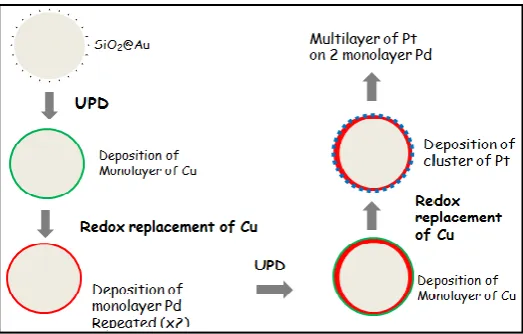
thermodynamically the redox replacement is feasible (Mrozek et al., 2001).Figure 4 shows the process of underpotential deposition of Cu followed by spontaneous irreversible replacement with Pd and Pt.
Fig. 4.Underpotential potential deposition of copper followed by Pt and Pd redox replacement. In the process above, UPD Cu was deposited by immersing the electrode copper solution at a potential (~0.05V) just above where bulk deposition commences ensuring full monolayer coverage. Thereafter, the electrode was transferred to the 5mM Pd or 5mM Pt salt in 0.1M HClO4 for 20 mins
at open circuit potential to ensure complete redox replacement of the UPD Cu. This procedure deposits one atomic layer of Cu in UPD. The deposition, however, is surface limited and therefore limits redox replacement of Cu by Pd to one atomic layer at each deposition. For Pt, only half a monolayer is deposited because of the stoichiometry as explained above. The process was repeated multiple times giving optimal films of Pd and Pt for the electrooxidation of HCOOH. This method of film deposition provides surface adlayer-controlled growth, compared to the current distribution controlled growth in conventional electrodeposition (Brankovic et al., 2001). It has been demonstrated as an effective approach for the design of catalyst monolayers with precise coverage and composition and as a procedure for the synthesis of high surface area catalysts with modified surfaces and various core-shell configurations.(Gokcen et al., 2011) This alternative method particularly has achieved success for Pt overlayers, because, unlike the direct electrodeposition, it does not require the use of phosphate buffer; which reduces the current efficiency due to competing hydrogen gas evolution thereby affecting the control of film thickness(Mrozek et al., 2001).
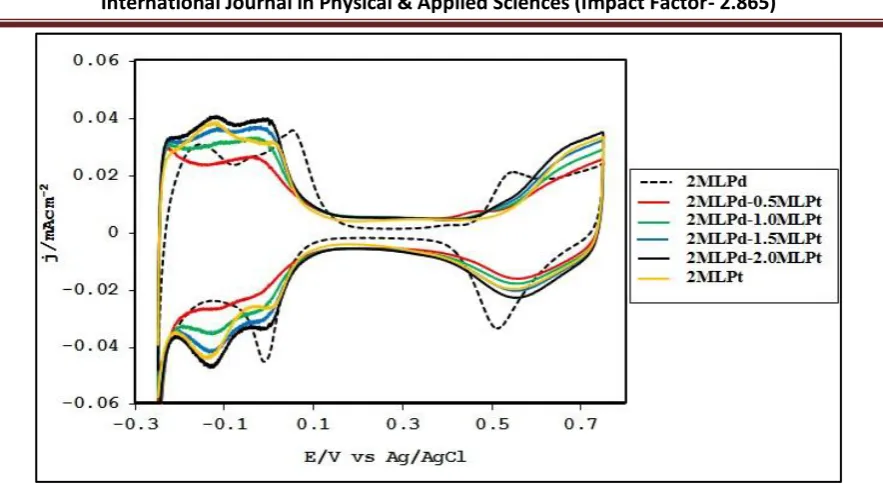
Observation towards electrooxidation of formic acid. Figure 5 reports the voltammetric profiles of Pd, Pt and Pt-modified Pd thin films in 0.1 M H2SO4. It shows the anodic and cathodic segments after
Fig. 5.Cyclic voltammogram of Pd, Pt and Pt-modified Pd thin films in 0.1M H2SO4 solution. Scan rate
is 50 mV/s.
The increase in current density may be due to the increase in surface area of Pt. An interesting property of such submonolayers of Pt clusters is an increased atomic scale roughness and the low co-ordination of many atoms are considered to have enhanced catalytic activity. The observed blockage of the oxide peaks of Pd by the Pt clusters was expected because Pt is oxidized at a more positive potential than Pd (Zhang et al., 2004).
Cyclic voltammetry was used to study the electrooxidation of HCOOH on our catalysts. Few studies have been conducted by the use of trimetallic and multimetallic catalyst in the studies of HCOOH electrooxidation. Interest in the use of multimetallic nanocatalystin electrooxidation of FA is rapidly growing because, unlike mono and bimetallic catalyst, trimetallic and multimetallic catalyst have greater degrees of catalytic activity and selectivity due to variables available for tuning (Jiang and Xu, 2011). Displayed in Figure 6 are the cyclic voltammograms of Pd, Pt, and Pt- modified Pddeposited on SiO2@Au in 0.025 M HCOOH + 0.1M H2SO4. The Figure shows the current density
Fig. 6.Cyclic voltammograms of formic acid oxidation on 2 monolayers Pd, 2 monolayers of Pt and Pt modified 2 monolayers of Pd surfaces in 0.025 M HCOOH + 0.1 M H2SO4. The scan rate was 50mV/s.
The catalysts studied in the current work are: SiO2@Au/2MLPd, SiO2@Au/2MLPt, and
SiO2@Au/2MLPd/0.5→2.0MLPt. It was observed from Figure 6 that, SiO2@Au/2MLPt/0.5MLPd gave the
highest catalytic activity at ~0.3V. For the SiO2@Au/2MLPd catalyst, onset potential for hydrogen
evolution coincided with HCOOH oxidation at - 0.25V and peaked at +0.1V. At potentials lower than 0.1 V, SiO2@Au/2MLPd was more active. The SiO2@Au/2MLPt catalyst gave the lowest catalytic activity
which peaked at ~0.4V. The oxidation of HCOOH was the fastest on SiO2@Au/2MLPd at low potential
and started slowing with the increase amount of Pt towards more positive potentials, with the peak potentials for the Pt modified Pd surfaces also shifting to more positive. The observation for SiO2@Au/2MLPt is not particularly unusual, because traditionally, Pt-based catalyst is thought to have
a dual pathway mechanism. FA is thought to be oxidized directly to carbon dioxide (CO2) via the first
pathway(Capon and Parsons, 1973), (Larsen et al., 2006).
Pt + HCOOH → X → Pt + CO2 + 2H+ + 2e- [5]
In the other pathway, however, HCOOH is oxidized to CO which can then be removed from the surface by activating water.
Pt + HCOOH → X → Pt-CO + H2O [6]
Pt + H2O → Pt-OH + H+ + e- [7]
Pt-CO + Pt-OH → 2Pt + CO2 + H+ + 2e [8]
The two pathways eventually give the same products but water activation process is difficult, consequently, CO remains on the surface blocking active sites and therefore slowing the HCOOH oxidation(Larsen et al., 2006), (Vidal‐Iglesias et al., 2010). Since the dehydration pathway of FA oxidation was not much favored on the bare Pd electrode surface, SiO2@Au/2MLPd, and the
absence of CO poisoning, initial activity of FA coincided with hydrogen evolution, which also explains the higher activity of SiO2@Au/2MLPd than SiO2@Au/2MLPt and SiO2@Au/2MLPd/0.5MLPt at potentials
lower than 0.1 V.
The present study of our trimetallic nanoparticles (Au, Pd and Pt) is consistent with what has been reported in the literature in that, our optimal catalyst, SiO2@Au/2MLPt/0.5MLPd showed the
highest peak catalytic performance. The enhanced activity of our trimetallic nanoparticle catalyst may be attributed to atomic scale surface roughness and low co-ordination of some atoms(Zhang et al., 2004) leading to the creation of unique mixed metal active sites, the so-called geometric effect; and change of electronic states due to the interaction of Au-Pd-Pt metals, the so-called ligand effect (Ham et al., 2010). The ligand effect result in the modification of the surface electronic structure thereby changing the surface chemical properties leading to an improved reactivity.(Kitchin et al., 2004)(Maroun et al., 2001).Similar observations have been reported in literature in related studies. Recently, Tian and coworkers(Fang et al., 2011) reported unusually high catalytic activity for their synthesized catalyst Au@Pd@Pt towards FA oxidation. With only half a monolayer of Pt (ƟPt = 0.5)
and two layers of Pd deposited on Au core, the activity was relatively higher compared to Au@Pt and Au@Pd nanoparticles. It was inferred from the results that synergistic effect existed between the different nanostructure components (core, shell and the island). In order to seek a microscopic understanding of their catalyst, Duan et al., 2013 investigated computationally local structures and adsorption energies of aFA molecule and its decomposed intermediates. The center and edges and four adsorption sites, bridge, fcc, hcp and top were considered in their simulation. From the potential energy calculations of the surfaces, they concluded that the enhanced activity at the edge area of their catalyst was due to CO being repulsed in this area and thereby promoted CO2 pathway
nanoparticles, peak current density, 1.02 mA/cm2 and 0.68 mA/cm2, respectively towards methanol oxidation.
Previous studies have demonstrated that, increasing the thickness of Pd layer above two atomic layers decreases catalytic activity(Fang et al., 2011), while another literature also reported no improvement in peak current when the thickness of Pd layer was increased from 1-5 atomic layers (Baldauf andKolb, 1996). Consequently, we examined the catalytic effect of increasing the thickness of Pt overlayer and limiting the Pd layer to two atomic layers. It was realized that a further increase in the thickness of Pt overlayer from 1-2 ML, decreases catalytic activity drastically. This decrease may be due to loss of active edges sites. With the increasing amount of Pt, the Pt/Pd interface area (the edge sites) is diminishing and the surface behaves more and more like Pt (Greeley et al., 2002),(Schlapka et al., 2003),(Bae et al., 2012).
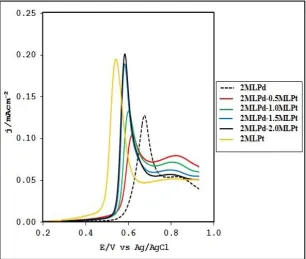
In order to further elucidate the dominant reaction mechanism and also determined the ESA for the various anode catalysts studied, CO stripping voltammetry was carried out. Figure 7shows the CO stripping on each catalyst. It was observed that the CO stripping peak on SiO2@Au/2MLPt
occurred at ~0.5V while the peak on SiO2@Au/2MLPd occurred at ~0.7V. The CO stripping peak for
Pt-modified Pd film is in between this two potentials. From the results shown in Figure 7, the CO oxidation gradually approaching that of Pt film on Au when the coverage of Pt on Pd increases.
Fig. 7.CVs for CO oxidation on SiO2@Au/2MLPd, SiO2@Au/2MLPt, and Pt modified Pd surfaces in 0.1 M
H2SO4. Scan rate is 50mV/s.
Evidently, SiO2@Au/2MLPd is the least active for CO oxidation and this further buttress the fact that
SERS measurement to study the mechanism of formic acid electrooxidation.Figure 8 show the SERS spectra for SiO2@Au/2MLPd from -0.25V to 0.7V in 0.025M HCOOH and 0.1M HClO4.
Fig. 8.SERS spectra showing electrooxidation of formic acid on SiO2@Au/2MLPd in 0.025 M HCOOH
and 0.1M HClO4
Since our core-shell nanoparticles have very high SERS enhancement, we employed that advantage to study the reactive intermediates during the FA oxidation (Fang et al., 2011). In the low frequency region, the peaks at 378 cm-1 and 450 cm-1correspond to Pd-CO stretching for bridging bound CO and atop bound CO respectively (Fang et al., 2011), (Mrozek et al., 2001). This can be seen to attenuate above 0.5V due to CO oxidation on the electrode surface which agrees with the CV results in Figure 6. The absence of the CO peaks around the region of 1870-1960 cm-1 may be due the low coverage of CO on the Pd surface which supports the argument that indirect pathway is insignificant for FA oxidation on Pd surfaces.(Zou and Weaver, 1998),(Miyake et al., 2008) At low potentials, there is a prominent peak at 1325 cm-1 which gradually deceases in intensity towards more positive potentials. This peak has been observed in previous studies and was assigned to symmetric OCO stretching mode of adsorbed formate (Fang et al., 2011), ( Chen et al., 2003; Y. Chen et al., 2006; Miyake et al., 2008). The near constant band at ~ 1460 cm-1 which showed up at all the potential region may be δCOH/δHCO which is linked to vibrations of FA molecules in the interfacial
region according to Cai and coworkers.(Wang et al., 2011) The corresponding peak at ~1550 cm-1 can be assigned to the asymmetric O-C-O stretching mode of formate (Miyake et al., 2008). The weak band around 1275 cm-1 has been reportedly ascribed to C-OH stretching of COOHad( Chen et al.,
2006),( Zhang and Weaver, 1993).
Figure 9 shows the SERS spectra for FA electrooxidation on SiO2@Au/2MLPt in 0.025M
Fig. 9. SERS spectra showing electro-oxidation of formic acid on SiO
2@Au/2MLPt in 0.025 M HCOOH +
0.1M HClO4
A strong peak 490 cm-1 showed up in all the potential regions but with decreasing intensity at more positive potentials (Fang et al., 2011), (Park et al., 2002) This peak is assigned to Pt-CO stretching and associated with the terminal CO which occurs in the range of 2040-2080 cm-1 in this case, very weak.(Zou and Weaver, 1998) The presence of intense CO at low potential regions may account for the slow reaction of FA oxidation on Pt at low potentials due to poisoning of the active sites and corroborated the electrochemical data.
Figure 10.Shows the SERS spectra of FA oxidation on SiO2@Au/2MLPd/0.5MLPt in 0.1 M HClO4 +
0.025M HCOOH from -0.25 to 0.7V.
Fig. 10.SERS spectra showing electro-oxidation of formic acid on SiO2@Au/2MLPd/0.5MLPt in
0.025 M HCOOH and 0.1M HClO4
With reference to the electrochemical data, the catalyst, SiO2@Au/2MLPd/0.5MLPt gave the
highest catalytic activity. From the figure above, a weak band of 370 cm-1 and intense band at 492 cm-1 occurred at all potential regions. Compared to the spectrum of SiO2@Au/2MLPt, these peaks are
relatively weak and the 370 cm-1 band may have come from artifacts of the Raman filters. Also, a relatively weak band at 1312 cm-1 shows up together with another band at 1460 cm-1 which is more intense and slightly broader from -0.25 to 0.7V. These are formate bands (Miyake et al., 2008). It is also evident from the figure that CO was present on the surface at all potentials mainly on the Pt clusters shown by the relatively intense Pt-C peaks but weaker comparatively to SiO2@Au/2MLPt
the low CO coverage was oxidized at more positive potentials, the results suggest that they blocked the active sites at low potentials effective enough to cause a shift in peak catalytic activity to 0.3V.
It is also important to point out that none of the spectra showed a peak at ~2110 cm-1VCO
feature diagnostic of CO bound to residual gold sites, indicating the essentially “pinhole free” of our Pd-Pt coatings (Zou and Weaver, 1998), (Park et al., 2002). In all, the SERS data yielded results consistent with recent studies. Fang et al., 2011 observed CO on their trimetallic catalyst (Au/2MLPd/0.5MLPt); Pd-CO, Pt-CO, with 395 cm-1 and 494 cm-1 respectively which exhibited the highest
catalytic activity. Osawa and coworkers(Samjeske et al., 2006) reported formate on Pt in their mechanistic study of electrocatalytic oxidation of FA in acidic solutions. Our current studies suggest the Pt-modified Pd has strong formate adsorption and therefore formate may be the reactive intermediate.
CONCLUSION
We have synthesized a new trimetallic catalyst (SiO2@Au/Pd/Pt) which has demonstrated the
potential for enhanced catalytic activity towards formic acid oxidation when compared with SiO2@Au/Pd and SiO2@Au/Pt. An alternate method of film deposition, galvanic redox replacement,
which offers a much better way of controlling the film thickness, and as well gives good precision and composition of the metallic films compared to direct synthesis and electrodeposition methods. The results showed that the reaction was faster on SiO2@Au/2MLPd at low potentials but
SiO2@Au/2MLPd/0.5MLPt with 0.5 monolayer Pt gave the highest catalytic activity at 0.3V. Our
substrate (SiO2@Au) shows good SERS enhancement as evident by PDI adsorption spectra. The SERS
experiment identified formate on both SiO2@Au/2MLPd and SiO2@Au/2MLPd/0.5MLPt with relatively
intense peaks at low potentials. The current catalyst gave good understanding of formic acid oxidation and shows the potential for exploring multimetallic nanocatalyst as an alternative to the traditional monometallic catalyst.
ACKNOWLEDGEMENT
I would like to express my gratitude to the department of chemistry and biochemistry, Miami University, Ohio-USA for financial assistance towards this research project.
REFERENCES
Ahn, M., & Kim, J. (2013). Insights into the electrooxidation of formic acid on pt and pd shellson au core surfaces via sers at dendritic au rod electrodes. The Journal of Physical Chemistry C, 117(46), 24438-24445.
Arenz, M., Stamenkovic, V., Schmidt, T.J., Wandelt, K., Ross, P.N., & Markovic, N.M. (2003). The electro-oxidation of formic acid on pt-pd single crystal bimetallic surfaces. Physical Chemistry Chemical Physics, 5(19), 4242-4251. doi: 10.1039/b306307k
Bae, S.-E., Gokcen, D., Liu, P., Mohammadi, P., & Brankovic, S.R. (2012). Size effects in monolayer catalysis—model study: Pt submonolayers on au (111). Electrocatalysis, 3(3-4), 203-210.
Baldauf, M., & Kolb, D. (1996). Formic acid oxidation on ultrathin pd films on au (hkl) and pt (hkl) electrodes. The Journal of Physical Chemistry, 100(27), 11375-11381.
Beden, B., Bewick, A., & Lamy, C. (1983). A study by electrochemically modulated infrared reflectance spectroscopy of the electrosorption of formic acid at a platinum electrode. Journal of Electroanalytical Chemistry and Interfacial Electrochemistry, 148(1), 147-160.
Brankovic, S., Wang, J., & Adžid, R. (2001). Metal monolayer deposition by replacement of metal adlayers on electrode surfaces. Surface Science, 474(1), L173-L179.
Capon, A., & Parsons, R. (1973). The oxidation of formic acid on noble metal electrodes: Ii. A comparison of the behaviour of pure electrodes. Journal of Electroanalytical Chemistry and Interfacial Electrochemistry, 44(2), 239-254.
Chen, Y.-X., Heinen, M., Jusys, Z., & Behm, R. (2006). Bridge-bonded formate: Active intermediate or spectator species in formic acid oxidation on a pt film electrode? Langmuir, 22(25), 10399-10408.
Chen, Y.X., Miki, A., Ye, S., Sakai, H., & Osawa, M. (2003). Formate, an active intermediate for direct oxidation of methanol on pt electrode. Journal of the American Chemical Society, 125(13), 3680-3681.
Chen, Y.X., Ye, S., Heinen, M., Jusys, Z., Osawa, M., & Behm, R.J. (2006). Application of in-situ attenuated total reflection-fourier transform infrared spectroscopy for the understanding of complex reaction mechanism and kinetics: Formic acid oxidation on a pt film electrode at elevated temperatures. The Journal of Physical Chemistry B, 110(19), 9534-9544.
Dai, L., & Zou, S. (2011). Enhanced formic acid oxidation on cu–pd nanoparticles. Journal of Power Sources, 196(22), 9369-9372.
Du, W., Wang, Q., LaScala, C.A., Zhang, L., Su, D., Frenkel, A.I., . . . Teng, X. (2011). Ternary ptsnrh– sno 2 nanoclusters: Synthesis and electroactivity for ethanol oxidation fuel cell reaction. Journal of Materials Chemistry, 21(24), 8887-8892.
Duan, S., Ji, Y.-F., Fang, P.-P., Chen, Y.-X., Xu, X., Luo, Y., & Tian, Z.-Q. (2013). Density functional theory study on the adsorption and decomposition of the formic acid catalyzed by highly active mushroom-like au@ pd@ pt tri-metallic nanoparticles. Physical Chemistry Chemical Physics, 15(13), 4625-4633.
Fang, P.-P., Duan, S., Lin, X.-D., Anema, J.R., Li, J.-F., Buriez, O., . . . Tian, Z.-Q. (2011). Tailoring au-core pd-shell pt-cluster nanoparticles for enhanced electrocatalytic activity. Chemical Science, 2(3), 531-539. doi: 10.1039/c0sc00489h
Gokcen, D., Bae, S.-E., & Brankovic, S.R. (2011). Reaction kinetics of metal deposition via surface limited red-ox replacement of underpotentially deposited metal monolayers. Electrochimica Acta, 56(16), 5545-5553.
Greeley, J., Nørskov, J.K., & Mavrikakis, M. (2002). Electronic structure and catalysis on metal surfaces. Annual Review of Physical Chemistry, 53(1), 319-348.
Gruenbaum, S.M., Henney, M.H., Kumar, S., & Zou, S. (2006). Surface-enhanced raman spectroscopic study of 1, 4-phenylene diisocyanide adsorbed on gold and platinum-group transition metal electrodes. The Journal of Physical Chemistry B, 110(10), 4782-4792.
Ham, H.C., Hwang, G.S., Han, J., Nam, S.W., & Lim, T.H. (2010). Geometric parameter effects on ensemble contributions to catalysis: H2o2 formation from h2 and o2 on aupd alloys. A first principles study. The Journal of Physical Chemistry C, 114(35), 14922-14928.
Jeroro, E., & Vohs, J.M. (2009). Reaction of formic acid on zn-modified pd (111). Catalysis letters, 130(3-4), 271-277.
Jiang, H.-L., & Xu, Q. (2011). Recent progress in synergistic catalysis over heterometallic nanoparticles. Journal of Materials Chemistry, 21(36), 13705-13725.
Jiang, K., Zhang, H.-X., Zou, S., & Cai, W.-B. (2014). Electrocatalysis of formic acid on palladium and platinum surfaces: From fundamental mechanisms to fuel cell applications. Physical Chemistry Chemical Physics, 16(38), 20360-20376. doi: 10.1039/c4cp03151b
Kitchin, J.R., Nørskov, J.K., Barteau, M.A., & Chen, J. (2004). Role of strain and ligand effects in the modification of the electronic and chemical properties of bimetallic surfaces. Physical review letters, 93(15), 156801.
Kumar, S., & Zou, S. (2007). Electrooxidation of carbon monoxide and methanol on platinum-overlayer-coated gold nanoparticles: Effects of film thickness. Langmuir, 23(13), 7365-7371.
Kunimatsu, K. (1986). Infrared spectroscopic study of methanol and formic acid adsorbates on a platinum electrode: Part i. Comparison of the infrared absorption intensities of linear co (a) derived from co, ch3oh and hcooh. Journal of electroanalytical chemistry and interfacial electrochemistry, 213(1), 149-157.
Larsen, R., Ha, S., Zakzeski, J., & Masel, R.I. (2006). Unusually active palladium-based catalysts for the electrooxidation of formic acid. Journal of Power Sources, 157(1), 78-84.
Maroun, F., Ozanam, F., Magnussen, O., & Behm, R. (2001). The role of atomic ensembles in the reactivity of bimetallic electrocatalysts. Science, 293(5536), 1811-1814.
Miyake, H., Okada, T., Samjeské, G., & Osawa, M. (2008). Formic acid electrooxidation on pd in acidic solutions studied by surface-enhanced infrared absorption spectroscopy. Physical Chemistry Chemical Physics, 10(25), 3662-3669.
Mrozek, M.F., Xie, Y., & Weaver, M.J. (2001). Surface-enhanced raman scattering on uniform platinum-group overlayers: Preparation by redox replacement of underpotential-deposited metals on gold. Analytical chemistry, 73(24), 5953-5960.
Nie, S., & Emory, S.R. (1997). Probing single molecules and single nanoparticles by surface-enhanced raman scattering. science, 275(5303), 1102-1106.
Park, S., Yang, P., Corredor, P., & Weaver, M.J. (2002). Transition metal-coated nanoparticle films: Vibrational characterization with surface-enhanced raman scattering. Journal of the American Chemical Society, 124(11), 2428-2429.
Reincke, F., Hickey, S.G., Kegel, W.K., & Vanmaekelbergh, D. (2004). Spontaneous assembly of a monolayer of charged gold nanocrystals at the water/oil interface. Angewandte Chemie International Edition, 43(4), 458-462.
Schlapka, A., Lischka, M., Groß, A., Käsberger, U., & Jakob, P. (2003). Surface strain versus substrate interaction in heteroepitaxial metal layers: Pt on ru (0001). Physical review letters, 91(1), 016101.
Toby, B., Avery, N., Anton, A., & Weinberg, W. (1983). Electron energy loss spectroscopy of the decomposition of formic acid on ru (111). Studies in Surface Science and Catalysis, 14, 317-321.
van der Vliet, D.F., Wang, C., Li, D., Paulikas, A.P., Greeley, J., Rankin, R.B., . . . Stamenkovic, V.R. (2012). Unique electrochemical adsorption properties of pt‐skin surfaces. Angewandte Chemie, 124(13), 3193-3196.
Vidal‐Iglesias, F.J., Solla‐Gullón, J., Herrero, E., Aldaz, A., & Feliu, J.M. (2010). Pd adatom decorated (100) preferentially oriented pt nanoparticles for formic acid electrooxidation. Angewandte Chemie, 122(39), 7152-7155.
Wang, H., Kundu, J., & Halas, N.J. (2007). Plasmonic nanoshell arrays combine surface‐enhanced vibrational spectroscopies on a single substrate. Angewandte Chemie International Edition, 46(47), 9040-9044.
Wang, J.-Y., Kang, Y.-Y., Yang, H., & Cai, W.-B. (2009). Boron-doped palladium nanoparticles on carbon black as a superior catalyst for formic acid electro-oxidation. The Journal of Physical Chemistry C, 113(19), 8366-8372.
Wang, J.-Y., Zhang, H.-X., Jiang, K., & Cai, W.-B. (2011). From hcooh to co at pd electrodes: A surface-enhanced infrared spectroscopy study. Journal of the American Chemical Society, 133(38), 14876-14879. doi: 10.1021/ja205747j
Wang, L., & Yamauchi, Y. (2010). Autoprogrammed synthesis of triple-layered au@ pd@ pt core− shell nanoparticles consisting of a au@ pd bimetallic core and nanoporous pt shell. Journal of the American Chemical Society, 132(39), 13636-13638.
Yu, X., & Pickup, P.G. (2008). Recent advances in direct formic acid fuel cells (dfafc). Journal of Power Sources, 182(1), 124-132. doi: 10.1016/j.jpowsour.2008.03.075
Zeng, J., Jean, D.-i., Ji, C., & Zou, S. (2011). In situ surface-enhanced raman spectroscopic studies of nafion adsorption on au and pt electrodes. Langmuir, 28(1), 957-964.
Zhang, J., Mo, Y., Vukmirovic, M., Klie, R., Sasaki, K., & Adzic, R. (2004). Platinum monolayer electrocatalysts for o2 reduction: Pt monolayer on pd (111) and on carbon-supported pd nanoparticles. The Journal of Physical Chemistry B, 108(30), 10955-10964.
Zhang, Y., & Weaver, M.J. (1993). Application of surface-enhanced raman spectroscopy to organic electrocatalytic systems: Decomposition and electrooxidation of methanol and formic acid on gold and platinum-film electrodes. Langmuir, 9(5), 1397-1403.