Cystic fibrosis (CF), one of the most commonly diagnosed mono genic disorders, has been well researched in many nations. Primarily affecting the mucussecreting organs of the body, such as the lungs, pancreas, liver and intestinal tract, no cure has been developed for this fatal disorder. Nevertheless, assisted by largescale research efforts and advances in sequencing technologies, several countries, including Australia, Belgium, Canada, France, Germany, the UK, The Netherlands and the USA, have successfully established CF registries. These registries have had a positive impact on the management and therefore on the quality of life of patients with CF and have also provided benefit in terms of reducing the costs associated with their care.[13]
In countries in which CF research has been well established and where CF registries and/or newborn screening programmes exist, median survival rates for patients with CF have increased steadily year on year. Currently the median age of survival is 52 years in Canada,[4] 42 years in the USA,[5] 40 years in Europe[6] and 27 years in Australia.[7] In South Africa (SA), the life expectancy of a CF patient, as reported in 2008, was less than 21 years.[8] In comparison, life expectancy for Canadian, American, French, British and Australian CF patients in the same year was approximately 30, 37, 28, 27 and 30 years, respectively.[913] Westwood[8] also highlighted the difference that existed between the median age of death in white individuals with CF, i.e. of Caucasian/European descent (25.8 years), and patients of mixed race (20.5 years) in the Western Cape Province of SA. Nevertheless, very little is known about causative CF variants in SA and other African nations.[14,15] This difference is due in part to the widespread and incorrect belief that CF only affects ‘white’ populations – a notion that is increasingly being shown to be incorrect.[16,17]
Consequences of an age-old problem
and potential solutions
The initial assumption that CF could only affect white South Africans was in part based on the observed disparity in mutation detection
rates between population groups. Variations in mutation detection rates have been influenced further by the fact that many CFcausing variants are population specific. Currently, more is known about CF mutations found in the wellcharacterised white SA population than any of the other affected population groups. As a result, causative variants are typically identified in 83% of white SA CF patients, while CFassociated variants have previously only been identified in 55% and 21% of mixedrace and black SA CF patients, respectively. [18] Screening panels initially used to diagnose CF in SA patients were based on variants that are common to European populations, and while attempts have been made to collect larger numbers of CF samples in other patient groups in SA, few publications addressing the chasm in variant data exist.
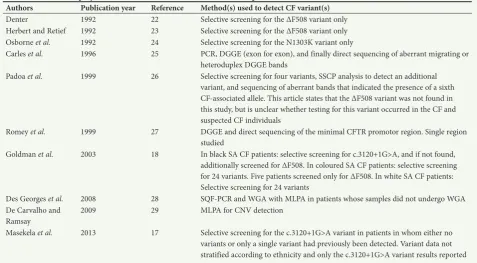
A lack of CF data in nonCaucasoid population groups is common to SA and other African countries. There are no patient registries for this disease on the African continent, which means that African CF patients cannot benefit from clinical interventions planned on the basis of trends in registry data. Despite the unparalleled genomic diversity that exists in African populations, African genomes have been vastly understudied.[19] This is illustrated in patients in whom genetic testing returns falsenegative results because the CFcausing mutations have not been fully characterised in their population(s). In some cases, this problem has been resolved through the application of gene sequencing methods.[20,21] Adding further complexity to existing information is the fact that a significant proportion of reported SA CF data were published over 10 years ago (Table 1). Altogether, when considering the lack of data and the absence of an SA newborn screening programme, making a quick and accurate molecular diagnosis of CF is difficult in many cases, and assessing the health of the local CF population in order to propose and implement the interventions needed to improve prognosis is challenging.
Early detection of CF has repeatedly been shown to be of benefit to patients and public healthcare systems.[30,31] For instance, in 2012, 65%, 63%, and 50% of all new CF cases in Australia, France and The Netherlands, respectively, were detected through neonatal screening
CLINICAL ALERT
Cystic fibrosis in South Africa: A changing
diagnostic paradigm
J van Rensburg,1 BSc, MSc; M Alessandrini,1,2 BSc, MSc, PhD; C Stewart,1,3 BSc, PhD; M S Pepper,1 MB ChB, PhD, MD, Privat Docent
1 South African Medical Research Council Extramural Unit for Stem Cell Research and Therapy and Institute for Cellular and Molecular
Medicine, Department of Immunology, School of Medicine, Faculty of Health Sciences, University of Pretoria, South Africa
2 Department of Pathology and Immunology, Faculty of Medicine, University of Geneva, Switzerland
3 Department of Basic Medical Sciences, Faculty of Medical Sciences, University of the West Indies, Mona, Jamaica
Corresponding author: M S Pepper ([email protected])
Cystic fibrosis (CF), one of the most commonly observed and diagnosed fatal monogenic disorders globally, was initially thought to affect individuals of Caucasian/European descent almost exclusively. It is increasingly appreciated, however, that nonCaucasian populations are also affected by this condition. Although this has been known in South Africa (SA) for over two decades, a large disparity still exists in data pertaining to the different population groups in the country. This article seeks to highlight existing published data on CF in SA populations and reflects on the means through which these have been generated over the years. Additionally, the article briefly discusses the consequences of incomplete data and how this could potentially be addressed in the future through innovative and collaborative approaches.
programmes.[12,32,33] In 2011, neonatal screening accounted for the detection of 74% of all new CF cases in the UK.[13] This has been highly beneficial, since early detection of CF can reduce negative nutritional outcomes, general health complications and decline in cognitive capacity, thereby improving the overall health of affected patients.[34,35] Early diagnosis has also been shown to provide an economic benefit. For example, Dutch patients identified by newborn screening programmes spend about a million euros less on treatment over the course of their lives than patients not discovered through this method.[36] Interestingly, despite the clearly demonstrated benefit of early diagnosis, in studies conducted on SA CF patientsthere is no correlation between specific CF variants and the severity of lung function decline and associated nutritional status.[37,38]
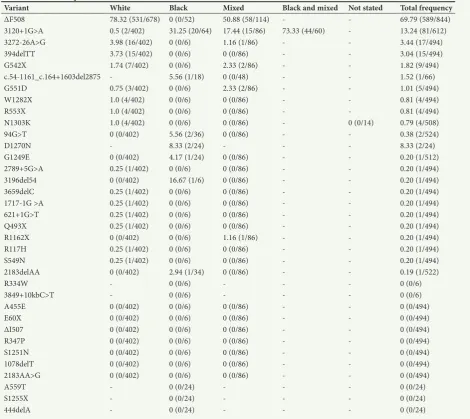
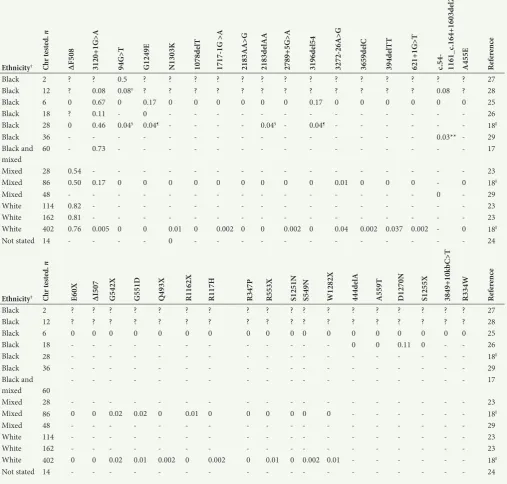
Based on CF variant data that are currently available, the most common CF variants in SA are ΔF508, c.3120+1G>A, c.327226A>G and 394delTT, which have been identified in 69.8%, 13.2%, 3.4%, and 3.0% of screened patients, respectively (Table 2). However, as reflected in Table 1, different screening methods were used in the detection of these variants. Although not always feasible, especially in early studies, it must also be noted that not a single reported study has made use of an unbiased DNA sequencing approach. For example, many black SA patients are screened only for the presence of the c.3120+1G>A variant in order to make a positive molecular diagnosis of CF.[17,18,39] Novel or SAspecific mutations in the major population groups have therefore gone undiscovered or could not have been detected owing to limited screening capacity. An additional confounding factor, as illustrated in Table 3, is that SA CF data have largely been dominated by white patients, a minority genetic group in the country. Although historical factors are largely responsible for this phenomenon, access to and the cost of sequencing technology now make it possible to obtain new information with relative ease, affordability and speed.[40] Use of advanced sequencing methods,
particularly in majority population groups, would be of benefit to SA CF patients, since SA is home to some of the most genetically diverse population groups in the world.[41]
A need for more molecular data to assist with accurately diagnosing SA and African CF patients therefore exists. Nevertheless, as illustrated by existing CF registries, several types of data (and not just causative variant information) are investigated. In the absence of molecular data, developing algorithms that can aid in the diagnosis of CF given limited clinical, biochemical and/or molecular information may be invaluable to SA clinicians in the interim. Although such programmes/tools are only as good as the quality and quantity of available data, they at least have the potential to present baseline probabilities as to a positive CF diagnosis. Such tools might easily serve as a standard by which potential CF patients could be selected for sequencing projects, thereby maximising the odds of identifying previously undescribed CF variants. In so doing, more exact data could be fed back into diagnostic algorithms to improve their accuracy.
Conclusions
[image:2.595.51.529.113.376.2]The lack of standardised SA CF data is having a negative impact on the longevity of SA CF patients. Driving CF research with the distinct aims of: (i) identifying CF variants relevant to all SA population groups; (ii) establishing and maintaining a countryspecific CF database/registry; (iii) establishing a solid foundation for a newborn screening programme; and (iv) exploring novel means through which a positive clinical diagnosis could be made (given limited molecular data) would be of great benefit to the overall care received by many local patients. The first of these points can be achieved through the use of nextgeneration sequencing methods, wholeexome sequencing, and/or targeted sequencing of the CFTR (cystic fibrosis transmembrane conductance regulator) gene. Although presenting
Table 1. Methods employed to detect CF-associated variants in SA CF patients
Authors Publication year Reference Method(s) used to detect CF variant(s)
Denter 1992 22 Selective screening for the ΔF508 variant only
Herbert and Retief 1992 23 Selective screening for the ΔF508 variant only Osborne et al. 1992 24 Selective screening for the N1303K variant only
Carles et al. 1996 25 PCR, DGGE (exon for exon), and finally direct sequencing of aberrant migrating or heteroduplex DGGE bands
Padoa et al. 1999 26 Selective screening for four variants, SSCP analysis to detect an additional variant, and sequencing of aberrant bands that indicated the presence of a sixth CFassociated allele. This article states that the ΔF508 variant was not found in this study, but is unclear whether testing for this variant occurred in the CF and suspected CF individuals
Romey et al. 1999 27 DGGE and direct sequencing of the minimal CFTR promotor region. Single region studied
Goldman et al. 2003 18 In black SA CF patients: selective screening for c.3120+1G>A, and if not found, additionally screened for ΔF508. In coloured SA CF patients: selective screening for 24 variants. Five patients screened only for ΔF508. In white SA CF patients: Selective screening for 24 variants
Des Georges et al. 2008 28 SQFPCR and WGA with MLPA in patients whose samples did not undergo WGA De Carvalho and
Ramsay 2009 29 MLPA for CNV detection
Masekela et al. 2013 17 Selective screening for the c.3120+1G>A variant in patients in whom either no variants or only a single variant had previously been detected. Variant data not stratified according to ethnicity and only the c.3120+1G>A variant results reported CF = cystic fibrosis; SA = South African; PCR = polymerase chain reaction; DGGE = denaturing gradient gel electrophoresis; SSCP = singlestrand conformation polymorphism;
their own unique challenges, sincere, multidisciplinary collaborative efforts that involve stakeholders from academic, private, public and government sectors would be able to address the remaining points. [42] Together, these changes could ensure a healthier and longer future for all SA CF patients.
Acknowledgements. The authors thank colleagues who have contributed
to the multiple discussions and feedback sessions held around this topic. They also thank the various institutions and enterprises that have contributed financially towards this research.
Author contributions. All the authors contributed equally to the conception
and construction of the article. JvR and MA were responsible for collating SA CF variant data, while CS and MSP were responsible for contributions relating to global incidence data and the economic impact of CF.
Funding. Funding sources include the Institute for Cellular and Molecular
Medicine and the Genomics Research Institute of the University of Pretoria, the South African Medical Research Council, and the National Research Foundation of South Africa.
Conflicts of interest. None.
1. Yuanyuan G, GarcíaPérez S, Massie J, van Gool K. Cost of care for cystic fibrosis: An investigation
of cost determinants using national registry data. Eur J Health Econ 2015;16(7):709717. https://doi.
org/10.1007/s1019801406215
2. Larsson S, Lawyer P. Improving Health Care Value: The Case for Disease Registries 2011. Boston
Consulting Group, 2016. https://www.bcg.com/publications/2011/healthcarepayersproviders
publicsectorvaluebasedhealthcareinteractive.aspx (accessed 9 July 2018).
3. Thomas M, Wanyama SS, Vermeulen F. The Belgian Cystic Fibrosis Registry. Brussels: Scientific Institute of Public Health (WIVISP): Registre Belge de la Mucoviscidose, 2011:144.
4. Stephenson A, Mak D, Mahmood A, et al. The Canadian Cystic Fibrosis Registry: 2015 Annual Report. Toronto: Cystic Fibrosis Canada, 2015:140.
5. Marshall BC, Elbert A, Petren K, et al. Cystic Fibrosis Foundation Patient Registry: 2015 Annual Data Report. Bethesda, Md.: Cystic Fibrosis Foundation, 2015:149.
6. Ikpa PT, Bijvelds MJC, de Jonge HR. Cystic fibrosis: Toward personalized therapies. Int J Biochem Cell
Biol 2014;52:192200. https://doi.org/10.1016/j.biocel.2014.02.008
7. Burke N, Bell S, Bye P, et al. Cystic fibrosis in Australia: 16th Annual Report from the Australian Cystic Fibrosis Data Registry. Baulkham Hills, NSW: Cystic Fibrosis Australia, 2013:144.
8. Westwood AT. The prognosis of cystic fibrosis in the Western Cape Province of South Africa: A 33 year
study. J Cyst Fibros 2008;7(S2):458. https://doi.org/10.1016/s15691993(08)604361
9. Marshall BC, Hazle L. Cystic Fibrosis Foundation Patient Registry: 2008 Annual Data Report. Bethesda, Md.: Cystic Fibrosis Foundation, 2008:124.
10. Stewart T, Bell S, Bye P, et al. Cystic Fibrosis in Australia: 11th Annual Report from the Australian Cystic Fibrosis Data Registry. North Ryde, NSW: Cystic Fibrosis Australia, 2008:157.
11. Stephenson A, Berthiaume Y, Chilvers M, et al. Canadian Cystic Fibrosis Patient Data Registry Report: 2008. Toronto: Cystic Fibrosis Canada, 2015:140.
[image:3.595.70.541.113.532.2]12. Bellis G, Lemonnier L, Sponga M, Zeghidour N. French CF Registry: Annual Data Report 2012. Paris: Vaincre la Mucoviscidose and Ined, 2014:148.
Table 2. Variant frequencies based on definitive outcomes*
Variant White Black Mixed Black and mixed Not stated Total frequency
ΔF508 78.32 (531/678) 0 (0/52) 50.88 (58/114) 69.79 (589/844)
3120+1G>A 0.5 (2/402) 31.25 (20/64) 17.44 (15/86) 73.33 (44/60) 13.24 (81/612)
327226A>G 3.98 (16/402) 0 (0/6) 1.16 (1/86) 3.44 (17/494)
394delTT 3.73 (15/402) 0 (0/6) 0 (0/86) 3.04 (15/494)
G542X 1.74 (7/402) 0 (0/6) 2.33 (2/86) 1.82 (9/494)
c.541161_c.164+1603del2875 5.56 (1/18) 0 (0/48) 1.52 (1/66)
G551D 0.75 (3/402) 0 (0/6) 2.33 (2/86) 1.01 (5/494)
W1282X 1.0 (4/402) 0 (0/6) 0 (0/86) 0.81 (4/494)
R553X 1.0 (4/402) 0 (0/6) 0 (0/86) 0.81 (4/494)
N1303K 1.0 (4/402) 0 (0/6) 0 (0/86) 0 (0/14) 0.79 (4/508)
94G>T 0 (0/402) 5.56 (2/36) 0 (0/86) 0.38 (2/524)
D1270N 8.33 (2/24) 8.33 (2/24)
G1249E 0 (0/402) 4.17 (1/24) 0 (0/86) 0.20 (1/512)
2789+5G>A 0.25 (1/402) 0 (0/6) 0 (0/86) 0.20 (1/494)
3196del54 0 (0/402) 16.67 (1/6) 0 (0/86) 0.20 (1/494)
3659delC 0.25 (1/402) 0 (0/6) 0 (0/86) 0.20 (1/494)
17171G >A 0.25 (1/402) 0 (0/6) 0 (0/86) 0.20 (1/494)
621+1G>T 0.25 (1/402) 0 (0/6) 0 (0/86) 0.20 (1/494)
Q493X 0.25 (1/402) 0 (0/6) 0 (0/86) 0.20 (1/494)
R1162X 0 (0/402) 0 (0/6) 1.16 (1/86) 0.20 (1/494)
R117H 0.25 (1/402) 0 (0/6) 0 (0/86) 0.20 (1/494)
S549N 0.25 (1/402) 0 (0/6) 0 (0/86) 0.20 (1/494)
2183delAA 0 (0/402) 2.94 (1/34) 0 (0/86) 0.19 (1/522)
R334W 0 (0/6) 0 (0/6)
3849+10kbC>T 0 (0/6) 0 (0/6)
A455E 0 (0/402) 0 (0/6) 0 (0/86) 0 (0/494)
E60X 0 (0/402) 0 (0/6) 0 (0/86) 0 (0/494)
ΔI507 0 (0/402) 0 (0/6) 0 (0/86) 0 (0/494)
R347P 0 (0/402) 0 (0/6) 0 (0/86) 0 (0/494)
S1251N 0 (0/402) 0 (0/6) 0 (0/86) 0 (0/494)
1078delT 0 (0/402) 0 (0/6) 0 (0/86) 0 (0/494)
2183AA>G 0 (0/402) 0 (0/6) 0 (0/86) 0 (0/494)
A559T 0 (0/24) 0 (0/24)
S1255X 0 (0/24) 0 (0/24)
444delA 0 (0/24) 0 (0/24)
13. Bilton D, Doull I, Brownlee K, et al. UK CF Registry: Annual Data Report 2011. Bromley, Kent: Cystic Fibrosis Trust, 2013:15.
14. Stewart C, Pepper MS. Cystic fibrosis on the African continent. Genet Med 2016;18(7):653662.
https://doi.org/10.1038/gim.2015.157
15. Stewart C, Pepper MS. Cystic fibrosis in the African diaspora. Ann Am Thorac Soc 2017;14(1):17.
https://doi.org/10.1513/annalsats.201606481fr
16. Mutesa L, Bours V. Diagnostic challenges of cystic fibrosis in patients of African origin. J Trop Pediatr
2009;55(5):281286. https://doi.org/10.1093/tropej/fmp064
17. Masekela R, Zampoli M, Westwood AT, et al. Phenotypic expression of the 3120+1G>A mutation in
nonCaucasian children with cystic fibrosis in South Africa. J Cyst Fibros 2013;12(4):363366. https://
doi.org/10.1016/j.jcf.2012.11.003
18. Goldman A, Graf C, Ramsay M. Molecular diagnosis of cystic fibrosis in South African populations. S Afr Med J 2003;93(7):518519.
19. Popejoy AB, Fullerton SM. Genomics is failing on diversity. Nature 2016;538(7624):161164. https://
doi.org/10.1038/538161a
20. Alper ÖM, Wong LJC, Young S, et al. Identification of novel and rare mutations in California Hispanic
and African American cystic fibrosis patients. Hum Mutat 2004;24(4):353. https://doi.org/10.1002/
humu.9281
21. Sugarman EA, Rohlfs EM, Silverman LM, Allitto BA. CFTR mutation distribution among U.S. Hispanic and African American individuals: Evaluation in cystic fibrosis patient and
carrier screening populations. Genet Med 2004;6(5):392399. https://doi.org/10.1097/01.gim.
0000139503.22088.66
22. Denter M, Ramsay M, Jenkins T. Cystic fibrosis: Part I. Frequency of the delta F508 mutation in South African families with cystic fibrosis. S Afr Med J 1992;82(1):710.
[image:4.595.38.546.138.622.2]23. Herbert JS, Retief AE. The frequency of the delta F508 mutation in the cystic fibrosis genes of 71 unrelated South African cystic fibrosis patients. S Afr Med J 1992;82(1):1315.
Table 3. Summary of available CF variant data derived from diagnosed CF and/or suspected SA CF patients*
Ethnicity† Chr
te
ste
d.
n
ΔF508 3120+1G>A 94G>T G1249E N1303K 1078d
elT
1717-1G >A 2183AA>G 2183d
elAA
2789+5G>A 3196d
el54
3272-26A>G 3659d
elC
394d
elT
T
621+1G>T c.54- 1161_c
.164+1603d
el2875
A455E Refer
en
ce
Black 2 ? ? 0.5 ? ? ? ? ? ? ? ? ? ? ? ? ? ? 27
Black 12 ? 0.08 0.08‡ ? ? ? ? ? ? ? ? ? ? ? ? 0.08 ? 28
Black 6 0 0.67 0 0.17 0 0 0 0 0 0 0.17 0 0 0 0 0 0 25
Black 18 ? 0.11 0 26
Black 28 0 0.46 0.04§ 0.04¶ 0.04§ 0.04¶ 18ǁ
Black 36 0.03** 29
Black and
mixed 60 0.73 17
Mixed 28 0.54 23
Mixed 86 0.50 0.17 0 0 0 0 0 0 0 0 0 0.01 0 0 0 0 18ǁ
Mixed 48 0 29
White 114 0.82 23
White 162 0.81 23
White 402 0.76 0.005 0 0 0.01 0 0.002 0 0 0.002 0 0.04 0.002 0.037 0.002 0 18ǁ
Not stated 14 0 24
Ethnicity† Chr
te
ste
d.
n
E60X ΔI507 G542X G551D Q493X R1162X R117H R347P R553X S1251N S549N W1282X 444d
elA
A559T D1270N S1255X 3849+10k
bC>T
R334W Refer
en
ce
Black 2 ? ? ? ? ? ? ? ? ? ? ? ? ? ? ? ? ? ? 27
Black 12 ? ? ? ? ? ? ? ? ? ? ? ? ? ? ? ? ? ? 28
Black 6 0 0 0 0 0 0 0 0 0 0 0 0 0 0 0 0 0 0 25
Black 18 0 0 0.11 0 26
Black 28 18ǁ
Black 36 29
Black and
mixed 60
17
Mixed 28 23
Mixed 86 0 0 0.02 0.02 0 0.01 0 0 0 0 0 0 18ǁ
Mixed 48 29
White 114 23
White 162 23
White 402 0 0 0.02 0.01 0.002 0 0.002 0 0.01 0 0.002 0.01 18ǁ
Not stated 14 24
CF = cystic fibrosis; SA = South African; Chr tested, n = number of chromosomes sampled in a study (sample size); CFTR = cystic fibrosis transmembrane conductance regulator.
*Variant frequencies are indicated within the table. Null values indicate variants that were screened for but not identified, indicates that variant screening was not performed, while ? indicates an inability to discern, from the literature, whether or not variant screening was performed.
†Ethnicity, as reported in each of the described publications, is represented here. ‡Previously reported by Romey et al.[27]
§Previously reported (CFTR mutation database: http://www.genet.sickkids.on.ca/cftr/app). ¶Previously reported by Carles et al.[25]
24. Osborne L, Santis G, Schwarz M, et al. Incidence and expression of the N1303K mutation of the cystic
fibrosis (CFTR) gene. Hum Genet 1992;89(6):653658. https://doi.org/10.1007/bf00221957
25. Carles S, des Georges M, Goldman A, et al. First report of CFTR mutations in black cystic fibrosis
patients of southern African origin. J Med Genet 1996;33(9):802804. https://doi.org/10.1136/
jmg.33.9.802
26. Padoa C, Goldman A, Jenkins T, Ramsay M. Cystic fibrosis carrier frequencies in populations of African origin. J Med Genet 1999;36(1):4144.
27. Romey MC, Guittard C, Carles S, Demaille J, Claustres M, Ramsay M. First putative sequence alterations in the minimal CFTR promoter region. J Med Genet 1999;36(3):263264.
28. Des Georges M, Guittard C, Templin C, et al. WGA allows the molecular characterization of a novel large CFTR rearrangement in a black South African cystic fibrosis patient. J Mol Diagn 2008;10(6):544
548. https://doi.org/10.2353/jmoldx.2008.080028
29. De Carvalho CL, Ramsay M. CFTR structural rearrangements are not a major mutational mechanism in black and coloured southern African patients with cystic fibrosis. S Afr Med J 2009;99(10):724. 30. Nshimyumukiza L, Bois A, Daigneault P, et al. Cost effectivness of newborn screening for cystic
fibrosis: A simulation study. J Cyst Fibros 2014;13(3):267274. https://doi.org/10.1016/j.jcf.2013.10.012
31. Brice P, Jarrett J, Mugford M. Genetic screening for cystic fibrosis: An overview of the science and the
economics. J Cyst Fibros 2007;6(4):255261. https://doi.org/10.1016/j.jcf.2007.02.002
32. Jack D, Bell S, Bye P, et al. Cystic fibrosis in Australia: 15th Annual Report from the Australian Cystic Fibrosis Data Registry. Baulkham Hills, NSW: Cystic Fibrosis Australia, 2012:144.
33. Noordhoekvan der Staay JJ, Koppelman GH, Kraan J, et al. Dutch Cystic Fibrosis Registry: Report on the year 2012. Baarn, The Netherlands: Nederlandse Cystic Fibrosis Stichting, 2013:133. 34. Accurso FJ, Sontag MK, Wagener JS. Complications associated with symptomatic diagnosis in infants
with cystic fibrosis. J Pediatr 2005;147(3):S37S41. https://doi.org/10.1016/j.jpeds.2005.08.034
35. Campbell PW, White TB. Newborn screening for cystic fibrosis: An opportunity to improve care and
outcomes. J Pediatr 2005;147(3):S2S5. https://doi.org/10.1016/j.jpeds.2005.08.016
36. Van der Ploeg C, van den Akkervan Marle M, Vernooijvan Langen A, et al. Costeffectiveness of newborn screening for cystic fibrosis determined with reallife data. J Cyst Fibros 2015;14(2):194202.
https://doi.org/10.1016/j.jcf.2014.08.007
37. Pentz A, Coetzee O, Masekela R, Green RJ. The impact of chronic pseudomonal infection on pulmonary function testing in individuals with cystic fibrosis in Pretoria, South Africa. S Afr Med J
2014;104(3):191194. https://doi.org/10.7196/SAMJ.7222
38. Masekela R, Olorunju S, Green RJ, Magidimisa NT. Lung function decline is accelerated in
South Africans with cystic fibrosis. S Afr Fam Pract 2016;58(1):2427. https://doi.org/10.1080%
2F20786190.2015.1078156
39. Goldman A, Claustres M, Guittard C, et al. The molecular basis of cystic fibrosis in South Africa. Clin
Genet 2001;59(1):3741. https://doi.org/10.1034/j.13990004.2001.590106.x
40. Goodwin S, McPherson JD, McCombie WR. Coming of age: Ten years of nextgeneration sequencing
technologies. Nat Rev Genet 2016;17(6):333351. https://doi.org/10.1038/nrg.2016.49
41. Schlebusch CM, Lombard M, Soodyall H. MtDNA control region variation affirms diversity and
deep substructure in populations from southern Africa. BMC Evol Biol 2013;13(1):121. https://doi.
org/10.1186/147121481356
42. Ramsey BW, Nepom GT, Lonial S. Academic, foundation, and industry collaboration in finding new
therapies. N Engl J Med 2017;376(18):17621769. https://doi.org/10.1056/nejmra1612575