COLD WAR ORIGINS
U.S vs. U.S.S.R.
Section One: Objectives
By the end, I will be able to:
1. Explain the breakdown in relations between
the United States and the Soviet Union after
World War II
2. Summarize the steps taken to contain Soviet
influence
3. Describe how the Truman Doctrine and the
Marshall Plan deepened Cold War tensions
Section One: Origins of the Cold War
Main Idea: The United
States and the Soviet Union emerged from World War II as two “superpowers” with vastly different political and economic systems
Why it Matters Now: After WWII, differences between the US and the Soviet Union led to a Cold War that lasted almost to the 21st Century
Key Terms: United Nations Satellite Nation Containment Iron Curtain Cold War Truman Doctrine Key Terms: Marshall Plan Berlin Airlift
ORIGINS OF THE COLD WAR
After being Allies
during WWII, the U.S. and U.S.S.R. soon
viewed each other with increasing
suspicion
Their political
differences created a climate of icy tension that plunged the two countries into an era of bitter rivalry known as the Cold War
The Cold War would dominate global affairs from 1945 until the
POLITICAL DIFFERENCES
At the heart of the tension wasa fundamental difference in political systems
America is a democracy that has a capitalist economic system, free elections and competing political parties
In the U.S.S.R., the sole political party – the Communists –
established a totalitarian
regime with little or no rights for the citizens
Comes to a head at the end of WW2
SUSPICIONS DEVELOPED
DURING THE WAR
Even during the war, the two nations disagreed The U.S. was furious that Soviet leader Joseph Stalin had been an ally of Hitler for a time
Stalin was upset that the U.S. had kept its development of the atomic bomb a secret The US discontinues Lend-Lease to USSR
Yalta Conference
At the Yalta Conference in February 1945, the leaders of America, England and Russia met.
They agreed to split up Germany into four zones, French, English, American, and Russian. Also, to split up Berlin into four zones.
All declare support for self-govt and free elections Stalin Promises to hold elections in Eastern
Potsdam
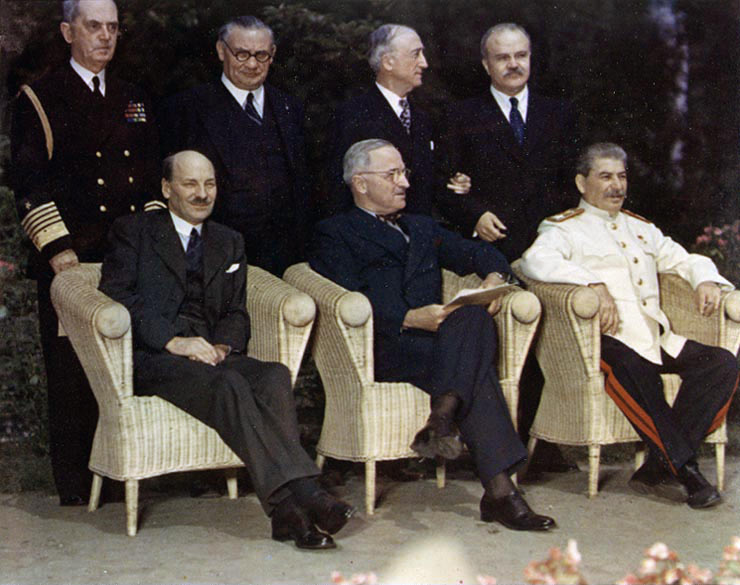
At the Potsdam Conference (near Berlin) in July & August 1945, the leaders of America (Truman), England (Attlee) and the Soviet Union (Stalin) met again.
The Atomic Bomb had been successfully tested, and President Truman let Stalin know that the U.S had a new weapon of extraordinary force. Stalin dislikes the secrecy around the Atomic Bomb
Finalize division of Germany and Berlin
Soviets had rigged elections in Poland to insure communist rule
THE UNITED NATIONS
PROVIDES HOPE
Hopes for world peace were high at the end of the war The most visible symbol of these hopes was the United Nations (U.N.)
Formed in June of 1945, the U.N. was composed of 50 nations
Unfortunately, the U.N. soon became a forum for
competing superpowers to spread their influence over others
The United Nations today has 191 member
CHURCHILL: “IRON CURTAIN”
ACROSS EUROPE
Europe was now divided into two political regions; a mostly democratic
Western Europe and a communist Eastern
Europe
In a 1946 speech,
Churchill said, “An iron curtain has descended across the continent”
The phrase “iron curtain” came to stand for the
division of Europe
Churchill, right, in Fulton, Missouri delivering his “iron
Iron Curtain cartoon,
SOVIETS DOMINATE EASTERN
EUROPE
The Soviet Union
suffered an estimated 20 million WWII
deaths, half of whom were civilian
Felt justified in their claim to Eastern
Europe
Eastern Europe could be a buffer against future German
STALIN INSTALLS PUPPET
GOVERNMENTS
Stalin installed“satellite” communist governments in the Eastern European
countries of Albania, Bulgaria,
Czechoslovakia,
Hungary, Romania, Yugoslavia and East Germany
This after promising “free elections” for Eastern Europe at the Yalta Conference
In a 1946 speech, Stalin said communism and capitalism were incompatible – and
U.S. ESTABLISHES A POLICY
OF CONTAINMENT
Assumption: Soviets seek world domination. Why did we think that?
In February 1946, George Kennan, an American
diplomat in Moscow, proposed a policy of containment
Containment meant the U.S. would assist countries
resisting communist rule
THE TRUMAN DOCTRINE
The American policy of“containment” soon expanded into a policy known as the
Truman Doctrine”
This doctrine, first used in
Greece and Turkey in the late 1940s, vowed to provide aid (money & military supplies) to support “free peoples who are resisting outside pressures” By 1950, the U.S. had given $400 million in aid to Greece and Turkey
THE MARSHALL PLAN
Post-war Europe was devastated economically, capitalism can not work if infrastructure is broken. In June 1947, Secretary of State
George Marshall proposed a U.S. aid package to European nations
Western Europe accepted the help, while Eastern Europe rejected the aid. Why wouldn't Eastern Europe want help from the US?
Over the next four years 16
European countries received $13 billion in U.S. aid
By 1952 Western Europe’s economy was flourishing
Containment?? The Marshall Plan helped
Marshall Plan aid sent to European
countries
USSR rejects help:
• Would have to share info with US
• Allow US to see how
funds were being spent
• Give some control over economic
planning and decision making
• What is better? • Communism
By providing
assistance
what is
America
doing for
Europe?
SUPERPOWERS STRUGGLE
OVER GERMANY
Agreements from Yalta and Potsdam divided Germany and BerlinThe U.S, France, and Great Britain decided to combine their 3 zones into one zone – West Germany, or the
federal Republic of Germany
The U.S.S.R. controlled East Germany, or the German Democratic Republic
Soviets see US Spheres of influence being created
BERLIN AIRLIFT – 1948
When the Soviets
attempted to block
the three Western
powers from
access to Berlin in
1948, the 2.1
million residents of
West Berlin had
only enough food
for five weeks,
resulting in a dire
situation
Like the whole of Germany, the city of Berlin was divided into
AMERICA & BRITAIN AIRLIFT
SUPPLIES TO WEST BERLIN
Not wanting to invade and start a war with the Soviets, America and
Britain started the Berlin airlift to fly supplies into West Berlin
For 327 days, planes took off and landed every few minutes, around the
clock
SOVIETS LIFT BLOCKADE
Realizing they
were beaten and
suffering a public
relations
nightmare, the
Soviets lifted
their blockade in
May, 1949
NATO FORMED
The Berlin blockade increased Western
Europe’s fear of Soviet aggression
As a result, ten West European nations
joined the U.S and
Canada on April 4, 1949 to form a defensive
alliance known as the North Atlantic Treaty Organization
Warsaw Pact
May 1955
Eight communist countries= Bloc
Pledged the mutual defense of any
member who is attacked
Section One: Objectives
By the end, I will be able to:
1. Explain the breakdown in relations between
the United States and the Soviet Union after
World War II
2. Summarize the steps taken to contain Soviet
influence
3. Describe how the Truman Doctrine and the
Marshall Plan deepened Cold War tensions
Section 2: The Cold War Heats Up
By the end of this lesson, I will be able to:
1. Explain how Communists came to power in
China and how the United States reacted.
Section Two: The Cold War Heats Up
Main Idea: After World
War II, China became a communist nation and Korea was split into a communist north and a democratic south.
Why it Matters Now: Ongoing tensions with China and North Korea continue to involve the United States. Key Terms: Chiang Kai-shek Mao Zedong Taiwan Key Terms:
38th parallel
SECTION 2: THE COLD WAR
HEATS UP
CHINA:
For two decades, Chinese communists had
struggled against the nationalist government of Chiang Kai-Shek
The U.S. supported Chiang and gave the Nationalist Party $3 billion in aid during WWII
However, Mao Zedong’s Communist Party in China was strong,
CHINESE CIVIL WAR: 1944-1947
After Japan left China at the end of the War, Chinese
Nationalists and Communists fought a bloody civil war
Despite the U.S. sending $ billions to the Nationalists, the Communists under Mao won the war and ruled China Chiang and the Nationalists fled China to neighboring Taiwan
Mao established the People’s Republic of China
MAO
AMERICA STUNNED
The American public was shocked that
China had fallen to the Communists
Many believed containment had
failed and communism was expanding
American fear of communism and
KOREAN WAR
Japan had taken over Korea in 1910 and ruled it until August 1945
As WWII ended, Japanese troops north of the 38th
parallel (38 N Latitude) surrendered to the Soviets
Japanese soldiers south of the 38th surrendered to the
Americans
As in Germany, two nations developed, one communist (North Korea) and one
democratic (South Korea)
Soviet controlled
U.S.
NORTH KOREA ATTACKS
SOUTH KOREA
On June 25, 1950, North Korean forces swept across the 38th parallel in a surprise
attack on South Korea
With only 500 U.S. troops in South Korea, the Soviets
figured the Americans would not fight to save South Korea Instead, America sent troops, planes and ships to South
Korea (Total UN forces
MACARTHUR’S
COUNTERATTACK
At first, North Korea seemed unstoppable However, General MacArthur launched a counterattackwith tanks, heavy artillery, and troops
Troops landed in the cities on Inchon and Pusan squeezing the NK troops into the middle Many North Koreans
CHINA JOINS THE FIGHT
US seemed to be near victory in N. Korea
300,000 Chinese soldiers joined the war on the side of the
North Koreans
Chinese overran the
American/S. Korean forces and captured Seoul for the 2nd time
on January 4, 1951
The fight between North and South Korea had turned into a war in which the main
MACARTHUR RECOMMENDS
ATTACKING CHINA
To halt the bloody stalemate, General MacArthur wanted to take the war into China
MacArthur called for the U.S. to drop atomic bombs on China
MACARTHUR VS. TRUMAN
MacArthur continued to urge President Truman to attack China and tried to go behind Truman’s back – Truman was furious with his general
On April 1, 1951, Truman made the shocking announcement that he had fired MacArthur
Americans were surprised and many still supported their fallen general
Macarthur was given
AN ARMISTICE IS SIGNED
July 1953, an
agreement was signed that ended the war in a stalemate
(38th parallel)
America’s cost: 54,000 lives and $67 billion
Difficulty fighting Everyone is Korean
Truman desegregates the armed forces
during Korean War
Discussion: Turn and Talk
1. What do you suppose were some of the reasons why American troops had trouble fighting this war? 2. In what ways did American troops underestimate their enemies?
3. Do you think we should have aided the South Koreans in this war?
4. Do you blame China for getting involved in the conflict?