DOI: 10.2478/10004-1254-64-2013-2351 Scientifi c paper
OXIDATIVE INDICES CORRELATE WITH
DYSLIPIDEMIA AND PRO-INFLAMMATORY
CYTOKINE LEVELS IN FLUORIDE-EXPOSED RATS
Olusegun Kayode AFOLABI, Emmanuel Bukoye OYEWO, Adeniran Sanmi ADEKUNLE, Olaniyi Tope ADEDOSU, and Adebayo Lawrence ADEDEJI
Department of Biochemistry, Faculty of Basic Medical Sciences, Ladoke Akintola University of Technology, Ogbomoso, Nigeria
Received in January 2013 CrossChecked in February 2013
Accepted in June 2013
The aim of this study was to establish the effects of fl uoride on lipid metabolism and attendant infl ammatory response by exposing rats to 50 mg L-1 and 100 mg L-1 of fl uoride through drinking water for seven weeks.
Both concentrations led to hypercholesterolemia while the 100 mg L-1 concentration induced
hypertriglyceridaemia. High density lipoprotein (HDL) cholesterol levels dropped in the exposed rats while interleukin 2 (IL-2) increased more than 1.5-fold (p<0.05) and IL-6 and plasma TNF-α more than 2.5 fold (p<0.05). Fluoride-exposed rats also had signifi cantly higher levels of liver malondialdehyde (MDA) and plasma lipid hydroperoxide (LOOH) but lower plasma paraoxonase (PON1) activity. Oxidative stress indices correlated with infl ammatory cytokines and plasma cholesterol. In contrast, pro-infl ammatory cytokines inversely correlated with plasma triglyceride, HDL cholesterol and PON1. Our results suggest that the association between fl uoride exposure with cardiovascular diseases may be related to its ability to disturb lipid homeostasis, and trigger pro-infl ammatory cytokines and oxidative stress.
KEY WORDS:cardiovascular disorders, IL-2, IL-6, paraoxonase, plasma lipid hydroperoxide, TNF-α
Fluorine and fl uoride compounds are constituents of minerals in rocks and soils, and the main sources of fl uoride exposure for humans include foodstuffs, fl uoride supplements, fl uoride dentifrices, and water contaminated with high concentrations of fl uoride compounds from geological sources (1, 2).
Fluoride compounds are being utilised in the life-science industry, crops, pharmaceuticals, hygiene, cosmetics, and domestic commodities. Their production has been increasing steadily over the years (3). Excessive chronic fl uoride intake results in fl uorosis, characterised by a vast array of symptoms and pathological changes such as dental mottling, crippling
deformities, osteoporosis, and osteosclerosis (4,5). Endemic fl uorosis has now become a global concern (6).
disruption of lipid metabolism such as progression of atherosclerosis and increased risk of heart attack and stroke (11).
Our intention was to investigate the effects of subchronic exposure to fl uoride through drinking water on the lipid metabolism and markers of infl ammatory response in rats and try to shed some light on the association between disturbances in lipid metabolism and cytokine activity, as we feel that little is still known about them and the underlying mechanisms.
MATERIALS AND METHODS
Materials
Sodium fl uoride, paraoxon, triphenylphosphine (TPP), butylhydroxytoluene (BHT), and xylenol orange were produced by Sigma-Aldrich (Munich, Germany), sodium deodecyl sulphate (SDS), trichloroacetic acid (TCA) and thiobarbituric acid (TBA) by Qualigens Fine Chemicals (Mumbai, India), the kits for the detection of total cholesterol, triglyceride, and phospholipids by Chemelex (Barcelona, Spain), and the ELISA kits by RayBiotech Inc. (Norcross, GA, USA).
Animals and treatment
For the experiment we used 24 male Wistar rats [bred at the Animal House of the Faculty of Basic Medical Sciences, Ladoke Akintola University of Technology (LAUTECH), Ogbomoso, Nigeria] aged between 9 and 10 weeks and weighing 120 g in average. The rats were housed in clean plastic cages and maintained on a standard pellet diet and distilled water ad libitum. After they were allowed to acclimatise for two weeks, their body weights were recorded, and the rats were then randomly distributed in three groups of eight animals. Group one served as control, while the groups two and three were exposed to subchronic concentrations of 50 mg L-1 and 100 mg L-1 fl uoride in the form of sodium fl uoride through drinking water for 7 weeks. Water exposure mimicked epidemiological exposure and the concentrations were chosen based on studies of fl uoride-induced toxicity (12-15).
At the end of the seven-week exposure, the rats were fasted overnight and their body weights recorded again. Blood was collected into heparinised tubes by cardiac puncture under light diethyl ether anaesthesia and the samples centrifuged at 3,000g for 10 min to
obtain plasma. The liver was removed and homogenised in ice-cold KCl (150 mmol L-1). The obtained 10 % homogenate was then stored at -20 °C until biochemical analysis. The LAUTECH Department of Biochemistry guidelines for the care and use of laboratory animals were followed throughout the experiment.
Determination of plasma lipids
Plasma concentrations of total cholesterol, triglyceride, and phospholipids were determined with commercial kits (Chemelex®, Barcelona, Spain). HDL cholesterol was analysed with the commercial kit for total cholesterol after very low density lipoproteins (VLDL) and LDL were precipitated with heparin-MnCl2 solution as described by Gidez et al. (16). LDL cholesterol was determined as described by Friedewald et al. (17).
Determination of thiobarbituric acid-reactive substances (TBARS)
Lipid peroxidation (LPO) was determined in liver homogenate using the method of Ohkawa et al. (18). Briefl y, to the reaction mixture consisting of 0.2 mL of 8 % sodium dodecyl sulphate (SDS), 1.5 mL of 20 % acetic acid, and 0.6 mL of distilled water we added 0.2 mL of tissue homogenate. Reaction was initiated by adding 1.5 mL of 1 % thiobarbituric acid (TBA) and terminated by adding 10 % trichloroacetic acid (TCA). It was then centrifuged and absorbance was read at 532 nm with a Genesys 10S UV-VIS spectrophotometer (THERMO SCIENTIFIC, Madison, WI, U.S.A.). LPO was expressed in nanomoles of MDA formed per milligram of tissue using the molar extinction coeffi cient of 1.56x10⁵ L mol-1 cm−1.
Determination of plasma lipid hydroperoxides
Lipid hydroperoxides (LOOH) in plasma were determined using the method of Naurooz-Zadeh et al. (19). Samples of plasma (90 μL) were mixed with either 10 μL of 10 mmol L-1 triphenylphosphine (TPP) in methanol or with 10 μL of methanol and incubated at room temperature for 30 min. Then, 900 μL of FOX2 reagent (250 μmol L-1 ammonium ferrous sulphate, 100 μmol L-1 xylenol orange, 25 mmol L-1 H2SO4 and 4 mmol L-1 BHT in 90 % methanol) was added, and the sample was incubated for another 30 min. The mixture was then centrifuged at 12,000g
spectrophotometer at 560 nm. The absorbance of the sample with TPP was subtracted from the sample without TPP and hydroperoxide concentration calculated from the standard curve prepared using different concentrations of H2O2 (1 μmol L-1 to 20 μmol L-1).
Determination of plasma paraoxonase activity
Paraoxonase activity of PON1 was determined u s i n g p a r a o x o n ( O , O - d i e t h y l -o-p -nitrophenylphosphate) as the substrate. We measured increase in absorbance at 405 nm due to the formation of 4-nitrophenol following the hydrolysis of paraoxon as described by Furlong and Richter (20). Plasma (20 μL) was added to 760 μL of the assay buffer containing 0.132 mol L-1 Tris-HCl, pH 8.5, and 1.32 mmol L-1 CaCl
2. The substrate, paraoxon in 50 mmol L-1 Tris-HCl (200 μL), was added to initiate the reaction. The change in absorbance was continuously monitored on the Genesys 10S UV-VIS spectrophotometer for 3 min. Molar extinction coeffi cient of 18,050 L mol-1 cm-1 was used to calculate enzyme activity. One unit of paraoxonase activity was defi ned as enzyme quantity that disintegrated one micromole of paraoxon substrate in 1 min at 25 °C.
Determination of plasma interleukins 2 and 6 and tumour necrosis factor alpha
Plasma concentrations of interleukin 2 (IL-2), 6 (IL-6), and tumour necrosis factor-alpha (TNF-α) were determined using commercial rat ELISA kits (RayBiotech, Inc., Norcross, GA, USA), following the instructions in respective kit manuals. The absorbance was monitored on a Hawksley HA-1600 microplate reader (Hawksley, London, U.K.).
Statistical analysis
Results, expressed as mean ± SD were analysed using one-way analysis of variance (ANOVA) and Tukey’s test. The power of <0.05 was considered signifi cant. Associations between the parameters were tested using Pearson’s correlation coeffi cient. All data analyses were run using the Graph Pad Prism version 5.0 statistical package (GraphPad Software, Inc., La Jolla, CA, U.S.A.).
RESULTS
Rat exposure to fl uoride through water signifi cantly increased total plasma cholesterol and LDL cholesterol
(Figure 1). In contrast, HDL cholesterol signifi cantly dropped. Interestingly, triglyceride concentrations responded differently to fl uoride concentrations used; the lower concentration lowered plasma triglycerides whereas the higher increased them.
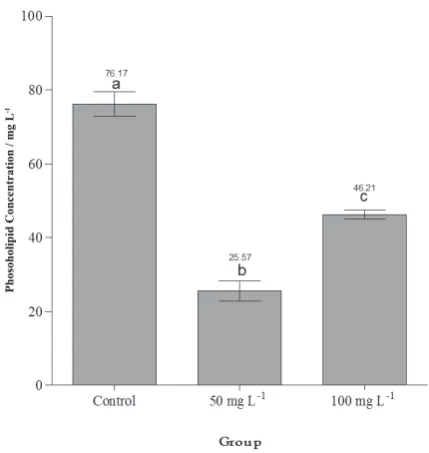
Another interesting observation is that plasma phospholipids (Figure 2) dropped signifi cantly more in rats treated with fl uoride in the lower than in the higher concentration.
Figure 1 Plasma lipids and lipoproteins in rats exposed to fl uoride vs. controls. Different bar letters denote signifi cant difference between the groups (p<0.05).
Figure 2 Plasma phospholipid concentrations in rats exposed to fl uoride vs. controls. Different bar letters denote signifi cant difference between the groups (p<0.05).
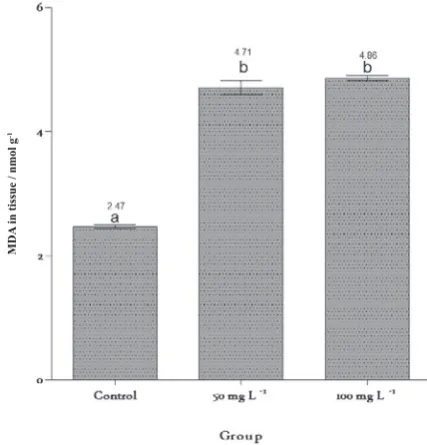
Plasma hydroperoxides signifi cantly increased in the concentration-dependent manner (Figure 3) whereas liver MDA levels showed a similar increase
Cholester
ol Concentration / mg L
-1
Phosoholipid Concentration / mg L
in both treated groups (Figure 4). Plasma paraoxonase, in turn, showed a signifi cant, concentration-dependent drop (Figure 5).
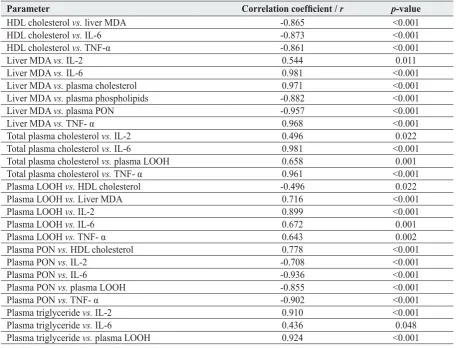
Associations between all parameters turned out to be significant (Table 1). HDL-cholesterol levels negatively correlated with the pro-inflammatory cytokines, IL-6, and TNF-α levels, while positive associations were observed between plasma triglyceride and the cytokines, IL-2, and IL-6. Strong positive correlations were found between the two oxidative stress parameters, liver MDA and plasma LOOH, on the one hand and the cytokines on the other. Plasma cholesterol also showed positive association with the cytokines. Plasma PON1 activity negatively correlated with IL-2, IL-6, TNF-α, liver MDA, plasma LOOH, and HDL-cholesterol.
Figure 6 Plasma IL-2, IL-6, and TNF-α levels in rats exposed to fl uoride vs. controls. Different bar letters denote signifi cant difference between the groups (p<0.05).
Figure 3 Plasma lipid hydroperoxide concentrations in rats exposed to fl uoride vs. controls. Different bar letters denote signifi cant difference between the groups (p<0.05).
Figure 4 Liver MDA levels in rats exposed to fl uoride vs. controls. Different bar letters denote signifi cant difference between groups (p<0.05).
IL-2 increased signifi cantly only with the higher fluoride concentration, whereas IL-6 and TNF-α showed a similar behaviour with either concentration (Figure 6).
Figure 5 Plasmaparaoxonase activity in rats exposed to fl uoride vs. controls. Different bar letters denote signifi cant difference between the groups (p<0.05).
Plasma Hydr
oper
oxide Concentration / μmol L
-1
Paraoxanase
Activity / U L
-1
MDA
in tissue / nmol g
-1
Cytokine Concentrations / pg mL
DISCUSSION
Studies on the effects of fl uoride on lipid metabolism are few and contradictory. Unlike Kanbur et al. (7), who reported a drop in both plasma cholesterol and triglyceride, fl uoride exposure of rats in our study induced dyslipidemia, which is a major risk factor for the development of cardiovascular diseases (21). This is quite signifi cant, as it has recently been reported that increased fl uoride uptake by coronary arteries may increase cardiovascular risk (22).
We o b s e r v e d h y p e r c h o l e s t e r o l e m i a a n d hypertriglyceridemia in the rats, which is in agreement with the report of Czerny et al. (8). The increase in plasma cholesterol may result from enhanced hepatic cholesterogenesis and/or reduced cholesterol clearance from the system, an effect that has been suggested for other metals (23, 24). Furthermore, lower clearance of LDL precursor particles could result in a persistence
of cholesterol, resulting in hypercholesterolemia (25). Consistent with this is the elevated LDL-cholesterol fraction observed in this study. The hypertriglyceridemic effect of fl uoride may be related to lower hydrolysis of triglyceride (TG), attributable to fl uoride-induced reduction in the activity of lipoprotein lipase (LPL) (26). Other possible contributors to hypetriglyceridemia include stimulation of hepatic synthesis of very low density lipoprotein (VLDL), which is a consequence of increased hepatic fatty acid (FA) synthesis, activation of adipose tissue lipolysis, and/or suppression of FA oxidation and ketogenesis (27). HDL-C inversely correlates with the risk of coronary heart disease (CHD) and its reduction by fl uoride refl ects changes in HDL metabolism that could lead to defective reverse cholesterol transport, eventually promoting atherogenesis. The dyslipidemic effect of fluoride reflected in hypercholesterolemia, hypertriglyceridemia, increased levels of
triglyceride-Table 1 Strength of association between oxidative stress indices, pro-infl ammatory cytokines, and lipid parameters in rats exposed to fl uoride
Parameter Correlation coeffi cient / r p-value
HDL cholesterol vs. liver MDA -0.865 <0.001
HDL cholesterol vs. IL-6 -0.873 <0.001
HDL cholesterol vs. TNF-α -0.861 <0.001
Liver MDA vs. IL-2 0.544 0.011
Liver MDA vs. IL-6 0.981 <0.001
Liver MDA vs. plasma cholesterol 0.971 <0.001
Liver MDA vs. plasma phospholipids -0.882 <0.001
Liver MDA vs. plasma PON -0.957 <0.001
Liver MDA vs. TNF- α 0.968 <0.001
Total plasma cholesterol vs. IL-2 0.496 0.022
Total plasma cholesterol vs. IL-6 0.981 <0.001
Total plasma cholesterol vs. plasma LOOH 0.658 0.001
Total plasma cholesterol vs. TNF- α 0.961 <0.001
Plasma LOOH vs. HDL cholesterol -0.496 0.022
Plasma LOOH vs. Liver MDA 0.716 <0.001
Plasma LOOH vs. IL-2 0.899 <0.001
Plasma LOOH vs. IL-6 0.672 0.001
Plasma LOOH vs. TNF- α 0.643 0.002
Plasma PON vs. HDL cholesterol 0.778 <0.001
Plasma PON vs. IL-2 -0.708 <0.001
Plasma PON vs. IL-6 -0.936 <0.001
Plasma PON vs. plasma LOOH -0.855 <0.001
Plasma PON vs. TNF- α -0.902 <0.001
Plasma triglyceride vs. IL-2 0.910 <0.001
Plasma triglyceride vs. IL-6 0.436 0.048
Plasma triglyceride vs. plasma LOOH 0.924 <0.001
rich lipoproteins, and HDL depletion may well contribute to its atherogenic tendencies, as dyslipidemia has been well implicated in cardiovascular disease (21).
Generation of reactive oxygen species (ROS) and enhanced lipid peroxidation are important pathological mediators in many disorders (28). In our study, fl uoride-exposed rats exhibited a high level of lipid peroxidation (through 90 % and 98 % increase in hepatic MDA at low and high doses, respectively) and four times higher plasma LOOH concentrations at the higher dose. The increased oxidative stress in the animals may be the consequence of depletion of the antioxidant scavenger system (29, 30). Our results are in accordance with previous studies showing close association between chronic fl uoride toxicity and increased oxidative stress (31, 32).
However, the effect of fluoride toxicity on paraoxonase activity has drawn our attention even more. This is because paraoxonase activity has been implicated in a number of pathological conditions, including coronary artery disease (33), but, to our knowledge, no study before ours has investigated the effects of fl uoride on this enzyme.
Paraoxonase, a high-density lipoprotein (HDL)-associated enzyme has been demonstrated to protect serum lipids from oxidative modifi cation, to reduce macrophage foam cell formation, and to attenuate atherosclerosis development (34). Lowered PON1 in animals may result in greater oxidative modifi cation of HDL-C and LDL-C and eventually to plaque formation and atherosclerosis. Its inhibition, along with dyslipidemia, suggest possible mechanisms of fl uoride toxicity in the development of cardiovascular diseases.
Infl ammation-related molecules, such as 2, IL-6, and TNF-α are considered good predictors of CHD, even in people with no conventional risk factors (35). Studies reviewed by Berg and Scherer (36) have demonstrated that increase in the levels of infl ammatory markers such as, IL-6 and TNF-α, may translate to accelerated atherogenesis. Our data have confi rmed the increasing effect of fl uoride on IL-2, IL-6, and TNF-α levels in rats. In contrast, a recent human ex vivo study revealed lower expression of IL-2 in peripheral blood mononuclear cell obtained from humans exposed to fl uoride (37, 38). In our study, however, IL-2 increase following fl uoride intoxication points to immunological response of T cells, as evidenced elsewhere (39). Normally, the antigen binding to the T cell receptor stimulates the secretion
of 2 and the expression of 2 receptors. The IL-2/IL-2R interaction then stimulates the growth, differentiation, and survival of antigen-selected cytotoxic T cells by activating the expression of specifi c genes (40, 41). Since there has not been any report describing fl uoride antigenicity, and our study does not evidence any infection, the increase recorded in plasma IL-2 concentration points to an indirect response, whose aim is to contain the cause of systemic and/or peripheral inflammation, as reported earlier (38, 42). The marked, greater than twofold increase in plasma IL-6 in rats exposed to fl uoride - even though not dose-dependent - suggests that IL-6 could have acted as a pro-infl ammatory cytokine and supports the IL-2 fi nding, strengthening further the hypothesis about immunological response triggered by systemic and/or peripheral infl ammation (43). TNF-α is a cytokine involved in systemic infl ammation, and its overexpression has been reported as the underlining factor in chronic infl ammatory response (44). High blood levels of TNF-α have been reported to increase the risk of heart disease by 79 % and that of heart failure by 121 % (45).
To sum up, our fi ndings have confi rmed earlier findings that fluoride exposure disturbs lipid metabolism (7, 8, 49), but unlike earlier studies, it has also demonstrated the association between dyslipidemia and pro-infl ammatory cytokines.
REFERENCES
1. Ozsvath DL. Fluoride and environmental health: A review. Rev Environ Sci Biotechnol 2009;8:59-79. doi: 10.1007/ s11157-008-9136-9
2. Ruiz-Payan A, Ortiz M, Duarte-Gardea M. Determination of fl uoride in drinking water and in urine of adolescents living in three counties in Northern Chihuahua, Mexico using a fl uoride ion selective electrode. Microchem J 2005;81:19-22.
3. Müller K, Faih C, Diederich F. Fluorine in pharmaceuticals: Looking beyond intuition. Science 2007;317:1881-6. doi: 10.1126/science.1131943
4. Whitford GM, Pashley DH, Reynolds KE. Fluoride tissue distribution: short-term kinetics. Am J Physiol 1979;236: F141-8. PMID: 420295
5. Zahvoronkov AA, Strochkova LS. Fluorosis: geographical pathology and some experimental findings. Fluoride 1981;14:182-91.
6. Fawell J, Bailey K, Chilton J, Dahi E, Fewtrell L, Magara Y. Fluoride in Drinking-water. Geneva: World Health Organization; 2006.
7. Kanbur M, Eraslan G, Silici S, Karabacak M. Effects of sodium fl uoride exposure on some biochemical parameters in mice: evaluation of the ameliorative effect of royal jelly applications on these parameters. Food Chem Toxicol 2009;47:1184-9. doi: 10.1016/j.fct.2009.02.008
8. Czerny B, Put A, Mysilwiec Z, Juzysyn Z. The infl uence of quercetin on some parameters of lipid metabolism in rats chronically exposed to ammonium fluoride. Fluoride 2000;33:27-32.
9. Wang FY, Zhang DX, Wang W. Toxic effects of fl uoride on beating myocardial cells cultured in vitro. Fluoride 1998;31:26-32.
10. Black PH. The infl ammatory consequences of psychologic stress: relationship to insulin resistance, obesity, atherosclerosis and diabetes mellitus, type II. Med Hypotheses 2006;67:879-91. PMID: 16781084
11. Dubiński A, Zdrojewicz Z. Rola interleukiny 6 w wystąpieniu i progresji miażdżycy [The role of interleukin-6 in development and progression of atherosclerosis, in Polish]. Pol Merkur Lekarski 2007;22:291-4. PMID: 17684929
12. Chouhan S, Flora SJS. Effects of fl uoride on the tissue oxidative stress and apoptosis in rats: biochemical assays supported by IR spectroscopy data. Toxicology 2008;254:61-7. doi: 10.1016/j.tox.2008.09.008
13. Guo XY, Sun GF, Shenyang YS. Oxidative stress from fl uoride-induced hepatotoxicity in rats. Fluoride 2003;36:25-9.
14. Chlubek D, Grucka-Mamczar E, Birkner E, Polaniak R, Stawiarska-Pieta B, Duliban H. Activity of pancreatic antioxidative enzymes and malondialdehyde concentrations
in rats with hyperglycemia caused by fl uoride intoxication. J Trace Elem Med Biol 2003;17:57-60. doi: 10.1016/S0946-672X(03)80047-0
15. Bharti VK, Srivastava RS. Fluoride-induced oxidative stress in rat’s brain and its amelioration by buffalo (bubalus bubalis) pineal proteins and melatonin. Biol Trace Elem Res 2009:130:131-40. doi: 10.1007/s12011-009-8320-2 16. Gidez LI, Miller GJ, Burstein M, Slagle S, Eder HA.
Separation and quantitation of subclasses of human plasma high density lipoproteins by a simple precipitation procedure. J Lipid Res 1982;23:1206-23.
17. Friedewald WT, Levy RT, Fredrickson DS. Estimation of the concentration of LDL-C in plasma without use of the preparative ultracentrifuge. Clin Chem 1972;18:499-502. PMID: 4337382
18. Ohkawa H, Ohishi N, Yagi K. Assay for lipid peroxides in animal tissues by thiobarbituric acid reaction. Ann Biochem 1979;95:351-8. PMID: 36810
19. Nourooz-Zadeh J, Tajaddini-Sarmadi J, Wolff SP. Measurement of plasma hydroperoxide concentrations by the ferrous oxidation-xylenol orange assay in conjunction with triphenylphosphine. Anal Biochem 1994;220:403-9. doi: 10.1016/j.cccn.2003.08.004
20. Furlong CE, Richter RJ, Seidel SL, Motulsky AG. Role of genetic polymorphism of human plasma paraoxonase/ arylesterase in hydrolysis of the insecticide metabolites chlorpyrifosoxon and paraoxon. Am J Human Genet 1988;43:230-8. PMID: 2458038
21. Despres JP. Abdominal obesity: the most prevalent cause of the metabolic syndrome and related cardiometabolic risk. Eur Heart J 2006;8:B4–B12. PMID: 2289821
22. Li Y, Berenji GR, Shaba WF, Tafti B, Yevdayev E, Dadparvar S. Association of vascular fl uoride uptake with vascular calcification and coronary artery disease. Nucl Med Commun 2012;33(1):14-20. PMID: 21946616
23. Gesquière L, Loreau N, Minnich A, Davignon J, Blache D. Oxidative stress leads to cholesterol accumulation in vascular smooth muscle cells. Free Radic Biol Med 1999;27:134-45. PMID: 10443930
24. Kojima M, Sekikawa K, Nemoto K, Degawa M. Tumor necrosis factor-alpha independent downregulation of hepatic cholesterol 7alpha hydroxylase gene in mice treated with lead nitrate. Toxicol Sci 2005;87:537-42. doi: 10.1093/toxsci/ kfi 267
25. Goldstein J, Hobbs H, Brown M. Familial hypercholesterolemia. In: Scriver C, Beaudet A, Sly W, Valle D, editors. The metabolic and molecular bases of inherited disease. 8th ed.
New York (NY): McGraw-Hill; 2001. p. 2863-913. 26. Hirano T, Takashashi T, Shigenobu S, Hiroto T. Apoprotein
C-III defi ciency markedly stimulates triglyceride secretion
in vivo: comparison with apoprotein E. Am J Physiol
Endocrinol Metab 2001;281:E665-9. PMID: 11551841 27. Khovidhunkit W, Kim MS, Memon RA, Shigenaga JK, Moser
AH. Effects of infection and infl ammation on lipid and lipoproteins metabolism: mechanisms and consequences to the host. J Lipid Res 2004;45:1169-95. PMID: 15102878 28. Kohen R, Nyska A. Oxidation of biological systems:
oxidative stress phenomena, antioxidants, redox reactions, and methods of their quantifi cation. 2002;30(6):620-50. PMID: 12512863
Transduct Ther 2007;2:190-213. doi: 10.2174/1574362077 81745300
30. Vasant RA, Narasimhacharya AVRL. A multigrain protein enriched diet mitigates fl uoride toxicity. J Food Sci Technol 2013;50:528-34. doi: 10.1007/s13197-011-0367-3. 31. Shanthakumari D, Srinivasalu S, Subramanian S. Effect of
fl uoride intoxication on lipid peroxidation and antioxidant status in experimental rats. Toxicology 2004;204:219-28. PMID: 15388248
32. Saralakumari D, Ramakrishna Rao P. Red cell membrane alterations in human chronic fl uoride toxicity. Biochem Int 1991;23:639-48. PMID: 1831358
33. Jayakumari N, Thejaseebai G. High prevalence of low serum paraoxonase-1 in subjects with coronary artery disease. J Clin Biochem Nutr 2009;45:278–284. doi:10. 3164/jcbn.08-255.
34. Aviram M. Introduction to the serial review on paraoxonases, oxidative stress, and cardiovascular diseases. Free Radic Biol Med 2004;1;37(9):1301-3. PMID: 15454270
35. Morrow DA, Ridker PM. C-reactive protein, infl ammation, and coronary risk. Med Clin North Am 2000;84:149-61. PMID: 10685132
36. Berg AH, Scherer PE. Adipose tissue, infl ammation, and cardiovascular disease. Circ Res 2005;96:939-49.
37. Salgado-Bustamante M, Ortiz-Pérez MD, Calderón-Aranda E, Estrada-Capetillo L, Niño-Moreno P, González-Amaro R, Portales-Pérez D. Pattern of expression of apoptosis and infl ammatory genes in humans exposed to arsenic and/or fl uoride. Sci Total Environ 2010;408:760-7. doi: 10.1016/ j.scitotenv.2009.11.016
38. Barbier O, Arreola-Mendoza L, Del Razo LM. Molecular mechanisms of fluoride toxicity. Chem Biol Interact 2010;188:319-33. doi: 10.1016/j.cbi.2010.07.011
39. Cantrell DA, Smith KA. The interleukin-2 T-cell system: a new cell growth model. Science 1984;224:1312-6. doi: 10.1126/science.6427923
40. Beadling C, Johnson KW, Smith KA. Isolation of interleukin 2-induced immediate-early genes. Proc Nat Acad Sci USA 1993;90:2719-23. PMCID: PMC46167 41. Beadling C, Smith KA. DNA array analysis of
interleukin-2-regulated immediate/early genes. Med Immunol 2002;1:2. doi: 10.1186/1476-9433-1-2
42. Yanqin M, Ruiyan N, Zilong S, Jinming W, Guangying L, Jianhai Z, Jundong W. Infl ammatory responses induced by fl uoride and arsenic at toxic concentration in rabbit aorta. Arch Toxicol 2012;86:849-56. doi: 10.1007/s00204-012-0803-9
43. Smolen JS, Maini RN. Interleukin-6: a new therapeutic target. Arthritis Res Ther 2006;8Suppl 2):S5-11. PMID: 16899109
44. Oyewo EB, Akanji MA. Toxicological implications of aqueous leaf extract of Andrographis paniculata in Wistar rat. Nature and Science 2012;10:91-108.
45. Cesari M, Penninx BW, Newman AB, Kritchevsky SB, Nicklas BJ, Sutton-Tyrrell K, Rubin SM, Ding J, Simonsick EM, Harris TB, Pahor M. Infl ammatory markers and onset of cardiovascular events: results from the Health ABC study. Circulation 2003;108:2317-32. doi: 10.1161/01. cir.0000097109.90783.fc
46. Elena C, Antonella S, Grabriella L, Simonetta C, Fiorella B, Paolo M, Marcello G, Antonio A, Alba R, Giuseppe P. Free Radicals Biol Med1997;22,889–94.
47. Elmarakby AA, Sullivan JC. Relationship between Oxidative Stress and Infl ammatory Cytokines in Diabetic Nephropathy. Cardiovasc Ther 2012;30:49-59. PMID: 20718759. 48. Libby P, Ridker PM, Maseri A. 2002. Infl ammation and
Atherosclerosis.Circulation. 2002;105:1135-1143. doi: 10.1161/hc0902.104353
Sažetak
INDIKATORI OKSIDACIJE KORELIRAJU S DISLIPIDEMIJOM I RAZINAMA UPALNIH CITOKINA U ŠTAKORA IZLOŽENIH FLUORIDU
Svrha je ovog istraživanja bila utvrditi djelovanje fl uorida na metabolizam lipida i upalni odgovor tako što smo štakore izložili fl uoridu u pitkoj vodi u koncentracijama od 50 mg L-1 i 100 mg L-1 sedam tjedana.
Obje su koncentracije dovele do hiperkolesterolemije, a viša je koncentracija inducirala i hipertrigliceridemiju. U odnosu na kontrolnu skupinu, u izloženih su se štakora razine lipoproteina visoke gustoće (HDL-a) smanjile, a interleukin 2 (IL-2) se povećao više od 1,5 put (p<0,05), kao i IL-6 i čimbenik tumorske nekroze alfa (TNF-α) u plazmi, i to više od 2,5 puta (p<0,05). Usto su izloženi štakori iskazali značajno više razine malondialdehida (MDA) u jetrima te lipidnog hidroperoksida (LOOH) u plazmi, odnosno sniženu aktivnost paraoksonaze (PON1) u plazmi. Indikatori oksidacijskog stresa korelirali su s upalnim citokinima i kolesterolom u plazmi, a upalni citokini inverzno su korelirali s trigliceridima, HDL kolesterolom i PON1 u plazmi. Rezultati istraživanja upućuju na to da povezanost između izloženosti fl uoridu i bolesti srca i krvožilja možda potječe od toga što fl uorid remeti lipidnu homeostazu te pokreće upalne citokine i, posljedično, oksidacijski stres.
KLJUČNE RIJEČI:bolesti srca i krvožilja, IL-2, IL-6, lipidni hidroperoksid, paraoksonaza, TNF-α
CORRESPONDING AUTHOR:
Olusegun Kayode Afolabi Department of Biochemistry Faculty of Basic Medical Sciences