International Journal of Applied Exercise Physiology
2322-3537 www.ijaep.comVol.6 No.3
Received: April 2017 , Accepted: August 2017 , Available online: October 2107
Comparing the effect of visual and non-visual music on functional factors in a
progressive aerobic exercise program
Faezeh Alizadeh
1, Zeinab Ramzani
2, Alireza Amani
3*1, 2
Master Student of Applied Physiology, Shomal University, Amol, Iran,
3Assistant Professor of Sport Physiology, Faculty of
Sport Sciences, Shomal University, Amol, Iran,
ABSTRACT: Objective: Aerobic exercises have a significant effect on losing weight and increasing the energy levels. This research aimed to
increase the fatigue time in this type of exercises, making it more enjoyable. Method: In this study, eight physical education female students with
the same preparedness level were selected by random sampling. The subjects participated ina periodic aerobic exercise during three stages with an
interval of 48 hours. The test was based on the Bruce Protocol, which measured the burnout, the maximum oxygen consumption, t he perceived
exercise pressure, and the heart rate in each stage. Findings: the results revealed that there was a significant difference in the subjects’ burnout time
(p = 0.039) while the impact of the visual music compared to the non-visual music in perceiving the exercise pressure was significantly different
(p = 0.034). Nonetheless, while measuring the heart rate (p = 0.443), the maximum oxygen consumption (p <0.05) had no significant effect.
Conclusion: In was found in the current research that the visual music can be a stronger factor than the non -visual music in making the exercise
more enjoyable and increasing the fatigue time.
KEY WORDS : Perceiving the exercise pressure, the burnout time, maximum oxygen consumption, heart rate.
INTRODUCTION
Aerobic power and human capacity inconsuming oxygen and
metabolism are undeniable. This helps the heart to work more efficiently
while the respiratory system functions better, and the daily efficiency of
the individuals would boost. This can exert an indispensable impact on each individual’s lifestyle. In addition, the aerobic power elevatesthe
athletes’ performanceso that they can achieve better results [1]. The
maximum oxygen consumption is aparamount factor in physical fitness
for the athletes, which can also affect the aerobic power. There are
several tests to measure the maximum oxygen consumption [2].
Treadmill exercises can be used to increase the aerobic capacity. The
treadmill allows the athletes to exercise freely and at maximum speed.
[3] Normally, the exercise performance can be investigated by the
exercise time and the burnout time [4]. Because the amount of oxygen
consumed during the exercise surges, the body would require more
oxygenin high-speed exercises. Consequently, there is a growth in the
consumption of the maximum oxygen, suggesting that the athlete's
needof receiving the oxygenis higher than that of the ordinary
individuals. This implies that there is a reverse relationship between the
burnout time and the maximum oxygen consumption [5].
The heart rate can be increased reaching maximum through various
exercises. In fact, the heart rate is one of the imperative factors in exercise
activities. The exercise intensity contributes to the increase in the amount
heart rate. To achieve the target heart rate, the maximum heart rate is
typically used. [6]. Furthermore,the maximum heart ratecan be
influenced by factors such as the age, height, weight, and physical
education. As such, it has been stated that there is areverserelationship
between the age and the maximum heart rate [7]. In line with examining
the mentioned factors, the perception of the exercise pressure is defined.
The perception of the exercise pressure supervises the exercise intensity
and the pressure imposed to the individuals, giving them a score to indicate the people’s pressure amount from the whole exercise. Those
studies measuring the intensity of the pressure by the table of th rate of
perceived exertion have illustrated the exercise pressure quantitatively.
Hence, perceiving the exercise pressure has been reported using scores
[8]. To perceive the exercise pressure and record it, a classified table is
employed so that the individuals would have a better perception of the
exercise intensity [9]. In resistance exercises, the perception of the
exercise pressure method could be used, which has studied three different
methods of training the resistance in terms of pressure [10].
The impact of music on the performance of the individuals during
physical activities has been scrutinized by several researchers. Mozorids
et al. (2009) examined theenergy-enhancing and psychological effects of
the music played simultaneously with treadmill walking on 30 subjects
with an average age of 20 years old. They investigated and ranked the
burnout using rate of perceived exertion in addition to using the one-way
repeated measurement method. Although two different types of music had been played, the participants’ resistance exhibited an increase under
both musical conditions and they were able to practice more time on
treadmill [11].
When exercising on a treadmill, the amount of pressure borne by the
athlete can be measured using the rate of perceived exertion. Many
researchers have elaborated on this issue. For instance, Quinn, Roger and
David (1999)scrutinized the perception of pressure during exercise on
treadmill. They examined 16 male athletes to determine their mental
judgment concerning the exercise intensity, assuming the existence of a
strong positive correlation with the physiological variables including the
oxygen uptake and the heart rate. These results proved the validity of
reassessing the mental judgment concerning the exercise intensity and
advanced sports tests in perceiving the exercise pressure [12].
Playing music can affect the athletes’ performances during exercise. A
study was undertaken by Michel et al. (2012) to investigate the effect of
music on lactate levels during the recovery from high-intensity physical
activities. They investigated 20 active young men. The results exhibited
a significant difference in the blood lactate concentrations, as well as a
reduction in the perception of the exercise pressure, while the
participants experienced a better recovery time [13].
Music can also exert pressure an impact onthe heart rate, perception of
the exercise, breathing, and energy consumption. In line with this,Sjejil
et al. (2013) scrutinized the effects of audio and instrumental music on
the heart and respiratory variables as well as on the energy consumed on
the treadmill. The music was tested on 44 healthy male volunteers, but
there was no significant difference in the heart rate and perception of the
exercise pressure; however, there was a difference in the number of
respiration, minute ventilation, oxygen consumption, and carbon dioxide
[14].
The exercises which elevate the heart rate for a relatively long time are
categorized as aerobic exercises. Doing aerobic exerciseswould improve
the heart function and breathing while helping to lose weight, in addition
to increasing the energy levels, reducing the stress and mental pressures,
and the physical body factors [15]. Aerobic exercise is also effective in
improving the muscle strength [16]. It is of note the few individuals are
willing to do aerobic exercise while having more tendency to do
resistance exercises because they offer a higher diversity. It needs to be
accentuated thatthe aerobic exercises improve the performance of the
individuals in doing their daily tasks and enhance the body's
performance, by particularly affecting the cardiovascular and respiratory
systems. They also enhance the body composition. One of the main
concerns of the coaches is indeed to entice the individuals to aerobic
exercise. As a result, it is inevitable to seek ways to offer diversity forthe
aerobic exercises. In line with this, the current study could bring diversity
to the aerobic exercisesand increased the time to do suchexercises
byusing visual music.
METHODS
The study sample included 8 female physical education students who
had similar conditions in terms of physical activity. They ranged in age from 18 to 25 with an average weight of 62.5 kg and a mean height of
68
tests during three different stages. At each stage, the maximum oxygenconsumption was measured using a gas analyzer, while the perception of
the exercise pressure was calculated using Burg’s 10-point modified classification rate of perceived exertion according to the pressure
imposed by the exercise pressure. Moreover, the heart rate was measured
using a polar machine while the duration of the exercises was recorded for each subject during three stages.
The exercise protocol
The stages of the test were fully introduced to the subjects on the first day. Their weights and heights were then measured using a scale and a
height meter with an error of less than 1 cm. The weight and height of
the subjects were measured in terms of kilogram and centimeter. Later, by entering the data related to the subjects’ weight, height, and age into
the gas analyzer connected to the treadmill (HP KasMas), the BMI was
calculated in kilograms per square meter. The 3-step exercise protocol
was performed with a 48-hour interval, and in the selection stage, the Bruce Protocol was used to. In the first stage, the subjects did the protocol
without music, while during the second stage they did it with music but
without video, and in the third stage they did the exercise with visual music in the lab. Bruce involves 7 stages, each lasting for 3 minutes in
which the slope and speed increase every 3 minutes. At the end of every 3 minutes, the subjects’ perceptions of the exercise pressure, and the
heart rates, their burnout time and their oxygen consumption were recorded by Metalizer 3B software. The subjects requested a stop
whenever they were unable to continue, and the exercise was stopped
accordingly.
The statistical method
A Kolmogorov-Smirnov statistical test was used to ascertain the data
normality. To evaluate the effect of training on the dependent variables
in three stages, a repeated-measure Anovs test was used. In all the tests, the error value was considered at the level (p≤0 / 05).
STATISTICAL RESULTS
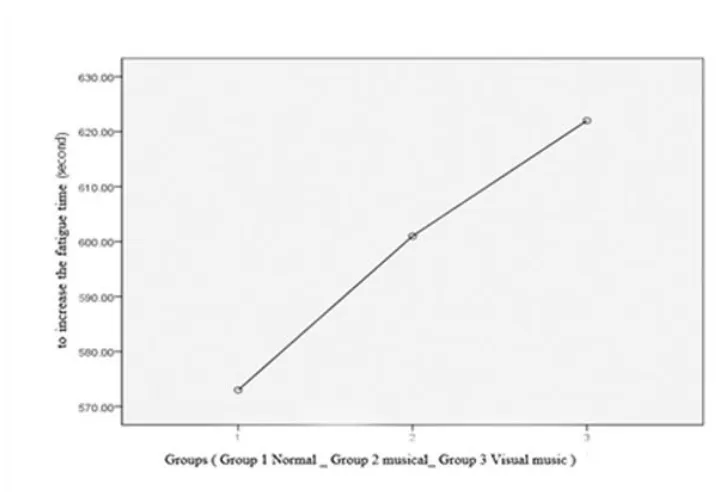
To evaluate the time to burnout, we made use of ANOVA tests with
repeated measurements for three times. Figure 1 exhibits the descriptive
characteristics and Kolmogorov-Smirnov coefficients along with a
significant level for time to burnout in 3 times. As illustrated, the distribution of burnout time is normal in all the three times (p≤0.05).
Considering the fact that the assumption of Mauchly Sphericity is not
significant for the Sphericity of the data (p≤0 / 05), Spilene Greenhouse
House Guizer was then reported to show the results of the test in the test.
The results of the ANOVA test with repeated measurements were used
to compare the aerobic performance of the individuals at the time of
burnout being measured three times. These results indicate that the
aerobic performances of the subjects at the time of burnout differ
significantly during the three stages of measurement (p = 0.039).
Moreover, there is a significant difference in the intra-group analysis
between all the stages (p = 0.039) and there is a difference between visual
and non-visual music groups at the time of reaching burnout (p = 0.007).
Concerning the perception of the exercise pressure, after 3-step
measurements, the ANOVA test with repeated measurements revealed
that the distribution of the data was normal, indicating a significant
difference (p = 0.034).
as for the heart rate and the maximum oxygen consumption after 3
measurements, the results of the ANOVA test with repeated
measurements showed that the distribution of the data was not normal
Figure 1: Comparing the effect of visual and non-visual music on the time to burnout
DISCUSSION
The results of this study approve that the effect of the visual music was more than the other two tests, while exerting a significant difference on the rate of
perceived exertion and the time to reach fatigue. Such a finding is consistent with the findings of the previous researchers, including Avinash et al. (2017), who overstated that the effects of music on the athletic performance and the heart rate of the individuals indicate that musi c can have a positive effect on the
duration of exercise while having no significant effect on the heart rate [17].
Qaderi et al. (2009) investigated the effect of the motivational music and relaxation music on the aerobic performance, the perception of the exercise pressure, and salivary cortisol in non-athlete men. All the participants with a maximum heart rate of 80-85% ran to burnout on the belt. The aerobic
performance in the motivational group was significantly more than the other two groups. In addition, 5 minutes after the end of the activity, the perceived
pressure and the concentration of the salivary cortisol in the relaxation-music group was significantly less than the other two groups [18]. This research is
consistent with the results of the present study in reducing the perception of the exercise pressure and increasing the time to burnout, which caused individuals to exercise for a longer period of time while feeling less fatigue.
Diwaliot et al. (2005) concluded that the music change the individuals’ attention from the internal factors (pain and fatigue) to the external factors which
is the same music, which will affect the level of the perceived pressure changes [19]. The results of this study are consistent with the current research in
70
By scrutinizing the performance of young subjects in maintainingthe weights by isometric methods in different conditions namely fast
and slow music, Trust and Colling (2006) overstated that in
comparison with non-music and slow music, the fast music would
increase the tolerance and endurance of any given exercise. [20]. This research is consistent with the current research in conditions of
exercising without music and with music, while showing that
exercising with music has been more effective.
John K. Mays (2003) by investigating the effect of music on
pedaling testing and Lee Crowst (2004) by examining the running performance under the condition of playing different music both
reported that even though music plays a pivotal role in motivating the
subjects in terms of performance and practice, their impacts on
physical variables such as the heart rate, the state of exhaustion and the level of perceived stress are not significant [21, 22]. This aspect of
the research shows a contradictory result with the result of the research
carried out in examining the perception of the exercise pressure and
the time to burnout due to the type of the tests taken in this research and the previous research.
Brian et al. (2017) scrutinized the effect of watching television on
gaining pleasure from the sports among the students. They declared
that those doing the sports while watching TV enjoyed more than the ones not watching TV. This led to a significant difference in
perception of the exercise pressure [23]. The current research is in
agreement with the previous research in this aspect.
Based on the results of this study, the perception of the exercise
pressure and the time to reach burnout were positively influenced by
listening to visual music as a distracting factor. When the time to reach burnout increased in the visual music stage, the perceived exercise
pressure decreased in the same stage; the inversion of these two factors imply that, despite the fact that the participants managed to continue
running more on the treadmill, less pressure was perceived in the last
stage in comparison with the previous two steps. The lack of
significant difference in maximum oxygen consumption indicates that the changes in this factor cannot be observed during one or more
sessions and are not affected by the external variables. Lack of effect
on the heart rate during the exercise should be further investigated.
This factor might have been under the effect of the maximum oxygen consumption that has not undergone any changes.