C. Dobrzynski, T. Colin & R. Abgrall, Editors
MULTISCALE EXPANSION AND NUMERICAL APPROXIMATION FOR
SURFACE DEFECTS
∗V. Bonnaillie-No¨
el
1, D. Brancherie
2, M. Dambrine
3, F. H´
erau
4, S. Tordeux
5and G. Vial
6Abstract. This paper is a survey of articles [5, 6, 8, 9, 13, 17, 18]. We are interested in the influence of small geometrical perturbations on the solution of elliptic problems. The cases of a single inclusion or several well-separated inclusions have been deeply studied. We recall here techniques to construct an asymptotic expansion. Then we consider moderately close inclusions, i.e. the distance between the inclusions tends to zero more slowly than their characteristic size. We provide a complete asymptotic description of the solution of the Laplace equation. We also present numerical simulations based on the multiscale superposition method derived from the first order expansion (cf [9]).
We give an application of theses techniques in linear elasticity to predict the behavior till rupture of materials with microdefects (cf [6]). We explain how some mathematical questions about the loss of coercivity arise from the computation of the profiles appearing in the expansion (cf [8]).
R´esum´e. Nous faisons ici une synth`ese des articles [5, 6, 8, 9, 13, 17, 18]. On s’int´eresse `a l’influence de petites perturbations g´eom´etriques sur la solution de probl`emes elliptiques. Les cas d’une inclusion isol´ee ou de plusieurs bien s´epar´ees ont ´et´e largement ´etudi´es. Nous consid´erons plus pr´ecis´ement le cas o`u la distance entre deux inclusions tend vers z´ero mais reste grande par rapport `a leur taille caract´eristique. Nous donnons un d´eveloppement asymptotique multi-´echelle complet de la solution de l’´equation de Laplace dans la situation de deux inclusions. Nous pr´esentons ´egalement quelques simu-lations num´eriques bas´ees sur une m´ethode de superposition multi-´echelle provenant du d´eveloppement au premier ordre (cf [9]).
Nous ´etendons ces techniques aux ´equations de l’´elasticit´e lin´eaire afin de pr´edire le comportement `a rupture de certains mat´eriaux pr´esentant des micro-d´efauts (cf [6]). Nous verrons ´egalement comment le calcul num´erique des profils intervenant dans le d´eveloppement asymptotique soul`eve des questions math´ematiques li´ees `a la perte de coercivit´e des probl`emes approch´es (cf [8]).
∗ This work has been supported by the ANR project
Macadamno JCJC06-139561. Is has been partially realized during the
stay of some of the authors at the CIRM in February 2008 and the authors are grateful for the very good working conditions.
1 IRMAR - UMR6625, ENS Cachan Bretagne, Univ. Rennes 1, CNRS, UEB, av Robert Schuman, 35170 Bruz, France,
2 Laboratoire Roberval - UMR6253, Universit´e de Technologie de Compi`egne, rue Personne de Roberval, BP 20529, 60205
Compi`egne Cedex, France, [email protected]
3 LMAP - UMR5142, Universit´e de Pau et des Pays de l’Adour, av de l’Universit´e, BP 1155, 64013 Pau Cedex, France,
4Laboratoire de math´ematiques Jean Leray - UMR6629, Universit´e de Nantes, 2 rue de la Houssini`ere, BP 92208, 44322 Nantes
Cedex 3, France, [email protected]
5 INRIA - IPRA, Universit´e de Pau et des Pays de l’Adour, av de l’Universit´e, BP 1155, 64013 Pau Cedex, France,
6Universit´e de Lyon - CNRS UMR 5208, ´Ecole Centrale de Lyon, Institut Camille Jordan, 36 avenue Guy de Collongue, 69134
Ecully Cedex, France, [email protected]
c
EDP Sciences, SMAI 2011
Introduction
In many physical situations, one has to consider objects whose geometry involves different scales. Typically, to the macroscopic description should be added a microscopic level of details: this is the case for granulates inside concrete, or bumps on a shell. The questions we are interested in deal in particular with mechanical properties of such materials. The mathematical modelling of these situations consists usually of a system of partial differential equations posed in a (2D or 3D) domain standing for the real geometry. While the theoretical aspects are usually unaffected by microscopic inhomogeneities, the numerics need special care. Indeed, taking into account two different scales in a finite element code requires an adapted mesh refinement in the vicinity of the defects. Resulting computations can become prohibitively costly. Hence, usually, only the macroscopic
description is preserved. The influence of local inhomogeneities on the global behavior of the material is
then ignored. We aim at designing a numerical method involving the two geometric scales, with a reasonable computational cost.
Our approach is based on a precise asymptotic analysis of the state equation with respect to the characteristic size ε of the microdefects. The limit solution asε tends to 0 corresponds to the solution in the unperturbed domain, which can be reasonably approximated with a coarse mesh. In the framework of our project, the perturbation resulting from the microdefects essentially concentrates near the latters. In a model case, it has been shown that the first corrector consists of a profile, i.e. a function defined on an infinite dimensionless domain, arising in the rapid variable x/ε, that is the scale of the perturbation. This structure suggests a numerical method based on a superposition of the unperturbed solution and the profile. The main difficulties concern the practical computation of the profiles, and the numerical analysis of the algorithmic efficiency. We propose several methods for this computation.
We derive and justify asymptotic expansions in various situations, especially to explain the influence of small inclusions close to each other. These results generalize to linear elasticity in the framework of damage structures to predict the behavior till rupture of materials with two microdefects close to each other. The multiscale superposition method is used in the preliminary step of crack detection, a continuum-discrete damage model is involved for its propagation.
The question of domains with small inclusions or inhomogeneities has been widely studied, especially in the case of electromagnetics and inverse problem, see for example [1, 2, 4, 11, 15, 20, 24, 25].
Organization of the paper
In Section 1, we deal with theoretical results about the asymptotic expansion for the Laplace equation in a domain with small perturbations. Then we apply these results to the Navier equation in the context of fracture mechanics in Section 2. In Section 3, we use the asymptotic expansion to compute the solution of these problems: it suffices to compute the solution of the non-perturbed problem and some profiles (solutions of some exterior problem) to construct a suitable approximation of the solution of the perturbed problem. We perform some simulations for the Laplace equation and for the linear elasticity problem. We also discuss about the numerical approximation of the profiles by introducing artificial boundary conditions.
1.
Asymptotic expansion for the Laplace equation
1.1.
The well-known case of one inclusion
The case of a single inclusionωbeing either in Ω0or on∂Ω0(or isolated inclusions), has been deeply studied,
see [17–19, 22]. Let us recall some results in this framework and give formally the construction of the expansion. We consider a fixed domain Ω0 in R2containing 0, and another domainω, centered at the origin 0. For anyε
small enough, we define the perturbed domain Ωε, see Figure 1, as
Ωε= Ω0\ωε, withωε=εω.
ωε
Ωε
Figure 1. One small interior inclusion.
−∆uε = f in Ωε, uε = 0 on∂Ω0, ∂nuε = 0 on∂ωε,
(1.1)
for somef ∈L2(Ω0) whose support does not contain the origin 0.
Letu0 denote the solution of the Dirichlet-Laplacian on Ω0, that is the unperturbed problem:
−∆u0 = f in Ω0, u0 = 0 on∂Ω0.
(1.2)
We can estimater0ε:=uε−u0and so prove thatu0is the first order term of the expansion ofuε. Let us explain
formally how we determine the following terms. To determine the second one, we notice thatr0ε satisfies:
−∆r0
ε = 0 in Ωε,
r0
ε = 0 on∂Ω0,
∂nr0ε = −∂nu0 on∂ωε,
where ndenotes the unit normal vector pointing intoω. To catch the following term of the expansion, we lift the Neumann conditions on∂ωε. At first order, we approximate∂nu0 on∂ωε by its Taylor expansion at 0 and
only lift the condition ∂nr0ε =−∇u0(0)·non ∂ωε. The techniques used here rely on the notion of profile, a
normalized solution of the Laplace equation in the exterior domain obtained by blow-up of the perturbation. Let us recall here a classical result about the existence and behavior of theprofile(see [3]):
Proposition 1.1. Let ω be a smooth bounded domain of R2 with 0 ∈ ω. We assume that g ∈ H−1/2(∂ω)
satisfieshg,1iH−1/2×H1/2 = 0. Then the boundary value problem
−∆V = 0 inR2 \ω, ∂nV = g on∂ω,
V → 0 at infinity,
(1.3)
admits a unique weak solutionV0 in the variational space
V ; ∇V ∈L2(R2\ω)and V
(1 +|X|) log(2 +|X|) ∈L
2( R2\ω)
.
Furthermore, this solution can be decomposed as
V0(X) = n
X
k=1
V0,k(X) +O∞(|X|−n+1), (1.4)
where V0,k is an homogeneous harmonic function of order −k and V0,k ∈ O∞(|X|−k), that is to say V0,k ∈
L(R2\ω)and for any multi-indicei∈N2, there exists a positive constant Ci,k such that
TheprofileV0 defined by (1.3) withg=−∇u0(0)·nis used in a fast variable to describe the local behavior
of the solution in the perturbed domain. Convergence of the asymptotic expansion is obtained thanks to the decay of theprofileat infinity. Thus the expansion of uε takes the form
uε(x) =u0(x) +εV0(xε) +rε1(x), withkr 1 εkH1(Ω
ε)=O(ε
2). (1.5)
To explicit the term inε2, we look at the system satisfied by r1ε:
−∆r1ε = 0 in Ωε, r1ε = −εV0(ε·) on∂Ω0, ∂nr1ε = ψε0 on∂ωε,
whereψ0ε comes from the Taylor expansion of∂nu0 around 0. Two terms have to be lifted: one in slow variable
to fulfil the Dirichlet condition on∂Ω0, one in fast variable to satisfy the Neumann condition on the inclusion.
For the first one, the model problem writes:
−∆w1 = 0 in Ω0, w1 = ϕ1 on∂Ω0,
withϕ1deduced from the behavior ofV0. For the term in fast variable, we are in the framework of Proposition 1.1
where g comes from the Taylor expansion ofu0 and the trace ofw1. By so on, we have a complete expansion
ofuε.
Theorem 1.2. For any N ∈N, the solutionuε of (1.1)reads
uε(x) =u0(x) + N
X
i=0
εi+1Vi(xε) + N
X
i=1
εi+1wi(x) +OH1(Ωε)(εN+2).
In this expansion,
• the profiles Vi, in fast variables, compensate the trace on the inclusion of thei-th term in the Taylor
expansion of u0 and the trace ofwj forj≤i,
• the profileswi, in slow variable, compensate the trace ofVj forj < ion∂Ω0.
Remark 1.3. When the inclusion lies on the boundary, the analysis can be more complicated. We refer to [17, 18] for more details.
1.2.
Two inclusions case
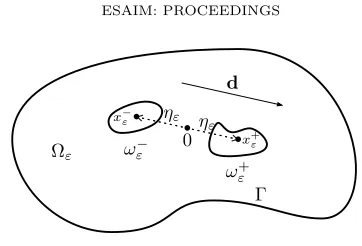
We now consider the case of two distinct inclusions inside the domain Ω0. Letω−, and ω+ be two bounded
domains ofR2, each containing the origin 0. Forε >0, small enough, we define the perturbed domain Ω ε as
Ωε= Ω0\ ω−ε ∪ωε+, withωε±=x
±
ε +εω
±, (1.6)
where x±ε =±ηεdfor a given unitary vector d, and a real numberηε. Shortly, Ωε consists of Ω0 from which
twoε-inclusions at distance 2ηεhave been removed, cf. Figure 2.
We aim at building an asymptotic expansion of the solutionuε of the Laplace problem in Ωε
−∆uε = f in Ωε, uε = 0 on∂Ω0, ∂nuε = 0 on∂ω±ε.
(1.7)
ωε−
ω+
ε
ηε η
ε Ωε Γ d x− ε•
•x+
ε 0•
Figure 2. Two inclusions of sizeε, at distance 2ηε.
The results concerning the case of one inclusion can be easily extended to the case of two (or finitely many) inclusions within two situations:
• Inclusions at distanceO(1). It corresponds toηε=η independent ofε. In this case, the centersx± are
independent ofε. The decaying profilesV0±are harmonic inR2
\ω±and satisfy the boundary conditions
∂nV0±=−∇u0(x±)·n on∂ω±.
At first order, the holes do not interact with each other, their contributions are merely superposed
uε(x) =u0(x) +ε
h
V0+(x−x+ ε ) +V
−
0 ( x−x−
ε )
i
+rε1(x), withkr1εkH1(Ω
ε)=O(ε
2). (1.8)
• Inclusions at distanceO(ε). It corresponds toηε=c εwith a constantc∈R+. Here the two inclusions
constitute a unique pattern at the scaleε. This case is actually handled as a single inclusionω=ω+∪ω−, selfsimilar with respect to the origin 0. The expansion reads
uε(x) =u0(x) +εW0(xε) +rε1(x), with krεk1 H1(Ωε)=O(ε
2), (1.9)
where the profileW0 is associated with the whole patternω.
These two situations show radically different behaviors: no interaction and full interaction. We focus now (see also [9] for more details) on the intermediate cases, where the inclusions aremoderately close, as illustrated in Figure 2: the distance between the two inclusions equalsεαwithα∈(0,1). The limit caseα= 0 corresponds to inclusions at distanceO(1) while the other limitα= 1 corresponds to inclusions at distanceO(ε) . We proceed exactly as for the case of one inclusion. We considerr0
ε:=uε−u0 which satisfies:
−∆r0
ε = 0 in Ωε,
r0
ε = 0 on∂Ω0,
∂nr0ε = −∂nu0 on∂ω+ε ∪∂ω−ε.
(1.10)
We introduce theprofilesV0± defined by (1.3) withω=ω± and write:
uε(x) =u0(x) +ε
h
V0−x−x − ε
ε
+V0+x−x+ε
ε
i
+rε1(x).
We check that r1
ε satisfies
−∆r1
ε = 0 in Ωε,
rε1(x) = −εhV0−x−x − ε
ε
+V0+x−x+ε
ε
i
forx∈∂Ω0, ∂nrε1(x) = n· ∇u0(0)−n· ∇u0(x)−n· ∇V0−
x−x− ε
ε
forx∈∂ωε+, ∂nrε1(x) = n· ∇u0(0)−n· ∇u0(x)−n· ∇V0+
x−x+ ε
ε
forx∈∂ωε−.
To determine the order of the remainder, we need more information about the behavior of the trace of r1 ε on
the boundaries. Using Proposition 1.1, we know the behavior ofV0±. Consequently,
• whenx∈∂Ω0,|x−x±ε| has an expansion into powers ofε
αand then there existf
j,k such that we can
rewrite
rε1(x) = X j≥1,k≥0, j+αk≤N
εj+αkfj,k(x) +O(εN), ∀x∈∂Ω0. (1.12)
• whenx=±εαd+εX ∈∂ω±
ε,|x−x±ε|admits an expansion into powers ofε1−α and then we deduce
∂nr1ε(x) =
X
j≥0,k≥0, 0<j+αk≤N
εj+αkg±j,k(X) + X
2≤j≤1N−α
εj(1−α)h∓j(X) +O(εN), (1.13)
where the functions gj,k± come from the Taylor expansion of u0 and h∓j from the trace of the profiles V0∓. These functions satisfy the compatibility conditions
Z
∂ω±
gj,k± (X)dσX= 0 and
Z
∂ω±
h∓j(X)dσX = 0. (1.14)
At this step, we have to lift each boundary condition appearing in (1.12) and (1.13). The functions fj,k
introduced in (1.12) generate correctorsFj,k defined by
−∆Fj,k = 0 in Ω0, Fj,k = −fj,k on∂Ω0.
(1.15)
These correctors do not satisfy the Neumann condition on the boundary of the inclusions∂ω±ε and so generate errors on these boundaries. The functionsg±j,kandh∓j generate profilesG±j,kandHj∓ with same behavior as the first corrector. These profiles satisfy:
−∆G±j,k = 0 in R2 \ω±, ∂nG±j,k = −g
±
j,k on∂ω
±,
G±j,k → 0 at infinity,
−∆Hj∓ = 0 in R2\ω±, ∂nHj∓ = −h
∓
j on∂ω
±,
Hj∓ → 0 at infinity.
(1.16)
Then we can give the following term of the expansion ofuε, iterate the procedure and prove the theorem:
Theorem 1.4. The solutionuε of problem (1.7)admits the expansion at order N
uε(x) =u0(x) +ε
h
V0− x−x−ε
ε
+V0+ x−x+ε
ε
i
+ X
(p,q)∈KN
εp+αqvp+αq(x) +ε
h
Vp+αq− x−x−ε
ε
+Vp+αq+ x−x+ε
ε
i
+rNε(x), withkrεNkH1(Ωε)=O(εN),
and
KN =(p, q)∈Z2|p≥0, q≥ −32p+ 1, q≥ −pandp+αq≤N .
The terms vp+αq,Vp+αq± are built inductively as explained before.
Remark 1.5. Considering only the first profilesV0±, we have the expansion
uε(x) =u0(x) +ε
h
V0− x−x − ε
ε
+V0+ x−x+ε
ε
i
+r1ε(x), with kr 1 εkH1(Ω
ε)=O(ε
min(1+α,3−2α)
We may understand expansion (1.17) in the following way: the main contribution of the two inclusions is
merely the superposition of their individual effects. The remainder r1
ε contains information about higher-order
influence. It is interesting to describe further the structure of this remainder:
• forα <2/3, the inclusions are relatively far away from each other. The leading term inr1
ε isO(ε1+α)
and arises from the Taylor expansion ofu0 at the origin0;
• for 2/3< α < 1, the inclusions are closer. The remainder r1
ε is O(ε3−2α)and mainly consists in the
interaction between the profilesV0− andV0+;
• forα= 2/3, the two contributions are equally balanced.
Remark 1.6. In the previous discussion, we restricted to twodimensional domains and homogeneous Neumann
boundary conditions on∂ωε±, although generalizations to other conditions are possible. In particular, our results
easily extend to Neumann boundary conditions in dimensiond≥2and Dirichlet conditions in dimensiond≥3.
The Dirichlet case in dimension 2 raises non trivial difficulties due to the increasing logarithmic potential.
Besides, one of the inclusions may be localized at the boundaryΓofΩ0(or even simply be removed, the remaining
inclusion moving towards the external boundary). The origin does not belong to the domains themselves anymore, but only to their closure (see [9]).
2.
Extension to linear elasticity
In this section, we state the asymptotic result for the linear elasticity equations. The procedure used for the Laplacian still holds for the Navier equations. Such an analysis is useful in the framework of mechanical engineering for elastic structures with small inhomogeneities, when considering their behavior till rupture. Our aim is to design a numerical strategy dealing with a coarse discretization of the unperturbed domain and able to perform the analysis of the structural response from the elastic phase to complete failure. To that purpose, we consider two macroscopic models dedicated to each of the two phases of the behavior:
• the asymptotic analysis is used to evaluate the influence of the presence of micro-defects on the solution,
• the strong discontinuity approach allows taking into account, at the structural scale, the development of localization zones or cohesive cracks, see [14].
In this paper, we only present results concerning the first phase for the evaluation of stress concentration due to the presence of geometrical defects. We refer to [6, 12, 13] for a more complete presentation.
We evaluate the influence of geometrical perturbations by a multiscale asymptotic analysis of the equations of linear elasticity. The inclusions are assumed to be located on the boundary.
Let Ω0 be a domain of R2 such that the regular point 0 belongs to the boundary and we assume that the
boundary coincides with the abscissa axis in a small neighbourhood of 0. The case of a single perturbation was presented in [13]. We present the case of two relatively close inclusions here (see [6] for more details). We consider a domain Ωεpierced with two perturbations of sizeεnear 0:
Ωε= Ω0\ωε1∪ωε2, with ω j ε=x
j ε+εω
j, x1 ε=ε
αdandx2 ε=−ε
αd, α
∈(0,1).
We assume that ωj contains 0 and d is the tangent vector of the boundary on 0. We denote by Hj∞ the
unbounded domains obtained by a blow-up around each perturbation:
Hj∞=R×R+\ωj.
The problem we focus on is written on the perturbed domain as:
−µ∆uε−(λ+µ)∇divuε = 0 in Ωε, uε = ud on Γ
d, σ(uε)·n = g on Γn,
where Γd and Γn denote the Dirichlet and Neumann boundary of the domain respectively, Γn includes the
boundary of the perturbation andgis supposed to be zero in a neighborhood of the perturbation. In the former equation,uεdenotes the displacement andσstands for the stress tensor:
σij(u) =λ(∂1u1+∂2u2)δij+µ(∂iuj+∂jui).
The solution of (2.1) is given at first order by
uε(x) =u0(x)−ε 2
X
j=1
α1vj1
x
−xj ε ε
+α2vj2
x
−xj ε ε
+Oεmin(1+α,3−2α), (2.2)
with u0 the solution on the unperturbed domain,α1 =σ11(u0)(0) and α2 =σ12(u0)(0). The profiles v j 1 and
vj2 are obtained as solution of an homogeneous Navier equation stated on the unbounded domain Hj
∞ with Neumann boundary conditions on the boundary of the normalized perturbation:
−µ∆v`j−(λ+µ)∇divv`j = 0 inHj
∞, σ(vj`)·nj = Gj
` on∂H j
∞,
v`j → 0 at infinity,
(2.3)
withGj1= (nj1,0),Gj2= (0,nj1) andnj1 the first component of the outer normal to∂Hj
∞.
3.
Numerical computations
3.1.
Superposition method
The computation of the solutionuεof problem (1.7) (or in a same way of (2.1)) is not straightforward since
a very fine mesh is required if ε is small. For such values ofε, it is natural to use the asymptotic expansion. Precisely, we approximateuεby its first order expansion
u1(x) =u0(x) +ε
h
V0− x−x−ε
ε
+V0+ x−x+ε
ε
i
. (3.1)
This means thatu0and the profiles V0± have to be computed. Whileu0 is the solution of a classical boundary
value problem (in an ε-independent domain which may be coarsely meshed), the profiles are solution of a
problem posed on an infinite domain. The computation of the profiles in a reference geometry has been done (once and for all if the shape of the defects is prescribed) by a finite element computation in a bounded domain with an approximate boundary condition on an artificial boundary (see next section).
In the context of fracture mechanics, we aim at predicting the behavior of damage structures till rupture under the presence of geometrical defects in the material. The asymptotic expansion (2.2) is used to compute the displacement field without meshing to the scale of the small holes or inhomogeneities. The superposition formula (2.2) is not necessarily suited for implementation in an existing finite element code. Indeed, we have preferred a kinematic enrichment of the approximation space through partition of unity, see [16, 23].
The displacement field discretisation is then of the form:
uh(x) =uh0(x)−ε 2
X
j=1 2
X
`=1
X
i∈Jj
Ni(x)hαji`,1˜v`,1j x−xjε
ε
+αji`,2˜vj`,2 x−xjε
ε
i
, (3.2)
whereJj denotes the indices of the nodes located in the enrichment zone related to perturbationj. Ni are the
standard shape functions associated to nodeiandαji`,k is a two-component vector consisting of the degrees of
freedom related to the enrichment function ˜vj`,k, obtained as approximations of the profilesv`j.
3.2.
Computation of the profiles
The problem defining the profiles is set in an unbounded domain. We use articifial boundary conditions to obtain an accurate approximation of the profiles. The numerical results shown hereafter have been performed with the Finite Element LibraryM´elina, see [21].
Laplace equation.
Let us first consider the computation of profiles satisfying (1.3) in the case of the Laplacian. In order to compute the profiles V0± involved in formula (3.1), we introduce the normalized vectorial profile V = Vω, solution of the following exterior boundary value problem
−∆V = 0 inR2\ω,
∂nV = g on∂ω,
V → 0 at infinity,
withg=−n. We can recoverV0± from Vω± via the formulaV0±=∇u0(0)·Vω±,so that formula (3.1) reads u1(x) =u0(x) +ε∇u0(0)·
h
Vω− x−x − ε
ε
+Vω+ x−x + ε
ε
i
. (3.3)
The profile V will be approximated componentwise: V and g denote the first component of V and g,
respectively (of course, the same can be done for the second component). Several approaches are available to compute V: integral equation, infinite elements, truncated domain with integral representation or artificial boundary condition. To determine an artificial boundary condition, we seek a linear combination of V and its normal and tangent derivatives for which the expansion into powers ofRat infinity starts withR−pfor various
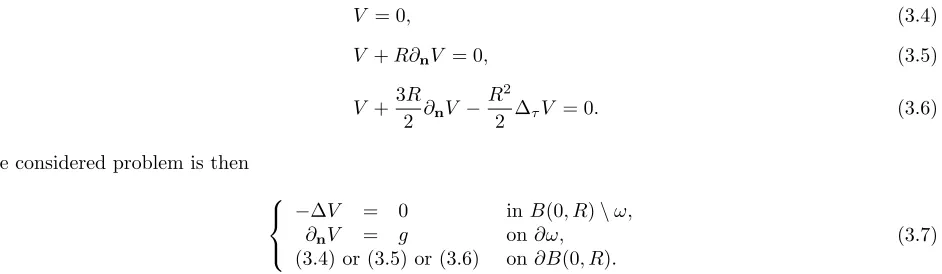
value of the order p. Forp= 0, 1, 2, we obtain Dirichlet, Robin, and Ventcel conditions respectively:
V = 0, (3.4)
V +R∂nV = 0, (3.5)
V +3R 2 ∂nV −
R2
2 ∆τV = 0. (3.6)
The considered problem is then
−∆V = 0 in B(0, R)\ω,
∂nV = g on∂ω,
(3.4) or (3.5) or (3.6) on∂B(0, R).
(3.7)
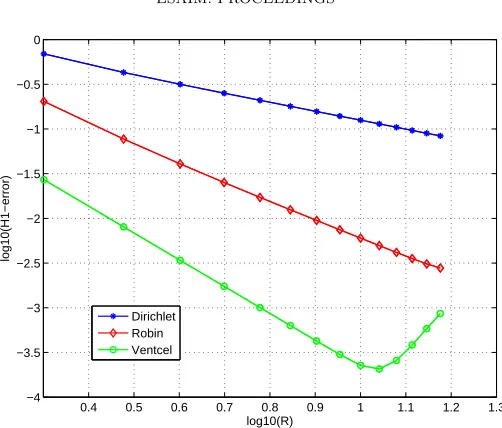
Figure 3 gives the convergence for these three conditions asR goes to infinity in the model case of ring with internal radius 1 and external radiusR. The domain is meshed into 64 square elements of degree Q8, a
non-isoparametric interpolationQ10is performed. We compare the solution of (3.7) to a reference computation and
observe the slopes 1, 2, 3 as expected. We notice that the Ventcel condition (3.6) is not satisfactory when R
becomes large, due to the unaccurate approximation of the tangential derivative (this could be improved with a finer mesh).
Navier equations.
0.4 0.5 0.6 0.7 0.8 0.9 1 1.1 1.2 1.3 −4
−3.5 −3 −2.5 −2 −1.5 −1 −0.5 0
log10(R)
log10(H1−error)
Dirichlet Robin Ventcel
Figure 3. Convergence of the approximate problems (3.7) with a fixed number of DOF.
leads to a more accurate boundary condition (see [5, 7, 10])
σ(u)n+ 1
R E
1 +ν
1
1−ν 0
0 1
u+
1
R
E(1−ν) 2(1 +ν)(1−2ν)
0 0
0 1
∆τu= 0, (3.8)
set on the circle of radius R. The physical parameters E and ν are such that the quantity in front of the
Laplace-Beltrami operator is nonnegative: Young’s modulusE is nonnegative and Poisson’s coefficientν takes values in the interval (−1,0.5). We have the following relations between the coefficients:
λ= νE
(1 +ν)(1−2ν), µ=
E
2(1 +ν).
The problem (3.8) is degenerate and we have to prove the existence of solution. To this purpose, we study in [8] the case of the Laplace operator as a model problem. We focus on the Ventcel boundary value problem for Laplace operator such as
−∆u = 0 in Ω, ∂nu+αu+β∆τu = ϕ on∂Ω,
(3.9)
under the unusual condition β >0. We reformulate the boundary value problem into a nonlocal equation on
the boundary ∂Ω. For this, we introduce the Dirichlet-to-Neumann map Λ associated to the Laplace operator
on Ω: this operator is defined from H1/2(∂Ω) onto H−1/2(∂Ω) by Λ(ψ) =∂
nU where U is the solution of the
boundary value problem
−∆U = 0 in Ω,
U = ψ on∂Ω.
The introduction of the Dirichlet-to-Neumann map allows us to rewrite (3.9) as the surface equation
β∆τw+ Λw+αw=ϕon∂Ω. (3.10)
Pseudodifferential and spectral techniques lead to existence and uniqueness results apart from exceptional cases. Then, we consider perforated geometries and give conditions to remove the genericity restriction.
3.3.
Numerics
Laplace equation
Let us present numerical simulations for the Laplace problem (1.7). To compare uε and its 0-th and first
order approximations, we need to computeuεaccurately. Figure 4 shows the differencesuε−u0 anduε−u1on
the example of two ellipses. The value ε= 0.0585 is relatively large for visibility reasons, but nevertheless the approximation given by the first order approximationu1is much better thanu0. The principal error inuε−u0
is mainly concentrated around the holes, it is partially corrected inuε−u1. In Figure 5, we present the errors
(a)uε−u0. (b)uε−u1.
Figure 4. uε−u0 anduε−u1forε= 0.0585 andα= 0.5.
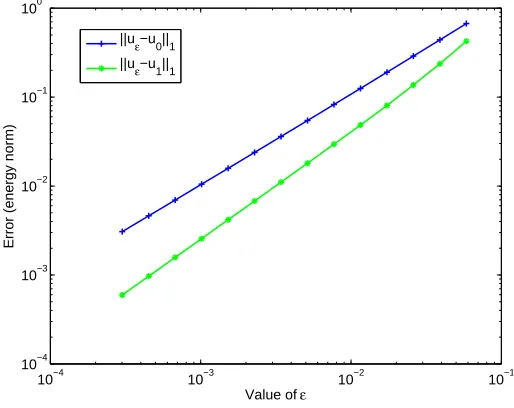
(in the H1(Ω
ε)-norm) obtained for the two approximationsu0 andu1 in the case where the two inclusions are
ellipses, and α = 0.2. When we compute the local convergence rates as the slopes between two consecutive
points in Figure 5, we recover the expected rate 1 +α= 1.2 foruε−u1, cf. expansion (1.17).
10−4 10−3 10−2 10−1
10−4
10−3
10−2
10−1
100
Value of ε
Error (energy norm)
||uε−u
0||1
||uε−u
1||1
ESAIM: PROCEEDINGS 33
Navier equation
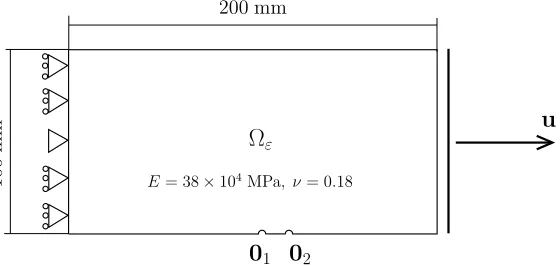
We present now the results obtained considering a domain submitted to a tensile load (Figure 6(a)). The domain is pierced by two perturbations: the first one is centered at point O1= (105,0) and is of radius 2 mm
and the second of radius 1.5 mm is centered at pointO2= (135,0).
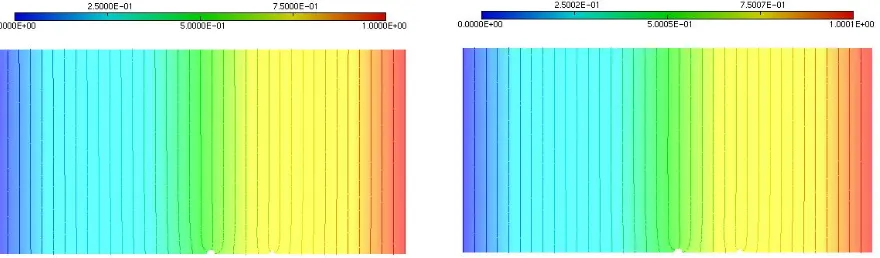
In order to validate the enrichment strategy adopted for the description of the influence of small defects, we compare the results obtained in terms of displacement and stress fields for a so called reference computation carried out on a fine discretization of the real geometry (Figure 6(b)) by standard Finite Element approach, and an enriched computation performed on a coarse discretization (Figure 6(c)) of the unperturbed domain.
Figure 7 gives the obtained results in terms of the displacement field in the direction of the traction for both discretization and interpolations. The relative error between those two computations is lower than 0.25% allowing to conclude that the proposed strategy gives satisfactory results.
19 `eme Congr`es Franc¸ais de M´ecanique Marseille, 24-28 aoˆut 2009
Ω
ε0
10
2E= 38×104MPa, ν= 0.18
u
10 0 m m 200 mmFIG. 3 – D´efinition du probl`eme mod`ele.
0 20 40 60 80 100 120 140 160 180 200 0 10 20 30 40 50 60 70 80 90 100
(a) maillage fin
0 50 100 150 200 0 20 40 60 80 100
(b) maillage grossier
FIG. 4 – Maillages utilis´es
4
(a) Problem definition: geometry, loading and material properties 19 `eme Congr`es Franc¸ais de M´ecanique Marseille, 24-28 aoˆut 2009
Ω
ε0
10
2E = 38×104MPa, ν = 0.18
u
10
0
m
m
200 mm
FIG. 3 – D´efinition du probl`eme mod`ele.
0 20 40 60 80 100 120 140 160 180 200 0 10 20 30 40 50 60 70 80 90 100
(a) maillage fin
0 50 100 150 200
0 20 40 60 80 100
(b) maillage grossier
FIG. 4 – Maillages utilis´es
4
(b) Fine discretization of the domain (reference computation)
Ω
ε0
10
2E = 38×104 MPa, ν= 0.18
u
10
0
m
m
200 mm
FIG. 3 – D´efinition du probl`eme mod`ele.
0 20 40 60 80 100 120 140 160 180 200
0 10 20 30 40 50 60 70 80 90 100
(a) maillage fin
0 50 100 150 200
0 20 40 60 80 100
(b) maillage grossier
FIG. 4 – Maillages utilis´es
4
(c) Coarse mesh for computation ofuh ε
Figure 6. Problem definition: geometry, loading, material properties and discretizations
References
[1] H. Ammari, E. Bonnetier, Y. Capdeboscq, M. Tanter, M. Fink. Electrical impedance tomography by elastic deformation.
SIAM J. Appl. Math.68(6) (2008) 1557–1573.
[2] H. Ammari, H. Kang, M. Lim, H. Zribi. Layer potential techniques in spectral analysis. I. Complete asymptotic expansions for eigenvalues of the Laplacian in domains with small inclusions.Trans. Amer. Math. Soc.362(6) (2010) 2901–2922. [3] C. Amrouche, V. Girault, J. Giroire. Dirichlet and Neumann exterior problems for then-dimensional Laplace operator:
an approach in weighted Sobolev spaces.J. Math. Pures Appl. (9)76(1) (1997) 55–81.
[5] V. Bonnaillie-No¨el, D. Brancherie, M. Dambrine, G. Vial. Artificial boundary conditions to compute correctors in linear elasticity.Submitted(2011).
[6] V. Bonnaillie-No¨el, D. Brancherie, M. Dambrine, S. Tordeux, G. Vial. Effect of micro-defects on structure failure : coupling asymptotic analysis and strong discontinuity approach.Eur. Journal Comput. Mech.19(1-3) (2010) 165–175. [7] V. Bonnaillie-No¨el, M. Dambrine, F. H´erau, G. Vial. Absorbing conditions for the linear elasticity equations.In
prepa-ration(2011).
[8] V. Bonnaillie-No¨el, M. Dambrine, F. H´erau, G. Vial. On generalized Ventcel’s type boundary conditions for Laplace operator in a bounded domain.SIAM J. Math. Anal.42(2) (2010) 931–945.
[9] V. Bonnaillie-No¨el, M. Dambrine, S. Tordeux, G. Vial. Interactions between moderately close inclusions for the Laplace equation.Math. Models Methods Appl. Sci.19(10) (2009) 1853–1882.
[10] V. Bonnaillie-No¨el, M. Dambrine, G. Vial. Small defects in mechanics.AIP Conference Proceedings ICNAAM 20111389 (2011) 1416–1424.
[11] E. Bonnetier, M. Vogelius. An elliptic regularity result for a composite medium with “touching” fibers of circular cross-section.SIAM J. Math. Anal.31(3) (2000) 651–677 (electronic).
[12] D. Brancherie, M. Dambrine, G. Vial, P. Villon. Ultimate load computation, effect of surfacic defect and adaptative techniques. In7th World Congress in Computational Mechanics, Los Angeles 2006.
[13] D. Brancherie, M. Dambrine, G. Vial, P. Villon. Effect of surface defects on structure failure: a two-scale approach.Eur.
Journal Comput. Mech.17(5-7) (2008) 613–624.
[14] D. Brancherie, A. Ibrahimbegovi´c. Novel anisotropic continuum-discrete damage model capable of representing localized failure of massive structures. Part I: theoretical formulation and numerical implementation.Engineering Computations26(1-2) (2009) 100–127.
[15] Y. Capdeboscq, M. Vogelius. A general representation formula for boundary voltage perturbations caused by internal conductivity inhomogeneities of low volume fraction.M2AN37(1) (jan 2003) 159–173.
(a) Reference computation on the fine discretization (b) Computation with kinematic enrichment on the coarse discretization
(c) Relative error
[16] E. Chahine, P. Laborde, J. Pommier, Y. Renard, M. Sala¨un. Study of some optimal XFEM type methods. InAdvances
in meshfree techniques, volume 5 ofComput. Methods Appl. Sci., pages 27–38. Springer, Dordrecht 2007.
[17] M. Dambrine, G. Vial. Influence of a boundary perforation on the Dirichlet energy.Control Cybernet.34(1) (2005) 117–136. [18] M. Dambrine, G. Vial. A multiscale correction method for local singular perturbations of the boundary.M2AN Math. Model.
Numer. Anal.41(1) (2007) 111–127.
[19] A. M. Il0in. Matching of asymptotic expansions of solutions of boundary value problems, volume 102 of Translations of Mathematical Monographs. American Mathematical Society, Providence, RI 1992.
[20] T. Lewi´nski, J. Soko lowski. Topological derivative for nucleation of non-circular voids. The Neumann problem. InDifferential geometric methods in the control of partial differential equations (Boulder, CO, 1999), volume 268 ofContemp. Math., pages 341–361. Amer. Math. Soc., Providence, RI 2000.
[21] D. Martin.M´elina, biblioth`eque de calculs ´el´ements finis. http://perso.univ-rennes1.fr/daniel.martin/melina(2008).
[22] V. Maz0ya, S. Nazarov, B. Plamenevskij.Asymptotic theory of elliptic boundary value problems in singularly perturbed domains. Vol. I, volume 111 ofOperator Theory: Advances and Applications. Birkh¨auser Verlag, Basel 2000.
[23] J. M. Melenk, I. Babuˇska. The partition of unity finite element method: basic theory and applications.Comput. Methods Appl. Mech. Engrg.139(1-4) (1996) 289–314.
[24] S. A. Nazarov, J. Soko lowski. Asymptotic analysis of shape functionals.J. Math. Pures Appl. (9)82(2) (2003) 125–196. [25] M. S. Vogelius, D. Volkov. Asymptotic formulas for perturbations in the electromagnetic fields due to the presence of