ISSN 0975-928X
Research Article
Heterosis for pod yield and its component traits in groundnut
(Arachis hypogaea L.)
B.D. Waghmode1*, A.B. Kore2, V.C. Navhale3, N.G. Sonone4 and S.G. Bhave
1,3,4
Agricultural Research Station, Shirgaon, Dist. Ratnagiri - 415 629 (MS) 2,5
Department of Agricultural Botany, Collage of Agriculture, Dapoli-415 712. * Email : [email protected]
(Received: 11 July 2017; Revised: 31 Oct 2017; Accepted: 21 Dec 2017)
Abstract
Twenty F1s were developed by utilizing nine diverse parents 4 lines and 5 testers in Line x Testers mating design During
Kharif 2015. The estimates of mean sum of squares due to male, female, male vs female, hybrids and parents vs hybrids showed significant variation. Large numbers of heterotic crosses were observed in most of the characters. The maximum positive standard heterosis for dry pod yield plant-1 (g) over best check TKG-Bold was observed in RHRG 6083 x TAG 24 (63.31%) followed by RHRG 6083 x JL 777(54.14%) and RHRG 1225 x TAG 24 (42.07%) and significant heterosis for other yield contributing traits viz., number of primary branches plant-1, number of pods plant-1, number of kernels pod-1, dry haulm yield plant-1, 100 kernel weight and shelling percentage. The maximum negative standard heterosis for days to maturity over best check TKG-Bold was observed in TG 37A x ICG 2630 18.61%) followed by RHRG 1225 x TAG 24 (-12.50) and TG 37A x JL 777(-11.67). The combinations viz., RHRG 6083 x TAG 24, RHRG 6083 x JL 777 and RHRG 1225 x TAG 24 could be utilize for selection of desirable segregants in further segregating generations
.
Key words
Groundnut, heterosis, hybrids, line × tester analysis.
Introduction
The cultivated groundnut (Arachis hypogaea L.; Family Leguminosae), native to Brazil in South America is one of the most important oilseeds and food crop of the world. It is cultivated in more than 100 countries on 26.54 m hectare area with an annual production of 43.91 m tonnes and productivity of 1655 kg/ha (FAOSTAT, 2015). In India, groundnut is grown on 4.77 m hectare area with the production of 7.40 m tonnes (FAOSTAT, 2015). The productivity of groundnut in India is low (1552 kg/ha) compared to Israel (7389 kg/ha), USA (4397 kg/ha), China (3492 kg/ha) and Argentina (2848 kg/ha) (FAOSTAT, 2015). Groundnut kernels are regarded as healthy foods as their nutrient profile is balanced (Arya et al., 2016). The kernels contain 48-50% oil, 10-20% carbohydrates, and 25-28% easily digestible protein, and provides 564 kcal of energy for every 100 g of kernels (Arya et al., 2016)
Most of the groundnut breeding programmes aimed at improving productivity have been directed towards hybridization followed by selection in segregating generation. Since groundnut is a predominately self pollinated crop and commercial product of F1 seed is not currently feasible, it was felt that heterosis in groundnut is unstable. However, the magnitude of heterosis provide the basis of genetic diversity and a guide for choice of desirable parents for developing superior F1 hybrids to exploit hybrid vigour and are building gene pool to be employed in breeding
programme. Heterosis in F1 generation expressed in terms of superiority over the better / mid-parent/standard parent is of direct relevance not only for developing hybrids in cross-pollinated crops, but also in self pollinated crops because heterotic crosses help the breeder to select appropriate crosses which would lead to desirable transgressive segregants in advanced generations (Arunachalam et al., 1984). Stokes and Hull (1930) first observed the manifestation of heterosis for different traits in groundnut. Since then, several investigators reported heterosis for yield and its components in groundnut (Deshmukh et al., 1985 and Dwivedi et al., 1994). According to the available evidence, heterosis in groundnut is related to the parental genetic diversity. Promising F1s with desirable traits may be advanced further to obtained transgressive segregants. Therefore with present study, the magnitude of heterosis for pod yield and other physiology traits were studied in 20 crosses of groundnut.
Materials and Methods
ISSN 0975-928X
http://ejplantbreeding.com 1141
November 2015 at the Experimental Farm of Agricultural Research Station, Shirgaon (Ratnagiri). The experiment was laid out in completely randomized block design with 3 replications. The experiment was sown with three rows of three meter length. The row to row spacing was 30 cm and 10 cm between plant to plant. The recommended fertilizer at the rate of 25 kg N and 50 kg P2O5 along with 5 tonns of FYM per hectare were applied at the time of sowing. All other recommended practices and plant protection measures were adopted to raise healthy crop. The observations were recorded on five randomly selected competitive plants in parents and F1s. Heterosis over better parent (BP) as per Fonseca and Patterson (1968) was calculated, while standard heterosis (SH) using two varieties TKG-Bold and Konkan Gaurav as standard check was calculated as per Meredith and Bridge (1972).
Result and discussion
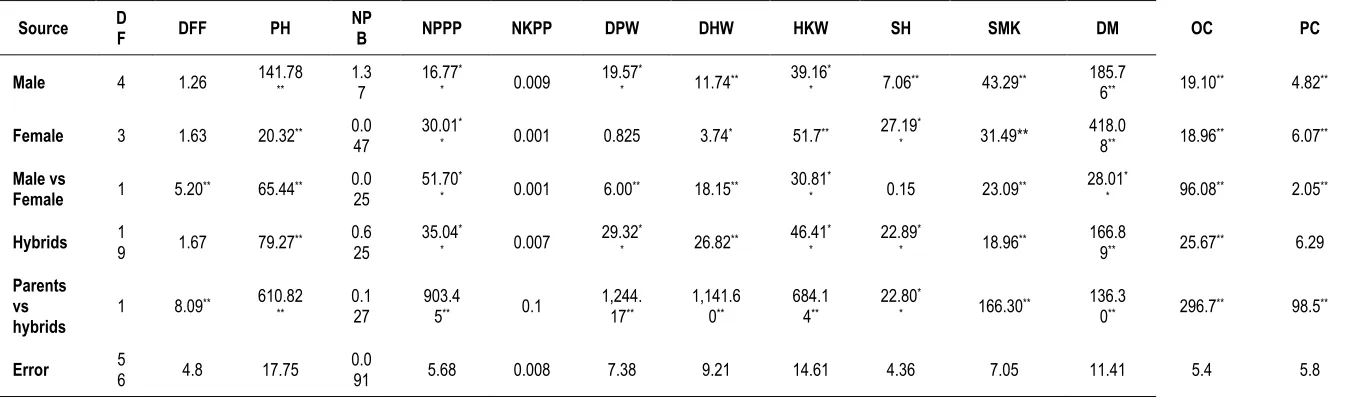
The estimates of mean sum of squares (Table 1) due to male, female, male vs female, hybrids and parents vs hybrid showed significant variation for most of the characters studied indicating the presence of significant variation among the genotypes as well as crosses studied. The significant variations were showed by the characters viz., plant height (cm), number of pods plant-1, dry pod yield plant-1 (except female),dry haulm weight plant-1, hundred kernel weights (g), shelling percentage % (except Males vs Female), sound mature kernel (%), oil content (%) and protein content % (except Parents vs Hybrids). For the traits days to fifty per cent flowering source of variation due to male vs female and parents vs hybrid were significant. Considerable genetic variation for various traits including pod yield have been reported by many workers (Golakia al. 2005; Khote et al. 2009).
In present investigation, heterosis was recorded over better parent, and two standard checks TKG Bold and Konkan Gaurav (SC-I and SC-II). The range of standard heterosis and number of hybrids showing desirable significant heterosis over better parents and standard checks are presented in Table 2. The important three best promising cross combinations, their heterobeltiosis and standard heterosis for various traits are presented in Table 3. Positive heterosis was considered as desirable for the yield contributing characters while negative heterosis is considered as desirable for the characters days to 50 per cent flowering, plant height and days to maturity. The significant negative heterosis for days to 50% flowering was observed in 1 and 19 hybrids over better parent and TKG Bold respectively. The cross RHRG 6083 X RTNG 29 recorded maximum negative heterosis over standard check-I (TKG Bold,-15.66) and standard check-II (Konkan Gaurav, -4.11). The standard heterosis ranged from -15.66 to 12.06.
Earliness is desirable character helps to develop early varieties. The early flowering in hybrids has also been reported by Khote et al., 2009. Large numbers of heterosis crosses were observed in most of the characters.
ISSN 0975-928X
The range of standard heterosis for 100 kernel weight was -27.72 to 25.24% over check. The maximum positive standard heterosis for 100 kernel weight (g) was recorded by the RHRG 6083 X KDG 209 over Konkan Gaurav was 14.65%. The significant positive heterosis for 100 kernel weight was observed in 10, 0 and 6 hybrids over better parent, TKG Bold and Konkan Gaurav respectively. The maximum positive standard heterosis was recorded for shelling percentages by the RHRG 1225 X ICG 26 over TKG Bold and Konkan Gaurav were 9.84 and 6.84% respectively. Estimate of standard heterosis for shelling percent were significant and positive in 3, 12 and 4 hybrids over BP, SH-I and SH-II. These results are comparable with the work done by Gor et al. (2012) and John et al. (2014).
The extent of standard heterosis for sound mature kernel (%) ranged from -8.23 to 11.03% over check. The cross TG 37A X TAG 24 recorded maximum positive heterosis over better parent (9.87%), TKG Bold (4.49%) and Konkan Gaurav (0.16%). The significant negative heterosis for days to maturity was observed in 3, 10 and 6 hybrids over better parent TKG Bold and Konkan Gaurav respectively. The cross TG 37A X ICG 2630 recorded maximum negative heterosis over TKG Bold 18.61%) and Konkan Gaurav (-16.05%). The standard heterosis over the check ranged from -23.06 to 10.97%. The early maturity in hybrids was also been reported by John et al. (2014), Arunachalam et al. (1984), Jayalakshmi et al. (2000). Thirteen crosses showed significant positive heterosis for oil content over TKG Bold with the range of -13.32 to 20.03%. The maximum positive standard heterosis for oil content was recorded by RHRG 6083 X ICG 2630 (13.84%) followed by RHRG 1225 X TAG 24 (10.26%) over check TKG Bold. The cross Konkan Gaurav X TAG 24 exhibited maximum standard heterosis for protein content (%) over TKG Bold (18.66%) and Konkan Gaurav (11.70%). The significant positive heterosis was observed for protein content in 9 hybrids over TKG Bold.
Improvement in a complex attribute like pod yield may be convenient if breeding programme will be made through attributing agro economical characters. The utility of hybrid breeding approach lies in the identification of most heterotic and useful cross combinations. Three hybrids were identified which were found superior than their respective better parents as well as standard checks in respect of dry pod weight plant-1. The best three hybrids on the basis of heterosis over high yielding standard checks TKG Bold and Konkan Gaurav were, RHRG 6083 x TAG 24 (I = 63.31%, SC-II = 82.94%), RHRG 6083 x RTNG 29 (SC-I = 57.41%, SC-II = 76.33%), and RHRG 6083 x JL 777 (SC-I = 54.14%, SC-II = 72.66%). The comparison of three crosses with high heterobeltiosis for pod yield with other yield
attributing traits (Table 4) revealed that manifestation of heterosis for pod yield by RHRG 6083 X TAG 24, also showed heterotic effect for days to 50% flowering, plant height, number of pod plant-1, number of kernels plant-1, dry haulm yield plant-1 and shelling percentage. Similarly, heterosis for pod yield by RHRG 6083 X RTNG 29, also showed heterotic effect for number of primary branches plant-1, number of pods plant-1, number of kernels pod-1 and dry haulm yield plant -1
. Also heterosis for pod yield by RHRG1225 X TAG 24 showed desirable heterotic effect for plant height, number of primary branches plant-1, number of pods plant-1 and dry haulm yield plant-1. Such varying heterotic effect exhibited by different character were reported by Gor et al. (2012), Boraih et al. (2012), Wyne et al. (1970), John et al. (2014), Azad et al. (2014), Arunachalam et al. (1984), Jayalakshmi et al. (2000).
The findings revealed that both additive and non-additive gene effects are main genetic components which controls pod yield and its contributing characters. The efforts can be made to develop multiple crosses among desirable F1s, following some sort of inter mating, which will considerably increase the frequency of potential and desirable transgressive segregants in the segregating generations. These segregating generations are to be subjected to intensive objective oriented selection for crop improvement.
References
Arya, S.S., Salve, A.R. and Chauhan, S. 2016. Peanuts as functional food: a review. J. Food Sci. Technol., 53: 31–41.
Arunachalam,V., Bandyopadhyay, A., Nigam, S.N. and Gibbons, R.W. 1984. Heterosis in relation to genetic divergence and specific combining ability in groundnut (Arachis hypogaea L.).
Euphytica., 33(1): 33-39.
Azad, A.K. Alam, S., Hamid, A., Rafii, Y. and Malek, M.A. 2014. Combining ability of pod yield and related traits of groundnut (Arachis hypogaea L.) under Salinity Stress. The Scientific World Journal,7(3): 1-7.
Deshmukh, S. K., Zade, V.R., Reddy, P.S., 1985. Heterobeltiosis in groundnut. Indian J. Agric. Sci. 85, 358-361.
Dwivedi, S. L., Nagabhushanam, G.V.S., Nigam, S.N., Raghunath, K., Jambhunathan, R., 1994. Germplasm enhancement for seed quality traits in groundnut. Int.Arachis Newslett. 14, 14-15.
FAOSTAT, 2015. Online Agriculture Statistics http/www.faostat.org.
ISSN 0975-928X
http://ejplantbreeding.com 1143
Golakia, P.R., Makne, V.G. and Monpara, B.A. 2005. Heritable variation and association in Virginia runner and Spanish bunch group of groundnut (Arachis hypogaea L.). National J. Pant Improv., 7: 50-53.
Gor, H.K., Dhaduk, L.K. and Lata, R. 2012. Heterosis and inbreeding depression for pod yield and its components in groundnut (Arachis hypogaea
L.). Electronic Journal of Plant Breeding,
3(3): 868-874.
Jayalakshmi, V., Reddy, C.R. and Reddy, G.L.K. 2000. Heterosis in groundnut (Arachis hypogaea L.)
Legume Res., 23(2): 155-158.
Jivani, L.L., Khanpara, M.D., Kachhadia, V.H. and Modhvadia, J.M. 2008. Heterosis and inbreeding depression for pod yield and its related traits in Spanish bunch groundnut (Arachis hypogaea L.). Res. on Crops, 9: 670-674.
John, K. and Reddy, R.P. 2014. Combining ability and heterosis for yield and water use efficiency traits in groundnut. Legume Research - An International Journal, 373: 235-244.
Khote, A.C., Patil, P.P., Patil, S.P. and Walke, B.K. 2009. Genetic variability studies in groundnut (Arachis hypogaea L.) Intl. J. Plant Sci., 4: 141-149.
Meredith, W.R. and Bridge, R.R. 1972. Heterosis and gene action in cotton (Gossypium hirsutum).
Crop Sci., 12: 304-310.
Sharma, L.K. and Gupta, S.C. 2010. Heterosis for pod yield and related attributes in groundnut (Arachis hypogaea L.). Res. on Crops, 11: 465-470.
Vyas, V., Nagda, A.K. and Sharma, S.P. 2001. Heterosis for pod yield and its components in groundnut (Arachis hypogaea L.). Crop Res., 22: 267-270.
ISSN 0975-928X
1144
Table 1. General ANOVA in Line x Tester analysis for thirteen characters of Groundnut (Arachis hypogaea L.)
Source DF DFF PH NPB NPPP NKPP DPW DHW HKW SH SMK DM OC PC
Male 4 1.26 141.78** 1.37 16.77* * 0.009 19.57* * 11.74** 39.16*
* 7.06** 43.29**
185.7
6** 19.10** 4.82**
Female 3 1.63 20.32** 0.0
47
30.01*
* 0.001 0.825 3.74* 51.7**
27.19*
* 31.49**
418.0
8** 18.96** 6.07**
Male vs
Female 1 5.20** 65.44**
0.0 25
51.70*
* 0.001 6.00** 18.15**
30.81*
* 0.15 23.09**
28.01*
* 96.08** 2.05**
Hybrids 19 1.67 79.27** 0.6
25
35.04*
* 0.007
29.32*
* 26.82**
46.41* *
22.89*
* 18.96**
166.8
9** 25.67** 6.29
Parents vs
hybrids 1 8.09
** 610.82
**
0.1 27
903.4
5** 0.1
1,244. 17**
1,141.6 0**
684.1 4**
22.80*
* 166.30**
136.3
0** 296.7** 98.5**
Error 56 4.8 17.75 0.091 5.68 0.008 7.38 9.21 14.61 4.36 7.05 11.41 5.4 5.8
* Significant at 5 per cent, ** Significant at 1 per cent
DFF = Days to fifty per cent flowering, PH = Plant Height (cm), NPB= Number of Primary Branches-1, NPPP = Number of pods plant-1, NKPP = number of kernel pod-1, DPW = Dry pod yield plant-1 (g), DHW = Dry haulm weight plant-1, HKW = Hundred kernel weight, SH % = Shelling percentage, SMK= Sound mature kernel, DM= Days to maturity, OC = Oil content (%), PC = Protein content (%)
Table 2. Heterosis ranged for quantitative trait and number of hybrids exhibiting significant heterosis in Groundnut
SI.
No. Characters Range (%) SE+
No. of hybrids showed desirable significant heterosis over
BP TKG-Bold (SH-I) Konkan Gaurav
(SH-II)
1 Days to 50 % flowering -15.66 to12.06 1.49 1 19 0
2 Plant height (cm) -36.00 to 50.47 2.81 4 19 2
3 No. of primary branches
plant-1 -32.17 to 25.65 0.20 6 3
10
4 No. of pods plant-1 -6.48 to 90.39 1.63 18 20 15
ISSN 0975-928X
1145
6 Dry pod yield plant-1 (g) 6.47 to 89.54 1.83 20 20 20
7 Dry haulm yield plant -1
(g) -4.39 to 72.37 1.88 19 13
20
8 100 Kernel weight (g) -27.72 to 25.24 2.53 10 0 6
9 Shelling (%) -7.87 to 8.84 1.41 3 12 4
10 Sound mature kernel
(%) -8.23 to 11.03 1.80 5 11
5
11 Days to maturity -23.06 to 10.97 2.24 3 10 6
12 Oil content (%) -13.32 to 20.03 1.18 12 13 10
13 Protein content (%) -7.41 to 27.15 1.43 15 9 4
ISSN 0975-928X
1146
Table 3 Three best performing cross combination, their heterobeltiosis and standard heterosis for various traits
Characters Best performing hybrids Heterobeltiosis (%) Standard Heterosis over checks
TKG-Bold (SH-I) Konkan Gaurav (SH-II)
Days to 50 % flowering RHRG 6083 X RTNG 29 -9.091** -15.66** -4.11
RHRG 1225 X KDG 209 -4.000 -13.25** -1.37
RHRG 1225 X JL 777 -2.667 -12.05** 0.28
Plant height (cm) K.GAURAV X ICG 2630 -28.090** -36.00** -12.99**
TG 37 A X ICG 2630 -15.730** -25.00** 1.96
RHRG 1225 X ICG 2630 -11.985** -21.67** 6.50
No. of primary branches plant-1 RHRG 6083 X JL 777 15.38** 8.11** 21.21**
K.GAURAV X TAG 24 10.10** -1.80** 10.10**
TG 37 A X JL 777 7.29** -7.21** 4.04**
No. of pods plant-1 RHRG 6083 X TAG 24 73.267** 79.49** 51.08**
RHRG 6083 X JL 777 63.366** 69.23** 42.45**
RHRG 1225 X TAG 24 51.406** 28.89** 8.49**
No. of kernels pod-1 RHRG 6083 X RTNG 29 3.448** 1.69** 2.56**
RHRG 6083 X ICG 2630 1.724** -0.85** 0.03
RHRG 6083 X JL 777 1.724** -0.85** 0.09
Dry pod yield plant-1 (g) RHRG 6083 X TAG 24 79.737** 63.31** 82.94**
RHRG 6083 X JL 777 69.641** 54.14** 72.66**
RHRG 1225 X TAG 24 55.625** 42.07** 59.14**
Dry haulm yield plant-1 (g) RHRG 6083 X TAG 24 61.335** 40.47** 53.00**
RHRG 6083 X RTNG 29 45.165** 35.35** 47.42**
RHRG 1225 X TAG 24 40.493** 21.66** 32.51**
100 Kernel weight (g) RHRG 6083 X KDG 209 21.755** -8.28* 14.65**
K.GAURAV X ICG 2630 17.847** -5.72 17.85**
K.GAURAV X RTNG 29 14.861** -8.11* 14.86**
Shelling (%) RHRG 1225 X ICG 2630 6.178** 9.84** 6.84**
RHRG 1225X RTNG 29 4.839* 4.60* 1.74
RHRG 6083 X TAG 24 4.254* 11.49** 8.45**
Cont….Cont….
Characters Best performing hybrids Heterobeltiosis (%) Standard Heterosis over checks
TKG-Bold (SH-I) Konkan Gaurav (SH-II)
Sound mature kernel (%) TG 37 A X TAG 24 9.879** 4.49 0.66
TG 37 A X KDG 209 7.886** 7.91** 3.95
RHRG 1225 X KDG 209 6.270* 9.30** 5.29*
Days to maturity TG 37 A X ICG 2630 -11.145** -18.61** -16.05**
TG 37 A X JL 777 -7.558* -11.67** -8.88**
RHRG 1225 X TAG 24 -7.080* -12.50** -9.74**
Oil content (%) RHRG 6083 X ICG 2630 15.73** 13.84** 10.70**
RHRG 1225 X TAG 24 13.45** 10.26** 7.22**
RHRG 6083 X RTNG 29 11.75** 2.05 -0.77
ISSN 0975-928X
1147
K.GAURAV X JL 777 18.39** 12.46** 5.87**
RHRG 6083 X TAG 24 10.72** 2.62 -3.39
* Significant at 5 per cent ** Significant at 1 per cent
Table 4. Promising hybrids for pod yield plant-1 with mid parent, heterobeltiosis and standard heterosis in groundnut
SI.
No. Hybrid
Pod yield plant-1
Mid parent
(%)
Heterobeltiosis (%)
Standard
heterosis (%) Useful and significant heterosis for component traits
SC-I SC-II MP Heterobeltiosis SC-I SC-II
1 RHRG 6083 X TAG 24
33.23 89.54** 79.73** 63.31** 82.94** DFF, PH, NPB, NPPP, NKPP,
DPW, DHW, HKW, SH %,
DFF, PH, NPPP, NKPP, DPW, DHW, HKW,
SH%,
DFF, PH, NPB, NPPP, NKPP, DPW, DHW, HKW,
SH %, DM,
DFF, PH, NPB, NPPP, NKPP, DPW, DHW, SH %,
2 RHRG 6083 X RTNG29
32.03 61.41** 51.10** 57.41** 76.33** DFF, PH, NPB, NPPP, NKPP,
DPW, DHW, DM,
DFF, NPB, NPPP, NKPP, DPW,
DHW,
DFF, PH NPB, NPPP, NKPP, DPW, DHW,
HKW,
NPB, NPPP, NKPP, DPW,
DHW,
3 RHRG 1225 X TAG 24
28.91 64.47** 55.62** 42.07** 59.14** PH, NPB, NPPP, DPW, DHW, HKW,
SMK,
PH, NPB, NPPP, NKPP, DPW, DHW, SMK, DM,
DFF, PH, NPB, NPPP, NKPP, DPW, DHW, HKW, SMK, DM,
PH, NPB, NPPP, NKPP,
DPW, DHW, DM,
*, ** Significant at 5 and 1 per cent probability levels, respectively; SC-I - TKG - Bold; SC-II - Kokan Gaurav.