Utilising Computer Simulation and Computerised Molecular
Modeling Software to Enhance the Teaching and Learning
of Hybridisation in Senior High Schools
Charles Kwesi Koomson
1, Godfred Safo-Adu
2*and Stephen Antwi
31,2Department of Integrated Science Education, Faculty of Science Education, University of Education, Winneba, Ghana 3Department of Science Education, Faculty of Science Education, University of Education, Winneba, Ghana
The study sought to investigate the effect of computer simulation and computerised molecular modeling software on teaching and learning of hybridisation in Senior High Schools. The framework for the study was hinged on constructivists and conceptual change theories. A quasi-experimental design, which made use of non-equivalent comparison group design, was used on science students at Odorgonno Senior High School in Ga Central District of Greater Accra Region of Ghana. A pre-test was used to categorise 129 students into a control group and experimental groups (intact class, individual and cooperative learning groups). The control group was taught using the traditional approach whilst the experimental groups were treated using computer simulation and computerised molecular modeling software for two weeks. Afterwards, post-test was administered to the groups in order to identify differences in their academic achievements. Statistical analysis of the pre and post-tests scores showed more improvement in the performance of the experimental groups than the control group. An independent sample t-test results showed a statistical significant difference between the performance of students in the experimental group (intact class group) and the control group (p =7.77x10⁻¹², p < 0.05) after
treatment. The study revealed that computer simulation and computerised molecular modeling software had positive effect on the teaching and learning of hybridisation. Also, student’s performance in the cooperative group setting was better than the individualised learning environment. It is recommended that Chemistry teachers should adopt computer simulation and computerised modeling software in teaching and learning hybridisation in Senior High Schools in a cooperative learning environment.
Keywords: Computer simulation, Computerised molecular modeling, Cooperative learning, Hybridisation, Individualised-learning, Senior High School
INTRODUCTION
The way Chemistry is being taught in our secondary schools has called for an appraisal because of its importance among other science subjects. The poor performance of learners in Chemistry also calls for improvement in the teaching and learning of the subject (Aluko, 2008). According to Çalış (2018), when the topic hybridisation and molecular shapes in Chemistry are examined under the Senior High School curriculum, students are required to understand hybrid orbitals and atomic orbitals and explain the formation of single, double and triple bonds. They are also expected to determine the hybridisation pattern of the central atoms of molecules with different geometries. Wu, Krajcik and Soloway (1997) also
assert that, students need to know atomic orbitals and chemical bonding to understand the hybridisation process. Their research further revealed that, understanding hybridisation, shapes of molecules and the associated bond angles are critical for learners of Chemistry because these topics serve as the basis for understanding of Organic Chemistry. The West African Senior School Certificate Examination (WASSCE) Chemistry syllabus
*Corresponding Author: Godfred Safo-Adu; Department of Integrated Science Education, Faculty of Science Education, University of Education, Winneba, Ghana.
Email: [email protected]; Tel: +233541084097
Research Article
Vol. 4(1), pp. 044-055, January, 2020. © www.premierpublishers.org. ISSN: 2169-3342
emphasise that students, recognise the role of modeling, evidence and theory in explaining and understanding the molecular shapes and structures, chemical bonding and properties of ionic and molecular compounds since understanding the type of chemical bond in a compound determines the physical and chemical properties of the compound (Curriculum Research and Development Division, 2010).
For the prediction of molecular and electronic properties of a substance, a clear understanding of the concept of hybridisation is vital to students in Senior High Schools, undergraduates and at postgraduate level (Jian, 2015). Several studies have noted that the concept of hybridisation is one of the most difficult topics to understand by students at all levels of learning (Salah & Dumon, 2014). Like many other topics in Chemistry, the concepts of atomic orbitals and hybridisation are also abstract, making them difficult to learn. There is, therefore, the need to adopt effective teaching strategies, integrated with appropriate technological teaching aids (Jian, 2015) to help in the conceptual understanding of hybridisation. Hence, this study used computer simulation and computerised molecular modeling software as an instructional method to improve students' conceptual understanding and academic performance in the concept of hybridisation. Computerised molecular modeling (CMM) contributes to the development of visualisation skills through vivid animation of three-dimensional representations. It helps to illustrate and explore phenomena in Chemistry teaching and stems from the convenience and simplicity of building molecules of any size and color in a number of presentation styles (Barnea & Dori, 1999). The purpose of using computer simulation and computerised molecular modeling software fit into the philosophies of constructivism and conceptual theories. It stimulates and maintains the interest of students, enables learners to obtain skills by building molecular models of interest, view multiple representations such as bond angles, lone pairs and molecular shapes (electron and molecular geometry). Computer simulation has an overwhelming potential for the enhancement of the teaching and learning of science concept as students become actively engaged in experience-based learning, which is one of the keys to the construction of new knowledge (Liu, 2005)
THEORETICAL AND CONCEPTUAL FRAMEWORK
Gillespie (2004) defines hybridisation as the mixing of atomic orbitals into new hybrid orbitals with different energies and shapes, suitable for the pairing of electrons to form chemical bonds. Petrucci (2007) views hybridisation as an idea that atomic orbitals fuse to form newly hybridised orbitals, which in turn, influences molecular geometry and bonding properties. Learning the concept of hybridisation necessitates the connection of different abstract concepts such as atomic orbitals, chemical bonding and molecular compounds. Lee (2009) posits that for the prediction of molecular and electronic
properties of a substance, a clear understanding of the concept of hybridisation is important to students of Chemistry. Students most often assume orbitals, shells and orbits to be the same and cannot distinguish between the terms atomic orbitals and molecular orbitals. In addition, students talk about bonding electrons in hybrid orbitals of molecules and some other times discuss these bonding electrons as being in s, p, or d orbitals (Taber, 2000).
The traditional classroom methods on their own are not enough to prepare students for the microscopic world of modern Chemistry. Students need to become familiar with molecular level concepts and must learn to use the new tools of Chemistry. The familiarisation process can begin at the introductory level, when students are forming their embryonic mental models of the molecular world (Jones, 1996). Several studies have noted that the concept of hybridisation is one of the topics students find it difficult to understand at all levels of education (Salah & Dumon, 2014; Jian, 2015). Although, most students do not understand some of the fundamental ideas of the concept of hybridisation, their misconceptions diminish with schooling. Students either consciously or subconsciously construct their concepts as explanations for behaviours, properties or theories they experience (Hanson, Sam & Antwi, 2012). One of the most difficult problems in teaching introductory Chemistry is conveying to students the three-dimensional structure of molecules and how molecules interact (Jones, 1996). The molecular level concepts are not visible to the eye and appear complex and abstract to students. This abstractness reaches its apex in some Chemistry topics such hybridisation, chemical equilibrium, and many others. Many students are not able to comprehend the molecular basis for chemical phenomena because of the differences in visual ability of unseen structures in three-dimensions (Bell & Trundle, 2008; Liao & Chen, 2007)). This implies that we need to ensure students have a firm grasp of the particulate state of matter before pursuing advanced studies in Chemistry. There has been influx of research about hand-held models that help students learn about molecular structure and hybridisation through touch as well as sight but the short fall is that these concepts do not allow students to explore electronic structures, molecular shapes and motions in real time and from many viewpoints.
has encouraged memorising many science concepts without any understanding (Chin & Chia 2004). Students who are excellent at memorizing facts and definitions often engage in what may be called lateral memorisation (Konicek-Moran & Keeley, 2015). Students with this understanding could memorise any page and reproduce it as it appeared in the book but may not understand the underlying concepts that provide vivid explanatory evidence for ideas about the phenomena. For instance, in the concept of hybridisation, students rely on memorising the term, but lack the conceptual understanding of what happens at the molecular level such as mixing of atomic orbitals (Adadan et al., 2010). The students make use of the word hybridisation, yet do not understand what necessitate bonding formation and the mixing of the atomic orbitals. Meaningful science learning requires conceptual understanding rather than rote memorisation (Adadan et al., 2010). Meaningful learning requires knowledge to be constructed by the learner and not transmitted from the teacher to the students (Veermans, Van Joolingen & de Jong, 2006) or the passive nature of learning where the teacher possess the repository of knowledge.
Constructivists on the other hand, often believe that actively involving learners in exploring and discovering make them comprehend scientific concepts better (Bonwell & Eison, 1991). Computer simulation can be powerful learning tools, as leaning involving doing is retained longer than learning through listening, reading or seeing (Akpan, 2000). In a computer-simulated environment, students play an authentic role and learn complex skills through carrying out complicated tasks (Harper, Squires & McDougall, 2000). A good computer simulation may teach abstract concepts better than direct experience. This is especially the case when the simulation shows phenomena that cannot be easily observed in the real world (Winn et al., 2005). A well-designed computer simulation should be more effective than traditional instruction, which can include both lectures and hands-on practice. Computer simulation provides a potential means of providing students with experiences that facilitate conceptual development (Akpan, 2000). Research has indicated that computer simulation can focus on learners’ misunderstanding and knowledge deficiency and enhance the transfer of learning (Winn et al., 2005). During their learning processes, it is unavoidable for students to often have misconceptions. Computer simulation has been found useful in helping to correct the misconceptions. This effect is especially evident in science learning when computer simulation is used as instructional strategy. Computer simulation has an overwhelming potential for the enhancement of the teaching and learning of science concepts. In addition, it provides interactive, authentic and meaningful learning opportunities for learners because simulations facilitate the learning of abstract concepts since students would have the chance to make observations and get instant feedback (Bell & Trundle, 2008).
In science education classrooms, computer simulations are often used as a support to allow students to gain initial understanding of a concept and to stimulate problem solving (Akpan, 2000). A research conducted by Strangman and Hall (2003) showed that students who worked with computer simulations performed much better in standard tests of content knowledge. Barnea and Dori (1996) examined computerised molecular modeling (CMM) software used in teaching Chemistry in Israeli high schools. There were three groups in their study, with one group learning through CMM and two groups learning through traditional methods. They studied the effect of CMM on students’ spatial ability, understanding of new concepts, and perception of modeling concept. They discovered that students in the experimental group performed better than those in the control group in all the three areas. As illustrated, computer simulation contributes to conceptual change, promote various kinds of skills, and strengthen content-area knowledge. Literature reports of the impact of computer representations of molecular structures, simulations and animations on student understanding and motivation find promise in these approaches (Strauss & Kinzie, 1994; Liao & Chen, 2007). Computer – based simulation is able to present certain dynamic and complex concepts that are extremely difficult to explain using word equations or class experiments (Mihindo, Wachanga & Anditi, 2017). A study carried out by Mihindo et al. (2017) among secondary school students in Nakuru, Kenya showed that computer – based simulation has a positive and significant impact contribution to the understanding of Chemistry concepts and principles. Liu (2005) opines that computer simulation helps students understand science concepts better. In addition, each individual may have his/her preference on the design of computer simulations, the format of representations and the integration with learning activities when using computer simulations to learn science concepts and principles. Again, a study carried out by Abdullahi, Yusuf and Mohammed (2018) among secondary school students in Zaria educational zones in Nigeria showed that computer assisted instructional packages significantly improved the performance of students in Chemistry. This supports the assertion that computer simulation is more effective in enhancing students’ academic achievements in concepts in Chemistry than lecture method (Nkemakolam, Chinelo & Jane, 2018).
The performance of students in Chemistry national examinations in many countries remain poor even though much importance has been attached to the subject (Mihindo et al., 2017). Senior High School students’ understanding of hybridisation and molecular shapes in Ghana is not encouraging. A study carried out by Hanson
et al. (2012) in Ghana about students misconceptions in
understanding of the concept. The way orbital hybridisation is being taught in our Senior High Schools has called for an appraisal because of its importance among other science subjects (Aluko, 2008). The poor performance of students in the concepts of hybridisation calls for improvements in the teaching and learning of the concept. Calis (2018) posits that students are required to understand the concepts of hybridisation and molecular shapes in Chemistry. This study sought to assess the performance of Senior High School students in the concept of hybridisation taught using computer simulations and Computerised molecular modeling software and traditional instructional method. It also sought to examine the effect of computer simulations and computerised molecular modeling software on performance of Senor High School students in the concept of hybridisation in individual learning setting and collaborative learning environment.
The following questions guided the study:
1. What would be the performance of Senior High School students in the concept of hybridisation, taught using computer simulation and computerised molecular modeling software and those taught with traditional instructional method?
2. What would be the effect of computer simulation and computerised molecular modeling software on the performance of Senor High School students in the concept of hybridisation in individual learning setting and collaborative learning environment?
The following null hypothesis were tested:
Ho 1: There is no statistically significant difference between students taught using computer simulation and computerised molecular modelling software and those taught using traditional approach
Ho 2: There is no statistically significant difference in the academic performance of students in the concept of hybridisation between individual and cooperative learning environment.
MATERIALS AND METHODS
Research Design
A quasi-experimental design was used to collect data for this study. A pre-test administered to measure the performance of students with regard to their previous knowledge on the topic, was used to classify the students into a control group and three experimental groups (intact class group, individual learning group and cooperative learning group). The four groups were categorised into group A (control and intact class) and group B which comprised of cooperative learning group and individual group to enable a statistical analysis to be carried out that would reflect the objectives of the research. The experimental groups were taken through a treatment session for two weeks, where they were exposed to interactive computerised molecular simulation software
and molecular modeling mixed with the normal traditional classroom instructions but under different learning settings. The control group was taught using the traditional method of teaching within the same period.
Population and Sample
The targeted population consisted of two Senior High Schools in Greater Accra Region; however, the study was limited to Odorgonno Senior High school located in Awoshie, Ga Central District in Greater Accra region of Ghana. The accessible population consisted of 129 form 2 students of Odorgonno Senior High School as the topic is been indexed in the second-year syllabus. The form two students selected were yet to be taught hybridisation in elective Chemistry as at the time the study commenced. The study was confined to an aspect of Chemistry focusing on hybridisation and shapes of molecules in the form two elective Chemistry syllabus. Four science classes were purposively sampled for the study. A pre-test was used to put the classes into groups, a control group and three experimental groups (intact class group, individual learning group and cooperative learning group). Mean scores obtained by the respective classes, were used as the basis of the categorisation of participants. The four groups were categorised into Group A (control and intact class) and Group B which comprised of cooperative learning group and individual group. The classes that obtained lower mean scores were designated as the experimental groups whilst the one with the highest mean score was selected as the control group. This was done to assess whether the performance of the classes with the lower mean scores would improve much more with the introduction of the concept of learning hybridisation using computer simulation and computerised molecular model instructional approach than those with the highest mean score, which were taught with the traditional instructional approach.
Research Instruments
The above reliability coefficients for the pre-test and post-test signified that both post-test instruments were considerably reliable. Reliability coefficient within the range of 0.5 to 0.6 is taken to depict an agreeable level of reliability for the instruments (Kothari, 2004). Thus, the items of the instruments were deemed reliable. The pre-test and post-test were both 20 item paper and pencil post-tests, which were made up of three sections, A, B and C repeated for pre-test and post-pre-test. Section A of the pre-pre-test and post-pre-test were both made up of 10 multiple-choice questions. Each of the multiple choice items in the pre-test and post-test has a stem about an aspect of the concept of hybridisation followed by four options or alternatives. The options comprised one correct answer and three plausible incorrect answers. Each correct answer circled or chosen was awarded one mark, resulting in a total score of 10 marks for section A. Section B was made up of five true or false items, which appeared as items 11 to 15 on the pre-test and post-pre-test. Each of the five true or false items has a statement about an aspect of the concept of hybridisation followed by True or False. Participants were required to circle ‘True’ if they agreed with a statement or ‘False’ if they disagreed with it. Each correct option circled or chosen was awarded one mark, giving a total score of five marks for section B of the pre-test and post-test. Section C was made up of five short essay-type questions from 16 to 20 on the pretest and pretest. The pre-test and post-test therefore, had overall total scores of 30 marks respectively.
Data Collecting Procedure
The pre-treatment phase of the research culminated with a pre-test (appendix A) which was administered to all participants in their respective classrooms at the same time to assess the homogeneity of their entry knowledge. This was used to assess the students’ knowledge and difficulty in the hybridisation in order to have a baseline about all participants before the implementation of the intervention. It was necessary to ensure none of the groups had high knowledge in the concept of hybridisation than the other. This was done for both the control group and the experimental groups. After the pre-test, the control group was taught using the traditional method of teaching whilst the experimental groups were treated using computer simulation and computerised molecular modeling instructional approach under different learning settings or environment. The treatment phase of the research lasted for two weeks. The first week was to familiarise the experimental groups on how to use the computerised molecular modeling to build molecular models of interest, view multiple representations such as bond angles, lone pairs, molecular shapes (electron and molecular geometry) and the use of the simulation software (PhET interactive simulations). The software was installed at the Information and Communication Technology (ICT) laboratory of the school to study hybridisation pattern. Experimental groups were taught the same concept of hybridisation using computer simulation
and computerised molecular modeling method of instructional approach blended with the traditional method by different Chemistry teachers. This was to assess whether the introduction of the new concept would augment the teaching of hybridisation by Chemistry teachers and improve the learning gains of students at the end of the treatment period. The control group on the other hand, was taught the same concept of hybridisation using only the traditional instructional approach, which involves lectures, demonstration, illustration and discussion, without the incorporation of the computer simulation and molecular modeling software instructional package. After the administration of the interventions, post-test was administered to all participants in the experimental groups and the control group. Chemistry teachers, whose classes were involved in study, helped with the administration of the post-test in their respective classrooms. This was done to assess the effectiveness of the incorporation of computer simulation and molecular modeling software as an instructional package in the teaching and learning of hybridisation.
Data Analysis
Data obtained from participants were analysed statistically using independent-measure t-test. The independent-measure t-test was used to investigate whether or not there was any statistically significant difference between the mean scores of the control and experimental groups at the statistically significant level of ρ = 0.05 after employing the two methods of teaching. This was done to answer the research questions and either reject or fail to reject the null hypotheses formulated for the study.
RESULTS AND DISCUSSION
Analysis of Research Question (RQ) One
RQ 1: What would be the performance of Senior High School students taught using computer simulation and computerised molecular modeling software and those taught with traditional instructional method?
experimental group (ρ > 0.05) in the pre-test. This implies that students in both control and experimental groups had the same level of understanding in the concept of hybridisation before treatment. Students in both groups had challenges or difficulties with the conceptual understanding of hybridisation. Although, students in both groups performed fairly well in the multiple choice questions in the pre-test (appendix A), some students found it difficult to identify the hybridisation state of central atoms of molecules. Other students were confused with the bond angles of BCl3 and C2H2 given in the essay type
questions and could not relate the geometry or shape of these molecular species. The poor performance among the groups was demonstrated in the essay type questions. Majority of students could not define the term
hybridisation, those who attempted ended up not scoring
the whole mark. It is interesting to note that 52 out of 69 did not respond to the question at all. Again, students showed a poor understanding of the contributing effect of
hybridisation on bonds. Student’s diagrammatic
representations explaining why water is not a linear
molecule were not well drawn and poorly represented. In
addition, about 60 % students failed the pre-test.
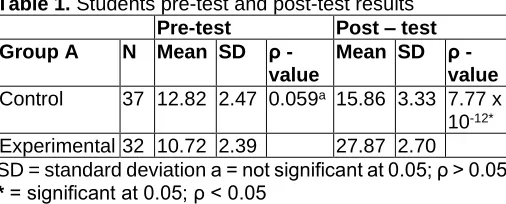
Table 1. Students pre-test and post-test results
Pre-test Post – test Group A N Mean SD ρ
-value
Mean SD ρ -value
Control 37 12.82 2.47 0.059a 15.86 3.33 7.77 x
10-12*
Experimental 32 10.72 2.39 27.87 2.70
SD = standard deviation a = not significant at 0.05; ρ > 0.05
* = significant at 0.05; ρ < 0.05
From Table 1, the performance of both the control group and experimental group improved in the post - test as compared to their performace in the pre-test. Notwithstanding, the academic achievements of students in the experimental group improved significantly in the post – test than students in the control group. The post-test scores for the control group participants ranged from 19 to 24, while post-test scores for the treatment group ranged from 25 to 29. The mean score for the control group (taught through traditional teaching method) was 15.86 (SD = 3.33) and that of the experimental group (exposed to the computer simulation and computerised molecular modeling software) was 27.87 (SD = 2.70). Comparatively, students in the experimental group had higher marks than their counterparts in the control group. The experimental group on the average gained 11.2 marks (21.88 -10.72) and that of the control group was 3.04 marks (15.86-12.82) when their pre-test and post-test marks were compared. The higher performance by students in the experimental group might be because of the use of computer simulation and computerised molecular modeling instructional method. With the introduction of the computer simulation and computerised molecular modeling approach, even the average students scored 25 out of 30 marks. This is a remarkable positive
change in performance. There was a statistically significant difference between the performance of the control group and experimental group (p < 0.05) in the post – test. This implies that the computer simulation and computerised molecular modeling software had a positive influence on the academic performance of the students in the experimental group. Similarly, a study carried out by Mihindo et al. (2017) in Kenya showed that there was statistically significant difference in Chemistry achievement of students who were taught through computer based simulation-teaching approach and those taught through regular teaching method.
The use of computer simulations in science education has been shown by many researchers (Strauss & Kinzie, 1994 and Liao & Chen, 2007) to be helpful to students’ understanding of difficult and abstract concepts such as hybridisation. Computer simulations have been found useful in helping to correct the misconceptions on some Chemistry concepts. This effect is especially evident in science learning when computer simulation is used as an instructional method. According to Akpan (2000), in science education classrooms, computer simulations are often used as a scaffold to allow students to gain initial understanding of a concept and to stimulate problem solving. Results of post-test indicated tremendous progress in students’ conceptual understanding of hybridisation after the two weeks treatment period. The treatment phase was to correct the difficulties and abstractness in the conceptual understanding of the concept of hybridisation. At the end of the two weeks treatment period, significant results were achieved. Student’s performance improved significantly in both the multiple choice and essay type of questions. Students performed remarkably in the multiple-choice type of questions except question 15 (appendix B) which was a plausible distracter to most students. In question 16 of the essay type question in the post-test instrument, about 50% of students were able to describe the bonding in CH2=CH2
correctly. This implies a remarkable improvement in students’ performance. A high proportion of students (79%) were able to state the shape and type of hybridisation exhibited by the central atom of some species (question 18). The least improvements were observed in questions 17(ii) and 19. Only 30% of participants were able to give an orbital description for molecular species and specified the location of any unshared pairs of electrons and orbital used for the multiple bonds (question 17). In addition, 70% of students attempted the question but did not earn the full mark. Most students were able to state that C-O bonds in CO2 and
H-O bonds in H2O were polar due to the electronegativity
differences between C and O and also H and O but failed to connect that, the structure of CO2 molecule is linear and
symmetrical and hence the net dipole moment is zero making the CO2 molecule non-polar (question 19).The
same reason was observed for whyH2O molecule is polar.
Again, students stated that, H2O is bent or has V-shape
Generally, students responded more intelligently and soundly to most of the question attempted which implied they understood the new concept.
The study revealed that performance of students when exposed to computer simulation and computerised molecular modelling software improved more than the traditional instructional approach. The hypothesis that there is difference in performance of students taught using computer simulations and computerised molecular modeling and traditional instructional method was accepted. The use of computer simulation and computerised molecular modelling software enhanced teaching and learning of hybridisation. The finding of this study is in parallel with the study carried out by Abdullahi
et al. (2018) among secondary school students in Zaria
educational zones, Nigeria, which showed that computer assisted instructional packages significantly improved the performance of students in Chemistry. Again, the finding of the present study is in line with the study carried out by Mihindo et al. (2017) among secondary school students in Nakuru, Kenya, which revealed that computer – based simulation had a positive impact and significantly contributed to the understanding of Chemistry concepts and principles. This supports the assertion that computer simulation is more effective in enhancing students’ academic achievements in Chemistry concepts than lecture method (Nkemakolam, Chinelo & Jane, 2018).
Analysis of Research Question Two
RQ 2: What would be the effect of computer simulation and computerised molecular modeling software on the performance of students’ in individual learning setting and collaborative learning environment?
The pre and post -tests results of academic achievements of the cooperative and the individual learning groups are shown in Table 2.
Table 2. Mean scores of participants in individual and cooperative group learning environment
Pre-test Post – test Group B N Mean SD ρ
-value
Mean SD ρ -value
Individual learning
30 17.67 2.78 0.049* 20.67 2.99 0.039*
Cooperative learning
30 18.08 3.66 21.88 3.24
SD – standard deviation * = significant at 0.05; ρ < 0.05 The mean score values of students’ academic achievements in the post-test were higher than the mean score values of students’ academic achievement in the pre-treatment test for both individual and cooperative learning groups. This implies that computer simulation and computerised molecular modelling software had a positive effect on the teaching and learning of hybridisation among the cooperative and the individual learning groups. The
cooperative group attained a better score than the competitive or individual group. The mean score of the cooperative group (M=18.67, SD =3.66) in the pre-treatment test was slightly higher than the mean score of the individual learning group (M=17.67, SD=2.78). Again, cooperative group mean score (M=21.88, SD=3.24) in the post treatment test was slightly higher than that of individual group (M=20.67, SD=2.99). Thus, the post-test results indicated slightly higher achievements in cooperative learning than in the individual or non-competitive learning environment. Thus, there were slight difference in performance between cooperative and individual groups. Also, the independent-measure t-test results showed that there was statistical significant difference in the academic performance of students in the concept of hybridisation between the individual and cooperative learning groups in the pre-treatment test (ρ = 0.049, ρ < 0.05). The slight difference in performance between the groups can be made more apparent by looking closely at the mean scores of each group (mean of post-test – mean of pre-test). Again, there was a statistical significant difference in the academic performance of students in the concept of hybridisation between the individual and cooperative learning groups in the pre-treatment test (ρ = 0.039, ρ < 0.05). The hypothesis that there is a significant difference between the performance of students’ in the cooperative settings and the individual learning environment was accepted.
The study revealed that there was a statistical significant difference between the academic achievement of students in the cooperative group and the individual learning group in both the pre-treatment test and the post- test. It was found that computer simulation instructional approach administered in cooperative learning settings had a greater positive effect on students’ performance than when administered in individualised, non-cooperative learning setting. This implies that cooperative group learning enhanced students understating in the concepts of hybridisation. The findings of this study is in parallel with the study carried out by Gull and Shehzad (2015) on the effects of cooperative learning on students’ academic achievements, which showed that cooperative learning had a positive effect on academic achievements of students enrolled in the subject of education. Gull and Shehzad (2015) posit that cooperative learning method when used as a teaching activity, improves motivation, class participation and academic achievements of students. According to Borich (2004), in cooperative learning, interaction among students is intense and students gradually take responsibility for each other’s learning.
Table 3. Comparative analysis of students’ performance in
experimental groups.
Experimental groups N
Pre – test Post – test
Mean Mean
Cooperative 30 18.08 21.88 Individual 30 17.67 20.67 Intact class in group A 32 10.70 27.87
From Table 3, the intact class group from group A performed remarkably (M =27.87, SD=2.70) followed by the cooperative learning group (M=21.88, SD=3.24) in the post-test. The intact class group in group A achieved better mean score than the cooperative group and the individual group although, they all had the same treatment but under different learning strategies, conditions or environment. Learning strategies are important factors that need to be taken into consideration by teachers when delivering lessons in the classroom. In the cooperative learning strategy, there is interpersonal exchange process that supports the use of higher thinking skill strategies and reasoning strategy (Johnson & Johnson, 1994; Widaman & Kagan, 1987). This implies that student’s knowledge and skill in metacognitive strategy is as important as systematic instruction using various kinds of methods and learning strategy (i.e. cooperative or individual learning) in facilitating students to promote better achievement in understanding the concept of hybridisation. According to Educational Research Service (1989), cooperative learning environment increased student motivation, positive behaviours, attitudes toward the content information being taught, and created a mutual respect among the students and the teacher. Figure 1 gives a pictorial view of the comparison of the experimental groups mean scores under different learning environment in the post – test.
Figure 1. A plot of post – test mean scores of experimental groups
IMPLICATIONS
In light of the findings of the study and their educational implications, the following suggestions are made for further research with respect to the use of computer simulations and molecular modeling software instructional packages in Chemistry teaching at the Senior High School level.
1. The study should be replicated using computer simulation instructional packages on other difficult Chemistry concepts such as chemical equilibrium, chemical kinetics, etc. This would provide a basis for greater generalisation of the conclusions drawn from the findings of the study.
2. The study should be replicated using larger samples to provide basis for more generalisation of the conclusions drawn from the findings of the study about the effectiveness of computer simulation instructional packages in the teaching and learning of hybridisation. 3. Similar studies should be conducted with larger samples using qualitative data from both teachers and students to find their attitudes towards the use of computer simulation instructional packages on the teaching and learning processes.
4. Empirical studies should be carried out on the use of computer simulation instructional packages on other science subjects and at different levels of science education to provide sound basis for the integration of computer simulation instructional packages in science education in Ghanaian schools.
ACKNOWLEDGEMENTS
We would like to thank the headmaster and Chemistry teachers at Odorgonno Senior High School in Ga Central District of Greater Accra Region of Ghana for their grand cooperation and support offered during the study.
REFERENCES
Adadan, E., Trundle, K.C. & Irving, K.E. (2010). Exploring grade 11 students conceptual pathways of particulate nature in context of misrepresentational instructional.
Journal of Research in Science Teaching, 47 (8), 1004
– 1035
Abdullahi, B., Yusuf, L.A. & Mohammed, I.A. (2018). A study of the effects of computer assisted packages on the performance of secondary school students in Chemistry in Zaria Educational Zone, Kaduna State, Nigeria. Internatinal Journal of Secondary Education, 6 (4), 59 – 65
Akpan, J. P., & Andre, T. (2000). Using a computer simulation before dissection to help student learn anatomy. Journal of Computers in Mathematics and
Science Teaching,19 (3), 297-313
Aluko, K. O. (2008). Teaching Chemistry in Secondary Schools: A Case for cooperative instructional strategy.
Ethiopian Journal of Education and Science, 3(2), 32
Ary, D., Lucy, C. J. & Asghar, R. (2002). Introduction to Educational Research. USA: Wadsworth Group Press. Barnea, N., and Dori, Y. J. (1996). Computerised molecular modeling as a tool to improve chemistry teaching. Journal of Chemical Information and
Computer Sciences, 36: 629–636.
computerised molecular modeling learning environment, Journal of Science Education and
Technology,8(4), 257–258.
Bell, R. L., & Trundle, K. C. (2008). Using computer simulations to promote science conceptions of moon phases. Journa of Research in Science Teaching, 45 (3), 346 – 372
Bonwell, C. C. & Eison, J. A. (1991). Active learning:
Creating excitement in the classroom. ASHE-ERIC
Higher Education Report No. 1. Washington, D.C.: The George Washington University, School of Education and Human Development.
Borich, G. D. (2004). Effective teaching method. (5th ed.), New Jersey: Pearson Merrill Prentice Hall.
Çalış, S. (2018). An Examination of the Achievement Levels of Acquisitions in Hybridization : High School Sample. Universal Journal of Education Research,
6(8), 1659–1666.
Creswell, J. W. (2008). Educational Research: Planning,
Conducting and Evaluating Qualitative and Quantitative
Research. New Jersey: Pearson Education Inc., Upper
Saddle River.
Curriculum Research and Development Division [CRDD] (2010). Teaching syllabus for chemistry (senior high
schools). Accra, Ghana Education Service.
Educational Research Service. (1989). ERS information
folio: Cooperative learning. Arlington, Virginia. NST
Press.
Gillespie, R.J. (2004). Teaching molecular geometry with Valence Shell Electrone Pair Repulsion Model. Journal
of Chemical Education, 81 (3), 298 – 304.
Gull, F., Shehzad, S. (2015). Effects of cooperative learning on students academic achievement. Journal of
Education and Learning, 9 (3), 246 – 255.
Hanson, R., Sam, A. & Antwi, V. (2012). Misconceptions of undergraduate chemistry teachers about hybridisation. African Journal of Eduational Studies in
Mathematics and Sciences, 10 (1), 45 – 54 a
Harper, B., Squires, D. & McDougall, A. (2000). Constructivist simulations in the multimedia age.
Journal of Educational Multimedia and Hypermedia, 9,
115-130.
Jian, K. V. (2015). The Concept of Hybridisation :A rapid and new innovative method for prediction of hybridised state of an Atom in a very short time. Indian Journal of
Applied Research, 4(3), 1–4.
Johnson,D.W. & Johnson, R.T. (1994). Learning together and alone: Cooperative, competitive, and individualistic
learning (4th ed). Boston, MA: Allyn & Bacon.
Jones, L. L. (1996). The role of molecular structure and modeling in general chemistry. An on-line computer
conference, Summer.
Lee, S.C. (2001). Development of international strategy of computer application software for group instruction.
Computers and Education, 48 (1), 216 – 233
Liao, Y., & Chen, Y. (2007). The effect of computer
simulation instruction on student learning: 105 A
Meta-analysis of Studies in Taiwan. The Development of Computer Simulation in Taiwan, 2(2), 69–79.
Liu, H. (2005). Examining the use of computer simulations to promote learning of electrochemistry among college students. Retrospective Thesis and Dissertation. https://lib.dr.iastate.edu.rtd/1576
Mihindo, W.J., Wachanga, S.W. & Anditi, Z.O. (2017). Effects of computer based simulations teaching approach on students’ achievement in the learning of Chemistry among secondary school students in Nakuru sub country, Kenya. Journal of education and practice,
8 (5), 65 – 75.
Nkemakolam, O.E.,Chinelo, O.F. & Jane, M.C. (2018). Effect of computer simulations on secondary schools’ academic achievement in Chemistry in Anambra State.
Journal of Education and Training, 4 (4), 284 – 289
Petrucci, R.H. (2007). Hybridisation of atomic orbitals.
General Chemistry: Principles and Modern
Applications. (9th ed.). Upper Saddle River, HJ:
Pesrson/Prentice Hall.
Konicek – Moran, R. & Keeley, P. (2015). Teaching for
conceptual understanding in science. Arlington,
Virgina. National Science Teachers Association Press. Kothari, C. R. (2004). Research methodology: methods
and techniques. New Age International.
Salah, H. & Dumon, A. (2014). Research and practice conceptual integration of hybridization by Algerian students intending to teach Physical Sciences.
Chemistry Educational Research. Practice, 2011, 12,
443– 453
Strangman, N. & Hall, T. (2003).Virtual reality/simulations.
Retrieved September 16, 2019, from http://www.cast.org/publications/ncac/ncac_textrans.ht ml
Strauss, R. & Kinzie, M. B. (1994). Student achievement and attitudes in a pilot study comparing and interactive videodisc simulation to conventional dissection. The
American Biology Teacher, 56 (7), 398-402.
Tarber (2001). Building the structural concepts of chemistry: some consideration from educational research. Chemistry Education Research and Practice,
2 (1), 123 – 158
Veermans, K., Van Joolinger, W. & de Jong (2006). Use of heaurictics to facilitate sciecntific discocovery learning in simulation learning environment in Physics domain.
Internstional Journal of Science Education, 28 (4), 341
– 361
Widaman, K.F. & Kagan, S. (1987). Cooperativeness and achievement: Interation of students cooperativeness with cooperative verses competitive classroom organisation. Journal of Psychology, 25 (4), 355 – 365
Winn, W. D., Stahr, F., Sarason, C., Fruland, R., Oppenheimer, P., & Lee, Y. (2005). Learning oceanography from a computer simulation compared with direct experience at sea. Journal of Research in
Science Teaching, 43(1), 25-42.
Wu, H., Krajcik, J. S., & Soloway, E. (1997). Promoting conceptual understanding of Chemical Representations : Students’ use of a visualisation tool in the Classroom. Journal of Research in Science
APPENDICES
Appendix A: Pre-test questions
INSTRUCTIONS: Choose the most appropriate answer (option) from the list of options provided for question 1 to 10 in section A. Indicate whether the statement is true or false for questions 11 to 15 in section B and write your answer for questions 16 to 20 (section C). Answer all questions in the answer booklet provided.
Section A
1. The planar shape of BCl3 molecule can be explained in terms of ……….
A. sp hybridisation of B. B. sp2 hybridisation of B.
C. sp3 hybridisation of B. D. sp hybridisation of Cl
2. What is the shape of CH4?
A. Linear B. Tetrahedral C. Planar D. Pyramidal 3. The bond angle in tetrahedral molecules such as tetra chloromethane (CCl4) is
A. 900 B. 1050 C. 1800 D. 109.50
4. Which of the following compound has a linear shape?
A. CO2 B. CH4 C. H2O D. NH3
5. Which of the following statements is correct?
A.π-bond is stronger than σ-bond B. π-bond is more reactive than a σ-bond. C. π-bond is formed by the head-on overlap of two atomic orbitals.
D. a triple bond consists of two σ-bond and one π-bond 6. All the following molecules are linear is shape except?
A. H2O B. CO2 C. C2H2 D. HCl
7. Mixing one s- orbital with three p orbitals results in the formation of
A. three sp2 hybrid orbitals B. three sp3 hybrid orbitals
C. four sp2 hybrid orbitals D. four sp3 hybrid orbitals
8. The shape of a molecule which is formed as a result of sp2 hybridization is ………
A. trigonal B. linear C. tetrahedral D. pyramidal 9. The hybrid orbital used in the formation of C-Cl bond in CCl4 is
A. spd2 B. sp2 C. sp D. sp3
10. A sigma bond is formed when……… A. an s-orbital from an atom mixes with two p-orbitals of the same atom
B. an s-orbital from an atom mixes with two p-orbitals from another. C. two sp2 hybrid orbitals from different atoms overlap head-on.
D. two p-orbitals from different atoms overlap sideways Section B
11.The sigma bond is formed from lateral or sideways overlap of p-orbitals. True or False
12. Hybridisation is defined as the intermixing of similar orbitals of the same atom but having slightly different energies to form the same number of hybrid orbitals of equal energies and identical shapes. True or False
13. Hybridisation was introduced to explain molecular structure when the valence bond theory proposed by G. N. Lewis failed to correctly predict them. True or False
14. Water (H2O) has a V-shape. True or False
15. CH4 has a bond angle of 109.50 and is trigonal in shape. True or False
Section C
16. Briefly explain the term hybridisation.
17. What effects does hybridisation have on bonds? 18. Consider the following compounds: BCl3 and C2H2.
(i) State the type of hybridization shown by the central atoms in each of the compounds. (ii) State the shapes of the molecules
19. Explain the following observation: Water is not a linear molecule.
Appendix B: Post- test questions
INSTRUCTIONS: Choose the most appropriate answer (option) from the list of options provided for question 1 to 10 in section A. Indicate whether the statement is true or false for questions 11 to 15 in section B and write your answer for questions 16 to 20 (section C). Answer all questions in the answer booklet provided.
Section A
1. Which of the following activities results in the formation of pi bond?
A. side-by-side overlap of two p- orbitals. B. head-on overlap of two p-orbitals C. overlap of two s-orbitals D. overlap of s-orbital and p-orbital. 2. The molecule PCl3 has a dipole moment of 0.78. What is it shape?
A. trigonal pyramidal B. tetrahedral C. trigonal planar D. V-shaped
3. Select the pair of molecules with linear structure from the following pairs of molecules. [Be=4, B=5,C=6,N=7]
A. CO2 and BeCl2 B. NH3 and BCl3 C. C2H2 and NH3 D. BCl3 and CO2
4. The CO2 molecule is linear in shape while SO2 is V-shaped because
A. sulphur is more electronegative than oxygen
B. CO2 contains sp hybridised orbitals while SO2 contains sp3-hybridised orbitals.
C. lone pair-bond pair repulsion occurs in SO2
D. bond pair-bond pair repulsion in CO2
5. The hybridised states of N in NCN and HN=NH are
A. sp3 and sp2 respectively B. sp2 and sp2 respectively
C. sp2 and sp respectively D. sp and sp2 respectively
6. Determine the total number of shared pair of electrons in A. 12 B. 10 C. 6 D. 5
7. The compound MX3 is sp3 hybridised. What is the bond angle in the compound?
A. 09.50 B. 1200 C. 1800 D. 900
8. The shape and hybridisation of S in SF6 are
A. tetrahedral and sp3 B. square planar and sp2d
C. octahedral and sp3d2 D. trigonal bipyramidal and sp3d
9. The percentage p-character is sp3 hybridisation is
A. 20% B. 50% C. 75% D. 66.67% 10. Which of the following molecule has both sigma and pi bonds?
A. H2S B. NO2 C. HClO D. NaCN
Section B
11. sp3d2 hybrid orbital is formed by mixing none s-orbital, three p-orbitals, and two d-orbital give six hybrid orbitals of
equivalent energy and shape. True or False
12. Carbon in CH4 is sp3 hybridised and the hybridised orbitals are separated at a bond angl1800. True or False
13. After excitation, the 2s, 2px and 2py orbitals mix to give three equivalent sp2 hybrid orbitals at angle of 1200. The
hybridized 2pz orbital lies perpendicular to the plane of the
hybridised C atom. True or False
14. The extent of overlap of orbitals in sigma (σ) bond formation is greater than in pi (π) bond formation. As a result, sigma (σ) bond is stronger than pi (π) bonds. True or False
15. HCN is linear, NCl3 is trigonal pyramidal, OF2 is angular or bent while CCl4 is tetrahedral. True or False
Section C
16. Describe the bonding in CH2=CH2 molecule.
17. i) What is the hybridised state of nitrogen in each of the following species? NH4+ and
ii) Give an orbital description for the species in (i) (α) and (β) specifying the location of any unshared pairs and orbital used for the multiple bonds.
18. Consider the following molecules: BeCl3, NH3, H2O, C2H2 . State the,
i) type the hybridisation exhibited by the central atom in each molecule ii) shape of each of molecule
19. Account for the following observations: CO2 and H2O are both oxides, but H2O is a polar molecule while CO2 is not.
20. Give the type of hybridization show by the central atoms in the following compounds: NH3,
Accepted 24 November 2019
Citation: Koomson CK, Safo-Adu G, Antwi S (2020). Utilising Computer Simulation and Computerised Molecular Modeling Software to Enhance the Teaching and Learning of Hybridisation in Senior High Schools. International Journal of Chemistry Education, 4(1): 044-055.