ISSN 0975-928X
http://sites.google.com/site/ejplantbreeding Peer Reviewed Journal 367
Research Article
Simple sequence repeats to identify true hybrids in bacterial wilt
susceptible X resistant crosses in groundnut
Yu Fei Ding1,2, Chuan Tang Wang1,2*, De Lian Zhao3, Yue Yi Tang2, Xiu Zhen Wang2, Qi Wu2, Jian Cheng Zhang2, Dian Xu Chen2
1
Qingdao Agricultural University, Qingdao, 266109,P R China
2
Shandong Peanut Research Institute, Qingdao 266100, P R China
3
Mengzhi Office, Zhaoyuan 265400, P R China * Email: [email protected]
(Received:13 Jul 2011; Accepted: 28Jul 2011)
Abstract:
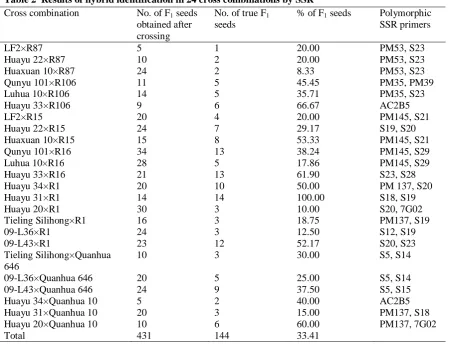
Bacterial wilt of groundnut is a devastating disease in China and Southeast Asia. Planting resistant cultivars is considered the most effective for disease management. Transfer of resistance to high yielding adapted groundnut cultivars is urgently needed. Identification of true hybrids in susceptible × resistant crosses is a must as it is of relevance to resistance genetics and breeding. In this study, simple sequence repeat primers coupled with DNA template prepared from 3-5 mg cotyledonary tissue and a 30 min fast silver-staining procedure were successfully utilized to discriminate true hybrids from selfs in 24 cross combinations. 144 (33.41%) out of 431 seeds were identified as hybrids, with percentage of hybrids ranging from 8.33%-100%.
Keywords: groundnut, hybrid identification, SSR, bacterial wilt Introduction:
Bacterial wilt (BW) caused by Ralstonia solanacearum (Smith) Yabuuchi et al. is a great threat to groundnut (Arachis hypogaea L.) production in China and Southeast Asia. At present, desirable methods for effective chemical control of the disease are unavailable, and planting resistant cultivars is regarded as the most effective and economical means to disease management (Wang et al., 2009). A large number of resistant germplasm accessions have so far been identified; unfortunately, most of them have low yield potential (Wang et al., 2009). In Shandong province, the leading groundnut producer of China, where large seeded groundnut varieties dominate, yield potential is the main factor influencing growers’ decision on a cultivar, even in diseased regions, Linyi and Rizhao. Reportedly, groundnut area severely affected by BW in the two cities amounted to 35 000 ha (Zhang et al., 2008). Transferring BW resistance to high yielding adapted groundnut cultivars through hybridization therefore becomes an urgent task. For breeding and genetics purposes, true hybrids in these crosses need to be identified, preferably soon after harvest of F1 seeds.
Groundnut breeders used to identify true hybrids and selfs by differences in morphological features, disease reaction and quality traits between F1 and
parental plants, or by segregation in F2 and
subsequent populations (Chen et al., 2009). Recently, molecular markers, in most cases simple sequences repeats (SSRs), have been used in identification of F1 hybrid groundnut plants
(Gomez et al., 2008, Chen et al., 2009, Li et al., 2009). Currently available protocols for DNA template preparation from groundnut seeds are either destructive or time-consuming (Chenault et al., 2007, Hu et al., 2009), except the one reported by Yu et al. (2010), where 3-5 micrograms of groundnut cotyledonary tissue and 30 min are enough for at least 20 polymerase chain reactions (15 µl total volume per reaction). In the present report, Yu et al. (2010)’s protocol was successfully used to identify true F1 hybrids from BW
susceptible × resistant crosses in groundnut.
Material and methods
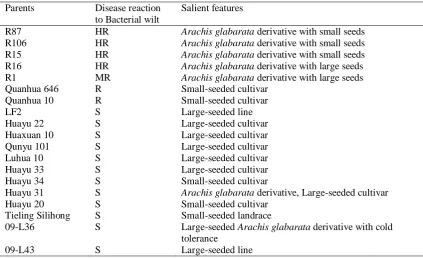
Groundnut material: Seven groundnut lines/cultivars with BW resistance were used as male parents, and 12 high yielding groundnut genotypes were used as female parents (table 1 and table 2). A total of 24 cross combinations were made (table 2). Artificial hybridization in groundnut was carried out according to the standard procedure (Yu et al. 2011).
ISSN 0975-928X
http://sites.google.com/site/ejplantbreeding Peer Reviewed Journal 368
the resultant hybrid seeds following the method described by Yu et al. (2010).
SSR analysis: SSR primers were synthesized based on He et al. (2003), He et al. (2005), Moretzsohn et al. (2005), Jiang et al. (2007) and Wang et al. (2007). SSR analysis was conducted in 3 replications. The PCR mixture (15 µl total volume) consisted of 2µl of DNA template, 0.6 µl of forward and reverse primers (10µM) each, 1 µl of MgCl2 (25 mM) and 7.5 µl of Tiangen 2 × Taq
PCR Master Mix (Tiangen Biotech, Beijing, China). PCR program was 10 cycles of denaturing at 95 ºC for 1 min, 65ºC for 1 min (1 ºC decrease per cycle), and 72 ºC for 90 sec, followed by 30 cycles of 95 ºC for 1 min, 55ºC for 1 min, and 72 º for 90 sec.
Bands were separated on a 6% denaturing polyacrylamide gel. Silver-staining was done based on protocol of Liang et al. (2008) with minor modifications. Afterwards, washed with distilled water for 2 times (1 min), the gel was placed in fixation and silver-staining solution containing 1% glacial acetic acid, 10% ethanol and 0.2% AgNO3,
for 10 min. Then the gel was washed again with distilled water for 2 times (2 min), and transferred to developing solution (3% NaOH, with 1 ml formaldehyde added in 200 ml total volume just prior to developing). Thirty minutes were generally enough to develop clear bands.
Results and Discussion
Totally 18 SSR primer pairs were found informative (He et al. 2003, He et al. 2005), and were used to identify true hybrids in the 24 cross combinations (table 2). Fig. 1 and fig. 2 showed the banding patterns in 2 of the cross combinations, where male parent produced a characteristic band absent in female parent, and the resultant “F1”
seeds with the band were identified as hybrids and those without the band as selfs. All the cross combinations and replications with 2 primer pairs gave consistent results, demonstrating that the present protocols were feasible and reproducible.
Out of 431 seeds, 144 (33.41%) resulting from the 24 cross combinations were identified as hybrids, with percentage of hybrids ranging from 8.33%-100% (table 2). In most part, this is not a reflection of difference in ease of hybridization, but rather, is a reflection of the performance of the operators. Lower percentage of hybrids may be ascribed to poor hand crossing operations. Hybrid identification by SSRs therefore will be useful to advance only hybrid progenies instead of selfs which in turn save the cost, time, labour and area of experimentation.
Acknowledgments
The authors are most grateful to the funding source listed below that made this study possible: China Agricultural Research System (CARS-14), New and High Technology Innovation Foundation of Shandong Academy of Agricultural Sciences (2006 YCX013), Qingdao Science & Technology Support Program (10-3-3-20-nsh, 09-1-3-67-jch), Shandong Natural Science Foundation (Y2008D11), and Shandong Key Project of Science & Technology (2009GG10009008).
References
Chen, J., Hu, X.H., Shi, Y.Q., Miao, H.R. and Yu, S.L. 2009. Identification of peanut (Arachis hypogaea
L) hybrids using SSR markers. J Nuclear Agril. Sci., 23 (4) :617-620.
Chenault, K.D., Gallo, M., Seib, J.C. and Jamne, V.A. 2007. A non-destructive seed sampling method for PCR-based analysis in marker assisted selection and transgene screening. Peanut Sci., 34(1):38-43. Gomez, S.M., Denwar, N.N., Ramasubramanian, T.,
Simpson, C.E., Burow, G., Burke, J.J., Puppala, N. and Burow, M.D. 2008. Identification of peanut hybrids using microsatellite markers and horizontal polyacrylamide gel electrophoresis.
Peanut Sci., 35(2): 123-129.
He, G., Meng, R., Newman, M., Gao, G., Pittman, R.N. and Prakash, C.S. 2003. Microsatellites as DNA markers in cultivated peanut (Arachis hypogaea
L.). BMC Plant Biol.,3(1), 3. DOI: 10.1186/1471-2229-3-3
He, G., Meng, R., Gao, H., Guo, B., Gao, G., Newman, M., Pittman, R.N. and Prakash, S.C. 2005. Simple sequence repeat marker for botanical varieties of cultivated peanut (Arachis hypogaea L.).
Euphytica,142:131-136.
Hu, X.H., Miao, H.R., Shi, Y.Q. and Chen, J. 2009. Isolation of DNA from dry peanut seeds. In
Proceedings of Mainland of China and Taiwan Groundnut Conference, August 29-31, 2009. Qingdao, China. China Agricultural Science & Technology Press, Beijing, China, p. 293-296. Jiang H.F., Liao B.S., Ren X.P., Lei Y., Mace E., Fu
T.D. and Crouch H.E. 2007. Comparative assessment of genetic diversity of peanut (Arachis hypogaea L.) genotypes with various levels of resistance to bacterial wilt through SSR and AFLP analyses. J. Genet. Genomics, 34(6): 544-554. Li, S.L., Wang, H., Ren, Y., Shi, Y.M., He, G.H., Yu,
S.L. and Yuan, M. 2009. Identification of peanut hybrids using SSR markers with fluorescence labeled M13-tailed primer. J. Peanut Sci.,
38(4):35-38.
Liang, H., Wang, C., Li, Z., Luo, X. and Zou, G. 2008. Improvement of the silver-stained technique of polyacrylamide gel electrophoresis. Hereditas
(Beijing), 30(10): 1379-1382.
Moretzsohn M.C., Leoi L.,Proite K., Guimarães P. M., Leal-Bertioli S. C. M., Gimenes M. A., Martins W. S., Valls J. F. M., Grattapaglia D. and Bertioli D. J. 2005. A microsatellite-based, gene-rich linkage map for the AA genome of Arachis
ISSN 0975-928X
http://sites.google.com/site/ejplantbreeding Peer Reviewed Journal 369
Wang, C.T., Yang, X.D., Chen, D.X., Yu, S.L., Liu, G.Z., Tang, Y.Y., Xu, J.Z. 2007. Isolation of simple sequence repeats from groundnut.
Electron. J. Biotech., 10(3).
http://www.ejbiotechnology.info/content/vol10/iss ue3/full/10/index.html
Wang, C.T., Wang, X.Z., Tang, Y.Y., Chen, D.X., Cui, F.G., Zhang, J.C. and Yu, S.L. 2009. Field screening of groundnut genotypes for resistance to bacterial wilt in Shandong province in China. J.
SAT Agril. Res., 7.
http://ejournal.icrisat.org/Volume7/Groundnut/GN 704.pdf
Yu, S.L., Wang, C.T., Yang, Q.L., Zhang, D.X., Zhang, X.Y., Cao, Y.L., Liang, X.Q. and Liao, B.S. (Eds). 2011. Peanut Genetics and Breeding in China. Shanghai Science and Technology Press, Shanghai, China.
Yu S.T., Wang C.T., Yu S.L., Wang X.Z., Tang Y.Y., Chen D.X. and Zhang, J.C. 2010. Simple method to prepare DNA templates from a slice of peanut cotyledonary tissue for polymerase chain reaction.
Electron. J. Biotech.,13(3). DOI: 10.2225/vol13-issue4-fulltext-9
ISSN 0975-928X
370
http://sites.google.com/site/ejplantbreeding Peer Reviewed Journal
Table 1 Parental lines/cultivars used in hybridization Parents Disease reaction
to Bacterial wilt
Salient features
R87 HR Arachis glabarata derivative with small seeds
R106 HR Arachis glabarata derivative with small seeds
R15 HR Arachis glabarata derivative with small seeds
R16 HR Arachis glabarata derivative with large seeds
R1 MR Arachis glabarata derivative with large seeds
Quanhua 646 R Small-seeded cultivar
Quanhua 10 R Small-seeded cultivar
LF2 S Large-seeded line
Huayu 22 S Large-seeded cultivar
Huaxuan 10 S Large-seeded cultivar
Qunyu 101 S Large-seeded cultivar
Luhua 10 S Large-seeded cultivar
Huayu 33 S Large-seeded cultivar
Huayu 34 S Small-seeded cultivar
Huayu 31 S Arachis glabarata derivative, Large-seeded cultivar
Huayu 20 S Small-seeded cultivar
Tieling Silihong S Small-seeded landrace
09-L36 S Large-seeded Arachis glabarata derivative with cold tolerance
09-L43 S Large-seeded line
ISSN 0975-928X
371
http://sites.google.com/site/ejplantbreeding Peer Reviewed Journal
Table 2 Results of hybrid identification in 24 cross combinations by SSR Cross combination No. of F1 seeds
obtained after crossing
No. of true F1
seeds
% of F1 seeds Polymorphic
SSR primers
LF2×R87 5 1 20.00 PM53, S23
Huayu 22×R87 10 2 20.00 PM53, S23
Huaxuan 10×R87 24 2 8.33 PM53, S23
Qunyu 101×R106 11 5 45.45 PM35, PM39
Luhua 10×R106 14 5 35.71 PM35, S23
Huayu 33×R106 9 6 66.67 AC2B5
LF2×R15 20 4 20.00 PM145, S21
Huayu 22×R15 24 7 29.17 S19, S20
Huaxuan 10×R15 15 8 53.33 PM145, S21
Qunyu 101×R16 34 13 38.24 PM145, S29
Luhua 10×R16 28 5 17.86 PM145, S29
Huayu 33×R16 21 13 61.90 S23, S28
Huayu 34×R1 20 10 50.00 PM 137, S20
Huayu 31×R1 14 14 100.00 S18, S19
Huayu 20×R1 30 3 10.00 S20, 7G02
Tieling Silihong×R1 16 3 18.75 PM137, S19
09-L36×R1 24 3 12.50 S12, S19
09-L43×R1 23 12 52.17 S20, S23
Tieling Silihong×Quanhua 646
10 3 30.00 S5, S14
09-L36×Quanhua 646 20 5 25.00 S5, S14
09-L43×Quanhua 646 24 9 37.50 S5, S15
Huayu 34×Quanhua 10 5 2 40.00 AC2B5
Huayu 31×Quanhua 10 20 3 15.00 PM137, S18
Huayu 20×Quanhua 10 10 6 60.00 PM137, 7G02
Total 431 144 33.41
Fig. 1 Primer pair S15 identified true F1 hybrid (H) and selfs (S) resulting from
09-L43×Quanhua 646, arrow indicating a characteristic band present in Quanhua 646 (Q, male
parent) but absent in 09-L43 (L). M: 10bp DNA Ladder (Invitrogen)
Fig. 2 Primer pair S20 identified true F1 hybrid (H) and selfs (S) resulting from Huayu22×R15,
arrow indicating a characteristic band present in R15 (R, male parent) but absent in Huayu22