7
ISSN 1392-2785 ENGINEERING ECONOMICS. 2007. No 3 (53) ECONOMICS OF ENGINEERING DECISIONS
Methodology of Business Risk Analysis and its Practical Application
in the Enterprises Working in the Global Market
Gražina Startienė, Rita Remeikienė
Kauno technologijos universitetas Laisvės al. 55, LT-44309, Kaunas
One of the most important aspects which guarantees successful work of a company, i.e. risk analysis is consid-ered. The exploration of risk analysis is essential both theoretically and practically as it reduces the risk of loss, venturesome dealings and harm for a company’s good will. The shortage of both theoretical and practical knowledge about risk, processes of risk analysis and its stages prevent companies from business development both locally and internationally.
The exploration of this field is even more relevant because there is no clear and unanimous concept of risk analysis which would be accepted both by scientists and business environment. At present, the conception of risk analysis of authorities, various institutions and foreign and Lithuanian scientist differs greatly.
Risk analysis is distinguished by the variety of meth-ods, their complexity and lengthening time of their im-plementation. The classification of methods may also vary greatly whereas reasons (advantages and disadvan-tages) for such classification are explained differently by scientists. Meanwhile, companies face real practical problem how to choose a method which could be the most appropriate and conforming to company’s financial pos-sibilities.
The perception that risk analysis is a very complex and responsible process during which risk should be identified, assessed, analyzed and estimated, i.e. to man-age, encourage companies to assign this process for pro-fessionals, i.e. specialized companies of risk analysis, the launching of which increased as there was the gap in the market in this field.
The aim of the article is to work out the methodology of risk analysis and to compare the stages of risk analysis process used by Lithuanian risk management analysis companies.
Having performed the analysis of scientific literature and summarized various approaches, risk analysis as a constituent part of risk management concept is presented, method groups and types of risk analysis, stages of indi-vidual method processes are discerned as well as advan-tages and disadvanadvan-tages of qualitative and quantitative risk analysis methods are explored. Having systemized different viewpoints of authors, four main stages of risk analysis process were distinguished: organizational in-vestigation, identification, estimation and evaluation. Business companies are recommended to use a resump-tive model of risk analysis process in the context of risk management process.
The investigation is conducted using the data of three
Lithuanian companies: SC Compservis, PriceWater-HouseCoopers/Lietuva and SC Synergy Consulting. The aim of the investigation was twofold: 1) to find out what risk analysis methods and stages are applied by risk analysis companies; 2) to compare the essential stages of risk analysis process which are described theoretically and applied practically and to identify their similarities and differences. The results of investigation were: 1) Lithuanian risk analysis companies more often apply qualitative risk analysis methods than quantitative ones; 2) the stages of SC Synergy Consulting and SC Comps-ervis risk analysis process (asset identification and valuation, threats assessment, vulnerabilities assessment and risk identification and its evaluation) are the same and identical to the stages of risk analysis discerned by R.K. Rainer, J.R. Charles A. Snyder, Houston H. Carr (1991); Sharon Halliday, Karin Badenhorst, Rossouw von Solms (1996).
Keywords: risk, risk analysis, risk management, risk ana-lysis methods, stages of risk anaana-lysis process.
Introduction
The processes of constantly changing conditions of business environment, increasing flow of information, integration to the world market augment the risk of busi-ness companies and stipulate the necessity of risk man-agement. One of the most important constituent parts of risk management processes is risk analysis, the analysis of which is significant both theoretically and practically. It is based on the fact that till now there is no unanimous methodology of risk analysis which would enable to make effective decisions that would reduce the unaccept-able risk till the admissible level. There is no homologous approach of risk analysis process. Foreign authors (Strutt, 1993; Boroush,1998; Frosdick, 1997; Chapman, 2007, and others), Lithuanian scientists (Bagdonas, 1996; Laskienė, 2003), heads of business companies (Vageris, 2006; Jokūbauskas, 2006) and various institutions (Aus-tralian Government, 2005; Aus(Aus-tralian Agency for Interna-tional Development (AusAID), 2005; InternaInterna-tional Or-ganization of Standards (ISO), 2002; International Ad-vancing Security Worldwide (ASIS), 2003) treat the con-cept of risk analysis differently.
8 qualitative, quantitative and combined (Bagdonas, 1996; Rasche, 2001; Urniežius, 2001; Bandyopadhyay, P. Mykytyn, K. Mykytyn, 1999; Snyder, Carr, 1991; Ach-med, Kays, Amornsawadwatana, 2007; Vageris, 2005; Jokūbauskas, 2006; Laskienė, 2003); qualitative method-ologies, tree based techniques and techniques for dy-namic systems (N. E. M.”Business Solutions“, 2002; Col-lege of Engineering and Engineering Technology North-ern Illinois University, 2006); update risk, downside risk, and composite methods (ISO/IEC Guide 73, 2002; Risk Management Standard, 2002); intuitive, inductive and deductive techniques (Frosdick, 1997); stages of risk analysis processes(White, 1995; Australian Agency for International Development (AusAID), 2005; Chapman, 2007; Backlund, Hannu, 2002; Rainer, Snyder, Carr, 1991; Sharon Halliday, Karin Badenhorst, Rossouw von Solms, 1996; Mobey, Parker, 2002); advantages and dis-advantages of methods (Vageris, 2005; Australian Gov-ernment, 2005; Bomil Suh&Ingo Han, 2002; Rainer, Snyder, Carr, 1991), therefore to choose the most appro-priate and accurate method of risk analysis is complex.
Business companies which try to tackle such risk analysis problems as risk analysis immaturity, lack of information and data security methods, insufficient com-petence of employees who participate in risk analysis or the lack of experience of a company, need methods which would offer effective solutions for the elimination of such problems.
In case of Lithuania, business companies often lack detailed and qualified information about the methods risk analysis, their processes and the methods of risk decrease (Jokūbauskas, 2006). Therefore, not all Lithuanian com-panies are able to evaluate the most risky branches them-selves. Realizing the incapability and competence
short-age of companies, specialized companies or risk man-agement are set up.
The aim of the article is to perform the methodology of risk analysis and to compare the stages of risk analysis process used by Lithuanian risk management analysis companies.
Tasks:
to introduce the definition of risk analysis based on the opinions of the authors ;
to determine the differences between the processes of risk analysis and risk management;
to outline the essence of methods and stages of processes analyzed in the research literature; to recommend a resumptive model of risk
man-agement process in the context of risk manage-ment process;
to present the advantages and disadvantages of quantitative and qualitative analysis methods; to evaluate the similarities and differences of the
stages of risk analysis processes applied in Lithua-nian enterprises.
Object of the article – risk analysis in the enter-prises working in the global market.
Research methods used in the article are systematic analysis of research literature and the comparative analy-sis of the risk analyanaly-sis methods and processes suggested by various authors and applied by Lithuanian companies.
Conception of risk
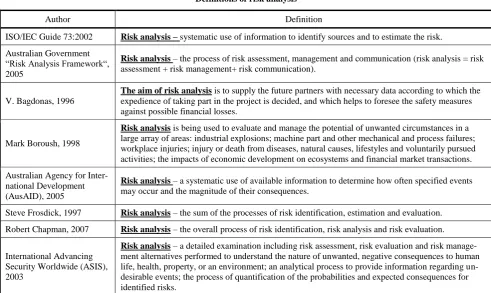
Many literary sources and authors provide a diverse definition of risk analysis (see Table 1).
Table 1
Definitions of risk analysis
Author Definition
ISO/IEC Guide 73:2002 Risk analysis – systematic use of information to identify sources and to estimate the risk. Australian Government
“Risk Analysis Framework“, 2005
Risk analysis – the process of risk assessment, management and communication (risk analysis = risk
assessment + risk management+ risk communication).
V. Bagdonas, 1996
The aim of risk analysis is to supply the future partners with necessary data according to which the expedience of taking part in the project is decided, and which helps to foresee the safety measures against possible financial losses.
Mark Boroush, 1998
Risk analysis is being used to evaluate and manage the potential of unwanted circumstances in a large array of areas: industrial explosions; machine part and other mechanical and process failures; workplace injuries; injury or death from diseases, natural causes, lifestyles and voluntarily pursued activities; the impacts of economic development on ecosystems and financial market transactions.
Australian Agency for Inter-national Development (AusAID), 2005
Risk analysis – a systematic use of available information to determine how often specified events
may occur and the magnitude of their consequences.
Steve Frosdick, 1997 Risk analysis – the sum of the processes of risk identification, estimation and evaluation. Robert Chapman, 2007 Risk analysis – the overall process of risk identification, risk analysis and risk evaluation. International Advancing
Security Worldwide (ASIS), 2003
Risk analysis– a detailed examination including risk assessment, risk evaluation and risk
9 Strutt (1993) gives the fullest definition of risk analy-sis where he sets out the concept in seven stages as fol-lows:
systematic assessment (item by item – question every part of the system);
identification of risks (global and local scale); assessment of risks (frequencies and
conse-quences). This may involve a number of different analyses;
establish acceptable or tolerable levels of risk; evaluation of risk. Are the risks acceptable? Can
they be reduced and at what cost?
determine, whether the risks are as low as rea-sonably practicable;
determine risk reduction measures where appro-priate.
The proposed definitions imply that some authors handle risk analysis in a wider sense, i.e. the definition includes risk evaluation, risk management, and other processes; meanwhile other authors treat risk analysis as a component of the whole risk management process. Having summarized different approaches of risk analy-sis, we can draw a conclusion that risk analysis as a constituent part of the risk management is systematic appliance of information for risk evaluation and assessment as well as for the selection of risk reduction methods.
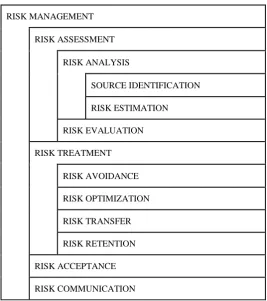
In order to understand the peculiarities of the proc-esses of risk management and risk analysis, the relation-ship between the terms which well reflect risk manage-ment and analysis is shown in the Figure 1 (based on their definition in the ISO Guide 72).
RISK MANAGEMENT
RISK ASSESSMENT
RISK ANALYSIS
SOURCE IDENTIFICATION
RISK ESTIMATION
RISK EVALUATION
RISK TREATMENT
RISK AVOIDANCE
RISK OPTIMIZATION
RISK TRANSFER
RISK RETENTION
RISK ACCEPTANCE
RISK COMMUNICATION
Figure 1. Relationship between terms, based on their definition in the ISO Guide 72 The processes of risk management and risk analysis
may seem to be identical; however, it is necessary to un-derstand their differences and commons. Risk manage-ment is the analysis of possible risk, the process of poten-tial loss decrease and tangible asset protection. Risk man-agement is a wider concept which encompasses risk analysis, risk monitoring, assumption of risk, and inform-ing about risk, i.e. the cooperated actions which are taken to manage and control risks of an organization.
The aim of risk management process is to decrease risk to the acceptable level; meanwhile, risk analysis is per-formed in order its results were used as a base to implement risk reduction processes and to assess their efficiency, for example, disposing of ineffective means, implementing new and maintaining existing risk management means.
According to S. Liučvaitis (2003) risk management is
not passive inclination to take risk but a set of methods and means used to influence the firm’s future results and get the least deviated from the expected results, mean-while risk analysis is a search for the least deviation pos-sible and its definition.
Risk analysis methods and stages of risk
analysis process
10
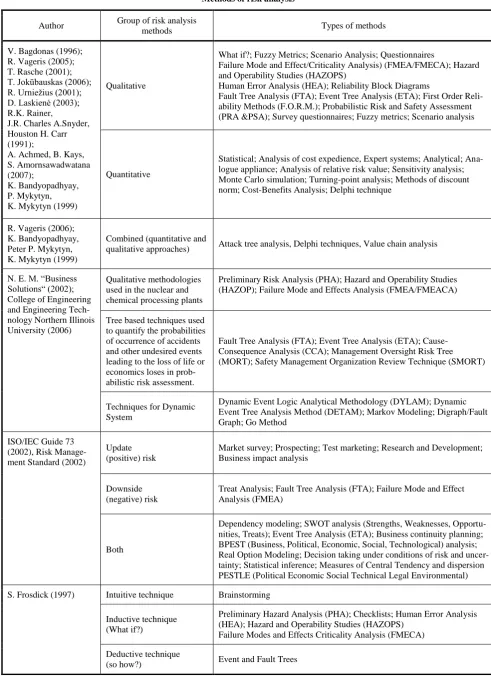
Table 2
Methods of risk analysis
Author Group of risk analysis
methods Types of methods
V. Bagdonas (1996); R. Vageris (2005); T. Rasche (2001); T. Jokūbauskas (2006); R. Urniežius (2001); D. Laskienė (2003); R.K. Rainer,
J.R. Charles A.Snyder, Houston H. Carr (1991);
A. Achmed, B. Kays, S. Amornsawadwatana (2007);
K. Bandyopadhyay, P. Mykytyn, K. Mykytyn (1999)
Qualitative
What if?; Fuzzy Metrics; Scenario Analysis; Questionnaires
Failure Mode and Effect/Criticality Analysis) (FMEA/FMECA); Hazard and Operability Studies (HAZOPS)
Human Error Analysis (HEA); Reliability Block Diagrams
Fault Tree Analysis (FTA); Event Tree Analysis (ETA); First Order Reli-ability Methods (F.O.R.M.); Probabilistic Risk and Safety Assessment (PRA &PSA); Survey questionnaires; Fuzzy metrics; Scenario analysis
Quantitative
Statistical; Analysis of cost expedience, Expert systems; Analytical; Ana-logue appliance; Analysis of relative risk value; Sensitivity analysis; Monte Carlo simulation; Turning-point analysis; Methods of discount norm; Cost-Benefits Analysis; Delphi technique
R. Vageris (2006); K. Bandyopadhyay, Peter P. Mykytyn, K. Mykytyn (1999)
Combined (quantitative and
qualitative approaches) Attack tree analysis, Delphi techniques, Value chain analysis
N. E. M. “Business Solutions“ (2002); College of Engineering and Engineering Tech-nology Northern Illinois University (2006)
Qualitative methodologies used in the nuclear and chemical processing plants
Preliminary Risk Analysis (PHA); Hazard and Operability Studies (HAZOP); Failure Mode and Effects Analysis (FMEA/FMEACA)
Tree based techniques used to quantify the probabilities of occurrence of accidents and other undesired events leading to the loss of life or economics loses in prob-abilistic risk assessment.
Fault Tree Analysis (FTA); Event Tree Analysis (ETA); Cause-Consequence Analysis (CCA); Management Oversight Risk Tree (MORT); Safety Management Organization Review Technique (SMORT)
Techniques for Dynamic System
Dynamic Event Logic Analytical Methodology (DYLAM); Dynamic Event Tree Analysis Method (DETAM); Markov Modeling; Digraph/Fault Graph; Go Method
ISO/IEC Guide 73 (2002), Risk Manage-ment Standard (2002)
Update (positive) risk
Market survey; Prospecting; Test marketing; Research and Development; Business impact analysis
Downside (negative) risk
Treat Analysis; Fault Tree Analysis (FTA); Failure Mode and Effect Analysis (FMEA)
Both
Dependency modeling; SWOT analysis (Strengths, Weaknesses, Opportu-nities, Treats); Event Tree Analysis (ETA); Business continuity planning; BPEST (Business, Political, Economic, Social, Technological) analysis; Real Option Modeling; Decision taking under conditions of risk and uncer-tainty; Statistical inference; Measures of Central Tendency and dispersion PESTLE (Political Economic Social Technical Legal Environmental)
S. Frosdick (1997) Intuitive technique Brainstorming
Inductive technique (What if?)
Preliminary Hazard Analysis (PHA); Checklists; Human Error Analysis (HEA); Hazard and Operability Studies (HAZOPS)
Failure Modes and Effects Criticality Analysis (FMECA)
Deductive technique
11 Summarizing the classification of methods of risk analysis, the conclusion was drawn that the majority of au-thors are predisposed to divide the methods of risk analysis into qualitative and quantitative, certain types of methods coincide in all classifications (for example, FTA and ETA).
There is a great variety of risk analysis methods;
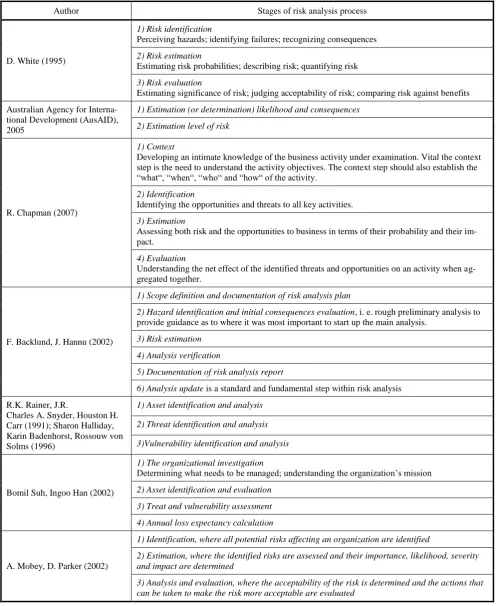
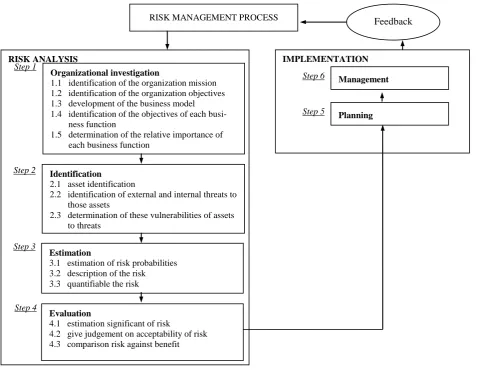
therefore, in order to avoid the complexity of the risk analysis process, stages of risk analysis process are sys-temized (see Table 3). Based on the stages of risk analy-sis process presented in Table 3, the general risk analyanaly-sis process is presented in the context of risk management (see Figure 2).
Table 3
Stages of risk analysis process
Author Stages of risk analysis process
D. White (1995)
1) Risk identification
Perceiving hazards; identifying failures; recognizing consequences
2) Risk estimation
Estimating risk probabilities; describing risk; quantifying risk
3) Risk evaluation
Estimating significance of risk; judging acceptability of risk; comparing risk against benefits
Australian Agency for Interna-tional Development (AusAID), 2005
1) Estimation (or determination) likelihood and consequences
2) Estimation level of risk
R. Chapman (2007)
1) Context
Developing an intimate knowledge of the business activity under examination. Vital the context step is the need to understand the activity objectives. The context step should also establish the “what“, “when“, “who“ and “how“ of the activity.
2) Identification
Identifying the opportunities and threats to all key activities.
3) Estimation
Assessing both risk and the opportunities to business in terms of their probability and their im-pact.
4) Evaluation
Understanding the net effect of the identified threats and opportunities on an activity when ag-gregated together.
F. Backlund, J. Hannu (2002)
1) Scope definition and documentation of risk analysis plan
2) Hazard identification and initial consequences evaluation, i. e. rough preliminary analysis to provide guidance as to where it was most important to start up the main analysis.
3) Risk estimation
4) Analysis verification
5) Documentation of risk analysis report
6) Analysis update is a standard and fundamental step within risk analysis
R.K. Rainer, J.R.
Charles A. Snyder, Houston H. Carr (1991); Sharon Halliday, Karin Badenhorst, Rossouw von Solms (1996)
1) Asset identification and analysis
2) Threat identification and analysis
3)Vulnerability identification and analysis
Bomil Suh, Ingoo Han (2002)
1) The organizational investigation
Determining what needs to be managed; understanding the organization’s mission
2) Asset identification and evaluation
3) Treat and vulnerability assessment
4) Annual loss expectancy calculation
A. Mobey, D. Parker (2002)
1) Identification, where all potential risks affecting an organization are identified
2) Estimation, where the identified risks are assessed and their importance, likelihood, severity and impact are determined
12
Figure 2. Risk analysis process in the context of risk management process
(Rainer, JR., Snyder, Carr (1991); Bomil Suh, Ingoo Han (2002); Chapman (2007); White (1995); Mobey, Parker (2002))
Organizations should develop conditionally simple risk analysis procedures, which should be adapted and adjusted for departments of various practice, as well as should incorporate both people who understand opera-tions of activity, and those who understand technical as-pects of systems under consideration
Before deciding which method of risk analysis to apply, the organization should estimate the advantages
and disadvantages of qualitative and quantitative risk analysis methods (Vageris, 2005; Australian Government “Risk Analysis Framework“, 2005; Bomil Suh & Ingo Han, 2002; Rainer, Snyder, Carr 1991). However, the advantages and disadvantages of each method suggest that each one may best be applied to certain types of threats or certain areas of the organi-zation.
Table 4
Advantages and disadvantages of two types of methods
Quantitative methods Qualitative methods
Advantages
Applicability to all assets Mathematical foundation Support to cost-benefit decision
Disadvantages
Inappropriateness of monetary asset value Inappropriateness of general statistics Time consuming
Simple risk calculation, flexible
Usefulness where there is the lack of experience Less time, effort and expensive consuming
Inability of cost-benefit decision Subjective results, inexact
More difficult to incorporate uncertainty
Summarizing disadvantages and disadvantages, the conclusion may be drawn that qualitative analysis is sim-ple, and its main task is to determine risk factors accord-ing to the stages or activities of the project which cause
danger, or to determine potential risk fields and at the same time to identify possible risks. (Bagdonas, 1996). Quantitative methods are more complex, and are based on complicated theories (statistics, theory of combinations, RISK MANAGEMENT PROCESS
Organizational investigation
1.1 identification of the organization mission 1.2 identification of the organization objectives 1.3 development of the business model 1.4 identification of the objectives of each
busi-ness function
1.5 determination of the relative importance of each business function
Identification
2.1 asset identification
2.2 identification of external and internal threats to those assets
2.3 determination of these vulnerabilities of assets to threats
Estimation
3.1 estimation of risk probabilities 3.2 description of the risk 3.3 quantifiable the risk
IMPLEMENTATION Management Planning
Feedback
Evaluation
4.1 estimation significant of risk
4.2 give judgement on acceptability of risk 4.3 comparison risk against benefit
RISK ANALYSIS
Step 1
Step 2
Step 3
Step 4
Step 6
13 theory of games, theory of chaos, etc.) and on artificial intelligence systems as well as neuron networks. These methods are more widely applied by insurance and in-vestment companies (Vageris, 2006).
Stages of risk analysis applied by Lithuanian
companies
Due to constantly growing competition and unavoid-able business environment changes related with the inte-gration into European Union organizations face the prob-lems of the establishment and maintenance of the com-pany’s value in the environment, in which constant changes are in process, new opportunities are coming along, uncertainty is dominating. In such conditions of activity, a thorough analysis of risk factors as well as risk analysis needs to be performed. In order to avoid or to re-duce the losses due to occurring risk, companies use the
services of companies which perform risk analysis more and more often.
Lithuanian companies’ catalogue of 2007 had 11 en-tries of companies dealing with the problem of risk man-agement. However, most of them provided only the ser-vices of lending risk evaluation, credit risk management, life risk assurance, business safety auditing, etc.
For the comparative analysis of raw data, two Lithuanian specialized risk management companies, which perform a thorough risk analysis in all sections of the company, were chosen.
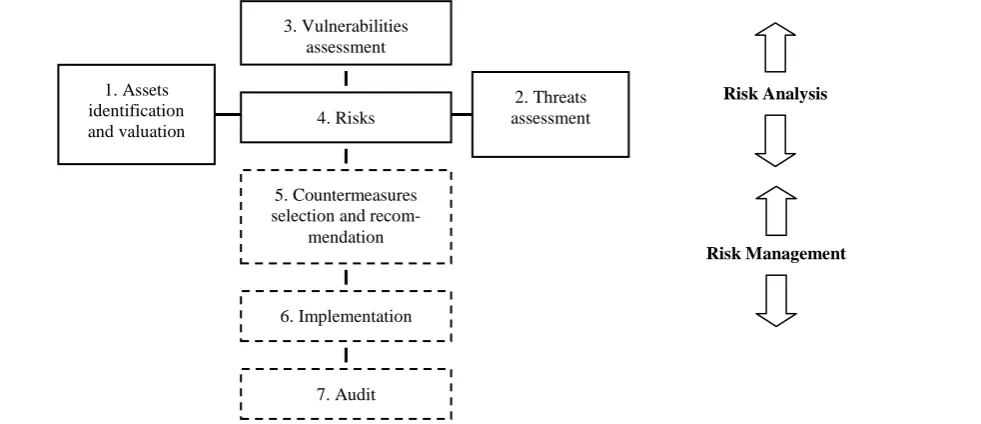
SC Compservis performing the risk analysis follows CRAMM (CCTA Risk Analysis and Management Meth-odology), the methodology of information protection risk analysis and management, developed by the order of the government of Great Britain and applied worldwide (see Figure 3).
Figure 3. Risk management process using CRAMM methodology According to the data of survey of company’s
em-ployees, during the year of 2005 and 2006 CRAMM model was purchased by 5 or 6 companies. The method-ology is not fully effective as specialized training of workers is required, the data of risk analysis are analyzed qualitatively.
The company PriceWaterHouseCoopers/Lietuva, performing the risk analysis of the company and prepar-ing the plan of congruence security measure and assis-tance in its appliance, follows Monte Carlo simulation.
PriceWaterHouseCoopers’s specialists of business dynamics C. Rodgers, J. Petch (1999) suggested the fol-lowing risk analysis model of reference nature. The struc-ture of the risk analysis process phases shown above, means:
identifying the risks: describes techniques used to get a list of possible risks, and how to deter-mine which risks are appropriate for modeling; quantifying the risks: this section looks at issues
that arise when trying to accurately quantify risks, such as which distribution is appropriate for what type of process, what is correlation, etc. It also gives an overview of the issues that can
arise when quantifying risks with clients; risk analysis: this section is devoted to the “how
to“ of Monte Carlo simulation within spreadsheet model, from the impact model design to the gen-eration of outputs;
presenting the results: describes the different ways of presenting the results of uncertainty and risk analysis, both graphically and ion translating the results back into easily understood terms; and beyond presentation: this last section looks at how to take outputs from the modeling and inter-pret them in the context of business decision making.
Imitative simulation with Monte Carlo method en-ables to form a mathematical model of business project with undefined values of parameters and, knowing the probabilistic distribution of project parameters and the relation between parameters, to learn the distribution of project efficiency (Laskienė, 2003).
SC Synergy Consulting uses both qualitative and quantitative risk analysis method to assess the informa-tion safety risks. Head of SC Synergy Consulting T. Jokūbauskas (2006) lists such stages of risk manage-3. Vulnerabilities
assessment
4. Risks 1. Assets
identification and valuation
2. Threats assessment
5. Countermeasures selection and
recom-mendation
6. Implementation
7. Audit
Risk Analysis
14 ment process that are successfully applied in twenty companies per year:
1st stage. Assets (the identification and modeling of the assets, the analysis of the impact on performance)
2nd stage. Threats (the identification of threats and their evaluation)
3rd stage. Vulnerabilities (identification of vulner-abilities and their evaluation)
4th stage. Risks (identification of risk, its evalua-tion)
5th stage. Control measures (the selection of rec-ommended control measures, the identifi-cation of existing control measures, the selection of measures scheduled to be ap-plied, and the preparation of safety devel-opment program)
6th stage. Appliance of control measures (organiza-tional, technological)
7th stage. Audit (the audit of the safety development program, the audit of the efficiency and correspondence to company’s safety pol-icy of the new control measures).
However, as T. Jokūbauskas claims, Lithuanian mar-ket prefers qualitative methods of risk analysis because companies are not predisposed to provide rates of their financial activity.
In summary, the conclusion can be made that the stages of SC Synergy Consulting and SC Compservis risk analysis process (1 – 4) are the same and identical to the ones described by R.K. Rainer, J.R. Charles A. Snyder, Houston H. Carr (1991); Sharon Halliday, Karin Baden-horst, Rossouw von Solms (1996). However, the only difference is that the risk is evaluated by risk manage-ment specialists in one company, and by the CRAMM methodology in the other.
The mentioned companies prefer the methods of qualitative risk analysis, meanwhile, PriceWaterHouse-Coopers/Lietuva favors the methods the qualitative risk analysis.
Conclusions
1. The globalization and Lithuanian’s integration into the world market, as any other new phenomena, increases the risk for the companies going into business. However, Lithuanian and foreign scien-tists agree that there is no common notion of risk analysis, classification of its methods, and division of stages of risk analysis process.
2. Having performed the analysis of scientific litera-ture, risk analysis is proposed to be treated as a constituent part of risk management process which involves risk identification, evaluation and estima-tion as well as the choice of risk decrease methods. 3. The survey of risk analysis methods showed that 4
classifications of risk analysis methods may be distinguished: 1) qualitative, quantitative, and composite methods; 2) qualitative, tree and
dy-namic system methodologies; 3) intuitive, induc-tive and deducinduc-tive methods; 4) upward risk, downward risk and composite methods.
4. Companies that have decided to apply qualitative or quantitative risk analysis methods should evalu-ate the advantages and disadvantages of them. Qualitative methodology is simpler and it defines the most important fields of risk, it is flexible when there is a shortage of information. However, the results depend on the competence of the risk analysis group. Though the computation of quanti-tative risk analysis methods is complex, the meth-odology is highly objective, not dependent on the estimator’s opinion.
5. With reference to the different author’s attitude to the division of the stages of the risk analysis proc-ess, the model was comprised summarizing risk analysis process in the context of risk management process.
6. Having performed the comparative analysis of sci-entific literature and investigated the stages of risk analysis process, it appeared that methodologies of SC Compservis CRAMM and stages of SC Syn-ergy Consulting risk analysis process are analogi-cal to the ones described by R.K. Rainer, J.R. Charles A. Snyder, Houston H. Carr (1991); Sharon Halliday, Karin Badenhorst, Rossouw von Solms (1996). The survey of the raw data showed that Lithuanian companies when performing risk analysis prefer qualitative risk analysis methods rather than quantitative ones.
References
1. Acutech Consulting Group. Process Risk Management, 2002.
Prieiga per internetą
<http://www.acusafe.com/Hazard_Analysis/HAZOP_Technique. pdf>
2. Ahmed, A. A review of techniques for risk management in projects
/A. Ahmed, B. Kays, S. Amornsawadwatana //Benchmarking: An International Journal, Vol. 14, No 1, 2007, p. 22-36.
3. Bagdonas V. Verslo rizika. Vilnius: Saulės vėjas, 1996, p. 116.
4. Bandyopadhyay, K. A framework for integrated risk management
in information technology /K. Bandyopadhyay, P. Mykytyn, K. Mykytyn. //Management Decision 37/5, 1999, p. 437-444.
5. Chapman, R. Successful management of IT risk, 2007. Prieiga per
internetą
<http://www.insight.co.uk/files/other/successful%20Management% 20%of%20IT%20risk.pdf>
6. Frosdick, S. The techniques of risk analysis are insufficient in
themselves//Disaster Prevention and Management, 1997, No 3, p. 165-177.
7. Hammett, P. Failure Mode and Effects Analysis. University
Michi-gan – Total Quality Management, 1995. Prieiga per internetą <http://www.fmeainfocentre.com/handbooks/umich.pdf>
8. Halliday, Sh. A business approach to effective information
tech-nology risk analysis and management / Sh. Halliday, K. Baden-horst, R. Solms //Information Management&Computer Security 4/1, 1996, p. 19-31.
9. Jokūbauskas T. Informaciniai saugos metodai, 2006. Prieiga per
internetą:
<http://www.aggrit.lt/docs/Informacines%20saugos%20metodai. pdf>
10. ISO/IEC Guide 73. Risk Management – Vocabulary – Guidelines
15
11. Informacijos saugumas. Prieiga per internetą
< http://www.synergy.lt/lt/content?id=3&pid=12>
12. Labuschagne, J. H. Real-time risk analysis using Java concepts /
J. H. Labuschagne, P. Eloff. //Information Management&Сomputer Security 6/5, 1998, p 212-217.
13. Laskienė D. Verslo rizikos valdymo modelis: daktaro disertacija:
socialiniai mokslai, ekonomika (04 S), Kaunas, 2003, p. 119.
14. Liučvaitis S. Rizikos valdymas ir jos analizės svarba verslo plėtotei
//Verslas: teorija ir praktika. VGTU, III tomas, 2003, Nr. 1.
15. N. E. M. Business Solutions. Risk Analysis Methodologies, 2002.
Prieiga per internetą < www.cip.ukcentre.com/risk.htm >
16. Overview „How CRAMM works“. Prieiga per internetą
<http://www.cramm.com/overview/howitworks.htm>
17. Rasche, T. Risk Analysis Methods – a Brief Review. The
Universi-ty of Queensland. Mineral Industry SafeUniversi-ty and Health Center (MISHC), 2001.
18. Rodger, Ch. PriceWaterHauseCoopers Uncertainty&Risk Analysis
/Ch. Rodger, J. Petch. 1999. Prieiga per internetą
<http://clem.mscd.edu/~mayest/Excel/Files/Uncertainty%20and%2 0Risk%20Analysis.pdf>
19. Risk Management Standard. AIRMIC, ALARM, IRM, 2002, p. 17.
20. Risk Analysis Framework. Australian Government Department of
Health and Ageing Office of the Gene Technology Regulator, 2005. 188 p.
21. Risk Managing. Australian Government AusAID, 2005 p. 33.
22. Risk Analysis Methodologies. College of Engineering and
Engi-neering Technology Northern Illinois University, 2006. Prieiga per internetą
<www.ceet.niu.edu/depts/tech/asse/tech482/risk_analysis_methodo logies.doc >
23. Mobey, A. Risk evaluation and its importance to project
implemen-tation/ A. Mobey, D. Parker// Work Study, Vol. 51, No 4, 2002. p. 202-206.
24. Urniežius R. Rizika. Vilnius: Mintis, 2001, 183 p.
25. Vageris R. Rizikos analizės vadovas. Lietuvos Respublikos Vidaus
reikalų ministerija, 2005. 160 p.
26. Vageris R. Rizikos valdymas. ISACA (Informacinių sistemų audito
ir valdymo asociacija), 2006. Prieiga per internetą
<www.ase.lt/Presentations/Rizikos%20valdymas%20200604.pdf>
27. White, D. Application of systems thinking to risk management: a
review of the literature. //Management Decision, Vol. 33, No 10, 1995, p. 35-45.
Gražina Startienė, Rita Remeikienė
Verslo rizikos analizės metodologija ir jos praktinis taikymas globalioje rinkoje veikiančiose įmonėse
Santrauka
Straipsnyje nagrinėjama aktuali verslo įmonių problema – rizi-kos analizės metodologijos taikymas siekiant sumažinti verslo riziką iki priimtino lygio.
Nuolat besikeičiančios verslo aplinkos sąlygos, informacijos srauto augimas, integracijos į pasaulinę rinką procesai didina verslo įmonių riziką ir kartu verčia ieškoti būdų, kaip tą riziką valdyti. Vi e-na iš svarbių verslo rizikos valdymo proceso sudedamųjų dalių yra rizikos analizė; jos tyrinėjimas reikšmingas tiek teoriniu, tiek prakti-niu požiūriu. Tai pagrindžiama tuo, jog iki šiol nėra vienos rizikos analizės metodologijos, leidžiančios priimti efektyvius sprendimus, kurie sumažintų nepriimtiną riziką iki leistino lygio. Mokslinėje lit e-ratūroje nėra vienareikšmiško požiūrio į rizikos analizės procesą. Užsienio autoriai (Strutt, 1993; Boroush,1998; Frosdick, 1997; Chapman, 2007 ir kt.), Lietuvos mokslininkai (Bagdonas, 1996; La s-kienė, 2003), verslo įmonių vadovai (Vageris, 2006; Jokūbauskas, 2006) bei įvairios institucijos (Australian Government, 2005; Austrlian Agency for International Development (AusAID), 2005; Intern a-tional Organization of Standards (ISO), 2002; Internaa-tional Adva n-cing Security Worldwide (ASIS), 2003) skirtingai traktuoja rizikos analizės sampratą.
Sparčiai didėjantys ekonominio augimo tempai lemia rizikos analizės metodų sudėtingumą, jų įvairovę ir ilgina metodams įgyven-dinti skirtą laiką (Labuschagne and Eloff, 1998). Mokslinėje literatū-roje gausiai aptariami įvairūs rizikos analizės metodai (kokybiniai, kiekybiniai ir kombinuoti (Bagdonas, 1996; Rasche, 2001; Urniežius, 2001; Bandyopadhyay, P. Mykytyn, K. Mykytyn, 1999; Snyder, Carr, 1991; Achmed, Kays, Amornsawadwatana, 2007; Vageris, 2005; Jokūbauskas, 2006; Laskienė, 2003); kokybinė, medžio ir dinaminės sistemos metodikos (N. E. M. „Business Solutions“, 2002; College of Engineering and Engineering Technology Northern Illinois Universi-ty, 2006); „aukštyn nukreiptos rizikos“, „žemyn nukreiptos rizikos“ ir mišrūs metodai (ISO/IEC Guide 73, 2002; Risk Management Stan-dard, 2002); intuityviniai, induktyviniai ir deduktyviniai metodai (Frosdick, 1997); rizikos analizės procesų etapai (White, 1995; Aust-ralian Agency for International Development (AusAID), 2005; Chapman, 2007; Backlund, Hannu, 2002; Rainer, Snyder, Carr, 1991; Halliday, Badenhorst, Rossouw von Solms, 1996; Mobey, Parker, 2002), metodų pranašumai ir trūkumai (Vageris, 2005; Australian Government, 2005; Bomil Suh&Ingo Han, 2002; Rainer, Snyder, Carr 1991), tad pasirinkti tinkamiausią ir tiksliausiai nustatantį rizikin-giausias veiklos sritis metodą yra sunku.
Verslo įmonėms, siekiančioms susidoroti su tokiomis rizikos analizės problemomis kaip rizikos analizės nebrandumas, informaci-jos ir duomenų saugos užtikrinimo metodų neturėjimas, nepakankama rizikos analizėje dalyvaujančių darbuotojų kompetencija ar patirties organizacijoje stoka, reikalingi rizikos analizės metodai, siūlantys efektyvius būdus minėtoms problemoms spręsti.
Lietuvos verslo įmonėms dažnai trūksta išsamios kokybiškos in-formacijos apie rizikos analizės metodus, jų procesų etapus bei rizi-kos mažinimo priemones (Jokūbauskas, 2006), todėl ne visos jos pajėgios savarankiškai įvertinti rizikingiausias veiklos sritis. Maty-damos įmonių nesugebėjimą valdyti riziką ar jų kompetencijos stoką, kuriasi specializuotos rizikos valdymo įmonės.
Straipsnio tikslas – nustatyti rizikos analizės metodologiją ir
palyginti Lietuvoje veikiančių rizikos valdymo įmonių atliekamus
rizikos analizės proceso etapus. Tikslui pasiekti iškelti šie
uždavi-niai: 1) remiantis autorių nuomonėmis, pateikti rizikos analizės
api-brėžimą; 2) nustatyti rizikos analizės ir rizikos valdymo procesų skirtumus; 3) nusakyti literatūroje analizuojamų rizikos analizės metodų esmę, rizikos analizės proceso etapus; 4) rekomenduoti api-bendrintą rizikos analizės proceso modelį rizikos valdymo proceso kontekste; 5) pateikti kiekybinių ir kokybinių rizikos analizės metodų pranašumus ir trūkumus; 6) įvertinti Lietuvos rizikos valdymo įmonių atliekamos rizikos analizės procesų etapų panašumus ir skirtumus.
Straipsnio objektas – rizikos analizė globalioje rinkoje
vei-kiančiose įmonėse.
Tyrimo metodika apima sisteminę literatūros analizę, skirtingų
autorių siūlomų ir Lietuvos įmonių taikomų rizikos analizės metodų bei procesų etapų lyginamąją analizę.
Straipsnio pirmoje dalyjeapibendrinamos įvairių autorių
patei-kiamos rizikos analizės sampratos ir prieinama prie išvados, kad rizikos analizė – tai rizikos valdymo proceso sudedamoji dalis, api-manti rizikos identifikavimą, apskaičiavimą ir įvertinimą bei rizikos mažinimo būdų parinkimą. Siekiant išvengti rizikos analizės ir rizi-kos valdymo procesų sutapatinimo, buvo nustatyti rizirizi-kos valdymo ir rizikos analizės procesų skirtumai, leidžiantys teigti, kad rizikos valdymas yra platesnė sąvoka ir apima rizikos analizę, rizikos prie-žiūrą, rizikos priėmimą ir informavimą apie riziką, t. y. koordinuoti veiksmai, kuriais siekiama valdyti ir kontroliuoti organizacijos riziką (ISO Vadovas, 2002).
Antroje straipsnio dalyjesusisteminamarizikos analizės metodų
klasifikacija, jų pranašumai ir trūkumai bei pateikiamas rizikos anali-zės proceso skirstymas į atskirus etapus. Rizikos analianali-zės metodų apžvalga parodė, kad skiriami keturi rizikos analizės metodai: 1) kokybiniai, kiekybiniai ir kombinuoti metodai; 2) kokybinė, me-džio ir dinaminės sistemos metodikos; 3) intuityviniai, induktyviniai ir deduktyviniai metodai; 4) „aukštyn nukreiptos rizikos“, „žemyn nukreiptos rizikos“ ir mišrūs metodai. Prieita prie išvados, kad dau-guma autorių rizikos analizės metodus linkę skirstyti į kokybinius ir kiekybinius, tačiau tam tikros metodų rūšys (klaidų medžio analizė (FTA) ir įvykių medžio analizė (ETA)) aptinkamos visose klasifikaci-jose.
informaci-16
jos trūkumui, ji pasižymi lankstumu, tačiau rezultatai priklauso tik nuo rizikos analizės grupės kompetentingumo. Nors kiekybinių rizi-kos analizės metodų apskaičiavimai sudėtingi, tačiau metodika pasi-žymi dideliu objektyvumu, nepriklauso nuo vertintojų nuomonės. Siekiant išvengti rizikos analizės proceso sudėtingumo ir painumo, buvo susisteminti skirtingų autorių pateikiami rizikos analizės proc e-so etapai. Daroma išvada, kad rizikos analizės procesą galima su-skirstyti į keturis pagrindinius etapus: organizacijos tyrimą, identif i-kavimą, vertinimą ir analizę.
2007 metų Lietuvos įmonių katalogo duomenimis, rizikos val-dymo klausimus skelbėsi sprendžiančios 11 įmonių, tačiau dauguma jų teikė tik tokias paslaugas kaip kreditavimo rizikos įvertinimas, kredito rizikų valdymas, gyvybės rizikos draudimas, verslo saugos auditas ir kt., todėl trečioje šio straipsnio dalyje pirminių duomenų lyginamajai analizei pasirinktos trys Lietuvoje veikiančios speciali-zuotos rizikos valdymo įmonės, atliekančios išsamią rizikos analizę
visose įmonės veiklos grandyse. Nustatyta, kad UABSynergy
Consul-ting ir UABCompservis pirmenybę teikia kokybiniams rizikos
anali-zės metodams, nors vienoje įmonėje riziką vertina rizikos valdymo specialistai, kitoje – tam naudojama CRAMM metodika. Tuo tarpu
bendrovė PriceWaterHouseCoopers/Lietuva, atlikdama įmonių
rizi-kos analizę bei rengdama atitikties užtikrinimo priemonių planus ir padėdama juos įgyvendinti, vadovaujasi Monte Karlo metodu, t. y. pirmenybę teikia kiekybiniams rizikos analizės metodams.
Atlikus sisteminę literatūros analizę, padarytos tokios išvados:
1. Globalizacija ir Lietuvos integracija į pasaulinę rinką, kaip ir
visi nauji reiškiniai, padidina rizikos laipsnį ekonomine veik-la užsiimančioms įmonėms, tačiau Lietuvos ir užsienio moks-lininkai pripažįsta, kad iki šiol vienareikšmiškos nuomonės dėl rizikos analizės sampratos, jos metodų klasifikavimo, ri-zikos analizės proceso etapų skirstymo nėra.
2. Remiantis skirtingų autorių nuomonėmis dėl rizikos analizės
proceso etapų skirstymo, buvo sudarytas apibendrinantis ri-zikos analizės proceso modelis riri-zikos valdymo proceso kon-tekste.
3. Atlikus mokslinės literatūros lyginamąją analizę ir įmonių
ri-zikos analizės procesų etapų tyrimą, paaiškėjo, kad UAB
Compservis CRAMM metodikos ir UABSynergy Consulting
rizikos analizės proceso žingsniai analogiški autorių R.K. Rainer, J.R. Charles A. Snyder, Houston H. Carr (1991); Sharon Halliday, Karin Badenhorst, Rossouw von Solms (1996) išskiriamiems rizikos analizės proceso žings-niams. Pirminių duomenų tyrimas parodė, kad Lietuvoje rizi-kos analizę atliekančios įmonės dažniau taiko kokybinius, o ne kiekybinius rizikos analizės metodus.
Raktažodžiai: rizika, rizikos analizė, rizikos valdymas, rizikos analizės
metodai, rizikos analizės proceso etapai.
The article has been reviewed.